Annals of global warming: NASA finds amplified greenhouse effects shift northern growing seasons

March 11, 2013

Global warming affects plants in northern hemisphere, NASA chart

From NASA: Of the 10 million square miles (26 million square kilometers) of northern vegetated lands, 34 to 41 percent showed increases in plant growth (green and blue), 3 to 5 percent showed decreases in plant growth (orange and red), and 51 to 62 percent showed no changes (yellow) over the past 30 years. Satellite data in this visualization are from the AVHRR and MODIS instruments, which contribute to a vegetation index that allows researchers to track changes in plant growth over large areas. Credit: NASA’s Goddard Space Flight Center Scientific Visualization Studio; click image for original view; click here for greater detail

Press release from NASA, March 10, 2013 (links in text added here):

RELEASE : 13-069


Amplified Greenhouse Effect Shifts North’s Growing Seasons

WASHINGTON — Vegetation growth at Earth’s northern latitudes increasingly resembles lusher latitudes to the south, according to a NASA-funded study based on a 30-year record of land surface and newly improved satellite data sets.

An international team of university and NASA scientists examined the relationship between changes in surface temperature and vegetation growth from 45 degrees north latitude to the Arctic Ocean. Results show temperature and vegetation growth at northern latitudes now resemble those found 4 degrees to 6 degrees of latitude farther south as recently as 1982.

“Higher northern latitudes are getting warmer, Arctic sea ice and the duration of snow cover are diminishing, the growing season is getting longer and plants are growing more,” said Ranga Myneni of Boston University’s Department of Earth and Environment. “In the north’s Arctic and boreal areas, the characteristics of the seasons are changing, leading to great disruptions for plants and related ecosystems.”

The study was published Sunday in the journal Nature Climate Change.

Myneni and colleagues used satellite data to quantify vegetation changes at different latitudes from 1982 to 2011. Data used in this study came from NOAA’s Advanced Very High Resolution Radiometers (AVHRR) onboard a series of polar-orbiting satellites and NASA’s Moderate Resolution Imaging Spectroradiometer (MODIS) instruments on the Terra and Aqua satellites.

As a result of enhanced warming and a longer growing season, large patches of vigorously productive vegetation now span a third of the northern landscape, or more than 3.5 million square miles (9 million square kilometers). That is an area about equal to the contiguous United States. This landscape resembles what was found 250 to 430 miles (400 to 700 kilometers) to the south in 1982.

“It’s like Winnipeg, Manitoba, moving to Minneapolis-Saint Paul in only 30 years,” said co-author Compton Tucker of NASA’s Goddard Space Flight Center in Greenbelt, Md.

The Arctic’s greenness is visible on the ground as an increasing abundance of tall shrubs and trees in locations all over the circumpolar Arctic. Greening in the adjacent boreal areas is more pronounced in Eurasia than in North America.

An amplified greenhouse effect is driving the changes, according to Myneni. Increased concentrations of heat-trapping gasses, such as water vapor, carbon dioxide and methane, cause Earth’s surface, ocean and lower atmosphere to warm. Warming reduces the extent of polar sea ice and snow cover, and, in turn, the darker ocean and land surfaces absorb more solar energy, thus further heating the air above them.

“This sets in motion a cycle of positive reinforcement between warming and loss of sea ice and snow cover, which we call the amplified greenhouse effect,” Myneni said. “The greenhouse effect could be further amplified in the future as soils in the north thaw, releasing potentially significant amounts of carbon dioxide and methane.”

To find out what is in store for future decades, the team analyzed 17 climate models. These models show that increased temperatures in Arctic and boreal regions would be the equivalent of a 20-degree latitude shift by the end of this century relative to a period of comparison from 1951-1980.

However, researchers say plant growth in the north may not continue on its current trajectory. The ramifications of an amplified greenhouse effect, such as frequent forest fires, outbreak of pest infestations and summertime droughts, may slow plant growth.

Also, warmer temperatures alone in the boreal zone do not guarantee more plant growth, which also depends on the availability of water and sunlight.

“Satellite data identify areas in the boreal zone that are warmer and dryer and ¬¬other areas that are warmer and wetter,” said co-author Ramakrishna Nemani of NASA’s Ames Research Center in Moffett Field, Calif. “Only the warmer and wetter areas support more growth.”

Researchers did find found more plant growth in the boreal zone from 1982 to 1992 than from 1992 to 2011, because water limitations were encountered in the latter two decades.

Data, results and computer codes from this study will be made available on NASA Earth Exchange (NEX), a collaborative supercomputing facility at Ames. NEX is designed to bring scientists together with data, models and computing resources to accelerate research and innovation and provide transparency.

For more information and images associated with this release, visit:

http://go.nasa.gov/12Amv2s

– end –


text-only version of this release

More:


The Presidential Library that isn’t a Presidential Library

March 9, 2013

Campaign poster showing William McKinley holdi...

Campaign poster showing William McKinley holding U.S. flag and standing on gold coin “sound money”, held up by group of men, in front of ships “commerce” and factories “civilization”. (Photo credit: Wikipedia)

Things you learn looking for documents:  The U.S. National Archives now manages the presidential libraries and museums — except for one:  The William McKinley Memorial Library and Museum.

President William McKinley Memorial Library and Museum, in Niles, Ohio.

President William McKinley Memorial Library and Museum, in Niles, Ohio. McKinley was born in Niles. Photo from the LIbrary’s website.

To be more accurate and fair, National Archives manages the documents for the presidential libraries starting with Herbert Hoover, though there are usually special arrangements with each of the libraries.

Separately, the Ladies of Mount Vernon Association manages the research facilities at Mount Vernon, Virginia,  (and the rest of the grounds) associated with George Washington, and the Abraham Lincoln Presidential Library and Museum in Springfield, Illinois, is operated by a separate foundation, too.  The Teddy Roosevelt Center at Dickinson State University in North Dakota stands apart from the National Archives system, too (much TR material can be found at Harvard, too).

The idea of a specific library to hold papers from a president’s term is a mid-20th century idea.  Franklin Roosevelt and Herbert Hoover were the first, with the idea coming about the same time.  Private foundations built and operated them until after the Nixon library, and since then Congress authorized the National Archives to get into the act and coordinate the work, and then made the links official, for libraries from here on out.

For presidents prior to Hoover, papers generally became the property of the outgoing president.  Collection was spotty.  The idea of library dedicated to one president is such a good one, though, that private groups have gone back to set them up for Washington and Lincoln.

And McKinley.

Modern texts don’t show well the high regard McKinley had from Americans before he was assassinated.  Within a few years after his death, the people of Ohio and his birthplace, in Niles, got Congress to approve a memorial.  Eventually the local library moved into the memorial building.

The National McKinley Birthplace Memorial Association was incorporated by a special Act of Congress on March 4, 1911.  The purpose of the Association was to erect a suitable structure marking the birthplace of President William McKinley, the 25th President of the United States. The result was the National McKinley Birthplace Memorial.

McKinley was born in the city of Niles, Ohio on January 29, 1843. The city donated the site for the Memorial which consisted of an entire city square. The architects were McKim, Mead & White of New York and the erection of the Memorial was done by John H. Parker Company, also of New York. Groundbreaking began in 1915 with the corner stone being laid on November 20, 1915.

The building was dedicated on October 5, 1917.

The cost was more than half a million dollars, all of which was donated by the American public.

The 232 foot by 136 foot by 38 foot monument is constructed of Georgian marble with two lateral wings–
one wing houses the public library called the McKinley Memorial Library, and the other wing houses the
McKinley Museum and an auditorium. The Museum contains artifacts of the life and presidency of McKinley.

In the center of the Memorial is a Court of   Honor supported by 28 imposing columns. It features a heroic statue of McKinley sculptured by John Massey-Rhind. Surrounding the statue are busts and tablets dedicated to the members of    McKinley’s cabinet and other prominent men who were closely associated with him.  These bronze busts, mounted on marble pedestals, weigh between 800 and 1100 pounds each.

As a presidential library, the McKinley Memorial Library in Niles is unique.  While it does not offer the vast research resources of the National Archives, it does offer a memorial from the people of Ohio and the U.S., a more down-home look at  reverence for presidents and the keeping of the history of our heroes.

Memorial to President William McKinley in Niles, Ohio

The memorial to President McKinley in Niles. Photo from the McKinley Memorial Library and Museum.

The “official” list of other presidential libraries and museums in the National Archives’ network, listed at the American Presidency Project at the University of California – Santa Barbara:

Herbert Hoover Presidential Library and Museum
Herbert Hoover Presidential Library Association
Franklin D. Roosevelt Library and Digital Archives
Harry S. Truman Library and Museum
The Dwight D. Eisenhower Library
John F. Kennedy Library and Museum
Lyndon Baines Johnson Library and Museum
Richard Nixon Library and Museum
Richard Nixon Library Foundation
Gerald R. Ford Library and Museum
Jimmy Carter Library
Ronald Reagan Presidential Foundation and Library
George Bush Presidential Library and Museum
William J. Clinton Presidential Library and Museum
Clinton Presidential Center
George W. Bush Presidential Library
George W. Bush Presidential Center

More:


Millard Fillmore: Still dead, still misquoted, 139 years later

March 8, 2013

Millard Fillmore wax head

A wax likeness of Millard Fillmore’s head, appearing to be for sale for $950.00 back in 2007. Did anyone ever buy it? Yes, it does bear an unusual resemblance to Tom Peters.

March 8, 2013, is the 139th anniversary of Millard Fillmore’s death.  Famous lore claims Fillmore’s last words were, “The nourishment is palatable.”

What a crock!

Manus reprints the text from the New York Times obituary that appeared on March 9:

Buffalo, N.Y., March 8 — 12 o’clock, midnight. — Ex-President Millard Fillmore died at his residence in this city at 11:10 to-night. He was conscious up to the time. At 8 o’clock, in reply to a question by his physician, he said the nourishment was palatable; these were his last words. His death was painless.

First, I wonder how the devil the writer could possibly know whether Fillmore’s death was painless?

And second, accuracy obsessed as I am, I wonder whether this is the source of the often-attributed to Fillmore quote, “The nourishment is palatable.” Several sources that one might hope would be more careful attribute the quote to Fillmore as accurate — none with any citation that I can find. Thinkexist charges ahead full speed; Brainyquote removed the quote after I complained in 2007. Wikipedia lists it. Snopes.com says the quote is “alleged,” in a discussion thread.

I’ll wager no one can offer a citation for the quote. I’ll wager Fillmore didn’t say it.

Let’s be more stolid:  The quote alleged to be Fillmore’s last words, isn’t.  No one says “palatable” when they’re dying, not even the man about whom it is claimed that Queen Victoria pronounced him the hansomest man she ever met (just try tracking that one down), and whose strongest legacy is a hoax about a bathtub, started 43 years after he died.  No one calls soup “sustenance.”

The alleged quote, the misquote, the distortion of history, was stolen from the obituary in the New York Times.  Millard Fillmore did not say, “The sustenance is palatable.”

What were Millard Fillmore’s last words?  They may be buried in the notebook of one of his doctors.  They may be recorded in some odd notebook held in the Buffalo and Erie County Historical Society, or in the Library of SUNY Buffalo, or in the New York State Library‘s dusty archives.

But the dying President Fillmore did not say, “The sustenance is palatable.”

Millard Fillmore: We’d protect his legacy, if only anyone could figure out what it is.

This is partly an encore post, based on a post from 2007.

More:


Millard Fillmore’s links to March 8: Hurrah! and R.I.P.

March 8, 2013

I awoke from a particularly hard sleep after a night celebrating ten Cub Scouts’ earning their Arrow of Light awards and advancing into Boy Scout troops, to a missive from Carl Cannon (RealClear Politics) wondering why I’m asleep at the switch.

Millard Fillmore died on March 8, 1874, and he expected to see some note of that here at the Bathtub.  This blog is not the chronicler of all things Millard Fillmore, but can’t we at least get the major dates right?

Carl is right.  Alas, Millard Fillmore’s Bathtub is avocation, and at times like these an avocation that should be far down the list of avocations.

To mark the date, here is a post out of the past that notes two key events on March 8 that Fillmore had a hand in, the second being his death.  Work continues on several fronts, and more may splash out of the tub today, even about Fillmore.  Stay tuned.

Fillmore died on March 8, 1874; exactly 20 years earlier, Commodore Matthew C. Perry landed in Japan, in the process of what may be the greatest and most overlooked legacy of Millard Fillmore’s presidency, the opening of Japan to the world.  Here’s that post:

Commodore Matthew C. Perrys squadron in Japan, 1854 - CSSVirginia.org image

The Black Ships — Commodore Matthew C. Perry’s squadron in Japan, 1854 – CSSVirginia.org image from Gleason’s Pictorial Drawing Room Companion, Boston, May 15, 1852 (also, see BaxleyStamps.com); obviously the drawing was published prior to the expedition’s sailing.

On March 8, 1854, Commodore Matthew C. Perry landed for the second time in Japan, having been sent on a mission a year earlier by President Millard Fillmore.  On this trip, within 30 days he concluded a treaty with Japan which opened Japan to trade with the U.S. (the Convention of Kanagawa), and which began a cascade of events that opened Japan to trade with the world.

Commodore Matthew C. Perry in 1852 photograph, Library of Congress via WikiMedia

Commodore Matthew C. Perry in 1852 photograph, Library of Congress via WikiMedia

Within 50 years Japan would come to dominate the seas of the the Western Pacific, and would become a major world power.

1854 japanese woodblock print of U.S. Navy Commodore Matthew C. Perry. Peabody Museum: The characters located across the top read from right to left, A North American Figure and Portrait of Perry. According to the Peabody Essex Museum, this print may be one of the first depictions of westerners in Japanese art, and exaggerates Perrys western features (oblong face, down-turned eyes, bushy brown eyebrows, and large nose).  But compare with photo above, right.  Peabody Museum holding, image from Library of Congress via WikiMedia

1854 japanese woodblock print of U.S. Navy Commodore Matthew C. Perry. Peabody Museum: “The characters located across the top read from right to left, ‘A North American Figure’ and ‘Portrait of Perry.’ According to the Peabody Essex Museum, ‘this print may be one of the first depictions of westerners in Japanese art, and exaggerates Perry’s western features (oblong face, down-turned eyes, bushy brown eyebrows, and large nose).'” But compare with photo above, right. Peabody Museum holding, image from Library of Congress via WikiMedia

Then, 20 years later, on March 8, 1874, Millard Fillmore died in Buffalo, New York.

The Perry expedition to Japan was the most famous, and perhaps the greatest recognized achievement of Fillmore’s presidency.  Fillmore had started the U.S. on a course of imperialistic exploitation and exploration of the world, with other expeditions of much less success to Africa and South America, according to the story of his death in The New York Times.

The general policy of his Administration was wise and liberal, and he left the country at peace with all the world and enjoying a high degree of prosperity. His Administration was distinguished by the Lopez fillibustering expeditions to Cuba, which were discountenanced by the Government, and by several important expeditions to distant lands. The expedition to Japan under Commodore Perry resulted in a favorable treaty with that country, but that dispatched under Lieut. Lynch, in search of gold in the interior of Africa, failed of its object. Exploring expeditions were also sent to the Chinese seas, and to the Valley of the Amazon.

More:


Neil Tyson, still at it: We need to spend more in government research, in space, in science, in education

March 7, 2013

Here’s a guy who Paul Ryan, Eric Cantor and other “deficit hawks” refuse to debate.  Grover Norquist blanches when you mention his name, and hopes and prays you won’t listen to him:  Neil de Grasse Tyson.

The film was put together from several statements by Tyson, by Evan Schurr.

WRITE TO CONGRESS:
http://www.penny4nasa.org/take-action/

The intention of this project is to stress the importance of advancing the space frontier and is focused on igniting scientific curiosity in the general public.
Facebook cover: (not sure who made this but thank you!)
http://i.imgur.com/yqAGm.png

*FOR THOSE SAYING THE MUSIC IS TOO LOUD* This is the adjusted one http://youtu.be/Fl07UfRkPas

I give immense credit to The Sagan Series for providing the inspiration for this video.
http://www.youtube.com/user/damewse?f…

Copyright Disclaimer Under Section 107 of the Copyright Act 1976, allowance is made for “fair use” for purposes such as criticism, comment, news reporting, teaching, scholarship, and research. Fair use is a use permitted by copyright statute that might otherwise be infringing. Non-profit, educational or personal use tips the balance in favor of fair use. All copyrighted materials contained herein belong to their respective copyright holders, I do not claim ownership over any of these materials. In no way do I benefit either financially or otherwise from this video.

MUSIC:
Arrival of the Birds and Transformation by The Cinematic Orchestra http://www.amazon.com/The-Crimson-Win…

Credits
When We Left Earth http://dsc.discovery.com/tv/nasa/nasa…
The Daily Show with Jon Stewart http://www.thedailyshow.com/
HUBBLE 3D http://www.imax.com/hubble/
NASA TV http://www.nasa.gov/multimedia/nasatv…
The Amazing Meeting http://www.amazingmeeting.com/TAM2011/
“US Mint” http://www.youtube.com/watch?v=-ZzKDL…
“New $100 Note” http://www.youtube.com/watch?v=zgaytK…
Real Time with Bill Maher http://www.hbo.com/real-time-with-bil…
Pale Blue Dot – http://en.wikipedia.org/wiki/Pale_Blu…
STS-135 Ascent Imagery Highlights http://www.youtube.com/watch?v=ikzxtw…
CSPAN State of the Union Address http://www.c-span.org/
The Sagan Series http://www.facebook.com/thesaganseries
The Asteroid that Flattened Mars http://www.youtube.com/watch?v=JgMXPX…
University of Buffalo Communications http://www.communication.buffalo.edu/
Mars Curiosity Rover http://www.youtube.com/watch?v=hnlvvu…
Red Aurora Australis http://www.youtube.com/watch?v=hC7Qro…

Thank you to user florentgermain for the French subtitles

Hey, this is a year old.  Why are you sitting on your hands?  Our future, our children’s future, our great-great-grandchildren’s futures, are on the line.

Tip of the old scrub brush to Robert Krulwich at NPR, who pulled this out and started discussing it again.

More:


Woodbadge sundancers, Heart of Virginia Council, BSA

March 6, 2013

This will make some Woodbadgers jealous:

Woodbadge stained glass, Heart of Virginia Council, BSA

Stained glass sundancers at an unnamed site, commemorating six Woodbadge classes in the Heart of Virginia Council, BSA.  Click image for better view at original site.

From a site which is, I presume, run by Heart of Virginia Council, BSA.  I have no details on this photo, location, time.  Please add details if you know them, in comments.


March 6: Did you remember the Alamo?

March 6, 2013

Did you remember?

Alamo with Texas flag flying

Texas law urges you to fly your Texas flag today to commemorate and remember the Alamo, which fell on this day in 1836. Image from Pinterest, All Things Texas

The fortress in an old church known as The Alamo, fell to Mexico’s Army led by President and Gen. Santa Anna, on March 6, 1836.

From Texas A&M:

This account appeared in the San Antonio Light newspaper on Sunday March 6, 1907 [links added here].

The fall of the Alamo has but one peer in the brilliant son of its glory. Thermopylae and the Alamo are side by side on the imperishable tables of history; the names of Leonidas and Travis are synonymous for heroism. The modern altar of liberty almost casts its shadow upon the majority of the readers of The Light………It is, therefore, the purpose, not so much to give history as to recall and keep green in memory all the patriots who died to give us one of the fairest lands the sun ever shone on, and the free and liberal government under which we enjoy it. Fifty years, a half century, have passed since that awful sacrifice was made. Few men are now alive who then took part in that almost hopeless struggle against the perfidious and bloody tyrant of Mexico, General Antonio Lopez de Santa Anna, and they are old and decrepit. None of the defenders of the Alamo escaped. The most concise account is that of Francisco Antonio Ruiz, published in the Texas Almanac for 1860. Ruiz was the alcalde of this city. Following is the account given:

“On the 23rd of February, 1836, at 2 p.m., General Santa Anna entered the city of San Antonio with a part of his army. This he effected without any resistances, the forces under the command of Travis, Bowie and Crockett having on the same day, at 8 a.m. learned that the Mexican army was on the banks of the Medina river, and concentrated in the Alamo.

“In the evening they commenced to exchange fire with guns, and from the 23rd of February to the 6th of March (in which the storming was made by Santa Anna), the roar of artillery and volleys of musketry were constantly heard. On the 6th of March at 3 p.m. General Santa Anna at the head of 4000 men, advanced against the Alamo. The infantry, artillery and cavalry had formed about 1000 varas from the walls of said fortress. The Mexican army charged and were twice repulsed by the deadly fire of Travis’ artillery, which resembled a constant thunder. At the third charge the Toluca battalion commenced to scale the walls and suffered severely. Out of 800 men, only 130 were left alive.

Every Texas school kid should get this history in 7th grade; I doubt it’s taught much, anymore.  Most of my students didn’t remember anything three years after they were supposed to have learned it.

More:


Quote of the Moment: Churchill’s Iron Curtain speech (encore)

March 5, 2013

March 5, 2013, is the 67th anniversary of Winston Churchill’s speech in Fulton, Missouri. He called the speech “Sinews of Peace,” but it is better known as the speech in which Churchill first used the phrase Iron Curtain to describe events in Eastern Europe after World War II.

Winston Churchill delivering the "Iron Curtain" speech, Westminster College, Fulton, Missouri, March 5, 1946 - Photo by George Skadding

Winston Churchill delivering the “Iron Curtain” speech, Westminster College, Fulton, Missouri, March 5, 1946 – Photo by George Skadding

“From Stettin in the Baltic to Trieste in the Adriatic, an iron curtain has descended across the Continent. Behind that line lie all the capitals of the ancient states of Central and Eastern Europe. Warsaw, Berlin, Prague, Vienna, Budapest, Belgrade, Bucharest and Sofia, all these famous cities and the populations around them lie in what I must call the Soviet sphere, and all are subject in one form or another, not only to Soviet influence but to a very high and, in many cases, increasing measure of control from Moscow.”

Sir Winston S. Churchill, in a speech at Westminster College, Fulton, Missouri, on March 5, 1946, titled “The Sinews of Peace.”

Some historians mark the beginning of the Cold War from this speech, in which a respected world leader first spelled out the enormous stakes at issue, and also pointed out that Russian, communist totalitarian governments were replacing more democratic governments in nations only recently freed from the spectre of Nazi rule, in World War II.

Last June son James and I stopped off in Fulton, on the way back from James’s graduation from Lawrence University in Appleton, Wisconsin.  We were treated royally by the people at the Churchill Centre, and got a chance to spend time in what is really a first rate museum.  More people should make Fulton a destination, or pause in their summer travels, for the sake of the kids.

This is an encore post; with a bit of time free, I may post more photographs of our trip.

Oh, why not: Below the fold is the speech in its entirety, from the transcript at the Churchill Centre. Read the rest of this entry »


March 4, National Grammar Day 2013

March 4, 2013

Are you motivated to do something about grammar?  If you’re lucky enough to subscribe to the Chicago Tribune and you read the paper today, you probably know where this is going.

Every year on March 4 (also known as march forth! which will make sense in a second), language-minded folks raise their grammartini glasses and drink to National Grammar Day.

Established in 2008 by author and editor Martha Brockenbrough, who also founded the Society for the Promotion of Good Grammar, National Grammar Day is a celebration of words in all their written, spoken, tweeted, texted splendor.

Grammar police

Grammar police visited this sign — for National Grammar Day? Photo: the_munificent_sasquatch

Probably the best place to start would be Motivated Grammar:

It’s National Grammar Day 2013, which has really snuck up on me. If you’ve been here in previous years, you know that I like to do three things on March 4th: have a rambling speculative discussion about the nature of grammar and/or linguistics, link to some people’s posts I’ve liked, and link to some of my posts. Unfortunately, I’ve been so busy with dissertation work lately that I’m a bit worn out on discussion and haven’t been adequately keeping up with everyone’s blogs. So I hope you’ll forgive my breach of etiquette in making this year’s NGD post all Motivated Grammar posts.

Well, not entirely. Everyone in our little community gets in on National Grammar Day, so let me mention a few good posts I’ve seen so far. Kory Stamper discusses her mixed feelings on the day, as well as on correcting people’s language in general. Dennis Baron looks at the abandoned, paranoid, wartime predecessor of NGD, “Better American Speech Week”. And from last year, but only better from the aging process, Jonathon Owen and goofy had posts asking what counts as evidence for grammatical correctness or incorrectness, and why we’re so often content to repeat grammar myths.

Yeah, yeah.  He said “snuck.”  You and I know he should have said “sneaked,” but he’s probably go the new dictionaries that caved on the issue.  I think this breach of common sense and moral standards of grammar is the cause of our present political trouble in Washington, the Stupid Sequestration, and the Great Gridlock.

The rest of the post is pretty good, though, especially the debunking of ten more myths of grammar.  Go see.

An actual National Grammar Day website exists, courtesy of Grammar Girl, I think.

Excited yet?  Go back to that Chicago Tribune article:

A highlight of the holiday each year is the haiku contest, in which contestants are urged to tweet grammar- or usage-based haikus. Judges include Ben Zimmer, the Boston Globe language columnist and executive producer of Visual Thesaurus, Martha Barnette, who hosts a nationally syndicated public radio program called “A Way with Words,” Bill Walsh, a copy editor at the Washington Post and author of “Lapsing into a Comma,” and, of course, Brockenbrough.

Last year’s winner was Larry Kunz, a technical writer from Raleigh-Durham, N.C.. His winning poem:

Being a dangler,

Jane knew it would have to come

out of the sentence

Runners-up included this gem from one Charlie MacFadyen:

Wanted: one pronoun,

To take the place of he/she

“They” need not apply

And this, from Tom Freeman:

People shouldn’t say

“I could care less” when they mean

“I could care fewer”

The holiday is not, planners says, an opportunity to scold.

I understand Grammarly runs an annual photo contest.  I haven’t found it yet.  Will you let us know in comments, if you find the photos?  (This isn’t it, though there may be overlap).

(But, no, Dear Reader, I had not been aware of National Grammar Day, either, until just about an hour ago.  March 4th/March Forth!, is the link, I suppose.  We’re ten days away from International Pi Day, too:  3.14.)

Also, let me interject one of my favorite sentences.  In a long, sometimes bitter discussion about grammar and social reform way back in 1957, there were people who argued that grammar is essential to meaning, and that correct grammar could carry the entire meaning.  To that idea, Noam Chomsky came up with a rebuttal in the form of a sentence that, though completely correct grammatically, means absolutely nothing.  Watching politics, life and organizations, you will discover Prof. Chomsky’s sentence applies in way more places than it should, or than you can stand.  Chomsky’s grammatically perfect, though meaningless sentence?

Colorless green ideas sleep furiously.

More:


March 4, 1933: Frances Perkins sworn in as Secretary of Labor, first woman to serve in the cabinet

March 4, 2013

FDR’s administration hit the ground running.

On March 4, 1933, Frances Perkins was sworn in as his Secretary of Labor.  She became the first woman to serve in a president’s cabinet.

Frances Perkins, by Robert Shetterly

Frances Perkins, the first woman to serve in a president’s cabinet, was Secretary of Labor in Franklin Roosevelt’s Administration. Painting by Robert Shetterly, part of his series, Americans Who Tell the Truth, Models of Courageous Citizenship

The text on the portrait:

“Very slowly there evolved… certain basic facts, none of them new, but all of them seen in a new light. It was no new thing for America to refuse to let its people starve, nor was it a new idea that man should live by his own labor, but it had not been generally realized that on the ability of the common man to support himself hung the prosperity of everyone in the country.”

Perkins was one of the chief proponents of Social Security and the Social Security System.  She was a crusader for better working conditions long before joining FDR’s cabinet.

Perkins witnessed the March 25, 1911 Triangle Shirtwaist Factory Fire and watched the trapped young women pray before they leapt off the window ledges into the streets below. Her incessant work for minimum hours legislation encouraged Al Smith to appoint her to the Committee on Safety of the City of New York under whose authority she visited workplaces, exposed hazardous practices, and championed legislative reforms. Smith rewarded her work by appointing her to the State Industrial Commission in 1918 and naming her its chair in 1926. Two years later, FDR would promote her to Industrial Commissioner of New York.

Tip of the old scrub brush to Jim Stanley and Rep. Rosa DeLauro, D-Connecticut; Rep. DeLauro posted a Facebook note of the anniversary, which Jim called to my attention.

More:


How wealth inequality crowds out America’s success

March 4, 2013

What happens when a lot of money — I mean, a lot of money — is concentrated in a few hands?

The nation runs the risk of economic failure.

This short video says that more money is concentrated in fewer hands than we think.

Description from the maker, Politizane:

Infographics on the distribution of wealth in America, highlighting both the inequality and the difference between our perception of inequality and the actual numbers. The reality is often not what we think it is.

This is just one facet of the figures necessary for having rational discussions about tax reform, federal budget and deficit cutting, tax policy, and economic and monetary policy.

But it’s an ugly portrait, isn’t it?  How much does it differ from the France of Louis XVI and Marie Antoinette?  How much does it differ from the going-to-hell-in-an-accelerating-handbasket U.S. of 1929?  Wealth’s concentration in the hands of a tiny few literally crowds out hundreds of millions of Americans from the ability to successfully accumulate modest nest eggs.

What do you think?

I wish the film’s creator had provided citations.

Have things improved since 2007?  Look at this chart based on Institute for Policy Studies figures:

Maldistribution of U.S. wealth, 2007; Inst for Policy Studies

Source: Institute for Policy Studies, via BusinessInsider

More:

More, since the original posting:

Update March 9, 2013:  This is funny, to me:  Some people think just talking about this stuff is “class warfare.”  How are they so familiar with class warfare, you wonder?  That’s a self-answering question, isn’t it?


Van Cliburn’s farewell

March 3, 2013

Van Cliburn performing at the Moscow Conservatory, 1958.

Van Cliburn performing at the Moscow Conservatory, 1958. Photo from the Van Cliburn Foundation; photographer unidentified.  Note the roses on the stage.

As I write this, the telecast of the funeral just started.

Interesting times.

Older brother Dwight played piano, at least through high school.  We had a Gulbranson upright in the living room in our home on Conant Avenue in Burley, Idaho.  I suspect his high school activities and social life cut out the actual lessons, but he still played.  Especially when he was bothered by some issue — if he broke up with a girlfriend, we might be awakened sometime after midnight with Dwight’s playing.

How could anyone sleep through it?  He’d open with Tchaikovsky’s Piano Concerto No. 1.  It’s stirring especially when it bounces you out of bed at 1:00 a.m.

I don’t know for sure that Dwight was emulating Harvey Lavan Cliburn, Jr., but it was, after all, just a year or so after Cliburn jolted the music world, and the world of the Cold War with his stunning win at the First Tchaikovsky Competition in Moscow, USSR — playing that Tchaikovsky piece with verve and power that brought tears to the cheeks of every Russian, except perhaps the teen girls who flocked to the competition to see the lanky Texan and treat him like a prehistoric Mick Jagger.

English: I took photo with Canon Camera.

Van Cliburn Way in Fort Worth’s Cultural District – Wikipedia image

Hidden throughout classical music we find pieces that stir our souls the way Tchaikovsky can in that concerto.  Generally these pieces stay hidden.  It takes a star like Van Cliburn at an event like the Tchaikovsky competition to make those pieces part of world culture — such big parts of world culture that kids in small potato-farming towns in southern Idaho learned the music before they learned Chubby Checker and Fats Domino.

Here in Dallas we’ve been hearing a lot of that opening snippet of the concerto, on radio and television, since Cliburn died last Wednesday.  Kathryn’s choir, the Arlington Master Chorale, got invited to provide a third of the choral force for the funeral — better than a front row seat, a choir seat, to actually take a role in the service.

You can read the history swirling around Cliburn in one of the good obituaries or remembrances  (see notes below).  His funeral today in Fort Worth, Texas, at Broadway Baptist Church, cannot be more than simply a cap to a life lived exceedingly well.  And fittingly, as he brought people of diverse and often opposing viewpoints together to agree on fine points of culture, to discover they could agree on broader points of politics, economics and morality, his funeral offers some interesting viewpoints.

  • Music makes up most of the funeral service.  Broadway Baptist’s Chancel Choir and Rildia Bee O’Bryan Cliburn Organ were joined by the Fort Worth Symphony Orchestra, and 200 more voices from the Arlington Master Chorale and Schola Cantorum.  300 voices make this combined choir slightly smaller than the Mormon Tabernacle Choir in Salt Lake City.
  • He’s known as a pianist, but Cliburn’s love was vocal music, particularly opera.  No piano was used at the service.
  • Cliburn loved Russia from a very young age, when his mother got a photographic atlas of the world, and he took a shine to the onion-domed churches of Moscow.  The choirs got three songs to sing, in Russian.  They got the music and lyrics after noon on Saturday for a 3:00 p.m. Sunday performance.  Astonishing what good musicians can do in a language they don’t speak, in just a short period.
  • One of the Russian songs is known in English as “Moscow Nights.”  Cliburn played and sang it for Mikhail Gorbachev, at the White House, in 1980 1987.
  • Broadway Baptist was Cliburn’s home church.  True Baptist, he usually sat in the last row.
  • The daughter of Mstislav Rostropovich, Olga spoke (Olga? Elena?), bringing a note of condolence from Russian President Vladimir Putin.  Fort Worth Republican U.S. Rep. Kay Granger read the note of condolence from U.S. President Barack Obama.  Former President George Bush remembered Cliburn’s performance of the National Anthem at the first game at the Ballpark in Arlington, where the Texas Rangers play.  Gov. Perry noted Cliburn’s polishing of the reputation of Texas.  Imelda Marcos, widow of Philippines’s president (or dictator) Ferdinand Marcos, sent an enormous floral arrangement of red roses outlined in yellow roses.  Democrat or dictator, socialist to fascist, highest culture to dusty-booted cowboy, people loved Cliburn.
  • Baptists loved Cliburn for his music, for his fellowship, and for the fame and good reputation he brought to the Baptists, Fort Worth and Texas.  No one ever challenged his sexual orientation from the church, so far as is recorded.  Broadway Baptist left the Baptist General Convention in 2010 over the congregation’s stand for gay members.
  • Within the past two weeks Gov. Rick Perry expressed his hope the Boy Scouts will keep a ban against homosexuals in leadership positions.  Today he didn’t hesitate to sing praises of Van Cliburn.

More:


A very young John Kennedy asks his father for a raise in his allowance, to cover Boy Scout dues

March 3, 2013

Can your students write this well?  This kid was 12:

JFK asking his father for a raise in his allowance

Letter from 12 year-old John Kennedy, asking his father for a raise in his allowance, in 1929.  Click image for larger view.  Photo from Peter Lenahan

Found the image at the U.S. Scouting Service Project site, part of their celebration of the history of Scouting.

John Fitzgerald Francis Kennedy, President of the United States, was a Scout in Troop 2 in the Bronxville, NY, from 1929 to 1931. This letter was written when he was 12 years old in 1929.

Transcript:   A Plea for a raise

By Jack Kennedy

Dedicated to my

Mr. J. P. Kennedy

     Chapter I

My recent allowance is 40¢. This I used for areoplanes and other playthings of child- hood but now I am a scout and I put away my childish things. Before I would spend 20¢ of my ¢.40 allowance and In five minutes I would have empty pockets and nothing to gain and 20¢ to lose. When I a a scout I have to buy canteens, haversacks, blankets, searchlidgs [searchlights] poncho things that will last for years and I can always use it while I cant use a cholcalote marshmellow sunday with vanilla ice cream and so I put in my plea for a raise of thirty cents for me to buy scout things and pay my own way more around.

Finis

John Fitzgerald Francis Kennedy

Contributed by: Peter Lenahan, Bronxville, NY


Video profile in courage: Gay Mormon comes out

March 3, 2013

Jimmy Lee Hales had news for his family, friends, mission companions, and a few others:

He seems to be handling things rather well, considering.  Surprisingly, so are others around him handling it well.

Jimmy Hales's self portrait, as he noted,

Jimmy Hales’s self portrait, as he noted, “Taken at location 40°28’44.16″N 111°35’2.45″W.” Gay Mormons may find it helpful to be extroverted.

Credits and more information from Hales:

Published on Feb 19, 2013

Studying at BYU as a closet gay Mormon has been quite an experience. I finally decided to come out and stop living a lie. I’m still, and will forever be, a faithful Mormon. While some gay Mormons still marry someone of the opposite sex, I do not see myself doing this. I will remain celibate and do not plan to marry.

Read more about my experience of coming out at my personal blog:
http://jimmyleehales.blogspot.com/201…

Link to my sister’s channel:
http://www.youtube.com/user/MormonsBe…

Mormon Church’s official site:
http://www.mormonsandgays.com

● Twitter: https://twitter.com/JimmyHales
● Facebook: https://www.facebook.com/FacetiousFac…

Featuring
Jimmy Hales ————- Myself (Gay Mormon)
Ian Collins —————- Roommate #1
Buddy Lindsey ———- Life Long Best Friend
Christy Buhr ————- Sister
Chloe Ith ——————- BFF
Khanh Le —————— Roommate #2
Tracy Cope ————— My Mom
Kei Ikeda —————— College Best Bud
Janelle Jiang ————– College Friend
Richard McDonald ——- High School Bro
Jonny Liu —————— Mission Companion
Dallin Hales ————— Brother
Lucy Lu ——————– College Friend

–Tech Info–
Shot with a Canon T2i 550D
Audio captured with a Zoom H4n
Visual effects done in Adobe After Effects
Edited in Adobe Premiere
Audio edited in Avid Pro Tools
Green screen & lights purchased at ePhotoInc
Music done by Jimmy Hales
All editing done by Jimmy Hales
————-

My G-day has arrived.

Tip of the old scrub brush to Upworthy.

More:


Punchline too brutal for work: Why it is that environmentalists are the real humanitarians (a necessary encore)

March 1, 2013

I wish it weren’t true.  I wish people didn’t appear to be getting stupider, less scientifically literate, and less knowledgeable of history (see Santayana‘s thoughts in the upper right-hand corner of the blog . . .).  My e-mail box is filling today with notes from people claiming environmentalists want to rid the Earth of humans, urging that we should oppose them and let poisoning of our air and water continue . . . oblivious to the irony of the claim coupled with their supposed opposition to the idea.  Here’s the truth, in large part, an encore post from several months ago (I apologize in advance for the necessary profanity):

The fictional but very popular memes that environmentalists hate humans, humanity and capitalism wouldn’t bother me so much if they didn’t blind their believers to larger truths and sensible policies on environmental protection.

One may argue the history of the environmental movement, how most of the originators were great capitalists and humanitarians — think Andrew Carnegie, Laurance Rockefeller, Theodore Roosevelt, Gifford Pinchot, and all the early medical doctors who warned of the dangers of pollution-caused diseases — but it falls on deaf ears on the other sides.

Here’s the 30-second response, from Humon, in cartoon form (or here, at Humon Comics):

First panel of cartoon by Humon at Deviant Art

Mother Gaia explains why environmental protection is important, from Humon at Deviant Art

Facts of life and environmental protection – from Humon at Deviant Art

Tip of the old scrub brush to P. Z. Myers, and Mia, whoever she is.  Myers noted, “Environmentalism is actually an act of self defense.”

More:

Wall of Shame; sites that don’t get it, or intentionally tell the error:

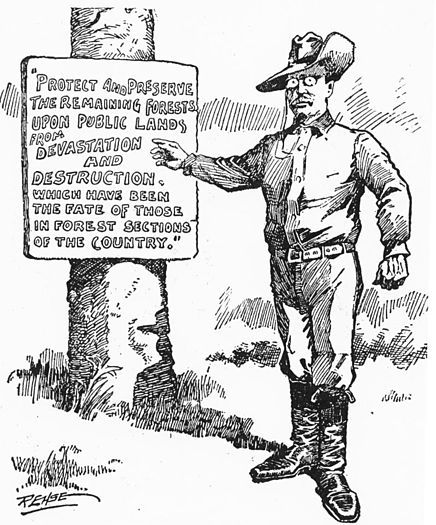
1908 editorial cartoon of President Theodore Roosevelt as “A Practical Forester.”  Source: St. Paul Minnesota “Pioneer Press”. Via GPO's Government Book Talk blog.

1908 Rense editorial cartoon of President Theodore Roosevelt as “A Practical Forester.” Source: St. Paul Minnesota “Pioneer Press”. Via GPO’s Government Book Talk blog.