Beleaguered sign makers will tell you, sometimes it’s damnably difficult to make signs make sense to motorists who speed by faster than they should — and sometimes, the story is just too difficult for pictures.
Take this one, posted on Twitter by @Weasel3071:
What does this sign mean? Sign near Bolinas, wherever than is. On Twitter from @Weasel3071.
Responses cover a lot of territory, and of course the flying cows of “Tornado” and “Monty Python and the Holy Grail” got mentions.
One response appears to come from an actual sign maker, who expresses sign maker frustration.
Cheap county didn't want to pay for two signs, one with the, also it should be 500 ft. on the plaque. Source: it's how I make a living. pic.twitter.com/rqBxb71Onn
— Barry Stock, The Carpet Does Not Match the Drapes (@BusStationDrift) July 30, 2021
Other responses hint that some people may be modifying actual cow warning signs, in New Mexico or Nevada.
A running whine on Twitter and Facebook: ‘Can you name anything government ever got right?’
One such occasion was July 20, 1969, when humans first put foot on the Moon.
It’s a day to remember history. Do you remember that day, the first time humans landed on the Moon?
God knows we could use more Americans to have faith in the good intentions of NASA scientists today; we could use more dreams like those NASA gave us then, too.
Southwest Elementary in Burley, Idaho, existed in a world far, far away from the U.S. space program. We watched rocket launches on black and white televisions — the orbital launches were important enough my father let me stay home from school to watch, but when he dropped me off at school, I was in a tiny band of students who actually made it to school. Potato farmers and the merchants who supported them thought the space program was big, big stuff, worth missing school.
By John Glenn’s flight, a three-orbit extravaganza on February 20, 1962, a television would appear in the main vestibule of the school, or in the auditorium, and we’d all watch. There were very few spitballs. Later that year my family moved to Pleasant Grove, Utah.
Toward the end of the Gemini series, television news networks stopped providing constant coverage. The launch, the splashdown, a space walk or other mission highlight, but the nation didn’t hold its breath so much for every minute of every mission. Barry McGuire would sing about leaving the planet for four days in space (” . . . but when you return, it’s the same old place.“), then six days, but it was just newspaper headlines.
The Apollo 1 fire grabbed the nation’s attention again.Gus Grissom, one of the three who died, was one of the original space titans; death was always a possibility, but the U.S. program had been so lucky. Apollo’s start with tragedy put it back in the headlines.
The space program and its many successes made Americans hopeful, even in that dark decade when the Vietnam War showed the bloody possibilities of the Cold War. That darkest year of 1968 — see the box below — closed nicely with Apollo 8 orbiting the Moon, and the famous Christmas Eve telecast from the three astronauts, Frank Borman, Jim Lovell, and William A. Anders. The space program kept us hopeful.
By early 1969 many of us looked forward to the flight of Apollo 11 scheduled for July — the space flight that promised to put people on the Moon for the first time in history, the realization of centuries-old dreams.
Then I got my assignment for Scouting for the summer. Out of nearly 50 nights under the stars, one of the days would include the day of the space walk. Not only was it difficult to get televisions into Maple Dell Scout Camp, a good signal would be virtually impossible. I went to bed Sunday night knowing the next day I’d miss the chance of a lifetime, to watch the first moon landing and walk.
Just after midnight my sister Annette woke me up. NASA decided to do the first walk on the Moon shortly after touchdown, at an ungodly hour. I’d be unrested to check Scouts in, but I’d have seen history.
Texas Essential Knowledge and Skills (TEKS) used to list 11 dates for U.S. history as the touchstones kids need to have: 1609, the founding of Jamestown; 1776, the Declaration of Independence; 1787, the Constitutional Convention; 1803, the Louisiana Purchase; 1861-1865, the American Civil War; 1877, the end of Reconstruction; 1898, the Spanish American War; 1914-1918, World War I; 1929, the Stock Market Crash and beginning of the Great Depression; 1941-1945, World War II; 1957, the launching of Sputnik by the Soviets. Most teachers used to add the end of the Cold War, 1991; I usually included Apollo 11 — I think that when space exploration is viewed from a century in the future, manned exploration will be counted greater milestone than orbiting a satellite; my only hesitance on making such a judgment is the utter rejection of such manned exploration after Apollo, which will be posed as a great mystery to future high school students, I think.)
Happy to report the Texas State Board of Education has caught on. TEKS dates now include 1968 and assassination of Rev. Dr. Martin Luther King, Jr., 1969 and Apollo 11, plus the terrorist attacks on the World Trade Center in 2001 and the 2008 election of Barack Obama as president.
* Why 1968 was such a tough year, in roughly chronological order: 1968 produced a series of disasters that would depress the most hopeful of people, including: the Pueblo incident, the B-52 crash in Greenland, the Tet Offensive in Vietnam, the nerve gas leak at the Army’s facility at Dugway, Utah, that killed thousands of sheep, Lyndon Johnson’s pullout from the presidential race with gathering gloom about Vietnam, the Memphis garbage strike, the assassination of Martin Luther King, Jr., riots, the Black Panther shoot-out in Oakland, the Columbia University student takeover, the French student strikes, the tornadoes in Iowa and Arkansas on May 15, the Catonsville 9 vandalism of the Selective Service office, the sinking of the submarine U.S.S. Scorpion with all hands, the shooting of Andy Warhol, the assassination of Robert F. Kennedy, the Buenos Aires soccer riot that killed 74 people, the Glenville shoot-out in Cleveland, the cynicism of the Republicans and the nomination of Richard Nixon and Spiro Agnew, the Warsaw Pact invasion of Czechoslovakia crushing the “Prague Spring” democratic reforms, the Chicago Democratic Convention and the police riot, the brutal election campaign, the Tlatololco massacre of students in Mexico City, Black Power demonstrations by winning U.S. athletes at the Mexico City Olympics, coup d’etat in Panama. Whew!
Then there are those happy masses who know him for his historical work, recovering the works of Johann Sebastian Bach’s final and most wayward child, P. D. Q. Bach.
One need not be a classical music fan to appreciate much of the humor in Schickele’s work. But if one is familiar with classical music and the tropes of critics and artists, there will be added nuances and fits of laughter.
Shickele has spent his life having a great time in music, and spreading cheer. A life well lived.
Happy birthday!
Tip of the old bathtub-hardened conductor’s baton to Eric Koenig.
Caption from NASA: The American flag heralded the launch of Apollo 11, the first Lunar landing mission, on July 16, 1969. The massive Saturn V rocket lifted off from NASA’s Kennedy Space Center with astronauts Neil A. Armstrong, Michael Collins, and Edwin “Buzz” Aldrin at 9:32 a.m. EDT. Four days later, on July 20, Armstrong and Aldrin landed on the Moon’s surface while Collins orbited overhead in the Command Module. Armstrong and Aldrin gathered samples of lunar material and deployed scientific experiments that transmitted data about the lunar environment. Image Credit: NASA
July 4. Surely everyone knows to fly the flag on Independence Day, the anniversary of the Declaration of Independence.*
In the month of the grand patriotic celebration, what other dates do we fly the U.S. flag? July 4 is the only date designated in the Flag Code for all Americans to fly the flag. Three states joined the union in July, days on which citizens of those states should show the colors, New York, Idaho and Wyoming.
Plus, there is one date many veterans think we should still fly the flag, Korean War Veterans Armistice Day on July 27. Oddly, the law designating that date urges flying the flag only until 2003, the 50th anniversary of the still-standing truce in that war. But the law still exists. What’s a patriot to do?
Patriots may watch to see whether the president issues a proclamation for the date.
Generally we don’t note state holidays or state-designated flag-flying events, such as Utah’s Pioneer Day, July 24, which marks the day in 1847 that the Mormon pioneers in the party of Brigham Young exited what is now Emigration Canyon into the Salt Lake Valley. But it’s a big day in Utah, where I spent a number of years and still have family. And I still have memories, not all pleasant, of that five-mile march for the Days of ’47 Parade, in that wool, long-sleeved uniform and hat, carrying the Sousaphone. Pardon my partisan exception. Utahns will fly their flags on July 24.
National Korean War Veterans Armistice Day, July 27 (flags fly at half-staff, if you are continuing the commemoration which was designated in law only until 2003; tradition keeps proclamations coming)
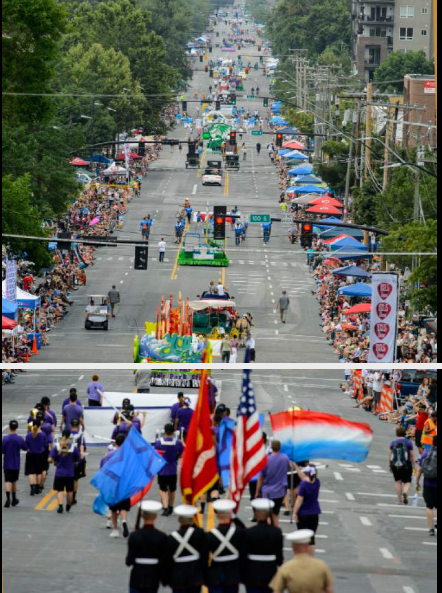
* July 4? But didn’t John Adams say it should be July 2? And, yes, the staff at Millard Fillmore’s Bathtub sadly noted that, at most July 4 parades, it appears no one salutes the U.S. flag as it passes, as the Flag Code recommends — though there were several people properly saluting the leading flags at the Duncanville Independence Day parade in 2021. MFB’s been fighting flag etiquette ignorance since 2006. It’s taking much, much longer than we wished.
Yes, this is an encore post. Defeating ignorance takes patience and perseverance.
Save
Spread the word; friends don't allow friends to repeat history.
John Adams, by By John Trumbull, 1793. National Portrait Gallery, Smithsonian Institution
“The Second Day of July 1776 will be the most memorable Epocha, in the History of America. . . . It ought to be solemnized with Pomp and Parade, with Shews, Games, Sports, Guns, Bells, Bonfires, and Illuminations from one End of this Continent to the other from this Time forward forever more.” — John Adams to Abigail Adams, July 3, 1776
Surely John Adams knew that July 4 would be Independence Day, didn’t he?
In writing to his wife Abigail on July 3, John Adams committed one of those grand errors even he would laugh at afterward. We’ll forgive him when the fireworks start firing.
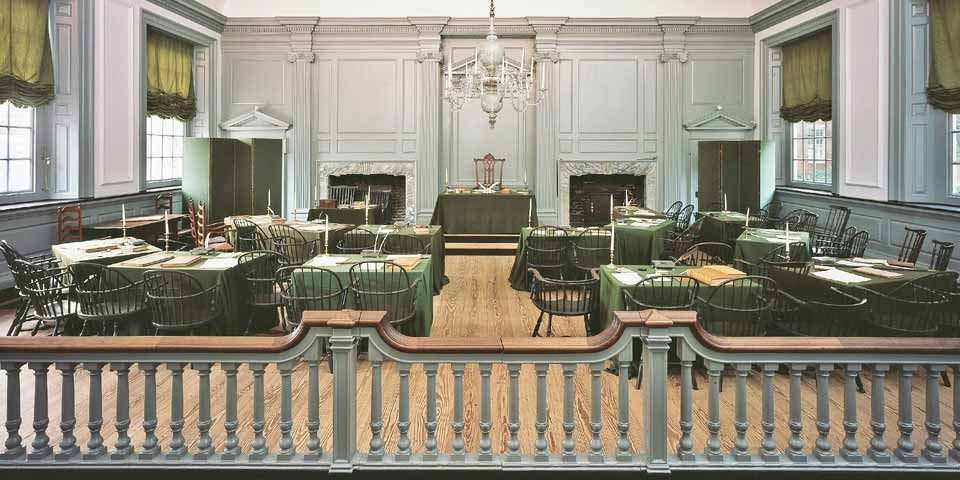
Scene of the crime — Independence Hall in Philadelphia, where the Second Continental congress approved the resolution to declare the colonies independent from Britain – (Photo credit: National Park Service)
Two days later, that same Congress approved the wording of the document Thomas Jefferson had drafted to announce Lee’s resolution to the world.
Today, we celebrate the date of the document Jefferson wrote, and Richard Henry Lee is often a reduced to a footnote, if not erased from history altogether.
Who can predict the future?
(You know, of course, that Adams and Jefferson both died 50 years to the day after the Declaration of Independence, on July 4, 1826. In the 50 intervening years, Adams and Jefferson were comrades in arms and diplomacy in Europe, officers of the new government in America, opposing candidates for the presidency, President and Vice President, ex-President and President, bitter enemies, then long-distance friends writing almost daily about how to make a great new nation. Read David McCullough‘s version of the story, if you can find it.)
The Lee Resolution, passed by the Second Continental Congress on July 2, 1776 – Wikipedia image (Wait a minute: Are those numbers added correctly? What are they?)
Did you really need a reminder to fly your flag today? The elves and bookworms at Millard Fillmore’s Bathtub were hoping to get a whole weekend off . . .
A few questions came my way this morning at a gathering. So, this post from 14 years ago seems appropriate.
Every kid should learn this stuff by third grade, but it’s clear from what we see that they don’t.
So here’s a quick review of dos and don’ts for display and behavior toward the U.S. flag on this most flag-worthy of days, the 4th of July. With a few comments.
1. Fly your flag, from sunup to sundown. If you’re lucky enough to have a flagpole, run the flag up quickly. Retire it slowly at sunset. Then go see fireworks.
2. Display flags appropriately, if not flown from a staff. If suspended from a building or a wall, remember the blue field of stars should always be on its right — the “northwest corner” as you look at it. Do not display a flag flat.
3. Salute the flag as it opens the 4th of July parade. In a better world, there would be just one U.S. flag at the opening of the parade, and the entire crowd would rise as it passes them in a great patriotic, emotional wave — civilians with their hands over their hearts, hats off; people in uniform saluting appropriately with hats on. It’s likely that your local parade will not be so crisp. Other entries in the parade will have flags, and many will be displayed inappropriately. A true patriot might rise and salute each one — but that would look silly, perhaps even sillier than those sunshine patriots who display the flag inappropriately. Send them a nice letter this year, correcting their behavior. But don’t be obnoxious about it.
4. Do not display the flag from a car antenna, attached to a window of a car, or attached in the back of a truck. That’s against the Flag Code, which says a flag can only be displayed attached to the right front fender of a car, usually with a special attachment. This means that a lot of the National Guard entries in local parades will be wrongly done, according to the flag code. They defend the flag, and we should not make pests of ourselves about it. Write them a letter commending their patriotism. Enclose the Flag Code, and ask them to stick to it next time. Innocent children are watching.
5. Do not dishonor the flag by abusing it or throwing it on the ground. It’s become popular for a local merchant to buy a lot of little plastic flags and pass them out to parade goers. If there is an advertisement on the flag, that is another violation of the Flag Code. The flag should not be used for such commercial purposes. I have, several times, found piles of these flags on the ground, dumped by tired people who were passing them out, or dumped by parade goers who didn’t want to carry the things home. It doesn’t matter if it’s printed on cheap plastic, and made in China — it is our nation’s flag anyway. Honor it. If it is worn, dispose of it soberly, solemnly, and properly.
That’s probably enough for today. When the Flag Desecration Amendment passes — if it ever does — those parade float makers, National Guard soldiers, and merchants, can all be jailed, perhaps. Or punished in other ways.
Until that time, our best hope is to review the rules, obey them, and set examples for others.
Have a wonderful 4th of July! Fly the flag. Read the Declaration of Independence out loud. Love your family, hug them, and feed them well. That’s part of the Pursuit of Happiness that this day honors. It is your right, your unalienable right. Use it wisely, often and well.
Image: Flag flying in front of the U.S. Capitol. If from a photo, this flag is probably one on one of the buildings of the Library of Congress. It is a Library of Congress photo.
Spread the word; friends don't allow friends to repeat history.
Or, until that account is unsuspended by the forces supporting Donald Trump: Follow @FillmoreWhite, the account of the Millard Fillmore White House Library
We've been soaking in the Bathtub for several months, long enough that some of the links we've used have gone to the Great Internet in the Sky.
If you find a dead link, please leave a comment to that post, and tell us what link has expired.
Thanks!
Retired teacher of law, economics, history, AP government, psychology and science. Former speechwriter, press guy and legislative aide in U.S. Senate. Former Department of Education. Former airline real estate, telecom towers, Big 6 (that old!) consultant. Lab and field research in air pollution control.
My blog, Millard Fillmore's Bathtub, is a continuing experiment to test how to use blogs to improve and speed up learning processes for students, perhaps by making some of the courses actually interesting. It is a blog for teachers, to see if we can use blogs. It is for people interested in social studies and social studies education, to see if we can learn to get it right. It's a blog for science fans, to promote good science and good science policy. It's a blog for people interested in good government and how to achieve it.
BS in Mass Communication, University of Utah
Graduate study in Rhetoric and Speech Communication, University of Arizona
JD from the National Law Center, George Washington University


 Posted by Ed Darrell









 Millard Fillmore's Bathtub
