Corey Amaro’s mother among flags flown in memory of military people, on Memorial Day. One of the few images I could find of a mother with U.S. flags. (Click the image to go to Amaro’s blog for a touching little story.)
Interesting to me that so few people make a deal out of flying the U.S. flag on Mothers Day, or Fathers Day, or Christmas or Easter, dates the Flag Code says we should fly the colors.
Spread the word; friends don't allow friends to repeat history.
In 2022, we may need this post more, to put up with anti-science backlash to the urgency of global heating, the threat of COVID-19, and still, to the defeat of Donald Trump.
Like faces in clouds, some people claimed to see a link. The first Earth Day, on April 22, 1970, coincided with Lenin’s birthday. There was no link — Earth Day was scheduled for a spring Wednesday, when the greatest number of college students would be on campus.
Google Doodle for Earth Day 2021
Now, years later, with almost-annual repeats of the claim from the braying right wing, it’s just a cruel hoax. It’s as much a hoax on the ill-informed of the right, as anyone else. Many of them believe it.
No, there’s no link between Earth Day and the birthday of V. I. Lenin:
One surefire way to tell an Earth Day post is done by an Earth Day denialist: They’ll note that the first Earth Day, on April 22, 1970, was an anniversary of the birth of Lenin.
Coincidentally, yes, Lenin was born on April 22, on the new style calendar; it was April 10 on the calendar when he was born — one might accurately note that Lenin’s mother always said he was born on April 10.
It’s a hoax. There is no meaning to the first Earth Day’s falling on Lenin’s birthday — Lenin was not prescient enough to plan his birthday to fall in the middle of Earth Week, a hundred years before Earth Week was even planned.
Does Earth Day Promote Communism?
Earth Day 1970 was initially conceived as a teach-in, modeled on the teach-ins used successfully by Vietnam War protesters to spread their message and generate support on U.S. college campuses. It is generally believed that April 22 was chosen for Earth Day because it was a Wednesday that fell between spring break and final exams—a day when a majority of college students would be able to participate.
U.S. Sen. Gaylord Nelson, the guy who dreamed up the nationwide teach-in that became Earth Day, once tried to put the whole “Earth Day as communist plot” idea into perspective.
“On any given day, a lot of both good and bad people were born,” Nelson said. “A person many consider the world’s first environmentalist, Saint Francis of Assisi, was born on April 22. So was Queen Isabella. More importantly, so was my Aunt Tillie.”
April 22 is also the birthday of J. Sterling Morton, the Nebraska newspaper editor who founded Arbor Day (a national holiday devoted to planting trees) on April 22, 1872, when Lenin was still in diapers. Maybe April 22 was chosen to honor Morton and nobody knew. Maybe environmentalists were trying to send a subliminal message to the national subconscious that would transform people into tree-planting zombies. One birthday “plot” seems just about as likely as the other. What’s the chance that one person in a thousand could tell you when either of these guys were born.
My guess is that only a few really wacko conservatives know that April 22 is Lenin’s birthday (was it ever celebrated in the Soviet Union?). No one else bothers to think about it, or say anything about it, nor especially, to celebrate it.
Certainly, the Soviet Union never celebrated Earth Day. Nor was Lenin any great friend of the environment. He stood instead with the oil-drillers-without-clean-up, with the strip-miners-without-reclamation, with the dirty-smokestack guys. You’d think someone with a bit of logic and a rudimentary knowledge of history could put that together.
Inventor of Earth Day teach-ins, former Wisconsin Governor and U.S. Senator Gaylord Nelson
The REAL founder of Earth Day, Wisconsin’s U.S. Sen. Gaylord Nelson, usually recognized as the founder and father of Earth Day, told how and why the organizers came to pick April 22:
Senator Nelson chose the date in order to maximize participation on college campuses for what he conceived as an “environmental teach-in.” He determined the week of April 19–25 was the best bet; it did not fall during exams or spring breaks, did not conflict with religious holidays such as Easter or Passover, and was late enough in spring to have decent weather. More students were likely to be in class, and there would be less competition with other mid-week events—so he chose Wednesday, April 22.
After President Kennedy’s [conservation] tour, I still hoped for some idea that would thrust the environment into the political mainstream. Six years would pass before the idea that became Earth Day occurred to me while on a conservation speaking tour out West in the summer of 1969. At the time, anti-Vietnam War demonstrations, called “teach-ins,” had spread to college campuses all across the nation. Suddenly, the idea occurred to me – why not organize a huge grassroots protest over what was happening to our environment?
I was satisfied that if we could tap into the environmental concerns of the general public and infuse the student anti-war energy into the environmental cause, we could generate a demonstration that would force this issue onto the political agenda. It was a big gamble, but worth a try.
At a conference in Seattle in September 1969, I announced that in the spring of 1970 there would be a nationwide grassroots demonstration on behalf of the environment and invited everyone to participate. The wire services carried the story from coast to coast. The response was electric. It took off like gangbusters. Telegrams, letters, and telephone inquiries poured in from all across the country. The American people finally had a forum to express its concern about what was happening to the land, rivers, lakes, and air – and they did so with spectacular exuberance. For the next four months, two members of my Senate staff, Linda Billings and John Heritage, managed Earth Day affairs out of my Senate office.
Five months before Earth Day, on Sunday, November 30, 1969, The New York Times carried a lengthy article by Gladwin Hill reporting on the astonishing proliferation of environmental events:
“Rising concern about the environmental crisis is sweeping the nation’s campuses with an intensity that may be on its way to eclipsing student discontent over the war in Vietnam…a national day of observance of environmental problems…is being planned for next spring…when a nationwide environmental ‘teach-in’…coordinated from the office of Senator Gaylord Nelson is planned….”
Nelson, a veteran of the U.S. armed services (Okinawa campaign), flag-waving ex-governor of Wisconsin (Sen. Joe McCarthy’s home state, but also the home of Aldo Leopold and birthplace of John Muir), was working to raise America’s consciousness and conscience about environmental issues.
Humor at The ObamaCrat: “Time reported that some suspected the date was not a coincidence, but a clue that the event was ‘a Communist trick,’ and quoted a member of the Daughters of the American Revolution as saying, ‘subversive elements plan to make American children live in an environment that is good for them.'” God forbid!
About.com, “Is Earth Day a communist plot?”; “U.S. Sen. Gaylord Nelson, the guy who dreamed up the nationwide teach-in that became Earth Day, once tried to put the whole “Earth Day as communist plot” idea into perspective.”On any given day, a lot of both good and bad people were born,” Nelson said. “A person many consider the world’s first environmentalist, Saint Francis of Assisi, was born on April 22. So was Queen Isabella. More importantly, so was my Aunt Tillie.”
Mike Ciandella campaigns for Pinocchios at CNS (Lenin asked for “days of service” to honor his birthday? Yeah, and those cans of dehydrated water have been recalled because the water they make isn’t wet.)
Do you know why Earth Day is April 22? (gds44.wordpress.com) [This blog appears not to accept any dissenting views . . . funny, Leninist tactics from a guy who claims not to like Lenin.]
Rich Kozlovich at Paradigms and Demographic; Kozlovich repeats these fantastic lies, without even bothering to hint at any backup: “There is one factor that is known. This whole green stuff was imposed in Nazi Germany and in Soviet Russia and their views are virtually identical to the views of modern greenies and it is a reasonable assumption to think they were inspirational to the green movement of today; who have morphed into the step child of socialism. I think it is fair to question any denials on their part, in that their denials can be being likened to cow flatulence. Back to today.” [Editor’s note: Complete and utter balderdash.]
Wall of Lenin’s Birthday Propaganda Shame from 2010:
David Zeimer, writing in The Wisconsin Law Journal (This guy is particularly nutty. He notes the successes of cleaning up the air and water in and around Milwaukee, and then claims that clean air and water are false goals. Nuts.)
One of the ways you know Earth Day is innocently timed is that the FBI investigated it; in 1970, the FBI investigated hippies, but not organized crime. Go figure.
Don Surber may be as nutty as Zeimer, above — he notes words of concern from 1970, then dismisses the progress that resulted because people worked to change things; clean air is bad, to him, I guess
It’s cruel to people who want to fly U.S. flags often, but only on designated flag-flying dates. (April is also National Poetry Month, so it’s a good time to look up poetry references we should have committed to heart).
For 2022, these are the three dates for flying the U.S. flag; Easter is a national date, the other two are dates suggested for residents of the states involved.
One date, nationally, to fly the flag. That beats March, which has none (in a year with Easter in April and not March). But March has five statehood days, to April’s two.
Take heart! You may fly your U.S. flag any day you choose, or everyday as many people do in Texas (though, too many do not retire their flags every evening . . .).
April usually sees the opening of Major League Baseball’s season — some teams jumped into March in 2018. In this photo, U.S. Navy sailors assigned to the USS Bonhomme Richard practice for the San Diego Padres’ opening day flag ceremony in San Diego on April 5, 2011. The ship sent nearly 300 volunteers to unfurl an 800-pound U.S. flag that covered the entire field. The Bonhomme Richard was in dry-dock for maintenance and upgrades. Defense Department photo via Wikimedia.
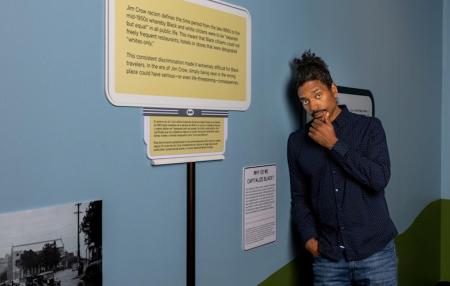
Professor Frederick Gooding at the display he curated on “The Green Book,” at the Fort Worth Museum of Science and History, 2022
A museum display DFW school kids should get out to see, “The Green Book,” at the Fort Worth Museum of Science and History.
Press release from Texas Christian University tells the story well.
Gooding Works to Make History Accessible
February 10, 2022
TCU professor is curator of The Green Book, an exhibit launching this month at the Fort Worth Museum of Science and History.
One of the ultimate freedoms is that of the open road – the simple act of driving a car when or wherever you want to go. But in Jim Crow America, a road trip for Black travelers was far from liberating. In fact, a drive outside of the neighborhood was dangerous, especially in the South.
“Imagine that it’s the 1950s. You are Black and your children are in the back seat of your car and you’re going on a trip,” said Frederick Gooding Jr., Dr. Ronald E. Moore Honors Professor of Humanities. “Think how much of a threat it was to find a safe place to eat and sleep in terms of avoiding humiliation or violence. Even a gas station could be a risky proposition. You needed a resource for your family’s safety and protection because the stakes were so high.”
That resource was the Negro Motorist Green Book, published from the 1930s until 1966, a mere two years after the 1964 Civil Rights Act financially penalized racial segregation for the first time. The handbook provided a state-by-state list of hotels, service stations, restaurants and other establishments considered safe for Black travelers.
The associate professor of African-American studies and chair of TCU’s Race & Reconciliation Initiative, Gooding is now helping to share the story about the book and its originator, Victor Hugo Green. The Fort Worth Museum of Science and History approached Gooding to be chief curator of its new exhibition, “Fort Worth and the Green Book: Black Travelers Navigating Racism in Mid-Century Texas,” opening Feb. 11.
While the 2018 Academy Award-winning movie Green Book may have introduced the same title to many Americans, Gooding notes that the exhibit certainly takes a different path.
“Whether you’re 6 or 60, this exhibit will help set the tone for how bizarre and befuddling it was for African Americans to have to navigate a Jim Crow society and to heighten awareness of our relative progress,” Gooding said. “It’s been a treat to be part of the creation process as well as provide an opportunity for exposure.”
Morgan Rehnberg, the museum’s project leader, said it was clear that Gooding would be an ideal partner.
“His scholarship on race and culture, as well as his leadership at TCU in addressing the university’s history with race, has given him a unique perspective on Fort Worth,” Rehnberg said. “It’s been tremendously fun to see his enthusiasm shine into every aspect of the exhibition.”
After receiving a grant, the museum acquired the materials for the exhibit. As a historian, Gooding looked for ways to make it accessible.
“We started from scratch in creating a balanced exhibit that has many layers. That helps to bring The Green Book to life, and there’s something for everyone,” he said “It’s been an interesting ride looking to reconcile introducing people to a topic while providing them with enough tools to discover the truth for themselves.”
The exhibit is expected to be seen by close to 300,000, including many school groups, before it’s taken down in August. In conjunction with the exhibit, Gooding will present as part of the museum’s lecture series Feb. 21. His “Navigating the Road to Reconciliation” talk will explore how to leverage a multiplicity of voices and support the principles of reconciliation. For visitor information, visit Fort Worth Museum of Science and History.
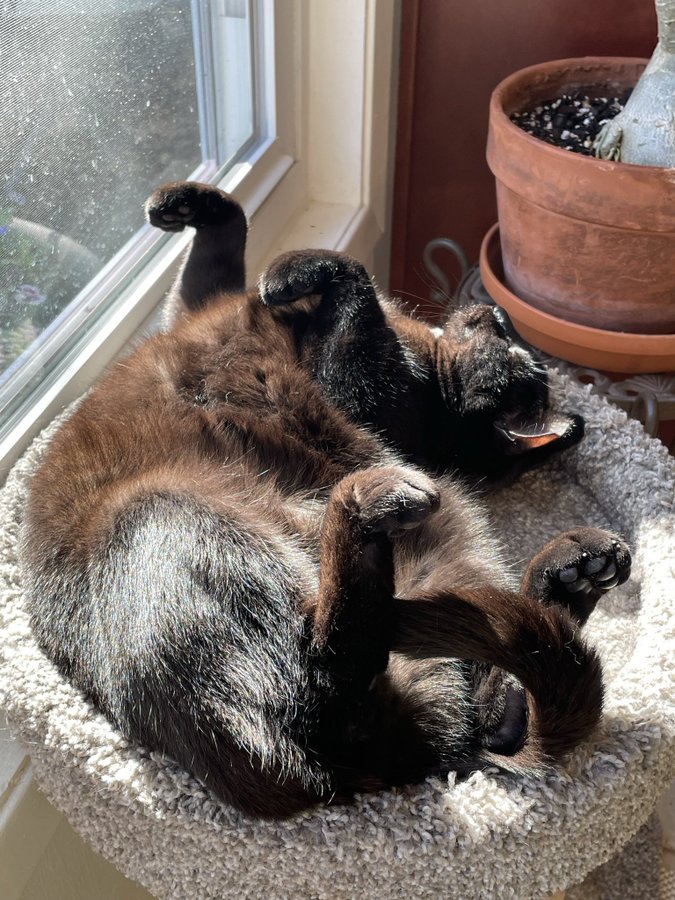
Her name is Xena. Born in New York City, now residing in Dallas, Texas.
On Twitter, this photo is, “Once-feral cat sleeping, totally at ease and fearing no predator.”
Xena came to us a couple years ago, rescued from the alleys of New York City by our daughter-in-law and our son. A small cat abandoned by her mother, she was preyed upon by every tomcat and larger cat in the neighborhood.
When the cat rescuers brought her in, got her doctored up and neutered, she refused to go back outside. So she was transplanted.
Now she sleeps peacefully, doesn’t fight for food — often shares. She provides great companionship for the humans here, too.
Spread the word; friends don't allow friends to repeat history.
Lesson is, we need to act now. The faster and harder we can act to block global heating, the greater chance we have of saving a place for humans on this planet without massive loss.
Rhode Island U.S. Sen. Sheldon White House (D). Photo of President Franklin Roosevelt in background. Roll Call photo.
As I suspected, some U.S. Senators have been exploring Senate Rules for ways to shut down filibusters and other delaying tactics, but mainly to find a path around Republican filibustering of voting protection legislation.
Sen. Sheldon Whitehouse (D-RI) laid it out tonight, after Republicans blocked action on the John R. Lewis Act.
It’s likely Senate Minority Leader Mitch McConnell knows this path exists. But if Whitehouse is right, knowing the rules and being able to overcome them are two different things.
Every Senate wonk should take a look at Sen. Whitehouse’s plan.
Here’s the deal. Once Senate debate on a measure ends, you can pass the bill with a simple majority vote. So if you’re willing to outlast the other side, you don’t need cloture. This could take weeks, as other Voting Rights bills did, but we have a few tools that help.
One is my DISCLOSE Act being in the bill. Republicans must vote against it for their dark-money donors, but that kills them with voters. Ditto gerrymandering. Lots of focus on those painful votes for them in the bill will help.
Another is the Senate speak-twice rule. Senators who’ve spoken twice on a question can be ruled out of order if they keep at it. That’s why real filibusters were long, uninterrupted speeches. Not one and done, but two and done. (Yup, that’s 100 speeches by Rs — sorry!)
The motion to table allows the Senate to clear the decks of amendments. Each requires a vote, but is not debatable. Week after week, even through weekends, table the bad amendments.
“Dilatory” motions, amendments and other delaying mischief can be ruled out of order by the presiding officer. It takes a fair amount of nonsense before it becomes clearly dilatory, but it’s then a simple point of order—no vote.
There can be a vote to overrule the call, which is debatable; but when that fails, whatever motion or amendment was ruled dilatory ends.
So it’s painful, and long, and you have to exhaust Republican speakers and table or stop dilatory motions and amendments, but you can get to a simple majority vote — eventually.
One objection is that the Senate cannot afford to concentrate on one issue for so long. I wager that there is a lot of other business that can be conducted anyway, but Republicans would try to monkeywrench that stuff, too.
Taking a longer perspective, can we afford to let a tiny minority of Americans hold off action while they continue to plot to bring down our government?
Make no mistake that is what this is about.
Spread the word; friends don't allow friends to repeat history.
Beinecke Library at Yale is a repository for Rachel Carson’s papers, and much more.
Including this beguiling photo of Rachel Carson’s cat investigating the typewriter on which she wrote Silent Spring.
Maybe the cat is trying to find where all those beautifully-crafted words came from. Even decades before the internet, cats tortured their humans in the humans’ offices. Royal Typewriter in Rachel Carson’s Maryland house.
Researchers into Rachel Carson should check the on-line holdings of the Beinecke Library.
Or, until that account is unsuspended by the forces supporting Donald Trump: Follow @FillmoreWhite, the account of the Millard Fillmore White House Library
We've been soaking in the Bathtub for several months, long enough that some of the links we've used have gone to the Great Internet in the Sky.
If you find a dead link, please leave a comment to that post, and tell us what link has expired.
Thanks!
Retired teacher of law, economics, history, AP government, psychology and science. Former speechwriter, press guy and legislative aide in U.S. Senate. Former Department of Education. Former airline real estate, telecom towers, Big 6 (that old!) consultant. Lab and field research in air pollution control.
My blog, Millard Fillmore's Bathtub, is a continuing experiment to test how to use blogs to improve and speed up learning processes for students, perhaps by making some of the courses actually interesting. It is a blog for teachers, to see if we can use blogs. It is for people interested in social studies and social studies education, to see if we can learn to get it right. It's a blog for science fans, to promote good science and good science policy. It's a blog for people interested in good government and how to achieve it.
BS in Mass Communication, University of Utah
Graduate study in Rhetoric and Speech Communication, University of Arizona
JD from the National Law Center, George Washington University


 Posted by Ed Darrell












 Millard Fillmore's Bathtub