Our textbooks and curriculum guides too often fail to make clear the links between the bloody conflicts in the Kansas Territory and the Civil War, between the conflicts engaged in by men like John Brown in Kansas, and later at Harper’s Ferry, Virginia, and the conflicts of the Civil War.
We might make the history more vivid and clear with the use of Julia Ward Howe’s “Battle Hymn of the Republic,” an epic war song based closely on a folk tune favored by Union troops of the time, conscripted specifically because of that affinity by Howe to serve the greater action of repurposing the war from merely saving the Union to freeing people from bondage. It’s a study in propaganda earlier than we usually think of it.
An early lyric sheet for "Battle Hymn of the Republic," by Julia Ward Howe, Library of Congress via New York Times
Most of my students claim not to know the song, “John Brown’s Body,” and an astonishing number of the students say they don’t know “The Battle Hymn of the Republic.” It’s a chance to bore them — or instruct them, if the planets and stars align — using a bit of music (a teacher should be able to find a copy of the Mormon Tabernacle Choir’s version of the “The Battle Hymn” with little difficulty; it appears in the hymnals of most Protestant sects, so you can get a copy of the lyrics; you’ll have to do a search to find a good copy of “John Brown’s Body,” though; I’ve not found one I like to use in class).
It might be a short lesson, an adjunct to a lesson, or a project for a student with some choir training.
Gilpin wrote:
Even if Howe’s song spoke to a different understanding of the war, her efforts to transform “John Brown’s Body” into a national patriotic text meant that, much like Brown’s afterlife, people would end up using and abusing “Battle Hymn” as they saw fit. What Howe observed in that Union camp outside of Washington in 1861 was just the beginning of a war of clashing agendas and endlessly obscured meanings. To be sure, those north and south of the Mason-Dixon Line knew that the developing war was being fought over slavery – its brutal realities, its political volatility and especially its uncertain future – but even in its opening months, commentary about the war was already cloaked in the bland language of preserving the Union or defending states’ rights. Assessing the war itself, Howe later wrote that “its cruel fangs fastened upon the very heart of Boston and took from us our best and bravest.”
For Howe and generations of Americans, the cruelty of war demanded a providential overseer. Despite her urge to celebrate noble-hearted men like Brown, “Battle Hymn” helped to take responsibility for the Civil War out of the brutal and clumsy hands of ordinary mortals. To be sure, Brown his death would help to make his nation holy and especially to make all men free, but his radical extremism was frightening to most Americans. Soon enough, the Civil War would be transformed by songs like Howe’s into a conflict of necessity and destiny – a providential trial by fire. That narrative, of a harrowing but essential national adolescence, would eventually be at the expense of those Brown had died for, and whose fate the war was being fought to settle.
Yet another version of readings of the Gettysburg Address — this time by actors, historians, and a winner of the Medal of Honor, in a campaign to prevent the construction of a casino next door to the battlefield monuments:
Spread the word; friends don't allow friends to repeat history.
A mostly encore post about today’s anniversary of Lincoln’s speech at Gettysburg.
148 years ago today, Abraham Lincoln redefined the Declaration of Independence and the goals of the American Civil War, in a less-than-two-minute speech dedicating part of the battlefield at Gettysburg, Pennsylvania, as a cemetery and final resting place for soldiers who died in the fierce battle fought there the previous July 1 through 3.
Now in 2011, we’re in the “150th anniversary” years of the Civil War. Maybe some will look back to the time our nation worked hard to tear itself asunder, and learn lessons that might help us keep from doing that in the 21st century. Some might find inspiration, or aspiration, in Lincoln’s words at Gettysburg.
Interesting news for 2007: More photos from the Library of Congress collection may contain images of Lincoln. The photo above, detail from a much larger photo, had been thought for years to be the only image of Lincoln from that day. The lore is that photographers, taking a break from former Massachusetts Sen. Edward Everett’ s more than two-hour oration, had expected Lincoln to go on for at least an hour. His short speech caught them totally off-guard, focusing their cameras or taking a break. Lincoln finished before any photographer got a lens open to capture images.
The plate lay unidentified in the Archives for some fifty-five years until in 1952, Josephine Cobb, Chief of the Still Pictures Branch, recognized Lincoln in the center of the detail, head bared and probably seated. To the immediate left (Lincoln’s right) is Lincoln’s bodyguard, Ward Hill Lamon, and to the far right (beyond the limits of the detail) is Governor Andrew G. Curtin of Pennsylvania. Cobb estimated that the photograph was taken about noontime, just after Lincoln arrived at the site and before Edward Everett’s arrival, and some three hours before Lincoln gave his now famous address.
To the complaints of students, I have required my junior U.S. history students to memorize the Gettysburg Address (though, not yet in this school year). In Irving I found a couple of students who had memorized it for an elementary teacher years earlier, and who still could recite it. Others protested, until they learned the speech. This little act of memorization appears to me to instill confidence in the students that they can master history, once they get it done.
Embedded video from CNN VideoIn 1863 Edward Everett, the former Massachusetts senator and U.S. secretary of state, was regarded as the greatest orator of the time. A man of infinite grace, and a historian with some sense of events and what the nation was going through, Everett wrote to Lincoln the next day after their speeches:
“I should be glad, if I could flatter myself that I came as near the central idea of the occasion in two hours, as you did in two minutes.”
Walk with Lincoln in Gettysburg, an interestingly complete stroll through the history of the battle and the creation of the cemetery, and Lincoln’s address
Eastern National is celebrating the 150th Anniversary of the Civil War with electronic editions of eParks’ National Park Civil War Series of books. Read them online or own your own paper edition by visiting our Civil War Series store.
With a color printer, a teacher could assemble 26 readers for use in the classroom, or for homework assignments. The books sell for $8.95 through the NPS bookstore. The first listed volume,A Concise History of the Civil War, provides a good, brief summary, with some features in the .pdf version teachers should be happy to find: A list of 25 battles of significance, and black-and-white maps of battle locations and the Confederacy, for examples.
Great idea to make this stuff available for free, online. I wonder, how many people will really take advantage of the opportunity?
Presidents and the Constitution, Bill of Rights Institute
This Presidents and the Constitution focuses on Abraham Lincoln and the Emancipation Proclamation. Though he had always hated slavery, President Lincoln did not believe the Constitution gave him the authority to bring it to an end—until it became necessary to free the slaves in order to save the Union. With the Emancipation Proclamation, which he viewed as an essential wartime measure to cripple the Confederacy’s ability to fight, Lincoln took the first step toward abolition of slavery in the United States.
If you teach social studies, you probably know about the Bill of Rights Institute already — subscribe for lesson plans, news updates, and news about seminars. They do good work, and the provide great resources.
Spread the word; friends don't allow friends to repeat history.
Very first photo of president-elect Abraham Lincoln with a beard, November 25, 1860. Lincoln was photographed in Chicago by Samuel G. Alschuler. Library of Congress photo, via New York Times
Goodheart points to the first photo of Lincoln’s beard, made November 25, 1860, exactly 150 years ago, today.
Spread the word; friends don't allow friends to repeat history.
A mostly encore post about today’s anniversary of Lincoln’s speech at Gettysburg.
Prior to 2007, this was the only known photo of Lincoln at Gettysburg, on the day of his address – Library of Congress
147 years ago today, Abraham Lincoln redefined the Declaration of Independence and the goals of the American Civil War, in a less-than-two-minute speech dedicating part of the battlefield at Gettysburg, Pennsylvania, as a cemetery and final resting place for soldiers who died in the fierce battle fought there the previous July 1 through 3.
Interesting news for 2007: More photos from the Library of Congress collection may contain images of Lincoln. The photo above, detail from a much larger photo, had been thought for years to be the only image of Lincoln from that day. The lore is that photographers, taking a break from former Massachusetts Sen. Edward Everett’ s more than two-hour oration, had expected Lincoln to go on for at least an hour. His short speech caught them totally off-guard, focusing their cameras or taking a break. Lincoln finished before any photographer got a lens open to capture images.
The plate lay unidentified in the Archives for some fifty-five years until in 1952, Josephine Cobb, Chief of the Still Pictures Branch, recognized Lincoln in the center of the detail, head bared and probably seated. To the immediate left (Lincoln’s right) is Lincoln’s bodyguard, Ward Hill Lamon, and to the far right (beyond the limits of the detail) is Governor Andrew G. Curtin of Pennsylvania. Cobb estimated that the photograph was taken about noontime, just after Lincoln arrived at the site and before Edward Everett’s arrival, and some three hours before Lincoln gave his now famous address.
To the complaints of students, I have required my junior U.S. history students to memorize the Gettysburg Address. In Irving I found a couple of students who had memorized it for an elementary teacher years earlier, and who still could recite it. Others protested, until they learned the speech. This little act of memorization appears to me to instill confidence in the students that they can master history, once they get it done.
Edward Everett, the former Massachusetts senator and secretary of state, was regarded as the greatest orator of the time. A man of infinite grace, and a historian with some sense of events and what the nation was going through, Everett wrote to Lincoln the next day after their speeches:
“I should be glad, if I could flatter myself that I came as near the central idea of the occasion in two hours, as you did in two minutes.”
Walk with Lincoln in Gettysburg, an interestingly complete stroll through the history of the battle and the creation of the cemetery, and Lincoln’s address
Perhaps the U.S. should celebrate the day, too, at least in those states who were not in the old Confederacy. On May 5, 1862, Mexicans under the command of 33 year old Commander General Ignacio Zaragoza Seguín stopped the quick advance of superior French forces trying to invade Mexico to take it over, at the Battle of Puebla. While France did eventually defeat Mexican forces (after getting 30,000 men in reinforcements), the spirit of May 5 inspired Mexicans to continue to fight for freedom. And ultimately, Mexican forces overpowered and captured the French forces and Emperor Maximilian, who was executed.
Thus ended a great hope for the Confederacy, that French-supported Mexican Army would lend aid to the Confederates in their struggle to secede from the Union.
It is one of the great what-ifs of history: What if France had kept Mexico, and what if French-led Mexican forces backed up the Confederate Army?
One thing is rather sure: Had that happened, and had the Confederacy been successful, we wouldn’t be celebrating Cinco de Mayo in Texas today.
Update: Sam DeBerry sends a note that Seguin was a Texan. So the Mexican hero of the Battle of Puebla was a Texan. You couldn’t make this stuff up — real history is always more interesting than fiction.
Spread the word; friends don't allow friends to repeat history.
But of course, we studied the Civil War in our U.S. history classes last fall, in the first six weeks, as a review of what the students were supposed to get in 8th grade.
In your classroom, how do you deal with anniversaries when they are out of the current course of study? How have you seen it done well?
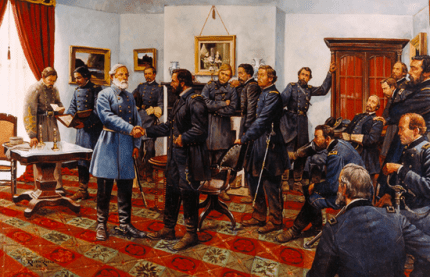
The Surrender, by Keith Rocco – image from National Park Service, via Pillar to Post
1865 – Lincoln’s funeral procession; Passing the (Cornelius) Roosevelt Mansion, sw corner 14th Street, Broadway, view looking North on Broadway – Flickr image from Stratis
See the house on the corner, at the left? Look at the second story, at the window on the side of the house facing the camera. Is that young Theodore Roosevelt watching Lincoln’s funeral procession?
6 year old, Theodore Roosevelt watches Abraham Lincoln’s funeral procession from an upstairs window of his grandfather, Cornelius Roosevelt’s mansion on Union Square with his younger brother Elliott and a friend. Teddy lived at 28 East 20th Street.
Is that accurate? Is that his grandfather’s house? I assume that it is not 28 East 20th Street, which is where he was born and the house of his father.
1865 – Watches Abraham Lincoln’s funeral procession from an upstairs window of his grandfather’s house on Union Square, New York City. With him are his younger brother Elliott and a friend named Edith Kermit Carow.
Interesting intersection of history. This would probably be the only meeting of Theodore Roosevelt and Abraham Lincoln, though Teddy almost certainly knew Lincoln’s sole surviving son, Robert, pretty well. Both were in Buffalo when William McKinley was assassinated; Robert Lincoln, having lived through his father’s assassination, and then been present at the assassinations of James Garfield and McKinley, declined an invitation to Roosevelt’s inauguration in 1905, not wishing to extend one of the oddest bad luck streaks ever imaginable.
Mrs. Lincoln could not say “no” most requests made of her in the days and weeks after the assassination. Many American cities asked to hold services while the body of Lincoln was on its way from Washington, D.C., to Springfield, Illinois. Consequently, astoundingly, there were 13 funeral services held for the dead president, including Baltimore, Philadelphia, New York City, Albany and Buffalo, New York; Cleveland, Columbus, Indianapolis, Michigan City (Indiana) (unscheduled), and Chicago, before the final service and interment in Springfield.
From “Whose father was he?” a four-part essay on tracking down the story of three children whose photograph was discovered on the corpse of a Union soldier killed at the Battle of Gettysburg, in 1863:
Perhaps more than any other artifact, the photograph has engaged our thoughts about time and eternity. I say “perhaps,” because the history of photography spans less than 200 years. How many of us have been “immortalized” in a newspaper, a book or a painting vs. how many of us have appeared in a photograph [32]? The Mayas linked their culture to the movements of celestial objects. The ebb and flow of kingdoms and civilizations in the periodicities of the moon, the sun and the planets. In the glyphs that adorn their temples they recorded coronations, birth, deaths. Likewise, the photograph records part of our history. And expresses some of our ideas about time. The idea that we can make the past present.
The photograph of Amos Humiston’s three children — of Frank, Alice and Fred — allows us to imagine that we have grasped something both unique and universal. It suggests that the experience of this vast, unthinkable war can be reduced to the life and death of one man — by identifying Gettysburg’s “Unknown Soldier” we can reunite a family. That we can be saved from oblivion by an image that reaches and touches people, that communicates something undying and transcendent about each one of us.
And the footnote, number 32:
[32] I had an opportunity to visit the fossil collections at the Museum of the Rockies in Bozeman, Montana. It was part of a dinosaur fossil-hunting trip with Jack Horner, the premier hunter of T-Rex skeletons. Downstairs in the lab, there was a Triceratops skull sitting on a table. I picked it up and inserted my finger into the brain cavity. (I had read all these stories about how small the Triceratops brain had to have been and I wanted to see for myself.) I said to Jack Horner, “To think that someday somebody will do that with my skull.” And he said, “You should be so lucky. It’s only the privileged few of us who get to be fossils.”
See Errol Morris’s whole series, “Whose father was he?” at the New York Times blogs:
Juneteenth, celebrated on June 19, is the name given to emancipation day by African-Americans in Texas. On that day in 1865 Union Major General Gordon Granger read General Order #3 to the people of Galveston. General Order #3 stated “The people of Texas are informed that, in accordance with a proclamation from the Executive of the United States, all slaves are free. This involves an absolute equality of personal rights and rights of property between former masters and slaves, and the connection heretofore existing between them becomes that between employer and hired labor. The freedmen are advised to remain quietly at their present homes and work for wages. They are informed that they will not be allowed to collect at military posts and that they will not be supported in idleness either there or elsewhere.”
Large celebrations on June 19 began in 1866 and continued regularly into the early 20th century. The African-Americans treated this day like the Fourth of July and the celebrations contained similar events. In the early days, the celebration included a prayer service, speakers with inspirational messages, reading of the emancipation proclamation, stories from former slaves, food, red soda water, games, rodeos and dances.
The celebration of June 19 as emancipation day spread from Texas to the neighboring states of Louisiana, Arkansas and Oklahoma. It has also appeared in Alabama, Florida, and California as African-American Texans migrated.
In many parts of Texas, ex-slaves purchased land, or “emancipation grounds,” for the Juneteenth gathering. Examples include: Emancipation Park in Houston, purchased in 1872; what is now Booker T. Washington Park in Mexia; and Emancipation park in East Austin.
Celebration of Juneteenth declined during World War II but revived in 1950 at the Texas State Fair Grounds in Dallas. Interest and participation fell away during the late 1950’s and 1960’s as attention focused on expansion of freedom for African-Americans. In the 1970’s Juneteenth revived in some communities. For example, in Austin the Juneteenth celebration returned in 1976 after a 25 year hiatus. House Bill no.1016 passed in the 66th legislature, regular session, declared June 19, “Emancipation Day in Texas,” a legal state holiday effective January 1, 1980. Since that time, the celebration of Juneteenth continues across the state of Texas with parades, picnics and dancing.
Texas State Library Reference Services 3/95
Celebrations across Texas started last Saturday, and will continue for another three or four days, I gather. Thought it’s an official State of Texas holiday, few people take it off. So celebrations are scheduled when they can be.
Maj. Gen. John A. Logan, Grand Army of the Republic (Union Army), inventor of Memorial Day; Library of Congress photo, Brady National Photographic Art Gallery, between 1860 and 1865
In 1868, Commander in Chief John A. Logan of the Grand Army of the Republic issued General Order Number 11 designating May 30 as a memorial day “for the purpose of strewing with flowers or otherwise decorating the graves of comrades who died in defense of their country during the late rebellion, and whose bodies now lie in almost every city, village, and hamlet churchyard in the land.”
The first national celebration of the holiday took place May 30, 1868, at Arlington National Cemetery, where both Confederate and Union soldiers were buried. Originally known as Decoration Day, at the turn of the century it was designated as Memorial Day. In many American towns, the day is celebrated with a parade.
Southern women decorated the graves of soldiers even before the Civil War’s end. Records show that by 1865, Mississippi, Virginia, and South Carolina all had precedents for Memorial Day. Songs in the Duke University collection Historic American Sheet Music, 1850-1920 include hymns published in the South such as these two from 1867: “Kneel Where Our Loves are Sleeping,” dedicated to “The Ladies of the South Who are Decorating the Graves of the Confederate Dead ” and “Memorial Flowers,” dedicated “To the Memory of Our Dead Heroes.”
Spread the word; friends don't allow friends to repeat history.
Or, until that account is unsuspended by the forces supporting Donald Trump: Follow @FillmoreWhite, the account of the Millard Fillmore White House Library
We've been soaking in the Bathtub for several months, long enough that some of the links we've used have gone to the Great Internet in the Sky.
If you find a dead link, please leave a comment to that post, and tell us what link has expired.
Thanks!
Retired teacher of law, economics, history, AP government, psychology and science. Former speechwriter, press guy and legislative aide in U.S. Senate. Former Department of Education. Former airline real estate, telecom towers, Big 6 (that old!) consultant. Lab and field research in air pollution control.
My blog, Millard Fillmore's Bathtub, is a continuing experiment to test how to use blogs to improve and speed up learning processes for students, perhaps by making some of the courses actually interesting. It is a blog for teachers, to see if we can use blogs. It is for people interested in social studies and social studies education, to see if we can learn to get it right. It's a blog for science fans, to promote good science and good science policy. It's a blog for people interested in good government and how to achieve it.
BS in Mass Communication, University of Utah
Graduate study in Rhetoric and Speech Communication, University of Arizona
JD from the National Law Center, George Washington University


 Posted by Ed Darrell







 Millard Fillmore's Bathtub