Four Freedoms: FDR’s January 6, 1941 speech inspires us, 74 years later

January 6, 2015

Franklin Roosevelt delivered a State of the Union address to Congress on January 6, 1941, that would at least bend history, if not change it.  In the last part of the speech he mentioned four freedoms which, he said, are worth going to war to preserve, protect and extend.

Now we call it the Four Freedoms speech.  Today is the 74th anniversary of his delivery.  Do our students even study this any more?

_____________

I found a photo that reminded me of Norman Rockwell‘s “Freedom from Want,” and wrote about it.

Then I ran into a tweet from Texas educator Bonnie Lesley:

That in turn led to an Alternet post, displayed at Reader Supported News (RSN), by a guy who claims that, compared to 1941 and the progress made on the Four Freedoms, all four of them are in danger, in America, today.

Could that be right?  In was in his State of the Union address in January 1941 that Roosevelt described the four freedoms he said the U.S. should work to secure around the world — this was clearly a philosophical foundation-laying for going to war on the side of Britain, and against Germany, in the World War that was already raging, but which the U.S. had managed to stay out of for five years in Asia and two years in Europe.

Near the end of the speech on January 6, 1941, Roosevelt explained why freedom needed to be fought for, what was important to us, as Americans in the freedom of others in other nations.  This was 10 months before Pearl Harbor.  The United States counted itself officially “neutral” in World War II, already raging in Asia and Europe — the Battle of Britain was already over.  Anyone who seriously thought the U.S. would be able to stay out of the war probably lived in deep denial (much as denialists of today on a number of topics).  Roosevelt was working furiously to get support to Great Britain, and had already started the wheels to cut off U.S. supplies of war materials, including petroleum, to the Japanese empire.  (Odd to remember the U.S. was the largest exporter of petroleum then.)

Roosevelt knew he had to establish a philosophy to follow to merit defense of freedom, if, or when as he expected, war would draw the U.S. in, or an attack would trap the nation with need of a very quick response. In his State of the Union to the newly-elected Congress, at the start of his third term, Roosevelt talked in modern language about just what the U.S. stands for, and what the U.S. should be willing to fight for.

Here is an excerpt of the speech, the final few paragraphs:

I have called for personal sacrifice, and I am assured of the willingness of almost all Americans to respond to that call. A part of the sacrifice means the payment of more money in taxes. In my budget message I will recommend that a greater portion of this great defense program be paid for from taxation than we are paying for today. No person should try, or be allowed to get rich out of the program, and the principle of tax payments in accordance with ability to pay should be constantly before our eyes to guide our legislation.

If the Congress maintains these principles the voters, putting patriotism ahead of pocketbooks, will give you their applause.

In the future days, which we seek to make secure, we look forward to a world founded upon four essential human freedoms.

Norman Rockwell's

Norman Rockwell’s “Freedom from Fear,” 1943 painting based on FDR’s 1941 State of the Union address, “The Four Freedoms.” This painting was used on posters urging Americans to buy War Bonds.

The first is freedom of speech and expression — everywhere in the world.

The second is freedom of every person to worship God in his own way everywhere in the world.

The third is freedom from want, which, translated into world terms, means economic under- standings which will secure to every nation a healthy peacetime life for its inhabitants — everywhere in the world.

The fourth is freedom from fear, which, translated into world terms, means a world-wide reduction of armaments to such a point and in such a thorough fashion that no nation will be in a position to commit an act of physical aggression against any neighbor — anywhere in the world.

That is no vision of a distant millennium. It is a definite basis for a kind of world attainable in our own time and generation. That kind of world is the very antithesis of the so-called “new order” of tyranny which the dictators seek to create with the crash of a bomb.
To that new order we oppose the greater conception — the moral order. A good society is able to face schemes of world domination and foreign revolutions alike without fear.

Since the beginning of our American history we have been engaged in change, in a perpetual, peaceful revolution, a revolution which goes on steadily, quietly, adjusting itself to changing conditions without the concentration camp or the quicklime in the ditch. The world order which we seek is the cooperation of free countries, working together in a friendly, civilized society.

This nation has placed its destiny in the hands and heads and hearts of its millions of free men and women, and its faith in freedom under the guidance of God. Freedom means the supremacy of human rights everywhere. Our support goes to those who struggle to gain those rights and keep them. Our strength is our unity of purpose.

To that high concept there can be no end save victory.

War Bonds poster showing all of Rockwell's

Posters showing all four of Rockwell’s paintings also were printed for the War Bonds Drive. Image from the digital collection of the libraries at the University of North Texas

This speech inspired Norman Rockwell to create a series of paintings in tribute to the four freedoms, which paintings were used as posters for War Bond drives.

Paul Bucheit argues we’re losing those four freedoms, which we as a nation fought to secure, in the Pacific, in the Atlantic, in Africa, Europe and Asia:

The 2013 version shows how our freedoms have been diminished, or corrupted into totally different forms.

  • Freedom from want? Poverty keeps getting worse. . .
  • Freedom from fear? The new Jim Crow. . .
  • Freedom of worship? Distorted by visions of the Rapture. . .
  • Freedom of speech? No, surveillance and harassment. . .

Mr. Bucheit offers longer explanations.  I don’t think I agree completely, but I’m interested in your opinion:  Are we losing the Four Freedoms we fought for?

Tip of the old scrub brush to Bonnie Lesley, @EdFocus on Twitter.

More:

Herblock cartoon, August 13, 1951, whatever happened to freedom from fear?

“Say, whatever happened to ‘Freedom from Fear?'” Herblock cartoon in the Washington Post, August 13, 1951, on McCarthyism and the hunt for communists in government jobs. CJR290 image; click image for more information.


Yes, this is mostly an encore post.  Fighting ignorance requires patience.

Yes, this is mostly an encore post. Fighting ignorance requires patience.


Fly your flag December 7, 2014, for National Pearl Harbor Remembrance Day

December 7, 2014

President Obama paid respects to those who died at Pearl Harbor on a visit in 2011; White House caption: President Barack Obama places a wreath at the USS Arizona Memorial, part of the World War II Valor in the Pacific National Monument, in Pearl Harbor, Hawaii, Dec. 29, 2011. (Official White House Photo by Pete Souza)

From the White House:

Presidential Proclamation — National Pearl Harbor Remembrance Day, 2014
NATIONAL PEARL HARBOR REMEMBRANCE DAY, 2014

– – – – – – –

BY THE PRESIDENT OF THE UNITED STATES OF AMERICA

A PROCLAMATION

On the morning of December 7, 1941, Japanese planes thundered over Hawaii, dropping bombs in an unprovoked act of war against the United States.The attack claimed the lives of more than 2,400 Americans.It nearly destroyed our Pacific Fleet, but it could not shake our resolve.While battleships smoldered in the harbor, patriots from across our country enlisted in our Armed Forces, volunteering to take up the fight for freedom and security for which their brothers and sisters made the ultimate sacrifice.On National Pearl Harbor Remembrance Day, we pay tribute to the souls lost 73 years ago, we salute those who responded with strength and courage in service of our Nation, and we renew our dedication to the ideals for which they so valiantly fought.

In the face of great tragedy at Pearl Harbor — our first battle of the Second World War — our Union rallied together, driven by the resilient and unyielding American spirit that defines us.The millions of Americans who signed up and shipped out inspired our Nation and put us on the path to victory in the fight against injustice and oppression around the globe.As they stormed the beaches of Normandy and planted our flag in the sands of Iwo Jima, our brave service members rolled back the tide of tyranny in Europe and throughout the Pacific theater.Because of their actions, nations that once knew only the blinders of fear saw the dawn of liberty.

The men and women of the Greatest Generation went to war and braved hardships to make the world safer, freer, and more just.As we reflect on the lives lost at Pearl Harbor, we remember why America gave so much for the survival of liberty in the war that followed that infamous day.Today, with solemn gratitude, we recall the sacrifice of all who served during World War II, especially those who gave their last full measure of devotion and the families they left behind.As proud heirs to the freedom and progress secured by those who came before us, we pledge to uphold their legacy and honor their memory.

The Congress, by Public Law 103-308, as amended, has designated December 7 of each year as “National Pearl Harbor Remembrance Day.”

NOW, THEREFORE, I, BARACK OBAMA, President of the United States of America, do hereby proclaim December 7, 2014, as National Pearl Harbor Remembrance Day. I encourage all Americans to observe this solemn day of remembrance and to honor our military, past and present, with appropriate ceremonies and activities.I urge all Federal agencies and interested organizations, groups, and individuals to fly the flag of the United States at half-staff this December 7 in honor of those American patriots who died as a result of their service at Pearl Harbor.

IN WITNESS WHEREOF, I have hereunto set my hand this fifth day of December, in the year of our Lord two thousand fourteen, and of the Independence of the United States of America the two hundred and thirty-ninth.

BARACK OBAMA

If your flag staff doesn’t have a half-staff ability, fly the flag anyway.

If you’re wondering: no, this flag-flying date has not been added to the Flag Code; but according to the law, it will recur every year.

More: 


Old Glory! Flying at Manzanar

August 30, 2014

It’s just a photo from World War II, the U.S. flag, flying against some California mountains.

It’s from Manzanar, the camp where Japanese Americans were detained during the war.

What words would be appropriate?

Dorothea Lange photo of the U.S. flag, flying at Manzanar, July 3, 1942.  Via Wikimedia.

Dorothea Lange photo of the U.S. flag, flying at Manzanar, July 3, 1942. Via Wikimedia. “Scene of barrack homes at this War Relocation Authority Center for evacuees of Japanese ancestry. A hot windstorm brings dust from the surrounding desert.” Public domain.

Many more than a thousand words there.


August 9, 1945, at Nagasaki: What we hope was last use of atomic weapons in war

August 9, 2014

Much has changed since I wrote most of the post, below, in 2009. The number of years, perhaps (and I’ve changed them in the text).  Not enough else.

The Obama Administration made some progress in getting Iran to the table to talk non-proliferation of nuclear weapons.   START was renewed.  But not much more.

We’re left with the hope that this was the last time atomic weapons are used.

Stars and Stripes posted this short video of the ceremonies held in 2011 in Peace Park in Nagasaki

21

Stars and Stripes said:

A memorial service was held at the Nagasaki Peace Park on Aug. 9, 2011, the 66th anniversary of the atomic bomb being dropped on the city at the tail end of World War II. The ceremony was attended by dignitaries from 44 countries – including an envoy from the United States – to honor the more than 155,000 people who were claimed by the bomb, including the 80,000 killed instantly.

The service came three days after one similar in Hiroshima, and marked the first time in history that an envoy from the United States attended both services.

In the wake of the March 11 disaster, Japanese officials called for the abolition of nuclear weapons and also for renewable sources of energy to replace nuclear power.

Below is mostly an encore post:

Nuclear anniversaries have been ignored again this year, it seems to me.

Ceremony in Nagasaki marked the remembrance of the victims of the second atomic weapon used in war, which was detonated over Nagasaki on August 9, 1945. Agence France Press reported (in 2009):

Nagasaki’s mayor, marking the 64th anniversary [66th in 2011] of his city’s atomic bombing by the United States, called on Sunday on the leaders of nuclear-armed powers to visit the site and build a nuclear-free world.

Hiroshima and Nagasaki, map by CNN

Hiroshima and Nagasaki, map by CNN

Tomihisa Tanoue urged world leaders from both declared nuclear powers and others such as Iran, Israel and North Korea to visit the city in southwestern Japan.

“I am sure anyone who visits here would feel the sorrow of the victims and be shaken by it,” the mayor said in an address at an annual ceremony commemorating the 1945 bombing.

A minute of silence was observed at 11:02 am (0202 GMT), when the US bomb exploded above the city, killing roughly 74,000 people. The bombing followed one a week before in Hiroshima and hastened Japan’s surrender in World War II.

Tanoue said an April speech by US President Barack Obama in Prague, where Obama pledged to build a world with no nuclear weapons, “impressed” the residents of Nagasaki.

“The Japanese government must support the Prague speech. As a nation that has come under nuclear attack, Japan must lead the international community” in abolishing the weapons, he said.

Similar appeals were made Thursday when Hiroshima marked the anniversary of its bombing, which killed 140,000 people.

At the Nagasaki ceremony, Prime Minister Taro Aso reiterated the Japanese government’s anti-nuclear stance, three weeks ahead of national elections that he is tipped to lose.

Aso raised eyebrows at the Hiroshima ceremony, when he pledged to work toward abolishing nuclear weapons but later told reporters that he thought it was “unimaginable” to attain a nuclear-free world.

Similar ceremonies, and similar pleas for nuclear non-proliferation marked the August 6 anniversary of the atomic bomb drop on Hiroshima. The Chinese news agency Xinhua reported:

Some 50,000 people gathered Thursday at the peace park in Hiroshima to mourn the 64th anniversary of the atomic bombing of the city by U.S. forces during the World War II.

Hiroshima Mayor Tadatoshi Akiba delivered a peace declaration, calling for the abolition of nuclear weapons by 2020.

“The hibakusha still suffer a hell that continues,” said Akiba.

“The Japanese government should support hibakusha, including those who were victims of black rain and those who live overseas,” he said.

Japanese Prime Minister Taro Aso delivers a speech in front of the Memorial Cenotaph during the Hiroshima Peace Memorial Ceremony in Hiroshima, western Japan on Aug. 6, 2009. Hiroshima on Thursday mourned the 64th anniversary of the atomic bombing of the city by U.S. forces during the World War II. (Xinhua/Ren Zhenglai)

“Japanese Prime Minister Taro Aso delivers a speech in front of the Memorial Cenotaph during the Hiroshima Peace Memorial Ceremony in Hiroshima, western Japan on Aug. 6, 2009. Hiroshima on Thursday mourned the 64th anniversary of the atomic bombing of the city by U.S. forces during the World War II. (Xinhua/Ren Zhenglai)”

It was reported Wednesday that the Japanese government aims to come to an agreement with all atomic bomb survivors who have sued the government for financial support to help them pay medical bills for illnesses related to the bombings of Hiroshima and Nagasaki.

Akiba also said “The year 2020 is important as we want to enter a world without nuclear weapons with as many hibakusha as possible. We call on the world to join forces with us to eliminate all nuclear weapons by 2020.”

Referring to the movements such as the environmentalists, Akibasaid, “Global democracy that respects the will of the world and respects the power of the people has begun to grow.”

“We have the power. We have the responsibility. We are the Obamajority. And we can abolish nuclear weapons. Yes we can,” said the mayor.

On Wednesday, Akiba urged the people around the world to join the city’s efforts to abolish nuclear weapons in response to U.S. President Barack Obama’ s appeal for a world free of nuclear weapons.

During the 50-minute memorial ceremony, a moment of silence was observed at 8:15 a.m., the time the atomic bomb detonated over Hiroshima 64 years ago, killing nearly 100,000 people in a blink.

This in a week when two burgeoning new nuclear powers, Iran and North Korea, continue to claim they will flout non-proliferation agreements for their own self defense. [Still true in 2014, alas.]

The question obtains on nuclear issues as well as genocides: When does “never again” start?

It’s up to you and me.  What have you done to make “never again” with atomic weapons, start now?

Other related posts at Millard Fillmore’s Bathtub:

This is an encore post.

This is an encore post.


Remembering Hiroshima on August 6, 2014

August 6, 2014

A few notes from Twitter.

http://twitter.com/HistoricalPics/status/496732489655021569

http://twitter.com/AFPTV_en/status/497050872292339712

http://twitter.com/timsquirrell/status/497050637801390080


August 6: Hiroshima atomic bomb, 69 years ago today

August 6, 2014

[Still true, from last year, with minor edits.]

A-Bomb Dome in Hiroshima, Japan

A-Bomb Dome in Hiroshima, Japan Wikipedia image

As a Utah Downwinder, I fight depressing ideas every August 6, and August 9.

The first atomic bomb used in war was dropped by my nation on August 6, 1945.  The second, on August 9.  Hiroshima, then Nagasaki, were the targets.

I know the arguments, both ways.  I feel certain my Uncle Leo B. Stewart’s life was saved by the bombs — and the lives of probably two or three million more Americans, and five or ten million Japanese.  And still I am troubled.

I’m troubled that there seems to be so little attention paid to the anniversary in the U.S.  Year by year, it gets tougher to get news out of remembrance ceremonies in Japan.  Here are some Twitter notes on the day.  I may be back with more, later.

http://twitter.com/TimHarford/status/364792998275448835

This comes from a pseudo-Truman, but it’s an accurate reflection of the angst Truman went through; once he made the decision, he did not have doubts that it was the right one.

Fortunately, in 68 years since, no other nuclear device has ever been used in war. May we have a planet that never sees their use in war, again.

More:

This is an encore post.

This is an encore post.


70 years ago today, August 4, 1944: Germans capture Anne Frank and her family

August 4, 2014

When I look at the time line, I feel frustrated and angry.

Commemorative stamp honoring Anne Frank, from Germany, 1979.

Commemorative stamp honoring Anne Frank, from Germany, 1979.

On August 4, 1944, the German Army in the Netherlands raided the warehouse where Anne Frank’s family hid from the Nazis since 1942.  As you know, Anne died in a concentration camp shortly after — only her father survived from her immediate family.

History students will recognize that this was nearly two months after D-Day, the Invasion of Normandy that set off the events leading to liberation of Europe from Nazi rule and the collapse of Hitler’s grand visions of conquest.  How could Nazi minions not know their time was limited, and oppression ultimately futile?

Germany surrendered in May 1945.  In nine months, the Frank family would not need to hide.  Anne died in March 1945, less than eight weeks before the surrender of Germany.

More:

Photos from the liberation of Amsterdam, which occurred on May 6, 1945:

This is an encore post.

This is an encore post.


Atomic Age enters with a bang, July 16, 1945 – Trinity test, world’s first atomic bomb

July 16, 2014

Another good reason to follow the National Archives on Twitter, Tumblr and other media:  Great updates.

Like this one on the explosive arrival of the Atomic Age:

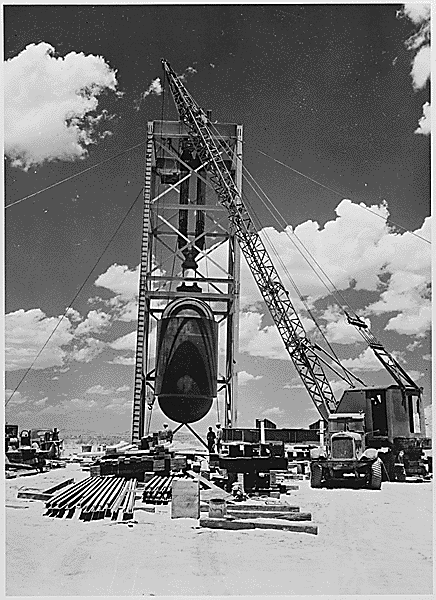
 Atomic Age Begins

"Trinity" atomic device being positioned at White Sands, New Mexico - National Archives

Trinity atomic device “Jumbo” being positioned at White Sands, New Mexico – National Archives

Atomic Age Begins

On July 16, 1945 the United States tested a nuclear device, code named “Trinity”, for the first time in White Sands Proving Ground, New Mexico.

Left: [“Jumbo” atomic device being positioned for “Trinity” test at Alamogordo, New Mexico.], 1945

Right: [“Trinity” explosion], 07/16/1945

Source: research.archives.gov

English: Rare color photograph of the first nu...

Rare color photograph of the first nuclear test at Trinity site, July 16, 1945. Blurriness is in the original photograph (done when color photography was still fairly new). (Photo credit: Wikipedia)

This is based on an earlier post, and is mostly an encore post.

This is based on an earlier post, and is mostly an encore post.


Chester Nez tells his story, life as a Code Talker

June 4, 2014

From the Navajo Codetalkers website:

Published on Sep 25, 2012

This documentary film was researched, photographed, edited and produced by students of Winona State University (Winona, Minnesota) and Diné College (Tsaile, Arizona, Navajo Nation) during summer 2012. It contains stories Chester Nez of Chichiltah, New Mexico, told the students during several hours of interviews about his life. Chester is the last surviving member of The Original 29 Navajo Code Talkers who were recruited in 1942 to create a code using the Navajo language for use in the battlefield so the South Pacific. Chester and the rest of The Original 29 then took the code they created into battle. This documentary film is archived at the Navajo Nation Museum, Navajo Nation Library, Winona State University Library, and Diné College Library, and will be archived at the Smithsonian Institution’s National Museum of the American Indian. The film is part of the Navajo Oral History project, a multi-year collaboration between the Winona State University Mass Communication Department and Diné College– The official Tribal College of the Navajo Nation.


Chester Nez told his story, for all the Code Talkers, often.  I last met him in 2012, when he was in Carrollton, Texas, telling the story and selling his books.

Navajo Code Talker, Marine Chester Nez, signing copies of his book, Carrollton, Texas Oct 14 2012

Navajo Code Talker, Marine Cpl. Chester Nez, signing copies of his book Code Talkers, in  Carrollton, Texas, October 14, 2012


Chester Nez, last surviving Navajo Code Talker from World War II, has died

June 4, 2014

Chester Nez saved America, but couldn’t tell anyone about it for decades.  His work was ignored.

He lived to see some recognition for the work he and his fellow Code Talkers did.

There are many morals to his tale, particularly appropriate now as we wind down two wars.


Navajo Code Talker, Marine Chester Nez, signing copies of his book, Code Talker, in Carrollton, Texas, October 14, 2012; photo by Ed Darrell

Navajo Code Talker, Marine Chester Nez in the yellow shirt, signing copies of his book, Code Talker, in Carrollton, Texas, October 14, 2012; photo by Ed Darrell

Mr. Nez died this morning, Wednesday, June 4, at his home in Albuquerque, New Mexico.  He was 93.

Others are saying:

More:


Happy birthday, Albert Einstein! 135 years, today

March 14, 2014

How many ways can we say happy birthday to a great scientist born on Pi Day?  So, an encore post.

E=mcc - logo from AIP

E=energy; m=mass; c=speed of light

Happy Einstein Day! to us.  Albert’s been dead since 1955 — sadly for us.  Our celebrations now are more for our own satisfaction and curiosity, and to honor the great man — he’s beyond caring.

Almost fitting that he was born on π Day, no? I mean, is there an E=mc² Day?

Albert Einstein was born on March 14, 1879, in Ulm, Germany, to Hermann and Pauline Einstein. 26 years later, three days after his birthday, he sent off the paper on the photo-electric effect; that paper would win him the Nobel Prize in Physics in another five years, in 1921. In that same year of 1905, he published three other papers, solving the mystery of Brownian motion, describing what became known as the Special Theory of Relativity and solving the mystery of why measurements of the light did not show any effects of motion as Maxwell had predicted, and a final paper that noted a particle emitting light energy loses mass. This final paper amused Einstein because it seemed so ludicrous in its logical extension that energy and matter are really the same stuff at some fundamental point, as expressed in the equation demonstrating an enormous amount of energy stored in atoms, E=mc².

Albert Einstein as a younger man - Nobel Foundation image

Albert Einstein as a younger man – Nobel Foundation image

Any one of the papers would have been a career-capper for any physicist. Einstein dashed them off in just a few months, forever changing the fields of physics. And, you noticed: Einstein did not win a Nobel for the Special Theory of Relativity, nor for E=mc². He won it for the photo electric effect. Irony in history.

106 years later Einstein’s work affects us every day. Relativity theory at some level I don’t understand makes possible the use Global Positioning Systems (GPS), which revolutionized navigation and mundane things like land surveying and microwave dish placement. Development of nuclear power both gives us hope for an energy-rich future, and gives us fear of nuclear war. Sometimes, even the hope of the energy rich future gives us fear, as we watch and hope nuclear engineers can control the piles in nuclear power plants damaged by earthquakes and tsunami in Japan.

English: Albert Einstein on a 1966 US stamp

Albert Einstein on a 1966 US stamp (Photo credit: Wikipedia)

If Albert Einstein was a genius at physics, he was more dedicated to pacifism. He resigned his German citizenship to avoid military conscription. His pacifism made the German Nazis nervous; Einstein fled Germany in the 1930s, eventually settling in the United States. In the U.S., he was persuaded by Leo Szilard to write to President Franklin Roosevelt to suggest the U.S. start a program to develop an atomic weapon, because Germany most certainly was doing exactly that. But while urging FDR to keep up with the Germans, Einstein refused to participate in the program himself, sticking to his pacifist views. Others could, and would, design and build atomic bombs. (Maybe it’s a virus among nuclear physicists — several of those working on the Manhattan Project were pacifists, and had great difficulty reconciling the idea that the weapon they worked on to beat Germany, was deployed on Japan, which did not have a nuclear weapons program.)

English: USSR stamp dedicated to Albert Einste...

Everybody wanted to claim, and honor Einstein; USSR issued this stamp dedicated to Albert Einstein Русский: Почтовая марка СССР, посвящённая Альберту Эйнштейну (Photo credit: Wikipedia)

Einstein was a not-great father, and probably not a terribly faithful husband at first — though he did think to give his first wife, in the divorce settlement, a share of a Nobel Prize should he win it. Einstein was a good violinist, a competent sailor, an incompetent dresser, and a great character. His sister suffered a paralyzing stroke. For many months Albert spent hours a day reading to her the newspapers and books of the day, convinced that though mute and appearing unconscious, she would benefit from hearing the words. He said he did not hold to orthodox religions, but could there be a greater show of faith in human spirit?

Einstein in 1950, five years before his death

Einstein in 1950, five years before his death

When people hear clever sayings, but forget to whom the bon mots should be attributed, Einstein is one of about five candidates to whom all sorts of things are attributed, though he never said them. (Others include Lincoln, Jefferson, Mark Twain and Will Rogers). Einstein is the only scientist in that group. So, for example, we can be quite sure Einstein never claimed that compound interest was the best idea of the 20th century. This phenomenon is symbolic of the high regard people have for the man, even though so few understand what his work was, or meant.

A most interesting man. A most important body of work. He deserves more study and regard than he gets.

More, Resources:


1943 War Department film, “Welcome to Britain”

February 8, 2014

Reader and veteran librarian Judy Crook sent a Tweet alerting us to a recent release from the U.S. National Archives, “A Welcome to Britain, 1943.”

It’s a fascinating little film, if 38 minutes is still “little.”

Yes, that’s Burgess Meredith playing the soldier. I haven’t confirmed whether he was actually enlisted, but he often played soldiers or people at war — in 1945, playing war reporter Ernie Pyle, for example. In the 1950s, the House Committee on Unamerican Activities (HUAC) claimed Meredith had consorted too closely with communists, and he was blacklisted for years including a seven-year drought of work.

When this film was made, the Soviet Union was an ally of Britain and the United States.  How times change.

This is a training film made by the War Department (later renamed “Defense Department”), to acquaint U.S. soldiers with what they would confront in Britain.  Why did soldiers need such training?  You can guess, perhaps.   258

Teachers, can you use this film in history class?  Is the discussion on civil rights, about 20 minutes at 25:30 in, instructive in the history of the time?

From the National Archives’s description on YouTube:

Published on Feb 5, 2014

Creator(s): Department of Defense.~. Armed Forces Radio and Television Service. (1954 – ) (Most Recent)

Series : Information and Education Films, compiled 1943 – 1969
Record Group 330: Records of the Office of the Secretary of Defense, 1921 – 2008

Access Restriction(s): Unrestricted
Use Restriction(s): Restricted – Possibly
Note: Some or all of this material may be restricted by copyright or other intellectual property restrictions.

Scope & Content: This film introduced soldiers to Britain and told them what to expect, how to behave and how not to behave in Britain during World War II. It includes footage of military cameramen and black soldiers.

Contact(s): National Archives at College Park – Motion Pictures (RD-DC-M), National Archives at College Park, 8601 Adelphi Road, College Park, MD 20740-6001
Phone: [omitted here]

National Archives Identifier: 7460305
Local Identifier: 330-IEF-7

http://research.archives.gov/descript…

What else hides in the vaults of the Archives?


Everybody comes to Casablanca? First presidential flight, January 14, 1943

January 15, 2014

Humphrey Bogart’s great turn in “Casablanca” got its start from an intended-for Broadway play, “Everybody Comes to Rick’s.

Rick’s Cafe Americain existed only in fiction, an invention of Murray Burnett and his playwright partner Joan Alison.  Casablanca was a rendezvous for people engages in some secret negotiations related to the war, however.

Historian Micheal Beschloss tweeted a photo of President Franklin Roosevelt on the airplane, flying to Casablanca to meet with Britain’s Prime Minister Winston Churchill, on January 14, 1943 — the first time a sitting president had flown in an airplane.  Roosevelt’s cousin Theodore flew in 1910, almost two years after he’d left the presidency.

More details! (Wasn’t that what you said?)

What kind of airplane was it?  Who are those other people? Smithsonian Air & Space Magazine already obliged with some details.  The airplane was a Boeing 314 flying boat, operated by TWA.

Photo from the FDR library, showing President Roosevelt in a happy conversation with the TWA pilot of the Boeing 314, Otis Bryan.

Photo from the FDR library, showing President Roosevelt in a happy conversation with the TWA pilot of the Boeing 314, Otis Bryan.

These photos may have been taken on a second flight Roosevelt took once he got to Africa; here are some more  details from Air & Space:

The Casablanca Conference, held 70 years ago this week [article from 2013], is remembered today for the agreement by Franklin D. Roosevelt and Winston Churchill to demand unconditional surrender from their Axis enemies. But even before the leaders sat down to talk, FDR made history. His trip across the Atlantic, in a Boeing 314 flying boat, was the first time a sitting U.S. president flew on an airplane.

Nobody was more impressed than his pilots. The flights had been planned in secrecy, and when Roosevelt and his entourage showed up at the Pan American airways base in Miami on the morning of January 11, 1943, to board the Dixie Clipper, “[the crew] were very much surprised to learn the identity of our guest,” recalled Pan Am pilot Howard M. Cone, Jr.  Cone, a 34-year-old veteran of transoceanic flights, flew Roosevelt, advisor Harry Hopkins and several military leaders on one Clipper, while another flying boat carried the presidential staff.

Cone said the President was an “excellent passenger” and a “good air sailor” on his 15,000-mile round-trip, displaying an impressive knowledge of geography on a journey that included stops in Trinidad and Brazil. Once in Africa, Roosevelt boarded a TWA C-54 piloted by 35-year-old Captain Otis F. Bryan, who flew him from Bathurst, Gambia to Morocco. The trip back from Casablanca included a flyover of the harbor at Dakar, Senegal, at an altitude of 3,000 feet.

In a War Department press conference following their return to the States, the two airline pilots couldn’t stop effusing about their VIP passenger’s ability to “make you feel perfectly at home. We felt at ease as long as he was,” said Bryan. Roosevelt even joined in the ritual of signing “short snorters” for the crew — dollar bills autographed by all the passengers on a flight.

The President also celebrated his 61st birthday on the way back, dining on caviar, olives, celery, pickles, turkey, dressing, green peas, cake, and champagne. (Captain Cone, reported the New York Times, drank coffee instead.)

It will take more sleuthing to identify all the people in the photos.  71 years ago this week.

More:


Four freedoms really at risk in America? FDR’s January 6, 1941 speech should still inspire

January 6, 2014

Franklin Roosevelt delivered a State of the Union address to Congress on January 6, 1941, that would at least bend history, if not change it.  In the last part of the speech he mentioned four freedoms which, he said, are worth going to war to preserve, protect and extend.

Now we call it the Four Freedoms speech, and of course, this is the 72nd anniversary of his delivery.

_____________

I found a photo that reminded me of Norman Rockwell‘s “Freedom from Want,” and wrote about it.

Then I ran into a tweet from Texas educator Bonnie Lesley:

That in turn led to an Alternet post, displayed at Reader Supported News (RSN), by a guy who claims that, compared to 1941 and the progress made on the Four Freedoms, all four of them are in danger, in America, today.

Could that be right?  In was in his State of the Union address in January 1941 that Roosevelt described the four freedoms he said the U.S. should work to secure around the world — this was clearly a philosophical foundation-laying for going to war on the side of Britain, and against Germany, in the World War that was already raging, but which the U.S. had managed to stay out of for five years in Asia and two years in Europe.

Near the end of the speech on January 6, 1941, Roosevelt explained why freedom needed to be fought for, what was important to us, as Americans in the freedom of others in other nations.

Here is an excerpt of the speech, the final few paragraphs:

I have called for personal sacrifice, and I am assured of the willingness of almost all Americans to respond to that call. A part of the sacrifice means the payment of more money in taxes. In my budget message I will recommend that a greater portion of this great defense program be paid for from taxation than we are paying for today. No person should try, or be allowed to get rich out of the program, and the principle of tax payments in accordance with ability to pay should be constantly before our eyes to guide our legislation.

If the Congress maintains these principles the voters, putting patriotism ahead of pocketbooks, will give you their applause.

In the future days, which we seek to make secure, we look forward to a world founded upon four essential human freedoms.

Norman Rockwell's

Norman Rockwell’s “Freedom from Fear,” 1943 painting based on FDR’s 1941 State of the Union address, “The Four Freedoms.” This painting was used on posters urging Americans to buy War Bonds.

The first is freedom of speech and expression — everywhere in the world.

The second is freedom of every person to worship God in his own way everywhere in the world.

The third is freedom from want, which, translated into world terms, means economic under- standings which will secure to every nation a healthy peacetime life for its inhabitants — everywhere in the world.

The fourth is freedom from fear, which, translated into world terms, means a world-wide reduction of armaments to such a point and in such a thorough fashion that no nation will be in a position to commit an act of physical aggression against any neighbor — anywhere in the world.

That is no vision of a distant millennium. It is a definite basis for a kind of world attainable in our own time and generation. That kind of world is the very antithesis of the so-called “new order” of tyranny which the dictators seek to create with the crash of a bomb.
To that new order we oppose the greater conception — the moral order. A good society is able to face schemes of world domination and foreign revolutions alike without fear.

Since the beginning of our American history we have been engaged in change, in a perpetual, peaceful revolution, a revolution which goes on steadily, quietly, adjusting itself to changing conditions without the concentration camp or the quicklime in the ditch. The world order which we seek is the cooperation of free countries, working together in a friendly, civilized society.

This nation has placed its destiny in the hands and heads and hearts of its millions of free men and women, and its faith in freedom under the guidance of God. Freedom means the supremacy of human rights everywhere. Our support goes to those who struggle to gain those rights and keep them. Our strength is our unity of purpose.

To that high concept there can be no end save victory.

War Bonds poster showing all of Rockwell's

Posters showing all four of Rockwell’s paintings also were printed for the War Bonds Drive. Image from the digital collection of the libraries at the University of North Texas

This speech inspired Norman Rockwell to create a series of paintings in tribute to the four freedoms, which paintings were used as posters for War Bond drives.

Paul Bucheit argues we’re losing those four freedoms, which we as a nation fought to secure, in the Pacific, in the Atlantic, in Africa, Europe and Asia:

The 2013 version shows how our freedoms have been diminished, or corrupted into totally different forms.

  • Freedom from want? Poverty keeps getting worse. . .
  • Freedom from fear? The new Jim Crow. . .
  • Freedom of worship? Distorted by visions of the Rapture. . .
  • Freedom of speech? No, surveillance and harassment. . .

Mr. Bucheit offers longer explanations.  I don’t think I agree completely, but I’m interested in your opinion:  Are we losing the Four Freedoms we fought for?

Tip of the old scrub brush to Bonnie Lesley, @EdFocus on Twitter.

More:

Herblock cartoon, August 13, 1951, whatever happened to freedom from fear?

“Say, whatever happened to ‘Freedom from Fear?'” Herblock cartoon in the Washington Post, August 13, 1951, on McCarthyism and the hunt for communists in government jobs. CJR290 image; click image for more information.

This is mostly an encore post.


October 31, also the anniversary of the sinking of the Reuben James

October 31, 2013

U.S.S. Reuben James (D-245) on the Hudson River in April 1939, over two years before she was sunk in the Battle of the Atlantic.

U.S.S. Reuben James (DD-245) on the Hudson River in April 1939, over two years before she was sunk in the Battle of the Atlantic. Photo from the Ted Stone Collection, Marines Museum, Newport News, Virginia, via Wikipedia

It was a tragedy in 1941, but before the U.S. could develop a serious policy response to Germany’s action, Japan attacked Pearl Harbor.  Within a week after that, our policy towards Germany was set by Germany’s declaration of war on the U.S.

It’s important history for a couple of reasons.

  • The sinking was part of the massive, years-long Battle of the Atlantic, which the Allies won only by building ships faster than Germany could sink them.  Had the Allies lost this battle, the war would have been lost, too.
  • While the USS Reuben James was a Navy destroyer, the key weapons of the Battle of the Atlantic were Merchant Marine cargo ships, carrying goods and arms to Britain and other Allied nations.  “Civilians” played a huge role in World War II, supplying the soldiers, armies, navies and air forces.
  • Recently, politicians took to making claims that the U.S. declared war on Germany without any hostile action having passed between them, without Germany having perpetrated any hostilities toward the U.S.  Look at the dates, it’s not so.
  • Woody Guthrie wrote a song about the event, giving us a touchstone to remember.

Millard Fillmore’s Bathtub covered the event with longer, detailed articles in past years, including these, which you should see especially if you are a student in a history class or a teacher of one:

Europe has changed. The world has changed.  The U.S. has changed.  War has changed.  We should remember, especially those people who died defending the merchants who defended the idea of the Four Freedoms.

More: