“It Takes Balls To Execute An Innocent Man”

August 4, 2011

Occasionally I stumble into a discussion of whether anywhere in the U.S. a government may have executed an innocent person.  Generally I note the horrible Texas case in which Texas fought for years for the point that a convicted murderer whose three allowed appeals had been exhausted should not be allowed to reopen his case simply because new evidence of his innocence had emerged.  In Herrera v. Collins (506 US 390, 1993), Texas won the right to not allow evidence of innocence to get a review of the case, and the man was executed.

Ladies and gentlemen I ask you:  Why would a state fight for the right to execute an innocent man, to the Supreme Court, if it did not intend to use that right?

The question rises more frequently these days as Texas Gov. Rick Perry steams toward announcing he will run for the presidency.

I point out that Herrera came down nearly eight years before Perry stumbled into the governor’s chair, his having been standing outside the door as Lieutenant Governor when George W. Bush persuaded the Supreme Court — most of the same justices — to stop both the popular vote and change the electoral vote to give him the presidency.  So we can’t blame that one on Perry.

But we can blame the execution of Todd Willingham on Rick Perry, even understanding that he was relying on what he assumed to be good evidence in his naturally uncurious waltz of destruction across Texas.   Perry could claim he got bad advice.  Though Texas’s governer really has little more than ceremonial power and some appointments, for someone like Perry it is a big job he can barely handle.  People would cut him slack on letting an innocent man die, convicted of a capital crime that as the evidence showed at the time probably did not occur, if he’d just confess it.

Instead, Perry engaged in a four-year campaign to cover up the affair — a cover up that is so far successful.

Jonathan Chait blogging at New Republic cites Politico and The New Yorker on the way to painting all Texans as morally bankrupt for allowing the coverup to go on — justifiably, I think.  While the newspapers cover the story, outrage does not rise from the drought-stricken populace.  New Republic’s blog explained the cover-up, and Texas’s blase attitude:

Alexander Burns and Maggie Haberman have a story for Politico about Rick Perry’s limitations as a general election candidate. It’s a really excellent piece on its own terms, but at the same time, it’s a bit of a parody of a Politico story in that it takes a vital moral question, drains it of all its moral significance, and presents it in purely electoral terms. The thesis of the piece is that Perry appeals to very conservative white southerners, but not to anybody else, making him a questionable choice to head the Republican ticket. The piece bears out that thesis pretty well. In the middle it includes a glancing reference to one episode of Perry’s gubernatorial tenure:

Perry would also have to answer for parts of his record that have either never been fully scrutinized in Texas, or that might be far more problematic before a national audience.

Veterans of Sen. Kay Bailey Hutchison’s unsuccessful 2010 primary challenge to Perry recalled being stunned at the way attacks bounced off the governor in a strongly conservative state gripped by tea party fever. Multiple former Hutchison advisers recalled asking a focus group about the charge that Perry may have presided over the execution of an innocent man – Cameron Todd Willingham – and got this response from a primary voter: “It takes balls to execute an innocent man.”

The Willingham case is just one episode in Perry’s gubernatorial tenure that could be revived against him in the very different context of a national race, potentially compromising him in a general election.

If you’re not familiar with this episode, David Grann wrote about in for the New Yorker in 2009 in what may be the single greatest piece of journalism I have ever read in my life. (I am biased, as David is a friend and former colleague.) The upshot is that Perry is essentially an accessory to murder. He executed an innocent man, displaying zero interest in the man’s innocence. When a commission subsequently investigated the episode, Perry fired its members.

I’m a Texan, and I’m appalled.  Dear Reader, what can a Texan do?  Please advise.

Surely the rest of America would be concerned and shocked, no?  We can excuse goofs in the histories of our presidential candidates.  Especially since Nixon, we should be doubly wary of those who work hard to cover up their errors, rather than learn from them.

By the way, in the latest action, the office of the Texas Attorney General issued a report on the duties of the commission established to investigate Texas justice to make it more fair — the commission whose members Perry fired when they got close to the Willingham case.  The report says that that Willingham case is water under the bridge, that the commission may not investigatet cases that predate the commission’s creation.

It’s a gross miscarriage of justice, and an attack on the democratic form of government which relies very much on continuous improvement of governmental processes, especially the due processes of criminal justice.


Whenever she opens her mouth

June 27, 2011

After the Republican presidential candidates’ debate, observers of the pageant opined that Michelle Bachmann had little command of history (as usual, in her case), but a great command of turning phrases that telegraph to particular interest groups that she is one of them.  For example, somewhere in the debate Bachmann sneaked in a claim that “we are the head and not the tail.”  This was said to be a cryptic shout out to fundamentalist Christians, a reference to Deuteronomy 28.13.

So, if Bachmann is so thoughtful, so careful to send coded messages to her supporters, one may wonder:  What group is she giving a shout out to, here, in her appearance in Waterloo, Iowa:

Nominally, one might think she’s sending a note to all of us in the John Wayne fan club.  But some of us in the fan club remember that Marion Mitchell Morrison  (John Wayne’s non-screen name) was born — in Iowa, true — but in Winterset, in the southern part of the state.

Waterloo was the home of another man who was born with the name “John Wayne.”  But that was John Wayne Gacy, the serial murderer who moved to Waterloo, Iowa in the middle 1960s.

Oy.  Wrong John Wayne to affiliate with Waterloo, or even to remind Waterloo residents about.  History that is, regretfully, bogus.  Or voodoo history, depending on whether one thinks Bachmann is conscious, not on drugs, and meant what she said.

Bachmann told CBS News that she’s running because “People are tired of being told things that aren’t so.”  Practice what you preach, Ms. Bachmann?

Sunday I watched Bachmann vs. CBS’s veteran report Bob Schieffer.  Schieffer asked her about her tendency to tell extremely tall tales — like her claim that the Obama administration had failed to approve any oil leases, when the total approved at that point was 270 leases.  Bachmann went off on a tangent.  Schieffer asked the question a second time.  She went on another tangent.  Schieffer asked a third time, a third tangent.

History challenged, veracity challenged: Every time Michelle Bachmann opens her mouth, it’s an adventure.


Abrupt end

June 22, 2011

News reports say Sarah Palin quit her bus tour of America less than halfway through.

Sarah Palin's custom-painted bus, parked

Sarah Palin's custom-painted bus, parked -- is this abandoned parking lot the last stop?

That’s rather unusual, don’t you think?  Our Band of Merry History Teachers stuck to our bus tour last week until the bus wore out.  I’d expect Palin to keep it up so long as the air conditioning held out.

No, I’m not running.  I may be better prepared than some of the candidates, but I have a job to do, and I can’t speak Mandarin.

Ed Darrell practices with a teleprompter, to avoid writing on his hand.

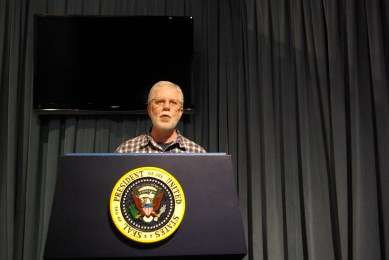
Ed Darrell wrestling with the Presidential Seal and a balky teleprompter.


What did we learn from the first Republican debate?

June 18, 2011

I was traveling, learning about past presidents, and I missed did not see or hear the “debate” last week among Republican hopefuls for the presidency.

Old friend and commentator Pat Carrithers asked on Facebook:

What did we learn from the Republican debate last night?

We learned they all hate Obama.
We learned they have no new thoughts or ideas for economic recovery.
We learned that they still think “No” is a policy and a program.

So, I repeat, What did we learn from the Republican debate last night.

I look at the Republican field, and I worry.  I may have explained before that my experience is that we should hope for, and work to obtain, the best possible candidate from each party, because circumstances well may conspire to elect the lesser of those two candidates.  I cannot in good conscience hope for a clown like Bachmann or Palin to win the Republican nomination.

Pat Bagley's cartoon on the 2012 Presidential Debates - Salt Lake Tribune

The Salt Lake Tribunes great, sharp-penned Pat Bagley's view of the June 2011 Republican Presidential Debates. (When is Bagley going to win a Pulitzer?)

It seems odd to me that the two candidates who rate highest on my Qualified to Lead (QTL) criteria are both Mormons, both of whom have employed people I worked with.   (This contrasts sharply with Texas’s Rick Perry who is not in the campaign officially yet, but who, to my mind, has abandoned most standards of propriety in his false claims about his shepherding of Texas — remember he claimed we had a budget surplus a year ago, but this year announced deficits of nearly $30 billion, which led him to propose cutting essential functions of government; Perry would be at least a third clown in the Republican race, to me.)

Mick Jagger got it right:

Let’s think of the wavering millions
Who need leaders but get gamblers instead
.


How to tell the Republican Party is not serious about fixing America’s problems

June 9, 2011

If Republicans were serious about looking for a candidate for president who could fix some of America’s tougher problems, they’d have an official delegation go see Robert Gates.

Actually, there is a tour underway that highlights the great things about America, but it isn’t Palin’s. It’s the farewell tour of Robert Gates, defense secretary to presidents George W. Bush and Obama, whose work over the past 41 /2 years has dramatically improved the state of the U.S. military. While Palin played cat-and-mouse with the press corps on Interstate 95, Gates set off on a tour of Asia and Europe, where he is receiving the gratitude of soldiers and the acclaim of allies.

Gates, who remained on the job at Obama’s request, took on sacred weapons programs at the Pentagon, fired ineffective generals, won the surge in Iraq, revived a crumbling war effort in Afghanistan and got Osama bin Laden.

During that same time, Palin quit midway through her term as Alaska governor, then went on to a life of $100,000 speaking fees, reality TV shows and incendiary political speech.

There is no such delegation from the Republican Party on the way to Gates’s house, and there probably will not be.   We are afflicted with Palin from the Republicans, even while Robert Gates affects us.  Why can’t they figure that out?


It’s on: Obama opened the campaign for 2012

April 4, 2011

I get e-mail — with a few million others, I’m sure:

2012

Ed —

Today, we are filing papers to launch our 2012 campaign.

We’re doing this now because the politics we believe in does not start with expensive TV ads or extravaganzas, but with you — with people organizing block-by-block, talking to neighbors, co-workers, and friends. And that kind of campaign takes time to build.

So even though I’m focused on the job you elected me to do, and the race may not reach full speed for a year or more, the work of laying the foundation for our campaign must start today.

We’ve always known that lasting change wouldn’t come quickly or easily. It never does. But as my administration and folks across the country fight to protect the progress we’ve made — and make more — we also need to begin mobilizing for 2012, long before the time comes for me to begin campaigning in earnest.

As we take this step, I’d like to share a video that features some folks like you who are helping to lead the way on this journey. Please take a moment to watch:

In the coming days, supporters like you will begin forging a new organization that we’ll build together in cities and towns across the country. And I’ll need you to help shape our plan as we create a campaign that’s farther reaching, more focused, and more innovative than anything we’ve built before.

We’ll start by doing something unprecedented: coordinating millions of one-on-one conversations between supporters across every single state, reconnecting old friends, inspiring new ones to join the cause, and readying ourselves for next year’s fight.

This will be my final campaign, at least as a candidate. But the cause of making a lasting difference for our families, our communities, and our country has never been about one person. And it will succeed only if we work together.

There will be much more to come as the race unfolds. Today, simply let us know you’re in to help us begin, and then spread the word:

http://my.barackobama.com/2012

Thank you,

Barack