Pixar’s 22 rules for a good story (how do they fit your organization?)

July 30, 2012

Pixar logo, with flourishes

From The Pixar Touch, a set of rules for writing a good story to translate to the screen.

Good rules to keep in mind for composition of stories in English, no?  Good rules of writing to keep in mind for any essay writing.

Where else do these rules apply?

Pixar story rules (one version)

Sunday, May 15, 2011 at 03:39PM

Pixar story artist Emma Coats has tweeted a series of “story basics” over the past month and a half — guidelines that she learned from her more senior colleagues on how to create appealing stories:

#1: You admire a character for trying more than for their successes.

#2: You gotta keep in mind what’s interesting to you as an audience, not what’s fun to do as a writer. They can be v. different.

#3: Trying for theme is important, but you won’t see what the story is actually about til you’re at the end of it. Now rewrite.

#4: Once upon a time there was ___. Every day, ___. One day ___. Because of that, ___. Because of that, ___. Until finally ___.

#5: Simplify. Focus. Combine characters. Hop over detours. You’ll feel like you’re losing valuable stuff but it sets you free.

#6: What is your character good at, comfortable with? Throw the polar opposite at them. Challenge them. How do they deal?

#7: Come up with your ending before you figure out your middle. Seriously. Endings are hard, get yours working up front.

#8: Finish your story, let go even if it’s not perfect. In an ideal world you have both, but move on. Do better next time.

#9: When you’re stuck, make a list of what WOULDN’T happen next. Lots of times the material to get you unstuck will show up.

#10: Pull apart the stories you like. What you like in them is a part of you; you’ve got to recognize it before you can use it.

#11: Putting it on paper lets you start fixing it. If it stays in your head, a perfect idea, you’ll never share it with anyone.

#12: Discount the 1st thing that comes to mind. And the 2nd, 3rd, 4th, 5th – get the obvious out of the way. Surprise yourself.

#13: Give your characters opinions. Passive/malleable might seem likable to you as you write, but it’s poison to the audience.

#14: Why must you tell THIS story? What’s the belief burning within you that your story feeds off of? That’s the heart of it.

#15: If you were your character, in this situation, how would you feel? Honesty lends credibility to unbelievable situations.

#16: What are the stakes? Give us reason to root for the character. What happens if they don’t succeed? Stack the odds against.

#17: No work is ever wasted. If it’s not working, let go and move on – it’ll come back around to be useful later.

#18: You have to know yourself: the difference between doing your best & fussing. Story is testing, not refining.

#19: Coincidences to get characters into trouble are great; coincidences to get them out of it are cheating.

#20: Exercise: take the building blocks of a movie you dislike. How d’you rearrange them into what you DO like?

#21: You gotta identify with your situation/characters, can’t just write ‘cool’. What would make YOU act that way?

#22: What’s the essence of your story? Most economical telling of it? If you know that, you can build out from there.

Presumably she’ll have more to come. Also, watch for her personal side project, a science-fiction short called Horizon, to come to a festival near you.

Tip of the old scrub brush to Farnam Street, who adds:

Still curious?Watch as Kurt Vonnegut explains the different shapes that stories can take.

Where else can you use this?

Consider the project you’ve got to lead, with one person from each department in your company.  What is your vision (the hackneyed but apt word) for how the project ends up?  Storyboard it — and keep in mind these 22 rules.  What’s the essence of your view of the project?  Can you tell it in a minute?  Get the story down to 30 seconds.  What are the stakes, if you get this project done well?  What are the stakes if you fail?   Everybody on the team knows the stakes?  Is your plan on paper?  Have you revised it?

More:


Sourced quote of the moment: Tax, or mandate? Lincoln said . . .

June 28, 2012

In light of this morning’s Supreme Court ruling on the Affordable Health Care Act, and questions about whether the law is a “mandate” or a “tax,” we might look to history to see whether the question matters, and what it is.

Lincoln probably had it right, as we noted here many months ago.  So, an encore post:

It’s a delightful story I’ve heard dozens of times, and retold a few times myself: Abraham Lincoln faced with some thorny issue that could be settled by a twist of language, or a slight abuse of power, asks his questioner how many legs would a dog have, if we called the dog’s tail, a leg. “Five,” the questioner responds confident in his mathematical ability to do simple addition.

Sunrise at the Lincoln Memorial; photo by Matthew Cavanaugh, EPA

“No,” Lincoln says. “Calling a dog’s tail a leg, doesn’t make it a leg.”

But there is always the doubt: Is the story accurate? Is this just another of the dozens of quotes that are misattributed to Lincoln in order to lend credence to them?

I have a source for the quote: Reminiscences of Abraham Lincoln by distinguished men of his time / collected and edited by Allen Thorndike Rice (1853-1889). New York: Harper & Brothers Publishers, 1909. This story is found on page 242. Remarkably, the book is still available in an edition from the University of Michigan Press. More convenient for us, the University of Michigan has the entire text on-line, in the Collected Works of Abraham Lincoln, an on-line source whose whole text is searchable.

However, Lincoln does not tell the story about a dog — he uses a calf.

Rice’s book is a collection of reminiscences of others, exactly as the title suggests. Among those doing the reminiscing are ex-president and Gen. U. S. Grant, Massachusetts Gov. Benjamin Butler (also a former Member of Congress), Charles A. Dana the editor and former Assistant Secretary of War, and several others. In describing Lincoln and the Emancipation Proclamation, George W. Julian relates the story. Julian was a Free-Soil Party leader and a Member of Congress during Lincoln’s administration. Julian’s story begins on page 241:

Few subjects have been more debated and less understood than the Proclamation of Emancipation. Mr. Lincoln was himself opposed to the measure, and when he very reluctantly issued the preliminary proclamation in September, 1862, he wished it distinctly understood that the deportation of the slaves was, in his mind, inseparably connected with the policy. Like Mr. Clay and other prominent leaders of the old Whig party, he believed in colonization, and that the separation of the two races was necessary to the welfare of both. He was at that time pressing upon the attention of Congress a scheme of colonization in Chiriqui, in Central America, which Senator Pomeroy espoused with great zeal, and in which he had the favor of a majority of the Cabinet, including Secretary Smith, who warmly indorsed the project. Subsequent developments, however, proved that it was simply an organization for land-stealing and plunder, and it was abandoned; but it is by no means certain that if the President had foreseen this fact his preliminary notice to the rebels would have been given. There are strong reasons for saying that he doubted his right to emancipate under the war power, and he doubtless meant what he said when he compared an Executive order to that effect to “the Pope’s Bull against the comet.” In discussing the question, he used to liken the case to that of the boy who, when asked how many legs his calf would have if he called its tail a leg, replied, ” Five,” to which the prompt response was made that calling the tail a leg would not make it a leg.

I believe it is fair to call the story “confirmed.” It’s not an exact quote, but it’s an accurate story.

_____________

So, is it a tax, or a mandate?  If it’s the right thing to do, does it matter what we call it?  A rose by any other name . . .

Update:  There remains the very strong danger that critics of the Affordable Healthcare Act can’t tell the difference between a calf’s tail and a calf’s leg, or ear, or any other part of the anatomy.


Robert Johnson’s centennial, May 8: Memorial to the blues

May 8, 2011

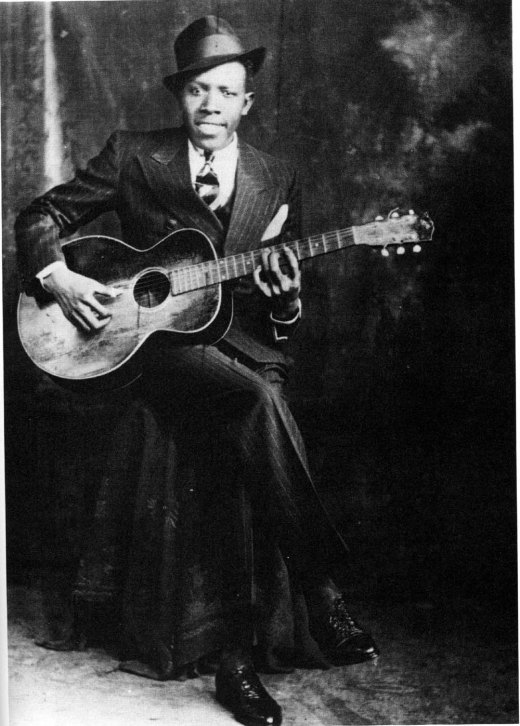
May 8, 2011, is the 100th anniversary of the birth of bluesman Robert Johnson.

Robert Johnson, hat and guitar
Robert Johnson — one of two known photographs of the Delta blues legend

In a fitting tribute to Johnson and an important coming-of-age coming-to-senses moment, First Presbyterian Church in downtown Dallas announced plans to save the old Brunswick Records Building at 508 Park Avenue, a site where Johnson recorded songs in 1937 that changed the blues, changed recording, and left us a legacy of Johnson to study from his short life.

(On at least one day of those 1937 recordings, Johnson could have brushed shoulders with the Light Crust Doughboys, the Texas Swing legends, who were recording in the same building.  The Doughboys set their own pace and gave birth to Bob Wills and the Texas Playboys.  Two of Texas’s greatest music legends, in the same building on the same day, both just stepping on the platform of the train to immortality.)

Saving 508 Park Avenue vexed Dallas for a couple of decades.  First, blues is not the music of Dallas cognescenti, though the world class musicians in town including Dallas Symphony Orchestra’s Jaap van Zweden tend to support the eclectic music scence and honoring musicians of all genres (and Texas is loaded with different music genres).  Second, while Park Avenue may have been a bustling business district adjunct once, Dallas’s city center suffered 50 years of decline after school desegregation.  Parts of downtown and Uptown begin to look prosperous again, but the southern peninsula of the city, away from the now-packed-with-performance venues Arts District, a freeway and ten blocks away from Uptown, with its back up against another freeway, part of Interstate 30 and the famous Dallas Mixmaster.

508 Park Avenue, Dallas, Robert Johnson's early recording site, photo by Justin Terveen for the Dallas Observer in 2011
508 Park Avenue, Dallas, Robert Johnson’s early recording site, photo by Justin Terveen for the Dallas Observer, 2011

Plus, the building is directly across the street from the Stewpot, a kitchen operated by First Presbyterian Church to serve Dallas large and unfortunately thriving homeless population.

Who wants to renovate an abandoned building that has homeless people as scenery for the better part of the day?

Big news this week:  508 Park Avenue was sold to First Presbyterian, who have plans to save the building (and recording studio!), add a performance amphitheatre at one end of the block, and a park at the other.  This is people-friendly development well ahead of its time — there is not a resident population in that part of the city to support such a venue — yet.

Last summer, it was the neighbors, First Presbyterian Church of Dallas, who made an offer to buy 508 Park Avenue and the adjacent building and empty lot. But the deal was contingent on the city allowing the church, which also operates the Stewpot, to tear down an unrelated building next door, at 1900 Young, and replace it with an outdoor amphitheater for church socials and concerts. The Landmark Commission went into last Monday’s meeting with angels on one shoulder and devils on the other: The commission’s task force suggested approval; city staff, denial. The latter would have sent 508 Park Avenue back into purgatory.

But Landmark OK’d the plan, and the church says it will restore 508 Park Avenue to its former glory, inside and out—including the construction of a real recording studio where Johnson once sat and played “Hell Hound on My Trail.”

The church promises: It has musicians lined up to participate, but it can’t yet reveal who. The church promises: 508 Park Avenue will be resurrected.

One hell of a birthday gift for a man who supposedly sold his soul to the Devil.

The second authenticated photo of blues legend Robert Johnson

So, on Robert Johnson’s 100th birthday (assuming he wasn’t really born in 1912 . . . another mystery for another time, perhaps), the news is that the legendary bluesman who burned out like a shooting star helped save one of the few examples of art deco building decoration in Dallas, when a group of Christians who help the homeless, decided to step in an update their downtown Dallas campus.

Every step of the way, it’s an unlikely story.  Truth is, in this case, much, much stranger than fiction.

Ovation Music released to YouTube the video of Eric Clapton playing and singing “Me and the Devil,” at 508 Park Avenue, in the same room where Robert Johnson sang for a record early on.  Johnson recorded the song at that same location on Sunday, June 20, 1937.

508 Park Avenue, Dallas, is already a memorial to Robert Johnson, to the blues, and to the city where these early blues hits were made.  The struggle remains to make the memorial accessible, and not threatened with destruction.

More, resources: 


Abraham Lincoln, ‘is a dog’s tail a leg?’ and Computational Complexity

February 22, 2011

It’s geek humor for Presidents Day.  I think it’s geek humor.  Computational Complexity analyzed the story attributed to Abraham Lincoln, about the moral of asking how many legs a dog has, if you call a tail “a leg.”

Amazing five-legged dog, Esther Derby.com

Amazing five-legged dog, image by Esther Derby.com

The author acknowledged it, but we now know it was a calf’s tail, not a dog’s tail.


Civility? Doing lunch the rights way, North Carolina, February 1, 1960

February 1, 2011

Today is the 51st anniversary of the Greensboro sit-in. Be sure to read Howell Raines’ criticism of news media coverage of civil rights issues in last year’s New York Times: “What I am suggesting is that the one thing the South should have learned in the past 50 years is that if we are going to hell in a handbasket, we should at least be together in a basket of common purpose.”

Four young men turned a page of history on February 1, 1960, at a lunch counter in a Woolworth’s store in Greensboro, North Carolina.

Ezell A. Blair, Jr. (now Jibreel Khazan), Franklin E. McCain, Joseph A. McNeil, and David L. Richmond, sat down at the counter to order lunch. Because they were African Americans, they were refused service. Patiently, they stayed in their seats, awaiting justice.

On July 25, nearly six months later, Woolworth’s agreed to desegregate the lunch counter. One more victory for non-violent protest.


Ezell A. Blair, Jr. (now Jibreel Khazan), Franklin E. McCain, Joseph A. McNeil, and David L. Richmond leave the Woolworth store after the first sit-in on February 1, 1960. (Courtesy of Greensboro News and Record)

Ezell A. Blair, Jr. (now Jibreel Khazan), Franklin E. McCain, Joseph A. McNeil, and David L. Richmond leave the Woolworth store after the first sit-in on February 1, 1960. (Courtesy of Greensboro News and Record) (Smithsonian Institution)

News of the “sit-in” demonstration spread. Others joined in the non-violent protests from time to time, 28 students the second day, 300 the third day, and some days up to 1,000. The protests spread geographically, too, to 15 cities in 9 states.

On the second day of the Greensboro sit-in, Joseph A. McNeil and Franklin E. McCain are joined by William Smith and Clarence Henderson at the Woolworth lunch counter in Greensboro, North Carolina. (Courtesy of Greensboro News and Record)

Smithsonian caption: "On the second day of the Greensboro sit-in, Joseph A. McNeil and Franklin E. McCain are joined by William Smith and Clarence Henderson at the Woolworth lunch counter in Greensboro, North Carolina. (Courtesy of Greensboro News and Record)"

Part of the old lunch counter was salvaged, and today is on display at the Smithsonian Institution’s Museum of American History. The museum display was the site of celebratory parties during the week of the inauguration as president of Barack Obama.

Part of the lunchcounter from the Woolworths store in Greensboro, North Carolina, is now displayed at the Smithsonians Museum of American History, in Washington, D.C.

Part of the lunchcounter from the Woolworth's store in Greensboro, North Carolina, is now displayed at the Smithsonian's Museum of American History, in Washington, D.C.

Notes and resources:

Student video, American History Rules, We Were There – First person story related by Georgie N. and Greg H., with pictures:

Associated Press interview with Franklin E. McCain:

This is mostly an encore post.


Almost neglecting the “neglected anniversary” of Millard Fillmore’s Bathtub, H. L. Mencken’s hoax, and the lessons that lie therein

December 29, 2010

Could I get a longer title?  Here is our annual tribute to the hoax that gave its name and much inspiration to this blog.

Otherwise occupied — Kenny’s due to board an airplane in Beijing soon; tires for the cars; papers to correct, curriculum to correct; our wedding anniversary I cannot forget pending —  I nearly forgot: 93 years ago yesterday, on December 28, 1917, this column by H. L. Mencken was published in The New York Evening Mail:

A Neglected Anniversary

Mencken on April 7, 1933 - end of low-alcohol beer - Baltimore Sun Photo

H. L. Mencken at approximately 12:30 a.m., April 7, 1933, at the Rennert Hotel, corner of Saratoga and Liberty Streets, 17 years later, not neglecting a sudsy anniversary – Baltimore Sun photo

On December 20 there flitted past us, absolutely without public notice, one of the most important profane anniversaries in American history, to wit, the seventy-fifth anniversary of the introduction of the bathtub into These States. Not a plumber fired a salute or hung out a flag. Not a governor proclaimed a day of prayer. Not a newspaper called attention to the day.

True enough, it was not entirely forgotten. Eight or nine months ago one of the younger surgeons connected with the Public Health Service in Washington happened upon the facts while looking into the early history of public hygiene, and at his suggestion a committee was formed to celebrate the anniversary with a banquet. But before the plan was perfected Washington went dry (This was war-time Prohibition, preliminary to the main catastrophe. — HLM), and so the banquet had to be abandoned. As it was, the day passed wholly unmarked, even in the capital of the nation.

Bathtubs are so common today that it is almost impossible to imagine a world without them. They are familiar to nearly everyone in all incorporated towns; in most of the large cities it is unlawful to build a dwelling house without putting them in; even on the farm they have begun to come into use. And yet the first American bathtub was installed and dedicated so recently as December 20, 1842, and, for all I know to the contrary, it may still be in existence and in use.

Curiously enough, the scene of its setting up was Cincinnati, then a squalid frontier town, and even today surely no leader in culture. But Cincinnati, in those days as in these, contained many enterprising merchants, and one of them was a man named Adam Thompson, a dealer in cotton and grain. Thompson shipped his grain by steamboat down the Ohio and Mississippi to New Orleans, and from there sent it to England in sailing vessels. This trade frequently took him to England, and in that country, during the ’30s, he acquired the habit of bathing.

The bathtub was then still a novelty in England. It had been introduced in 1828 by Lord John Russell and its use was yet confined to a small class of enthusiasts. Moreover, the English bathtub, then as now, was a puny and inconvenient contrivance — little more, in fact, than a glorified dishpan — and filling and emptying it required the attendance of a servant. Taking a bath, indeed, was a rather heavy ceremony, and Lord John in 1835 was said to be the only man in England who had yet come to doing it every day.

Thompson, who was of inventive fancy — he later devised the machine that is still used for bagging hams and bacon — conceived the notion that the English bathtub would be much improved if it were made large enough to admit the whole body of an adult man, and if its supply of water, instead of being hauled to the scene by a maid, were admitted by pipes from a central reservoir and run off by the same means. Accordingly, early in 1842 he set about building the first modern bathroom in his Cincinnati home — a large house with Doric pillars, standing near what is now the corner of Monastery and Orleans streets.

There was then, of course, no city water supply, at least in that part of the city, but Thompson had a large well in his garden, and he installed a pump to lift its water to the house. This pump, which was operated by six Negroes, much like an old-time fire engine, was connected by a pipe with a cypress tank in the garret of the house, and here the water was stored until needed. From the tank two other pipes ran to the bathroom. One, carrying cold water, was a direct line. The other, designed to provide warm water, ran down the great chimney of the kitchen, and was coiled inside it like a giant spring.

The tub itself was of new design, and became the grandfather of all the bathtubs of today. Thompson had it made by James Cullness, the leading Cincinnati cabinetmaker of those days, and its material was Nicaragua mahogany. It was nearly seven feet long and fully four feet wide. To make it water-tight, the interior was lined with sheet lead, carefully soldered at the joints. The whole contraption weighed about 1,750 pounds, and the floor of the room in which it was placed had to be reinforced to support it. The exterior was elaborately polished.

In this luxurious tub Thompson took two baths on December 20, 1842 — a cold one at 8 a.m. and a warm one some time during the afternoon. The warm water, heated by the kitchen fire, reached a temperature of 105 degrees. On Christmas day, having a party of gentlemen to dinner, he exhibited the new marvel to them and gave an exhibition of its use, and four of them, including a French visitor, Col. Duchanel, risked plunges into it. The next day all Cincinnati — then a town of about 100,000 people — had heard of it, and the local newspapers described it at length and opened their columns to violent discussions of it.

The thing, in fact, became a public matter, and before long there was bitter and double- headed opposition to the new invention, which had been promptly imitated by several other wealthy Cincinnatians. On the one hand it was denounced as an epicurean and obnoxious toy from England, designed to corrupt the democratic simplicity of the Republic, and on the other hand it was attacked by the medical faculty as dangerous to health and a certain inviter of “phthisic, rheumatic fevers, inflammation of the lungs and the whole category of zymotic diseases.” (I quote from the Western Medical Repository of April 23, 1843.)

The noise of the controversy soon reached other cities, and in more than one place medical opposition reached such strength that it was reflected in legislation. Late in 1843, for example, the Philadelphia Common Council considered an ordinance prohibiting bathing between November 1 and March 15, and it failed of passage by but two votes. During the same year the legislature of Virginia laid a tax of $30 a year on all bathtubs that might be set up, and in Hartford, Providence, Charleston and Wilmington (Del.) special and very heavy water rates were levied upon those who had them. Boston, very early in 1845, made bathing unlawful except upon medical advice, but the ordinance was never enforced and in 1862 it was repealed.

This legislation, I suspect, had some class feeling in it, for the Thompson bathtub was plainly too expensive to be owned by any save the wealthy; indeed, the common price for installing one in New York in 1845 was $500. Thus the low caste politicians of the time made capital by fulminating against it, and there is even some suspicion of political bias in many of the early medical denunciations. But the invention of the common pine bathtub, lined with zinc, in 1847, cut off this line of attack, and thereafter the bathtub made steady progress.

The zinc tub was devised by John F. Simpson, a Brooklyn plumber, and his efforts to protect it by a patent occupied the courts until 1855. But the decisions were steadily against him, and after 1848 all the plumbers of New York were equipped for putting in bathtubs. According to a writer in the Christian Register for July 17, 1857, the first one in New York was opened for traffic on September 12, 1847, and by the beginning of 1850 there were already nearly 1,000 in use in the big town.

After this medical opposition began to collapse, and among other eminent physicians Dr. Oliver Wendell Holmes declared for the bathtub, and vigorously opposed the lingering movement against it in Boston. The American Medical Association held its annual meeting in Boston in 1849, and a poll of the members in attendance showed that nearly 55 per cent of them now regarded bathing as harmless, and that more than 20 per cent advocated it as beneficial. At its meeting in 1850 a resolution was formally passed giving the imprimatur of the faculty to the bathtub. The homeopaths followed with a like resolution in 1853.

But it was the example of President Millard Fillmore that, even more than the grudging medical approval, gave the bathtub recognition and respectability in the United States. While he was still Vice-President, in March, 1850, he visited Cincinnati on a stumping tour, and inspected the original Thompson tub. Thompson himself was now dead, but his bathroom was preserved by the gentlemen who had bought his house from the estate. Fillmore was entertained in this house and, according to Chamberlain, his biographer, took a bath in the tub. Experiencing no ill effects, he became an ardent advocate of the new invention, and on succeeding to the Presidency at Taylor’s death, July 9, 1850, he instructed his secretary of war, Gen. Charles M. Conrad, to invite tenders for the construction of a bathtub in the White House.

This action, for a moment, revived the old controversy, and its opponents made much of the fact that there was no bathtub at Mount Vernon, or at Monticello, and that all the Presidents and other magnificoes of the past had got along without any such monarchical luxuries. The elder Bennett, in the New York Herald, charged that Fillmore really aspired to buy and install in the White House a porphyry and alabaster bath that had been used by Louis Philippe at Versailles. But Conrad, disregarding all this clamor, duly called for bids, and the contract was presently awarded to Harper & Gillespie, a firm of Philadelphia engineers, who proposed to furnish a tub of thin cast iron, capable of floating the largest man.

This was installed early in 1851, and remained in service in the White House until the first Cleveland administration, when the present enameled tub was substituted. The example of the President soon broke down all that remained of the old opposition, and by 1860, according to the newspaper advertisements of the time, every hotel in New York had a bathtub, and some had two and even three. In 1862 bathing was introduced into the Army by Gen. McClellan, and in 1870 the first prison bathtub was set up at Moyamensing Prison, in Philadelphia.

So much for the history of the bathtub in America. One is astonished, on looking into it, to find that so little of it has been recorded. The literature, in fact, is almost nil. But perhaps this brief sketch will encourage other inquirers and so lay the foundation for an adequate celebration of the centennial in 1942.

(Text courtesy of Poor Mojo’s Almanac(k))

The entire history was a hoax composed by Mencken.

Even conservative wackoes appreciate the column.

Content with his private joke, Mencken remained silent about the hoax until a follow-up article, “Melancholy Reflections,” appeared in the Chicago Tribune on May 23, 1926, some eight years later. This was Mencken’s confession. It was also an appeal for reason to the American public.

His hoax was a joke gone bad. “A Neglected Anniversary” had been printed and reprinted hundreds of times in the intervening years. Mencken had been receiving letters of corroboration from some readers and requests for more details from others. His history of the bathtub had been cited repeatedly by other writers and was starting to find its way into reference works. As Mencken noted in “Melancholy Reflections,” his “facts” “began to be used by chiropractors and other such quacks as evidence of the stupidity of medical men. They began to be cited by medical men as proof of the progress of public hygiene.” And, because Fillmore’s presidency had been so uneventful, on the date of his birthday calendars often included the only interesting tidbit of information they could find: Fillmore had introduced the bathtub into the White House. (Even the later scholarly disclosure that Andrew Jackson had a bathtub installed there in 1834—years before Mencken claimed it was even invented—did not diminish America’s conviction that Fillmore was responsible.)

(No, dear reader, probably not correct; surely John Adams brought a bathtub with him when he moved into the White House, then called the President’s Mansion. Plumbing, hot water, and finally hot water to a bathtub in the president’s residence, were installed between 1830 and 1853, as best I can determine.)

Mencken wrote an introduction to the piece in a later book, A Mencken Chrestomathy (Alfred A. Knopf, 1949):

The success of this idle hoax, done in time of war, when more serious writing was impossible, vastly astonished me. It was taken gravely by a great many other newspapers, and presently made its way into medical literature and into standard reference books. It had, of course, no truth in it whatsoever, and I more than once confessed publicly that it was only a jocosity . . . Scarcely a month goes by that I do not find the substance of it reprinted, not as foolishness but as fact, and not only in newspapers but in official documents and other works of the highest pretensions.

There’s a moral to the story: Strive for accuracy!

So, Dear Reader, check for accuracy, and question authority.

Fact checks — what else might need to be corrected in this story?

Resources:


Beard that saved the Union

November 25, 2010

Adam Goodheart’s online essay on the beginning of Abraham Lincoln’s beard makes worthy reading.

Library of Congress image, first photo of Lincoln's beard, by Samuel Alschuler in Chicago, 11-25-1860 (via NY Times)

Very first photo of president-elect Abraham Lincoln with a beard, November 25, 1860. Lincoln was photographed in Chicago by Samuel G. Alschuler. Library of Congress photo, via New York Times

Goodheart points to the first photo of Lincoln’s beard, made November 25, 1860, exactly 150 years ago, today.


October 14: Chuck Yeager/BOOM! Day

October 15, 2010

Rats. On October 14 I missed noting the anniversary of Chuck Yeager’s great feat, breaking the sound barrier in level flight.

BOOM! Day.

Greg Laden’s blog reminded me, “Happy Anniversary, the Breaking of the Barrier.” Below, what I wrote in 2007, mostly still accurate.

_____________

Panorama of the Mountains noted the 60th anniversary of the first known faster-than-sound flight by a human — October 14, 1947. Test pilot and all-around good guy Chuck Yeager did it.

Bell X-1, on display at National Air and Space Museum

Bell X-1 displayed at the National Air and Space Museum

This is a great post-World War II, Cold War story of technology that should pique interest in the time and the events for many students. For a 90 minute class, a solid lesson plan could be developed around the science and technology of the flight (yes, even in history — this is key stuff in the development of economics, too). The physics of sound, a brief history of flight and aircraft, the reasons for post-war development of such technologies, the political situation: There are a dozen hooks to get into the topic. Fair use would cover showing a clip from “The Right Stuff” about the flight, and there are some dramatic clips there. (The movie is 3 hours and 13 minutes; great stuff in a format too long for classroom use. Is there any possibility your kids would read the Tom Wolfe book?)

When will someone – the Air Force? NASA? an aircraft company? — put together a DVD with authorized film clips from the newsreels and the movie, and suggested warm ups and quiz questions?

Back in the bad old days one of my elementary school teachers did an entire morning on the speed of sound, aircraft engineering, and the history of faster-than-sound flight. I learned the accurate way to measure the distance to lightning by counting seconds to the thunder (it’s about a mile for every 5 seconds, not a mile for every second, as our school-yard lore had it).

Chuck Yeager at C. R. Smith Museum, 7-25-2010 - photo by Ed Darrell

Brig. Gen. Chuck Yeager at the C. R. Smith Museum at American Airlines HQ, July 25, 2010. Photo by Ed Darrell

This program, to fly at the speed of sound, at what is now Edwards Air Force Base changed the way science of flight is done in the U.S. Yeager led the group of Air Force pilots who proved that military pilots could do the testing of aircraft; the project proved the value of conducting research with experimental aircraft on military time. The methods developed for testing, evaluating, redesigning and retesting are still used today. The drive for safety for the pilots also grew out of these early efforts at supersonic flight.

Yeager’s flight came when technology was cool, not just for the virtual reality role playing games (RPGs), which were still decades in the future, but because it was new, interesting, and it opened a world of possibilities. We all wanted to fly airplanes, especially small, fast airplanes. A sonic boom over southern Idaho produced a couple dozen calls to the local police and fire departments (long before 911 emergency calling systems), and a couple of paragraphs in the local newspaper.Later, when we moved to Utah County at the foot of Mt. Timpanogos, we kids relished the flights of fighter jets at 6,000 or 7,000 feet above MSL on their way to or from Hill AFB in Ogden, only a thousand feet or so above our heads in those mountain valleys.

Whether authorized to fly them or not, the fighter jocks recruited us kids with their ground-hugging forays. And if one jet occasionally passed the speed of sound, the school bus-stop would buzz with it for a couple of days, as we tried to determine whether anybody ever really lost a window to such fun and excitement as a sonic boom. We could hardly wait to be the pilots of those airplanes, giving a start and a thrill to housewives across America who worried their replica Ming vases and picture windows would crash to smithereens.

Supersonic transport excited me then, and still does. As a lover of the environment, perhaps I should have stood firmly against supersonic flights of the British-French Concord over the U.S., but I hoped a compromise could be reached. New York to Los Angeles in two hours seemed like a good idea to me at the time, and it still does. The U.S. legislated ban on supersonic passenger flights probably doomed the idea of supersonic transport. Boeing dropped its plans to build a competitor to the Concord. The Concord itself never got the support it needed to continue production and refinement of the idea. By the time the Concord was retired in October 2004, it was 50-year-old technology.

I wondered at the time what would have happened had research on passenger supersonic flight continued. Shutting off technology is a strange thing. Steam engine technology was poised to make a great leap forward in the early 20th century, some argue. Diesel and gasoline engine sales blocked the leap, especially the creation of the Diesel-electric railroad locomotive engine.

But make no mistake about it: The Concord was fun. My friend Perry W. Buffington — as amiable and useful a traveling companion as is known in the modern world — found a fantastic fare for a Concord flight for us over the Christmas-New Year’s holidays, 1978 and 1979. We flew to London on a Delta L-1011 on Christmas night; we spent a week in London getting cheap tickets to great shows (the Royal Ballet’s Nutcracker, featuring a kid I knew from Spanish Fork, Utah; Pirates of Penzance at D’Oyly Carte; Evita in the first run, as I recall; a great revival of Oliver! Great stuff, cheap tickets). Then, to cap it off, the Concord from London to New York. Mach 2, on January 1.

It snowed record depths in all of southern England. On New Year’s Eve day, we skated the snow-packed streets to Harrod’s for last minute souvenir shopping, and bumped into Lauren Bacall. Then we sat in the bar of the hotel and watched the news reports of how the entire country was shut down by the snow, including the British Railroad. Our flight out seemed to be due a delay, at least. But we got a call from British Airways confirming the flight, later that night. So on January 1 we got a snowcat — not really, just a brave taxi — to the downtown check-in office of BA.

Then the show kicked in. The agent checking us in took our bags, reached into a drawer and pulled out a roll of pound notes. Without breaking his conversation with us, he beckoned over a woman who was helping passengers onto the shuttle bus to Heathrow, handed her the roll of bills and said simply, “Concord for these gentleman.” She sprinted to the curb outside and hailed a taxi. The agent had called the airport and informed us that while nothing else had flown, “The Concord will depart on schedule. Thank you for flying British Air — your taxi is waiting.” The woman at the curb held the door for us — no bus shuttle for Concord passengers!

The taxi rocketed to Heathrow. I don’t know how much BA paid, but the driver was extremely happy to move us at extreme speeds over slippery roads.

Concord waiting lounges provided the best amenities. Separated from even First Class lounges, the free champagne, and any other liquor, was served on the ground as well as in the air. For morning departures, a chef in the lounge created elaborate egg dishes to order, for breakfast.

Flying the Concord was always a celebrity experience. The festive feeling of our New Year’s Day flight zoomed considerably when Lauren Bacall breezed into the waiting room. (The only other time I got into a Concord lounge was at Dulles a few years later; Ray Charles checked in for the flight. He asked for a window seat.) We watched a television news report that all flights at Heathrow were delayed by the snow as we got the announcement the Concord was ready to board, on time. If our flight wasn’t the only flight leaving Heathrow that day, it was definitely the first. “Snow doesn’t bother the Concord,” one agent explained.

Supersonic flight passenger jets present special problems to air traffic control, especially with their speed. Plus, they fly better where the air is thinner. So instead of the normal 30,000 to 45,000 feet altitude of commercial airliners, Concords flew at about 70,000 feet. This becomes clear to a passenger on take off: Concords get off the ground, and then take a radically steeper climb that, from the inside, feels like going straight up. At cruising altitude, at about noon, a passenger looking out the window can look up to see the blue sky disappearing into darkness (a night flight with the Aurora Borealis must have been some great spectacle).

Concord’s cabin was not spacious. It held 100 passengers, a bit smaller than a modern 737. The food service was divine, with plenty of stewards on hand to attend to passengers. Among the best lamb chops I’ve ever had (and mind you, I come from sheep country). Complimentary champagne, wine, and cigars — “not Cuban, I’m sorry,” the steward explained. “U.S. rules.”

Sit back, sip the champagne, or puff a cigar and sip the port, and watch the Machmeter: “0.5 . . . 0.7 . . . 0.9 . . . 1.0 (Mach 1, the speed of sound).” The ride, smooth as it was, got a lot smoother. The entire aircraft was quieter. “1.3 . . . 1.7 . . . 2.0.” Twice the speed of sound is half as scary as Mach 1, once you’re already moving so fast.

Two hours from Heathrow to JFK. We flew faster than the time zones changed, landing a couple of hours earlier than our departure. Time travel!

(The week in London, airfare there, and the Concord back, was under $1,500 in 1978. Inflation affected the prices before the Concord retired.)

Two in my immediate family have flown faster than sound. My brother, Wes, flew F-4s. And champagne and steward service notwithstanding, he had the much better deal. He did it more often, and he had the stick.

Chuck Yeager did it first, in level flight (there is some conjecture that a British pilot had done it earlier, in a dive — but he didn’t recover from the dive).

How best to commemorate breaking the sound barrier? Do it again!

Photo of Astronauts Chuck Yeager and Dave Scott, with their co-pilots, prior to the 60th anniversary sound-barrier breaking flight, 2007 Edwards AFB

Astronauts Chuck Yeager and Dave Scott, with their co-pilots, prior to the 60th anniversary sound-barrier breaking flight, 2007 Edwards AFB

Edwards Air Force Base, September 21, 2007 – General Yeager flew a US Air Force F-16 to commemorate the 60th anniversary of Breaking the Sound Barrier (October 14, 2007), the 60th anniversary of the United States Air Force (September 18, 2007) and 65 years of General Yeager flying in military cockpits. Yeager was part of a flight of four planes; two F-16’s with Gen. Chuck Yeager and Maj. Gen. Joe Engle aboard, and two T-38’s carrying F-15 pilot Fitz Fulton, NASA Astronaut Col. Dave Scott, and Commander Curt Bedke. Yeager and Engle’s F-16’s broke the sound barrier high above the Base Operations Center – a double sonic boom, then the four planes executed a slow straight through pass, pitched out, landed, and taxied up to the hanger where the 2007 Air Force Ball was about to begin, attended by more than 1,000. Hundreds of ball guests, in gowns, tuxedoes, and dress blues, were assembled to greet the flyers, who snapped on black bowties and strolled into the ball wearing their flight suits. Gen. Yeager was honored at the dinner with a 60th Anniversary Sound Barrier Busting cake.

Additional resources:


Eleanor Roosevelt: Didn’t like the description, “No good in a bed”

October 3, 2010

Eleanor Roosevelt, image from MedScape; at Pearl Harbor, 1943

Eleanor Roosevelt at Pearl Harbor in 1943 - image from MedScape

Is this story true? I’ve not been able to verify the quote — it’s a great story, and better if true. From MedScape Today, “The Case of the Well-known Woman with Unexplained Anemia”:

Although reserved, Roosevelt had a quiet sense of humor. When commenting about how she felt about having a rose named after her, she remarked: “I was very flattered . . . but not pleased with the description in the catalogue: no good in a bed, but fine up against a wall.”

Can anyone tell us when and where she said that?  Gardeners, can you confirm?  Can anyone find a photo of the rose, “Eleanor Roosevelt?”  (It’s probably a yellow rose, but I haven’t found a description.)

Eleanor Roosevelt teacup, First Ladies Library

Eleanor Roosevelt teacup, First Ladies Library

More:


Music stopped the deadly sniper

October 2, 2010

Fascinating story well told by the man who lived it:  After D-Day, an Allied unit was pinned down by a sniper.  Unable to move, and on an inspired whim, one of the American soldiers, Jack Leroy Tueller,  took out his trumpet, and played “Lili Marlene.”

Jack Tuler holding his trumpet, at 90 (maniacworld)

Jack Tueller holding his trumpet, at 90 (image from maniacworld/ Wearethemusic.com)

In the morning he was introduced to a German soldier, a sniper who had surrendered, unable to keep fighting after some mysterious trumpeter played the song that made him think of his home, his mother, his girlfriend, and love.

Two minutes of amazing history, vividly told and played, suitable for classroom use.

Go view “Taming a Nazi sniper with a trumpet,” at ManiacWorld.


[Is this the lost video from above? I think so.]

Videos say that Jack Tueller is 90 years old.  I’m guessing the video is about a year old — does anyone know any more about Col. Jack Tuler, his story, or where he livesCould this be the late Jack Tuler of Chicago? Hey, anyone:  Where is Jack Tueller today?  Who has his life details?  (Tueller lives today in Bountiful, Utah, with his wife, Marjorie.  He still plays the trumpet.)

Tip of the old scrub brush to Kenny, in China, and to Common American Journal, who had a YouTube copy.  Special tip of the old scrub brush to J. A. Higginbotham, who tracked down the Deseret News stories.

(Our YouTube host misspelled the name of the song, I think.)

_____________

Update, October 3, 2010: Reader J. A. Higginbotham tracked down two stories in the Deseret News, in Salt Lake City, about Col. Tueller.  I’ve corrected the spellings above, and edited otherwise to point to the details.  A new post is probably warranted.  Go to the Deseret News site and read their fine work, especially the long story by Doug Robinson.

Update March 2019: Both video links above seem to have died; here’s a video from StudiesWeekly.com, put up on YouTube in 2015.

Sad to hear, Jack Tueller died in 2016, at age 95.


Towel Day 2010

May 25, 2010

After the train wreck in the Star Chamber of the Texas State Soviet of Education last week, I’m glad to have my towel.

How big a towel would it take to fix the McLeroy Massacre?

Remember the words of Douglas Adams, wherever he is:  “Don’t panic.”

More:

Towel Day display, 2010

Towel Day display, 2010 - from http://wxpython.org/blog/about-42/

So long!  And, thanks for the fish!


Cinco de Mayo, really (encore post)

May 5, 2010

(Mostly an encore post, from 2009)

You thought Cinco de Mayo was Independence Day for Mexico?

No, it’s not.

History.com has a nice explanation, with a nice little video. Yahoo has a video this year, mostly animation with lots of advertising.

Perhaps the U.S. should celebrate the day, too, at least in those states who were not in the old Confederacy. On May 5, 1862, Mexicans under the command of 33 year old Commander General Ignacio Zaragoza Seguín stopped the quick advance of superior French forces trying to invade Mexico to take it over, at the Battle of Puebla. While France did eventually defeat Mexican forces (after getting 30,000 men in reinforcements), the spirit of May 5 inspired Mexicans to continue to fight for freedom. And ultimately, Mexican forces overpowered and captured the French forces and Emperor Maximilian, who was executed.

Thus ended a great hope for the Confederacy, that French-supported Mexican Army would lend aid to the Confederates in their struggle to secede from the Union.

It is one of the great what-ifs of history: What if France had kept Mexico, and what if French-led Mexican forces backed up the Confederate Army?

One thing is rather sure: Had that happened, and had the Confederacy been successful, we wouldn’t be celebrating Cinco de Mayo in Texas today.

Battle of Puebla, Wikimedia (artist?)

Battle of Puebla, Wikimedia (artist?)

Mexican Independence Day is September 16.

_______________________________________

Update: Sam DeBerry sends a note that Seguin was a Texan.  So the Mexican hero of the Battle of Puebla was a Texan.  You couldn’t make this stuff up — real history is always more interesting than fiction.


December 30 – Happy Hubble Day 2009!

December 30, 2009

Ultraviolet image of the Andromeda Galaxy, first known to be a galaxy by Edwin Hubble on December 30, 1924 - Galaxy Evolution Explorer image courtesy NASA

Ultraviolet image of the Andromeda Galaxy, first known to be a galaxy by Edwin Hubble on December 30, 1924 - Galaxy Evolution Explorer image courtesy NASA

Today is a good day to celebrate the universe in all it’s glory – December 30. This year, the International Year of Astronomy, makes it a double celebration.

On December 30, 1924, Edwin Hubble announced he’d discovered other galaxies in distant space.  Though it may not have been so clear at the time, it meant that, as a galaxy, we are not alone in the universe (whether we are alone as intelligent life is a separate question).  It also meant that the universe is much, much bigger than most people had dared to imagine.

Logo for International Year of Astronomy 2009 - Astronomy2009.org

Go to Astronomy2009.org

Below, mostly an encore post.

Last year for Hubble Day, Wired picked up on the story (with a gracious link to 2007’s post here at the Bathtub). Wired includes several links to even more information, a good source of information.  See Wired’s 2009 post here.

Hubble was the guy who showed us the universe is not only bigger than we imagined, it’s probably much bigger and much more fantastic than we can imagine. Hubble is the guy who opened our imaginations to the vastness of all creation.

How does one celebrate Hubble Day? Here are some suggestions:

  • Easier than Christmas cards: Send a thank-you note to your junior high school science teacher, or whoever it was who inspired your interest in science. Mrs. Hedburg, Mrs. Andrews, Elizabeth K. Driggs, Herbert Gilbert, Mr. Willis, and Stephen McNeal, thank you.
  • Rearrange your Christmas/Hanukkah/Eid/KWANZAA lights in the shape of the Andromeda Galaxy — or in the shape of any of the great photos from the Hubble Telescope (Andromeda Galaxy pictured above; Hubble images here)

    A few of the images from the Hubble Telescope

    A few of the images from the Hubble Telescope

  • Go visit your local science museum; take your kids along – borrow somebody else’s kids if you have to (take them along, too)
  • Spend two hours in your local library, just looking through the books on astronomy and the universe
  • Anybody got a good recipe for a cocktail called “The Hubble?” “The Andromeda?” Put it in the comments, please

The encore post, from 2007:

December 30, 1924, Edwin Hubble announced the results of his observations of distant objects in space.

PBS

Edwin Hubble - source: PBS

In 1924, he announced the discovery of a Cepheid, or variable star, in the Andromeda Nebulae. Since the work of Henrietta Leavitt had made it possible to calculate the distance to Cepheids, he calculated that this Cepheid was much further away than anyone had thought and that therefore the nebulae was not a gaseous cloud inside our galaxy, like so many nebulae, but in fact, a galaxy of stars just like the Milky Way. Only much further away. Until now, people believed that the only thing existing outside the Milky Way were the Magellanic Clouds. The Universe was much bigger than had been previously presumed.

Later Hubble noted that the universe demonstrates a “red-shift phenomenon.” The universe is expanding. This led to the idea of an initial expansion event, and the theory eventually known as Big Bang.

Hubble’s life offered several surprises, and firsts:

Hubble was a tall, elegant, athletic, man who at age 30 had an undergraduate degree in astronomy and mathematics, a legal degree as a Rhodes scholar, followed by a PhD in astronomy. He was an attorney in Kentucky (joined its bar in 1913), and had served in WWI, rising to the rank of major. He was bored with law and decided to go back to his studies in astronomy.

In 1919 he began to work at Mt. Wilson Observatory in California, where he would work for the rest of his life. . . .
Hubble wanted to classify the galaxies according to their content, distance, shape, and brightness patterns, and in his observations he made another momentous discovery: By observing redshifts in the light wavelengths emitted by the galaxies, he saw that galaxies were moving away from each other at a rate constant to the distance between them (Hubble’s Law). The further away they were, the faster they receded. This led to the calculation of the point where the expansion began, and confirmation of the big bang theory. Hubble calculated it to be about 2 billion years ago, but more recent estimates have revised that to 20 billion years ago.

An active anti-fascist, Hubble wanted to joined the armed forces again during World War II, but was convinced he could contribute more as a scientist on the homefront. When the 200-inch telescope was completed on Mt. Palomar, Hubble was given the honor of first use. He died in 1953.

“Equipped with his five senses, man explores the universe around him and calls the adventure Science.”

That news on December 30, 1924, didn’t make the first page of the New York Times. The Times carried a small note on February 25, 1925, that Hubble won a $1,000 prize from the American Academy for the Advancement of Science.

(Does anyone have a suitable citation for that video? Where did it come from? Who produced it? Is there more somewhere?)

Happy Hubble Day! Look up!

Resources:

Alert others to look up and toast Hubble:

Add to FacebookAdd to NewsvineAdd to DiggAdd to Del.icio.usAdd to StumbleuponAdd to RedditAdd to BlinklistAdd to TwitterAdd to TechnoratiAdd to Furl


A neglected, “Neglected Anniversary” – Mencken, Fillmore and the bathtub

December 29, 2009

Otherwise occupied, I nearly forgot:  92 years ago yesterday, on December 28, 1917, this column by H. L. Mencken was published in The New York Evening Mail:

A Neglected Anniversary

Mencken on April 7, 1933 - end of low-alcohol beer - Baltimore Sun Photo

H. L. Mencken at approximately 12:30 a.m., April 7, 1933, at the Rennert Hotel, corner of Saratoga and Liberty Streets, 17 years later, not neglecting a sudsy anniversary - Baltimore Sun photo

On December 20 there flitted past us, absolutely without public notice, one of the most important profane anniversaries in American history, to wit, the seventy-fifth anniversary of the introduction of the bathtub into These States. Not a plumber fired a salute or hung out a flag. Not a governor proclaimed a day of prayer. Not a newspaper called attention to the day.

True enough, it was not entirely forgotten. Eight or nine months ago one of the younger surgeons connected with the Public Health Service in Washington happened upon the facts while looking into the early history of public hygiene, and at his suggestion a committee was formed to celebrate the anniversary with a banquet. But before the plan was perfected Washington went dry (This was war-time Prohibition, preliminary to the main catastrophe. — HLM), and so the banquet had to be abandoned. As it was, the day passed wholly unmarked, even in the capital of the nation.

Bathtubs are so common today that it is almost impossible to imagine a world without them. They are familiar to nearly everyone in all incorporated towns; in most of the large cities it is unlawful to build a dwelling house without putting them in; even on the farm they have begun to come into use. And yet the first American bathtub was installed and dedicated so recently as December 20, 1842, and, for all I know to the contrary, it may still be in existence and in use.

Curiously enough, the scene of its setting up was Cincinnati, then a squalid frontier town, and even today surely no leader in culture. But Cincinnati, in those days as in these, contained many enterprising merchants, and one of them was a man named Adam Thompson, a dealer in cotton and grain. Thompson shipped his grain by steamboat down the Ohio and Mississippi to New Orleans, and from there sent it to England in sailing vessels. This trade frequently took him to England, and in that country, during the ’30s, he acquired the habit of bathing.

The bathtub was then still a novelty in England. It had been introduced in 1828 by Lord John Russell and its use was yet confined to a small class of enthusiasts. Moreover, the English bathtub, then as now, was a puny and inconvenient contrivance — little more, in fact, than a glorified dishpan — and filling and emptying it required the attendance of a servant. Taking a bath, indeed, was a rather heavy ceremony, and Lord John in 1835 was said to be the only man in England who had yet come to doing it every day.

Thompson, who was of inventive fancy — he later devised the machine that is still used for bagging hams and bacon — conceived the notion that the English bathtub would be much improved if it were made large enough to admit the whole body of an adult man, and if its supply of water, instead of being hauled to the scene by a maid, were admitted by pipes from a central reservoir and run off by the same means. Accordingly, early in 1842 he set about building the first modern bathroom in his Cincinnati home — a large house with Doric pillars, standing near what is now the corner of Monastery and Orleans streets.

There was then, of course, no city water supply, at least in that part of the city, but Thompson had a large well in his garden, and he installed a pump to lift its water to the house. This pump, which was operated by six Negroes, much like an old-time fire engine, was connected by a pipe with a cypress tank in the garret of the house, and here the water was stored until needed. From the tank two other pipes ran to the bathroom. One, carrying cold water, was a direct line. The other, designed to provide warm water, ran down the great chimney of the kitchen, and was coiled inside it like a giant spring.

The tub itself was of new design, and became the grandfather of all the bathtubs of today. Thompson had it made by James Cullness, the leading Cincinnati cabinetmaker of those days, and its material was Nicaragua mahogany. It was nearly seven feet long and fully four feet wide. To make it water-tight, the interior was lined with sheet lead, carefully soldered at the joints. The whole contraption weighed about 1,750 pounds, and the floor of the room in which it was placed had to be reinforced to support it. The exterior was elaborately polished.

In this luxurious tub Thompson took two baths on December 20, 1842 — a cold one at 8 a.m. and a warm one some time during the afternoon. The warm water, heated by the kitchen fire, reached a temperature of 105 degrees. On Christmas day, having a party of gentlemen to dinner, he exhibited the new marvel to them and gave an exhibition of its use, and four of them, including a French visitor, Col. Duchanel, risked plunges into it. The next day all Cincinnati — then a town of about 100,000 people — had heard of it, and the local newspapers described it at length and opened their columns to violent discussions of it.

The thing, in fact, became a public matter, and before long there was bitter and double- headed opposition to the new invention, which had been promptly imitated by several other wealthy Cincinnatians. On the one hand it was denounced as an epicurean and obnoxious toy from England, designed to corrupt the democratic simplicity of the Republic, and on the other hand it was attacked by the medical faculty as dangerous to health and a certain inviter of “phthisic, rheumatic fevers, inflammation of the lungs and the whole category of zymotic diseases.” (I quote from the Western Medical Repository of April 23, 1843.)

The noise of the controversy soon reached other cities, and in more than one place medical opposition reached such strength that it was reflected in legislation. Late in 1843, for example, the Philadelphia Common Council considered an ordinance prohibiting bathing between November 1 and March 15, and it failed of passage by but two votes. During the same year the legislature of Virginia laid a tax of $30 a year on all bathtubs that might be set up, and in Hartford, Providence, Charleston and Wilmington (Del.) special and very heavy water rates were levied upon those who had them. Boston, very early in 1845, made bathing unlawful except upon medical advice, but the ordinance was never enforced and in 1862 it was repealed.

This legislation, I suspect, had some class feeling in it, for the Thompson bathtub was plainly too expensive to be owned by any save the wealthy; indeed, the common price for installing one in New York in 1845 was $500. Thus the low caste politicians of the time made capital by fulminating against it, and there is even some suspicion of political bias in many of the early medical denunciations. But the invention of the common pine bathtub, lined with zinc, in 1847, cut off this line of attack, and thereafter the bathtub made steady progress.

The zinc tub was devised by John F. Simpson, a Brooklyn plumber, and his efforts to protect it by a patent occupied the courts until 1855. But the decisions were steadily against him, and after 1848 all the plumbers of New York were equipped for putting in bathtubs. According to a writer in the Christian Register for July 17, 1857, the first one in New York was opened for traffic on September 12, 1847, and by the beginning of 1850 there were already nearly 1,000 in use in the big town.

After this medical opposition began to collapse, and among other eminent physicians Dr. Oliver Wendell Holmes declared for the bathtub, and vigorously opposed the lingering movement against it in Boston. The American Medical Association held its annual meeting in Boston in 1849, and a poll of the members in attendance showed that nearly 55 per cent of them now regarded bathing as harmless, and that more than 20 per cent advocated it as beneficial. At its meeting in 1850 a resolution was formally passed giving the imprimatur of the faculty to the bathtub. The homeopaths followed with a like resolution in 1853.

But it was the example of President Millard Fillmore that, even more than the grudging medical approval, gave the bathtub recognition and respectability in the United States. While he was still Vice-President, in March, 1850, he visited Cincinnati on a stumping tour, and inspected the original Thompson tub. Thompson himself was now dead, but his bathroom was preserved by the gentlemen who had bought his house from the estate. Fillmore was entertained in this house and, according to Chamberlain, his biographer, took a bath in the tub. Experiencing no ill effects, he became an ardent advocate of the new invention, and on succeeding to the Presidency at Taylor’s death, July 9, 1850, he instructed his secretary of war, Gen. Charles M. Conrad, to invite tenders for the construction of a bathtub in the White House.

This action, for a moment, revived the old controversy, and its opponents made much of the fact that there was no bathtub at Mount Vernon, or at Monticello, and that all the Presidents and other magnificoes of the past had got along without any such monarchical luxuries. The elder Bennett, in the New York Herald, charged that Fillmore really aspired to buy and install in the White House a porphyry and alabaster bath that had been used by Louis Philippe at Versailles. But Conrad, disregarding all this clamor, duly called for bids, and the contract was presently awarded to Harper & Gillespie, a firm of Philadelphia engineers, who proposed to furnish a tub of thin cast iron, capable of floating the largest man.

This was installed early in 1851, and remained in service in the White House until the first Cleveland administration, when the present enameled tub was substituted. The example of the President soon broke down all that remained of the old opposition, and by 1860, according to the newspaper advertisements of the time, every hotel in New York had a bathtub, and some had two and even three. In 1862 bathing was introduced into the Army by Gen. McClellan, and in 1870 the first prison bathtub was set up at Moyamensing Prison, in Philadelphia.

So much for the history of the bathtub in America. One is astonished, on looking into it, to find that so little of it has been recorded. The literature, in fact, is almost nil. But perhaps this brief sketch will encourage other inquirers and so lay the foundation for an adequate celebration of the centennial in 1942.

(Text courtesy of Poor Mojo’s Almanac(k))

The entire history was a hoax composed by Mencken.

Even conservative wackoes appreciate the column.

Content with his private joke, Mencken remained silent about the hoax until a follow-up article, “Melancholy Reflections,” appeared in the Chicago Tribune on May 23, 1926, some eight years later. This was Mencken’s confession. It was also an appeal for reason to the American public.

His hoax was a joke gone bad. “A Neglected Anniversary” had been printed and reprinted hundreds of times in the intervening years. Mencken had been receiving letters of corroboration from some readers and requests for more details from others. His history of the bathtub had been cited repeatedly by other writers and was starting to find its way into reference works. As Mencken noted in “Melancholy Reflections,” his “facts” “began to be used by chiropractors and other such quacks as evidence of the stupidity of medical men. They began to be cited by medical men as proof of the progress of public hygiene.” And, because Fillmore’s presidency had been so uneventful, on the date of his birthday calendars often included the only interesting tidbit of information they could find: Fillmore had introduced the bathtub into the White House. (Even the later scholarly disclosure that Andrew Jackson had a bathtub installed there in 1834—years before Mencken claimed it was even invented—did not diminish America’s conviction that Fillmore was responsible.)

(No, dear reader, probably not correct; surely John Adams brought a bathtub with him when he moved into the White House, then called the President’s Mansion.  Plumbing, hot water, and finally hot water to a bathtub in the president’s residence, were installed between 1830 and 1853, as best I can determine.)

Mencken wrote an introduction to the piece in a later bookA Mencken Chrestomathy (Alfred A. Knopf, 1949):

The success of this idle hoax, done in time of war, when more serious writing was impossible, vastly astonished me. It was taken gravely by a great many other newspapers, and presently made its way into medical literature and into standard reference books. It had, of course, no truth in it whatsoever, and I more than once confessed publicly that it was only a jocosity . . .  Scarcely a month goes by that I do not find the substance of it reprinted, not as foolishness but as fact, and not only in newspapers but in official documents and other works of the highest pretensions.

There’s a moral to the story:  Strive for accuracy!

So, Dear Reader, check for accuracy, and question authority.

Resources:

Warn others of the hoax!

Add to FacebookAdd to NewsvineAdd to DiggAdd to Del.icio.usAdd to StumbleuponAdd to RedditAdd to BlinklistAdd to TwitterAdd to TechnoratiAdd to Furl


Who invented Santa Claus? Who really wrote the “Night Before Christmas?”

December 7, 2009

An encore post from 2007

Thomas Nast invented Santa Claus? Clement C. Moore didn’t write the famous poem that starts out, “‘Twas the night before Christmas, and all through the house . . . ?”

The murky waters of history from Millard Fillmore’s Bathtub soak even our most cherished ideas and traditions.

But isn’t that part of the fun of history?

Santa Claus delivers to Union soldiers, "Santa Claus in Camp" - Thomas Nast, Harper's Weekly, Jan 3, 1863
Thomas Nast’s first published drawing featuring Santa Claus; for Harper’s Weekly, “A Journal of Civilization,” January 3, 1863 Nast portrayed the elf distributing packages to Union troops: “Santa Claus in camp.” Nast (1840-1904) was 23 when he drew this image.

Yes, Virginia (and California, too)! Thomas Nast created the image of Santa Claus most of us in the U.S. know today. Perhaps even more significant than his campaign against the graft of Boss Tweed, Nast’s popularization of a fat, jolly elf who delivers good things to people for Christmas makes one of the great stories in commercial illustration. Nast’s cartoons, mostly for the popular news publication Harper’s Weekly, created many of the conventions of modern political cartooning and modeled the way in which an illustrator could campaign for good, with his campaign against the graft of Tammany Hall and Tweed. But Nast’s popular vision of Santa Claus can be said to be the foundation for the modern mercantile flurry around Christmas.

Nast is probably ensconced in a cartoonists’ hall of fame. Perhaps he should be in a business or sales hall of fame, too.  [See also Bill Casselman’s page, “The Man Who Designed Santa Claus.]

Nast’s drawings probably drew some inspiration from the poem, “Account of a Visit from St. Nicholas,” traditionally attributed to Clement C. Moore, a New York City lawyer, published in 1822. The poem is among the earliest to describe the elf dressed in fur, and magically coming down a chimney to leave toys for children; the poem invented the reindeer-pulled sleigh.

Modern analysis suggests the poem was not the work of Moore, and many critics and historians now attribute it to Major Henry Livingston, Jr. (1748-1828) following sleuthing by Vassar College Prof. Don Foster in 2000. Fortunately for us, we do not need to be partisans in such a query to enjoy the poem (a complete copy of which is below the fold).

The Library of Congress still gives Moore the credit. When disputes arise over who wrote about the night before Christmas, is it any wonder more controversial topics produce bigger and louder disputes among historians?

Moore was not known for being a poet. The popular story is that he wrote it on the spur of the moment:

Moore is thought to have composed the tale, now popularly known as “The Night Before Christmas,” on December 24, 1822, while traveling home from Greenwich Village, where he had bought a turkey for his family’s Christmas dinner.

Inspired by the plump, bearded Dutchman who took him by sleigh on his errand through the snow-covered streets of New York City, Moore penned A Visit from St. Nicholas for the amusement of his six children, with whom he shared the poem that evening. His vision of St. Nicholas draws upon Dutch-American and Norwegian traditions of a magical, gift-giving figure who appears at Christmas time, as well as the German legend of a visitor who enters homes through chimneys.

Again from the Library of Congress, we get information that suggests that Moore was a minor celebrity from a well-known family with historical ties that would make a good “connections” exercise in a high school history class, perhaps (”the link from Aaron Burr’s treason to Santa Claus?”): (read more, below the fold)

Clement Moore was born in 1779 into a prominent New York family. His father, Benjamin Moore, president of Columbia University, in his role as Episcopal Bishop of New York participated in the inauguration of George Washington as the nation’s first president. The elder Moore also administered last rites to Alexander Hamilton after he was mortally wounded in a tragic duel with Aaron Burr.

A graduate of Columbia, Clement Moore was a scholar of Hebrew and a professor of Oriental and Greek literature at the General Theological Seminary in Manhattan. [See comment from Pam Bumsted below for more on Moore.] He is said to have been embarrassed by the light-hearted verse, which was made public without his knowledge in December 1823. Moore did not publish it under his name until 1844.

Tonight, American children will be tucked in under their blankets and quilts and read this beloved poem as a last “sugarplum” before slipping into dreamland. Before they drift off, treat them to a message from Santa, recorded by the Thomas Edison Company in 1922.

Santa Claus Hides in Your Phonograph
By Arthur A. Penn, Performed by Harry E. Humphrey.
Edison, 1922.
Coupling date: 6/20/1922. Cutout date: 10/31/1929.
Inventing Entertainment: The Motion Pictures and Sound Recordings of the Edison Companies

Listen to this recording (RealAudio Format)

Listen to this recording (wav Format, 8,471 Kb)

But Henry Livingston was no less noble or historic. He hailed from the Livingtons of the Hudson Valley (one of whose farms is now occupied by Camp Rising Sun of the Louis August Jonas Foundation, a place where I spent four amazing summers teaching swimming and lifesaving). Livingston’s biography at the University of Toronto site offers another path for a connections exercise (”What connects the Declaration of Independence, the American invasion of Canada, the famous poem about a visit from St. Nick, and George W. Bush?”):

Henry Livingston Jr. was born in Poughkeepsie, New York, on Oct. 13, 1748. The Livingston family was one of the important colonial and revolutionary families of New York. The Poughkeepsie branch, descended from Gilbert, the youngest son of Robert Livingston, 1st Lord of Livingston Manor, was not as well off as the more well-known branches, descended from sons Robert and Philip. Two other descendants of Gilbert Livingston, President George Walker Herbert Bush and his son, President-Elect George W. Bush, though, have done their share to bring attention to this line. Henry’s brother, Rev. John Henry Livingston, entered Yale at the age of 12, and was able to unite the Dutch and American branches of the Dutch Reformed Church. At the time of his death, Rev. Livingston was president of Rutgers University. Henry’s father and brother Gilbert were involved in New York politics, and Henry’s granduncle was New York’s first Lt. Governor. But the law was the natural home for many of Henry’s family. His brother-in-law, Judge Jonas Platt, was an unsuccessful candidate for governor, as was his daughter Elizabeth’s husband, U.S. Supreme Court Justice Smith Thompson. Henry’s grandson, Sidney Breese, was Chief Justice of the Illinois Supreme Court.

Known for his encyclopedic knowledge and his love of literature, Henry Livingston was a farmer, surveyor and Justice of the Peace, a judicial position dealing with financially limited criminal and civil cases. One of the first New Yorkers to enlist in the Revolutionary Army in 1775, Major Henry Livingston accompanied his cousin’s husband, General Montgomery, in his campaign up the Hudson River to invade Canada, leaving behind his new wife, Sarah Welles, and their week-old baby, on his Poughkeepsie property, Locust Grove. Baby Catherine was the subject of the first poem currently known by Major Livingston. Following this campaign, Livingston was involved in the War as a Commissioner of Sequestration, appropriating lands owned by British loyalists and selling them for the revolutionary cause. It was in the period following Sarah’s early death in 1783, that Major Livingston published most of his poems and prose, anonymously or under the pseudonym of R. Ten years after the death of Sarah, Henry married Jane Patterson, the daughter of a Dutchess County politician and sister of his next-door neighbor. Between both wives, Henry fathered twelve children. He published his good-natured, often occasional verse from 1787 in many journals, including Political Barometer, Poughkeepsie Journal, and New-York Magazine. His most famous poem, “Account of a Visit from St. Nicholas,” was until 2000 thought to have been the work of Clement Clarke Moore (1779-1863), who published it with his collected poems in 1844. Livingston died Feb. 29, 1828.

More on Henry Livingston and his authorship of the Christmas poem here.

Thomas Nast, Merry Old Santa Claus, Harper's Weekly, Jan 1, 1881

Our views of Santa Claus owe a great deal also to the Coca-Cola advertising campaign. Coca-Cola first noted Santa’s use of the drink in a 1922 campaign to suggest Coke was a year-round drink (100 years after the publication of Livingston’s poem). The company’s on-line archives gives details:

In 1930, artist Fred Mizen painted a department store Santa in a crowd drinking a bottle of Coke. The ad featured the world’s largest soda fountain, which was located in the department store of Famous Barr Co. in St. Louis, Mo. Mizen’s painting was used in print ads that Christmas season, appearing in The Saturday Evening Post in December 1930.

1936 Coca-Cola Santa cardboard store display

  • 1936 Coca-Cola Santa cardboard store display

Archie Lee, the D’Arcy Advertising Agency executive working with The Coca-Cola Company, wanted the next campaign to show a wholesome Santa as both realistic and symbolic. In 1931, The Coca-Cola Company commissioned Michigan-born illustrator Haddon Sundblom to develop advertising images using Santa Claus — showing Santa himself, not a man dressed as Santa, as Mizen’s work had portrayed him.
1942 original oil painting - 'They Remembered Me'

  • 1942 original oil painting – ‘They Remembered Me’

For inspiration, Sundblom turned to Clement Clark Moore’s 1822 poem “A Visit From St. Nicholas” (commonly called “‘Twas the Night Before Christmas”). Moore’s description of St. Nick led to an image of Santa that was warm, friendly, pleasantly plump and human. For the next 33 years, Sundblom painted portraits of Santa that helped to create the modern image of Santa — an interpretation that today lives on in the minds of people of all ages, all over the world.

Santa Claus is a controversial figure. Debates still rage among parents about the wisdom of allowing the elf into the family’s home, and under what conditions. Theologians worry that the celebration of Christmas is diluted by the imagery. Other faiths worry that the secular, cultural impact of Santa Claus damages their own faiths (few other faiths have such a popular figure, and even atheists generally give gifts and participate in Christmas rituals such as putting up a decorated tree).

For over 100 years, Santa Claus has been a popular part of commercial, cultural and religious life in America. Has any other icon endured so long, or so well?

________________________
Below:
From the University of Toronto Library’s Representative Poetry Online

Major Henry Livingston, Jr. (1748-1828)

Account of a Visit from St. Nicholas

1 ‘Twas the night before Christmas, when all thro’ the house,
2 Not a creature was stirring, not even a mouse;
3 The stockings were hung by the chimney with care,
4 In hopes that St. Nicholas soon would be there;
5 The children were nestled all snug in their beds,
6 While visions of sugar plums danc’d in their heads,
7 And Mama in her ‘kerchief, and I in my cap,
8 Had just settled our brains for a long winter’s nap –
9 When out on the lawn there arose such a clatter,
10 I sprang from the bed to see what was the matter.
11 Away to the window I flew like a flash,
12 Tore open the shutters, and threw up the sash.
13 The moon on the breast of the new fallen snow,
14 Gave the lustre of mid-day to objects below;
15 When, what to my wondering eyes should appear,
16 But a miniature sleigh, and eight tiny rein-deer,
17 With a little old driver, so lively and quick,
18 I knew in a moment it must be St. Nick.
19 More rapid than eagles his coursers they came,
20 And he whistled, and shouted, and call’d them by name:
21 “Now! Dasher, now! Dancer, now! Prancer, and Vixen,
22 “On! Comet, on! Cupid, on! Dunder and Blixem;
23 “To the top of the porch! to the top of the wall!
24 “Now dash away! dash away! dash away all!”
25 As dry leaves before the wild hurricane fly,
26 When they meet with an obstacle, mount to the sky;
27 So up to the house-top the coursers they flew,
28 With the sleigh full of Toys — and St. Nicholas too:
29 And then in a twinkling, I heard on the roof
30 The prancing and pawing of each little hoof.
31 As I drew in my head, and was turning around,
32 Down the chimney St. Nicholas came with a bound:
33 He was dress’d all in fur, from his head to his foot,
34 And his clothes were all tarnish’d with ashes and soot;
35 A bundle of toys was flung on his back,
36 And he look’d like a peddler just opening his pack:
37 His eyes — how they twinkled! his dimples how merry,
38 His cheeks were like roses, his nose like a cherry;
39 His droll little mouth was drawn up like a bow.
40 And the beard of his chin was as white as the snow;
41 The stump of a pipe he held tight in his teeth,
42 And the smoke it encircled his head like a wreath.
43 He had a broad face, and a little round belly
44 That shook when he laugh’d, like a bowl full of jelly:
45 He was chubby and plump, a right jolly old elf,
46 And I laugh’d when I saw him in spite of myself;
47 A wink of his eye and a twist of his head
48 Soon gave me to know I had nothing to dread.
49 He spoke not a word, but went straight to his work,
50 And fill’d all the stockings; then turn’d with a jerk,
51 And laying his finger aside of his nose
52 And giving a nod, up the chimney he rose.
53 He sprung to his sleigh, to his team gave a whistle,
54 And away they all flew, like the down of a thistle:
55 But I heard him exclaim, ere he drove out of sight –
56 Happy Christmas to all, and to all a good night.

Online text copyright © 2005, Ian Lancashire for the Department of English, University of Toronto. Published by the Web Development Group, Information Technology Services, University of Toronto Libraries. Be sure to visit this site for more information on this poem, on Maj. Livingston, and on poetry in general.