Accuracy: A good bias (DDT again)

August 4, 2007

Jay Ambrose retired from editing newspapers, and now writes commentary for the Scripps News chain of papers. Because of his experience in editing, I was suprised to see his commentary from last week which takes broad, inaccurate swipes at environmental groups (here from the Evansville, Indiana, Courier & Press).

Ambrose is victim of the “DDT and Rachel Carson bad” hoax.

His column addresses bias in reporting, bias against Christians, which he claims he sees in reporting on issues of stem cell research, and bias “in favor” of environmentalists, which has resulted in a foolish reduction in the use of DDT. I don’t comment here on the stem cell controversy, though Ambrose’s cartoonish presentation of how federally-funded research works invites someone to correct its errors.

Relevant excerpts of Ambrose’s column appear below the fold, with my reply (which I have posted to the Scripps News editorial section, and in an earlier version, to the on-line version of the Evansville paper).

Read the rest of this entry »


Power Line documents flag desecretion in Minnesota

July 28, 2007

What’s wrong with this picture?

Uncle Sam on stilts, carrying a flag improperly; citizens do not salute

They didn’t mean to, but there it is: Flag displays not in accordance with the U.S. Flag Code at every turn — flag desecration! Or, as Power Line titles it, “A Minnesota 4th of July.” You can see the slide show here. I point out some Flag Code violations in a slide-by-slide list, after the fold.

No, I’m not calling for the Sheriff of Buncombe County, North Carolina, to dispatch his deputies to arrest everyone in Apple Valley, Minnesota, who participated in the 2004 4th of July Parade — not even if they are Ron Paul supporters (in 2004, who knew?). Heck, we’d need to do the same for Duncanville, Texas (I was there; I probably still have some photographs somewhere), and probably for Provo, Utah (“the nation’s biggest Freedom Day celebration”) and Prescott, Arizona, and 15,000 other towns in America where citizens turn out on the celebration for our Declaration of Independence and have a parade. Of course, most of those towns are not fettered with North Carolina’s outdated and uconstitutional flag desecration law, either.

Fact is, most people are not too familiar with the U.S. Flag Code, and in their attempts to have a good time and celebrate the good stuff in and of this nation, they sometimes do not hew to the Flag Code’s call.

Which means simply that we need to do a better job of educating citizens on how to respect their flag and display it respectfully; and it also means we shouldn’t get all worked up whenever someone screams “FLAG DESECRATION!” to alarm us and make us rally around George Bush (who, as we saw in the last post, needs some Flag Code education for himself).

To his credit, Scott Johnson at Power Line is not a huge backer of flag desecration amendments to the Constitution. Nor are the other two contributors at PowerLine, except for their frequent complaint that the First Amendment “protects flag burning and nude dancing” but not whatever it is they want to rant about at that moment.

But if these über patriots think all this Flag Code bustin’ is good patriotism, where does a deputy in Asheville, North Carolina, get off telling people they can’t use the flag in their protest? Isn’t that THE core value the flag stands for, that citizens can protest?

Or, is it really true that the Bush defenders have politicized the nation so badly that only some political statements are protected by the First Amendment? We, our people, fought King George III to win the right to speak our minds. We shouldn’t yield to anyone that right won with the blood of patriots.

Read the rest of this entry »


Nonqoute of the Moment: What Ben Bradlee did NOT say

July 27, 2007

My respect for Fred Gielow rose when I found this on-line erratum notice, correcting a vicious misquoting of former Newsweek columnist and Washington Post editor Ben Bradlee.

This is one way a responsible author corrects a misquoting of someone, particularly one that puts words in the person’s mouth that convey a message opposite to the message they delivered:

____________________________________

I have been advised by the assistant counsel at The Washington Post that Mr. Benjamin C. Bradlee, vice-president at-large of The Washington Post, never made the statement attributed to him on page 117 of my book, You Don’t Say. The principal source of that quotation is the book Trashing the Planet, by Dixy Lee Ray with Lou Guzzo, Regnery Gateway, 1990, page 76. The assistant counsel states the quote is a fabrication.

The assistant counsel tells me Mr. Bradlee says he was discussing a matter at an environmental conference with fellow panelists and had no problem with what the panelists were saying, but he warned that there was

“a minor danger in saying it, because as soon as you say, ‘To hell with the news, I’m no longer interested in the news, I’m interested in causes,’ you’ve got a whole kooky constituency to respond to, which you can waste a lot of time on.”

That statement is indeed significantly different in meaning from the statement I quoted from Trashing the Planet, which said,

“To hell with the news. I’m no longer interested in the news. I’m interested in causes. We don’t print the truth. We don’t pretend to print the truth . . .”

Inasmuch as Trashing the Planet cites as a reference for its quotation an article by David Brooks in the October 5, 1989 Wall Street Journal, and inasmuch as I now find that Wall Street Journal article contains wording wholly consistent with the first quotation (above), not the second, I’m led to believe the second quotation is in error. This is a difficult conclusion for me to reach because I greatly respect Dixy Lee Ray and Regnery Gateway, and I have great confidence in their integrity.

Nevertheless, I must now apologize to Mr. Bradlee and I must apologize to all readers of my book who have depended on the correctness of the quote I obtained from Trashing the Planet. As I have stated to the assistant counsel, I’m interested only in the truth. When it can be shown that I have relied on information or a quotation that is shown to be incorrect or improper, I am anxious to correct the record.

Once again, let my extend my most sincere and genuine apologies to Mr. Bradlee. It was never my intention to attribute to him something he did not say. I know how painful it is to be accused of something you did not do or say. I would not wish that pain on anyone. And to demonstrate my desire to disseminate this information to set the record straight, I will post this message on my website for an indefinite period of time and will highlight access to it.

Fred Gielow_____________________________[end quote from Gielow]

Mr. Gielow’s faith in the Regnery publishing house is misplaced, in my experience.

Now, perhaps Mr. Gielow will correct his misquoting of Charles Wurster at his website. [Update, 7-29-2007:  Mr. Gielow responds by e-mail that he will check out the citations of the Wurster misquote.  Good news.]


Textbook critic Norma Gabler, 84

July 26, 2007

Appropriate to a discussion of textbook approvals and the Texas State Board of Education comes this news: Norma Gabler died in Phoenix, Sunday. She was 84.

Norma and her husband Mel started the practice of nit-picking textbooks during the approval process, always pushing to get a Christian view inserted into books, especially science and history books. Eventually they founded a non-profit group to criticize texts, Education Research Associates, based in Longview, Texas. Despite the deaths of both Gablers, the non-profit will continue.

Steven Schafersman of Texas Citizens for Science alerted me in an e-mail. The Longview News-Journal carried the news of Mrs. Gabler’s death:

The 84-year-old Longview resident died Sunday in Phoenix, Ariz., after serving for decades as the public face of an effort to bolster both accuracy and conservative beliefs in public school textbooks. She and her husband, Mel, who died in 2004, began their work in 1961 in Hawkins after finding errors in a textbook of one of their sons.

They became nationally famous, and a Rice University professor who was head of the Texas Council for Science Education in 1982 said the Gablers were “the most effective textbook censors in the country.”

They founded the Longview-based nonprofit organization Educational Research Analysts, which describes itself as a conservative Christian organization.

Educational Research Analysts is dedicated to finding factual errors in textbooks, as well as to pointing out “censorship of conservative political or social views,” said Neal Frey, president of the organization who worked with the Gablers since 1982. The group’s work will continue, he said.

The Gablers’ work, he said, had national impact because Texas is such a large buyer of textbooks; what is approved here is often repeated nationally by publishers.

Update, August 2, 2007: Afarensis points us to NPR, who seem to speak admiringly of the dead. Awfully polite of them to do so, unless it’s getting in the way of accuracy.


Not reading for comprehension: Glenn Reynolds, National Geographic and DDT

July 17, 2007

It’s best to avoid the tabloids most of the time, but particularly its good not to rely on tabloids for good information for making policy.

Glenn Reynolds at Instapundit, often an internet tabloid, demonstrates these dangers, especially with regard to the hoax campaign against Rachel Carson and the World Health Organization.

In a post today, Instapundit said:

A REPORT ON MALARIA, from National Geographic.

And note this bit:

Soon after the program collapsed, mosquito control lost access to its crucial tool, DDT. The problem was overuse—not by malaria fighters but by farmers, especially cotton growers, trying to protect their crops. The spray was so cheap that many times the necessary doses were sometimes applied. The insecticide accumulated in the soil and tainted watercourses. Though nontoxic to humans, DDT harmed peregrine falcons, sea lions, and salmon. In 1962 Rachel Carson published Silent Spring, documenting this abuse and painting so damning a picture that the chemical was eventually outlawed by most of the world for agricultural use. Exceptions were made for malaria control, but DDT became nearly impossible to procure. “The ban on DDT,” says Gwadz of the National Institutes of Health, “may have killed 20 million children.”

Read the whole thing. [Emphasis from Instapundit.]

“Malaria: Stopping a Global Killer,” cover of National Geographic Magazine, July 2007. Test to see if your reading comprehension is better than Instapundit’s Glenn Reynolds!

Please do read the whole thing — what is emphasized is not what the brief snippet at Instapundit says at all. The National Geographic article, “Bedlam in the Blood,” gives details of the fight against malaria, including details about how difficult it is to beat. Among other things, the article talks about the medical difficulties and the political difficulties. The article emphasizes that there is not a panacea solution, including especially DDT.

But, that paragraph Reynolds quotes already carries that message. Did you miss it? Reynolds appears to have missed it big time. Here’s the paragraph again, with my emphasis for what you should understand about the difficulties

Soon after the program collapsed, mosquito control lost access to its crucial tool, DDT. The problem was overuse—not by malaria fighters but by farmers, especially cotton growers, trying to protect their crops. The spray was so cheap that many times the necessary doses were sometimes applied. The insecticide accumulated in the soil and tainted watercourses. Though nontoxic to humans, DDT harmed peregrine falcons, sea lions, and salmon, [especially predators of mosquitoes]. In 1962 Rachel Carson published Silent Spring, documenting this abuse and painting so damning a picture that the chemical was eventually outlawed by most of the world for agricultural use [years later]. Exceptions were made for malaria control, but DDT became nearly impossible to procure. “The ban on DDT,” says Gwadz of the National Institutes of Health, “may have killed 20 million children.”

In the critical area of Subsaharan Africa, governments were unable to put together programs to spray for mosquitoes and deliver pharmaceuticals to victims. Although DDT was largely ineffective against the mosquitoes that carried some forms of the disease in that area, the human institutions simply did not exist to make an eradication program work.

Instapundit puts the blame on Rachel Carson, as if the later restrictions on DDT were what she urged, and as if Carson could personally have saved the Belgian Congo, Rwanda, Rhodesia/Zimbabwe and other nations from revolutions that crippled governmental efficacy throughout Africa.

Read the entire article. Malaria eradication in the U.S. was made easier by the fact that the mosquitoes that carry the disease here tend to eschew humans for meals — they bite cattle instead (who have their own forms of malaria). The U.S. had money to put screens on windows, a medical establishment to treat malaria, and the less aggressive form of the malaria parasites.

Subsaharan Africa had none of those advantages. Reynolds suggests, and the Competitive Enterprise Institute says, all of that was Rachel Carson’s fault.

The power of a bad, wrong idea should not be underestimated. Malaria cannot be conquered today without a combination of better medical care, education, strong governmental agencies to carry out government malaria-fighting programs, and consistent work to prevent evolution of malaria parasites into tougher diseases, or malaria-carrying mosquitoes into pesticide-resistant weapons of disease dissemination.

If Reynolds were to actually read Silent Spring, he’d begin to understand the enormity of the problems, and he could become a tool to stop the spread of malaria, instead of a voice unwittingly calling for surrender.

DDT is not a panacea against malaria now. Insects are resistant, the parasites are resistant to medical treatment (and DDT never played a key role in that process), money is scarce for creating and distributing effective blocks to malaria infections, and political institutions to fight the disease are wobbly. None of that is Rachel Carson’s fault. Much of that information was carried in the warnings from Rachel Carson.

But, if you read the article, you understand that DDT never could have been effective against some of the worst forms of malaria. DDT was never a panacea against malaria.

You won’t learn that from tabloid journalism, which offers solutions to difficult problems which are, as Ronald Reagan described them, simple and easy, but also ineffective and wrong. Instapundit misleads with such reports.

Read the rest of this entry »


The scary truth about Powerline

July 16, 2007

Clearly somebody at Powerline proofs the copy — I imagine spelling errors that sneak into publication get corrected. But does anyone ever bother to check the boys’ work for reality?

Today Powerline appears to be complaining about Rep. Keith Ellison, Minnesota’s and America’s first Moslem congressman. After reciting the usual Powerline diatribes claiming Ellison is probably a Marxist, certainly out of touch with America, and probably responsible in an unsavory fashion for the designated hitter rule and the movie “Gigl,” the blog details Ellison’s sins (in the eyes of Powerline).

Do they need glasses? A refresher course in history? What’s scary is that Ellison’s criticisms of the Bush administration start sounding so rational — and for that, Powerline has no response.

Powerline warns us that Ellison spoke to a group of atheists in Edina, Minnesota, in towns that suggest disaster in the next film reel, copying from the Minneapolis Star-Tribune:

“You’ll always find this Muslim standing up for your right to be atheists all you want,” Ellison, the first Muslim to serve in Congress, said in a speech to more than 100 atheists at the Southdale Library in Edina. As Minnesota’s first black member of the U.S. House ends his first six months in office, Ellison did not disappoint a crowd that seemed energized the more pointed he made his opinions.

Oh, my! Ellison takes the Jeffersonian stand on the First Amendment. Are we swooning yet? What? Oh, yeah, well — Powerline prefers to think that parts of the Bill of Rights don’t exist, not in the rude company they keep, I guess.

The truly revelatory point there is that Edina has 100 atheists. If Powerline had any sense, they’d worry about how that might limit their market.

On impeaching Cheney, which the Minneapolis DFLer supports: “[It is] beneath his dignity in order for him to answer any questions from the citizens of the United States. That is the very definition of totalitarianism, authoritarianism and dictatorship.”

So, Powerline worries that Ellison thinks the administration should be answerable to the American people? That strikes me as a pretty good idea, actually. Bully for Ellison. Unsurprisingly, even Republicans say the same thing [see the last paragraph].

The Vice President should answer to and be held accountable to the citizens of the nation. That’s one of the key points of our Constitution — the founders wrote in formal occasions for the administration to make such presentations. Do the guys at Powerline know about the Constitution and its requirement for reports to Congress?

On calling the war in Iraq an “occupation”: “It’s not controversial to call it an occupation — it is an occupation.”

Ellison calls a shovel, a shovel. What was it Powerline wanted? What does Powerline call it?

While it is possible to hope for a better future, analysts and business consultants teach that people must recognize the reality of the situation they are in before making effective and executable plans to change things for the better in the future. Powerline has other plans in Iraq than success for America?

Here’s the money quote, the one that has caused a major kerfuffle of controversy today:

On comparing Sept. 11 to the burning of the Reichstag building in Nazi Germany: “It’s almost like the Reichstag fire, kind of reminds me of that. After the Reichstag was burned, they blamed the Communists for it and it put the leader of that country [Hitler] in a position where he could basically have authority to do whatever he wanted. The fact is that I’m not saying [Sept. 11] was a [U.S.] plan, or anything like that because, you know, that’s how they put you in the nut-ball box — dismiss you.”

Powerline comments:

In promoting the disgusting conspiracy myths of radical “truthers” and extremist Muslims, Ellison is simply working his latest hustle to the growing audience in the nut-ball box. It’s an audience that includes the Minneapolis atheists who fancy themselves too intelligent to believe in God.

Here’s the problem: The Bush administration did use the events of 9/11 as an the emergency event to get things done that they needed a contingency for. What was to become the PATRIOT Act, instituting a new system of spying on Americans, was already drafted by September 1, 2001; administration officials worried that it appeared too great an over-reach. Memos show that some officials suggested waiting for an event that might galvanize opinion in favor of such a move. That event occurred on September 11, and the PATRIOT Act was before Congress within a few days.

Powerline doesn’t deny that, of course. They can’t . All they can do is throw invective at Ellison, call him a Marxist, and suggest he’s out of touch.

Which, of course, is what the National Socialist Party did to their political rivals in Germany after February 27, 1933, the day after the Reichstag building burned. President Hindenberg issued the Reichstag Fire Decree, suspending many civil liberties in Germany.

Powerline says Ellison can’t accuse them of doing what they’re doing, after they call him “Marxist” for noting the historical parallels — just as the National Socialists called their enemies Marxists (several communists were arrested and tried for starting the fire; while most were acquitted, Marinus van der Lubbe was convicted and beheaded; a German court overturned his conviction in 1981).

If you don’t want to be accused of latter-day Reichstag political fixing, don’t do the crime. The rest of us may wish Ellison weren’t so scarily close with his historic comparisons. The solution is for the government to defend civil rights, and to stop calling people communists or worse for simply disagreeing about policy.

I think I hear Santayana’s ghost giggling a bit, between sighs. If our national future weren’t at stake, it would be really funny.


Quote of the moment: Immigration and economic growth

July 15, 2007

Immigrants’ Contribution to Economic Growth
“The pace of recent U.S. economic growth would have been impossible without immigration. Since 1990, immigrants have contributed to job growth in three main ways: They fill an increasing share of jobs overall, they take jobs in labor-scarce regions, and they fill the types of jobs native workers often shun. The foreign-born make up only 11.3 percent of the U.S. population and 14 percent of the labor force. But amazingly, the flow of foreign-born is so large that immigrants currently account for a larger share of labor force growth than natives (Chart 1).”

Foreign-born share of U.S. Labor Force and Labor Force Growth; Orrenius, Dallas FRB

Foreign-born share of U.S. Labor Force and Labor Force Growth; Orrenius, Dallas FRB

Foreign-born share of U.S. labor force and labor force growth

Pia M. Orrenius, senior economist in the Research Department of the Federal Reserve Bank of Dallas, Southwest Economy, Issue 6, November/December 2003, Federal Reserve Bank of Dallas


Creationist fear to debate in the spotlight

July 12, 2007

How can we tell creationists and intelligent design advocates fear debating their ideas with scientists?

Religious kooks send threatening notes to biologists at the University of Colorado.

Other religious kooks contemptibly make excuses for the threats.

– Don’t take my word for it; read the things for yourself, and you decide.

Bug Girl lists several instances of threats against teachers of evolution. The phenomenon is not new, and does not appear to be decreasing (though not rampant, either — thank God).

Vox Day, Pat Sullivan, time to stand up for free debate, civilized answers, and no threats — where are you?


Update: War against science and Rachel Carson

July 11, 2007

Some links you should check out, in the continuing fight for reason against the bizarre campaign against the reputation of Rachel Carson, against the World Health Organization, and against fighting malaria, and for unwise use of DDT:

1.  Alan Dove, at Dove Docs, notes an entirely new way of thinking about immunity against malaria:  “A New Twist on Herd Immunity”

2.  Insight from Bug Girl:  “Scientists, media, and political activism;”  also check out her post on new research on mosquito bed nets.

3.   Deltoid posted several good pieces since last I linked; go here, and here.  Be ready:  Tinfoil hat brigade comes out in the comments to the first piece.


Quote of the moment: Rachel Carson on DDT fish kills

July 9, 2007

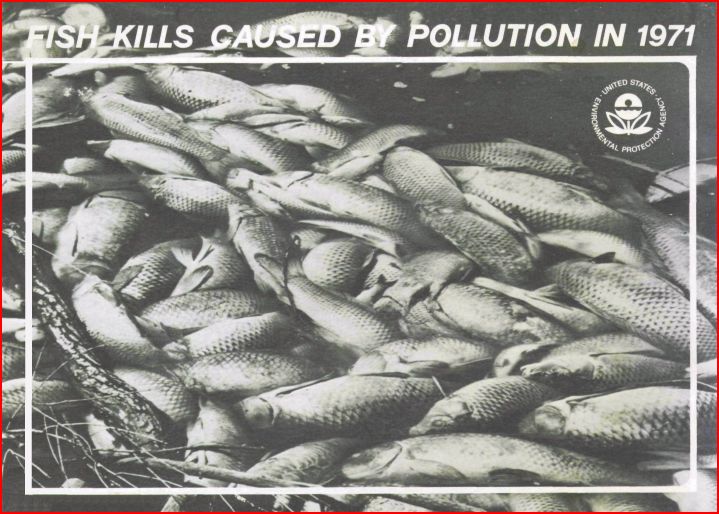
Cover of 1971 EPA publication, Fish Kills Caused By Pollution in 1971.

Cover of 1971 EPA publication, Fish Kills Caused By Pollution in 1971. According to the publication, in Texas, in 1971, 16 million fish died in just 6 pollution-caused incidents. (page 9 of the report).

One of the most spectacular fish kills of recent years occurred in the Colorado River below Austin, Texas, in 1961. Shortly after daylight on Sunday morning, January 15, dead fish appeared in the new Town Lake in Austin and in the river for a distance of about 5 miles below the lake. None had been seen the day before. On Monday there were reports of dead fish 50 miles downstream. . . . By January 21, fish were being killed 100 miles downstream. . . . During the last week of January the locks on the Intracoastal Waterway were closed to exclude the toxic waters from Matagorda Bay and divert them into the Gulf of Mexico.

. . . investigators in Austin noticed an odor associated with the insecticides. . . The manager of the (chemical) plant admitted that quantities of powdered insecticide had been washed into the storm sewer recently and, more significantly, he acknowledged that such disposal of insecticide spillage and residues had been common practice for the past 10 years.

. . . For 140 miles downstream from the lake the kill of fish must have been almost complete, for when seines were used later in an effort to discover whether any fish had escaped they came up empty. Dead fish of 27 species were observed, totaling about 1000 pounds to a mile of riverbank.

Rachel Carson, 1962, Silent Spring

Cribbed from the US Geological Survey site.


Nutshell: The case against the critics of Rachel Carson

July 9, 2007

Mothers who read Rachel Carson’s book asked supermarkets to stop carrying produce or other products laced with DDT, as a precaution against damage to their children. It’s appropriate that a mom’s blog would make the case against Carson’s critics so succinctly, so go read it.


Whom the gods destroy, they first make mad

July 9, 2007

(Who said that, first?)

Vox Day writes a column at the abominable WorldNet Daily. Also he blogs.  Frequently he demonstrates the flight of reason from those pages, such as his column on July 7, in which he wrote:

What is interesting is observable evidence shows that even professional evolutionary biologists are increasingly frightened to expose themselves to the ridicule that the softness of their science renders them liable. Consider this recent post at the science blog Pharyngula by Dr. P.Z. Myers, a biologist and associate professor at the University of Minnesota, Morris, entitled Don’t Debate Creationists.

Why does that demonstrate Day’s flight from reason?  Here, let me explain.

First, Day establishes as his premise that real biologists, scientists who practice in the real world and actually understand Darwin and evolution, are “afraid to expose themselves to the ridicule that the softness of their science renders them liable.”  In short, he’s saying they don’t talk to the public.

His evidence?  He cites a blog post by P. Z. Myers, an evolutionary development biologist at the University of Minnesota, Morris, a co-founder of and frequent contributor to the evolution-promoting weblog Panda’s Thumb, and the creator and author of the science weblog Pharyngula.

So, what Day is saying is that Myers doesn’t bother to expose himself to public scrutiny despite Myers’ being a distinguished researcher and teacher who daily exposes himself to tens of thousands of readers on two of the most heavily trafficked blogs in the world — generally, many times each day — in addition to his work exposing himself to other scientists via his research publications, and through his teaching several classes. 

Right.  And preachers never speak, Pope Benedict is not Catholic, and polar bears don’t defecate on the ice or in the water.  Nor is the sky blue.

Of such evidence are most rants at WorldNet Daily made.


Flag etiquette for the 4th of July

July 4, 2007

Every kid should learn this stuff by third grade, but it’s clear from what we see that they don’t.

Flag flying in front of U.S. Capitol (East side) LOC photo

So here’s a quick review of dos and don’ts for display and behavior toward the U.S. flag on this most flag-worthy of days, the 4th of July. With a few comments.

1. Fly your flag, from sunup to sundown. If you’re lucky enough to have a flagpole, run the flag up quickly. Retire it slowly at sunset. Then go see fireworks.

2. Display flags appropriately, if not flown from a staff. If suspended from a building or a wall, remember the blue field of stars should always be on the right — the “northwest corner” as you look at it. Do not display a flag flat.

3. Salute the flag as it opens the 4th of July parade. In a better world, there would be just one U.S. flag at the opening of the parade, and the entire crowd would rise as it passes them in a great patriotic, emotional wave — civilians with their hands over their hearts, hats off; people in uniform saluting appropriately with hats on. It’s likely that your local parade will not be so crisp. Other entries in the parade will have flags, and many will be displayed inappropriately. A true patriot might rise and salute each one — but that would look silly, perhaps even sillier than those sunshine patriots who display the flag inappropriately. Send them a nice letter this year, correcting their behavior. But don’t be obnoxious about it.

4. Do not display the flag from a car antenna, attached to a window of a car, or attached in the back of a truck. That’s against the Flag Code, which says a flag can only be displayed attached to the right front fender of a car, usually with a special attachment. This means that a lot of the National Guard entries in local parades will be wrongly done, according to the flag code. They defend the flag, and we should not make pests of ourselves about it. Write them a letter commending their patriotism. Enclose the Flag Code, and ask them to stick to it next time. Innocent children are watching.

5. Do not dishonor the flag by abusing it or throwing it on the ground. It’s become popular for a local merchant to buy a lot of little plastic flags and pass them out to parade goers. If there is an advertisement on the flag, that is another violation of the Flag Code. The flag should not be used for such commercial purposes. I have, several times, found piles of these flags on the ground, dumped by tired people who were passing them out, or dumped by parade goers who didn’t want to carry the things home. It doesn’t matter if it’s printed on cheap plastic, and made in China — it is our nation’s flag anyway. Honor it. If it is worn, dispose of it soberly, solemnly, and properly.

That’s probably enough for today. When the Flag Desecration Amendment passes — if it ever does — those parade float makers, National Guard soldiers, and merchants, can all be jailed, perhaps. Or punished in other ways.

Until that time, our best hope is to review the rules, obey them, and set examples for others.

Have a wonderful 4th of July! Fly the flag. Read the Declaration of Independence out loud. Love your family, hug them, and feed them well. That’s part of the Pursuit of Happiness that this day honors. It is your right, your unalienable right. Use it wisely, often and well.


Inexplicable insanity about DDT and Rachel Carson

July 3, 2007

Sheesh! I thought Rep. Rob Bishop, R-Utah, and Sen. Tom Coburn, R-Okla., pretty much took the cake in fanatical ideas close to insanity in the calumny campaign against Rachel Carson. I may have erred.

Please understand, it is important that good people speak up for science, for political sanity, for reason and reality. There are forces of ignorance and evil who willingly fill the information vacuum with excrement, and who thereby pollute political discourse — if you don’t speak up.

Here: Send Sen. Tom Coburn a note, tell him you think he should come to his senses and stop blocking a bill giving a minor honor to Rachel Carson. He needs to do the Christian thing and stand up for truth, for health care, for honesty, you should tell him. Here’s his official message-leaving site.

No, he’s not answered me, either. Swamp him with mail. Or telephone his office: 202-224-5754 (Washington, D.C. office).


Encore post: Recognizing bogus history, 2

July 3, 2007

Editor’s Note:  I’m traveling this week, celebrating our independence 231 years on.  While mostly out of pocket, I’ll feature some encore posts, material that deserves another look to keep it from fading from memory.  This post, below, is the second of a two-part series from August 2006.

Recognizing bogus history, 2

Bogus history infects political discussions more than others, though there are some areas where bogus history strays into the realm of science (false claims that Darwin and Pasteur recanted, for example).

1. The author pitches the claim directly to the media or to organizations of non-historians, for pay.

Historians are detectives, and they like to share what they find. One historian working in the papers of one figure from history will find a letter from another figure, and pass that information on to the historian working on the second figure. Historians teach history, write it up for scholarly work, and often spin it in more fascinating tales for popular work. Most years there are several good works competing for the Pulitzer Prize in history. Academic historians, those tied to universities and other teaching institutions, join societies, attend meetings, and write their material in journals — all pitched to sharing what they have learned.

Bogus historians tend to show up at conferences of non-historians. Douglas Stringfellow’s tales of World War II derring do were pitched to civic clubs, places where other historians or anyone else likely to know better, generally would not appear (Stringfellow’s stories of action behind enemy lines in World War II won him several speaking awards, and based on his war record, he was nominated to a seat in Congress for Utah, in 1952, which he won; a soldier who knew Stringfellow during the war happened through Salt Lake City during the 1954 re-election campaign, and revealed that Stringfellow’s exploits were contrived; he was forced to resign the nomination). Case in point: David Barton speaks more often to gun collectors than to history groups.

2. The author says that a powerful establishment is trying to suppress his or her work.

Sen. Joseph McCarthy insisted that anyone who opposed his claims that communists dominated certain government agencies, or that any given person was a communist, was because those who challenged him were, themselves, part of the greater conspiracy, trying to silence him. Utah Sen. Arthur V. Watkins, who chaired the committee that recommended censure for Sen. McCarthy, lost his own re-election campaign in 1958 in part to the belief by Utah voters that such a conspiracy existed and had succeeded in suppressing McCarthy.

But there was no organized campaign against McCarthy.  Individual Americans, spurred by patriotism, the Boy Scout Law, or just a sense that truth is valuable, spoke up against him, time and again in many different forums.  Sen. Watkins powerfully opposed communism.  Later historians found any truth in McCarthy’s claims against the State Department and other government agencies, and his critics, got there accidentally, below the usual levels of coincidence.

3. The sources that verify the new interpretation of history are obscure; if they involve a famous person, the sources are not those usually relied on by historians.

Most internet hoaxes simply don’t list sources. Bogus quotes circulating that have been attributed to Madison, Jefferson, Washington, Lincoln, and others, often list a year, and nothing else. When I staffed the Senate, several times a year I’d get letters to work on with claims that the Supreme Court had ruled in 1892 that the U.S. is, officially, a “Christian nation.” Usually there there was no case name attached, but I came to understand that the case referred to was the Church of the Holy Trinity vs. U.S. 1892 was far enough back that it was a difficult case for people outside of a decent law library to get — and then, it is couched in 1892 legalese, which makes it difficult to understand. It is an obscure enough case that most of the time it won’t be checked out. If the case can be produced, rarely will it be among lawyers who can interpret what happened from the fog of the language of the decision. The case is not listed at the Cornell University Law School’s on-line Legal Information Institute, nor at Findlaw.com — the databases they rely on go back to 1893. There is a full text copy at the Justicia website. [This was written in 2007.]

The case involved a law that prohibited the importing of laborers, and the Court ruled that the law probably was not intended to apply to a white, white collar worker, a preacher from England (the law was probably aimed at Chinese workers, coming as it did in that time when immigration from China was prohibited). It appears from the case that the church had argued some First Amendment justification to be exempt, and the U.S. Solicitor General had argued in response that the First Amendment requires the courts to assume that the government is hostile to religion; Justice David Brewer wrote at length about how the nation had accommodated religion over the years, especially Christianity, in dismissing the Solicitor General’s argument (he did not accept the church’s argument, either). This sort of writing is called obiter dicta in legal studies — words of an opinion wholly unnecessary to the decision. The case is cited rarely, and never for its religious “ruling,” because that was not what was ruled, and the language was not applied as law then, nor has it been since.  The Supreme Court ruled that importing preachers from England was not covered by the law. The ruling makes no mention of religion.

A bit of reflection on what really happened in history should make this clear: Consider the effect of such a ruling by the Supreme Court on later cases involving textbooks, busing of parochial students, student prayer, Bible readings, etc. Had such a precedent existed, lawyers would have sniffed it out regardless its obscurity.

4. Evidence for the history is anecdotal.

America’s founders carefully wrote laws that assure religious freedom, largely by creating a separation of state and church. To those unhappy with such a separation, every utterance of a founder in which God is praised, or invoked in any way, becomes “proof” that the founders did not mean what they wrote in the laws. Anecdote trumps any other evidence, to these people.
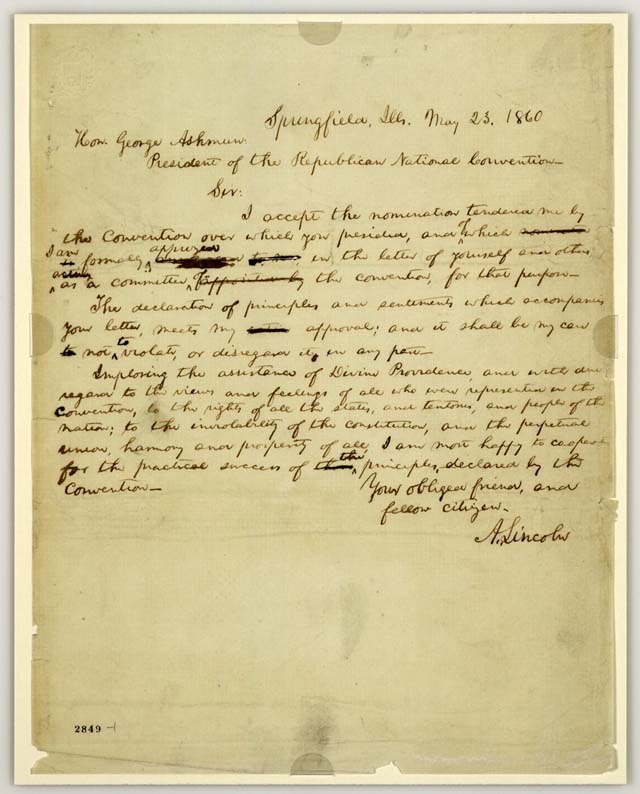
Abraham Lincoln's letter to the president of the Republican National Convention of 1860, accepting the convention's nomination for the presidency.

Abraham Lincoln’s letter to the president of the Republican National Convention of 1860, accepting the convention’s nomination for the presidency. It was written, you will note, from Springfield, Illinois, 200 miles away from Chicago where the convention was held.

To prove to me the piety of Abraham Lincoln, a fellow showed me photograph of a plaque on a church in Chicago, said to be the church where Abraham Lincoln said his prayers every morning during the Republican Convention of 1860, at which Lincoln got the nomination for president. Other records — newspapers, Lincoln’s letters and other documents, show that, as was the fashion in 1860, Lincoln did not attend the convention in Chicago, but as a candidate for president, stayed at home in Springfield, nearly 200 miles away.

Most real history can be read in documents, and does not need to rely on folk retellings exclusively.

5. The author says a belief is credible because it has endured for some time, or because many people believe it to be true.

Faced with the evidence that a dozen quotes he had attributed to figures such as James Madison, George Washington and Patrick Henry were whole cloth inventions, Texas quote-purveyor David Barton issued a statement urging people not to rely on them because they were “questionable.

A great example of belief triumphing over fact presents itself as the Cardiff Giant, now on display at the Farmers’ Museum in Cooperstown, New York (go visit when you visit the Baseball Hall of Fame). After an argument with a cleric over whether the Bible’s claim that giants once existed, a tobacconist named George Hull hired stonecarvers to carve a giant; then he hired a farmer to bury the carving on his farm, and claim to have struck it when planting. Once discovered the “petrified man” was put on display, for a fee. Hull got lucky: Syracuse businessmen offered to buy it from him for an enormous sum.

Paleontologist Othniel Marsh inspected it on display, and pronounced it a hoax. For some odd reason, that increased the popularity of the attraction. Carnival and side show entrepreneur P. T. Barnum offered $60,000 for the carving, but was refused. Barnum then had a plaster replica made and put on display. The owners of the original hoaxed carving sued, but the suit was thrown out because they could not demonstrate the “genuineness” of their own hoax.  Barnum made more money than the original.  A hoaxed hoax is even more popular than the truth.

A photo (staged?) of the 1869 unearthing of the Cardiff Giant (Cardiff, New York). Photograph courtesy Farmers Museum via Associated Press, and via National Geographic.

A photo (staged?) of the 1869 unearthing of the Cardiff Giant (Cardiff, New York). Photograph courtesy Farmers Museum (where the carving now rests, on display to museum visitors)  via Associated Press, and via National Geographic.

6. The author has worked in isolation.

Historians often help each other. Good historians put out queries to many sources, the better to assure accuracy. So, conversely, if there are only a few people who know anything about an account, that fact alone may cause suspicion. Clifford Irving’s hoax biography of Howard Hughes, while remarkably accurate in some regards, was unraveled when enough people familiar with Hughes called the bluff — including, of course, Hughes himself. The book got as far as it did with extreme secrecy on Irving’s part. Working alone makes error easier, and is essential for intentional frauds.

7. The author must propose a new interpretation of history to explain an observation.

Various conspiracy claims require that key people act counter to their known character. If Franklin Roosevelt had “allowed” Pearl Harbor to occur in order to get the U.S. into war, his actions over the previous six years to support Britain start to make little sense. Had Lyndon Johnson been part of a conspiracy to assassinate John Kennedy, his later carrying out the legislative plan of Kennedy runs contrary to all such motivations. If the founders of the U.S. actually intended to make Christianity the state religion, their efforts to disestablish the churches in all 13 colonies, efforts to write bills of rights for each state including freedom of religion, and efforts to create the First Amendment in the Bill of Rights seem like incredible, repeated errors.

Bogus history is much like the conjectured problems that result from time travel: Change one jot of history, and there is a cascading effect on later events. In many cases,were the bogus histories accurate, what follows could not be so, and we wouldn’t be here to discuss it.

Those are the seven warning signs of bogus history. Bogus, or voodoo history should be suspected if two or more of the signs are present — though it is quite possible for actual history to show more than two signs (perhaps actual history could show all seven signs — but I’d have to see an example before stating it’s so).

More: