May 23, 1926: Mencken confessed the Millard Fillmore bathtub hoax

May 23, 2011

May 23, 1926, H. L. Mencken’s newspaper column confessed his hoax of nine years earlier — he had made up whole cloth the story of Millard Fillmore’s only accomplishment being the installation of a plumbed bathtub in the White House (in the 1850s known as the Executive Mansion).

Alas, the hoax cat was out of the bag, and the hoax information still pollutes the pool of history today.

Text of the confession, from the Museum of Hoaxes:

Melancholy Reflections

On Dec. 28, 1917, I printed in the New York Evening Mail, a paper now extinct, an article purporting to give the history of the bathtub. This article, I may say at once, was a tissue of absurdities, all of them deliberate and most of them obvious…

This article, as I say, was planned as a piece of spoofing to relieve the strain of war days, and I confess that I regarded it, when it came out, with considerable satisfaction. It was reprinted by various great organs of the enlightenment, and after a while the usual letters began to reach me from readers. Then, suddenly, my satisfaction turned to consternation. For these readers, it appeared, all took my idle jocosities with complete seriousness. Some of them, of antiquarian tastes, asked for further light on this or that phase of the subject. Others actually offered me corroboration!

But the worst was to come. Pretty soon I began to encounter my preposterous “facts” in the writings of other men. They began to be used by chiropractors and other such quacks as evidence of the stupidity of medical men. They began to be cited by medical men as proof of the progress of public hygiene. They got into learned journals. They were alluded to on the floor of congress. They crossed the ocean, and were discussed solemnly in England and on the continent. Finally, I began to find them in standard works of reference. Today, I believe, they are accepted as gospel everywhere on earth. To question them becomes as hazardous as to question the Norman invasion.

* * *

And as rare. This is the first time, indeed, that they have ever been questioned, and I confess at once that even I myself, their author, feel a certain hesitancy about doing it. Once more, I suppose, I’ll be accused of taking the wrong side for the mere pleasure of standing in opposition. The Cincinnati boomers, who have made much of the boast that the bathtub industry, now running to $200,000,000 a year, was started in their town, will charge me with spreading lies against them. The chiropractors will damn me for blowing up their ammunition. The medical gents, having swallowed my quackery, will now denounce me as a quack for exposing them. And in the end, no doubt, the thing will simmer down to a general feeling that I have once more committed some vague and sinister crime against the United States, and there will be a renewal of the demand that I be deported to Russia.

I recite this history, not because it is singular, but because it is typical. It is out of just such frauds, I believe, that most of the so-called knowledge of humanity flows. What begins as a guess — or, perhaps, not infrequently, as a downright and deliberate lie — ends as a fact and is embalmed in the history books. One recalls the gaudy days of 1914-1918. How much that was then devoured by the newspaper readers of the world was actually true? Probably not 1 per cent. Ever since the war ended learned and laborious men have been at work examining and exposing its fictions. But every one of these fictions retains full faith and credit today. To question even the most palpably absurd of them, in most parts of the United States, is to invite denunciation as a bolshevik.

So with all other wars. For example, the revolution. For years past American historians have been investigating the orthodox legends. Almost all of them turn out to be blowsy nonsense. Yet they remain in the school history books and every effort to get them out causes a dreadful row, and those who make it are accused of all sorts of treasons and spoils. The truth, indeed, is something that mankind, for some mysterious reason, instinctively dislikes. Every man who tries to tell it is unpopular, and even when, by the sheer strength of his case, he prevails, he is put down as a scoundrel.

* * *

As a practicing journalist for many years, I have often had close contact with history in the making. I can recall no time or place when what actually occurred was afterward generally known and believed. Sometimes a part of the truth got out, but never all. And what actually got out was seldom clearly understood. Consider, for example, the legends that follow every national convention. A thousand newspaper correspondents are on the scene, all of them theoretically competent to see accurately and report honestly, but it is seldom that two of them agree perfectly, and after a month after the convention adjourns the accepted version of what occurred usually differs from the accounts of all of them.

I point to the Republican convention of 1920, which nominated the eminent and lamented Harding. A week after the delegates adjourned the whole country believed that Harding had been put through by Col. George Harvey: Harvey himself admitted it. Then other claimants to the honor arose, and after a year or two it was generally held that the trick had been turned by the distinguished Harry M. Daugherty, by that time a salient light of the Harding cabinet. The story began to acquire corroborative detail. Delegates and correspondents began to remember things that they had not noticed on the spot. What the orthodox tale is today with Daugherty in eclipse, I don’t know, but you may be sure that it is full of mysterious intrigue and bold adventure.

What are the facts? The facts are that Harvey had little more to do with the nomination of Harding than I did, and that Daugherty was immensely surprised when good Warren won. The nomination was really due to the intense heat, and to that alone. The delegates, torn by the savage three cornered fight between Lowden, Johnson, and Wood, came to Saturday morning in despair. The temperature in the convention hall was at least 120 degrees. They were eager to get home. When it became apparent that the leaders could not break the deadlock they ran amuck and nominated Harding, as the one aspirant who had no enemies. If any individual managed the business it was not Harvey or Daugherty, but Myron T. Herrick. But so far as I know Herrick’s hand in it has never been mentioned.

* * *

I turn to a more pleasant field — that of sport in the grand manner. On July 2, 1921, in the great bowl at Jersey City, the Hon. Jack Dempsey met M. Carpentier, the gallant frog. The sympathy of the crowd was overwhelmingly with M. Carpentier and every time he struck a blow he got a round of applause, even if it didn’t land. I had an excellent seat, very near the ring, and saw every move of the two men. From the first moment Dr. Dempsey had it all his own way. He could have knocked out M. Carpentier in the first half of the first round. After that first half he simply waited his chance to do it politely and humanely.

Yet certain great newspapers reported the next morning that M. Carpentier had delivered an appalling wallop in the second round and that Dr. Dempsey had narrowly escaped going out. Others told the truth, but what chance had the truth against that romantic lie? It is believed in to this day by at least 99.99 per cent of all the boxing fans in Christendom. Carpentier himself, when he recovered from his beating, admitted categorically that it was nonsense, but even Carpentier could make no headway against the almost universal human tendency to cherish what is not true. A thousand years hence schoolboys will be taught that the frog had Dempsey going. It may become in time a religious dogma, like the doctrine that Jonah swallowed the whale. Scoffers who doubt it will be damned to hell.

The moral, if any, I leave to psycho-pathologists, if competent ones can be found. All I care to do today is to reiterate, in the most solemn and awful terms, that my history of the bathtub, printed on Dec. 28, 1917, was pure buncombe. If there were any facts in it they got there accidentally and against my design. But today the tale is in the encyclopedias. History, said a great American soothsayer, is bunk.


Is the Constitution dead?

May 13, 2011

Oh, the eternal crabbiness of the conservative, striving-to-be intellectual mind.

Time cover, Is God Dead?

Time cover, Is God Dead? -- April 8, 1966

At one of those hangouts for conservatives with more education and degrees than brains and sense — for example, friends and sympathizers with Francis “I am not an ID advocate” Beckwith — forgetting the trouble Time got into with the cover story asking “Is God dead?” I nearly twisted my ankle on a rhetorical hole that opened with this:

But more importantly, America has a problem: the Constitution is dead. Now what?

Assuming that statement to be a fact rather than a radical, perhaps hallucinatory claim, comments proceeded to denigrate the New Deal as completely unconstitutional and therefore worthy of complete rollback, in that future when these people take over and replace the Constitution.

Can you imagine what they would say if they stumbled into a leftist, pro-communist site making the same claims?

So, I questioned their judgment that the New Deal was unconstitutional, bad, and unjustified.   No nibbles on the invite to make a case they might be right, so I noted the thread earlier.

Those who think they are He-and-She-Who-Must-Be Obeyed* took great exception to my posts, said I had “one more chance.”

Skroom, you know?

Dear Readers:  Is the Constitution dead?  What evidence do you see?

Was the New Deal complete, unvarnished hoakum, or do you see value in any of the vestiges and legacy of the New Deal?

It could be an interesting discussion, if the Bathtub had any influence and a bunch of readers who would chime in.

Constitution in a casket

Is the U.S. Constitution dead? Libertarians, Conservatives, and other ne'er-get-wells can't tell. So they use it as cover for raucous behavior, What's Wrong With the World, May 5, 2011.

_____________

* Apologies to John Mortimer and Horace Rumpole.


Pure political smear from Walter Williams, or is there any factoid to back his claim?

April 30, 2011

Walter Williams wrote a column a dozen years ago in which he made some wild claims about Stanford population biologist Paul Ehrlich.

Stanford University Prof. Paul R. Ehrlich - L A Cicero image

What did he really say?  Stanford University Prof. Paul R. Ehrlich – L A Cicero image

Williams wrote:

Paul Ehrlich wrote The Population Bomb, widely read on college campuses during the late sixties.  Ehrlich predicted that there’d be a major food shortage in the U.S. and “in the 1970s . . . hundreds of millions of people are going to starve to death.”  He forecast that 65 million Americans would die of starvation between 1980 and 1989, and that by 1999 the U.S. population would have declined to 22.6 million.  Ehrlich’s predictions about England were worse:  “If I were a gambler, I would take even money that England will not exist in the year 2000.”

Walter Williams, More Liberty Means Less Government:  Our founders knew this well, Hoover Institution Press Publication No. 453, 1999, p. 134

Recently Williams revived that claim for another column, and the revived claim is all over conservative sites.

Steven Goddard, who appears to be making a living on screwing up references to the work of others, though had restricted most of his error to sciency issues like climate change denial, put up a post repeating Williams’ claim.

I imagined Ehrlich might have said something like that, but most likely in one of his “scenarios” like the three much different disaster scenarios he proposed in his 1968 book Population Bomb So I asked Goddard for a reference (pollution and economic scarcity, disease, and food shortages, were the three apocalyptic horsemen Ehrlich wrote about then).

It didn’t occur to me that the quote attributed to Ehrlich was wholly fictitious, but in more than a week of searching, neither Goddard nor Maurizio Moribito commenting at Goddard’s site can find anything even close to what Williams claimed.  I’ve pored through my old copy of Population Bomb, and it’s not there that I can find, not without a much more thorough reading I don’t have time for right now.  (My copy of Ehrlich’s Population, Resources and Environment is buried somewhere here in my bookshelves — that was the textbook Ehrlich wrote, a book used in a population and ecology course I took in the Biology Department at the University of Utah way back when.  It’s also a favorite book for conservatives to quote mine, wringing fantastic mischaracterizations from the early edition or a later one where Ehrlich and his wife were joined by John Holdren, now an adviser to President Obama.)

Dear Readers, help me out:  Did Ehrlich say anything like what Williams via Goddard claims he said, or did Williams pluck this smear from a some unlighted private library?  Was Williams just playing fast and loose with the truth (again)?

Did Ehrlich ever “predict” 65 million deaths from starvation in America in the 1980s?  Can anyone source the quote?

More, strings to follow:  

Even more stuff on the topic:


Obama’s birth certificate: Putting the sideshow freaks and carnival barkers on the hot seat

April 27, 2011

No, it’s not particularly important, especially since we knew from so many other sources that Obama was, indeed, Honolulu born.

The White House pried the old birth certificate out of the records of the State of Hawaii, and released copies to the world today.

The White House video:

ABC Television’s report:

View a .pdf of the form here:  President Obama\’s original Hawaiian birth certificate

I predict Orly Taitz, Donald Trump, and all the other sideshow freaks and carnival barkers, will continue to bark away.  Remember, when P. T. Barnum made a copy of the hoax “Cardiff Giant,” people paid a premium to see the fake of the hoax.  P. T. Barnum’s ghost stalks and stomps on Republican and birther grounds now.

More:

_____________

Boy, looking at this, you gotta know that Obama planned this all out, as Morgan claimed in comments below — just so he could get this story from Juan Williams and Shepard Smith at Fox News:

Oh, For Goodness Sake posted that video, without any other comment, as “National Mirror Moment.”  Birthers, Palinistas and Republicans must be choking on their dinners from that report.  Has the Fox turned on ’em?

Always a good site to expose the inanity and insanity of Obama’s critics, especially on the issues of Obama’s history, Oh, For Goodness Sake has a particular bead on the hypocrisy of those same critics:

How many times have you heard the promise: The president could end this today if he’d just release his long form birth certificate? So now they’ve got the f—ing long form birth certificate, is it done for the Birthers?

No. No. No. No. No. No. And Nope.

Bigots.  Probably no small amount of racism in there, too.  Plus, they’ve exposed themselves as genuinely opposed to America’s good health.  David Gardner and Milton Goldstein pegged it, even if we have to paraphrase them a bit:  Had a foreign government tried to do what the birthers are doing, we’d have considered it an act of war.  History is not kind to idlers, those who fail to call out injustice, nor idiots.


Pareidolia? No, there’s no link between Earth Day and Lenin

April 23, 2011

This is mostly an encore post — sad that it needs repeating.

You could write it off to pareidolia, once.  Like faces in clouds, some people claimed to see a link.  The first Earth Day, on April 22, 1970, coincided with Lenin’s birthday.  There was no link — Earth Day was scheduled for a spring Wednesday.  Now, years later, with almost-annual repeats of the claim from the braying right wing, it’s just a cruel hoax.

No, there’s no link between Earth Day and the birthday of V. I. Lenin:

One surefire way to tell an Earth Day post is done by an Earth Day denialist: They’ll note that the first Earth Day, on April 22, 1970, was an anniversary of the birth of Lenin.

Coincidentally, yes, Lenin was born on April 22 (new style calendar; it was April 10 on the calendar when he was born — but that’s a digression for another day).

It’s a hoax. There is no meaning to the first Earth Day’s falling on Lenin’s birthday — Lenin was not prescient enough to plan his birthday to fall in the middle of Earth Week, a hundred years before Earth Week was even planned.

My guess is that only a few really wacko conservatives know that April 22 is Lenin’s birthday (was it ever celebrated in the Soviet Union?). No one else bothers to think about it, or say anything about it, nor especially, to celebrate it.

Gaylord Nelson, Living Green image

Inventor of Earth Day teach-ins, former Wisconsin Governor and U.S. Senator Gaylord Nelson

Wisconsin’s U.S. Sen. Gaylord Nelson, usually recognized as the founder and father of Earth Day, told how and why the organizers came to pick April 22:

Senator Nelson chose the date in order to maximize participation on college campuses for what he conceived as an “environmental teach-in.” He determined the week of April 19–25 was the best bet; it did not fall during exams or spring breaks, did not conflict with religious holidays such as Easter or Passover, and was late enough in spring to have decent weather. More students were likely to be in class, and there would be less competition with other mid-week events—so he chose Wednesday, April 22.

In his own words, Nelson spoke of what he was trying to do:

After President Kennedy’s [conservation] tour, I still hoped for some idea that would thrust the environment into the political mainstream. Six years would pass before the idea that became Earth Day occurred to me while on a conservation speaking tour out West in the summer of 1969. At the time, anti-Vietnam War demonstrations, called “teach-ins,” had spread to college campuses all across the nation. Suddenly, the idea occurred to me – why not organize a huge grassroots protest over what was happening to our environment?

I was satisfied that if we could tap into the environmental concerns of the general public and infuse the student anti-war energy into the environmental cause, we could generate a demonstration that would force this issue onto the political agenda. It was a big gamble, but worth a try.

At a conference in Seattle in September 1969, I announced that in the spring of 1970 there would be a nationwide grassroots demonstration on behalf of the environment and invited everyone to participate. The wire services carried the story from coast to coast. The response was electric. It took off like gangbusters. Telegrams, letters, and telephone inquiries poured in from all across the country. The American people finally had a forum to express its concern about what was happening to the land, rivers, lakes, and air – and they did so with spectacular exuberance. For the next four months, two members of my Senate staff, Linda Billings and John Heritage, managed Earth Day affairs out of my Senate office.

Five months before Earth Day, on Sunday, November 30, 1969, The New York Times carried a lengthy article by Gladwin Hill reporting on the astonishing proliferation of environmental events:

“Rising concern about the environmental crisis is sweeping the nation’s campuses with an intensity that may be on its way to eclipsing student discontent over the war in Vietnam…a national day of observance of environmental problems…is being planned for next spring…when a nationwide environmental ‘teach-in’…coordinated from the office of Senator Gaylord Nelson is planned….”

Nelson, a veteran of the U.S. armed services (Okinawa campaign), flag-waving ex-governor of Wisconsin (Sen. Joe McCarthy’s home state, but also the home of Aldo Leopold and birthplace of John Muir), was working to raise America’s consciousness and conscience about environmental issues.

Lenin on the environment? Think of the Aral Sea disaster, the horrible pollution from Soviet mines and mills, and the dreadful record of the Soviet Union on protecting any resource. Lenin believed in exploiting resources, not conservation.

So, why are all these conservative denialists claiming, against history and politics, that Lenin’s birthday has anything to do with Earth Day?

Can you say “propaganda?”

Good information from 2011:

Good information from 2010:

Wall of Lenin’s Birthday Propaganda Shame from 2011:

Wall of Lenin’s Birthday Propaganda Shame from 2010:

Warn people not to be sucked in by the hoax:

Add to FacebookAdd to NewsvineAdd to DiggAdd to Del.icio.usAdd to StumbleuponAdd to RedditAdd to BlinklistAdd to TwitterAdd to TechnoratiAdd to Furl


Hawaii confirms Obama’s eligibility (again); but who knows where Donald Trump really came from?

April 11, 2011

NBC’s Michael Isikoff grubbed out the story to get Hawaii to confirm, once again, that President Obama’s birth certificate is archived and well, and says exactly what Obama said it says, and what Hawaii said it says, under seal.

The mystery deepens:  Why is Donald Trump making an issue about this now?

After the Bathtub noted that we don’t know where Trump was born, and that the story of his life can’t be corroborated exactly as he claims, Trump released what he called a birth certificate.

But it turned out to be bogus.

What is Trump trying to hide, with all his pointless fulminations?  At this point, anything he releases must be regarded as suspect.


Annals of global warming: Records from Mauna Loa show continuing rise in atmospheric CO2

March 26, 2011

NOAA's Mauna Loa Observatory, NOAA photo, 1982, Cmdr. John Bortniak

NOAA's Mauna Loa Observatory, from NOAA At the Ends of the Earth Collection, 1982 NOAA photo by Commander John Bortniak

John Adams observed, and Ronald Reagan was fond of quoting, “Facts are stubborn things . . .”

Here are the facts on atmospheric carbon dioxide (CO2):


Monthly CO2 levels since 1960, Mauna Loa Observatory (Scripps Inst of Oceanography)

Mauna Loa Observatory, Scripps Institution of Oceanography, UCSD (University of Calfornia-San Diego); CO2 concentrations in parts per million (ppm)

As described at the Scripps Institution of Oceanography site:

Description:
Monthly average atmospheric carbon dioxide concentration versus time at Mauna Loa Observatory, Hawaii (20°N, 156°W) where CO2 concentration is in parts per million in the mole fraction (p.p.m.). The curve is a fit to the data based on a stiff spline plus a 4 harmonic fit to the seasonal cycle with a linear gain factor.

Data from Scripps CO2 Program.

For perspective, here’s a chart from Scripps that shows why there is concern over current levels of CO2:

CO2 over the past 420,000 years - Scripps Institution of Oceanography

CO2 over the past 420,000 years - Scripps Institution of Oceanography

Resources, More:


Bathtub reading near the end of spring break, 2011

March 18, 2011

No, they are not trying to get rid of unions, just trying to balance their budgets.  Right?

Other than Rand Paul, Republicans don’t need low-flow toilets, because when it comes to conservation, climate change and the facts, Republicans just don’t give a s—.

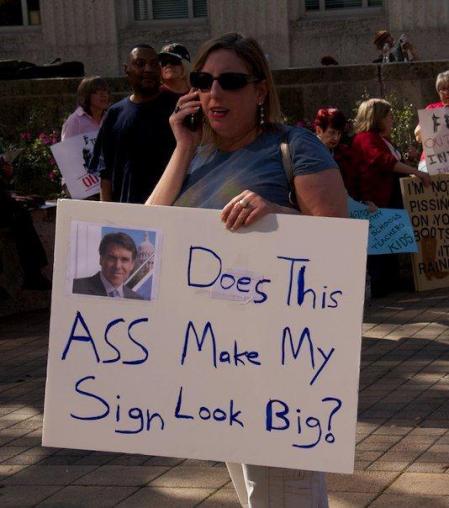
Oooh.  Signs from the teacher protests of budget cuts in Austin, Texas!

Does this ass, Rick Perry, make my sign look big?  Austin, March 2011

Protester in Austin, Texas, March 2011

Peace Corps celebrates 50 years this year.  Steve Mott tells of his first year as a Peace Corps volunteer in a remote corner of Nepal. (From the Norwell (Massachusetts) Mariner Wicked Local online.) (Suitable for a warm-up at least, teachers — maybe good for your unit on the 1960s and the Kennedy administration.  “In 1966 it was the Beach Boys and when I got back in ’68 it was Janis Joplin,” he said.  “A lot of social changes had taken place in two years.”

Oh, those jocular Tea Partiers!  Now they want to bring back child labor, in Maine, and in Missouri.  They’re serious when they say they oppose all the “progressive agenda” from the Progressive Era.  Look out Women’s Christian Temperance Union and anti-child abuse laws.  (Tea Partiers get all get their marching orders from Tea Bag Central — surely other states will follow; let us know if similar bills are in the hopper in your state legislature, eh?)

I keep finding good and interesting stuff in the Imperial War Museum.  Have you ever been there?  I wish they would do more online.  “War Shapes Lives,” a motto on their website.  An understatement of history.  This painting hangs in the museum, John Singer Sargent’s  “Gassed.”  At the museum, you may view it in its majesty, 20 feet along the wall, 7½ feet high.

Gassed, by John Singer Sargent.  Imperial War Museum

Gassed, by John Singer Sargent. Imperial War Museum


Quotes that will live in infamy: Michelle Bachmann, another history “F” (“shot heard ’round the world”)

March 14, 2011

In Concord, New Hampshire, on March 11 and 12, 2011, apparently testing to see whether that little state has bad enough education standards before announcing a presidential bid, Michelle Bachmann butchered history and geography once again, according to the conservative Minnesota Independent:

“You’re the state where the shot was heard around the world in Lexington and Concord,” she said, referencing Ralph Waldo Emerson’s “Concord Hymn,” an ode to the lives lost at the start of the American Revolution in Concord, Massachusetts, not New Hampshire.

How many bites at the apple does stupid get?  Has Ed Brayton picked up on this yet?

Minnesota U.S. Rep. Michelle Bachmann

Minnesota U.S. Rep. Michelle Bachmann

More:

Tip of the old scrub brush to Pat Carrithers.

Update:  Oh, yeah, others noticed:

Jeff Danziger on Michelle Bachmann's mixing up Concords

Jeff Danziger


Green Hell? Milloy slanders Ruckelshaus as “mass murderer”

March 10, 2011

This week, EPA bashing took front and center on the performance stage that passes as Congress these days.  There is a school of thought that thinks EPA should be eviscerated because EPA is carrying out the mandate an earlier Congress gave it, to clean up the air.  Especially, the recent assailants claim, EPA should not try to reduce carbon emissions, because clean air might cost something.

Steven Milloy, making stuff up and passing it as fact

Steven Milloy, who makes crude and false claims against William Ruckelshaus, a great lawyer and the hero of the Saturday Night Massacre. Why does Milloy carry such a pathetic grudge?

Wholly apart from the merits, or great lack of merits to those arguments, the anti-EPA crowd is just ugly.

78-year-old William Ruckelshaus, the Hero of the Saturday Night Massacre, a distinguished lawyer and businessman, and the founding Director of EPA who was called back to clean it up after the Reagan administration scandals, granted an interview on EPA bashing to Remapping Debate, an ambitious, independent blog from the Columbia School of Journalism designed to provide information essential to policy debates that too-often gets overlooked or buried.  [Remapping Debate sent a note that they are not affiliated with CSJ; my apologies for the error.]

Ruckelshaus, as always, gave gentlemanly answers to questions about playing politics with science, and bashing good, honest and diligent government workers as a method of political discourse.

Steven Milloy, one of the great carbuncles on the face of climate debate or any science issue, assaulted Ruckelshaus at Milloy’s angry, bitter blog, Green Hell.  Milloy calls Ruckelshaus “a mass-murderer,” a clear invitation for someone to attack the man. Milloy wrote, cravenly:

He’s the 20th century’s only mass murderer to survive and thrive (as a venture capitalist) in the 21st century.

Milloy owes Ruckelshaus an apology and a complete retraction.  I rather hope Ruckelshaus sues — while Milloy will claim the standards under New York Times vs. Sullivan as a defense, because Ruckelshaus is a public figure, I think the only question a jury would have to deal with is how much malice aforethought Milloy exhibits.  Malice is obvious.  Heck, there might not even be a question for a jury — Milloy loses on the law (nothing he claims against Ruckelshaus is accurate or true in any way).

This is much more damning than what got two NPR officials to lose their jobs.

Who will stand up for justice here?  Rep. Upton?  Rep. Boehner?  Anthony Watts?

I tried to offer a correction, and since then have written Milloy demanding an apology and retraction — neither comment has surfaced yet on Milloy’s blog.  Here’s the truth Milloy hasn’t printed:

No, Sweeney did not rule that DDT is not a threat to the environment. He said quite the opposite. Sweeney wrote, in his ruling:

20. DDT can have a deleterious effect on freshwater fish and estuarine organisms when directly applied to the water.

21. DDT is used as a rodenticide. [DDT was used to kill bats in homes and office buildings; this was so effective that, coupled with accidental dosing of bats from their eating insects carrying DDT, it actually threatened to wipe out some species of bat in the southwest U.S.]

22. DDT can have an adverse effect on beneficial animals.

23. DDT is concentrated in organisms and can be transferred through food chains.

On that basis, two federal courts ruled that DDT must be taken off the market completely. Sweeney agreed with the findings of the courts precisely, but he determined that the law did not give him the power to order DDT off the market since the newly-proposed labels of the DDT manufacturers restricted use to emergency health-related tasks. With the benefit of rereading the two federal courts’ decisions, Ruckelshaus noted that the courts said the power was already in the old law, and definitely in the new law. [See, for example, EDF v. Ruckelshaus, 439 F. 2d 584 (1971)]

DDT was banned from use on crops in the U.S. as an ecosystem killer. It still is an ecosystem killer, and it still deserves to be banned.

Ruckelshaus’s order never traveled outside the U.S. DDT has never been banned in most nations of the world, and even though DDT has earned a place on the list of Dirty Dozen most dangerous pollutants, even under the Persistent Organic Pollutants Treaty of 2001, DDT is available for use to any country who wishes to use it.

Please get your facts straight.

Would you, Dear Reader,  help spread the word on Facebook, Reddit, Twitter, or any other service you have, that the Brown Lobby has gone too far in it’s error-based propaganda against clean air and those who urge a better environment?  Please?


Hoaxing Congress: Claiming DDT as pixie dust

March 9, 2011

Tuesday morning, March 8,  the Republican-controlled House of Representatives Committee on Energy and Commerce opened hearings on global warming, staging an assault on science with a series of witnesses, some of whom recently have made a career out of mau-mauing scientists.

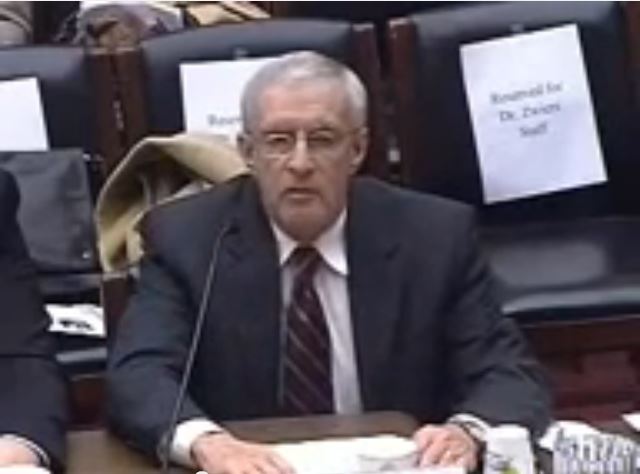
Dr. Donald Roberts' testimony to the House Committee on Energy and Power, on March 8, 2011, presented a grand collection of Bogus History, coupled with Bogus Science.

Dr. Donald Roberts’ testimony to the House Committee on Energy and Power, on March 8, 2011, presented a grand collection of Bogus History, coupled with Bogus Science. Roberts has an unfortunate history of presenting doctored data and false claims to Congress.

One witness took after the EPA directly and Rachel Carson by implication, with a specious claim that DDT is harmless.  Donald Roberts is a former member of the uniformed public health service.  Since retiring, and perhaps for a while before, he started running with a bad crowd.  Of late he’s been working with the Merry Hoaxsters of the unrooted Astroturf organization Africa Fighting Malaria (AFM), a group dedicated to publishing editorials tearing down the reputation of Rachel Carson, the World Health Organization (WHO) and the Environmental Protection Agency (EPA).

(That would all be purple prose, were it not accurate in its description of people, organizations and their actions.)

Here’s a link to Roberts’ written testimony at the committee website.

(Here’s a link to all the other written stuff from the March 8 hearing.) [April 27, 2015: These two cites now link to the Democratic Minority record; GOP site was moved or taken down.]

Why was Roberts testifying at a hearing on global warming?  He’s carrying water for the anti-science, “please-do-nothing” corporate crowd.  It’s a tactic from the old tobacco lobbyist book:  Roberts claims that scientists got everything wrong about DDT, and that the ban on DDT done in error has wreaked havoc in the third world.  Therefore, he says, we should never trust scientists.  If scientists say “duck!” don’t bother, in other words.

Roberts is in error.  Scientists, especially Rachel Carson, were dead right about DDT.  Because corporate interests refused to listen to them, the overuse and abuse of DDT rendered it ineffective in the fight against malaria, and DDT use as part of a very ambitious campaign to eradicate malaria had to be abandoned in 1965.  The entire campaign had to be abandoned as a result, and more than 30 million kids have died since.

So don’t grant credence to Roberts now.  He’s covering up one of the greatest industrial screw-ups in history, a screw up that, by Roberts’ own count, has killed 30 million kids.  What in the world would motivate Roberts to get the story so wrong, to the detriment of so many kids?

Roberts said:

Putting issues of EPA budget aside, I want to introduce my technical comments with a quote from a recent Associated Press article with a lead statement “none of EPA’s actions is as controversial as its rules on global warming.”  In my opinion, this is wrong.

Dr. Donald Roberts testifying to the House Energy Committee, March 8, 2011. Screen capture from Committee video.

Dr. Donald Roberts testifying to the House Energy Committee, March 8, 2011. Screen capture from Committee video.

Roberts is correct here in his opinion.  It is simply wrong that EPA’s rules on global warming and controls of the pollutants that cause it should be controversial.  Among air pollution scientists the rules are not controversial.  Among climate scientists the rules are not controversial.  Roberts and his colleagues at the so-called Competitive Enterprise Institute, Africa Fighting Malaria (AFM), and American Enterprise Institute (AEI) work hard to manufacture controversy where the science does not support their case.

It is wrong.  Roberts should be ashamed.

Roberts said:

Almost forty years ago EPA banned DDT in the United States. Its action against DDT was extraordinarily controversial, and still is. As activists advanced fearful claims against DDT, the EPA was warned, over and over again, a ban would destroy critically important disease control programs and millions upon millions of poor people in developing countries would die as consequence. Leaders of the World Health and Pan American Health Organizations, and even the U.S. Surgeon General warned against the ban. The EPA banned DDT anyway, and the doomsday predictions of those public health leaders proved prescient.

Hmmm.  Roberts signed a “truth in testimony” statement — but that’s not the truth, even if no one paid him to fib.

EPA’s ban on DDT in the U.S. was limited to the United States.  Roberts doesn’t say it flat out, but he implies that the U.S. ban on spraying DDT on cotton fields in Texas and Arkansas — and cotton was about the only crop where DDT was still used — somehow caused a ban on DDT in Africa, or Asia, or South America, or other places where malaria still occurs.

Not so.

In fact, EPA Director William Ruckelshaus defied two federal courts who had ordered a complete ban on DDT use and manufacturing — and left U.S. manufacturing to continue for export markets.  This met all objections to the U.S. ban from all health officials.  DDT use could be allowed in the U.S. for health reasons, or for other emergencies (DDT was used in the Pacific Northwest against the tussock moth in 1974, after the “ban”).  Because U.S. DDT manufacturing was dedicated to export, the ban on domestic use of DDT effectively multiplied the stocks of DDT available to fight malaria, or river blindness, or any other insect vector disease.

I’m also not sure that health officials “pleaded” to stop the U.S. ban on any grounds, but certainly they did not plead with Ruckelshaus to keep spraying DDT on cotton.  Roberts is making stuff up in effect, if not in intent.

Probably more to the point, health officials had stopped significant use of DDT in Africa in 1965, seven years before EPA acted in the U.S., because overuse of DDT on crops in Africa had bred mosquitoes that were resistant and immune to the stuff. Since 1955, in close cooperation with the malaria-fighting experts from the Rockefeller Foundation including the great Fred Soper, WHO carried on a methodical, militant campaign to wipe out malaria.  The program required that public health care be beefed up to provide accurate malaria diagnoses, and complete treatment of human victims of the parasitic disease.  Then an army of house sprayers would move in, dosing the walls of houses and huts with insecticide.  Most malaria-carrying mosquitoes at the time would land on the walls of a home or hut after biting a human and getting a blood meal, pausing to squeeze out heavy, excess water to make flight easier.  If the wall were coated with an insecticide, the mosquito would die before being able to bite many more people, maybe before becoming capable of spreading malaria.

DDT was Soper’s insecticide of choice because it was long-lasting — six months or more — and astonishingly deadly to all small creatures it contacted.

But, as Malcolm Gladwell related in his 2001 paean to Soper in The New Yorker, Soper and his colleagues well understood they were racing against the day that mosquitoes became resistant enough to DDT that their program would not work.  They had hoped the day would not arrive until the late 1970s or so — but DDT is such an effective killer that it greatly speeds evolutionary processes.  In the mid-1960s, before an anti-malaria campaign could even be mounted in most of Subsaharan Africa, resistant and immune mosquitoes began to stultify the campaign.  By 1965, Soper’s crews worked hard to find a substitute, but had to switch from DDT.  By 1972 when the U.S. banned DDT use on cotton in the U.S., it was too late to stop the resistance genes from killing WHO’s anti-malaria program.  In 1969 WHO formally abandoned the goal of malaria eradication.  The fight against malaria switched to control.

Roberts claims, implicitly, that people like those who worked with Soper told EPA in 1971 that DDT was absolutely essential to their malaria-fighting efforts.  That could not be accurate.  In 1969 the committee that oversaw the work of the UN voted formally to end the malaria eradication project.  In effect, then, Roberts claims UN and other health officials lied to EPA in 1971.  It is notable that Soper is credited with eradicating malaria from Brazil by 1942, completely without DDT, since DDT was not then available.  Soper’s methods depended on discipline in medical care and pest control, and careful thought as to how to beat the disease — DDT was a help, but not necessary.

Interestingly, the only citation Roberts offers is to his own, nearly-self-published book, in which he indicts almost all serious malaria fighters as liars about DDT.

Can Roberts’ testimony be trusted on this point?  I don’t think we should trust him.

In fact, DDT and the eradication campaign had many good effects.  In 1959 and 1960, when DDT use was at its peak in the world, malaria deaths numbered about 4 million annually.  The eradication campaign ultimately was ended, but it and other malaria-fighting efforts, and general improvements in housing and sanitation, helped cut the annual death toll to 2 million a year by 1972.

After the U.S. stopped spraying DDT on cotton, mosquitoes did not migrate from Texas and Arkansas to Africa.  As noted earlier, the EPA order stopping agricultural use, left manufacturing untouched, to increase U.S. exports.  So the ban on DDT in the U.S. increased the amount of DDT available to fight malaria.

Malaria fighting, under Soper’s standards, required great discipline among the malaria fighters — the sort of discipline that governments in Subsaharan Africa could not provide.  Had WHO not slowed its use of DDT because of mosquito resistance to the stuff, WHO still would not have been able to mount eradication campaigns in nations where 80% of residences could not be sprayed regularly.

Advances in medical care, and better understanding of malaria and the vectors that spread it, helped continue the downward trend of malaria deaths.  There was a modest uptick in the 1980s when the parasites themselves developed resistance to the drugs commonly used to treat the disease.  With the advent of pharmaceuticals based on Chinese wormwood, or artemisinin-based drugs, therapy for humans has become more effective.  Today, the annual death toll to malaria has been cut to under a million, to about 900,000 per year — a 75% drop from DDT’s peak use, a 50% drop from the U.S. ban on farm use of DDT.

With the assistance of WHO, most nations who still suffer from malaria have adopted a strategy known as Integrated Vector Management, or IVM (known as integrated pest management or IPM in the U.S.).  Pesticides are used sparingly, and insect pests are monitored regularly and carefully to be sure they are not developing genetic-based resistance or immunity to the pesticides.  This is the method that Rachel Carson urged in 1962, in her book, Silent Spring.  Unfortunately, much of the malaria-suffering world didn’t come to these methods until after the turn of the century.

Progress against malaria has been good since 2001, using Rachel Carson’s methods.

Don Roberts’ blaming of science, EPA, WHO, and all other malaria fighters is not only misplaced, wrong in its history and wrong in its science, but it is also just nasty.  Is there any way Roberts could not know and understand the facts?

These are the facts Roberts works to hide from Congress:

  1. “Science” and scientists were right about DDT.  DDT is a dangerous substance, uncontrollable in the wild according to federal court findings and 40 years of subsequent research.  If we were to judge the accuracy of scientists about DDT, we would have to conclude that they were deadly accurate in their judgment that use of DDT should be stopped.
  2. If the ban on DDT was controversial in 1972, it should not be now.  All research indicates that the judgment of EPA and its director, William Ruckelshaus, was right.
  3. EPA was not warned that a ban on agricultural use of DDT would harm public health programs, in the U.S., nor anywhere else in the world.  In any case, EPA’s jurisdiction ends at U.S. borders — why would WHO say anything at all?
  4. DDT use to fight malaria had been curtailed in 1965, years before the U.S. ban on farm use, because overuse of DDT on crops had bred DDT-resistant and DDT-immune mosquitoes.  Consequently, there was not a huge nor vociferous lobby who warned that health would be put at risk if DDT were banned.  Claims that these warnings were made are either false or grossly misleading.
  5. Malaria death rates declined to less than 50% of what they were when DDT was banned from farm use in the U.S. — there was no “doomsday” because the U.S. stopped spraying DDT on cotton, and there never has been a serious shortage of DDT for use against malaria, anywhere in the world.

How much of the rest of the testimony against doing something about global warming, was complete hoax?

More:

[Editor’s note:  My apologies.  I put this together on three different machines while conducting other activities.  On proofing, I find several paragraphs simply disappeared, and edits to make up for the time of composing and fix tenses, got lost.  It should be mostly okay, now, and I’ll add in the links that disappeared shortly . . . oh, the sorry work of the part-time blogger.]

Update, 2015: Video of the hearing, from YouTube:


“Only the dead have seen the end of war.” Who said that?

February 25, 2011

When I wrote about George Santayana’s observation that, “Only the dead have seen the end of war,” I didn’t realize it was a quote with controversy over the attribution.

English: Spanish-American philosopher and writ...

He said it: Spanish-American philosopher and writer George Santayana, early in his career (Photo: Wikipedia)

Ridley Scott‘s outstanding 2001 movie, “Blackhawk Down,” opened with the quote, but attributing it to Plato, according to Plato expert Bernard Suzanne in Paris.  One philosopher is as good as another, you might say, so it’s understandable that a good line from a modern philosopher like Santayana might be attributed to one of the most famous philosophers of all time (“they all look alike,” I hear someone saying).  Or, the cynics might say, perhaps Santayana lifted it from Plato — after all, who but another philosopher would actually read the stuff?  Who would know?

Suzanne’s sleuthing is impressive if only because it shows the murkiness of the issue.  According to Suzanne:

  • The quote is popular among American soldiers (ask one — report back in comments).
  • Michael Takiff found it attributed to Plato by a U.S. soldier in Vietnam, writing home, in a book published in 2003.
  • No one has found it in any of Plato’s dialogues — at least, no one Suzanne can find.
  • Gen. Douglas MacArthur used the quote in a farewell address to cadets at the U.S. Military Academy at West Point, in 1962, attributing it to Plato.  That would be a likely source of its popularity among U.S. soldiers.
  • The Imperial War Museum, in London, has the quote engraved on its walls, attributed to Plato.  The museum opened in 1936.  Santayana’s version was published in 1922.
  • Reminder: Santayana said it here: Soliloquies in England and Later Soliloquies, number 25 (1922)

Who put it on the wall of the Imperial War Museum, and why did they misattribute it, just a dozen years after Santayana wrote it?

More:

Quote from George Santayana misattributed to Plato

Quote from George Santayana misattributed to Plato, on a coffee mug from Zazzle

Save


Debunking Junk Science’s hoax “100 Things You Should Know About DDT”: #14, William Ruckelshaus’s bias

February 17, 2011

Another in a continuing series, showing the errors in JunkScience.com’s list of “100 things you should know about DDT.” (No, these are not in order.) In the summer of 2009, the denialists have trotted this error out again.

At the astonishingly truthfully-named site “Junk Science,” Steven Milloy creates a series of hoaxes with a page titled “100 things you should know about DDT.”  It is loaded with hoaxes about DDT, urging its use, and about Rachel Carson, and about EPA and the federal regulation of DDT, and about malaria and DDT’s role in the ambitious but ill-fated campaign to eradicate malaria operated by the World Health Organization (WHO) from 1955, officially until 1969.  Milloy knows junk science, and he dishes it out with large ladles.

Among what must be 100 errors, Milloy makes this claim, I suppose to suggest that William Ruckelshaus was biased when Rickelshaus headed the Environmental Protection Agency:

14.  William Ruckelshaus, the administrator of the U.S. Environmental Protection Agency who made the ultimate decision to ban DDT in 1972, was a member of the Environmental Defense Fund. Ruckelshaus solicited donations for EDF on his personal stationery that read “EDF’s scientists blew the whistle on DDT by showing it to be a cancer hazard, and three years later, when the dust had cleared, EDF had won.”

This is a false statement on Milloy’s site.  After finding no credible source for the claim that Ruckelshaus was ever affiliated with EDF in any way, I contacted Ruckelshaus’s office, and got confirmation that Ruckelshaus was not and never has been affiliated with EDF.  It should be a clue that this claim appears only at sites who impugn Ruckelshaus for his action in banning DDT use in U.S. agriculture.


Junk Science's oddly apt logo and slogan

Hiding the truth in plain view: Junk Science is a site that promotes junk science, an unintended flash of honesty at a site that otherwise promotes hoaxes about science. Note the slogan. Does this site cover its hoaxes by stating plainly that it promotes “all the junk science that’s fit to debunk?”

It is also highly unlikely that he ever wrote a fund-raising letter for the group, certainly not while he was a public official.  The implicit claim of Junk Science.com, that William Ruckelshaus was not a fair referee in the DDT case, is a false claim.

I asked Milloy to correct errors at his site, and he has steadfastly refused.

Here is what Milloy’s point #14 would say, with the falsehoods removed:

14.  William Ruckelshaus [was] the administrator of the U.S. Environmental Protection Agency who made the ultimate decision to ban DDT in 1972[.], was a member of the Environmental Defense Fund. Ruckelshaus solicited donations for EDF on his personal stationery that read “EDF’s scientists blew the whistle on DDT by showing it to be a cancer hazard, and three years later, when the dust had cleared, EDF had won.”

Below the fold:  William D. Ruckelshaus’s “official” biography, if you call him today, February 17, 2011.  You should note, there is no mention of any work with EDF.

Read the rest of this entry »


Don’t misquote Jefferson . . . a moving target

January 27, 2011

Monticello, from the former header of A Summary View

Monticello, from the former header of A Summary View

That wonderful blog, “A Summary View,” which so often worked on misquotes from Jefferson? Moribund at the old WordPress site.

But arisen anew, in a grander cover, and keeping up the spirit of learning about Thomas Jefferson, here: A Summary View, at Monticello’s site.

Great history, like:

Anna Berkes continues to enlighten and brighten the study of history.


Science ethics: Ten biggest science paper retractions of 2010

January 18, 2011

Science uses a tough system to correct errors and prevent frauds.  Peer-review makes it difficult to get a paper into a journal, period, let alone one with hoaxed-up data or conclusions.  Still, out of the tens of thousands of serious science papers published each year, a few sneak through that shouldn’t, sometimes due to researcher error, sometimes due mix-ups in peer review, sometimes — rarely — due to outright fraud.

In the past 15 months political action to fight global warming took huge hits around December 2009 when a few thousand e-mails were hacked from computers at the Hadley Climate Research Unit in England, one of the leading groups in climate research that indicates a warming Earth.   Critics of Hadley made great hay about how the alleged wrong-doing in the e-mails meant that all climate research was wrong, or at least questionable.

So, I was greatly interested to stumble across this article in The Scientist, which lists what that magazine calls the “Top Retractions of 2010” — papers retracted for errors and ethical reasons.

None of the top retractions had anything to do with climate research.  One of the most under-reported stories of 2010 was that the claims of error and fraud by climate scientists were, themselves, hoaxes.  Looking at the list of top retractions, unless you were really looking for the climate papers, you might never notice.

Most of the retractions were in medicine and health.  Several were in cancer research.  False science in climate studies does not appear to be a major problem, measured by retractions.

Those who accuse climate scientists falsely don’t really have anything to retract in a formal sense.  They did no science work that was published.

When do people wake up and realize that global warming is a real problem, and we shouldn’t be fooled by political smears of the scientists who discover the data?