January 2, 2007
Browsing at Positive Liberty today I first saw the news that the Rev. D. James Kennedy suffered a heart attack, and is hospitalized. Kennedy is the head of Coral Ridge Ministries in Florida, and a leader of the history revisionist movement to rewrite especially textbooks to argue that the U.S. should have a religiously-based government.
It appears the news didn’t get out quickly. The Miami Herald had a story just today, though Kennedy’s heart attack was last Thursday. Jonathan Rowe urges a speedy recovery, so Kennedy can continue to provide material for that blog. I think there’s enough material for this blog without Kennedy, but I wish him a complete recovery anyway.
Spread the word; friends don't allow friends to repeat history.
 2 Comments |
  America's founding, Bad Quotes, Creationism, History, History Revisionism, Hoaxes, Intelligent Design, Science and faith, Voodoo history |
  Permalink
 Posted by Ed Darrell
January 2, 2007
At Boston 1775, J. L. Bell discusses what is known about the accuracy of reports that Gen. George Washington had a vision of an angel while the Continental Army camped at Valley Forge, Pennsylvania. I cannot improve on Mr. Bell’s telling of the story, so go read it there.
Spread the word; friends don't allow friends to repeat history.
7 Comments | 1776, Accuracy, America's founding, Bogus history, George Washington, History, History blogs, History Revisionism, Hoaxes | Permalink
Posted by Ed Darrell
December 26, 2006
While denying that they have any racist or other xenophobic intent, critics of Minnesota’s U.S. Representative-elect Keith Ellison, like the abominable Dennis Prager, continue to try to gin up reasons why he cannot carry his own scriptures to Congress, why he cannot have the rights that every school child in America has, because the scriptures Ellison carries are Islamic.
Except for Roy Moore, the Xian Nationalist, unreconstructed Christian Reconstructionist, and Christian Dominionist who probably got the memorandum about how they aren’t supposed to talk about it in public, but who lets it fly anyway.
Representing the Great Booboisie, Roy Moore says Ellison should not be seated in Congress at all.
Alabama’s voters were wise to reject Roy Moore as governor, after Moore burned the people so badly when they trusted him to be chief justice of the state’s supreme court, and he instead turned the court into a circus of religious pomposity and disregard for the laws of religious freedom. Another History Blog Fisks the manifold, manifest errors Moore makes.
I cannot escape the feeling that Moore is speaking for most Reconstructionists and Dominionists, Read the rest of this entry »
Spread the word; friends don't allow friends to repeat history.
9 Comments | Accuracy, America's founding, Bad Quotes, Bill of Rights, Bogus history, Civil Rights, First Amendment, Freedom - Political, Good Quotes, History Revisionism, Patriotism, Religious Freedom, Voodoo history | Permalink
Posted by Ed Darrell
November 22, 2006
It is the day before Thanksgiving, a holiday generally associated with the English colonists of New England. What better time to re-run a piece on the Mayflower Compact and its religious implications? Originally, this desultory ran here, on July 26, 2006.
Dispatches from the Culture Wars features a set of comments on an interview right-right-wing pundit John Lofton did with Roy Moore, the former chief justice of Alabama’s Supreme Court who lost his job when he illegally tried to force his religion on the court and on Alabama. This year Moore ran for governor of Alabama, losing in the primary election.
One of the grandest canards in current thought about U.S. history is that the Mayflower Compact set up a theocracy in Massachusetts. Lofton and Moore banter about it as if it were well established fact — or as if, as I suspect, neither of them has looked at the thing in a long time, and that neither of them has ever diagrammed the operative sentence in the thing.
The Mayflower Compact was an agreement between the people in two religiously disparate groups, that among them they would fairly establish a governing body to fairly make laws, and that they would abide by those laws. Quite the opposite of a theocracy, this was the first time Europeans set up in the New World a government by consent of the governed.
That is something quite different from a theocracy. Read the rest of this entry »
Spread the word; friends don't allow friends to repeat history.
10 Comments | America's founding, Bad Quotes, Bogus history, Good Quotes, History, History Revisionism, Religious Freedom, Thanksgiving, Voodoo history | Permalink
Posted by Ed Darrell
November 19, 2006
I have nothing new or enlightening to add to the discussion about whether George Washington actually added “so help me, God” to his oath of office when he assumed the presidency of the United States. So let me merely point you to History is Elementary, where the issue is covered very well.
Spread the word; friends don't allow friends to repeat history.
Leave a Comment » | Accuracy, America's founding, Good Quotes, History, History Revisionism, Voodoo history | Permalink
Posted by Ed Darrell
October 19, 2006

Trumbull’s painting of Cornwallis’ surrender, Sons of the American Revolution
Bernarda notes in comments:
This is the 225th anniversary of the Franco-American victory at Yorktown. The French Defense Minister, Alliot-marie, will be attending the commemoration on October 19th.
Funny, no news about it in the MSM, or you might say thundering silence. Where is the rightwing press, 0′Reilly, Hannity, et al? Do you think they will mention it on the 10th, and the following detail?
“Did You Know?
The 9,000 American forces were in the minority during the Yorktown Campaign. The French army and navy combined for over 25,000 men, while the British army and navy participants numbered over 21,000.”
http://www.nps.gov/york/index.htm
More history kids ought to know better, and today’s a chance to tell them about it.
Spread the word; friends don't allow friends to repeat history.
3 Comments | America's founding, History | Permalink
Posted by Ed Darrell
October 1, 2006
Conservatives complain constantly that “mainstream media” (or “MSM” as it is usually abbreviated in right-wing blogs, derisively) are biased to the left. That’s much contrary to my experience, as a reporter, as a PR flack, and as a consumer of news.
I do expect a striving for balance, however. So I was surprised to find, in an on-line test of American history and government at the site of Newsweek Magazine, that conservative misinformation about religious freedom had crept into “MSM.” A poster, Bernarda, pointed to the poll in comments to an earlier post.
When I saw this question, I rather expected Newsweek might have made the turn to the right — but I answered as the law is anyway. As you can see from what I copied off the answer screen, below, Newsweek’s poll said the legal answer is wrong:
| |
2. The idea that in America there should be a “wall of separation” between church and state appears in:
|
|
| |
The Constitution is not correct.
Thomas Jefferson’s letters
—Percentage of seniors who scored correctly: 27.2 percent
|
The idea that there should be a wall of separation between church and state was rather carefully and ambitiously developed in law by George Mason, Thomas Jefferson and James Madison in Virginia, starting in 1776 with the Virginia Bill of Rights, and perhaps climaxing in 1786 when Madison engineered the passage of Jefferson’s Statute for Religious Freedom (one of the three things Jefferson thought noteworthy for his tombstone, above even his two-terms as president), and continuing through the adoption of the Bill of Rights. Read the rest of this entry »
Spread the word; friends don't allow friends to repeat history.
2 Comments | 1776, America's founding, First Amendment, History Revisionism, Religious Freedom, U.S. Constitution | Permalink
Posted by Ed Darrell
August 10, 2006
One of my chief complaints about the history textbooks available in Texas is that they are, ultimately, dull. They don’t sing. The narrative quality suffers. To meet Texas standards publishers make sure to pack the chapters with facts and factoids. But students have a difficult time figuring out what the story is, why the story is important, and why they should care. One way I know things are working in my class is when kids tell me “that’s not in the book, and that’s cool” (even though, yes, it is in the book). If the kids think it’s a good story, they let me know — and it sticks with them.
History is where we tell our cultural myths, and I use the word “myth” in the sense that a rhetorician or rhetorical critic would: Those stories around which we build our lives.
I hope to be able to present the Texas State Board of Education with serious criticism of the textbooks in the next round of approvals, to urge them to let the publishers loose to really tell the stories that make up the story of America — knowing about the de Llome letter might be part of an interesting narrative of the Spanish-American War, but the narrative should be the focus, not the letter itself (if you don’t know what that letter is, you’re in good company; it’s an interesting factoid, but not really critical to understanding the war, or the times).
I look around the web to see what other teachers see and think, too. At a blog called In the Trenches of Public Ed., a veteran and probably very good teacher addresses the same issue. Go see.
History is not a collection of dates memorized. History’s value is in the stories, told parable-like, that warn us from future error, or call us to keep on a steady path. George Washington’s story is impressive, for example; it’s more impressive when we recognize and understand that he fashioned his life around that of his hero, Cincinnatus, the Roman general who, given the powers of dictator in 458 B.C., vanquished the threatening armies of the barbarians, and then resigned the dictatorship to return to his plow. That story is not in the textbooks. More the pity.
Spread the word; friends don't allow friends to repeat history.
1 Comment | America's founding, Curricula, Education blogs, History, Public education, State school boards, Teaching, Textbook Selection, Textbooks | Permalink
Posted by Ed Darrell
August 7, 2006
Mark Olson is a veteran blogger on issues of concern to conservatives and to Christians, at Pseudo-Polymath. He’s responded to my earlier post on vouchers. Marks calls it ‘a bit of a quibble.’
His first complaint goes to history: I wrote that once we had a broad consensus on the value of education. Mark wrote:
In colonial (and I presume probably pre-Civil War Virginia) the Chesapeake bay/plantation folkway had a … hegemonic attitude toward education. In fact, while the plantation “masters” were 100% literate, the servants and other classes in the society (white) were some 70% illiterate. It was something of a point of pride that public education was not generally available. Literacy and education as well, was not emphasised in the backcountry as well (which continues (I think) today in Appalachia for example). So of the four folkways which made up our early nation, only two held that education was of value.
That official policy prevented education as a mark of oppression and/or racism only makes the point. Infamously, some states and localities at various times had laws against teaching slaves to read, or to educate slaves formally in other ways. Denying education is a traditional form of oppression. This does not change the consensus that education is valuable, but instead is a dramatic demonstration that the policy makers regarded education as valuable and as a political tool for change. At the same time that these governments forbade educating slaves, they established schools for other people. Read the rest of this entry »
Spread the word; friends don't allow friends to repeat history.
5 Comments | America's founding, Education, Freedom - Political, History, Public education, School vouchers, TAKS, Teaching | Permalink
Posted by Ed Darrell
August 6, 2006
Huntsville Times (Alabama) on extensive summer workshops teachers take in order to keep current and keep teaching credentials: Who says teaches take summer off?
Sydney Morning Herald (Australia) notes that some educators seem to fear teaching history for fear of saying something politically incorrect; Australia’s public school history courses are virtually non-existent, with the topic covered in other subjects: Schools ‘afraid of teaching history.’
An Associated Press story on a project that I think would work wonders in my high school classes: Pitt professor aims to help teach other subjects through music. A sample:
What do Woody Guthrie, Neil Young, James Brown, Dolly Parton, Irving Berlin and Bob Dylan have in common? They, among others, just may save music in American schools and put a powerful tool in the hands of teachers of all subjects.
A University of Pittsburgh music professor is disseminating a new approach to teaching history, English, social studies and other humanities by including music to be studied like any primary text. The results have been stunning for those teachers who have implemented his program in their curriculums.
More from Down Under: The Australian notes that several parts of Australian history face pressure from revisionists — and goes on to detail a challenge to the common notion that the Great Depression there featured a lot of evictions of renters into the rain — it was, instead, a tough time where Australians helped each other get by: The Myth of the Great Depression.
A press release from Pearson Scott Foresman details a new California history curriculum the company is selling, which is almost completely digital, and focused intensely on California standards.
A high school history teacher in Tibet got a 10-year prison sentence for writing a text on Tibetan history, government and geography that appears to have come too close to telling the facts, for Chinese authorities. He’s asked the United Nations to intervene.
One of America’s great local newspapers, the Louisville Courier-Journal, carried a report on the death of Henry E. Cheaney, a University of Kentucky professor who collected massive amounts of data on the state’s African American people, for in-depth history.
The Grand Rapids Press (Michigan) criticized proposed history standards from the Michigan State Board of Education. According to the newspaper:
A straight telling of the American story is what Michigan students need. State education bureaucrats should have been able to provide it.
Instead, they produced a truncated and ideologically tilted version that fully deserved the subsequent uproar and the decision of state Superintendent Michael Flanagan to send it back for remedial work.
Enjoy!
Spread the word; friends don't allow friends to repeat history.
Leave a Comment » | America's founding, Education, Geography - Physical, History, Public education, Textbooks | Permalink
Posted by Ed Darrell
August 5, 2006
Third or fourth time is the charm, right?
In Arizona, where the legislature recently decreed a U.S. flag and a copy of the Constitution and Bill of Rights will be displayed in all college classrooms, the debate now turns to whether the legislature should require the study of U.S. history by undergraduates. I appears the legislators do not find college kids have enough appreciation for our nation’s history.
I’ll reproduce the entire story out of the Arizona Republic below the fold (Dan Quayle’s family’s newspaper!).
Is it just me, or is it that these pseudo-patriots who don’t think our kids are well-enough indoctrinated always stamp the life out of history when they start these tirades? I have yet to find a law that mandates that history be interesting. Instead we get standards that provide great, boring, history-crushing, mind-and-butt-numbing lists. In short, these requirements tend to make history not worth the study.
And, as with those who celebrate Fillmore’s bringing the bathtub to the White House, the advocates almost always get history wrong. [Millard Fillmore himself, never attended college; he apprenticed first in the cloth business, and then in law.]
Barry Goldwater will be coming out of his grave to stop this silliness. Maybe literally. If such standards don’t make high school students history literate, what makes anyone think the failed methods would work on college students? If the standards do work to make high school kids knowledgeable in history, why would the college standards be necessary?
This controversy smells. It has the earmarks of being one more way to issue diatribes against “librul college professors.” It’s one more way of flogging public education, while refusing to give educators the tools to solve the problems.
Article below the fold; please comment. Read the rest of this entry »
Spread the word; friends don't allow friends to repeat history.
2 Comments | America's founding, Bill of Rights, Curricula, Education, Flag etiquette, History, History Revisionism, U.S. Constitution | Permalink
Posted by Ed Darrell
August 1, 2006
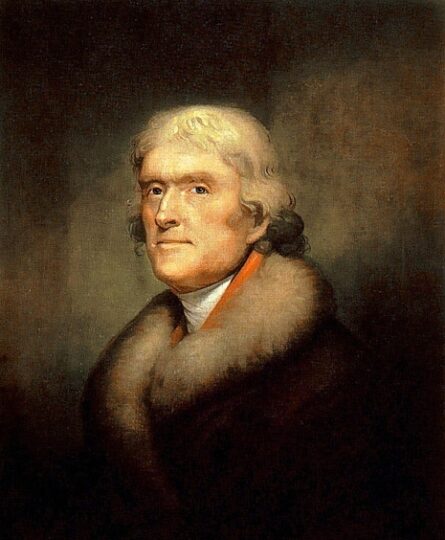
Thomas Jefferson, by Rembrandt Peale. Library of Congress image
In his Autobiography Jefferson recounted the 1786 passage of the law he proposed in 1779 to secure religious freedom in Virginia, the Statute for Religious Freedom:
The bill for establishing religious freedom, the principles of which had, to a certain degree, been enacted before, I had drawn in all the latitude of reason and right. It still met with opposition; but, with some mutilations in the preamble, it was finally passed; and a singular proposition proved that its protection of opinion was meant to be universal. Where the preamble declares, that coercion is a departure from the plan of the holy author of our religion, an amendment was proposed, by inserting the word “Jesus Christ,” so that it should read, “a departure from the plan of Jesus Christ, the holy author of our religion;” the insertion was rejected by a great majority, in proof that they meant to comprehend, within the mantle of its protection, the Jew and the Gentile, the Christian and the Mahometan, the Hindoo, and the Infidel of every denomination.
Life and Selected Writings of Thomas Jefferson, Modern Library 1993 edition, pp. 45 and 46.
* Image is a photo of detail from a painting of Jefferson by Rembrandt Peale, courtesy of the New York Historical Society by way of the Library of Congress.
Spread the word; friends don't allow friends to repeat history.
2 Comments | America's founding, First Amendment, Good Quotes, Religious Freedom, Thomas Jefferson | Permalink
Posted by Ed Darrell
July 31, 2006
School starts soon. History classes will study the founding of the United States. And especially under the topical restrictions imposed by standardized testing, many kids will get a short-form version of history that leaves out some of the most interesting stuff.
James Madison gets short shrift in the current canon, in my opinion. Madison was the fourth president, sure, and many textbooks note his role in the convention at Philadelphia that wrote the Constitution in 1787. But I think Madison’s larger career, especially his advocacy for freedom from 1776 to his death, is overlooked. Madison was the “essential man” in the founding of the nation, in many ways. He was able to collaborate with people as few others in order to get things done, including his work with George Mason on the Virginia Bill of Rights, with George Washington on the Constitution and national government structure, Thomas Jefferson on the structure and preservation of freedom, Alexander Hamilton on the Constitution and national bank, and James Monroe on continuing the American Revolution.
We need to look harder at the methods and philosophy, and life, of James Madison. This is an opinion I’ve held for a long time. Below the fold I reproduce a “sermon” I delivered to the North Texas Church of Freethought in November 2001. Read the rest of this entry »
Spread the word; friends don't allow friends to repeat history.
2 Comments | 1789, America's founding, Freedom - Political, History, James Madison, Religious Freedom, Thanksgiving, U.S. Constitution | Permalink
Posted by Ed Darrell
July 27, 2006
I added a link to a lively blog, to the blogroll (Faucets of information) on the side: Boston 1775. The blog’s author, J. L. Bell, tends to provide the interesting details that tip the scale towards understanding, especially on the motivations of the people of Boston at in the key year of 1775.
To the great benefit of his readers he strays a bit outside of 1775 on occasion. Bell is an active, practicing historian, something a lot of high school kids never see. 1775 was a key year, with the British occupying Boston and the American rebel forces laying siege to the city — all before the Declaration of Independence.
Take a look. Especially see his recent post, Marginalizing rhetoric, in which he explores what makes people regard Sam Adams as a “radical” when he was actually a very conservative man; and George Washington’s signing statements, in which he explores the views of our first president on an issue that vexes many today.
Good historians make history come alive in our minds. Bell does that well, and you would do well to check out his site. I plan to check it out frequently.
Spread the word; friends don't allow friends to repeat history.
Leave a Comment » | America's founding, History | Permalink
Posted by Ed Darrell
July 26, 2006
Dispatches from the Culture Wars features a set of comments on an interview right-right-wing pundit John Lofton did with Roy Moore, the former chief justice of Alabama’s Supreme Court who lost his job when he illegally tried to force his religion on the court and on Alabama. This year Moore ran for governor of Alabama, losing in the primary election.
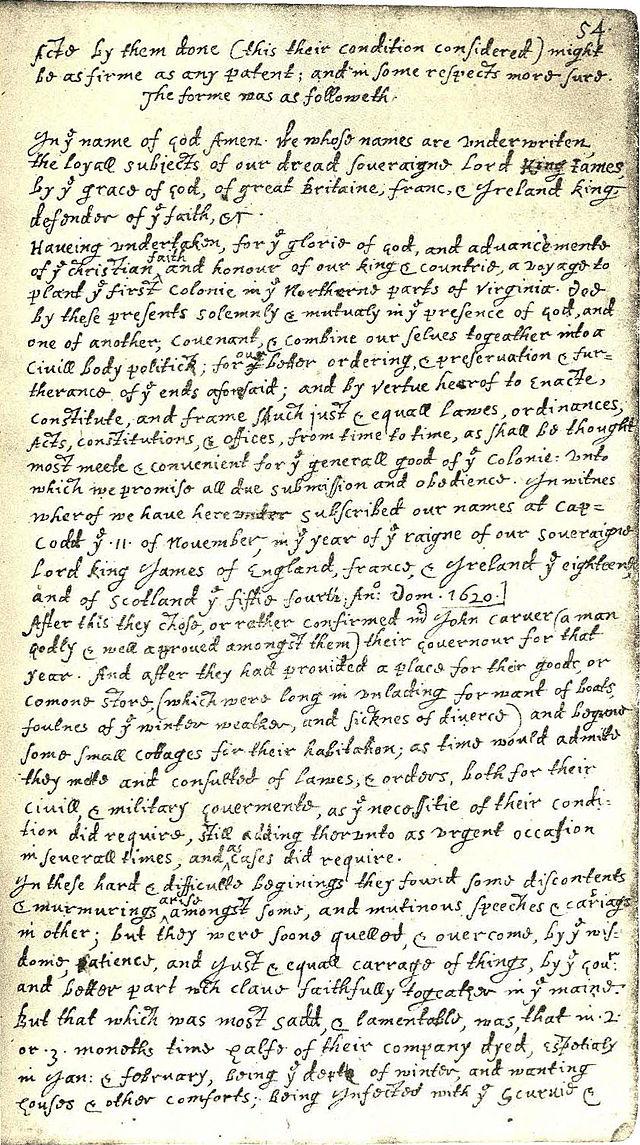
Mayflower Compact. It’s a contract between people. God is a witness, but not a party.
One of the grandest canards in current thought about U.S. history is that the Mayflower Compact set up a theocracy in Massachusetts. Lofton and Moore banter about it as if it were well established fact — or as if, as I suspect, neither of them has looked at the thing in a long time, and that neither of them has ever diagrammed the operative sentence in the thing.
The Mayflower Compact was an agreement between the people in two religiously disparate groups, that among them they would fairly establish a governing body to fairly make laws, and that they would abide by those laws. Quite the opposite of a theocracy, this was the first time Europeans set up in the New World a government by consent of the governed. That is something quite different from a theocracy. Read the rest of this entry »
Spread the word; friends don't allow friends to repeat history.
4 Comments | America's founding, History Revisionism, Religious Freedom, U.S. Constitution | Permalink
Posted by Ed Darrell




 Millard Fillmore's Bathtub