Afarensis left the Seed stable. Here’s the new (old) site.

Afarensis skull - symbol of Afarensis blog
Some story there, maybe some drama, maybe not much. Still worth reading.
Afarensis left the Seed stable. Here’s the new (old) site.
Afarensis skull - symbol of Afarensis blog
Some story there, maybe some drama, maybe not much. Still worth reading.
 Leave a Comment » |
  Anthropology, Archaeology, Science, Weblogs | Tagged: Anthropology Weblogs, Archaeology, Science |
  Permalink
 Posted by Ed Darrell
Okay, now Four Stone Hearth can apply for Social Security. It has come of age.
Seriously, FSH 65, hosted by Primate of Modern Aspect, continues the tradition of that particular carnival with great links to great research, in anthropology, archaeology, and linguistics.
Hobbits? Chimps? Linguistics? Brains? It’s all there. Go see.
Leave a Comment » | Ancient history, Anthropology, Archaeology, Fossils, History, Science | Tagged: Anthropology, Archaeology, Four Stone Hearth, Hobbits, Linguistics, Research, Science | Permalink
Posted by Ed Darrell
Do you have to know geology to get the title of that blog?
Four Stone Hearth 64 is hosted by Quiche Moraine. Lots of good stuff. F’rinstance:
With a few hours, an ambitious teacher could get 20 or 30 good bell-ringers out of FSH. Bell ringers based on real research — what a concept.

A modern version of an ancient hearth - State Cooking Pot of Utah, the Dutch oven - photo by Jason Slemons
1 Comment | Ancient history, Anthropology, Archaeology, History, History and art, Paleontology, Prehistory, Research, Science | Tagged: Ancient history, Anthropology, Archaeology, Blog Carnival, Four Stone Hearth, History, Linguistics, Paleontology, Prehistory, Research, Science | Permalink
Posted by Ed Darrell
Welcome to the 63rd edition of Four Stone Hearth (4SH), the only blog carnival on the planet dedicated entirely to the four stone foundations of modern anthropology. We’re happy to invite readers in for a soak at Millard Fillmore’s Bathtub.
It’s spring, and in spring a young anthropologist’s fancy turns to thoughts of . . . grading papers, maybe love, getting ready to dig over the summer, finishing up the term, love, getting the snow tires off the car, the Texas State Board of Education, if not love then maybe a good dinner companion, finishing the paper up for publication (where?), how to finance next semester, how to stretch the grant, love in the future, where to get the next grant . . . almost everything but submitting entries to that history and social studies guy at Millard Fillmore’s Bathtub.

Need some cowboy coffee?
Interesting entries this edition, but in onesies and twosies, not by dozens. Trusting that the enterprise is blessed by the patron saints (St. Damasus I, or St. Helen, for archaeologists; is there a patron saint for anthropology or linguistics? In a pinch we can just invoke St. Francis de Sales, the patron saint of writers and authors), we push on.
The Four Stone Hearth name pays homage to four areas of anthro: Archaeology, socio-cultural anthropology, bio-physical anthropology and linguistic anthropology. Shorter form: What humans did, and a bit of what we do.
So, grab a cup of cowboy coffee (the favorite of diggers and backpackers, and sheep herders). In no particular order, and in no particular theme, here’s what caught our fancies over the past couple of weeks:
Globalization — love it or hate it — how does it really affect us? The Spitoon comments on newly-published research that reveals people are choosing mates from farther abroad than before. At least, that’s what our genes show. People don’t marry people from their own village so much. Unanswered: How does this affect human evolution?
Digital Archaeology: Colleen Morgan at Middle Savagery, demonstrates the clash between the earthen and the electronic — she spoke on a panel at SXSW (“South By Southwest”), the massive, hip music conference and riot in Austin, Texas. Topic: The Real Technology of Indiana Jones. It starts out with a promising description: “Archaeologists no longer rely on whips and fedoras . . .” The panel also featured Bernard Frischer of the University of Virginia, and Adam Rabinowitz, University of Texas at Austin. “Notes and tweets” from the panel.

Cover to Goldschmidt's book, The Bridge to Humanity, Oxford Press
Does morality have any connection to evolution — Appropriate for the opening day of hearings and voting on Texas public school science standards, Greg Downey at Neuroanthropology looks at the evolution of altruism, with a review and commentary on Walter Goldschmidt’s book, The Bridge to Humanity. Goldschmidt notes that selfish genes don’t explain everything, and that there’s probably a good function to a baby’s being very cute. (Goldschmidt must hang out at our PTA meetings: “It’s a good thing the kid’s so cute, or he’d have been dead long ago.”) “Affect hunger” is not a common phrase in daily conversations, and it deserves a solid explanation. Altruism cannot form naturally, many education officials in Texas believe, and so they oppose teaching evolution in public schools. They’ll be too busy to read this article before they vote on Friday — but they should read it, and maybe the book, too.
Martin Rundkvist at Aardvarchaeology offers a lighter but critical note, on putting ice cream sticks in museums. Archaeological museum weirdness. What should a museum be? In the past 14 months I’ve had the pleasure of spending time (on someone else’s dime!) at the Abraham Lincoln Presidential Library and Museum in Springfield, Illinois, and at the greatly expanded museum and visitor center at Mount Vernon, Virginia, George Washington’s estate. In these places there is a concerted effort to make museums more informative, more inviting, and more focused on education missions. Both museums feature multimedia presentations designed to kick off anyone’s visit with a punch, holographic images in Springfield, and theater seats that kick and get snowed on at Mount Vernon.

Tuamatuan Conception of the Cosmos, by Paiore. Inspiration for Margaret Mead's fieldwork in American Samoa. Running After Antelope
RafRaf Girls notes that someone is collecting images used to illustrate anthropology, linguistics and social theory. It’s a form of on-line museum, and Martin’s concerns are well directed: How much of this stuff should be preserved, especially if the preservation perpetuates odd ideas or misinformation? Browse the images, see for yourself. Nice to know it’s there, if you need it. (Is all this stuff from Running After Antelope?)
Again at Neuroanthropology, Daniel Lende offers what a reader in comments calls “the best damn article on alcoholism” in “The Insidious, Elusive Becoming: Addiction in Four Steps.” I thought it ironic that the post is illustrated with a diagram showing how to tie the famous knot, the bowline, in four steps. Every Girl Scout and Boy Scout knows the bowline is the “lifesaving knot,” a knot that is used to tie loops used to hoist people from danger. The bowline will not slip, and so will not suffocate the victim upon lifting. Addiction is no bowline. Falling into addiction involves four steps Lende outlines, basing the title on a line from Caroline Knapp’s Drinking: A Love Story.
But we do know much more about the process of becoming than we used to. Here I will outline four important factors that shape the terrible becoming – vulnerability, training, intention, and meaning. My focus will be on understanding the subjective transformations, and I will use Knapp’s own words and experiences to help us grasp how this happens. In a forthcoming post, I will address a core biological process—competitive plasticity—that acts as the complement to this description, a process that has also helped me see the interactions in new light.
A Primate of Modern Aspect (formerly Zinjanthropus?) offers what I thought to be a fascinating story about studying the inner ears of fossilized primates, “Navigating the Bony Labyrinth.” It’s a continued exercise in pulling paleontology out of the usually-imagined realm of dusty reconstructions in badly-lighted corners of musty museums.
Fossil primates can pose some especially interesting questions to a paleoprimatologist. Because they live in trees, many different kinds of locomotion are possible. We can look at limb proportions to see if the little guys were clinging to vertical supports and then leaping from them, or perhaps walking on top of thick, horizontal branches, or maybe even swinging below these brances. We can look at the shape of the scapula to see whether the animal kept its arms underneath itself or used them to reach out to the side or above itself. We can look at the fingers to see if they were grasping branches or balancing above them. In species known only from cranial bones, we can also look at the ear bones to see how these guys positioned themselves while in the trees.
It’s spring, I know, and we are hopeful. Politics and war push on, however, and they push into the fields of science we love. Some things we would like to confine to dusty corners of musty museums, like war.
Afarensis notes that the coup d’etat in Madagascar threatens lemurs in the forests of the island.
It’s on the fringes of blogging, but well worth knowing about: San Diego City Beat tells a story of guerrilla archaeology, beating the construction of the border fence between the U.S. and Mexico to get a dig done, “Hush hush archaeology.”
It’s spring, and students in American schools look forward (ha!) to the standardized tests they must take under the New Regime. I was interested to see Kris Hirst has started a weekly quiz, this week about bog bodies — just the sort of stuff I need for my classroom to take out the tension and get kids to think. Now, if only it were on PowerPoint, or in a form I could just print off to open a class . . .
Wish us luck here in Texas this week. Science standards, especially evolution studies, are on the grill before the State Board of Education, where creationists hold sway. If you know someone in Texas, you may want to persuade them to call their representative on the state board. No scientist is an island, as John Donne would have said had he thought a bit longer about it. How Texas goes will affect us all.
Four Stone Hearth #64 returns to the hands of people who know a bit about the topic, at Quiche Moraine.
Thanks for reading. Remember to send your nominations for the next edition to Quiche Moraine, or to Martin.
Friends of Four Stone Hearth, sites that link to this edition (if you’ve linked and I missed it, please note it in the comments):
6 Comments | Anthropology, Archaeology, Evolution, History, Paleontology, Research, Science | Tagged: 4 Stone Hearth, Anthropology, Archaeology, Evolution, Four Stone Hearth, History, Linguistics, Paleontology, Research, Science | Permalink
Posted by Ed Darrell
Four Stone Hearth #63 comes for a soak in Millard Fillmore’s Bathtub on March 25. Zounds! That’s next week!
You can start sending in nominations now. Drop a note to me here — edarrell AT sbcglobal DOT net — or send them to Martin Rundkvist, who keeps the fire burning on the original four big stones (and blogs at Aardvarchaeology).
The Four Stone Hearth is a blog carnival that specializes in anthropology in the widest (American) sense of that word. Here, anthropology is the study of humankind, throughout all times and places, focussing primarily on four lines of research:
- archaeology
- socio-cultural anthropology
- bio-physical anthropology
- linguistic anthropology
Each one of these subfields is a stone in our hearth

Marriage of Bathtub and Hearth, at Cape San Blas, Florida - yours for just $1.7 million! Four Stone Hearth, much cheaper.
Leave a Comment » | Anthropology, Archaeology, Science, Weblogs | Tagged: Anthropology, Archaeology, Blog Carnival, Four Stone Hearth, History, Linguistics, Science | Permalink
Posted by Ed Darrell
Oh, yeah, they call it the Ossa Edition. Or OSSA Edition — but they are the Swedish Osteological Association, and we all know they mean bones.
4 Stone Hearth #62 is up at Osteologiska föreningen.
Great stuff, as usual.
And I mention it because Millard Fillmore’s Bathtub will host the next edition of 4 Stone Hearth. No bones about it.
Since I am dense as a stone about some of the great issues this carnival involves, I’m hopeful there will be plenty of good, early entries . . .
The Four Stone Hearth is a blog carnival that specializes in anthropology in the widest (American) sense of that word. Here, anthropology is the study of humankind, throughout all times and places, focussing primarily on four lines of research:
- archaeology
- socio-cultural anthropology
- bio-physical anthropology
- linguistic anthropology
Each one of these subfields is a stone in our hearth.
Four Stone Hearth is published bi-weekly, Wednesdays in odd-number weeks. If you would like to host the carnival, please write to Martin Rundkvist.
If you would like to submit content to the next issue of the carnival, please write to the keeper of the blog in question [Millard Fillmore’s Bathtub] or to Martin. You are encouraged to submit other bloggers’ work as well as your own.
So, cook something up to bring to the next Four Stone Hearth. It’s pot luck, the more stuff you bring, the more to share. Please include a mention of Four Stone Hearth in your e-mail’s title. I get a lot of e-mail, and I hate to miss anything important.
In the interim, take a good look at FSH #62. Several posts drive directly at the work scientists do with wonderful details about how they do it. It’s a bit of a slog to follow me to this conclusion, but I was struck by the amount of work required, the careful ways these guys go about it, and the way the work itself rather exposes the paucity of grounding of pseudo sciences. Science is under attack here in Texas, so I’m a little sensitive to that issue. Give it a look.
I love a good carnival!
Leave a Comment » | Ancient history, Anthropology, Archaeology, History, Research, Science, Weblogs | Tagged: Archaeology, Blog Carnival, Linguistics | Permalink
Posted by Ed Darrell
Anthony Watts want to make a case that rising ocean levels aren’t connected to human activities, there’s nothing we can do about it, there’s nothing we should do about it, or something. Looking for a touchstone in history, Watts said:
In 2002, the BBC reported that a submerged city was found off the coast of India, 36 meters below sea level. This was long before the Hummer or coal fired power plant was invented. It is quite likely that low lying coastal areas will continue to get submerged, just as they have been for the last 20,000 years.
Submerged city? Hmm. Not in the textbooks published since 2002. What’s up with that?

NASA Earth Observatory photo of the Gujarat Gulfs, including the Gulf of Cambay (Khambhat), where a "lost city" was thought to have been found in 2001; later research indicates no city underwater.
Oh, this is what’s up: Watts links to a BBC news story, not a science journal — one of the warning signs of Bogus Science and Bogus History, both. The news story talks about preliminary findings in 2002 that did not hold up to scrutiny. Measurement error was part of the problem — the pattern of the scanning radar sweep was mistaken for structures found on the sea floor. Natural formations were mistaken for artificial formations. When the news announcement was made, archaeologists and other experts in dating such things had not be consulted (and it’s unclear when or whether they were ever brought in). The follow-up didn’t support the story, notes Bad Archaeology. Terrible archaeology to support pseudo climate science? Why not?
This doesn’t deny Watts’ general claims in his post, but it is too indicative of the type of “find anything to support the favored claim of denial” mindset that goes on among denialists. (There is evidence of a much lower waterline in the area during the last ice age; water levels have risen, according to physical evidence, but probably not inundating the what would be the oldest civilization on Earth.)
It will be interesting to watch what happens. Will Watts note an oopsie and apologize, or will the entire group circle their Radio Super wagons around the issue and call it a mainstream science plot against them? Will Watts correct his citation, or will they move on to cite the disappearance of Atlantis as evidence that warming can’t be stopped?
Anybody want to wager?
What sort of irony is there in a guy’s complaining about a scientific consensus held by thousands of scientists with hundreds of publications supporting their claims, and his using one news report almost totally without any scientific corroboration in rebuttal?
Resources:
1 Comment | Ancient history, Archaeology, Bogus history, Climate change, Global warming, History, Prehistory, Science, Voodoo history, Voodoo science | Tagged: Anthony Watts, Archaeology, Bogus history, bogus science, Cambay, Climate change, denialism, Global warming, Gulf of Cambay, History, India, Khambhat, Lost City, Science, Voodoo history, Voodoo science, Watts Up With That | Permalink
Posted by Ed Darrell
Four Stone Hearth #60 is up, hosted by Middle Savagery.
Yes, I know, I’ve been remiss in carnivalling lately. Heck, I’ve been remiss in posting. The water in the Bathtub is actually too cold for bathing at the moment, as I’m away metaphorically, working on serious curriculum matters.
So, it’s a good time to take a look at something like the best archaeology blog carnival around. It’s up to edition Number 60? Great news, really, that there is so much material to cover. There is some delightful morsel in every edition.

Bad Death Ritual - See the entire post at Ideophone: "A 'bad death' ritual in Ghana's Volta Region. On the village cemetery, relatives of a man who died in a hunting accident listen anxiously to a woman who is possessed by the spirit of the deceased. The hunters, who have just brought the spirit home from the place of the accident deep in the jungle, keep their distance. Red is the colour of danger, black that of death." Photo by Mark Dingemanse
FSH #60 is heavy on photos — grist for your better slide presentations, no?
Zenobia, Empress of the East looks at a project that used lasers to scan a bas relief on a rock in the 3rd century A.D. Parthian empire — er, maybe Persian — but wait! Is that Greek influence in that carving?
This extraordinary relief is carved on a huge limestone boulder at the cliff edge of a remote, not to say ‘hidden’ valley in the rugged mountains of northeastern Khuzistan [at the southwestern edge of the Iranian plateau, sharing a border with southern Iraq (= the big red blob on the map, below right)]. In ancient times, this was the heartland of Elymais, sometimes a small empire, more often a vassal to more powerful states.
21st century technology and science applied to help solve a 700-year-old mystery. Does archaeology get much better than that?
Especially if you’re inclined to study Neanderthals, or for a great sidebar on the value of biodiveristy, take a look at Remote Central’s post on the last stand of Neanderthal, on Gibralter.
There is much more in Four Stone Hearth #60.
1 Comment | Ancient history, Anthropology, Archaeology, Art, History and art, History images, History Methods and Tools, Research, Science, Weblogs | Permalink
Posted by Ed Darrell
Fred Wendorf, an in-the-digs sort of archaeologist, will talk about his life and work Thursday night at the DeGolyer Library.
Remember, teachers who call in advance may earn continuing education credit from the SMU History Department.
This will be a good session for geography and world history teachers, and probably for U.S. history teachers, too.
(SMU PRess, 2008)
Fred Wendorf
Henderson-Morrison Professor of Prehistory
Emeritus, Southern Methodist University
Thursday, February 5, 2009
6:00 pm reception.
6:30 pm lecture followed by book signing
DeGolyer Library
Southern Methodist University
6404 Hilltop Lane at McFarlin“Archaeologists know that Fred Wendorf’s expeditions produced most of what we know about the Stone Age prehistory of northeastern Africa. They also realize that he contributed centrally to the archaeology of the American Southwest before he focused his talents on Africa. They know he’s consistently reported his research in timely, thorough, and lucid monographs. In this book, they’ll discover he can also describe, with modesty and candor, the circumstances that shaped his extraordinary career.”—Richard Klein, Professor of Biology and Anthropology and Bass Professor in Humanities and Sciences, Stanford University
“Celebrated by his colleagues in the Americas, Europe, and Africa as a brilliant innovator who made significant advances in archaeological method and theory, Fred Wendorf has been a dominant figure in American and North African archaeology in an extremely productive career spanning nearly six decades. His engaging autobiography chronicles his personal and professional lives—warts and all.”—Don D. Fowler, Mamie Kleberg Distinguished Professor of Anthropology Emeritus, University of Nevada-Reno
“Fred Wendorf is an archaeological Midas. He and his collaborators have written the prehistory for vast swaths of the Sahara, work thatinvolves adventure, decades-long persistence, and the ability to piece together seemingly irreconcilable small pieces of a very large jigsaw puzzle.”—John Yellen, president of the Paleoanthropology Society and for many years an excavator in Kenya, Ethiopia, and the Congo
“Wendorf’s rousing good story of archaeological adventures in harsh desert environments demonstrates that real archaeological adventures are only made possible by good planning, sound organization, scientific discipline, and hard work.”—Raymond H. Thompson, Riecker Professor of Anthropology Emeritus, University of Arizona, and Director Emeritus, Arizona State Museum
FRED WENDORF, Henderson-Morrison Professor of Prehistory Emeritus, Southern Methodist University, grew up in Terrell, Texas, was wounded as a lieutenant serving in Italy during World War II, received his Ph.D. from Harvard, and spent more than sixty years as a field archaeologist in this country and in Africa. In 1987 he was elected to the American National Academy of Sciences.
To register for this event, please click here.
Leave a Comment » | Anthropology, Archaeology, History, Science | Tagged: Africa, Archaeology, Desert Southwest, History, Science | Permalink
Posted by Ed Darrell
Listverse has a list called “The top 10 signs of evolution in modern man.”
It’s a decent, well-intentioned list, but is it really the “top 10?” What about DNA? Shouldn’t our relationships to other creatures as demonstrated by DNA make at least the top 10 list?
Here’s the list:
10. Goose bumps
9. Jacobson’s Organ
8. Junk DNA
7. Extra ear muscles
6. Plantaris muscle
5. Wisdom teeth
4. Third eyelid
3. Darwin’s point
2. Coccyx
1. Appendix
I think there are some difficulties with the list, too. There are minor problems, such as calling vestigial DNA “Junk DNA” when we know much of it still functions. And there are major problems, like missing the ancestry aspects of DNA. The appendix is known to play roles in the immune system, so some of the claims appear dated.
But I still wonder: Are these the real top 10? How about our inablity to manufacture vitamin C? How about the vagus nerve’s loop from the head down to the heart and back up?
What do you think, Dear Reader? If we make a list of the top 10 signs of evolution in modern humans, what goes on that list? Please include links in your post, if you have them (the spam filter will kick in at five links, so let me know if you’ve got more than five).
And, is there any value to such a list?
Tip of the old scrub brush to Gnomestrath.
Resources:
4 Comments | Anthropology, Archaeology, Biology, Evolution, Paleontology, Science | Tagged: Biology, Evolution, Genetics, human evolution, Science, Top Ten List | Permalink
Posted by Ed Darrell
Cognition and Culture hosts the 54th edition of 4 Stone Hearth, the blog carnival on issues archaeological. Interesting venue — solidly academic, and a valuable resource for teachers all by itself.
It’s a great carnival, really — marriage, poetry, and even a video of a new toy from Bandai.
And on a related note, here’s a post that ought to make the 55th edition of 4 Stone Hearth: Remote Central found a list of the top 100 anthropology blogs. Useful searching. There be great resources for the classroom, I’ll wager.
2 Comments | Ancient history, Anthropology, Archaeology, Research, Weblogs | Tagged: Ancient history, Anthropology, Archaeology, Education, Four Stone Hearth, marriage | Permalink
Posted by Ed Darrell
A sure sign of scientific naiveté, especially among those of the creationist religion, is the raft of pseudo complaints about dating the ages of objects, especially fossils, through the use of radioisotopes.
First, creationists will complain that dating things with radiocarbon is impossible. They aren’t sure why they think that, but it just makes sense to them that radioactivity in stones can’t be used to tell time, and don’t confuse them with any information about how their watches on their wrists are driven by electric currents sent through quartz crystals, and for God’s sake do not confuse them with any references to quantum theory and the workings of the cell phones most of them use to tell time since they evolved to lose the ability to read analog watches anyway (evolution always is to the detriment of the creature they believe, and try to demonstrate).
Then, without any hint that they understand or even see the irony, creationists complain that scientists lie when they say isotope dating puts the age of the Earth and the Moon at about 4.5 billion years, because, they observer, carbon dating is only good to about 50,000 years in most circumstances, and certainly no more than 100,000 years. Don’t confuse them by telling them that dating of rocks almost always involves an isotope of an element other than carbon, like uranium.
As if to prove their science untrainability, from time to time a creationist will send a sample of something to a lab, asking that it be dated. When the lab returns a date of several million years for the stuff dated, the creationists crow that they had crushed a brick, or in some other way provided a tainted sample, and they’ve “proven” that carbon dating doesn’t work.
Aardvarchaeology offers a quick primer on carbon dating, “Think before you carbon date.” Bookmark the site. It’s a good rebuttal for whatever pseudo science claims creationists make about carbon dating.
Real scientists have to do real work. Radiocarbon dating, or any isotope dating, is usually pretty expensive as a general rule. It’s not something to be done lightly. In addition to the expense, to get the dating done correctly, there is a lot of preparation to be done. Martin Rundkvist details the process, from a live project of his. If you read his piece carefully, you note that he’s giving a primer in dendrochronology, too, the science of dating by tree rings.
Real science is always more interesting than creationists can imagine. Go see how it works. Great stuff
5 Comments | Accuracy, Archaeology, Creationism, Education, Evolution, History, Physics, Science, Technology | Tagged: Archaeology, Creationism, Dendrochronology, Evolution, History, Radiocarbon dating, Science, Technology, Tree Rings | Permalink
Posted by Ed Darrell
Oh, the life of the globe-trotting, Indiana Jones-style archaeologist!
Millard Fillmore’s Bathtub brought you the world’s oldest animation.
MFB brought you the world’s oldest playable musical instrument.
And now, with a tip from Dr. Bumsted at Grassroots Science, the world’s oldest joke. It’s a one-liner about flatulence.
Academics have compiled a list of the most ancient gags and the oldest, harking back to 1900BC, is a Sumerian proverb from what is now southern Iraq.
“Something which has never occurred since time immemorial; a young woman did not fart in her husband’s lap,” goes the joke.
Perhaps it loses something in the translation from Sumerian. (The oldest animation comes in at 5,200 years, the oldest joke at about 3,900 years — cartoons lacked punch lines for more than 1,000 years?)
“Jokes have varied over the years, with some taking the question and answer format while others are witty proverbs or riddles,” said Dr Paul McDonald, who led the study by academics at the University of Wolverhampton.
“What they all share, however, is a willingness to deal with taboos and a degree of rebellion.”
My students complain my jokes are too dry as it is. Should I try to work these into the presentations?
As today, world leaders make good foils for ancient humour, particularly Egyptian pharaohs, as shown by this 1600BC joke:
“How do you entertain a bored pharaoh? Sail a boatload of young women dressed only in fishing nets down the Nile – and urge the pharaoh to go fishing.”
One Roman jape dating back to the 1st Century BC details the Emperor Augustus touring his realm and coming across a man who bears a striking resemblance to himself.
Intrigued, he asks the man: “Was your mother at one time in service at the palace?”
The man replies: “No your highness, but my father was.”
Full press release on the World’s Ten Oldest Jokes, from the University of Wolverhampton and the full list of the jokes from Dave TV, below the fold.
5 Comments | Ancient history, Anthropology, Archaeology, History, Humor, psychology, Science | Tagged: Archaeology, History, Humor, psychology, Science | Permalink
Posted by Ed Darrell
Summer travel has me farther behind than I imagined!
Two editions of Four Stone Hearth whizzed by in the past three weeks. Number 45 was hosted by Remote Central, “Caves, Graves and Audio Files Edition (with a tip to a post from Millard Fillmore’s Bathtub); Number 46 is out today at Testimony of the Spade.
In #45: Open Anthropology notes concerns about archaeological digs in Iraq during the U.S. military operations; you’ll need to follow threads around, since some of the sources referred to were deleted after the post appeared. This is the 100th anniversary of the finding of a famous Neandertal specimen which has fueled all sorts of misconceptions about Neandertal and evolution; Writer’s Daily Grind has a remembrance, “Happy 100th, La Chapelle aux Saintes!” Some people even worry about how we will structure our societies when we take to touring the stars. There’s a lot more, at Remote Central.
Check out these things in #46: Texas history teachers, and U.S. history teachers will want to look at the “dig” in the Gulf of Mexico from Remote Central; also, check out the post at Hot Cup of Joe on the Serpent Mound in Ohio (pre-history should come fairly quickly in August or September, no?). Be sure to check out this post at John Hawks’ Weblog on teaching science, and teaching humanities.
Leave a Comment » | Anthropology, Archaeology, Education, History, Paleontology, Science | Tagged: Archaeology, Education, Evolution, Pre-history, Research, Science | Permalink
Posted by Ed Darrell
Don’t know how I missed this story earlier: Actor Harrison Ford won election to the Board of Directors of the Archaeological Institute of America (AIA).
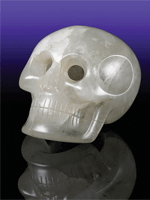
Caption from AIA's Archaeology: "In 1992, this hollow rock-crystal skull was sent to the Smithsonian anonymously. A letter accompanying the 30-pound, 10-inch-high artifact suggested it was of Aztec origin. (James Di Loreto & Donald Hurlburt/Courtesy Smithsonian Institution)"
He doesn’t just play one on the silver screen — he is one. Or at least, he’s part of the professional association. The press report from AIA stressed Ford’s support for archaeology and knowledge.
The Archaeological Institute of America is North America’s oldest and largest non-profit organization devoted to archaeology. With more nearly a quarter of a million members and subscribers and 105 local chapters, it promotes archaeological excavation, research, education, and preservation on a global basis. At the core of its mission is the belief that an understanding of the past enhances our shared sense of humanity and enriches our existence. As archaeological finds are a non-renewable resource, the AIA’s work benefits not only the current generation, but also those yet to come in the future.
“Harrison Ford has played a significant role in stimulating the public’s interest in archaeological exploration,” said Brian Rose, President of the AIA. “We are all delighted that he has agreed to join the AIA’s Governing Board.”
AIA was chartered by Congress in 1906 — a full decade before the Boy Scouts of America, for comparison — with a charge to help enforce the Antiquities Act ().
More interesting, and more useful in the classroom, are the story and sidebar in the online magazine of the Institute, which notes that the crystal skull stories involve faked artifacts — and even that the idol in the opening scene of the very first Indy movie involves a faked artifact.
“Legend of the Crystal Skulls: The truth behind Indianapolis Jones’s latest quest” tells a great story by Jane MacLaren Walsh, a true story, the best kind for history buffs.
Sixteen years ago, a heavy package addressed to the nonexistent “Smithsonian Inst. Curator, MezoAmerican Museum, Washington, D.C.” was delivered to the National Museum of American History. It was accompanied by an unsigned letter stating: “This Aztec crystal skull, purported to be part of the Porfirio Díaz collection, was purchased in Mexico in 1960…. I am offering it to the Smithsonian without consideration.” Richard Ahlborn, then curator of the Hispanic-American collections, knew of my expertise in Mexican archaeology and called me to ask whether I knew anything about the object–an eerie, milky-white crystal skull considerably larger than a human head.
I told him I knew of a life-sized crystal skull on display at the British Museum, and had seen a smaller version the Smithsonian had once exhibited as a fake. After we spent a few minutes puzzling over the meaning and significance of this unusual artifact, he asked whether the department of anthropology would be interested in accepting it for the national collections. I said yes without hesitation. If the skull turned out to be a genuine pre-Columbian Mesoamerican artifact, such a rare object should definitely become part of the national collections.
I couldn’t have imagined then that this unsolicited donation would open an entirely new avenue of research for me.
Great story. In the classroom, it shows the methods of archaeologists and historians. Walsh reveals how archaeologists work, and along the way she details a lot of the history that prompts adventure stories like the Indiana Jones series.
Archaeology, the real stuff, never nukes the fridge.
File these links and this article away. The new movie in the “Mummy” series with Brendan Fraser in the starring role, is due out August 1, “The Mummy: Tomb of the Dragon Emperor.” The new movie is set on a dig in China, presenting more opportunities to use popular entertainment as an entré to real history, and real science (and probably all sorts of historical errors to correct).
But while the latest Indiana Jones epic reunites Jones with Marian Ravenwood played by Karen Allen, Rachel Weisz doesn’t appear in the pending Mummy installment. Weisz was replaced by another actress playing Evelyn O’Connell.
6 Comments | Ancient history, Archaeology, Education, Fake Artifacts, History, Hoaxes, Movies, Museums, Prehistory, Research, Science | Tagged: Archaeology, Harrison Ford, History, Indiana Jones, Movies, Science | Permalink
Posted by Ed Darrell
You are currently browsing the archives for the Archaeology category.


Ed Darrell on Texas's Colorado River


Come on in, the water's fine. Come often: Cleanliness is next to godliness.


 Millard Fillmore's Bathtub