Millard Fillmore waxes on

April 5, 2013

Millard Fillmore at Madame Tussaud's, D.C.

President Millard Fillmore, as displayed at Madame Tussaud’s Wax Museum, Washington, D.C.; photo from About.com

Ever on the lookout for images of Millard Fillmore, I found this photo at About.com.  This is the “wax” sculpture of Fillmore displayed at Madame Tussaud’s Wax Museum – D.C.

Is it art?

More:


Renaissance shadow over contemporary art: Penultimate suppers (an encore)

March 24, 2013

It’s that Easter season among western Christian sects; this is Holy Week, which commemorates Jesus’s final entry into Jerusalem and the events leading Jesus’s crucifixion.

Our congregation will stage a “living” Last Supper a la da Vinci, which got me to thinking about the painting, which reminded me of this post from years ago; some minor updating, and I’ve added a new version I found from ABC’s series, “Lost,” which was in the middle of its run when I posted this originally in 2008:

Jeremy Barker at Popped Culture assembled more than 30 versions of contemporary recastings of DaVinci’s painting of “The Last Supper.” There’s the Simpsons version, the cartoon version with Disney and Warner Bros. characters. There’s the Sopranos version, and the Battlestar Galactica version.

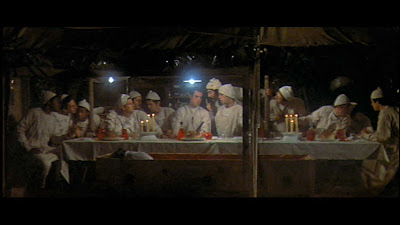
For example, the Robert Altman version, from M*A*S*H:

Last Supper, M*A*S*H style

Last Supper, M*A*S*H style

If you need a 20 minute lesson on the influence of Renaissance art on contemporary art, this is one many high school kids may find interesting, if not amazingly historically informative. I suspect there is a great lesson plan hiding in there about 20th century history as reflected in parody art.

It’s a brilliant and subtle demonstration of the power of DaVinci’s art that there are so many copy cat pictures, don’t you think?

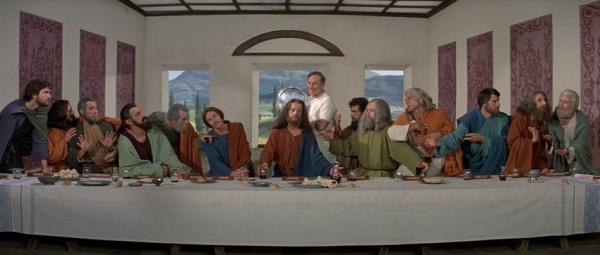
I did notice, however, that Barker left out the Mel Brooks version, from “History of the World, Part I.” It may not fit the meme.

Mel Brooks'

“Last Supper” as portrayed in Mel Brooks’s “History of the World, Part I”

Finally, looking today I found this “Lost” version of the Last Supper at Art is Everywhere, showing the meme is live and well.

“Lost” Last Supper; probably a publicity still, found at Art is Everywhere.

Do you have favorite parodies or homages of the Last Supper left off of these lists of 31 different versions?  By all means, list them in comments, with links if you have them.

Resources:

Resources added in 2013:


Woodbadge sundancers, Heart of Virginia Council, BSA

March 6, 2013

This will make some Woodbadgers jealous:

Woodbadge stained glass, Heart of Virginia Council, BSA

Stained glass sundancers at an unnamed site, commemorating six Woodbadge classes in the Heart of Virginia Council, BSA.  Click image for better view at original site.

From a site which is, I presume, run by Heart of Virginia Council, BSA.  I have no details on this photo, location, time.  Please add details if you know them, in comments.


Van Cliburn’s farewell

March 3, 2013

Van Cliburn performing at the Moscow Conservatory, 1958.

Van Cliburn performing at the Moscow Conservatory, 1958. Photo from the Van Cliburn Foundation; photographer unidentified.  Note the roses on the stage.

As I write this, the telecast of the funeral just started.

Interesting times.

Older brother Dwight played piano, at least through high school.  We had a Gulbranson upright in the living room in our home on Conant Avenue in Burley, Idaho.  I suspect his high school activities and social life cut out the actual lessons, but he still played.  Especially when he was bothered by some issue — if he broke up with a girlfriend, we might be awakened sometime after midnight with Dwight’s playing.

How could anyone sleep through it?  He’d open with Tchaikovsky’s Piano Concerto No. 1.  It’s stirring especially when it bounces you out of bed at 1:00 a.m.

I don’t know for sure that Dwight was emulating Harvey Lavan Cliburn, Jr., but it was, after all, just a year or so after Cliburn jolted the music world, and the world of the Cold War with his stunning win at the First Tchaikovsky Competition in Moscow, USSR — playing that Tchaikovsky piece with verve and power that brought tears to the cheeks of every Russian, except perhaps the teen girls who flocked to the competition to see the lanky Texan and treat him like a prehistoric Mick Jagger.

English: I took photo with Canon Camera.

Van Cliburn Way in Fort Worth’s Cultural District – Wikipedia image

Hidden throughout classical music we find pieces that stir our souls the way Tchaikovsky can in that concerto.  Generally these pieces stay hidden.  It takes a star like Van Cliburn at an event like the Tchaikovsky competition to make those pieces part of world culture — such big parts of world culture that kids in small potato-farming towns in southern Idaho learned the music before they learned Chubby Checker and Fats Domino.

Here in Dallas we’ve been hearing a lot of that opening snippet of the concerto, on radio and television, since Cliburn died last Wednesday.  Kathryn’s choir, the Arlington Master Chorale, got invited to provide a third of the choral force for the funeral — better than a front row seat, a choir seat, to actually take a role in the service.

You can read the history swirling around Cliburn in one of the good obituaries or remembrances  (see notes below).  His funeral today in Fort Worth, Texas, at Broadway Baptist Church, cannot be more than simply a cap to a life lived exceedingly well.  And fittingly, as he brought people of diverse and often opposing viewpoints together to agree on fine points of culture, to discover they could agree on broader points of politics, economics and morality, his funeral offers some interesting viewpoints.

  • Music makes up most of the funeral service.  Broadway Baptist’s Chancel Choir and Rildia Bee O’Bryan Cliburn Organ were joined by the Fort Worth Symphony Orchestra, and 200 more voices from the Arlington Master Chorale and Schola Cantorum.  300 voices make this combined choir slightly smaller than the Mormon Tabernacle Choir in Salt Lake City.
  • He’s known as a pianist, but Cliburn’s love was vocal music, particularly opera.  No piano was used at the service.
  • Cliburn loved Russia from a very young age, when his mother got a photographic atlas of the world, and he took a shine to the onion-domed churches of Moscow.  The choirs got three songs to sing, in Russian.  They got the music and lyrics after noon on Saturday for a 3:00 p.m. Sunday performance.  Astonishing what good musicians can do in a language they don’t speak, in just a short period.
  • One of the Russian songs is known in English as “Moscow Nights.”  Cliburn played and sang it for Mikhail Gorbachev, at the White House, in 1980 1987.
  • Broadway Baptist was Cliburn’s home church.  True Baptist, he usually sat in the last row.
  • The daughter of Mstislav Rostropovich, Olga spoke (Olga? Elena?), bringing a note of condolence from Russian President Vladimir Putin.  Fort Worth Republican U.S. Rep. Kay Granger read the note of condolence from U.S. President Barack Obama.  Former President George Bush remembered Cliburn’s performance of the National Anthem at the first game at the Ballpark in Arlington, where the Texas Rangers play.  Gov. Perry noted Cliburn’s polishing of the reputation of Texas.  Imelda Marcos, widow of Philippines’s president (or dictator) Ferdinand Marcos, sent an enormous floral arrangement of red roses outlined in yellow roses.  Democrat or dictator, socialist to fascist, highest culture to dusty-booted cowboy, people loved Cliburn.
  • Baptists loved Cliburn for his music, for his fellowship, and for the fame and good reputation he brought to the Baptists, Fort Worth and Texas.  No one ever challenged his sexual orientation from the church, so far as is recorded.  Broadway Baptist left the Baptist General Convention in 2010 over the congregation’s stand for gay members.
  • Within the past two weeks Gov. Rick Perry expressed his hope the Boy Scouts will keep a ban against homosexuals in leadership positions.  Today he didn’t hesitate to sing praises of Van Cliburn.

More:


Punchline too brutal for work: Why it is that environmentalists are the real humanitarians (a necessary encore)

March 1, 2013

I wish it weren’t true.  I wish people didn’t appear to be getting stupider, less scientifically literate, and less knowledgeable of history (see Santayana‘s thoughts in the upper right-hand corner of the blog . . .).  My e-mail box is filling today with notes from people claiming environmentalists want to rid the Earth of humans, urging that we should oppose them and let poisoning of our air and water continue . . . oblivious to the irony of the claim coupled with their supposed opposition to the idea.  Here’s the truth, in large part, an encore post from several months ago (I apologize in advance for the necessary profanity):

The fictional but very popular memes that environmentalists hate humans, humanity and capitalism wouldn’t bother me so much if they didn’t blind their believers to larger truths and sensible policies on environmental protection.

One may argue the history of the environmental movement, how most of the originators were great capitalists and humanitarians — think Andrew Carnegie, Laurance Rockefeller, Theodore Roosevelt, Gifford Pinchot, and all the early medical doctors who warned of the dangers of pollution-caused diseases — but it falls on deaf ears on the other sides.

Here’s the 30-second response, from Humon, in cartoon form (or here, at Humon Comics):

First panel of cartoon by Humon at Deviant Art

Mother Gaia explains why environmental protection is important, from Humon at Deviant Art

Facts of life and environmental protection – from Humon at Deviant Art

Tip of the old scrub brush to P. Z. Myers, and Mia, whoever she is.  Myers noted, “Environmentalism is actually an act of self defense.”

More:

Wall of Shame; sites that don’t get it, or intentionally tell the error:

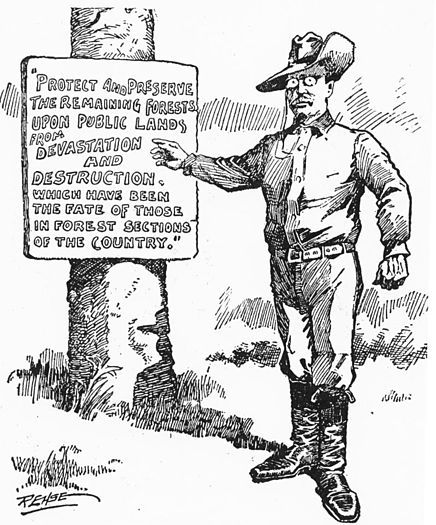
1908 editorial cartoon of President Theodore Roosevelt as “A Practical Forester.”  Source: St. Paul Minnesota “Pioneer Press”. Via GPO's Government Book Talk blog.

1908 Rense editorial cartoon of President Theodore Roosevelt as “A Practical Forester.” Source: St. Paul Minnesota “Pioneer Press”. Via GPO’s Government Book Talk blog.


Odd juxtaposition of images — but it gives me some hope

January 29, 2013

A great photo from Pete Souza, the current White House photographer.  I’m hoping to track down I’ve tracked down even more details on this, because not all sources like to post all the credit information or other stuff a newspaper or blog should have . . .

Pete Souza photo, lunch in the White House, Obama, Boehner, Pelosi, Reid, McConnell

Photo of a lunch in an anteroom of the President’s office, with President Obama, House Speaker John Boehner, House Minority Leader Nancy Pelosi, Senate Majority Leader Harry Reid, and Senate Minority Leader Mitch McConnell.

Consolidated News published the photo for its clients with this information:

United States President Barack Obama has lunch with members of the Congressional Leadership in the Oval Office Private Dining Room, May 16, 2012. The President served hoagies from Taylor Gourmet, which he purchased after a small business roundtable earlier in the day. Seated, clockwise from the President, are: U.S. Senate Majority Leader Harry Reid (Democrat of Nevada), U.S. Senate Republican Leader Mitch McConnell (Republican of Kentucky), U.S. House Minority Leader Nancy Pelosi (Democrat of California), and U.S. House Speaker John Boehner (Republican of Ohio)..Mandatory Credit: Pete Souza – White House via CNP

At least we know where to get sandwiches like that, now. (Here’s the photo in the White House Flickr set.)

Senate Majority Leader Mike Mansfield

Senate Majority Leader Mike Mansfield; oil on canvas by Aaron Shikler, 1978;  photo of painting from Wikipedia

Way back in the Early Holocene, when I first interned with the U.S. Senate, Majority Leader Mike Mansfield, D-Montana, held a close friendship with Sen. George Aiken, R-Vermont.  Many mornings they breakfasted together in the staff carry-out in the basement of the Capitol; their wives were friends, too.  One morning we got a question on some hot political issue at the Democratic Policy Committee (where I shared the best office I ever had in the third floor of the Capitol); I was dispatched to find Mansfield at breakfast and get an answer.  I found him dining with Aiken.

I forget the issue, but it was highly politically charged, something about policy on Vietnam.  Republicans and Democrats were much at war on the issue.  Mansfield read the note, and showed it to Aiken.  They discussed the issue while Mansfield penned an answer and handed it to me.  No big deal — two senators dealing with an important issue, talking it over.

When I joined Senate staff in a permanent position, life was much different among the senators.  The easy camradery between Mansfield and Aiken couldn’t be found anywhere.  That was in the late 1970s.  Partisanship was much sharper and nastier than I had seen earlier.  Vietnam was over, and that was probably a good thing.  The divisiveness I found would not have lent itself to any resolution of Vietnam.

At the RARE II conference at the University of Montana, in 1978, I heard a presentation from a staffer to Montana’s Sen. Paul Hatfield, if I recall correctly, a guy who had staffed for Sen. Lee Metcalf before.  He described the difficulties in getting serious legislation done on public lands issues.  As he described it, especially before the installation of air conditioning in the Capitol, the Senate would recess for the insufferable summer heat.  Senators, who had developed working relationships, if not friendships, would visit each other in their home states, for hunting and sight-seeing, among other things.  A Montana senator might show his colleague from Vermont how different the Rocky Mountains are from the Appalachians.  A Louisana senator might show his colleagues from western states how different is flood control on the Mississippi than on the Colorado or Sacramento, or Columbia.  By the time the Senate got back to business in the fall, legislation had been worked out, key alliances formed to get things done for various states, and though opposition was expressed to many projects, it was genuine difference of opinion expressed to friends.

That’s gone.  In 2013, it’s rare a Member of Congress can develop those kinds of relationships with other Members, especially with the fund-raising requirements for re-election.  Members travel back to their states and districts as many weekends as they can; they get to know their staff on each end, but they don’t know the other senators, or members of Congress.

President Warren G. Harding doesn’t have a reputation as a great president; but his poker parties were famous.  Lyndon Johnson didn’t play poker a lot (though I understand he did on occasion), but his presidency’s record in photographs show that he invited Members of Congress individually for afternoon meetings, often punctuated with a drink, always slathered in business and the potential for favors or arm-twisting.  Those sessions are legendary for the legislation they greased into law.

When I saw that photo at the top, I was put in mind of another famous image.

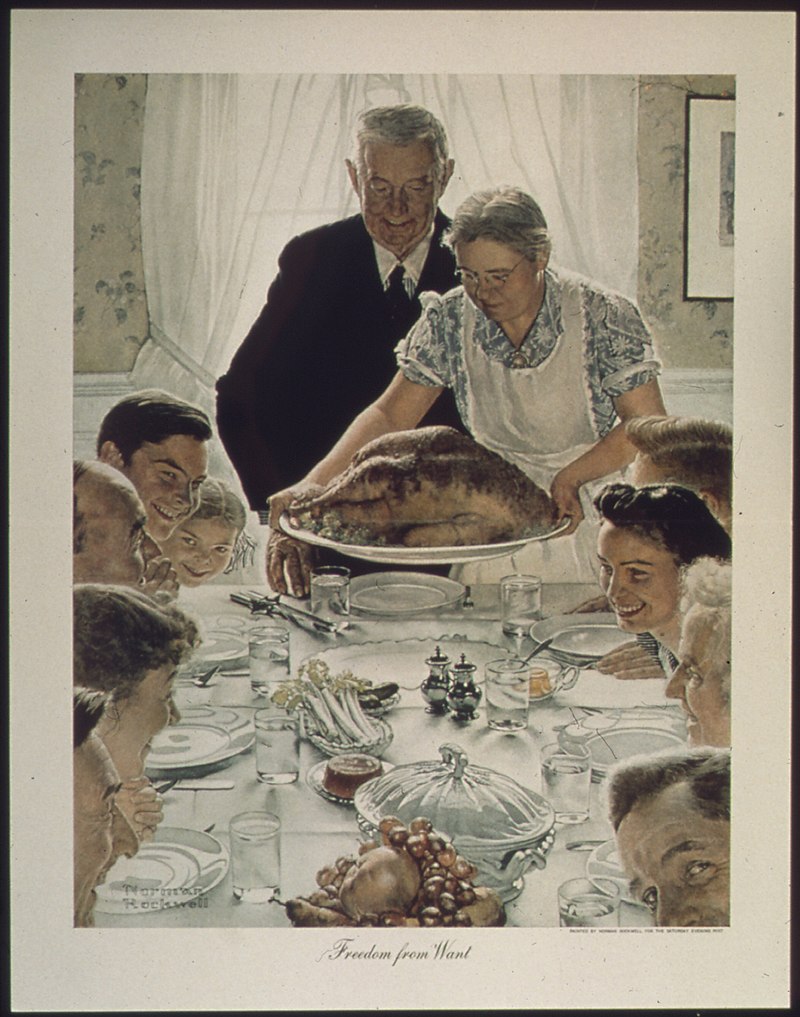
Norman Rockwell's Freedom from Want

Norman Rockwell’s painting, “Freedom from Want,” part of a quartet based on the Four Freedoms State of the Union Speech of Franklin Roosevelt, in January 1941.

Did Souza have that Rockwell painting in mind when he framed that shot?

Rockwell’s work was more than just iconic, really.  In the simple history, from Wikipedia:

The Four Freedoms or Four Essential Human Freedoms is a series of oil paintings produced in 1943 by the American artist Norman Rockwell. The paintings are approximately equal in dimension with measurements of 45.75 inches (116.2 cm) × 35.5 inches (90 cm).[1] The series, now in the Norman Rockwell Museum, was made for reproduction in The Saturday Evening Post over the course of four consecutive weeks in 1943 alongside essays by prominent thinkers of the day. Later they were the highlight of a touring exhibition sponsored by the Saturday Evening Post and the United States Department of the Treasury. The touring exhibition and accompanying sales drives raised over US$132 million in the sale of war bonds.[2]

The Four Freedoms theme was derived from the 1941 State of the Union Address by United States President Franklin Roosevelt delivered to the 77th United States Congress on January 6, 1941.[3] During the speech he identified four essential human rights (Freedom of Speech, Freedom of Worship, Freedom From Want and Freedom From Fear) that should be universally protected and should serve as a reminder of the American motivation for fighting in World War II.[4]

The theme was incorporated into the Atlantic Charter,[5] and it became part of the charter of the United Nations.[6] Roosevelt’s message was as follows: “In the future days which we seek to make secure, we look forward to a world founded upon four essential human freedoms.”[3][7]

Torpedo sandwiches from Taylor’s don’t exactly make a Thanksgiving dinner, but that’s not the point.  Rockwell portrayed an American family — at Thanksgiving, perhaps — sitting down to enjoy dinner together, breaking bread together as a Christian preacher might put it in a sermon.  President Johnson famously invited, “Come, let us reason together.”  Around Obama’s smaller-than-Rockwell’s table, the smiles are not so evident.  But I still see hope.

I see some hope for friendship, for the relationships that might move legislation, for the legislation that might move the nation.  God and Norman Rockwell know we could use it.

We can hope, can’t we?

More, perhaps related:


Banksy’s modern Nativity, revisited in 2012

December 25, 2012

An encore post, from 2008.

Thomas Nast helped bring down the crooks at Tammany Hall with cartoons. Boss Tweed, the chief antagonist of Nast, crook and leader of the Tammany Gang, understood that Nast’s drawings could do him in better than just hard hitting reporting — the pictures were clear to people who couldn’t read.

But a cartoon has to get to an audience to have an effect.

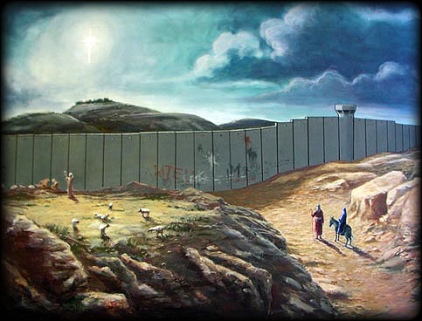
Here’s a cartoon below, a comment on the security wall being built in Israel, that got very little circulation in the west at Christmas time. Can you imagine the impact had this drawing run in newspapers in Europe, the U.S., and Canada?

It’s a mashup of a famous oil painting* related to the Christian Nativity, from a London-based artist who goes by the name Banksy. (Warning: Banksy pulls no punches; views shown are quite strong, often very funny, always provocative, generally safe for work unless you work for an authoritarian like Dick Cheney who wants no counter opinions.)

banksy-israels-wall-77721975_fda236f91a.jpg

Banksy’s modern nativity — does he ever bother to copyright his stuff, or would he rather you broadcast it?

*  At least I thought so in 2008.  I can’t find the painting now.  Anybody recognize a work underneath Banksy’s re-imagining?  Let us know in comments, eh?  Perhaps this one, by David Roberts?  Perhaps this engraving after Joseph M. W. TurnerTurner’s original?

Tip of the old scrub brush to Peoples Geography.

More, in 2011: 

More in 2012:


In 2012, do we know who invented Santa Claus? Who really wrote the “Night Before Christmas?”

December 23, 2012

An encore post and Millard Fillmore’s Bathtub tradition from 2007

Thomas Nast invented Santa Claus? Clement C. Moore didn’t write the famous poem that starts out, “‘Twas the night before Christmas, and all through the house . . . ?”

The murky waters of history from Millard Fillmore’s Bathtub soak even our most cherished ideas and traditions.

But isn’t that part of the fun of history?

Santa Claus delivers to Union soldiers, "Santa Claus in Camp" - Thomas Nast, Harper's Weekly, Jan 3, 1863

In Janaury 1863, Thomas Nast portraye Santa Claus delivered gifts to Union troops in Washington, D.C., wearing a blue, star-spangled coat, just a few days earlier.

Yes, Virginia (and California, too)! Thomas Nast created the image of Santa Claus most of us in the U.S. know today. Perhaps even more significant than his campaign against the graft of Boss Tweed, Nast’s popularization of a fat, jolly elf who delivers good things to people for Christmas makes one of the great stories in commercial illustration. Nast’s cartoons, mostly for the popular news publication Harper’s Weekly, created many of the conventions of modern political cartooning and modeled the way in which an illustrator could campaign for good, with his campaign against the graft of Tammany Hall and Tweed. But Nast’s popular vision of Santa Claus can be said to be the foundation for the modern mercantile flurry around Christmas.

Nast is probably ensconced in a cartoonists’ hall of fame. Perhaps he should be in a business or sales hall of fame, too.  [See also Bill Casselman’s page, “The Man Who Designed Santa Claus.]

Nast’s drawings probably drew some inspiration from the poem, “Account of a Visit from St. Nicholas,” traditionally attributed to Clement C. Moore, a New York City lawyer, published in 1822. The poem is among the earliest to describe the elf dressed in fur, and magically coming down a chimney to leave toys for children; the poem invented the reindeer-pulled sleigh.

Modern analysis suggests the poem was not the work of Moore, and many critics and historians now attribute it to Major Henry Livingston, Jr. (1748-1828) following sleuthing by Vassar College Prof. Don Foster in 2000. Fortunately for us, we do not need to be partisans in such a query to enjoy the poem (a complete copy of which is below the fold).

The Library of Congress still gives Moore the credit. When disputes arise over who wrote about the night before Christmas, is it any wonder more controversial topics produce bigger and louder disputes among historians?

Moore was not known for being a poet. The popular story is that he wrote it on the spur of the moment:

Moore is thought to have composed the tale, now popularly known as “The Night Before Christmas,” on December 24, 1822, while traveling home from Greenwich Village, where he had bought a turkey for his family’s Christmas dinner.

Inspired by the plump, bearded Dutchman who took him by sleigh on his errand through the snow-covered streets of New York City, Moore penned A Visit from St. Nicholas for the amusement of his six children, with whom he shared the poem that evening. His vision of St. Nicholas draws upon Dutch-American and Norwegian traditions of a magical, gift-giving figure who appears at Christmas time, as well as the German legend of a visitor who enters homes through chimneys.

Again from the Library of Congress, we get information that suggests that Moore was a minor celebrity from a well-known family with historical ties that would make a good “connections” exercise in a high school history class, perhaps (”the link from Aaron Burr’s treason to Santa Claus?”): (read more, below the fold)

Clement Moore was born in 1779 into a prominent New York family. His father, Benjamin Moore, president of Columbia University, in his role as Episcopal Bishop of New York participated in the inauguration of George Washington as the nation’s first president. The elder Moore also administered last rites to Alexander Hamilton after he was mortally wounded in a tragic duel with Aaron Burr.

A graduate of Columbia, Clement Moore was a scholar of Hebrew and a professor of Oriental and Greek literature at the General Theological Seminary in Manhattan. [See comment from Pam Bumsted below for more on Moore.] He is said to have been embarrassed by the light-hearted verse, which was made public without his knowledge in December 1823. Moore did not publish it under his name until 1844.

Tonight, American children will be tucked in under their blankets and quilts and read this beloved poem as a last “sugarplum” before slipping into dreamland. Before they drift off, treat them to a message from Santa, recorded by the Thomas Edison Company in 1922.

Santa Claus Hides in Your Phonograph
By Arthur A. Penn, Performed by Harry E. Humphrey.
Edison, 1922.
Coupling date: 6/20/1922. Cutout date: 10/31/1929.
Inventing Entertainment: The Motion Pictures and Sound Recordings of the Edison Companies

Listen to this recording (RealAudio Format)

Listen to this recording (wav Format, 8,471 Kb)

But Henry Livingston was no less noble or historic. He hailed from the Livingstons of the Hudson Valley (one of whose farms is now occupied by Camp Rising Sun of the Louis August Jonas Foundation, a place where I spent four amazing summers teaching swimming and lifesaving). Livingston’s biography at the University of Toronto site offers another path for a connections exercise (”What connects the Declaration of Independence, the American invasion of Canada, the famous poem about a visit from St. Nick, and George W. Bush?”):

Henry Livingston Jr. was born in Poughkeepsie, New York, on Oct. 13, 1748. The Livingston family was one of the important colonial and revolutionary families of New York. The Poughkeepsie branch, descended from Gilbert, the youngest son of Robert Livingston, 1st Lord of Livingston Manor, was not as well off as the more well-known branches, descended from sons Robert and Philip. Two other descendants of Gilbert Livingston, President George Walker Herbert Bush and his son, President-Elect George W. Bush, though, have done their share to bring attention to this line. Henry’s brother, Rev. John Henry Livingston, entered Yale at the age of 12, and was able to unite the Dutch and American branches of the Dutch Reformed Church. At the time of his death, Rev. Livingston was president of Rutgers University. Henry’s father and brother Gilbert were involved in New York politics, and Henry’s granduncle was New York’s first Lt. Governor. But the law was the natural home for many of Henry’s family. His brother-in-law, Judge Jonas Platt, was an unsuccessful candidate for governor, as was his daughter Elizabeth’s husband, U.S. Supreme Court Justice Smith Thompson. Henry’s grandson, Sidney Breese, was Chief Justice of the Illinois Supreme Court.

Known for his encyclopedic knowledge and his love of literature, Henry Livingston was a farmer, surveyor and Justice of the Peace, a judicial position dealing with financially limited criminal and civil cases. One of the first New Yorkers to enlist in the Revolutionary Army in 1775, Major Henry Livingston accompanied his cousin’s husband, General Montgomery, in his campaign up the Hudson River to invade Canada, leaving behind his new wife, Sarah Welles, and their week-old baby, on his Poughkeepsie property, Locust Grove. Baby Catherine was the subject of the first poem currently known by Major Livingston. Following this campaign, Livingston was involved in the War as a Commissioner of Sequestration, appropriating lands owned by British loyalists and selling them for the revolutionary cause. It was in the period following Sarah’s early death in 1783, that Major Livingston published most of his poems and prose, anonymously or under the pseudonym of R. Ten years after the death of Sarah, Henry married Jane Patterson, the daughter of a Dutchess County politician and sister of his next-door neighbor. Between both wives, Henry fathered twelve children. He published his good-natured, often occasional verse from 1787 in many journals, including Political Barometer, Poughkeepsie Journal, and New-York Magazine. His most famous poem, “Account of a Visit from St. Nicholas,” was until 2000 thought to have been the work of Clement Clarke Moore (1779-1863), who published it with his collected poems in 1844. Livingston died Feb. 29, 1828.

More on Henry Livingston and his authorship of the Christmas poem here.
Thomas Nast, Merry Old Santa Claus, Harper's Weekly, Jan 1, 1881

Our views of Santa Claus owe a great deal also to the Coca-Cola advertising campaign. Coca-Cola first noted Santa’s use of the drink in a 1922 campaign to suggest Coke was a year-round drink (100 years after the publication of Livingston’s poem). The company’s on-line archives gives details:

In 1930, artist Fred Mizen painted a department store Santa in a crowd drinking a bottle of Coke. The ad featured the world’s largest soda fountain, which was located in the department store of Famous Barr Co. in St. Louis, Mo. Mizen’s painting was used in print ads that Christmas season, appearing in The Saturday Evening Post in December 1930.

1936 Coca-Cola Santa cardboard store display

  • 1936 Coca-Cola Santa cardboard store display

Archie Lee, the D’Arcy Advertising Agency executive working with The Coca-Cola Company, wanted the next campaign to show a wholesome Santa as both realistic and symbolic. In 1931, The Coca-Cola Company commissioned Michigan-born illustrator Haddon Sundblom to develop advertising images using Santa Claus — showing Santa himself, not a man dressed as Santa, as Mizen’s work had portrayed him.
1942 original oil painting - 'They Remembered Me'

  • 1942 original oil painting – ‘They Remembered Me’

For inspiration, Sundblom turned to Clement Clark Moore’s 1822 poem “A Visit From St. Nicholas” (commonly called “‘Twas the Night Before Christmas”). Moore’s description of St. Nick led to an image of Santa that was warm, friendly, pleasantly plump and human. For the next 33 years, Sundblom painted portraits of Santa that helped to create the modern image of Santa — an interpretation that today lives on in the minds of people of all ages, all over the world.

Santa Claus is a controversial figure. Debates still rage among parents about the wisdom of allowing the elf into the family’s home, and under what conditions. Theologians worry that the celebration of Christmas is diluted by the imagery. Other faiths worry that the secular, cultural impact of Santa Claus damages their own faiths (few other faiths have such a popular figure, and even atheists generally give gifts and participate in Christmas rituals such as putting up a decorated tree).

For over 100 years, Santa Claus has been a popular part of commercial, cultural and religious life in America. Has any other icon endured so long, or so well?

________________________
Below:
From the University of Toronto Library’s Representative Poetry Online

Major Henry Livingston, Jr. (1748-1828)

Account of a Visit from St. Nicholas

1 ‘Twas the night before Christmas, when all thro’ the house,

2 Not a creature was stirring, not even a mouse;

3 The stockings were hung by the chimney with care,

4 In hopes that St. Nicholas soon would be there;

5 The children were nestled all snug in their beds,

6 While visions of sugar plums danc’d in their heads,

7 And Mama in her ‘kerchief, and I in my cap,

8 Had just settled our brains for a long winter’s nap –

9 When out on the lawn there arose such a clatter,

10 I sprang from the bed to see what was the matter.

11 Away to the window I flew like a flash,

12 Tore open the shutters, and threw up the sash.

13 The moon on the breast of the new fallen snow,

14 Gave the lustre of mid-day to objects below;

15 When, what to my wondering eyes should appear,

16 But a miniature sleigh, and eight tiny rein-deer,

17 With a little old driver, so lively and quick,

18 I knew in a moment it must be St. Nick.

19 More rapid than eagles his coursers they came,

20 And he whistled, and shouted, and call’d them by name:

21 “Now! Dasher, now! Dancer, now! Prancer, and Vixen,

22 “On! Comet, on! Cupid, on! Dunder and Blixem;

23 “To the top of the porch! to the top of the wall!

24 “Now dash away! dash away! dash away all!”

25 As dry leaves before the wild hurricane fly,

26 When they meet with an obstacle, mount to the sky;

27 So up to the house-top the coursers they flew,

28 With the sleigh full of Toys — and St. Nicholas too:

29 And then in a twinkling, I heard on the roof

30 The prancing and pawing of each little hoof.

31 As I drew in my head, and was turning around,

32 Down the chimney St. Nicholas came with a bound:

33 He was dress’d all in fur, from his head to his foot,

34 And his clothes were all tarnish’d with ashes and soot;

35 A bundle of toys was flung on his back,

36 And he look’d like a peddler just opening his pack:

37 His eyes — how they twinkled! his dimples how merry,

38 His cheeks were like roses, his nose like a cherry;

39 His droll little mouth was drawn up like a bow.

40 And the beard of his chin was as white as the snow;

41 The stump of a pipe he held tight in his teeth,

42 And the smoke it encircled his head like a wreath.

43 He had a broad face, and a little round belly

44 That shook when he laugh’d, like a bowl full of jelly:

45 He was chubby and plump, a right jolly old elf,

46 And I laugh’d when I saw him in spite of myself;

47 A wink of his eye and a twist of his head

48 Soon gave me to know I had nothing to dread.

49 He spoke not a word, but went straight to his work,

50 And fill’d all the stockings; then turn’d with a jerk,

51 And laying his finger aside of his nose

52 And giving a nod, up the chimney he rose.

53 He sprung to his sleigh, to his team gave a whistle,

54 And away they all flew, like the down of a thistle:

55 But I heard him exclaim, ere he drove out of sight –

56 Happy Christmas to all, and to all a good night.

Online text copyright © 2005, Ian Lancashire for the Department of English, University of Toronto. Published by the Web Development Group, Information Technology Services, University of Toronto Libraries. Be sure to visit this site for more information on this poem, on Maj. Livingston, and on poetry in general.

More:


Typewriters of the moment: Isaac Asimov’s astonishingly prolific career

December 22, 2012

Isaac Asimov remains one of my favorite writers.  He wrote well enough, and his curiosity took him to topics I often find interesting.  At one time having published more books than anyone else in history on a wide variety of topics from quantum mechanics to trivia in the books of the Bible (does he still hold that record?), it was a sure bet one could find at least one book in one’s area of interest penned by Asimov.

When I started the spasmodic feature, “Typewriter of the Moment,” years ago I did a search for Asimov with a typewriter.  I didn’t find an image I thought suitable back when the internet was still operated by steam, and somehow I just never got back to that.

The other night this image popped up on one of my Facebook feeds, from “the Other 98%”:

Painting of Isaac Asimov creating at a typewriter, an early IBM Selectric. Who did the painting?

Painting of Isaac Asimov creating at a typewriter, an early IBM Selectric. Who did the painting?

I appreciate the sentiment in the quote.  Asimov noted the Dunning-Kruger Effect, even if he didn’t have the advantage of Dunning and Kruger having named it yet, and he lamented the powerful undertone of anti-intellectualism that victims of the syndrome exhibit:

Anti- intellectualism has been a constant thread winding its way through our political and cultural life, nurtured by the false notion that democracy means that my ignorance is just as good as your knowledge. (Asimov in an essay for Newsweek: “A Cult of Ignorance,” January 21, 1980, p. 19)

It’s an arresting image, a heckuva a quote, and it would make a good poster.  Plus, it’s an early IBM Selectric typewriter, marrying Asimov’s creativity with a great technological advancement in writing tools.

One boggles at the idea of Asimov with a great word processing program, a fast computer with great memory, and the internet at his disposal.  If Asimov were alive and creating today, we’d think Moore’s Law a great hindrance to the advancement of knowledge.

The painting delights me.  It’s almost photographic, and I like paintings that take great care to get small details right, photographically.  No dig at more spare or even abstract art, but this sort of painting takes great skill and great creativity.  Rising spirit-like from the typewriter’s platen we see a satellite (manned spacecraft, perhaps?), a flask of chemicals, and a leather-bound book, essential components in science fiction, and science.

So, who did the painting?  Was it done solely for that Facebook poster?

English: An IBM Selectric typewriter, model 71...

This is what that typewriter in the painting looks like, from the author’s angle. An IBM Selectric typewriter, model 713 (Selectric I with 11″ writing line), circa 1970. Wikipedia image

I’ve searched on TinEye, and Bing and Google, without success to identify the painter.

One version of the painting, before text was added, showed up at IO9, a site dedicated to science fiction, in an article discussing the writing habits of famous writers.

This does not appear to me to be the original, simply because data on the artist is not contained in the information section of the image.  The artist who did this illustration would be proud of it, and want to advertise her or his work.

This version has a slightly higher resolution; click on the image and note the reflections of lights in Asimov’s glasses, the reflections on the desk, and even the dings on the edge of the desk facing the viewer — this is great stuff!

But still I wonder:  Who was the original artist?

Any ideas, Dear Reader?

Rowena Morrill's painting of Isaac Asimov, before posterization with a quote over his head.

Rowena Morrill’s painting of Isaac Asimov, before posterization with a quote over his head.

Did Asimov write on a Selectric?  Did he switch to the newer version, with a wider carriage, or stick with the old original?  Is there a photo upon which this painting is based?

Almost immediate update:  This site claims the artist is the same as the one at the bottom of the post, Rowena Morrill.  That’s a start.  Here’s more:  At Rowenaart, both pictures appear credited to Rowena.  Mystery solved?  Go buy a poster from her; this is great stuff.

First Amendment Update, January 2015: You will want to read Asimov’s entire essay.  He’s not just insulting ignorants and ignorance; he also urges that Americans, almost all Americans, do not read enough to keep freedom alive.  For example, on the “right to know”:

There are 200 million Americans who have inhabited schoolrooms at some time in their lives and who will admit that they know how to read (provided you promise not to use their names and shame them before their neighbors), but most decent periodicals believe they are doing amazingly well if they have circulations of half a million. It may be that only 1 per cent–or less―of American make a stab at exercising their right to know. And if they try to do anything on that basis they are quite likely to be accused of being elitists.

I contend that the slogan “America’s right to know” is a meaningless one when we have an ignorant population, and that the function of a free press is virtually zero when hardly anyone can read.

More:

English: This image is a reproduction of an or...

Hello! Could this be by the same artist? Caption from Wikipedia: This image is a reproduction of an original painting by renowned science-fiction and fantasy illustrator Rowena http://www.rowenaart.com/. It depicts Dr. Isaac Asimov enthroned with symbols of his life’s work. (Photo credit: Wikipedia)


Americans love George Washington’s nose

November 19, 2012

Looked at a lot of statues and busts in the past year.  One of the things that intrigues me is the way people interact with sculpture, particularly the ways and places people touch sculpture.

At Mount Vernon, Americans have a fondness for George Washington’s nose:

06-23-2012 TAH Mt Vernon 094 George's nose, Avard Fairbanks bust, photo copyright by Ed Darrell

Avard Fairbanks‘ very large bust of George Washington invites touching by visitors at the Mount Vernon Visitors Center; people touch his nose.  Photo by Ed Darrell; use allowed with attribution, some rights reserved.

Other copies of the bust exist around the country, by Utah sculptor Avard Fairbanks.  If I’m correct on the provenance, this one was placed at Salt Lake International Airport for the nation’s bicentennial, then was obtained by George Washington University (one of my alma maters, by the way), and was loaned by GWU to the Ladies of Mount Vernon. (No wonder the thing looked so familiar to me . . . it’s been following me around for years.  I wonder when it gets to Texas, or upstate New York.)

A bust of George Washington on the campus of G...

Bust of George Washington on the campus of George Washington University — same one? (Photo credit: Wikipedia)

Displayed at the main entrance to the visitors center at Mt. Vernon, the bust is at a level that people can touch it, and they do.

It’s fun to watch people who stop to look at the bust.  Almost inevitably they look a bit awed by it.  Then, if they take a minute, they look it up and down, and put out their hand to touch George’s nose.

Almost as if they consider George Washington a good luck charm, and a touch of his nose might rub some luck off onto them.  It’s rubbing the nose shiny, an interesting way Americans pay tribute to our first president.

More:

06-23-2012 TAH Mt Vernon 093 Avard Fairbanks bust, George Washington - photo by Ed Darrell, use with attribution encouraged

The bust is quite imposing; people who pause to study it, however, overcome their reticence, and reach out to touch the First President.


Election day art: Norman Rockwell

November 6, 2012

Can’t let election day go by without at least noting this great, undersung painting by Normal Rockwell, “Election Day (1944)”:

Norman Rockwell, Election Day, 1944, watercolor and gouache, 14 x 33 1/2 in., Museum purchase, Save-the-Art fund, 2007.037.1.

Norman Rockwell, Election Day, 1944, watercolor and gouache, 14 x 33 1/2 in., Museum purchase, Save-the-Art fund, 2007.037.1.

Remember when people used to dress up to go to the polls?

In 1944 President Franklin Roosevelt ran for an unprecedented fourth term.  Most Americans did not know it, but he was deathly ill at the time.  He dropped Vice President Henry Wallace from his ticket — some argue it was a mutual disaffection at that time — and selected the relatively unknown young Missouri U.S. Sen. Harry S Truman for the vice president’s slot.

In November 1944, D-Day was known to be a successful invasion, and most Americans hoped for a relatively speedy end to World War II in both Europe and the Pacific.  Within the next ten months, the nation would endure the last, futile, desperate and deadly gasp of the Third Reich in the Battle of the Bulge, the liberation of Berlin in April 1945, and end of the war in the European Theatre on May 8; the Battle of Leyte Gulf, the Philippines Campaign, and the bloody, crippling battles of Iwo Jima and Okinawa in the Pacific Theatre, and then the first use of atomic weapons in war, at Hiroshima and Nagasaki (and we hope, the last use).

Voters in Cedar Rapids could not have known that.  They did not know that, regardless their vote for FDR or his Republican challenger, New York Gov. Thomas Dewey, Harry S Truman would be president within six months, nor that the entire world would change in August 1945.

This painting captures a time of spectacular moment, great naivity, and it pictures the way history got made.

For a 2007 exhibition, the Cedar Rapids Museum of Art offered this history:

Norman Rockwell: Fact & Fiction

September 12, 2009 – January 3, 2010

In 2007, the citizens of Cedar Rapids rallied together to purchase a series of watercolors destined for the auction block in New York. These five watercolors, by acclaimed 20th century American artist Norman Rockwell, depicted scenes associated with an election day and were created specifically for the November 4, 1944 issue of the Saturday Evening Post. To complete the Post commission, Rockwell traveled to a quintessential Midwestern town, Cedar Rapids, to study local citizens as models for his series of images.

In the 65 years since his visit, numerous anecdotes and stories have arisen about the artist’s time in Cedar Rapids and the creation of this work. This exhibition uses these five, newly conserved and restored watercolors and a related oil painting from the Norman Rockwell Museum, along with numerous photographs taken by local photographer Wes Panek for Rockwell, to investigate the many facts and fictions associated with Rockwell’s visit and this set of watercolors.

Norman Rockwell: Fact & Fiction has been made possible in part by Rockwell Collins, Candace Wong, and local “Friends of Norman Rockwell.” General exhibition and educational support has been provided by The Momentum Fund of the Greater Cedar Rapids Community Foundation.

Friends of Norman Rockwell: Wilma E. Shadle, Howard and Mary Ann Kucera, Jean Imoehl, Ben and Katie Blackstock, Marilyn Sippy, Chuck and Mary Ann Peters, Phyllis Barber, Ann Pickford, Anthony and Jo Satariano, Barbara A. Bloomhall, Virginia C. Rystrom, Jeff and Glenda Dixon, Robert F. & Janis L. Kazimour Charitable Lead Annuity Trust, Fred and Mary Horn, Mrs. Edna Lingo, John and Diana Robeson, Jewel M. Plumb, Carolyn Pigott Rosberg, Mr. and Mrs. Robert J. Buchacek, Dan and Anne Pelc, Mary Brunkhorst, and John and Diana Robeson.

I am amused and intrigued that this scene also closely resembles the scene when I voted in Cheverly, Maryland, in 1984 — down to the dog in the picture.  Oh, and most of the women didn’t wear dresses, none wore hats, and I was the only guy in the room with a tie.

Roosevelt won the 1944 election in an electoral college landslide, 432 to 99, but Dewey won Iowa, and we might assume Dewey won Cedar Rapids, too.

More:


Election Day 2012: Fly the flag, vote

November 6, 2012

Saint Louis Art Museum, St. Louis, Missouri George Caleb Bingham (American, 1811–1879). The County Election, 1852. Oil on canvas. 38 x 52 in. (96.5 x 132.1 cm). Gift of Bank of America.

The County Election, 1852. Saint Louis Art Museum, St. Louis, Missouri George Caleb Bingham (American, 1811–1879).  Oil on canvas. 38 x 52 in. (96.5 x 132.1 cm). Gift of Bank of America.

Every polling place should be flying the U.S. flag today.  You may fly yours, too.  In any case, if you have not voted already, go vote today as if our future depends upon it, as if our nation expects every voter to do her or his duty.

Today the nation and world listen to the most humble of citizens.  Speak up, at the ballot box.

Did you notice?  In Bingham’s picture, there are no U.S. flags.  You may fly yours anyway.

The whole world is watching.

More:


Go vote! says the Jack-o-lantern

November 5, 2012

Go Vote jack-o-lantern gif

Found on Tumblr

Stuff found on Tumblr.  Nice sentifment from a winking jack-o-lantern.

Trick: Animated #govote jack-o-lantern to keep away the ghosts of low voter turnout.

Treat: Tell your friends to visit rockthevote.com to find their polling station!

animated gif by Bruce Willen

At the GoVoteNov6 Tumblr site:

Click here to find your polling station and if you’re eligible for early voting.

For more #govote images and to submit your own go to:govote.org 


Forgotten art, forgotten artists: Dick Sargent, and Cub Scouts in a phone booth

November 3, 2012

Years between 1900 and 1970-something, when computers, television and digital media started to bite into artists’ work, make up a golden age of magazine illustration.

Much of that art is essentially lost now.  It appeared in magazines no longer published, and therefore having no champion for digitizing the art and prose; and it appeared in magazines that libraries, now cramped for space, are tossing away after getting access to digitized text, or through microfiche — or not at all.

Many of the images are compelling, like this one from Dick Sargent (1911-1978):

Cub Scouts in phonebooth, Dick Sargent, via American Gallery

Cub Scouts crammed in a phonebooth, Dick Sargent image preserved by American Gallery

The image is archaic, technically antique, in so many ways.

  • Do any phonebooths remain in America, especially of this outdoor type?  The booths had already begun to fade in the late 1970s, comically chronicled in Superman movies where Clark Kent could not find a phone booth in which to change from his reporter’s disguise into Superman’s body suit and cape.  Rapid spread of cell phones, now digital communications, and the disappearance of T-1 lines to tap into for pay phones, all contribute to make this image seriously dated (could students put a date on it by tracking down clues in the image?).
  • Paper maps?  Not even a hold-alone GPS, but a paper road map (probably a freebie from a “service station).
  • Cub Scouts abandoned the blue beanie at least 20 years ago, probably more like 30.
  • One Scout leader?  Since at least the early 1990s, Scouting has a “two-deep leadership” rule, to prevent child molestation, under the Scouts’ tough Youth Protection rules.  At no time should one leader only be with one Scout or a group of Scouts.  Such a hike today would require a much larger phone booth, just to accommodate additional leaders.
  • The axe was out of place when the painting was made; it’s a tool for older Boy Scouts.  Today, axes trend to rarity even with Boy Scouts.  Wood fires depleted the woods near popular camping sites and Boy Scout camps.  Drought conditions create local fire bans in many Scout camps nationwide in most of the past two decades — a Scout needs to know how to fire up a WhisperLite or Jetboil stove, or even a Coleman propane or white gas stove (have I told you the story of Sheldon Coleman and the Alaskan Native with the 30-year-old Coleman stove?).  None of that requires a hand-axe.
  • No women leaders?  When the painting was made — early 1950s? — the only male in a direct leadership position in a Cub Scout Pack would be the Cubmaster, who is largely the ceremonial ring-leader for the once-a-month pack meeting.  Women would have been Den Mothers, meeting weekly with a Den of boys.  This is artistic license, of course — but a modern painting would look really odd without women in leadership roles, especially on an outing, and wholly apart from the two-deep leadership rule.
  • It’s Cub Scouting, but there’s a clear cross-message with the Boy Scout Motto, Be Prepared.  This group is not prepared for rain at all — nor much prepared for hiking.  See any water bottles?  In the 1950s, Scouts would have carried canteens instead — but even Cub Scouts could be counted on to carry a cool, military-looking canteen.

I’m guessing this was an illustration for a magazine.  For various reasons I think it was not a Boy Scout publication, like Boys’ Life or Scouting.  Sargent’s work appeared in publications like Saturday Evening Post.  It would be fascinating to know the publication, and whether there was an occasion for the painting.  Scouting and this form of realistic painting from the 20th century really go hand in hand.  One of America’s favorite painters, Norman Rockwell, got his first job at 19 as art director for Boy Scouts of America, including Boys’ Life.  He went on to a long and very productive career, including hundreds of magazine covers for many publications, including Saturday Evening Post.  Rockwell was followed by Joseph Csatari.

American Gallery specializes in rescuing collections of work from American painters and other visual artists.  Teachers and students looking for period art from the 20th century might do well to check out that site, and do a few searches.  History, education and the internet could use a few more sites like that.

More:


Why a campfire? (reprise)

October 26, 2012

It was more than five years ago I originally posted this?  Heck, I won’t even add links or a “More” section at the bottom.  I deserves to be repeated though, I think, especially in an election year when we wish we could gather more people around a campfire.  Here goes:

Training adult Scout leaders always produces a few puzzled looks, and occasional passionate, fearful rebukes, when I note that a campfire gives a boy or a girl an opportunity to play with fire.

No, I don’t mean, exactly, that we should let kids play with fire.  There are rules — what’s burning must be in the fire pit, is the chief rule.

There is some primal need to watch a fire, to study it, to experiment with it, and finally just to watch it go. If you camped as a kid, you probably know what I mean.

Camp fires are universal.  This one was outside Bangalore.

Camp fires are universal. This one was outside Bangalore.

Every kid needs to do that.  It’s a part of growing up.  It’s a necessary memory for healthy and sane adults.

Start a fire, and a kid will get a stick and poke the burning logs and, especially, the red-, yellow- and white-hot coals after the fire burns a while.  They’ll start the stick on fire, put it out, and light it again.  They’ll pull the stick out of the fire and watch the flame consume the stick.  Kids will experiment with different things on the fire, to see whether, how fast, and how they burn.

Just keep it in the fire pit.

A Scoutmaster can tell which kids have been camping. A Scoutmaster knows which kids have been able to sit around a campfire and play with fire in that way.  Kids who know fire are more mature, generally, more relaxed about the excitement of the stuff, and much more careful with it.  Scouts who have dabbled in the campfire respect fire for what it is and for what it can do, good and bad.

What you’ll remember 20 years later, or 30 years, or (God bless me!) 40 years, and I hope 50 and 60 years, is the watching of the fire as the flames die down to a red and pulsing bed of coals.

You’ll remember some of the stories — Freddy Jonas’s often-told story of racing down the Champs Elysee in horse-drawn carriages, bribing the driver of the other carriage to go slower to win the race; the story of Rulon Skinner, the best non-swimming canoe instructor on Earth, and the big canoe race in which his opponent finally tipped Skinner’s canoe, and then yelled “snake!” to appeal to Skinner’s other great fear; the night the bear invaded the camp at Ben de la Tour, a bear later found to have antlers and four hooves.  You’ll remember the s’mores, and you’ll forget how messy they are.  You’ll remember the time you waited for the cobbler to cook after someone forgot to start the charcoal, or the the time the story got so good you forgot to take the cobbler off the fire, and how the Dutch oven had to be thrown away because it never would come clean.

You may remember that little fox at Camp Carter, sneaking just beyond the light of the fire and carefully circling every chair, looking for something good to eat, to steal.  Or that stupid porcupine that, now that you think of it must have been rabid, heading straight for the fire there in the only stand of Ponderosa pine in Utah County, up Payson Canyon.  And that will trigger the story of the night the fire wouldn’t start in the Catskills, and what seemed like hundreds of giant porcupines convened in bacchanalian festivities while campers dared not sleep, in their tents.

Someone will mention retiring U.S. flags, and you’ll remember the retirement ceremony for the flag from the widow of the veteran, how she insisted that you promise the flag would be burned completely and honorably, and warned “he’ll be watching!”  You’ll remember the mass flag retirement after the lifting of the burn ban at Wisdom, and how you suddenly realized lots of flags put out lots of toxic fumes — but somebody ad libbed a part to the ceremony to add time to let the fumes clear, and no Scout noticed (you hope!).

We haven’t even gotten to the singing.

I was put in mind of the power of the campfire with a remembrance from Real Live Preacher writing at High Calling:

I remember how worried we were the first time we tried to set one of those brush piles on fire. We nervously stood before a ten-foot high, fifteen-foot wide mound with a can of lighter fluid and a couple of matches. I squirted a modest amount around the bottom of the pile and stood back while Michael threw the match. That’s when we discovered that it’s surprisingly difficult to set things on fire. Now I marvel at stories of people casually throwing cigarettes out of their cars and setting whole forests ablaze. Michael and I had a hard time starting fires even when we used diesel fuel and a blowtorch.

It takes about five hours to burn a giant pile of brush and cedar, so Michael and I would start a fire, then sit on the tailgate of the brown pickup truck and talk while we kept an eye on it. Apart from the searing heat and looking like chimney sweeps, it was fun. I’m always looking for guilt-free reasons to sit around and talk with friends. I don’t suppose I’ll ever have as good an excuse as I did back then.

A guilt-free reason to sit around and talk with friends?  A campfire is an automatic reason — guilt only obtains if there’s a ban on burning where you’re making the fire.

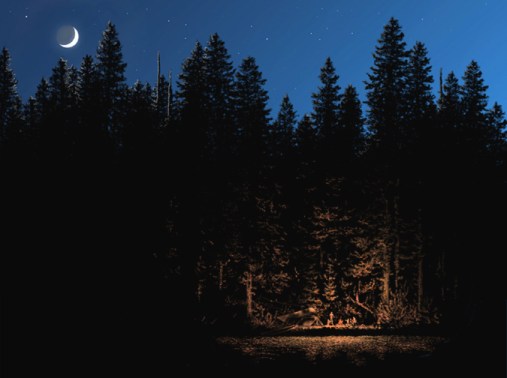
Carl Buell painted another one that took my breath away the first time I saw it.  Go see it. (I’m asking permission on this one; it may take a little while. Posted below with permission.)

That’s not a photograph, you can tell because it so well preserves what you remember — better than any photograph ever could —  it preserves what you remember from that campout up in the San Franciscos the night the sky was so blue so late and you could see the whole moon from the earthglow — or was it in New Mexico?  Probably not Colorado because there aren’t any mountains — oh, but if he’s looking east, it could have been south of Pueblo . . . no, maybe near Albion in the Sawtooths . . . Buell works in the east; it’s probably up in Maine . . . but he lived and painted in Marin County.

Didn’t he perfectly capture that night?

Campfire, by Carl Buell.  Copyright Carl Buell, all rights reserved; used with permission