December 30, 1924, Hubble Day: Bigger universe than you can imagine

December 30, 2007

Edwin Hubble

December 30, 1924, Edwin Hubble announced the results of his observations of distant objects in space.

In 1924, he announced the discovery of a Cepheid, or variable star, in the Andromeda Nebulae. Since the work of Henrietta Leavitt had made it possible to calculate the distance to Cepheids, he calculated that this Cepheid was much further away than anyone had thought and that therefore the nebulae was not a gaseous cloud inside our galaxy, like so many nebulae, but in fact, a galaxy of stars just like the Milky Way. Only much further away. Until now, people believed that the only thing existing outside the Milky Way were the Magellanic Clouds. The Universe was much bigger than had been previously presumed.

Later Hubble noted that the universe demonstrates a “red-shift phenomenon.” The universe is expanding. This led to the idea of an initial expansion event, and the theory eventually known as Big Bang.

Hubble’s life offered several surprises, and firsts:

Hubble was a tall, elegant, athletic, man who at age 30 had an undergraduate degree in astronomy and mathematics, a legal degree as a Rhodes scholar, followed by a PhD in astronomy. He was an attorney in Kentucky (joined its bar in 1913), and had served in WWI, rising to the rank of major. He was bored with law and decided to go back to his studies in astronomy.

In 1919 he began to work at Mt. Wilson Observatory in California, where he would work for the rest of his life. . . .
Hubble wanted to classify the galaxies according to their content, distance, shape, and brightness patterns, and in his observations he made another momentous discovery: By observing redshifts in the light wavelengths emitted by the galaxies, he saw that galaxies were moving away from each other at a rate constant to the distance between them (Hubble’s Law). The further away they were, the faster they receded. This led to the calculation of the point where the expansion began, and confirmation of the big bang theory. Hubble calculated it to be about 2 billion years ago, but more recent estimates have revised that to 20 billion years ago.

An active anti-fascist, Hubble wanted to joined the armed forces again during World War II, but was convinced he could contribute more as a scientist on the homefront. When the 200-inch telescope was completed on Mt. Palomar, Hubble was given the honor of first use. He died in 1953.

“Equipped with his five senses, man explores the universe around him and calls the adventure Science.”

That news on December 30, 1924, didn’t make the first page of the New York Times. The Times carried a small note on February 25, 1925, that Hubble won a $1,000 prize from the American Academy for the Advancement of Science.

Update, December 31: CBS’s Sunday Morning has an “Almanac” feature weekly; Hubble was featured on December 30. Unfortunately CBS has not posted the video. However, I did find a description of Hubble’s work on YouTube — in true, irritating internet fashion, stripped of citations. The video is below. If you know details — who made the video, where good copies might be available — please note it in comments.

Update:  See the 2009, improved  Hubble Day post here.

See the 2010 post here.


Science history slips away: Ralph Alpher and Big Bang

September 20, 2007

Looking for something else in an old newspaper, I came across a small obituary for Ralph Alpher. Alpher died August 12, 2007, in Austin, Texas, at the home of his son, Dr. Victor S. Alpher.

Ralph Alpher, physicist who co-hypothesized the Big Bang

Ralph Alpher, physicist who co-hypothesized the Big Bang

Ralph Alpher gave us the Big Bang. We let him slip away, almost unnoticed. Odds are you don’t recall ever hearing of Alpher. Here’s your mnemonic: The alphabet paper.

In 1948, as a graduate student under George Gamow at the George Washington University, Alpher and Robert Herman of Johns Hopkins laid the groundwork for what would become Big Bang theory, calculating how matter could arise in the Universe. Gamow, exhibiting the sense of humor for which physicists are famous, listed the authors of the paper as Alpher, Bethe, Gamow and Herman — a play on the Greek alphabet’s first three letters (alpha, beta, gamma), and a joke invoking the name of the great physicist Hans Bethe. Bethe liked the joke, consulted on the paper, and the theory of Big Bang was published.

Ralph Alpher, in Florida, 2006; Alpher home page

The name “Big Bang” was applied a few years later; Sir Frederick Hoyle and his colleagues favored a “steady state” universe, and at the time both hypotheses could accurately predict most of what was observed, and neither could be disproven. Hoyle, hoping to poke ridicule at the competing hypothesis, belittled it as “a big bang.” The name stuck. The name misleads the unwary; the theory posits a rapid expansion at the beginning of the universe and time, but not an explosion, per se.

Alpher wrote the mathematical model; the model predicted Big Bang, and specifically, it predicted the cosmic background radiation that would have been left over; it was this background radiation, the “echo” of Big Bang, that Arno Penzias and Robert Wilson stumbled across in 1965. Robert H. Dicke had invested several years in trying to discover this signature, and had to explain to Penzias and Wilson what they had found. Penzias and Wilson won the Nobel Prize for their discovery; Dicke, Alpher, Herman and Gamow, did not get Nobel Prizes. This is generally regarded as one of the great miscarriages of justice in Nobel Prize awards, not that Penzias and Wilson did not deserve an award, but that the chief theorists and the man who unveiled the discovery were overlooked.

This is another story of rejection leading to great discovery; it is also a rather sad story of a momentous achievement, mostly overlooked through the years.

Alpher was the son of Jewish émigrés from the Russian pogroms. His high school achievements merited a scholarship to the Massachusetts Institute of Technology, in 1937. MIT had a rule at the time that scholarship recipients could not work outside the school. Alpher assisted his father in building houses in the Washington, D.C. area; the family had little money, and Alpher would be unable to pay room and board without working. Discussions with MIT broke down — the offer of a scholarship was withdrawn, according to most accounts when MIT discovered he was a Jew. As so many great people of the post World War II era, he enrolled at the George Washington University.

At GWU, Alpher found Gamow as a mentor, and much of the rest is history.

The New York Times:

The paper reported Dr. Alpher’s calculations on how, as the initial universe cooled, the remaining particles combined to form all the chemical elements in the world. This elemental radiation and matter he dubbed ylem, for the Greek term defining the chaos out of which the world was born.

The research also offered an explanation for the varying abundances of the known elements. It yielded the estimate that there should be 10 atoms of hydrogen for every one atom of helium in the universe, as astronomers have observed.

Months later, Dr. Alpher collaborated with Robert Herman of the Applied Physics Laboratory at Johns Hopkins University on a paper predicting that the explosive moment of creation would have released radiation that should still be echoing through space as radio waves. Astronomers, perhaps thinking it impossible to detect any residual radiation or still doubting the Big Bang theory, did not bother to search.

The Alpher-Bethe-Gamow paper, or αβγ paper, as explained by the American Institute of Physics:

When Alpher and Gamow prepared a paper on the subject, Gamow mischievously added the name of the noted nuclear physicist Hans Bethe to the list of authors so it would be called the “Alpher-Bethe-Gamow paper,” mimicking the “alpha-beta-gamma” of the first letters of the Greek alphabet. Unknown to Gamow, Bethe was a reviewer for the journal to which Gamow submitted the article. Bethe took it in good humor, later explaining, “I felt at the time that it was rather a nice joke, and that the paper had a chance of being correct, so that I did not mind my name being added to it.” Gamow also urged Herman to change his name to Delter to match delta, the next letter in the Greek alphabet. Despite Herman’s refusal, in a paper in a major scientific journal Gamow referred to “the neutron-capture theory…developed by Alpher, Bethe, Gamow and Delter.” Not least among his notable characteristics was his sense of humor.

Alpher continued in this work for a time, but joined General Electric’s labs in the 1950s. When he retired from GE, in 1986 he joined the faculty at Union College in Schenectady, New York, and taught there until 2004.

Alpher was largely overlooked for awards even while his theory was big news in astronomy and physics for the last 40 years of the 20th century. I regret that I was wholly unaware he was in Austin; how many other great contributors to science and history live among us, unrecognized, uncelebrated, and their stories unrecorded?

Alpher, Herman and Gamow - and the famous Cointreau bottle

Photo caption from AIP: A 1949 composite picture with Robert Herman on the left, Ralph Alpher on the right, and George Gamow in the center, as the genie coming out of the bottle of “Ylem,” the initial cosmic mixture of protons, neutrons, and electrons from which the elements supposedly were formed. [The Cointreau bottle from which the three drank a toast upon the acceptance of the paper, is now in the collection of the Smithsonian Institution.]

Alpher was an Eagle Scout. I wonder whether anyone has a history of his time in Scouting?

While the Nobel Prize eluded Alpher, he collected a host of other prestigious awards and honors. Earlier this year, President Bush announced that Alpher had been awarded the National Medal of Science, which is administered by the National Science Foundation and is the highest honor for science.

. . . [T]he citation reads in part:

“For his unprecedented work in the areas of nucleosynthesis, for the prediction that universe expansion leaves behind background radiation, and for providing the model for the Big Bang theory.”

Note from George Gamow, on confirmation of Big Bang Gamow’s humor again on display — an undated note from Gamow upon the confirmation of the Big Bang, with a punny reference to Steady State backer Sir Frederick Hoyle. Image from the American Institute for Physics.

Online sources for Ralph Alpher:

More:

Help others hear the echo:

Add to FacebookAdd to NewsvineAdd to DiggAdd to Del.icio.usAdd to StumbleuponAdd to RedditAdd to BlinklistAdd to TwitterAdd to TechnoratiAdd to Furl


Preacher looks again: Did Hubble kill God?

August 30, 2007

Sometimes religion and science don’t clash at all.


Hubble Ultra Deep Field Image Reveals Galaxies Galore

[Update February 17, 2015:  Real Live Preacher is a dead blog.  Author Gordon Atkinson now writes here (and other places you can find from there); but most of these links won’t work.  My apologies for the passage of time . . .]

Unlike the last time we visited this remarkable photograph, some people of faith look at it and see beauty, insted of seeing conflict between reality and their holy books.

I know of a Real Live Preacher who doesn’t abuse the science in finding a religious message in the photo.

Image of man and stars, from Real Live Preacher

So first vertigo, then panic, then longing. After that I generally calm down a bit. My tiny mind and delicate emotions cannot bear even my small thoughts of the universe for more than a few minutes. I relax. Sometimes a shrinking reality can be a comfort. My sins, the things that I have done wrong and the ways that I cannot be what I should be, also shrink. I feel I can forgive myself for them, small man that I am. Why the hell not? Look at the size of the universe!

This forgiveness is the Grace that Christians speak of. The main story of our faith tells us that we must be forgiven and can be. Funny how it takes science to bring that reality to my guts.

For some reason, this experience always ends with a crazy happiness that I cannot easily explain. I become giddy with the knowledge that ultimate reality is so far beyond our grasp. This lets me off the hook, to a certain extent. We’ll never know reality. We’ll never even map our solar system, you and I. We’re small people, but we have grasped the idea of existence. We know love, seek knowledge, and recognize goodness and evil.

Our saintly scientists, single-minded and incredibly committed to the search for truth, draw down amazing pictures from the ancient light in the sky. These pictures help me to know that it is okay to be nothing more or less than what we are.

One might visit Real Live Preacher just for the art, too (see sample above). A remarkable site.

Read the rest of this entry »


Olla podrida

December 29, 2006

Olla podrida is a local, Spanish term for a Mulligan stew, for olio, etc.

Founding fathers and illegal immigrants — A new blog on the migration debate, cleverly titled Migration Debate, highlights a New York Times opposite-editorial page piece that details how many of our “founding fathers” took advantage of illegal immigration, or immigrated illegally themselves.  William Hogeland wrote the piece, whom some of you will recognize as the author of The Whiskey Rebellion:  George Washington, Alexander Hamilton and the Frontier Rebels who challenged America’s newfound sovereignty. (Scribner, 2006)

Google’s amazing powers:   Bad time to be speechless:  Over at 31fps, Google.com/maps magical powers are explained:  The author finds a store on Google maps, clicks a button, and Google first calls his phone, and then calls the store — go Google, and leave the dialing to Google.  Star Trek wasn’t this good.  Just be sure you’re over being speechless when the party at the other end answers.

Amazing cosmos:  Phil Plait at Bad Astronomy lists his top 10 images from outer space for 2006.  #1 is a doozy, but be sure you read the explanation Phil offers.

Fashionable extinction:  Microecos explains how fashion wiped out a beautiful, unique bird, the huia, in New Zealand, a century ago.   It’s a reminder of how stupid humans can be — a good exercise is in there somewhere for geography classes, or a general lecture on the effects of colonization.


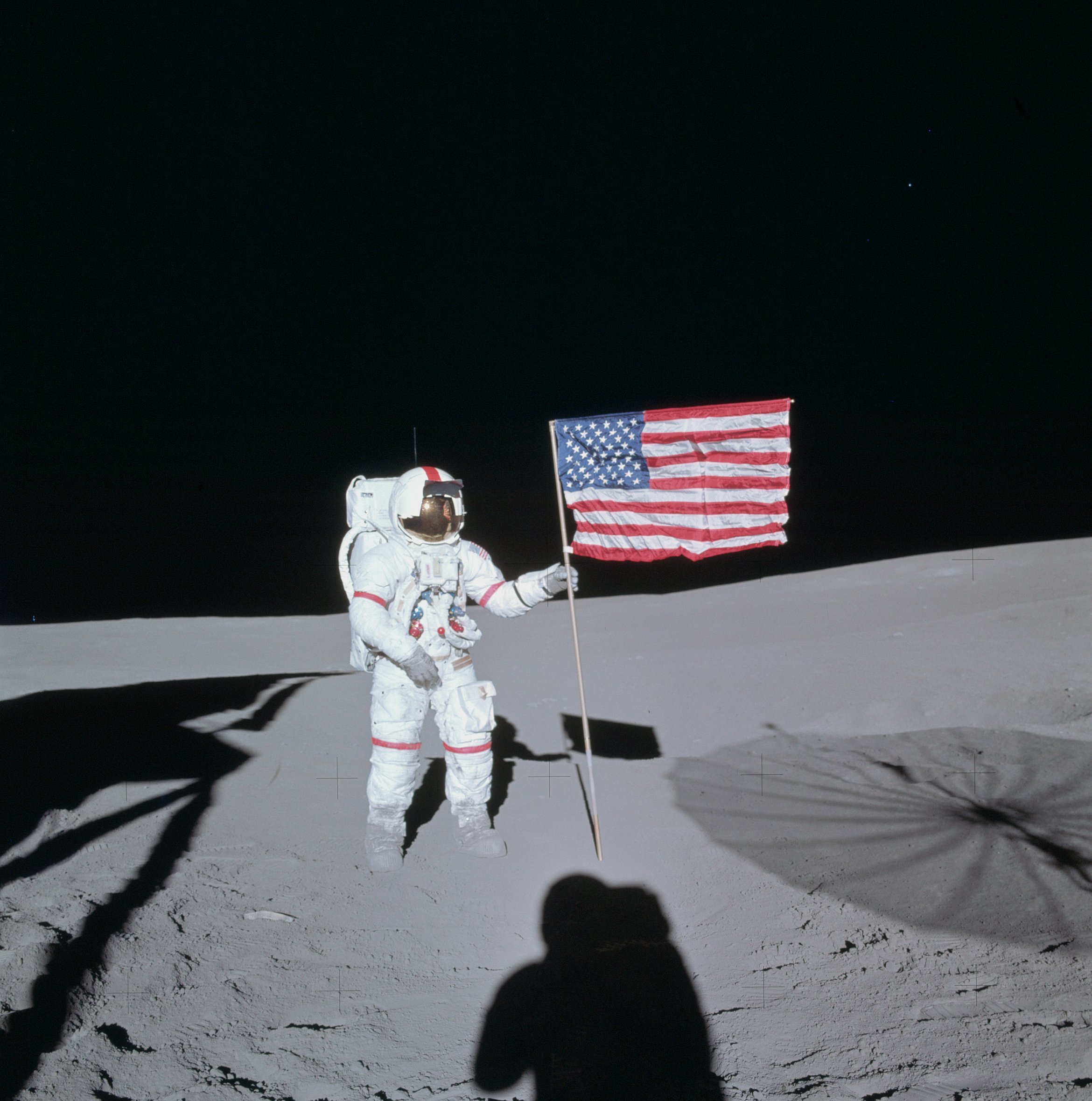
Hall of Fame: Debunking the Moon landing hoax hoax

December 10, 2006

Apollo 14 on the moon - Alan Shepard?

Photo from Apollo 14 Moon Mission


In a classroom discussion of “how do we know what we know” about history, another student brought up the allegations that the National Aeronautics and Space Administration (NASA) faked the manned Moon landings. That makes about a dozen times this year a kid has mentioned this claim (who thinks to start counting these things?). The kid was pretty unshakable in his convictions — after all, he said, how can a flag wave in a vacuum?

I usually mention a couple of things that the fake claimers leave out — that dozens, if not hundreds, of amateur astronomers tracked the astronauts on their way to the Moon, that many people intercepted the radio transmissions from the Moon, that one mission retrieved debris from an earlier unmanned landing, etc. Younger students who lack experience in serious critical thinking have difficulty with these concepts. They also lack the historic background — the last manned Moon landing occurred when their parents were kids, perhaps. They didn’t grow up with NASA launches on television, and the whole world holding its breath to see what wonders would be found in space.

Phil Plait runs a fine blog called Bad Astronomy. Five years ago he got fed up with the Fox Television program claiming the Moon landings were hoaxes, and he made a significant reply that should be in some hall of fame for debunking hoaxes. Since the claim that the Moon landings were hoaxes is, itself, a hoax, I have titled this “Debunking the Moon landing hoax hoax.”

In any case, if you’re wondering about whether the Moon landings were hoaxes, you need to see Phil Plait’s post. Phil writes:

From the very first moment to the very last, the program is loaded with bad thinking, ridiculous suppositions and utterly wrong science. I was able to get a copy of the show in advance, and although I was expecting it to be bad, I was still surprised and how awful it was. I took four pages of notes. I won’t subject you to all of that here; it would take hours to write. I’ll only go over some of the major points of the show, and explain briefly why they are wrong.

Also, consider these chunks of evidence, which Phil does not mention so far as I know:

First, the first Moon landing left a mirror on the surface, off of which Earth-bound astronomers may bounce laser transmissions in order to measure exactly the distance from the Earth to the Moon. Read the rest of this entry »


Hubble didn’t “kill God”

November 12, 2006

Stu Hasic argues that a photo from the Hubble Space Telescope (HST) “killed God,” or at least the notion that God played a role in creation.

Hubble Ultra Deep Field Image Reveals Galaxies Galore

Where do bloggers get such fantastic, erroneous ideas? My educated guess is that most preachers looking at this photograph of hundreds of galaxies (no, not individual stars), deep in space and therefore deep back in time, would be awestruck — and were they to preach about it, they’d call this evidence of God’s hand in creation, making a leap in logic and faith about equal to that of Hasic, but in the opposite direction. Hasic’s post nicely encapsulates some of the knowledge we get from the photo, but then he leaps to an unwarranted conclusion.

Hasic argues that since the photo is a brilliant refutation of some of the less scientific claims of creationism, it disproves God.

If Man is the purpose of creation, why did it take so long to create Man? And what’s with all the over-the-top elaborate sky decorations? Surely some painted white dots on a big canvas hung around the Earth would have sufficed?

Thanks should go to Hubble for opening our eyes. If only some men would open theirs. Being a Christian or being a Muslim means being different. Being a Human means being the same.

I can’t speak for all Christians, of course, but I’d wager most Christians would agree with Hasic’s last sentence there: Being a human means being the same as other humans. That’s rather the point of much of scripture (see Ecclesiastes, for many examples). I would also note that most Christians like the Hubble photos as much as anyone else. Photos of “star incubators” (see end of the post for an example) are among the more popular images in religious publications in the last decade. Contrary to Hasic’s assertion, the photo offers no challenge at all to any belief of most Christians. Read the rest of this entry »


Brilliant news about dark matter

August 23, 2006

No, not “dark matters,” nor even “a dark matter.”  Dark matter.  The stuff that we can’t see that may make up three quarters of the matter in the universe.

And with news this big, it still took a couple of days to get to me, courtesy of P. Z. Myers at Pharyngula.  Why wasn’t this on the front page of every newspaper on the planet?

The National Aeronautics and Space Administration (NASA) announced they have direct evidence of dark matter.  Here’s the photograph:

X-ray/Optical Composite of 1E 0657-56

Caption:  This composite image shows the galaxy cluster 1E 0657-56, also known as the “bullet cluster.” This cluster was formed after the collision of two large clusters of galaxies, the most energetic event known in the universe since the Big Bang.

Hot gas detected by Chandra in X-rays is seen as two pink clumps in the image and contains most of the “normal,” or baryonic, matter in the two clusters. The bullet-shaped clump on the right is the hot gas from one cluster, which passed through the hot gas from the other larger cluster during the collision. An optical image from Magellan and the Hubble Space Telescope shows the galaxies in orange and white. The blue areas in this image show where astronomers find most of the mass in the clusters. The concentration of mass is determined using the effect of so-called gravitational lensing, where light from the distant objects is distorted by intervening matter. Most of the matter in the clusters (blue) is clearly separate from the normal matter (pink), giving direct evidence that nearly all of the matter in the clusters is dark.

I am old enough to be able to recall that the news of Wilson and Penzias’ confirmation of the Big Bang, and consequent disproof of Steady State, also was not front page news.

All of which suggests newspapers have their priorities wrong.

NASA’s press release was headlined simply, but importantly:  NASA Finds Direct Proof of Dark Matter.  Go to the NASA site and look at the great animations.

Scientists usually have a few beers after such news.  It may be a good time to purchase stock in breweries.