Vox Day: Trapped in a quote mine cave-in

August 31, 2007

Vox Day, who claims to know more than most mortals can even think about, has fallen into a quote mine. (Quote mine defined.) Worse, the mine appears to have caved in.

Vox Day wishes to make the claim that Darwin is responsible for the evils of the Soviet Union. Apart from the prima facie absurdity of the claim, Vox has a dozen highly tenuous links he wishes to torture into supporting his claim, despite their refusal to do so.

This just in: Since I started out on this particular Fisking, Vox has popped up with this gem:

Unsurprisingly, evolutionists are reacting strongly to my column today. They swear up and down that there is no connection whatsoever between evolution and Communism, despite the fact that every single major Communist not only subscribed to Darwinist evolution but considered Darwin to be second only to Hegel as a pre-Marxist socialist figure.

There is no evidence Stalin or Lenin ever subscribed to evolution theory, and at any rate, Stalin expressly rejected Darwin and evolution, eviscerating the Soviets’ lead in genetics in 1920 by banning the teaching of evolution, banning research in evolution or research that had Darwinian overtones, stripping Darwin-theory subscribing biologists of their jobs, exiling a few to Siberia and death in several cases, and executing a few just for good measure. In place of evolution, Stalin backed Trofim Lysenko who advocated, apart from his creationist-like hatred of Darwin, an odd, almost-Lamarckian idea that stress in utero would change characteristics.

So, for example, Lysenko ordered that seed wheat be frozen, and then planted in winter. The freezing, the Stalin-Lysenko idea held, would make the wheat able to grow in cold weather. The crop failures were so spectacular that at least 4 million people died of starvation in the Soviet Union. By 1954 the crop failures were so massive the Soviet Union had to purchase wheat from the U.S., with loans from the U.S. These loans crippled any hope of the Soviet economy ever breaking out of its doldrums, and started the long slide to the collapse of the Soviet Union. You’d think Vox Day, who professes to be a libertarian and a Christian, would approve of the collapse of the Soviet Union by any cause — but he does not approve of the collapse if it came by a lack of evolution theory.

Vox Day never lets the facts get in the way of a rant. (As evidence that Marx was so deeply influenced by evolution theory, Vox notes that a fellow who knew Darwin, Edward Aveling attended Marx’s funeral. If that doesn’t convince, you, Vox says, Aveling later wrote an article saying it’s true, Marxism was based on evolution theory. So take THAT all you people who think Marxism emphasizes collectivism and the state: Darwin’s individual competition for survival is the REAL root of socialism. No, I’m not making this up — go read it for yourself. Then get some facts — read this account, which includes the guest list of Marx’s funeral. There were only nine people at Marx’s funeral, and Vox got the guest list wrong: Aveling wasn’t there. One more Vox claim refuted.)

Back to the regularly scheduled Vox Day quote mine cave-in, below the fold.

Read the rest of this entry »


What Churchill did NOT say

August 16, 2007

Winston Churchill often gets credit, or blame, for “famous quotations” that he did not say.

Cartoon of Churchill speaking (frustrated?)

Misattribution is a common problem in speeches, press releases, DeathbyPowerPoint, and in all other human interaction. I believe the third or fourth most powerful human instinct is to misattribute aphorisms to admired, famous people. So in business presentations across the world today, someone will quote Lincoln, Jefferson, Madison, Washington, Franklin, Einstein and Churchill, as saying things they never uttered.

Below the fold, from the Churchill Centre in London, here is a collection of famous things often attributed to Winston Churchill that he did not actually say: Read the rest of this entry »


Nonqoute of the Moment: What Ben Bradlee did NOT say

July 27, 2007

My respect for Fred Gielow rose when I found this on-line erratum notice, correcting a vicious misquoting of former Newsweek columnist and Washington Post editor Ben Bradlee.

This is one way a responsible author corrects a misquoting of someone, particularly one that puts words in the person’s mouth that convey a message opposite to the message they delivered:

____________________________________

I have been advised by the assistant counsel at The Washington Post that Mr. Benjamin C. Bradlee, vice-president at-large of The Washington Post, never made the statement attributed to him on page 117 of my book, You Don’t Say. The principal source of that quotation is the book Trashing the Planet, by Dixy Lee Ray with Lou Guzzo, Regnery Gateway, 1990, page 76. The assistant counsel states the quote is a fabrication.

The assistant counsel tells me Mr. Bradlee says he was discussing a matter at an environmental conference with fellow panelists and had no problem with what the panelists were saying, but he warned that there was

“a minor danger in saying it, because as soon as you say, ‘To hell with the news, I’m no longer interested in the news, I’m interested in causes,’ you’ve got a whole kooky constituency to respond to, which you can waste a lot of time on.”

That statement is indeed significantly different in meaning from the statement I quoted from Trashing the Planet, which said,

“To hell with the news. I’m no longer interested in the news. I’m interested in causes. We don’t print the truth. We don’t pretend to print the truth . . .”

Inasmuch as Trashing the Planet cites as a reference for its quotation an article by David Brooks in the October 5, 1989 Wall Street Journal, and inasmuch as I now find that Wall Street Journal article contains wording wholly consistent with the first quotation (above), not the second, I’m led to believe the second quotation is in error. This is a difficult conclusion for me to reach because I greatly respect Dixy Lee Ray and Regnery Gateway, and I have great confidence in their integrity.

Nevertheless, I must now apologize to Mr. Bradlee and I must apologize to all readers of my book who have depended on the correctness of the quote I obtained from Trashing the Planet. As I have stated to the assistant counsel, I’m interested only in the truth. When it can be shown that I have relied on information or a quotation that is shown to be incorrect or improper, I am anxious to correct the record.

Once again, let my extend my most sincere and genuine apologies to Mr. Bradlee. It was never my intention to attribute to him something he did not say. I know how painful it is to be accused of something you did not do or say. I would not wish that pain on anyone. And to demonstrate my desire to disseminate this information to set the record straight, I will post this message on my website for an indefinite period of time and will highlight access to it.

Fred Gielow_____________________________[end quote from Gielow]

Mr. Gielow’s faith in the Regnery publishing house is misplaced, in my experience.

Now, perhaps Mr. Gielow will correct his misquoting of Charles Wurster at his website. [Update, 7-29-2007:  Mr. Gielow responds by e-mail that he will check out the citations of the Wurster misquote.  Good news.]


Encore post: Recognizing bogus history, 2

July 3, 2007

Editor’s Note:  I’m traveling this week, celebrating our independence 231 years on.  While mostly out of pocket, I’ll feature some encore posts, material that deserves another look to keep it from fading from memory.  This post, below, is the second of a two-part series from August 2006.

Recognizing bogus history, 2

Bogus history infects political discussions more than others, though there are some areas where bogus history strays into the realm of science (false claims that Darwin and Pasteur recanted, for example).

1. The author pitches the claim directly to the media or to organizations of non-historians, for pay.

Historians are detectives, and they like to share what they find. One historian working in the papers of one figure from history will find a letter from another figure, and pass that information on to the historian working on the second figure. Historians teach history, write it up for scholarly work, and often spin it in more fascinating tales for popular work. Most years there are several good works competing for the Pulitzer Prize in history. Academic historians, those tied to universities and other teaching institutions, join societies, attend meetings, and write their material in journals — all pitched to sharing what they have learned.

Bogus historians tend to show up at conferences of non-historians. Douglas Stringfellow’s tales of World War II derring do were pitched to civic clubs, places where other historians or anyone else likely to know better, generally would not appear (Stringfellow’s stories of action behind enemy lines in World War II won him several speaking awards, and based on his war record, he was nominated to a seat in Congress for Utah, in 1952, which he won; a soldier who knew Stringfellow during the war happened through Salt Lake City during the 1954 re-election campaign, and revealed that Stringfellow’s exploits were contrived; he was forced to resign the nomination). Case in point: David Barton speaks more often to gun collectors than to history groups.

2. The author says that a powerful establishment is trying to suppress his or her work.

Sen. Joseph McCarthy insisted that anyone who opposed his claims that communists dominated certain government agencies, or that any given person was a communist, was because those who challenged him were, themselves, part of the greater conspiracy, trying to silence him. Utah Sen. Arthur V. Watkins, who chaired the committee that recommended censure for Sen. McCarthy, lost his own re-election campaign in 1958 in part to the belief by Utah voters that such a conspiracy existed and had succeeded in suppressing McCarthy.

But there was no organized campaign against McCarthy.  Individual Americans, spurred by patriotism, the Boy Scout Law, or just a sense that truth is valuable, spoke up against him, time and again in many different forums.  Sen. Watkins powerfully opposed communism.  Later historians found any truth in McCarthy’s claims against the State Department and other government agencies, and his critics, got there accidentally, below the usual levels of coincidence.

3. The sources that verify the new interpretation of history are obscure; if they involve a famous person, the sources are not those usually relied on by historians.

Most internet hoaxes simply don’t list sources. Bogus quotes circulating that have been attributed to Madison, Jefferson, Washington, Lincoln, and others, often list a year, and nothing else. When I staffed the Senate, several times a year I’d get letters to work on with claims that the Supreme Court had ruled in 1892 that the U.S. is, officially, a “Christian nation.” Usually there there was no case name attached, but I came to understand that the case referred to was the Church of the Holy Trinity vs. U.S. 1892 was far enough back that it was a difficult case for people outside of a decent law library to get — and then, it is couched in 1892 legalese, which makes it difficult to understand. It is an obscure enough case that most of the time it won’t be checked out. If the case can be produced, rarely will it be among lawyers who can interpret what happened from the fog of the language of the decision. The case is not listed at the Cornell University Law School’s on-line Legal Information Institute, nor at Findlaw.com — the databases they rely on go back to 1893. There is a full text copy at the Justicia website. [This was written in 2007.]

The case involved a law that prohibited the importing of laborers, and the Court ruled that the law probably was not intended to apply to a white, white collar worker, a preacher from England (the law was probably aimed at Chinese workers, coming as it did in that time when immigration from China was prohibited). It appears from the case that the church had argued some First Amendment justification to be exempt, and the U.S. Solicitor General had argued in response that the First Amendment requires the courts to assume that the government is hostile to religion; Justice David Brewer wrote at length about how the nation had accommodated religion over the years, especially Christianity, in dismissing the Solicitor General’s argument (he did not accept the church’s argument, either). This sort of writing is called obiter dicta in legal studies — words of an opinion wholly unnecessary to the decision. The case is cited rarely, and never for its religious “ruling,” because that was not what was ruled, and the language was not applied as law then, nor has it been since.  The Supreme Court ruled that importing preachers from England was not covered by the law. The ruling makes no mention of religion.

A bit of reflection on what really happened in history should make this clear: Consider the effect of such a ruling by the Supreme Court on later cases involving textbooks, busing of parochial students, student prayer, Bible readings, etc. Had such a precedent existed, lawyers would have sniffed it out regardless its obscurity.

4. Evidence for the history is anecdotal.

America’s founders carefully wrote laws that assure religious freedom, largely by creating a separation of state and church. To those unhappy with such a separation, every utterance of a founder in which God is praised, or invoked in any way, becomes “proof” that the founders did not mean what they wrote in the laws. Anecdote trumps any other evidence, to these people.
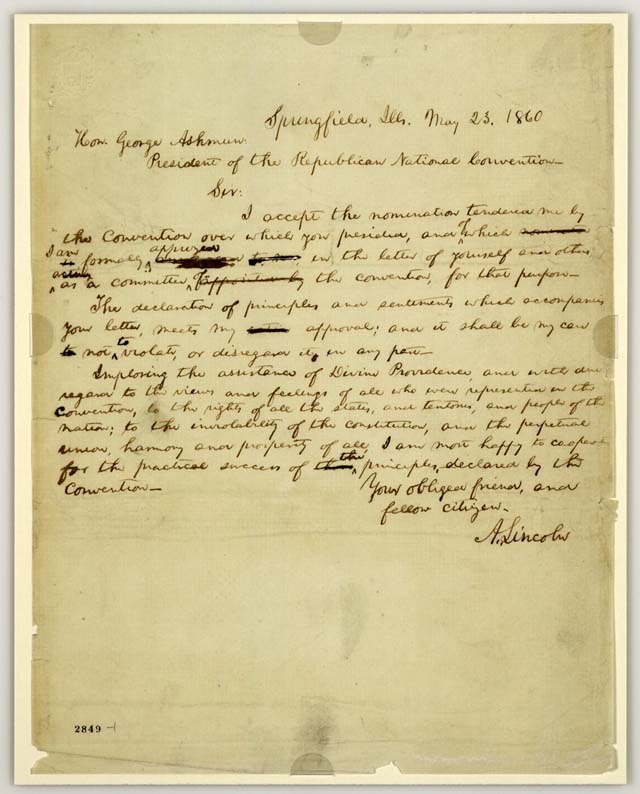
Abraham Lincoln's letter to the president of the Republican National Convention of 1860, accepting the convention's nomination for the presidency.

Abraham Lincoln’s letter to the president of the Republican National Convention of 1860, accepting the convention’s nomination for the presidency. It was written, you will note, from Springfield, Illinois, 200 miles away from Chicago where the convention was held.

To prove to me the piety of Abraham Lincoln, a fellow showed me photograph of a plaque on a church in Chicago, said to be the church where Abraham Lincoln said his prayers every morning during the Republican Convention of 1860, at which Lincoln got the nomination for president. Other records — newspapers, Lincoln’s letters and other documents, show that, as was the fashion in 1860, Lincoln did not attend the convention in Chicago, but as a candidate for president, stayed at home in Springfield, nearly 200 miles away.

Most real history can be read in documents, and does not need to rely on folk retellings exclusively.

5. The author says a belief is credible because it has endured for some time, or because many people believe it to be true.

Faced with the evidence that a dozen quotes he had attributed to figures such as James Madison, George Washington and Patrick Henry were whole cloth inventions, Texas quote-purveyor David Barton issued a statement urging people not to rely on them because they were “questionable.

A great example of belief triumphing over fact presents itself as the Cardiff Giant, now on display at the Farmers’ Museum in Cooperstown, New York (go visit when you visit the Baseball Hall of Fame). After an argument with a cleric over whether the Bible’s claim that giants once existed, a tobacconist named George Hull hired stonecarvers to carve a giant; then he hired a farmer to bury the carving on his farm, and claim to have struck it when planting. Once discovered the “petrified man” was put on display, for a fee. Hull got lucky: Syracuse businessmen offered to buy it from him for an enormous sum.

Paleontologist Othniel Marsh inspected it on display, and pronounced it a hoax. For some odd reason, that increased the popularity of the attraction. Carnival and side show entrepreneur P. T. Barnum offered $60,000 for the carving, but was refused. Barnum then had a plaster replica made and put on display. The owners of the original hoaxed carving sued, but the suit was thrown out because they could not demonstrate the “genuineness” of their own hoax.  Barnum made more money than the original.  A hoaxed hoax is even more popular than the truth.

A photo (staged?) of the 1869 unearthing of the Cardiff Giant (Cardiff, New York). Photograph courtesy Farmers Museum via Associated Press, and via National Geographic.

A photo (staged?) of the 1869 unearthing of the Cardiff Giant (Cardiff, New York). Photograph courtesy Farmers Museum (where the carving now rests, on display to museum visitors)  via Associated Press, and via National Geographic.

6. The author has worked in isolation.

Historians often help each other. Good historians put out queries to many sources, the better to assure accuracy. So, conversely, if there are only a few people who know anything about an account, that fact alone may cause suspicion. Clifford Irving’s hoax biography of Howard Hughes, while remarkably accurate in some regards, was unraveled when enough people familiar with Hughes called the bluff — including, of course, Hughes himself. The book got as far as it did with extreme secrecy on Irving’s part. Working alone makes error easier, and is essential for intentional frauds.

7. The author must propose a new interpretation of history to explain an observation.

Various conspiracy claims require that key people act counter to their known character. If Franklin Roosevelt had “allowed” Pearl Harbor to occur in order to get the U.S. into war, his actions over the previous six years to support Britain start to make little sense. Had Lyndon Johnson been part of a conspiracy to assassinate John Kennedy, his later carrying out the legislative plan of Kennedy runs contrary to all such motivations. If the founders of the U.S. actually intended to make Christianity the state religion, their efforts to disestablish the churches in all 13 colonies, efforts to write bills of rights for each state including freedom of religion, and efforts to create the First Amendment in the Bill of Rights seem like incredible, repeated errors.

Bogus history is much like the conjectured problems that result from time travel: Change one jot of history, and there is a cascading effect on later events. In many cases,were the bogus histories accurate, what follows could not be so, and we wouldn’t be here to discuss it.

Those are the seven warning signs of bogus history. Bogus, or voodoo history should be suspected if two or more of the signs are present — though it is quite possible for actual history to show more than two signs (perhaps actual history could show all seven signs — but I’d have to see an example before stating it’s so).

More:


Encore post: Recognizing bogus history, 1

July 3, 2007

While traveling this week, I’ll feature a few blasts from the past — posts that may merit new attention. This post comes from a two-part series in August 2006:

Recognizing bogus history, 1

Robert Park provides a short e-mail newsletter every Friday, covering news in the world of physics. It’s called “What’s New.” Park makes an art of smoking out bogus science and frauds people try to perpetrate in the name of science, or for money. He wrote an opinion column for the Chronicle of Higher Education published January 31, 2003, in which he listed the “7 warning signs of bogus science.”

Please go read Park’s entire essay, it’s good.

And it got me thinking about whether there are similar warning signs for bogus history? Are there clues that a biography of Howard Hughes is false that should pop out at any disinterested observer? Are there clues that the claimed quote from James Madison saying the U.S. government is founded on the Ten Commandments is pure buncombe? Should Oliver Stone have been able to to more readily separate fact from fantasy about the Kennedy assassination (assuming he wasn’t just going for the dramatic elements)? Can we generalize for such hoaxes, to inoculate ourselves and our history texts against error?

Perhaps some of the detection methods Park suggests would work for history. He wrote his opinion piece after the Supreme Court’s decision in Daubert v. Merrell Dow Pharmaceuticals, Inc., in which the Court laid out some rules lower courts should use to smoke out and eliminate false science. As Park described it, “The case involved Bendectin, the only morning-sickness medication ever approved by the Food and Drug Administration. It had been used by millions of women, and more than 30 published studies had found no evidence that it caused birth defects. Yet eight so-called experts were willing to testify, in exchange for a fee from the Daubert family, that Bendectin might indeed cause birth defects.” The Court said lower courts must act as gatekeepers against science buncombe — a difficult task for some judges who, in their training as attorneys, often spent little time studying science.

Some of the Daubert reasoning surfaced in another case recently, the opinion in Pennsylvania district federal court in which Federal District Judge John Jones struck down a school board’s order that intelligent design be introduced to high school biology students, Kitzmiller v. Dover Area School District.

Can we generalize to history, too? I’m going to try, below the fold.

Here are Park’s seven warning signs, boiled down:

Park wrote:

Justice Stephen G. Breyer encouraged trial judges to appoint independent experts to help them. He noted that courts can turn to scientific organizations, like the National Academy of Sciences and the American Association for the Advancement of Science, to identify neutral experts who could preview questionable scientific testimony and advise a judge on whether a jury should be exposed to it. Judges are still concerned about meeting their responsibilities under the Daubert decision, and a group of them asked me how to recognize questionable scientific claims. What are the warning signs?

I have identified seven indicators that a scientific claim lies well outside the bounds of rational scientific discourse. Of course, they are only warning signs — even a claim with several of the signs could be legitimate. [I have cut out the explanations. — E.D.]

  1. The discoverer pitches the claim directly to the media.
  2. The discoverer says that a powerful establishment is trying to suppress his or her work.
  3. The scientific effect involved is always at the very limit of detection.
  4. Evidence for a discovery is anecdotal.
  5. The discoverer says a belief is credible because it has endured for centuries.
  6. The discoverer has worked in isolation.
  7. The discoverer must propose new laws of nature to explain an observation.

Voodoo history

Here, with thanks to Robert Park, is what I propose for the warning signs for bogus history, for voodoo history:

  1. The author pitches the claim directly to the media or to organizations of non-historians, for pay.
  2. The author says that a powerful establishment is trying to suppress his or her work.
  3. The sources that verify the new interpretation of history are obscure; if they involve a famous person, the sources are not those usually relied on by historians.
  4. Evidence for the history is anecdotal.
  5. The author says a belief is credible because it has endured for some time, or because many people believe it to be true.
  6. The author has worked in isolation.
  7. The author must propose a new interpretation of history to explain an observation.

Any history account that shows one or more of those warning signs should be viewed skeptically.

In another post, I’ll flesh out the reasoning behind why they are warning signs.


Dembski’s blog caught hoaxing again

June 30, 2007

An acquaintance sends word he’s happy to be back in the mountains with his hammer again, breaking rocks as a geologist in support of a mining venture. The price of gold is high, a few advances in technology have helped the process, and our friend was tapped by suits with money to help keep the actual gold mining operation in the proper vein, so to speak.

Mining is best done with a good scientist on hand to make sure the hole dug out is done right, and to be sure that the digging keeps going for the genuine nuggets.

William Dembski’s blog, Uncommon Descent, has no scientists with any geology training, it appears. But again they’ve been mining, for quotes instead of useful ore, and they’ve come up with fool’s information. Unable to tell the difference between fool’s information and the real stuff, they’ve published the fool’s information for the world to see.

A wise person does not allow fool’s information into one’s information banks. Read the rest of this entry »


Fighting history hoaxes

May 11, 2007

Daily Kos I don’t get to daily. But here’s a post I did see that all history teachers ought to read, if only to raise their consciousness about the frauds that plague us every day: Help Fight Fake History that Powers the American Right.

Fight fake historyChris Rodda needs help supporting her research against all the old dogs of history revisionism, and the post from Troutfishing goes through most of the dishonor roll: D. James Kennedy, David Barton, Catherine Millard, and Chuck Norris

Rodda’s blog series can be found at Talk2Action.

My interest in getting history done right was kindled when high school teachers mentioned early versions of David Barton’s work — stuff that showed up on tests, though anyone who had read our texts and had a passing knowledge of real history would have known was in error. As a staffer in the U.S. Senate I had to got to read letters from people who bought the Barton tales lock, stock, and monkey barrel, and who consequently felt that everyone else on Earth was lying to them.

I wish Rodda luck.


Fearful IDists can’t meet ethics challenge in Dallas

April 10, 2007

Advocates of intelligent design at the Discovery Institute have been rattled by the strong showing of scientists at Southern Methodist University who called their bluff, and questioned SMU for hosting an ID conference this week. SMU’s officials pointed out they were just renting out facilities, and not hosting the conference at all.

The ID conference, with special religious group activities preceding it, is scheduled for April 13 and 14 at SMU. It is a rerun of a similar revival held in Knoxville, Tennessee, last month. The conference features no new scientific research, no serious science sessions with scientists looking at new research, or new findings from old data.

In return, ID advocates “challenged” scientists to show up at a creationist-stacked function Friday evening. To the best of my knowledge, all working scientists declined the invitation, on the understanding that in science, there is no debate.

This morning’s Dallas Morning News features the expected desperation move by Discovery Institute officials Bruce Chapman and John West. They accuse the scientists of being “would-be censors.”

This is highly ironic coming from the group that spent tens of thousands of dollars trying to convince the Texas State Board of Education to censor and bowdlerize* Texas biology books in 2003.  (*  Thanks, Jim Dixon)

But go read the stuff for yourself. Some of us have real work to do today, and there is not time for the appropriate, godly Fisking this piece deserves right now. (Readers? Friends?)

My dander is up, however, and I offer a counter challenge:

Discovery Institute, what is it you’re afraid of? Let’s meet, and discuss the ethical challenges you’ve experienced in this discussion. Specifically, let’s discuss:

One, your misrepresentation of the science of Darwin, and your repeated attempts to mislead school officials — remember the claim in Ohio that federal law requires discussion of intelligent design? Was that a hoax that fell flat, or an honest misunderstanding? In any case, we still await your disowning of the falsehood, years later.

Two, your support of unethical screeds against science and scientists. I’ll mention one here: You need to disown the dishonest and unethical work of Jonathan Wells. Look at his book, Icons of Evolution, which is promoted at your website. I call your attention to his chapter of misinformation against the work of Bernard Kettlewell on peppered moths. Check out the citations in his chapter. If one believes his footnotes, there are many scientists who support his views on Kettlewell’s pioneering and still valid work. You need to acknowledge that the footnotes are ethically challenged; you need to acknowledge in print that each of the scientists involved, and others, have disowned Wells’ work and said that his claims misrepresent their work and the status of science. In polite, scientific terms, these people have called Wells a prevaricator. You still promote his screed as valid.

Three, your support of name-calling must stop. Especially, you need to pull your support from books, conferences, and editorial pieces that say evolution was a cause of the Holocaust. The attempts to connect Darwin to Hitler are scurrilous, inaccurate, unethical and unholy.

Chapman, West, the Methodist Church does not endorse your views on evolution, and if they understood your tactics I suspect they would disown your tactics as well. You are guests on a campus that does serious science work and also hosts people of faith. You need to bring your organizations ethical standards up to a higher level.

You want a debate? The science journals are open — the federal courts have repeatedly found that claims of bias against you are completely unfounded (untrue, that is . . . well, you understand what I’m trying to say politely, right?). The journals await your research reports.

All of science has been awaiting your research reports for years, for decades. (Here’s one famous case: “Three Years and Counting,” at Pharyngula (a science-related blog run by an evolutionary biologist).

You want to debate? Stop hurling epithets, and bring evidence.

As an attorney, parent, teacher, and reader of Texas biology textbooks, I’d be pleased to debate your need to change your ways. The debate needs to focus on your methods and ethics. Are you up to it?

Earlier posts of interest:


Quote to think by: Timothy J. Campbell and the Constitution

March 29, 2007

What’s the Constitution between friends?

–Timothy J. Campbell (1840-1904), Attributed, circa 1885

A little more below the fold? Certainly. Read the rest of this entry »


Millard Fillmore’s famous quotes?

March 8, 2007

Some U.S. history curricula ran into Millard Fillmore — 8th grade in Texas, a few AP courses, perhaps. This blog is getting hit by people looking for “Millard Fillmore’s famous quotes.”

Here’s a word of warning, kids: You’ll probably get bad quotes if you hit the standard sites. The quotes listed on the quote sites and Wikipedia, I would not vouch for, for accuracy.

Instead, take a look at Fillmore’s State of the Union Speeches, and whatever else you can get from the New York State Library, Cornell University Library, or the Buffalo and Erie County Historical Society. You’re in an area that historians have not trod, much — which quotes do you think should be Fillmore’s “famous” ones? You get to decide, kids.

Drop a line here, and tell us which ones you listed, will you? This is your chance to write some history worth the reading.

Nota bene:  If you need information about Millard Fillmore’s childhood, this source at the Cornell University Library is the best I’ve found — in Fillmore’s own words.


Millard Fillmore: Still dead, still misquoted, 133 years later

March 8, 2007

Millard Fillmore wax head A wax likeness of Millard Fillmore’s head, appearing to be for sale for $950.00.

March 8, 2007, is the 133rd anniversary of Millard Fillmore’s death.

Manus reprints the text from the New York Times story a few days later:

Buffalo, N.Y., March 8 — 12 o’clock, midnight. — Ex-President Millard Fillmore died at his residence in this city at 11:10 to-night. He was conscious up to the time. At 8 o’clock, in reply to a question by his physician, he said the nourishment was palatable; these were his last words. His death was painless.

First, I wonder how the devil the writer could possibly know whether Fillmore’s death was painless?

And second, accuracy obsessed as I am, I wonder whether this is the source of the often-attributed to Fillmore quote, “The nourishment is palatable.” Several sources that one might hope would be more careful attribute the quote to Fillmore as accurate — none with any citation that I can find. Thinkexist and Brainyquote charge ahead full speed. Wikipedia lists it. Snopes.com says the quote is “alleged,” in a discussion thread.

I’ll wager no one can offer a citation for the quote. I’ll wager Fillmore didn’t say it.

Millard Fillmore: We’d protect his legacy, if only anyone could figure out what it is.


Fisking Paszkiewicz — or virtual carnage in Kearny, N.J.

February 20, 2007

That kid in New Jersey whose town turned on him, on the town’s internet bulletin board, after he ratted out the history teacher who was preaching instead of teaching? He’s still under attack.

The teacher took some time out to defend his odd views in the local paper. His letter is several weeks old, and it’s been fisked by others, but I want my licks. I fisk the letter below the fold. Read the rest of this entry »


Nixon’s dead, but dirty tricks live on

January 31, 2007

Do I correctly recall that President Bush suggested Republicans and Democrats can work together?

How long ago was that?

Already the right-wing hoax machine is out in force (Swift Boat Veterans again?). A couple of people sent me the latest hoax against Speaker of the House Nancy Pelosi, claiming she was advocating a 100% tax on incomes of the rich. To be really fair and accurate, we need to note the hoax has been circulating since at least October.

Speaker of the House Nancy Pelosi in her office

Pelosi didn’t say she favors a 100% tax. The e-mail circulating is a hoax.

Snopes.com, that grand internet ally for getting the story straight, has a debunking post up.

Here are a few of the victims of the hoax:

It’s almost painful to watch how quickly some people succumb to hoaxes like these. One hopes the perpetrators of the hoaxes get the same twinge of regret that Mencken got from the Fillmore bathtub hoax — but one may be hoping against experience.

So far as I can tell, no one who posted the hoax has yet corrected the post, or noted the error (in a few places, others have written in to note the hoax).


D. James Kennedy suffers heart attack

January 2, 2007

Browsing at Positive Liberty today I first saw the news that the Rev. D. James Kennedy suffered a heart attack, and is hospitalized. Kennedy is the head of Coral Ridge Ministries in Florida, and a leader of the history revisionist movement to rewrite especially textbooks to argue that the U.S. should have a religiously-based government.

It appears the news didn’t get out quickly. The Miami Herald had a story just today, though Kennedy’s heart attack was last Thursday. Jonathan Rowe urges a speedy recovery, so Kennedy can continue to provide material for that blog. I think there’s enough material for this blog without Kennedy, but I wish him a complete recovery anyway.


‘First, Roy Moore came for Keith Ellison . . .’

December 26, 2006

While denying that they have any racist or other xenophobic intent, critics of Minnesota’s U.S. Representative-elect Keith Ellison, like the abominable Dennis Prager, continue to try to gin up reasons why he cannot carry his own scriptures to Congress, why he cannot have the rights that every school child in America has, because the scriptures Ellison carries are Islamic.

Except for Roy Moore, the Xian Nationalist, unreconstructed Christian Reconstructionist, and Christian Dominionist who probably got the memorandum about how they aren’t supposed to talk about it in public, but who lets it fly anyway.

Representing the Great Booboisie, Roy Moore says Ellison should not be seated in Congress at all.

Alabama’s voters were wise to reject Roy Moore as governor, after Moore burned the people so badly when they trusted him to be chief justice of the state’s supreme court, and he instead turned the court into a circus of religious pomposity and disregard for the laws of religious freedom. Another History Blog Fisks the manifold, manifest errors Moore makes.

I cannot escape the feeling that Moore is speaking for most Reconstructionists and Dominionists, Read the rest of this entry »
