What? The Texas State Board of Education is doing such a shoddy job of writing social studies standards that they don’t even name the current president of the U.S.?
It’s a cautionary tale of overprescribing, and of looking at everything as if it has some ulterior motive. But is there any rational reason why the SBOE refuses to utter the name “Obama?”
Who is this man? Texas social studies standards let his identity remain a mystery, despite the historical significance of his election.
SBOE should stop gutting social studies standards and vote to simply accept the updates provided by teachers, historians, economists and geographers. The process is out of control, embarrassing to Texas, and damaging to education.
TSTA President Rita Haecker created a stir among legislators today when she testified, at a hearing hosted by the Mexican American Legislative Caucus, that the State Board of Education, in its recent rewrite of social studies curriculum standards, had refused to name President Barack Obama.
That bit of news seemed to catch several lawmakers by surprise. They already knew that the right-wing bloc on the board had attempted to rewrite history. But to go so far as to omit the name of the historic, first African American president of the United States seemed preposterous, even by conservative leader Don (the Earth is 5,000 years old) McLeroy’s standards.
Haecker was correct. Barack Obama’s name, so far, has not been included in the history curriculum standards on which the SBOE is scheduled to take a final vote next month. The standards do note the “election of first black president” as a significant event of 2008, but they don’t say who that black president is.
Haecker urged legislators to make changes, if necessary, to the curriculum setting process to protect educator input and ensure that “scholarly, academic research and findings aren’t dismissed or diminished at the whim of a board member’s own political or religious view of the world.”
State Education Commissioner Robert Scott accepted the caucus’ invitation to voluntarily testify on the curriculum adoption process. He said his and the Texas Education Agency’s role was mostly in technical support of the SBOE.
Board Chairwoman Gail Lowe of Lampasas, who also had been invited, declined to attend, even though the caucus had offered to pay her travel expenses.
Predictably, Lowe was skewered for her failure to show up by the mostly Democratic legislators who attended the caucus hearing. Lowe must have figured it was better to be skewered in absentia than in person.
You can read Rita Haecker’s prepared testimony here:
Research that Cuccinelli has targeted to investigate includes work Mann did with the National Oceanographic and Atmospheric Administration (NOAA) and the National Science Foundation (NSF). Cuccinelli probably lacks jurisdiction for much of the stuff he wants, trumped by those federal agencies.
Mann is the guy who put together the chart of all the different threads of research that show warming climate, commonly known as the “hockey stick” after Al Gore’s years of presentations on the chart and the movie, “Inconvenient Truths.” Mann also is among those scientists in U.S. and England whose private e-mails were exposed in the breach of the e-mail servers at England’s Hadley Climate Research Unit.
Three different investigations have put Mann in the clear so far (Penn State’s .pdf of investigation results; response to Texas U.S. Rep. Joe Barton’s assault) — odd that stolen e-mails would produce doubts about the victims of the theft, but ethical standards in science research are indeed that high. Caesar’s wife couldn’t be considered for research grants.
Why do I think the statute of limitations may apply? Look at the law, linked above, the Fraud Against Taxpayers Act:
§ 8.01-216.9. Procedure; statute of limitations.
A subpoena requiring the attendance of a witness at a trial or hearing conducted under this article may be served at any place in the Commonwealth.
A civil action under § 8.01-216.4 or 8.01-216.5 may not be brought (i) more than six years after the date on which the violation is committed or (ii) more than three years after the date when facts material to the right of action are known or reasonably should have been known by the official of the Commonwealth charged with responsibility to act in the circumstances, but in that event no more than ten years after the date on which the violation is committed, whichever occurs last.
In any action brought under § 8.01-216.5, the Commonwealth shall be required to prove all essential elements of the cause of action, including damages, by a preponderance of the evidence.
Research at a major research institution like a big, public university involves many layers of regulation and bureaucratic checking. Generally the university’s research office will require adherence to the school’s ethical code and all state laws up front, and then the auditors check the money flow and research activities through the project. There is a final sign off at most schools, which would qualify as “the date when facts material to the right of action are known or reasonably should have been known by the official of the Commonwealth charged with responsibility to act in the circumstances.”
Cuccinelli is sending a clear signal to researchers that they are unwelcome in Virginia if their research doesn’t square with his politics — and his politics are weird. Watch to see what the response of the University is, especially if their delivery of documents doesn’t put this witch hunt to bed.
[Update notice: The text of the law noting the statute of limitations was updated on May 5, to show application to § 801-216.4 as well as § 801-216.5]
Utah has a movement out to slander education and the Constitution, with a pointless claim that the Constitution cannot be called a “democracy,” damn Lincoln, Hamilton, Madison, Washington, both Roosevelts, and Reagan.
Sadly, it started in my old school district, the one where I got the last nine years of public school education, Alpine District, in the north end of Utah County.
They even have a website, Utah’s Republic. (No, Utah was never an independent republic before it was a state — it’s not like the Texas Republic wackoes, except in their wacko interpretations of law and history, where they are indistinguishable.)
Can you vouch for any of these “quotes?” Is any one of them accurate?
The Jefferson “mob rule” quote isn’t in any Jefferson data base that I can find. I find it also attributed to George Washington — but almost always without any citation, so you can’t check.
That maneuver is one of the key indicators of Bogus Quotes, the lack of any citation to make it difficult to track down. All of these quotes come without citation:
As for a moral people, Washington said there could be no morality without religion and called it the “indispensable support,” not education. Obviously Jefferson and the Founders wanted education of the constitution to take place but we are very far removed from it in our education system.
Democracy… while it lasts is more bloody than either aristocracy or monarchy. Remember, democracy never lasts long. It soon wastes, exhausts, and murders itself. There is never a democracy that did not commit suicide. – John Adams
A democracy is nothing more than mob rule, where fifty-one percent of the people may take away the rights of the other forty-nine. – Thomas Jefferson
The democracy will cease to exist when you take away from those who are willing to work and give to those who would not. – Thomas Jefferson
Democracy is two wolves and a lamb voting on what to have for lunch. Liberty is a well-armed lamb contesting the vote. – Benjamin Franklin
Democracy is the most vile form of government… democracies have ever been spectacles of turbulence and contention: have ever been found incompatible with personal security or the rights of property: and have in general been as short in their lives as they have been violent in their deaths. – James Madison
As I would not be a slave, so I would not be a master. This expresses my idea of democracy. – Abraham Lincoln
The last one is probably accurate, but irrelevant to this discussion (nice red herring, there, Oak). Can you offer links to verify any of them?
Is this what I suspect? The “Utah Republic” drive is not only a tempest in a teapot (though perhaps caused by other more serious maladies), but also a tempest based on false readings of history?
Funny: Nowhere do these guys discuss one of the greatest drivers of the republic, over more egalitarian and more democratic forms of government. Remember, Hamilton preferred to have an aristocracy, an elite-by-birth group, who would rule over the peasants. He didn’t trust the peasants, the people who he saw as largely uneducated, to make critical decisions like, who should be president. Norton doesn’t trust the peasants to get it right, and so he wants to dictate to them what they are supposed to know, in Nortonland.
Just because Oak Norton slept through high school history and government is no reason to shut down Utah’s Alpine School District or any other school; he’s not offered much evidence that everyone else missed that day in class, nor evidence that it has any significant effect.
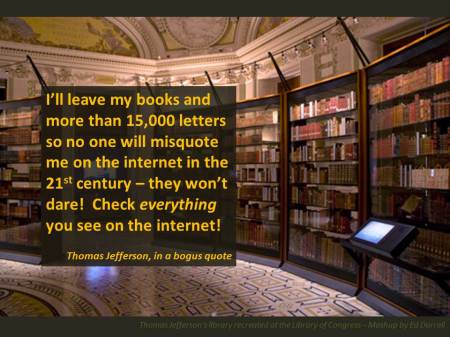
Jefferson’s advice on quotes found on the internet, backdropped by his books now held by the Library of Congress.
Spread the word; friends don't allow friends to repeat history.
The first one featured pure crankery, often, from Christopher Monckton and Steven Milloy, two people who have made careers out of pissing in the soup of science. The second conference pretended warming isn’t happening (the title of the conference was). The theme of the third conference is “Reconsidering the Science and the Economics,” but you’d have to be complete fool to think the Heartland Institute would allow a reconsideration of their misplaced sniping at science and bizarre claims that we cannot afford a healthy planet (we can’t afford an unhealthy planet!).
Watts’s topic will be “Is the U.S. Surface Temperature Record Reliable?” It should be a remarkable presentation.
If the surface temperature record isn’t reliable, what’s he doing using it every day in his weather forecasts? If it is reliable, what’s he doing attacking scientists for using it, and where does he propose to get better, more reliable data?
You can rely on this: There will be lots of press releases, but precious little science that has gone through any peer review process to provide reliability.
In fact, now would be a great time to brush up on Jeremy Bernstein’s methods for telling crank science from genius, and Bob Parks’s “Seven Warning Signs of Bogus Science.”
I’d love to have the concession to sell the “Bogus Science Bingo” cards at the meeting.
Chicago in May can be delightful. Cooler days do not get so cool. Spring flowers still erupt. Warmer days will invite outdoor dining downtown and at Chicago’s great neighborhood restaurants.
But these guys will stay indoors and carp about science, about imagined conspiracies to keep their words of wisdom out of publication. Most of them will have some corporate or PAC group paying their way, but a few people will pay to see this parade of voodoo science. They will be had by all.
Spread the word; friends don't allow friends to repeat history.
He continues: “Remember DDT, the pesticide used to kill mosquitoes that carried malaria. Jackie Kennedy read a book saying it was harmful, got her husband the president to bring pressure to have it banned and in 40 years 40 million people, mainly children, died. Now we’ve come to our senses and re-introduced it but only after the fashionable left did their damage.
Not so fast. Here are a few of the errors.
1. Key phrase: “the pesticide that used to kill mosquitoes that carried malaria.” It’s not very good anymore. Mosquitoes acquired alleles that allow them to digest DDT, rather as food, instead of getting poisoned by it. This evolutionary response was speeded when DDT was overused (abused, that is) by big farmers. The World Health Organization had a campaign to use DDT to knock down a mosquito population for about six months, quickly treat all the humans who had the disease, and so when the mosquitoes came roaring back after six months, there would be no malaria for them to get from one person to spread. WHO stopped the program when the quickly-evolving resistance to DDT made it impossible. This was in the years 1964 through about 1966. DDT was not banned, and production and use of the stuff continued around the world.
2. President Kennedy was asked about DDT at a press conference. He said he’d read the book. It wasn’t “meddling” by Jackie Kennedy — though she would have been right had she done it. Jackie Kennedy proved her mettle later as an editor of books, a real force to be reckoned with and a woman of great judgment.
(Yeah, I had sound trouble with it, except for the press conference with Kennedy.)
3. Kennedy didn’t act against DDT.
President John F. Kennedy at a press conference on August 29, 1962; he announced the retirement of Supreme Court Associate Justice Felix Frankfurter and the appointment of Arthur Goldberg to replace him; in questions, he was asked about DDT and Rachel Carson’s book, Silent Spring.
4. Kennedy did ask the experts to check out Carson’s book. The President’s Science Advisory Commitee (PSAC) (including Nobel winners) spent several months studying the book and its footnotes, and checking with other experts. In May 1963 they issued a verdict: Carson’s book, Silent Spring, was accurate and true, but suffered one flaw: Carson’s alarm wasn’t loud enough nor demanding action quickly enough. PSAC urged Kennedy to act immediately to slow or stop the use of DDT. Alas, he was assassinated six months later. (Full text of the PSAC report is available on this blog, here.)
5. Though the federal government stopped massive use of DDT on its side, large agricultural interests used it extensively. After a decade of devastation across the country, in two separate trials federal judges ruled DDT a dangerous substance — they withheld injunctions when the newly-formed EPA promised to expedite hearings on tighter regulations for the stuff which had been floundering for a few years. So it was that in 1971, more than seven years after John F. Kennedy’s death, a full administrative hearing on DDT began at EPA. DDT had been fully available world wide for 9 years after Carson’s book.
6. In 1972, still under court order, the EPA administrative law judge Edmund Sweeney ruled that a new label for DDT would be adequate control. Under the new label, use would be severely restricted, and broadcast spraying on crops would be prohibited, but DDT would be freely available. If someone wanted to, they could buy DDT and broadcast it themselves. Under the labeling rules, nothing could be done to such violators. Judge Sweeney carefully documented in his hearings all the benefits and drawbacks of DDT. A more restrictive proposal, such as a ban, would not do much more than the new label (if the label was followed), and Sweeney said that he did not find that EPA had the power to do any more. EPA administrator William Ruckleshaus got a more detailed review of the law from his legal team, and concluded that EPA could indeed ban broadcast use, and so he did. At least two of the DDT manufacturers sued, claiming there was no scientific basis for a ban. Under U.S. law, if the scientific data do not back up such a rule, the courts are obligated to overturn the rule. Both courts granted summary judgment for EPA, meaning that even if all the evidence were interpreted to favor the pesticide manufacturers, they would still lose on the law. There were no further appeals.
7. The EPA ban allowed DDT to be used in emergencies, especially if there were an emergency involving malaria or other insect-borne disease; specifically, EPA’s order allowed DDT use against any insect “vector” to fight disease at any time, for indoor residual spraying (IRS) the preferred method of fighting malaria. The EPA ban did not cover manufacturing, and U.S. DDT manufacturers ran a lively export business through 1984. On the day before the Superfund law took effect in 1984, requiring manufacturers to clean up toxic wastes they had dumped in violation of law, several of the DDT manufacturers declared bankruptcy, leaving the Superfund to clean up DDT sites in Texas and California, and other places. Clean up continues today, 25 years later, costing tens of millions of dollars a year.
Manufacture of DDT today is chiefly in India and China. Pollution problems abound near those sites.
8. DDT use was never banned in Africa, especially for use to fight malaria. Considering mosquito resistance and immunity, however, Africans generally chose not to use DDT. DDT’s reputation was further tarnished when it was revealed that broadcast outdoor spraying had killed food fishes in several places, leading to near starvation for local populations. South Africa used DDT right up through 1996, then stopped. When mosquitoes with malaria flowed over the border from neighboring nations without adequate disease control programs, malaria rates shot up, and DDT was again used as a last-ditch defense.
9. Generally, malaria infections and malaria deaths continued to decline in Africa and Asia after Silent Spring, and after the U.S. banned DDT use on crops. Malaria in Africa rose after 1985 when malaria parasites developed immunity to the pharmaceuticals used to treat the disease in humans. Without an effective drug regimen, death rates rose, too. DDT could not offer any help in this fight.
10. One of the greatest barriers to fighting malaria in Africa has been unstable governments. For example, it is difficult to believe that Idi Amin, the horrible dictator who ruled Uganda from 1971 to 1979, and claimed to have eaten some of his executed enemies, refused to spray DDT because he wanted to be environmentally friendly. If Monckton wants to make such a claim explicitly, he’s nuts (he may be nuts anyway, but this unspoken claim of his is particularly insane). Other nations had less spectacular misrule, but the effect was the same: When governments could not, or did not mount fights against mosquitoes and malaria, malaria spread. This had nothing to do with DDT, nor with a lack of DDT.
11. When WHO suspended their campaign against malaria using large-scale DDT spraying out of doors, malaria killed about two million people annually, down from a peak of nearly four million 15 to 20 years earlier. Today, malaria kills about 900,000 people annually. Monckton says the lack of DDT has been responsible for 40 million deaths in the last 40 years. That’s a good trick, really — it’s a lower rate than others have claimed, but it assumes that every malaria death could have been prevented with DDT, something we know is not the case. More, it assumes that the U.S. ban on spraying DDT on cotton in Texas in 1972 somehow caused Africans to stop using DDT in 1965, a neat feat of time travel, and an astounding feat of regular travel, Texas being about 10,000 miles from most of Africa, too far for mosquitoes to migrate.
In three sentences, Monckton crammed in 11 grotesque falsehoods. And that paragraph was not even the topic of the article. And what is it about these propaganda attacks dead women? Unholy attacks on Rachel Carson are bad enough — now Monckton goes after Jackie Kennedy, too? Do these guys carefully choose targets who cannot respond, and who, because dead, cannot sue for libel?
Is it true that a Lie can get halfway around the world before Truth gets its boots on? Isn’t there some Truth Police who could stop Monckton from spreading that crap?
People have been complaining for months about Barack Obama’s birth certificate, complaining that the official, under seal document from the State of Hawaii should not be honored, contrary to Hawaii law, contrary to federal immigration law, and contrary to the Constitution’s full faith and credit clause. Something must be wrong with the document, they have claimed over and over, though no credible evidence of any problem has ever surfaced, let alone been presented to any authority. Lawsuits have been dismissed for standing, dismissed for failure to state a case, and lately dismissed with warnings that nuisance suits will bring Rule 11 sanctions (Rule 11 of the Federal Rules of Civil Procedure require that an attorney not file false or misleading documents, and that they swear that what they allege in a complaint is actual controversy and not hoax or false).
Even a reiteration from Hawaii officials didn’t quell the lunatic screams from the birther asylums. (Here’s I’ve usually referred to the birth certificate-obsessed, or BCOs; I’ll continue using that acronym.)
The BCO universe erupted with glee over the weekend with the presentation of a document purported to be a birth certificate for Barack Obama, Jr., from Mombasa, Kenya.
While warning more sane and cool people that they were not skeptical enough of Obama’s Hawaiian birth certificate, BCOs claimed they now had the smoking gun. Orly Taitz, a California dentist/lawyer, promised to blow the case of Obama’s alleged ineligibility wide open with new filings of documents in California state courts.
They wanted so badly for the document to true and accurate, even though it would have offered no new ammunition for their claims, since Obama’s mother was a citizen and under U.S. law a child born to a U.S. citizen is considered a born citizen no matter where in the universe it is born . . .
That was Friday night. Beginning Saturday morning, the hoax began to unravel.
BCO’s were had! Someone had hoaxed them!
So, of course, they have gotten louder in their demands that the White House toss Obama to the crowd with pitchforks and torches, so they can investigate.
The document is a classic hoax, delivered where and when gullibility made the BCO arguments most vunerable (which is any time, really).
Hoax birth certificate for Barack Obama, Jr, alleged to be showing birth in Mombasa, then Zanzibar
Never mind that the certificate offered suffers from more problems than the BCOs claimed to find with the document Hawaii offered — no signatures of any official, no attending physician, unintelligible seal, not a “long form,” etc. — it was, WorldNet Daily, Orly Taitz and others said, THE jenyu-wine article. They even offered close-ups.
Another view of the hoax document offeree by BCO Orly Taitz.
See? Right there you can see: Barack Obama, Sr. (Obama’s father), 26 years old. The Registrar, E. F. Lavender. Registered in Mombasa on August 5, 1961, one day after Obama’s birthday. It even shows the book and page number of the original registration document, and the date the official who signed this document issued it in Mombasa, Republic of Kenya, on February 17, 1964.
Okay, students: How many problems can you find with the document?
Wiley Drake cannot show us his green card, and so, by his standards, he is an illegal alien.
What’s that you say? Drake was born in the U.S.? So was Obama, and it doesn’t stop Drake from claiming Obama illegal. The only criterion Drake offers is that Obama doesn’t have a green card. On that criterion, Drake is also an illegal alien, since he has no green card, either.
As God is our witness, we could not make this stuff up.
Do you think Drake is part of the reason California is having such great fiscal difficulties?
Seriously, Wiley Drake does not speak for God, nor even for other Christians. That was a shameful performance on Drake’s part not least because he didn’t have a clue how shameful it was. The Bible says Christian elders have an obligation to rebuke false doctrine, false preachers and hooey. Consider Drake rebuked.
Not that Drake would ever listen to a Christian elder.
Star-spangled Banner and the War of 1812 – The original Star-Spangled Banner, the flag that inspired Francis Scott Key to write the song that would become our national anthem, is among the most treasured artifacts in the collections of the Smithsonian’s National Museum of American History in Washington, D.C.
Every school kid learns the story of the “Star-Spangled Banner,” or should.
During the War of 1812, Georgetown lawyer Francis Scott Key, stood aboard a British ship in Baltimore Harbor to negotiate the release of his friend, Dr. William Beanes, who had been taken prisoner while the British stormed through Bladensburg, Maryland, after burning Washington, D.C. Key witnessed the British shelling of Fort McHenry, the guardian of Baltimore’s harbor. Inspired when he saw the U.S. flag still waving at dawn after a night of constant shelling, Key wrote a poem.
Key published the poem, suggested it might be put to the tune of “Anachreon in Heaven” (a tavern tune popular at the time) — and the popularity of the song grew until Congress designated it the national anthem in 1931. In telling the story of the latest restoration of that garrison flag now housed at the Smithsonian Museum of American History,Smithsonian Magazine repeated the story in the July 2000 issue: “Our Flag Was Still There.”
It’s a wonderful history with lots of splendid, interesting details (Dolley Madison fleeing the Executive Mansion clutching the Gilbert Stuart portrait of George Washington, the guy who had introduced Dolley to James Madison and then snubbed them after they were married; the British troops eating the White House dinner the Madisons left in their haste; the gigantic, 42 by 30 foot flag sewn by Mary Pickersgill, a Baltimore widow trying to support her family; the rag-tag Baltimore militia stopping cold “Wellington’s Invicibles;” the British massing of 50 boats and gunships; and much more).
It’s a grand and glorious history that stirs the patriotic embers of the most cynical Americans.
And it’s all true.
So it doesn’t deserve the voodoo history version, the bogus history created by some person preaching in a church (I gather from the “amens”) that is making the rounds of the internet, stripped of attribution so we cannot hunt down the fool who is at fault.
We got this in an e-mail yesterday; patriots save us, there must be a hundred repetitions that turn up on Google, not one correcting this horrible distortion of American history.
Horrible distortion of American history
(The full version is a mind-numbing 11 minutes plus. Some people have put it on other sites.)
Why do I complain?
It was the War of 1812, not the Revolutionary War — there were 15 states, not 13 colonies.
There was no ultimatum to to Baltimore, nor to the U.S., as this fellow describes it.
Key negotiated for the release of one man, Dr. Beanes. There was no brig full of U.S. prisoners.
It’s Fort McHenry, not “Henry.” The fort was named after James McHenry, a physician who was one of the foreign-born signers of the Constitution, who had assisted Generals Washington and Lafayette during the American Revolution, and who had served as Secretary of War to Presidents Washington and Adams.
Fort McHenry was a military institution, a fort defending Baltimore Harbor. It was not a refuge for women and children.
The nation would not have reverted to British rule had Fort McHenry fallen.
There were 50 ships, not hundreds. Most of them were rafts with guns on them. Baltimore Harbor is an arm of Chesapeake Bay; Fort McHenry is not on the ocean.
The battle started in daylight.
Bogus quote: George Washington never said “What sets the American Christian apart from all other people in this world is he will die on his feet before he will live on his knees.” Tough words. Spanish Civil War. Not George Washington. I particularly hate it when people make up stuff to put in the mouths of great men. Washington left his diaries and considerably more — we don’t have to make up inspiring stuff, and when we do, we get it wrong.
The battle was not over the flag; the British were trying to take Baltimore, one of America’s great ports. At this point, they rather needed to since the Baltimore militia had stunned and stopped the ground troops east of the city. There’s enough American bravery and pluck in this part of the story to merit no exaggerations.
To the best of our knowledge, the British did not specifically target the flag.
There were about 25 American casualties. Bodies of the dead were not used to hold up the flag pole — a 42 by 30 foot flag has to be on a well-anchored pole, not held up by a few dead bodies stacked around it.
You can probably find even more inaccuracies (please note them in comments if you do).
The entire enterprise is voodoo history. The name of Key is right; the flag is right; almost everything else is wrong.
Please help: Can you find who wrote this piece of crap? Can you learn who the narrator is, and where it was recorded?
I keep finding troubling notes with this on the internet: ‘My school kids are going to see this to get the real story.’ ‘Why are the libs suppressing the truth?’ ‘I didn’t know this true story before, and now I wonder why my teachers wouldn’t tell it.’
If Peter Marshall and David Barton gave a gosh darn about American history, they would muster their mighty “ministries” to correct the inaccuracies in this piece. But they are silent.
Dallas Morning News columnist Jackie Floyd gets at the real issues week after week, stripping away the spin and silliness other reporters cover in the misaimed hope for objectivity.
A lot of what the expert advisers have to say about the standards for teaching social studies to Texas kids is genuinely depressing stuff.
It’s depressing because, as you wade through the half-dozen point-by-point reports that will be used to advise the people deciding what your kids will learn, you might wonder whether the people who oversee our public schools care a lot less about education than they do about ideology.
You might even get the sense they care an awful lot less about helping the next generation of Texans lead meaningful, productive lives than about telling them how to vote.
It’s not a big surprise, since some members of the State Board of Education sometimes behave as if schooling children is simply a matter of making them memorize an encyclopedic list of political talking points.
She names names, though I doubt she had a chance to actually kick the butts that need kicking.
And it’s the board that appointed a panel of experts that includes a family-values activist from Aledo and a minister in Massachusetts who specializes in “Christian heritage.” It’s that awful, embarrassing fight over evolution all over again.
As a result, what is presumably supposed to be a sensible discussion about what children need to learn has been reduced to a self-serving bickering match over who gets to be commandant of the indoctrination camp.
“To have Cesar Chavez listed next to Ben Franklin is ludicrous,” snarls one of the panelists; another says kids must be drilled more about Roe vs. Wade, which he says has “arguably more impacted American life than any other Supreme Court decision in the 20th century.”
Another expert makes careful tallies over whether curriculum recommendations cite Latinos with the same frequency as black and white historical figures – as if classroom studies can be reduced to a racial quid pro quo of the number of times specific historical figures are mentioned.
It’s not all ideological flag-waving, of course – but a lot of it is. There’s a silly freedom-fries debate over whether to substitute the term “free enterprise system” for “capitalism,” of whether suggested teaching examples should exclude Carl Sagan or Neil Armstrong or the guy who invented canned milk; of whether there are too many women and minorities and not enough founding fathers; of whether religion and the rule of law should be taught with more or less vigor than civil liberties and colonial adventurism.
Best, she notices that there were a couple of real experts on the panel whose reports have gotten short shrift in the news, and whose reports will be give short shrift by the politically-driven education board.
Miraculously – or at least astonishingly – in one of the reports, I found that awareness candidly articulated.
Somehow, Dr. Lybeth Hodges, a Texas Woman’s University history professor and a last-minute panel appointee, did not see a need to draft a political manifesto. She just made (get this!) sensible, useful curriculum recommendations.
She pointed out items that might actually help kids learn more and be better prepared for tests, such as that specific grade-level curriculum doesn’t always match the dreaded TAKS tests.
She noted that there are more than 90 “student expectations” for fifth-graders, an unrealistic pipe dream given that “some sound like test questions I give my college freshmen.”
Hodges, unlike some other appointees, took the blessedly pragmatic view that constantly trying to balance dueling ideologies will only result in a bloated, unmanageable list of standards that few kids will find meaningful and retain.
“It should not be a political exercise,” she said briskly, when we spoke a few days ago.
“I never thought about the political aspect at all,” she said. “I thought we were being asked to do what is reasonable and helpful for teachers. … They have enough red tape as it is.”
As we talked, my head was gradually swaddled in a pleasurable sense of optimism: Here was one person, at least, more interested in getting something useful done than in endlessly re-enacting the same old tired-out culture battle.
Call me a starry-eyed dreamer, but American education isn’t supposed to be a tedious exercise in demagoguery.
“To me, teachers aren’t there to carry out indoctrination in our schools,” Hodges said. “These people are trying to open little minds.”
If we’re going to open them successfully, we need more big minds at the top.
I’m reviewing the reviews of Texas social studies curricula offered by the six people appointed by the Texas State Board of Education. David Barton, a harsh partisan politician, religious bigot, pseudo-historian and questionable pedagogue, offers up this whopper, about fifth grade standards.:
In Grade 5 (b)(24)(A), there are certainly many more notable scientists than Carl Sagan – such as Wernher von Braun, Matthew Maury, Joseph Henry, Maria Mitchell, David Rittenhouse, etc.
Say what? “More notable scientists than Carl Sagan . . . ?” What is this about?
It’s about David Barton’s unholy bias against science, and in particular, good and great scientists like Carl Sagan who professed atheism, or any faith other than David Barton’s anti-science brand of fundamentalism.
David Barton doesn’t want any Texas child to grow up to be a great astronomer like Carl Sagan, if there is any chance that child will also be atheist, like Carl Sagan. Given a choice between great science from an atheist, or mediocre science from a fundamentalist Christian, Barton chooses mediocrity.
(24) Science, technology, and society. The student understands the impact of science and technology on life in the United States. The student is expected to:
(A) describe the contributions of famous inventors and scientists such as Neil Armstrong, John J. Audubon, Benjamin Banneker, Clarence Birdseye, George Washington Carver, Thomas Edison, and Carl Sagan;
(B) identify how scientific discoveries and technological innovations such as the transcontinental railroad, the discovery of oil, and the rapid growth of technology industries have advanced the economic development of the United States;
(C) explain how scientific discoveries and technological innovations in the fields of medicine, communication, and transportation have benefited individuals and society in the United States;
(D) analyze environmental changes brought about by scientific discoveries and technological innovations such as air conditioning and fertilizers; and
(E) predict how future scientific discoveries and technological innovations could affect life in the United States.
Why doesn’t Barton like Carl Sagan? In addition to Sagan’s being a great astronomer, he was a grand populizer of science, especially with his series for PBS, Cosmos.
But offensive to Barton was Sagain’s atheism. Sagan wasn’t militant about it, but he did honestly answer people who asked that he found no evidence for the efficacy or truth of religion, nor for the existence of supernatural gods.
More than that, Sagan defended evolution theory. Plus, he was Jewish.
Any one of those items might earn the David Barton Stamp of Snooty-nosed Disapproval, but together, they are about fatal.
Do the scientists Barton suggests in Sagan’s stead measure up? Barton named four:
Wernher von Braun, Matthew Maury, Joseph Henry, Maria Mitchell, David Rittenhouse
In the category of “Sagan Caliber,” only von Braun might stake a claim. Wernher von Braun, you may recall, was the guy who ran the Nazi’s rocketry program. After the war, it was considered a coup that the U.S. snagged him to work, first for the Air Force, and then for NASA. Excuse me for worrying, but I wonder whether Barton likes von Braun for his rocketry, for his accommodation of anti-evolution views, or for his Nazi-supporting roots. (No, I don’t trust Barton as far as I can hurl the Texas Republican Party Platform, which bore Barton’s fould stamp while he was vice chair of the group.)
So, apart from the fact that von Braun was largely an engineer, and Sagan was a brilliant astronomer with major contributions to our understanding of the cosmos, what about the chops of the other four people? Why would Barton suggest lesser knowns and unknowns?
Matthew Maury once headed the U.S. Naval Observatory, in the 19th century. He was famous for studying ocean currents, piggy-backing on the work of Ben Franklin and others. Do a Google search, though, and you’ll begin to undrstand: Maury is a favorite of creationists, a scientist who claimed to subjugate his science to the Bible. Maury claimed his work on ocean currents was inspired at least in part by a verse in Psalms 8 which referred to “paths in the sea.” Maury is not of the stature or achievement of Sagan, but Maury is politically correct to Barton.
Joseph Henry is too ignored, the first head of the Smithsonian Institution. Henry made his mark in research on magnetism and electricity. But it’s not Henry’s science Barton recognizes. Henry, as a largely unknown scientist today, is a mainstay of creationists’ list of scientists who made contributions to science despite their being creationists. What? Oh, this is inside baseball in the war to keep evolution in science texts. In response to the (accurate) claim that creationists have not contributed anything of scientific value to biology since about William Paley in 1802, Barton and his fellow creationists will trot out a lengthy list of scientists who were at least nominally Christian, and claim that they were creationists, and that they made contributions to science. The list misses the point that Henry, to pick one example, didn’t work in biology nor make a contribution to biology, nor is there much evidence that Henry was a creationist in the modern sense of denying science. Henry is obscure enough that Barton can claim he was politically correct, to Barton’s taste, to be studied by school children without challenging Barton’s creationist ideas.
David Rittenhouse, a surveyor and astronomer, and the first head of the U.S. Mint, is similarly confusing as part of Barton’s list. Rittenhouse deserves more study, for his role in extending the Mason-Dixon line, if nothing else, but it is difficult to make a case that his contributions to science approach those of Carl Sagan. Why is Rittenhouse listed by Barton? If nothing else, it shows the level of contempt Barton holds for Sagan as “just another scientist.” Barton urges the study of other scientists, any other scientists, rather than study of Sagan.
Barton just doesn’t like Sagan. Why? Other religionists give us the common dominionist or radical religionist view of Sagan:
Just what is the Secular Humanist worldview? First and foremost Secular Humanists are naturalists. A naturalist believes that nature is all that exists. “The Cosmos is all there is, or was, or ever will be.” This was the late Carl Sagan’s opening line on the television series “Cosmos.” Sagan was a noted astronomer and a proud secular humanist. Sagan maintained that the God of the Bible was nonexistent. (Imagine Sagan’s astonishment when he came face to face with his Maker.)
Sagan’s science, in Barton’s view, doesn’t leave enough room for Barton’s religion. Sagan was outspoken about his opposition to superstition. Sagan urged reason and the active use of his “Baloney-Detection Kit.” One of Sagan’s later popular books was titled Demon-haunted World: Science as a candle in the dark. Sagan argued for the use of reason and science to learn about our world, to use to build a framework for solving the world’s problems.
Barton prefers the dark to any light shed by Sagan, it appears.
More resources on the State Board of Education review of social studies curricula
Just when you thought it was safe to take a serious summer vacation, finish the latest Doris Kearns Goodwin, and catch up on a couple of novels . . .
The sharks of education policy are back.
Or the long knives are about to come out (vicious historical reference, of course, but I’m wagering the anti-education folks didn’t catch it). Pick your metaphor.
Our friend Steve Schafersman sent out an e-mail alert this morning:
The Expert Reviews of the proposed TexasSocial Studies curriculum are now available at
David Barton, President, WallBuilders
Review of Current Social Studies TEKS
Jesus Francisco de la Teja, Professor and Chair, Department of History, Texas State University
Review of Current Social Studies TEKS
Daniel L. Dreisbach, Professor, American University Review of Current Social Studies TEKS
Lybeth Hodges, Professor, History, Texas Woman’s University
Review of Current Social Studies TEKS
Jim Kracht, Associate Dean and Professor, College of Education and Human Development, Texas A&M University
Review of Current Social Studies TEKS
Peter Marshall, President, Peter Marshall Ministries
Review of Current Social Studies TEKS
You can download their review as a pdf file.
Three of these reviewers are legitimate, knowledgeable, and respected academics who undoubtedly did a fair, competent, and professional job. The other three are anti-church- state separation, anti-secular public government, and pseudoscholars and pseudohistorians. I expect their contributions to be biased, unprofessional, and pseudoscholarly. Here are the bad ones:
Barton may be the worst of the three. He founded Wallbuilders to deliberately destroy C-S separation and promote Fundamentalist Christianity in US government. Just about everything he has written is unhistorical and inaccurate. For example, Barton has published numerous “quotes” about C-S separation made by the Founding Fathers that upon investigation turned out to be hoaxes. Here’s what Senator Arlen Specter had to say about Barton:
Probably the best refutation of Barton’s argument simply is to quote his own exegesis of the First Amendment: “Today,” Barton says, “we would best understand the actual context of the First Amendment by saying, ‘Congress shall make no law establishing one Christian denomination as the national denomination. ‘ ” In keeping with Barton’s restated First Amendment, Congress could presumably make a law establishing all Christian denominations as the national religion, and each state could pass a law establishing a particular Christian church as its official religion.
All of this pseudoscholarship would hardly be worth discussing, let alone disproving, were it not for the fact that it is taken so very seriously by so many people.
I am sure these six will participate in a Great Texas History Smackdown before our crazy SBOE. Perhaps this will finally sicken enough citizens that they will finally vote to get rid of the SBOE, either directly or indirectly. Be sure to listen to this hearing on the web audio. Even better, the web video might be working so you can watch the SBOE Carnival Sideshow.
Steven Schafersman, Ph.D.
President, Texas Citizens for Science
The non-expert experts were appointed by Don McLeroy before the Texas Senate refused to confirm his temporary chairmanship of the State Board of Education. The good McLeroy may have done as chairman is interred with his dead chairmanship; the evil he did lives on. (Under McLeroy and Barton’s reading of history and literature, most students won’t catch the reference for the previous sentence.)
This may be the #1 hoax site on the web: Martinlutherking.org. Certainly it is a site dangerous for children, because it cleverly purports to be an accurate history site, while selling voodoo history and racism.
A racist group bought the domain name (note the “.org” suffix), and they’ve managed to keep it. The site features a drawing of Martin Luther King, Jr., on the first page. The racist elements are subtle enough that unwary students and teachers may not recognize it for the hoax site it is.
It is both racist and hoax: Note the link to a racist argument on “Why the Martin Luther King, Jr., holiday should be repealed;” note the link to a hoax page, “Black invention myths.”
Students, nothing on that site should be trusted. Teachers, warn students away from the site. You may want to use that site as a model of what a bad site looks like, and the importance of weighing the credibility of any site found on the web.
Why do I even mention the racist, hoax site? Because it comes upi #3 on Google searches for “Martin Luther King.” Clearly a lot of people are being hoodwinked into going to that site. I’ve seen papers by high school students citing the site, with teachers unaware of the site’s ignoble provenance.
Here are a few good sites on the Rev. Dr. Martin Luther King, Jr.; you can help things by clicking on each one of these sites, and by copying this list with links and posting it on your blog:
Nothing new to careful observers. Several of the Usual Suspects™ bad quotes turned up.
The trouble with these quotations, which are central to the theses of both pieces, is that all of them are fake. And by fake I don’t mean, please note, that they had a word off here and there, or that they were a popular misquoting of something Washington or Franklin actually said or wrote—I mean that they were out-and-out fakes, words put into their mouths by somebody else with an axe to grind. (And even worse—a number of them were actually misquotations of the original fake quotation.) Here are the seven, in all their glory:
It cannot be emphasized too strongly or too often that this great nation was founded, not by religionists, but by Christians, not on religions, but on the Gospel of Jesus Christ! (falsely attributed to Patrick Henry)
It cannot be emphasized too clearly and too often that this nation was founded, not by religionists, but by Christians; not on religion, but on the gospel of Jesus Christ. For this very reason, peoples of other faiths have been afforded asylum, prosperity and freedom of worship here. (falsely attributed to Patrick Henry)
He who shall introduce into public affairs the principles of primitive Christianity will change the face of the world. (falsely attributed to Benjamin Franklin)
The reason that Christianity is the best friend of government is because Christianity is the only religion that changes the heart. (falsely attributed to Thomas Jefferson)
The future and success of America is not in this Constitution but in the laws of God upon which this Constitution is founded. (falsely attributed to James Madison)
It is impossible to rightly govern the world without God and the Bible. (falsely attributed to George Washington)
It is impossible to rightly govern a country without God and the Bible. (falsely attributed to George Washington)
It’s difficult to get students to attribute quotes with proper citations. Students are mightily confused by the notion of plagiarism. We teachers need to work harder to get them to verify what they quote, and to offer appropriate citations. Since these quotes can’t be cited, students should have discovered the errors as they wrote.
One of the offending pieces was written by a high school junior, the other by a 10-year-old. There’s time to make them savvy (but will anyone do it?).
Do we need to give judges, of essay and speech competitions, sheets of the quotes that most frequently show up, though they are faked?
Spread the word; friends don't allow friends to repeat history.
Texas Freedom Network’s Insider blog reports that embattled chairman Don McLeroy is working to create a panel of experts to review studies curricula. The experts he has proposed so far are all well-known cranks in academia, people who bring their axes to grind on the minds of innocent children.
This panel is a bold insult to Texas’s community of economists, historians, and other practitioners of fields of social studies, not to mention educators. A more qualified panel of experts could be assembled in the coffee break rooms of the history departments at most of Texas’s lesser known state colleges and universities.
Why does Don McLeroy hate Texas so?
I’ve been buried in teaching, grading, planning and the other affairs of the life of a teacher, and had not paid much attention to the movement on this issue (“movement” because I cannot call it “progress”). My students passed the state tests by comfortable margins, more than 90% of them; this news from SBOE makes me despair even in the face of the news that our achievements are substantial in all categories.
The panel lacks knowledge and experience in economics, geography and history. The panel is grotesquely unbalanced — at least two of the panel members remind me of Ezra Taft Benson, who was Secretary of Agriculture for Dwight Eisenhower. When he resigned from that post, he complained that Eisenhower was too cozy with communism. Barton and Quist lean well to the right of Ezra Taft Benson. Quist has complained of socialist and Marxist leanings of Reagan administration education policy and policy makers.
Or, until that account is unsuspended by the forces supporting Donald Trump: Follow @FillmoreWhite, the account of the Millard Fillmore White House Library
We've been soaking in the Bathtub for several months, long enough that some of the links we've used have gone to the Great Internet in the Sky.
If you find a dead link, please leave a comment to that post, and tell us what link has expired.
Thanks!
Retired teacher of law, economics, history, AP government, psychology and science. Former speechwriter, press guy and legislative aide in U.S. Senate. Former Department of Education. Former airline real estate, telecom towers, Big 6 (that old!) consultant. Lab and field research in air pollution control.
My blog, Millard Fillmore's Bathtub, is a continuing experiment to test how to use blogs to improve and speed up learning processes for students, perhaps by making some of the courses actually interesting. It is a blog for teachers, to see if we can use blogs. It is for people interested in social studies and social studies education, to see if we can learn to get it right. It's a blog for science fans, to promote good science and good science policy. It's a blog for people interested in good government and how to achieve it.
BS in Mass Communication, University of Utah
Graduate study in Rhetoric and Speech Communication, University of Arizona
JD from the National Law Center, George Washington University


 Posted by Ed Darrell





 Millard Fillmore's Bathtub