Ardeatine Massacre: Bombers were soldiers, not terrorists

August 13, 2007

Our Italian physicist friend, Dorigo, at A Quantum Diaries Survivor reports that an Italian court ruled against a newspaper that started a campaign to deny the history of the Ardeatine Massacre.

Good news today. The supreme court of Cassazione in Italy has ruled that the press campaign labeling “terrorists” the GAP partisans who organized the bombing of Via Rasella in nazi-occupied Rome in 1944, launched by the national newspaper “Il Giornale”, was a striking example of manipulation of historic truth for political means. The newspaper is owned by Paolo Berlusconi (brother of Silvio, formerly premier of Italy in 1994 and 2001-2006), and was directed by Vittorio Feltri . . . a journalist who never hid his sympathy for the extreme right.

What was the Ardeatine Massacre?

Statue memorial to the victims of the Ardeatine Massacre, Italy Wikipedia:

The massacre of Fosse Ardeatine (Italian: Eccidio delle Fosse Ardeatine) took place in Rome, Italy during World War II. On 23 March 1944, 2 German soldiers, 31 Italian soldiers of Battaglione Bozen and a few Italian civilians passing along the road, were killed when members of the Italian Resistance set off a bomb close to a column of German soldiers who were marching on via Rasella[1]. This terrorist attack was led by the Gruppi di Azione Patriottica, of Rosario Bentivegna, Carla Capponi, Antonello Trombadori (Head of GAP in Roma) and the approval of Sandro Pertini (later President of Italian Republic), in order to provocate the reaction of SS troops.

Adolf Hitler is reported but never confirmed to have ordered that within 24 hours, one-hundred Italians were to be shot for each dead German. Commander Herbert Kappler in Rome concluded that ten Italians for each dead German would be sufficient and quickly compiled a list of 320 civilians who were to be killed. Kappler voluntarily added ten more names to the list when the 33rd German/Italian died after the Partisan attack. The total number of people murdered at the Fosse Ardeatine was 335, most Italians. The largest cohesive group among the murdered were the members of Bandiera Rossa, a Communist military Resistance group.

Why is there controversy 60 years later? Read the rest of this entry »


Original Documents: Long history of DDT trouble, from U.S. Fish and Wildlife Service, 1945 and later

August 12, 2007

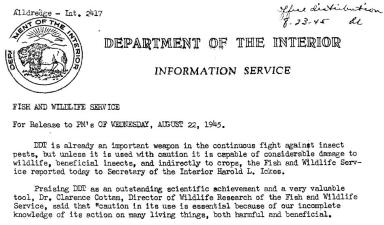
Header of FWS press release, Aug 22 1945

Archives of the U.S. Fish and Wildlife Service (FWS) reveal a long history of trouble with DDT, almost from the first uses of the chemical as an insecticide during World War II. You’ll find extensive links to historic press releases from FWS below the fold.

Critics of the various restrictions on DDT use often claim that DDT is a God-sent chemical that nearly eradicated malaria from the world (absolutely untrue) and which was banned only because of hysteria caused by Rachel Carson’s 1962 book, Silent Spring (untrue at both ends, hysteria and the power of Carson’s book). This is history revisionism at its worst, it is bogus history.

A careful study of the history of the use of DDT shows that scientists were concerned about its dangers from the first uses as a pesticide. The U.S. Fish and Wildlife Service reported dangers in a press release on August 22, 1945, just a week after the surrender of Japan ended World War II (VJ Day was August 15 in Tokyo, August 14 in Washington). In that release FWS noted the beneficial uses of DDT to fight insect and lice infestations that threatened troops and civilians with typhus and other diseases, but cautioned that such use should not become common, that more study was needed: Read the rest of this entry »


Fisking “Junk Science’s” campaign for DDT: Point #6

August 9, 2007

Another in a continuing series, showing the errors in JunkScience.com’s list of “100 things you should know about DDT.” (No, these are not in order.)

Steven Milloy and the ghost of entomologist J. Gordon Edwards listed this as point six in their list of “100 things you should know about DDT “[did Edwards really have anything to do with the list before he died?]:

6. “To only a few chemicals does man owe as great a debt as to DDT… In little more than two decades, DDT has prevented 500 million human deaths, due to malaria, that otherwise would have been inevitable.”

[National Academy of Sciences, Committee on Research in the Life Sciences of the Committee on Science and Public Policy. 1970. The Life Sciences; Recent Progress and Application to Human Affairs; The World of Biological Research; Requirements for the Future.]

In contrast to their citation for the Sweeney hearing record, which leads one away from the actual hearing record, for this citation, the publication actually exists, though it is no longer available in print. It’s available on-line, in an easily searchable format. [I urge you to check these sources out for yourself; I won’t jive you, but you should see for yourself how the critics of Rachel Carson and WHO distort the data — I think you’ll be concerned, if not outraged.] The quote, though troubled by the tell-tale ellipses of the science liar, is accurately stated so far as it goes.

The problems? It’s only part of the story as told in that publication.  The National Academy of Science calls for DDT to be replaced in that book; NAS is NOT calling for a rollback of any ban, nor is NAS defending DDT against the claims of harm.  The book documents and agrees with the harms Rachel Carson wrote about eight years earlier.

Cover of the electronic version of Life Sciences, the 1970 book looking to future needs in biology and agriculture.

Cover of the electronic version of Life Sciences, the 1970 book looking to future needs in biology and agriculture.

Milloy (and Edwards, he claims), are trying to make a case that the National Academy of Sciences, one of the more reputable and authoritative groups of distinguished scientists in the world, thinks that DDT is just dandy, in contrast to the views of Rachel Carson and environmentalists (who are always cast as stupid and venal in Milloy’s accounts) who asked that DDT use be reduced to save eagles, robins and other songbirds, fish, and other wildlife, and to keep DDT useful against malaria.

First, there is no way that a ban on DDT could have been responsible for 500 million deaths due to malaria.  Calculate it yourself, the mathematics are simply impossible: At about 1 million deaths per year, if we assume DDT could have prevented all of the deaths (which is not so), and had we assumed usage started in 1939 instead of 1946 (a spot of 7 years and 7 million deaths), we would have 69 million deaths prevented by 2008. As best I can determine, the 500 million death figure is a misreading from an early WHO report that noted about 500 million people are annually exposed to malaria, I’m guessing a bit at that conclusion — that’s the nicest way to attribute it to simple error and not malicious lie. It was 500 million exposures to malaria, not 500 million deaths. It’s unfortunate that this erroneous figure found its way into a publication of the NAS — I suppose it’s the proof that anyone can err.

Read the rest of this entry »


Don’t trust what you read — on blogs, as well as in the news

August 6, 2007

The CEO of Fark suggests people turn off the newsfeeds for a while, and ignore the constant chatter of the internet.

Happy to be a Rock n’ Roller carries an excerpt of an interview with Drew Curtis:

Q: Which media patterns do you find most annoying, and which media patterns do you think are the most dangerous without being obviously so?

Equal time for nutjobs. It’s all funny when you talk about people not believing in moon landings, or who think an alien crash-landed in Texas in 1897, or who believe that there was once an ancient mediterranean civilization in Florida. It’s another thing entirely when people start to believe that denying the holocaust is a valid opinion.

Curtis wrote a book, It’s Not News, It’s Fark: How Mass Media Tries to Pass Off Crap As News .  It should be required reading for students doing research on the internet, I suspect. 

(I wonder what the original venue of that interview is — anybody know?)


Brainwashing for politics and profit: Global warming denial

August 5, 2007

Newsweek cover, August 13, 2007

We are plagued by industries set up to deny reality. It’s impossible to discuss public policy without smashing into organizations set up specifically to question history and hard science, and plant seeds of doubt in the minds of the public about the way things really are. When my job was to fight them, with essentially no budget, as late as 1985 there was a well-funded lobby in Washington that cranked out weekly “news” and opinion columns for smaller and less discriminating news outlets like weekly papers and local television stations, extolling the virtues of tobacco and claiming that no scientist had any real evidence that smoking is unhealthy.

A lot of those disinformation artists have moved on — not to the Soviet Union, since it collapsed and took most its propaganda machine with it — to denial of reality on global warming, evolutionary biology, pesticides and chemicals, and a host of other issues.

Sharon Begley’s story in the August 13, 2007, Newsweek pulls back the veil on the well-funded industry that tries to plant doubt about the reality of global warming: “The Truth about Denial.” If this is news to you, that people get paid well to hoax the public, you really need to read the story:

If you think those who have long challenged the mainstream scientific findings about global warming recognize that the game is over, think again. Yes, 19 million people watched the “Live Earth” concerts last month, titans of corporate America are calling for laws mandating greenhouse cuts, “green” magazines fill newsstands, and the film based on Al Gore’s best-selling book, “An Inconvenient Truth,” won an Oscar. But outside Hollywood, Manhattan and other habitats of the chattering classes, the denial machine is running at full throttle—and continuing to shape both government policy and public opinion.

Since the late 1980s, this well-coordinated, well-funded campaign by contrarian scientists, free-market think tanks and industry has created a paralyzing fog of doubt around climate change. Through advertisements, op-eds, lobbying and media attention, greenhouse doubters (they hate being called deniers) argued first that the world is not warming; measurements indicating otherwise are flawed, they said. Then they claimed that any warming is natural, not caused by human activities. Now they contend that the looming warming will be minuscule and harmless. “They patterned what they did after the tobacco industry,” says former senator Tim Wirth, who spearheaded environmental issues as an under secretary of State in the Clinton administration. “Both figured, sow enough doubt, call the science uncertain and in dispute. That’s had a huge impact on both the public and Congress.”

Do these deniers affect public policy? Gullibles, political opponents, handmaidens of error, and even well-meaning suckers fall for spin on science, over and over again: On global warming (see this one, too), on DDT and malaria, teaching science in public schools, alternative medicine and preventive vaccines, and other issues including (who could make this up?) riding a bicycle.

No, I don’t have a solution.


Not reading for comprehension: Glenn Reynolds, National Geographic and DDT

July 17, 2007

It’s best to avoid the tabloids most of the time, but particularly its good not to rely on tabloids for good information for making policy.

Glenn Reynolds at Instapundit, often an internet tabloid, demonstrates these dangers, especially with regard to the hoax campaign against Rachel Carson and the World Health Organization.

In a post today, Instapundit said:

A REPORT ON MALARIA, from National Geographic.

And note this bit:

Soon after the program collapsed, mosquito control lost access to its crucial tool, DDT. The problem was overuse—not by malaria fighters but by farmers, especially cotton growers, trying to protect their crops. The spray was so cheap that many times the necessary doses were sometimes applied. The insecticide accumulated in the soil and tainted watercourses. Though nontoxic to humans, DDT harmed peregrine falcons, sea lions, and salmon. In 1962 Rachel Carson published Silent Spring, documenting this abuse and painting so damning a picture that the chemical was eventually outlawed by most of the world for agricultural use. Exceptions were made for malaria control, but DDT became nearly impossible to procure. “The ban on DDT,” says Gwadz of the National Institutes of Health, “may have killed 20 million children.”

Read the whole thing. [Emphasis from Instapundit.]

“Malaria: Stopping a Global Killer,” cover of National Geographic Magazine, July 2007. Test to see if your reading comprehension is better than Instapundit’s Glenn Reynolds!

Please do read the whole thing — what is emphasized is not what the brief snippet at Instapundit says at all. The National Geographic article, “Bedlam in the Blood,” gives details of the fight against malaria, including details about how difficult it is to beat. Among other things, the article talks about the medical difficulties and the political difficulties. The article emphasizes that there is not a panacea solution, including especially DDT.

But, that paragraph Reynolds quotes already carries that message. Did you miss it? Reynolds appears to have missed it big time. Here’s the paragraph again, with my emphasis for what you should understand about the difficulties

Soon after the program collapsed, mosquito control lost access to its crucial tool, DDT. The problem was overuse—not by malaria fighters but by farmers, especially cotton growers, trying to protect their crops. The spray was so cheap that many times the necessary doses were sometimes applied. The insecticide accumulated in the soil and tainted watercourses. Though nontoxic to humans, DDT harmed peregrine falcons, sea lions, and salmon, [especially predators of mosquitoes]. In 1962 Rachel Carson published Silent Spring, documenting this abuse and painting so damning a picture that the chemical was eventually outlawed by most of the world for agricultural use [years later]. Exceptions were made for malaria control, but DDT became nearly impossible to procure. “The ban on DDT,” says Gwadz of the National Institutes of Health, “may have killed 20 million children.”

In the critical area of Subsaharan Africa, governments were unable to put together programs to spray for mosquitoes and deliver pharmaceuticals to victims. Although DDT was largely ineffective against the mosquitoes that carried some forms of the disease in that area, the human institutions simply did not exist to make an eradication program work.

Instapundit puts the blame on Rachel Carson, as if the later restrictions on DDT were what she urged, and as if Carson could personally have saved the Belgian Congo, Rwanda, Rhodesia/Zimbabwe and other nations from revolutions that crippled governmental efficacy throughout Africa.

Read the entire article. Malaria eradication in the U.S. was made easier by the fact that the mosquitoes that carry the disease here tend to eschew humans for meals — they bite cattle instead (who have their own forms of malaria). The U.S. had money to put screens on windows, a medical establishment to treat malaria, and the less aggressive form of the malaria parasites.

Subsaharan Africa had none of those advantages. Reynolds suggests, and the Competitive Enterprise Institute says, all of that was Rachel Carson’s fault.

The power of a bad, wrong idea should not be underestimated. Malaria cannot be conquered today without a combination of better medical care, education, strong governmental agencies to carry out government malaria-fighting programs, and consistent work to prevent evolution of malaria parasites into tougher diseases, or malaria-carrying mosquitoes into pesticide-resistant weapons of disease dissemination.

If Reynolds were to actually read Silent Spring, he’d begin to understand the enormity of the problems, and he could become a tool to stop the spread of malaria, instead of a voice unwittingly calling for surrender.

DDT is not a panacea against malaria now. Insects are resistant, the parasites are resistant to medical treatment (and DDT never played a key role in that process), money is scarce for creating and distributing effective blocks to malaria infections, and political institutions to fight the disease are wobbly. None of that is Rachel Carson’s fault. Much of that information was carried in the warnings from Rachel Carson.

But, if you read the article, you understand that DDT never could have been effective against some of the worst forms of malaria. DDT was never a panacea against malaria.

You won’t learn that from tabloid journalism, which offers solutions to difficult problems which are, as Ronald Reagan described them, simple and easy, but also ineffective and wrong. Instapundit misleads with such reports.

Read the rest of this entry »


Update: War against science and Rachel Carson

July 11, 2007

Some links you should check out, in the continuing fight for reason against the bizarre campaign against the reputation of Rachel Carson, against the World Health Organization, and against fighting malaria, and for unwise use of DDT:

1.  Alan Dove, at Dove Docs, notes an entirely new way of thinking about immunity against malaria:  “A New Twist on Herd Immunity”

2.  Insight from Bug Girl:  “Scientists, media, and political activism;”  also check out her post on new research on mosquito bed nets.

3.   Deltoid posted several good pieces since last I linked; go here, and here.  Be ready:  Tinfoil hat brigade comes out in the comments to the first piece.


Upon these rocks . . .

July 9, 2007

. . . Ken Ham’s creationist museum is established. An amateur geologist/paleontologist in Cincinnati lets the rocks tell their own story. Interestingly, the story they cry out is not the one promoted by Ken Ham.

Tip of the old scrub brush to Panda’s Thumb and P. Z. Myers.


Inexplicable insanity about DDT and Rachel Carson

July 3, 2007

Sheesh! I thought Rep. Rob Bishop, R-Utah, and Sen. Tom Coburn, R-Okla., pretty much took the cake in fanatical ideas close to insanity in the calumny campaign against Rachel Carson. I may have erred.

Please understand, it is important that good people speak up for science, for political sanity, for reason and reality. There are forces of ignorance and evil who willingly fill the information vacuum with excrement, and who thereby pollute political discourse — if you don’t speak up.

Here: Send Sen. Tom Coburn a note, tell him you think he should come to his senses and stop blocking a bill giving a minor honor to Rachel Carson. He needs to do the Christian thing and stand up for truth, for health care, for honesty, you should tell him. Here’s his official message-leaving site.

No, he’s not answered me, either. Swamp him with mail. Or telephone his office: 202-224-5754 (Washington, D.C. office).


Encore post: Recognizing bogus history, 2

July 3, 2007

Editor’s Note:  I’m traveling this week, celebrating our independence 231 years on.  While mostly out of pocket, I’ll feature some encore posts, material that deserves another look to keep it from fading from memory.  This post, below, is the second of a two-part series from August 2006.

Recognizing bogus history, 2

Bogus history infects political discussions more than others, though there are some areas where bogus history strays into the realm of science (false claims that Darwin and Pasteur recanted, for example).

1. The author pitches the claim directly to the media or to organizations of non-historians, for pay.

Historians are detectives, and they like to share what they find. One historian working in the papers of one figure from history will find a letter from another figure, and pass that information on to the historian working on the second figure. Historians teach history, write it up for scholarly work, and often spin it in more fascinating tales for popular work. Most years there are several good works competing for the Pulitzer Prize in history. Academic historians, those tied to universities and other teaching institutions, join societies, attend meetings, and write their material in journals — all pitched to sharing what they have learned.

Bogus historians tend to show up at conferences of non-historians. Douglas Stringfellow’s tales of World War II derring do were pitched to civic clubs, places where other historians or anyone else likely to know better, generally would not appear (Stringfellow’s stories of action behind enemy lines in World War II won him several speaking awards, and based on his war record, he was nominated to a seat in Congress for Utah, in 1952, which he won; a soldier who knew Stringfellow during the war happened through Salt Lake City during the 1954 re-election campaign, and revealed that Stringfellow’s exploits were contrived; he was forced to resign the nomination). Case in point: David Barton speaks more often to gun collectors than to history groups.

2. The author says that a powerful establishment is trying to suppress his or her work.

Sen. Joseph McCarthy insisted that anyone who opposed his claims that communists dominated certain government agencies, or that any given person was a communist, was because those who challenged him were, themselves, part of the greater conspiracy, trying to silence him. Utah Sen. Arthur V. Watkins, who chaired the committee that recommended censure for Sen. McCarthy, lost his own re-election campaign in 1958 in part to the belief by Utah voters that such a conspiracy existed and had succeeded in suppressing McCarthy.

But there was no organized campaign against McCarthy.  Individual Americans, spurred by patriotism, the Boy Scout Law, or just a sense that truth is valuable, spoke up against him, time and again in many different forums.  Sen. Watkins powerfully opposed communism.  Later historians found any truth in McCarthy’s claims against the State Department and other government agencies, and his critics, got there accidentally, below the usual levels of coincidence.

3. The sources that verify the new interpretation of history are obscure; if they involve a famous person, the sources are not those usually relied on by historians.

Most internet hoaxes simply don’t list sources. Bogus quotes circulating that have been attributed to Madison, Jefferson, Washington, Lincoln, and others, often list a year, and nothing else. When I staffed the Senate, several times a year I’d get letters to work on with claims that the Supreme Court had ruled in 1892 that the U.S. is, officially, a “Christian nation.” Usually there there was no case name attached, but I came to understand that the case referred to was the Church of the Holy Trinity vs. U.S. 1892 was far enough back that it was a difficult case for people outside of a decent law library to get — and then, it is couched in 1892 legalese, which makes it difficult to understand. It is an obscure enough case that most of the time it won’t be checked out. If the case can be produced, rarely will it be among lawyers who can interpret what happened from the fog of the language of the decision. The case is not listed at the Cornell University Law School’s on-line Legal Information Institute, nor at Findlaw.com — the databases they rely on go back to 1893. There is a full text copy at the Justicia website. [This was written in 2007.]

The case involved a law that prohibited the importing of laborers, and the Court ruled that the law probably was not intended to apply to a white, white collar worker, a preacher from England (the law was probably aimed at Chinese workers, coming as it did in that time when immigration from China was prohibited). It appears from the case that the church had argued some First Amendment justification to be exempt, and the U.S. Solicitor General had argued in response that the First Amendment requires the courts to assume that the government is hostile to religion; Justice David Brewer wrote at length about how the nation had accommodated religion over the years, especially Christianity, in dismissing the Solicitor General’s argument (he did not accept the church’s argument, either). This sort of writing is called obiter dicta in legal studies — words of an opinion wholly unnecessary to the decision. The case is cited rarely, and never for its religious “ruling,” because that was not what was ruled, and the language was not applied as law then, nor has it been since.  The Supreme Court ruled that importing preachers from England was not covered by the law. The ruling makes no mention of religion.

A bit of reflection on what really happened in history should make this clear: Consider the effect of such a ruling by the Supreme Court on later cases involving textbooks, busing of parochial students, student prayer, Bible readings, etc. Had such a precedent existed, lawyers would have sniffed it out regardless its obscurity.

4. Evidence for the history is anecdotal.

America’s founders carefully wrote laws that assure religious freedom, largely by creating a separation of state and church. To those unhappy with such a separation, every utterance of a founder in which God is praised, or invoked in any way, becomes “proof” that the founders did not mean what they wrote in the laws. Anecdote trumps any other evidence, to these people.
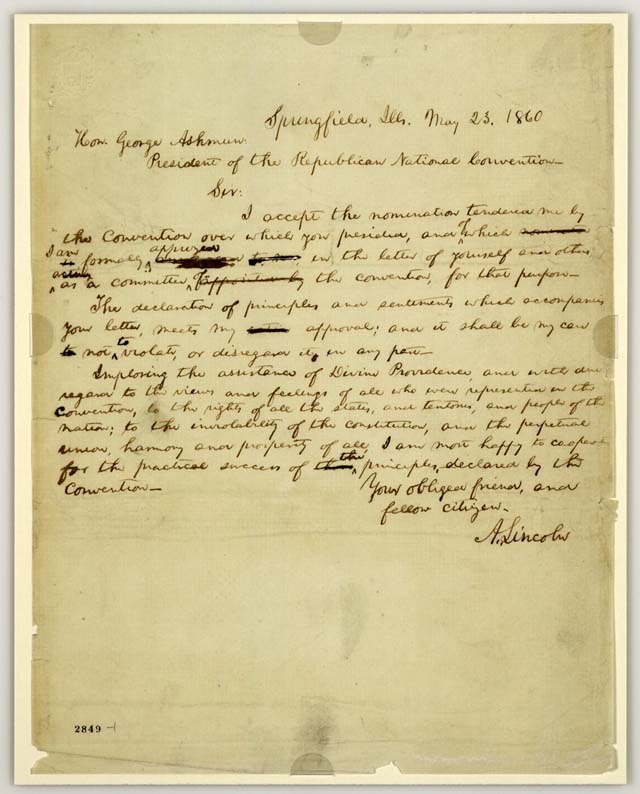
Abraham Lincoln's letter to the president of the Republican National Convention of 1860, accepting the convention's nomination for the presidency.

Abraham Lincoln’s letter to the president of the Republican National Convention of 1860, accepting the convention’s nomination for the presidency. It was written, you will note, from Springfield, Illinois, 200 miles away from Chicago where the convention was held.

To prove to me the piety of Abraham Lincoln, a fellow showed me photograph of a plaque on a church in Chicago, said to be the church where Abraham Lincoln said his prayers every morning during the Republican Convention of 1860, at which Lincoln got the nomination for president. Other records — newspapers, Lincoln’s letters and other documents, show that, as was the fashion in 1860, Lincoln did not attend the convention in Chicago, but as a candidate for president, stayed at home in Springfield, nearly 200 miles away.

Most real history can be read in documents, and does not need to rely on folk retellings exclusively.

5. The author says a belief is credible because it has endured for some time, or because many people believe it to be true.

Faced with the evidence that a dozen quotes he had attributed to figures such as James Madison, George Washington and Patrick Henry were whole cloth inventions, Texas quote-purveyor David Barton issued a statement urging people not to rely on them because they were “questionable.

A great example of belief triumphing over fact presents itself as the Cardiff Giant, now on display at the Farmers’ Museum in Cooperstown, New York (go visit when you visit the Baseball Hall of Fame). After an argument with a cleric over whether the Bible’s claim that giants once existed, a tobacconist named George Hull hired stonecarvers to carve a giant; then he hired a farmer to bury the carving on his farm, and claim to have struck it when planting. Once discovered the “petrified man” was put on display, for a fee. Hull got lucky: Syracuse businessmen offered to buy it from him for an enormous sum.

Paleontologist Othniel Marsh inspected it on display, and pronounced it a hoax. For some odd reason, that increased the popularity of the attraction. Carnival and side show entrepreneur P. T. Barnum offered $60,000 for the carving, but was refused. Barnum then had a plaster replica made and put on display. The owners of the original hoaxed carving sued, but the suit was thrown out because they could not demonstrate the “genuineness” of their own hoax.  Barnum made more money than the original.  A hoaxed hoax is even more popular than the truth.

A photo (staged?) of the 1869 unearthing of the Cardiff Giant (Cardiff, New York). Photograph courtesy Farmers Museum via Associated Press, and via National Geographic.

A photo (staged?) of the 1869 unearthing of the Cardiff Giant (Cardiff, New York). Photograph courtesy Farmers Museum (where the carving now rests, on display to museum visitors)  via Associated Press, and via National Geographic.

6. The author has worked in isolation.

Historians often help each other. Good historians put out queries to many sources, the better to assure accuracy. So, conversely, if there are only a few people who know anything about an account, that fact alone may cause suspicion. Clifford Irving’s hoax biography of Howard Hughes, while remarkably accurate in some regards, was unraveled when enough people familiar with Hughes called the bluff — including, of course, Hughes himself. The book got as far as it did with extreme secrecy on Irving’s part. Working alone makes error easier, and is essential for intentional frauds.

7. The author must propose a new interpretation of history to explain an observation.

Various conspiracy claims require that key people act counter to their known character. If Franklin Roosevelt had “allowed” Pearl Harbor to occur in order to get the U.S. into war, his actions over the previous six years to support Britain start to make little sense. Had Lyndon Johnson been part of a conspiracy to assassinate John Kennedy, his later carrying out the legislative plan of Kennedy runs contrary to all such motivations. If the founders of the U.S. actually intended to make Christianity the state religion, their efforts to disestablish the churches in all 13 colonies, efforts to write bills of rights for each state including freedom of religion, and efforts to create the First Amendment in the Bill of Rights seem like incredible, repeated errors.

Bogus history is much like the conjectured problems that result from time travel: Change one jot of history, and there is a cascading effect on later events. In many cases,were the bogus histories accurate, what follows could not be so, and we wouldn’t be here to discuss it.

Those are the seven warning signs of bogus history. Bogus, or voodoo history should be suspected if two or more of the signs are present — though it is quite possible for actual history to show more than two signs (perhaps actual history could show all seven signs — but I’d have to see an example before stating it’s so).

More:


Encore post: Recognizing bogus history, 1

July 3, 2007

While traveling this week, I’ll feature a few blasts from the past — posts that may merit new attention. This post comes from a two-part series in August 2006:

Recognizing bogus history, 1

Robert Park provides a short e-mail newsletter every Friday, covering news in the world of physics. It’s called “What’s New.” Park makes an art of smoking out bogus science and frauds people try to perpetrate in the name of science, or for money. He wrote an opinion column for the Chronicle of Higher Education published January 31, 2003, in which he listed the “7 warning signs of bogus science.”

Please go read Park’s entire essay, it’s good.

And it got me thinking about whether there are similar warning signs for bogus history? Are there clues that a biography of Howard Hughes is false that should pop out at any disinterested observer? Are there clues that the claimed quote from James Madison saying the U.S. government is founded on the Ten Commandments is pure buncombe? Should Oliver Stone have been able to to more readily separate fact from fantasy about the Kennedy assassination (assuming he wasn’t just going for the dramatic elements)? Can we generalize for such hoaxes, to inoculate ourselves and our history texts against error?

Perhaps some of the detection methods Park suggests would work for history. He wrote his opinion piece after the Supreme Court’s decision in Daubert v. Merrell Dow Pharmaceuticals, Inc., in which the Court laid out some rules lower courts should use to smoke out and eliminate false science. As Park described it, “The case involved Bendectin, the only morning-sickness medication ever approved by the Food and Drug Administration. It had been used by millions of women, and more than 30 published studies had found no evidence that it caused birth defects. Yet eight so-called experts were willing to testify, in exchange for a fee from the Daubert family, that Bendectin might indeed cause birth defects.” The Court said lower courts must act as gatekeepers against science buncombe — a difficult task for some judges who, in their training as attorneys, often spent little time studying science.

Some of the Daubert reasoning surfaced in another case recently, the opinion in Pennsylvania district federal court in which Federal District Judge John Jones struck down a school board’s order that intelligent design be introduced to high school biology students, Kitzmiller v. Dover Area School District.

Can we generalize to history, too? I’m going to try, below the fold.

Here are Park’s seven warning signs, boiled down:

Park wrote:

Justice Stephen G. Breyer encouraged trial judges to appoint independent experts to help them. He noted that courts can turn to scientific organizations, like the National Academy of Sciences and the American Association for the Advancement of Science, to identify neutral experts who could preview questionable scientific testimony and advise a judge on whether a jury should be exposed to it. Judges are still concerned about meeting their responsibilities under the Daubert decision, and a group of them asked me how to recognize questionable scientific claims. What are the warning signs?

I have identified seven indicators that a scientific claim lies well outside the bounds of rational scientific discourse. Of course, they are only warning signs — even a claim with several of the signs could be legitimate. [I have cut out the explanations. — E.D.]

  1. The discoverer pitches the claim directly to the media.
  2. The discoverer says that a powerful establishment is trying to suppress his or her work.
  3. The scientific effect involved is always at the very limit of detection.
  4. Evidence for a discovery is anecdotal.
  5. The discoverer says a belief is credible because it has endured for centuries.
  6. The discoverer has worked in isolation.
  7. The discoverer must propose new laws of nature to explain an observation.

Voodoo history

Here, with thanks to Robert Park, is what I propose for the warning signs for bogus history, for voodoo history:

  1. The author pitches the claim directly to the media or to organizations of non-historians, for pay.
  2. The author says that a powerful establishment is trying to suppress his or her work.
  3. The sources that verify the new interpretation of history are obscure; if they involve a famous person, the sources are not those usually relied on by historians.
  4. Evidence for the history is anecdotal.
  5. The author says a belief is credible because it has endured for some time, or because many people believe it to be true.
  6. The author has worked in isolation.
  7. The author must propose a new interpretation of history to explain an observation.

Any history account that shows one or more of those warning signs should be viewed skeptically.

In another post, I’ll flesh out the reasoning behind why they are warning signs.


Photos of a hoax: The Cardiff Giant

July 2, 2007

David Carlson's pinhole camera photo of a sign promoting the Cardiff Giant

The Cardiff Giant was a great hoax of the 19th century. George Hull, a cigar maker in upstate New York, hired a Chicago sculptor to make a large statute of a man. He then buried the statue on a friend’s farm, and year later hired workmen to dig a well where the statue was buried, and of course the well-diggers “discovered” the statue. Hull’s intent was to hoax Bible literalists who talked about giants in the ground, based on Genesis 6:4.When the statue was discovered, it was claimed to be a petrified giant, evidence of giants living in America. The stone piece was put on traveling display.

The hoax was discovered. That only increased the desire to see the statue, and the price to see it was raised. P. T. Barnum tried to buy the thing, and when his offer was refused, initially he created a hoax of the hoax for his own display.

The Cardiff Giant is on display today at the Farmers Museum in Cooperstown, New York (also home of the Baseball Hall of Fame). Barnum’s fake fake is on display at Marvin’s Marvelous Mechanical Museum, Farmington Hills, Michigan.

Cardiff Giant on display at Cooperstown, New York

The photo at top was created with a grant from the Vermont Council on the Arts by David Carlson, whose website is here (his work is for sale — some of the photos would be good conversation starters in history classrooms) It’s a photo made with a pinhole camera, a camera without a lens. The second photo is from Roadside America, showing the Cardiff Giant as displayed today.


Dembski’s blog caught hoaxing again

June 30, 2007

An acquaintance sends word he’s happy to be back in the mountains with his hammer again, breaking rocks as a geologist in support of a mining venture. The price of gold is high, a few advances in technology have helped the process, and our friend was tapped by suits with money to help keep the actual gold mining operation in the proper vein, so to speak.

Mining is best done with a good scientist on hand to make sure the hole dug out is done right, and to be sure that the digging keeps going for the genuine nuggets.

William Dembski’s blog, Uncommon Descent, has no scientists with any geology training, it appears. But again they’ve been mining, for quotes instead of useful ore, and they’ve come up with fool’s information. Unable to tell the difference between fool’s information and the real stuff, they’ve published the fool’s information for the world to see.

A wise person does not allow fool’s information into one’s information banks. Read the rest of this entry »


Fisking “Junk Science’s” campaign FOR the poison DDT, against Rachel Carson: Point #8, mosquito resistance to DDT

June 29, 2007

This is the second in a series of Fisks of “100 things you should know about DDT,” a grotesquely misleading list of factoids about DDT put up a site called JunkScience.com. While one would assume that such a site would be opposed, this particular site promotes junk science. I’m not taking the points in order.The “100 things” list is attributed to Steven Milloy, a guy who used to argue that tobacco use isn’t harmful, and who has engaged in other hoaxes such as the bizarre and false claim that Compact Fluorescent Lightbulbs (CFLs) can pose serious toxic hazards in your home (and therefore, you should continue to waste energy with less efficient bulbs); and to J. Gordon Edwards, a San Jose State University entomologist who, despite being a great entomologist, was a bit of a nut on some political things; Edwards assisted Lyndon Larouche’s group in their campaign against Rachel Carson before his death in 2004. (Did Edwards actually have a role in the development of this list?)

100 things you should know about DDT

Claim #8. Some mosquitoes became “resistant” to DDT. “There is persuasive evidence that antimalarial operations did not produce mosquito resistance to DDT. That crime, and in a very real sense it was a crime, can be laid to the intemperate and inappropriate use of DDT by farmers, especially cotton growers. They used the insecticide at levels that would accelerate, if not actually induce, the selection of a resistant population of mosquitoes.”

[Desowitz, RS. 1992. Malaria Capers, W.W. Norton & Company]

Cover of The Malaria Capers, by Robert S. Desowitz

Cover of The Malaria Capers, by Robert S. Desowitz

This was what Rachel Carson warned about. Indiscriminate use of DDT, such as broadcast application on crops to kill all insect, arthropod or other pests, would lead to mosquitoes and other dangerous insects developing resistance to the chemical. Of course, resistance developed as a result of overspraying of crops has exactly the same result, in the fight against malaria, as overuse in the fight against malaria.  Cover of The Malaria Capers, by Robert S. Desowitz

Worse, such overuse also killed predators of mosquitoes, especially birds. In an integrated pest management program, or in a well-balanced ecosystem, birds and other insect predators would eliminate a large number of mosquitoes, holding the population in check and preventing the spread of malaria. Unfortunately, when the predators are killed off, the mosquitoes have a population explosion, spreading their range, and spreading the diseases they carry.

Assuming Milloy quoted the book accurately, and assuming the book actually exists, this point says nothing in particular in favor of DDT; but it reaffirms the case Rachel Carson made in her 1962 book, Silent Spring. Contrary to suggestions from the campaign against Rachel Carson, she urged that we limit use of DDT to tasks like preventing malaria, around humans, to preserve the effectiveness of DDT and prevent overspraying.

And then, there is this: Milloy doesn’t bother to quote the first part of the paragraph he quotes, on page 214 of Malaria Capers. Here is what the paragraph actually says:

There were a number of reasons for the failure, not least that the anophaline vector mosquitoes were becoming resistant to the action of DDT both physiologically — they developed the enzymes to detoxify the insecticide — and behaviorally — instead of feeding and wall-resting, they changed in character to feed and then quickly bugger off to the great outdoors. [from this point, Milloy quotes correctly]

In other words, the DDT-based campaign against malaria failed because DDT failed; mosquitoes became resistant to it.  DDT’s declining ability to kill mosquitoes is one of the major reasons DDT use plunged after 1963, and continues to decline to no use at all.

To combat the dastardly campaign of calumny against Rachel Carson and science, you should also read: Deltoid, here, here and here, and the rest of his posts on the topic; Bug Girl, here, at least, and here, and the rest of her posts; denialism, here; and Rabett Run, here.

Save

Save


Cold, Clear and Deadly

June 28, 2007

Title of a book that documents and discusses the omnipresence of DDT and related pesticides in waters all over the world, even in places far from any known application, such as the Arctic and Antarctic.

Author Melvin J. Visser wrote a tribute to Rachel Carson at his blog, also called Cold, Clear and Deadly.

Cover of Cold, Clear and Deadly, by Melvin J. Visser.  Michigan State University Press

Cover of Cold, Clear and Deadly, by Melvin J. Visser. Michigan State University Press; at Thrift Books

More: