Making Boy Scouting a political football — shame on those outlets

July 27, 2010

When President Barack Obama met with a group of outstanding Boy Scouts in the Oval Office a few weeks ago to discuss policies affecting Scouting, and especially policies affecting children, teen agers and young adults in the U.S., very few conservative sites thought it important to cover.  Let’s be more precise:  No conservative Obama critics, nor much of anyone else, bothered to cover it.  I’d love to see links even of local media in the Scouts’ hometowns that printed a story or photo.

To the credit of the White House, neither did the press promote the meeting as a political point.  Scouting prefers not to be a political football, and Scouting policy asks that Scouts avoid even looking like politicking while in uniform. (Scouts are encouraged to participate in the political process, including through the three citizenship merit badges, which encourage Scouts to communicate their concerns about policy to elected representatives, while working for the merit badge and in the future as participating citizens.)

2010 is a grand year for Scouting.  It’s the centennial of Scouting’s coming to the United States.  There’s a special Scout Jamboree, being held at Fort A. P. Hill in Virginia (the last time the Jamboree will be held on federal property — that’s another story for another time).   It’s always fun when presidents come to the Jamboree and speak, but it’s not always possible.

But today, news comes that President Obama will send a video speech to the Scouts at the Jamboree, as has been done sometimes in the past.  Many of us are disappointed that President Obama will not appear in person; but some of us who have experience scheduling such things know that elected officials cannot make every appearance they would like to.  Presidential schedules in the modern world are particularly difficult; for an appearance at Fort A. P. Hill security must be imposed (even on a Scouting event), aircraft landing sites need to be arranged and secured . . . dealing with more than 30,000 Scouts becomes an onerous task.

Still, we’re disappointed.

Adding to that disappointment, comes now a group of harpy Obama critics, no friends of Scouting that I can determine, but anxious to claim this scheduling decision as some sort of snub to Scouting, and to the American flag.

Media Matters has the facts, and puts the scheduling stuff into perspective, “Overhyped conservative nonsense of the Day:  Obama hates the Boy Scouts.”  UpdateBlue Wave News has it in perspectiveWonkette’s satire, unfortunately, goes awry, but her heart and brain are in the right places.

The snub is by those critics who attempt to turn Scouting into a political football.  The insults are all from them.

Shame on them, collectively and individually:

Update: We’re going to have to add on a wing to accommodate the Wall of Shame:

Hmmmm.

I’ll wager none of those authors bothers to volunteer for Scouting.  I’d be surprised (and disappointed) to discover any were Scouts.  Scouting wouldn’t revoke their citizenship merit badges, but they’ve forgotten them, if they ever earned them.

Scouting faces severe hurdles these days, some of them I would say were placed by poobahs at the top of Scouting; these guys listed above are not helping.

Here are some tests to see which of these blogs and pundit outlets is friendly to Scouting:  Which of them covered the award, this morning of the Distinguished Eagle Scout Award to Tuskegee Airman Charles McGee?  Which of them covered the dedication of the U.S. Postal Service’s stamp honoring the Scouting Centennial, today?  As of this moment, I can find no media coverage of these things at all, even by local media.

Why do these pundits cover Scouting only when it gives them a chance to make an unfair shot at a politician they don’t like?  Seriously, who is doing disservice to Scouting, and the nation?

Good news about Scouting’s 100th Year, and the Jamboree:


Oldest Eagle Scout, Walter Hart

July 20, 2010

Working to confirm, but news from Florida and a highly reliable source is that Walter Hart died over the weekend, at 91 by my calculations.

You would remember Hart as the oldest Eagle Scout, having gotten his award three years ago, when he was 88.

Mr. Hart should be remembered as a hero, and certainly as an inspiration to aspiring Eagle Scouts — especially those facing a short time to their 18th birthday.


Boy Scout died in fall from Utah’s Gemini Bridges

July 19, 2010

Tragic accident at a spectacular site in Utah’s desert.

A Scout from Wisconsin attempted a leap from one part of a natural bridge to another, lost his balance and fell to his death.  According to the Salt Lake Tribune in Salt Lake City:

A Wisconsin Boy Scout died Saturday after falling 100 feet from Grand County’s Gemini Bridges.

Anthony Alvin, 18, of Green Lake, Wis., was with a Scout group at the Gemini Bridges rock formation, which is on federal land northwest of Moab, deputies wrote in a press statement. At about 9:30 a.m., Alvin tried to jump from one span of the double bridge to the other span, six feet away, when he fell backwards, dropping 100 feet to the bottom of the bridges.

Rescuers rappelled off the bridges and found Alvin had died. His body was lowered down two separate cliffs to the bottom of Bull Canyon, deputies wrote.

Erin Alberty

Anthony Alvin was a member of Troop 630 from Green Lake, Wisconsin, in the Bay Lakes Council, BSA.  The Troop has years of experience in high adventure trips.  This was a transition trip for Alvin, moving from Scout to leader.

High adventure Scouting takes teens to outstanding places with some risks.  Strict safety rules protect Scouts and leaders from most accidents.  Jumping the gap between the two natural bridge sections is a leap that experienced rock climbers and Scouters should advise against — and probably did — precisely because of the dangers of minor mishaps, 100 feet or more in the air.  A six-foot gap would look eminently leapable to a capable young man.

This is a picture of Gemini Bridges from below:

Gemini Bridges, near Moab, Utah - NaturalArches.org image

Gemini Bridges, near Moab, Utah, from below. Image from NaturalArches.org image, photo by Galen Berry.

NaturalArches.org includes details about many of these natural spans in the desert Southwest, in Utah and Arizona.  For Gemini Bridges we get this warning note:

These magnificent twin bridges are a popular 4-wheel drive destination on BLM land northwest of Moab, Utah. A few foolhardy individuals have lost their lives here. One person fell to his death while attempting to jump the 10 feet between the two spans, and in October 1999 a jeep and driver fell 160 feet off the outer span.

From atop the bridges, the gap between the two can appear deceptively small — see one view here.

Gemini Bridges from the trail, on top - PaulandKate.com

For safety’s sake, no one should attempt to leap the gap without proper rock-climbing safety equipment in place and in use — and frankly, I’m not sure how it could be secured even then, in the sandstone.

Redrock country brings out the worst in otherwise adventurous-but-mostly-sane people.  Even rock climbers will act irresponsibly.

Four-wheelers and off-road vehicles frequently climb these trails — despite the dangers, the area offers a huge playground for people out of the jurisdiction of the National Park Service or National Forest Service, each of which discourage excessive vehicular risk taking.   Several sites extoll the glories of conquering these deserts with gasoline-power.

Irresponsible jump at Gemini Bridges, from rockclimbing.com

Irresponsible jump at Gemini Bridges captured on film, from rockclimbing.com

The photo at the bottom shows a memorial plaque to the four-wheeler who lost his life off of Gemini Bridges in 1999.  So long as people make monuments to people who pull daredevil stunts, others who have less experience, or even more sense, will be tempted to try the same daredevil stuff.

Go to these wild and beautiful places.  Please remember they are treacherous, however, and stay safe.

Tribute to Beau James Daley, who died when his jeep plunged off of Gemini Bridges, Utah

Tribute to Beau James Daley, who died when his jeep plunged off of Gemini Bridges, Utah

Also at Millard Fillmore’s Bathtub:

More:


Boy Scouts talk with President Obama in the White House

July 13, 2010

President Obama and Boys Scouts in Oval Office, July 12, 2010

President Barack Obama shakes hands with a young Cub Scout, during a meeting with representatives from the Boy Scouts, in the Oval Office, July 12, 2010. (Official White House Photo by Pete Souza)

I suspect this was a press release from BSA, which I found at the Cracker Barrel, a blog for Scouting Magazine:

BSA representatives meet with Obama to discuss top concerns for nation’s youth

A group of Boy Scouts of America youth members and executive leaders met with President Barack Obama today to discuss top priorities for the organization’s next century of service.

During the White House meeting, the president and the BSA delegation shared their mutual goals for addressing key concerns for our nation’s youth: healthy living, service to the community, and environmental stewardship.

Obama has shown his support for each of these issues by introducing three relevant programs: Let’s Move!, United We Serve, and America’s Great Outdoors.

As has been the case with every U.S. president since William Howard Taft, Obama serves as the Honorary President of the BSA and helps recognize the achievements of more than 50,000 Eagle Scouts each year by signing their Eagle Scout cards.

Obama’s three initiatives match several concerns not just for the BSA but also for the entire country, said Chief Scout Executive Bob Mazzuca.

“Health, community service, and preserving our environment are priorities for all Americans,” Mazzuca said. “Our first 100 years in Scouting taught us the importance of these issues to America’s youth; our next century of Scouting will focus on creating programs to expand our efforts in these areas.”

To show its commitment to these issues and in honor of the BSA’s 100th Anniversary, the organization presented Obama and the first lady, Michelle Obama, with two camperships for Scouts in their home councils. These scholarships will help two Scouts attend summer camp: one each from the Aloha Area and Chicago Area councils.

While at summer camp, these two deserving Scouts will see first-hand how much fun it is to stay active in the outdoors and learn how preserving our environment is critical in today’s world.

The camperships were presented by the youth members of the BSA’s delegation. This group was made up of young people who represent several of the BSA’s programs. Eagle Scout Brad Lichota, national Order of the Arrow chief, led the youth members.

Others were Cub Scout Raphael Cash from Bowie, Md.; Venturer Shannon Hoff from Falls Church, Va.; Sea Scout M. Robert Marks Jr. from Pittsburgh, Pa.; and Boy Scout Arnold Mears from Parkville, Md.

The photo came from the White House‘s website, separate from the press release.

Add to FacebookAdd to NewsvineAdd to DiggAdd to Del.icio.usAdd to StumbleuponAdd to RedditAdd to BlinklistAdd to TwitterAdd to TechnoratiAdd to Furl


Boy Scouts Centennial: Dan Beard and Ed Dodd

June 21, 2010

Dan Beard, a founder of Boy Scouts of America, and cartoonist Ed Dodd, photo dated (incorrectly) February 14, 1950 – Georgia State University Library Photography Collection, Atlanta Area Photographs from the Lane Brothers and Tracy O’Neal Collections

Dan Beard, a founder of Boy Scouts of America, and cartoonist Ed Dodd, photo dated (incorrectly) February 14, 1950 – Georgia State University Library Photography Collection, Atlanta Area Photographs from the Lane Brothers and Tracy O’Neal Collections

Daniel Carter Beard was best known as an illustrator of children’s adventure books.  He founded a group for boys, the Sons of Daniel Boone, in 1905.  That group was merged into the Boy Scouts of America at BSA’s founding in 1910.

Ed Dodd (November 7, 1902 – May 27, 1991) was an illustrator and cartoonist, probably best known for his comic strip “Mark Trail,” which is still carried in many newspapers today.

According to his listing at Wikipedia:

Ed Dodd went to work for Dan Beard, founder of the Boy Scouts of America, at the age of 16. Dodd worked at Beard’s camp in Pennsylvania for thirteen summers, where he honed his writing and illustration skills under Beard’s guidance. Dodd became a scoutmaster and the first paid Youth and Physical Education Director for the city of Gainesville, Georgia.

Another story of Scouting providing a career for a kid, another story of Scouting providing a career for an illustrator (see also Norman Rockwell, and the Csataris).

Dodd was a Georgian.  This photograph, dated February 14, 1950, shows a meeting of the two illustrators, with Dodd appearing older than the 16 he was when he first met Beard.  The photo is in the collections of the Georgia State University Library, in the Atlanta Area Photographs from the Lane Brothers and Tracy O’Neal Collections.  We might assume it was taken in Georgia, perhaps at Dodd’s “Lost Forest” home and workshop.

We know that can’t be the right date, however, since Dan Beard died in 1941.

Who can shed more light on this bit of history?

Updates:  See comments below — among other things, we know that the February 14, 1950 date was the date that a duplicate negative was made.  Please note in comments if you have further details.

More:

Mark Trail strip on NOAA's 200th-2D-MarkTrail650

Click on image: Marke Trail on NOAA’s 200th anniversary; King Features Syndicate

Ed Dodd and others in his studio at Lost Forest, Georgia, drawing the comic strip Mark Trail - Wikimedia

Dodd and others working on “Mark Trail”: The Mark Trail studio was on the second floor of Ed Dodd’s Frank Lloyd Wright-designed home in the Lost Forest at the Atlanta suburb of Sandy Springs, Georgia. At work are (l. to r.) Ed Dodd, Jack Elrod, Tom Hill and Rhett Carmichael. The 130-acre Lost Forest was the model for the fictional Lost Forest National Forest in the strip. Dodd’s house was located on Marsh Creek, a tributary of the Chattahoochee River. Wikimedia photo and caption

  • Sadly, Dodd’s Lost Forest was completely burned in 1996.  I can find no information on any of the studio surviving the fire (anyone know differently?).   Dodd was honored in 1991 with the naming of the Mark Trail Wilderness Area, in the Chattahoochee National Forest.
  • According to the official information at King Features Syndicate, Jack Elrod first assisted Dodd, then in 1978 took over the creative writing and drawing of the strip when Dodd retired and Tom Hill, who had done the Sunday strips, died.  Elrod was a Boy Scout when he first met Dodd, in Dodd’s role as Scoutmaster.  The Scouting links are strong in this strip.

Tip of the old scrub brush to Chamblee54, for showing the way to the Georgia State University photographs.

[Editor’s note: Georgia State Library keeps changing the link url on the photograph; if you find a higher resolution version, please, please let us know where it is!]


Scouts in stained glass: St. Barnabas Church, Heigham

June 16, 2010

Let the light shine through:

South aisle window by Alfred L Wilkinson, 1956, in St. Barnabas Church, Heigham, Norwich.  Photo from Flickr, by Simon K:

Scouts and Girl Guides, at South aisle window by Alfred L Wilkinson, 1956, in St. Barnabas Church, Heigham, Norwich. Photo from Flickr, by Simon K

The photographer has additional photos of window details at his Flickr site.

Just a reminder that 2010 marks the 100th anniversary of Boy Scouting in the United States.


June 15, 1916: Wilson signed the National Charter for the Boy Scouts of America

June 16, 2010

Troop 1, Brownsville, Texas, May 20, 1916 - photo by Robert Runyon (U of Texas image via Library of Congress)

Troop 1, Brownsville, Texas, May 20, 1916 - photo by Robert Runyon (The Center for American History and General Libraries, University of Texas at Austin; via American Memory, Library of Congress)

On June 15, 1916, President Woodrow Wilson signed the law granting a national charter to the Boy Scouts of America, which had been incorporated six years earlier.  The charter is now encoded at 36 USC 309.

The purposes of the corporation are to promote, through organization, and cooperation with other agencies, the ability of boys to do things for themselves and others, to train them in scoutcraft, and to teach them patriotism, courage, self-reliance, and kindred virtues, using the methods that were in common use by boy scouts on June 15, 1916.

Good goals then, good goals now — maybe more important now.

Have you volunteered to be a leader?

Resources (and councils where I’ve Scouted and volunteered):

Tip of the old scrub brush to the Bill of Rights Institute on Facebook.

Brownsville Troop 1, May 20, 1916 - LOC and U of Tex (Am Memory) RUN07730

Click here for a larger view of the Troop 1 of Brownsville, Texas, in 1916

Brownsville Troop 1, May 20, 1916 - LOC and U of Tex (Am Memory) RUN07730

Click here for a larger view of a second photo of Troop 1 of Brownsville, Texas, in 1916


Boy Scouts with wreath, 1924

June 14, 2010

From the digital collections at the Library of Congress:

Boy Scout wreath, 1924 - Library of Congress Digital Collection, National Photo Company Collection

Boy Scout wreath, 1924 - Library of Congress Digital Collection, National Photo Company Collection (Call Number: LC-F8- 28581 (P&P))

Three Boy Scouts and a wreath with the BSA’s fleur de lis, in 1924.  Who are the Scouts?  What was the occasion?  Questions we have in the centennial year of Boy Scouting.

This photo is in the middle of a collection of photos taken at the funeral of President Woodrow Wilson, which was on February 6, 1924.  Was this the Boy Scouts’ tribute to Wilson?  By the way, Wilson is the only president interred in the District of Columbia (Arlington National Cemetery is across the Potomac River, in Virginia).  Wilson’s sarcophagus in in the main chapel of the National Cathedral.

Woodrow Wilson's tomb in the National Cathedral, Washington, D.C.  - Wikimedia image

Woodrow Wilson's tomb in the National Cathedral, Washington, D.C. - Wikimedia image


Pinewood Derby, Scouting and the West Wing

May 14, 2010

What if you were a Cub Scout, hoping to win your Pack’s Pinewood Derby, but your father worked at the White House?  Does the White House support Scouting?

Robert Gibbs at White House press briefing, February 12, 2010

Robert Gibbs at White House press briefing, February 12, 2010 - White House photo

Transcript of White House press briefing from February 12, 2010:

Q    As the honorary President of the Boy Scouts of America, what is the President’s reaction to the New York Post report that because the Scouts have a policy similar to our armed forces, “New York institutions are barring scouts from meeting or recruiting in all public schools”?

MR. GIBBS:  I have not seen the New York Post report and can have somebody —

Q    Well, does he think that it’s fair for them to cut the Scouts out of this?  How does he support — does he disagree with the Scouts or what?  (Laughter.)

MR. GIBBS:  Where are you on this, Lester?  Are you — is this —

Q    Nowhere.  (Laughter.)

MR. GIBBS:  Yes, I do know where.

Q    I support the Scouts.  Do you support the Scouts?

MR. GIBBS:  My son is — we’re constructing the pinewood derby car as we speak.  (Laughter.)

Q    He’s a Scout, your son is a Scout?

MR. GIBBS:  He is, and I think he’s going to be disappointed if his car doesn’t do well, but his father tends to be constructionally challenged.

Thanks, guys.

END
1:52 P.M. EST


Stained glass Scouting: Grand Canyon Council offices, Phoenix

February 11, 2010

Did I remember to tell you Scouting celebrates 100 years in the U.S. this year?

Stained glass Scout fleur de lis, Grand Canyon Council, B.S.A., offices, Phoenix (Decor to Adore photo)

Stained glass Scout fleur de lis, Grand Canyon Council, B.S.A., offices, Phoenix (Decor to Adore photo)

More photos of Grand Canyon Council, B.S.A., offices, at Decor to Adore.


Happy birthday, Boy Scouts of America

February 8, 2010

No special post — I’ll be commenting all year — but today is the official anniversary date for the founding of the Boy Scouts of America.

100 million boys later, we can tell for certain it’s a good idea.

Boy Scouts paddling canoes on the Blackwater River, Virginia

Boy Scouts paddling canoes on the Blackwater River, Virginia - Wikipedia image


Stained glass Boy Scouting: Torrington, Connecticut

February 8, 2010

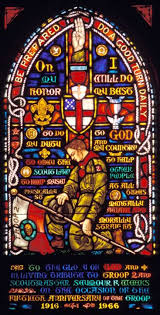
In honor of Scouting’s 100 years in the U.S., I call your attention to the stained glass window in Trinity Episcopal Church in Torrington, Connecticut, The Boy Scout Window:

The Boy Scout Window, Trinity Church, Torrington, Connecticut

Described at the church’s website:

This is one of Trinity’s most well-known windows.

It was dedicated on Boy Scout Sunday, 13 February 1966, a service of Morning Prayer that began with the hymn “We Thank You, Lord of Heaven.” The window was given “to the Glory of God and in living tribute to Troop 2 and Seymour F. Weeks on the 50th anniversary of the Troop, 1916-1966.”

Mr. Weeks had been scoutmaster of Troop 2 since 1934 and would continue to lead the troop until his death in 1967.

Troop 2 produced Torrington’s first Eagle Scout, Paul Pfistner, whose family donated another window at Trinity Church.

Behind the kneeling scout with the flag is the seal of the Episcopal Church and above that a hand raised in the scout hand sign. Flanking the Episcopal seal are the emblems of the First Class Scout and the Eagle Scout badge. The words of the Boy Scout oath form the background. The border is composed of ropes showing some of the knots Scouts must learn. In between the ropes are two of the Scout’s mottoes: Do a Good Turn Daily, and Be Prepared.

Obviously, this window does not follow the architect’s pictorial plan for a window here showing the Holy Family with Jesus as a child.

Although several of Trinity’s windows were made by Len Howard of Kent, CT, one of Mr. Howard’s former associates is nearly positive this window was not made by Mr. Howard. However, a current parishioner’s great uncle, who was on the vestry in 1966, recalls that the church was dealing with an artist in Kent, CT, and there were no other stained glass artists in Kent except for Len Howard. Until further proof one way or another, this window will be attributed to Len Howard of Kent.

To the best of my searching, Troop 2 appears to have vanished from Torrington.

Add to FacebookAdd to NewsvineAdd to DiggAdd to Del.icio.usAdd to StumbleuponAdd to RedditAdd to BlinklistAdd to TwitterAdd to TechnoratiAdd to Furl


Just in case you thought any climate contrarian remains sane . . .

February 2, 2010

Which of these would be accurate in showing the insanity, but not so sharp as to raise the hackles of the climate contrarians?

  • “Contrarians think Antarctic unworthy of protection”
  • “Denialists criticize efforts to keep Antarctic clean”
  • “Climate change critics’ brains have left the building”

Read these stories, and tell me.

The Intergovernmental Panel on Climate Change (IPCC) noted the delicate condition of the Antarctic with regard to its two main industries, fishing and tourism.  IPCC AR4 noted that the tourism industry takes steps to protect Antarctic environments made more vulnerable by melting.  (Footnote here; actual flyer here, assessment document here in Microsoft Word .doc format)

Contrarians come unglued, here at ClimateQuotes.com, and here at Air Vent.

It’s clear that the contrarians don’t have much experience in heavy documentation.  If you follow the links they provide, you quickly get to the paper provided by the tourist industry noting their precautions to prevent contamination, provided to meet a request by scientists from the Australian team, and based on information well vetted to the point that it includes substantial excerpts from what appears to be a peer-reviewed journal on the types of solutions suitable for decontaminating foreign boots in the Antarctic (Polar Record, vol. 41, no. 216, Jan. 2005, p. 39-45; it is actually the official journal of the Scott Polar Research Institute at Cambridge, UK).  There is astounding and commendable attention to detail, much more than the contrarians can grok, it appears.

More troubling to the Boy Scout in me is the contrarians’ contempt for what is, really, Leave No Trace Camping carried to an Antarctic tourist stop.  This is part of the environment protection credo of the Boy Scouts and Girl Scouts, and it is sound policy that everyone should be teaching their children.

What is wrong with that?  Why do the contrarians mock wise policies?  Why do they make false claims against what amounts to good Scouting?

Leave No Trace logo

Contratians disapprove of the ethics of environmental stewardship?

One implicit complaint is that the footnote does not provide evidence of damage from climate change, in the Antarctic.  It’s clear that the critics have not followed the footnote path to see why the boot cleaning poster and directive were issued, nor to see what is the research or official government action that prompted the tourist companies to implement the procedure.

It appears in a section of the IPCC reports on effects of warming on industries in affected areas.  Only two industries are noted in the Antarctic, fishing and tourism.  After establishing the increased chance of problem organisms, including micro-organisms, showing up in Arctic and Antarctic areas as the areas warm, and after noting two plagues that killed penguins recently, from micro-organisms, the IPCC paper notes that concern to prevent such tragedies have so far required only boot decontamination, and it offers a link to the flyer provided by an Antarctic tour operators group.

Got that?  To show that the tour operators are affected, IPCC cited the flyer put out by the tour operators showing how and why they were changing their operations.  It’s a minor, almost trivial point.

At no point did IPCC’s report claim this procedure as evidence of warming, or the effects of warming.  So the claims of the contrarians and denialists are completely off base, as they’d recognize except for their own shouting for the lynching of science to proceed.

Criticism of IPCC for noting the good stewardship techniques used in the Antarctic comprises more political smear than scientific enlightenment, by a huge factor.  Voodoo science from the contrarians begets voodoo criticism.

Contrarians lack wisdom in posing this complaint of theirs.  This is one more point IPCC got right, factually and ethically.  IPCC should be commended for that.

Wall of Shame (update added on February 7)

Outlets that cite the boot reference, falsely or stupidly, as some sort of flaw in the IPCC report, and thereby demonstrate malevolent intentions, and not scientific (“malice” for you Times v. Sullivan fans):


Who are those Boy Scouts in 1943?

November 13, 2009

A posed photograph:  Three Boy Scouts, from at least two different units, holding a poster Scouts were distributing about international cooperation in World War II.  They are saluting, and behind them rises the dome of the U.S. Capitol on a brilliantly sunny day.

Boy Scouts at the Capitol, 1943? - Library of Congress image

Caption from the U.S. Senate Historical Office: "Boy Scouts aid the war effort by delivering posters that encourage a united fight for freedom, ca.1943. credit: Library of Congress"

1943?  Who were the Scouts?

The photo is online in the collection of the U.S. Senate Historical Office (a good source of images, by the way).

I just wondered, who are those Scouts, and where are they today?

Boy Scouts assisted war efforts in a lot of ways in a lot of American cities, towns and villages.  Affiliates at the Tom Harbin Scout Museum at Camp Wisdom in Dallas (Circle 10 Council) have papers documenting and detailing massive scrap and paper drives, and a lot of other activities we probably wouldn’t let Scouts get into today.

The three Scouts in the photo wear what appears to be two different neckerchiefs, suggesting they come from at least two different troops or other units.  All three wear the uniform of the Boy Scouts of America, but two of the three look as though they may be immigrants or children of immigrants.

The date given is a “circa 1943.”  But the poster plugs a “United Nations” — could it have been as late as 1945 or 1946 and the official organizing of the United Nations?

What do you think?  What do you know?

Update: Wikimedia puts the date of the poster as 1941Shorpy says the photo is 1943:

“Washington, 1943. “United Nations Fight for Freedom: Colored, white and Chinese Boy Scouts in front of Capitol. They help out by delivering posters to help the war effort.” View full size. 4×5 Kodachrome transparency by John Rous for the Office of War Information. What photo expert out there can tell us about the numbers on these Kodachromes — how and at what point in the manufacturing/ exposure/ developing process they were made, and what they signify.

All those details and not the names of the Scouts?  In comments at Shorpy we also see that the temporary patch for the Scout on the left is for a 1942 campout.  So we know the photo was later than 1941.  The community patch for the Scout on the right says Washington where the city patch should be, with no state patch (if they had separate patches then).  So it’s probably a Washington, D.C. unit — and it’s Troop 11.  Anybody from National Capital Council ever read this site?  Were all three of these Scouts from Troop 11?

I have found, but cannot yet examine, another photo from the same roll of film, showing just the Scout in the middle.

Update 2: This may identify one of the Scouts, with an astounding story:

1941, Boy Scout, poster urging water saving, Anderson Grimes

Caption from CityDesk.net: "July 1941. Local Boy Scout Anderson Grimes in front of the U.S. Capitol building in Washington, D.C., holding a copy of a WPA poster designed for the city’s landmark water conservation program."

That solo Scout is clearly the same one in the first photo, so we have one name:  Anderson Grimes.

But the entire story from CityDesk.net is more amazing, if true:

July 1941. Local Boy Scout Anderson Grimes in front of the U.S. Capitol building in Washington, D.C., holding a copy of a WPA poster designed for the city’s landmark water conservation program. Shortly after this photo was taken, he was to present the poster to local congressman Harford Collins in a brief ceremony. Tragically, Grimes, along with several local reporters and congressional aides, instead found Senator Collins slumped over his desk, dead from a heart attack.

Thirty years later, Grimes ended up serving the same seat in Congress for four terms. He did not die in office.
– RJ White

If true?  I can’t find a listing for a Sen. Harford Collins in the Congressional biography pages, nor for any Member in either house named Anderson Grimes.

More mystery.  Is the Scout even named Anderson Grimes?

Okay, after j. a. higginbotham wrote in, I finally got it:  CityDesk.net is a satire site.  They wrote a phony story to accompany the photograph.

That’s right:  I got hoaxed.

Still looking for information on the Scouts and their troop(s).

Update, November 15: Is the water conservation poster in the version above a PhotoShop addition?  Here’s a photo held by the Library of Congress:

Boy Scout after 1942 showing posters Scouts distributed; photo by John Rous, Library of Congress collection

From Library of Congress: "United Nations Fight for Freedom: Boy Scout in front of Capitol. They help out by delivering posters to help the war effort"

Add to FacebookAdd to NewsvineAdd to DiggAdd to Del.icio.usAdd to StumbleuponAdd to RedditAdd to BlinklistAdd to TwitterAdd to TechnoratiAdd to Furl


Museum of North Texas History: 100 years of Scouting

October 3, 2009

Wondering what to do while you’re in Wichita Falls, Texas?

Through March 2010, you can view a display commemorating Scouting’s 100th anniversary in the United States, featuring nearly 100 years of Scouting history in Wichita Falls.

Stephanie Wood, assistant curator of the exhibit “Boy Scouts of America: 100 Years,” hangs Boy Scout uniforms at the Museum of North Texas History.  Photo by Photos by Marissa Millender/Times Record News

Stephanie Wood, assistant curator of the exhibit “Boy Scouts of America: 100 Years,” hangs Boy Scout uniforms at the Museum of North Texas History. Photo by Photos by Marissa Millender/Times Record News

Again showing the value of local “mainstream” media, the Wichita Falls Times-Record News featured a story on the exhibit on September 14, “Scouting through the ages.”

History teaches us if you learn from the past, you’ll be better prepared for the future. But being prepared is a quality also embraced by another organization — the Boy Scouts of America.

And so it seemed fitting that when the Boy Scouts reached their 100th anniversary this year, the Northwest Texas Council would commemorate the event at the Museum of North Texas History.

The downtown museum will open its latest exhibit, “Boy Scouts of America: 100 Years,” with a preview dinner at 6 p.m. Thursday at the dowtown museum, 720 Indiana, though more than 400 visitors got a sneak peek of the display Saturday during the Wichita Falls Museum Coalition’s Stroll ‘N’ Roll Museum Day.

The $40 preview dinner will include a viewing of the exhibit and a talk by Jim Hughes, George Adams and Darrell Kirkland.

Hughes, the Boy Scouts Chartered Organization Representative at Floral Heights United Methodist Church, has been involved in Scouting for about seven decades. A lot of his Scouting memorabilia peppers the exhibit, such as his Order of the Arrow badges and Boy Scout, Cub Scout and Explorer awards.

One of the most valuable pieces of memorabilia in the display, he said, is a flag hand-sewn by Scouts in 1913.

“Boys didn’t have money back then and had to make their own flag,” Hughes said.

Another impressive contribution to the exhibit is Bill McClure’s Eagle badge. McClure received his Eagle rank — the highest rank that can be achieved in the organization — in 1921. He was the first Eagle in the Wichita Falls Council to do so. He earned 21 merit badges and would eventually become a journalist for the Times Record News and sold advertising for KWFT before his death in 1982.

Hughes said what he treasures most among his scouting collection over the years is his own Eagle badge.

The exhibit, curated by Betsy O’Connor with Stephanie Wood as assistant curator, also includes a Pinewood Derby track on which visitors can race wooden cars, along with a display of a tent and camp fire.

Visitors will see Boy Scout, Cub Scout and Webelos uniforms on display, as well, such as the 1930s-era uniform of Billy Sims, the 1961 outfit of Tim Hunter and the 1998 uniform of Cory Wood, along with the “brag vest” of Cole Watson.

One area features information about Philmont Scout Ranch, a 137,493-acre ranch in the mountains of northeastern New Mexico in the Sangre de Christo Range of the Rockies, donated by Oklahoma oilman Waite Phillips.

Posters in the exhibit show various ropes and knots Scouts learn to tie, and things Scouts can do in nature conservation.

From left, Betsy O’Connor, curator, and Stephanie Wood, assistant curator, set up a camping display in the “Boy Scouts of America: 100 Years” exhibit at the Museum of North Texas History.  Photos by Marissa Millender/Times Record News

From left, Betsy O’Connor, curator, and Stephanie Wood, assistant curator, set up a camping display in the “Boy Scouts of America: 100 Years” exhibit at the Museum of North Texas History. Photos by Marissa Millender/Times Record News

Other items to look for: Carl Watson’s walking stick, an Order of the Arrow Native American headdress and Eagle Claw necklace and photographs of local scouts.

The Boy Scouts of America was incorporated on Feb. 8, 1910, by William D. Boyce and others. It was modeled after an organization in Great Britain founded by Lord Baden-Powell.

In 1911, Dr. J.L. McKee, pastor of First Presbyterian Church, organized the first troop in Wichita Falls with 27 members before the troop disbanded after McKee left town. But two years later, four more troops were organized. The Wichita Falls Council became the Northwest Texas Council in 1937.

All three of Jim Hughes’ sons, like their father, earned the rank of Eagle Scout. So has one of his grandsons. Another grandson is a Cub Scout who is continuing the tradition of Scouting in the Hughes family.

“I got so much out of it,” Hughes said. “I wanted to have my kids have the same experience.”

Following the exhibit’s opening, “Boy Scouts of America” can be viewed through March 2010.

Do museums in your area have Scouting exhibits planned, or already up?  Let us know in comments.

Share this post with others:

Add to FacebookAdd to NewsvineAdd to DiggAdd to Del.icio.usAdd to StumbleuponAdd to RedditAdd to BlinklistAdd to TwitterAdd to TechnoratiAdd to Furl