BusinessWeek cover, April 18-24, 2011 - Don't play chicken with debt ceiling; chicken image by Jan Hamus/Alamy
Not every one of the Bloomberg Businessweek covers has been a hit, but a lot of them are — vastly more entertaining since Bloomberg took over the old workhorse magazine.
This one packs a political punch along with visual excitement.
And it’s right. Do any Republicans pay attention to the finance and business worlds anymore?
Years ago when I staffed a U.S. senator’s office, one of my tasks was to look through all the weekly newspapers in the state. Back then subscriptions were cheap, and most senators would take out a subscription to these weeklies more to flatter the editors and publishers than to read. We put them to use, first checking to see whether the clipping services were getting all the clips (mostly), and then on a hunch, to see what issues were raging in the state, well below the radar of the big city daily newspapers and broadcast outlets.
You can learn a lot.
Many of those old weekly newspapers are gone, now, victims to local populations that turn over in every recession, and to electronic news gathering services — and to general alienation: People are not so sure they want to know what their neighbors are up to, these days. Heck, many people aren’t sure they want to know their neighbors.
My own electronic news gatherers occasionally pull out something to think about from a minor news outlet. For example, below is an opinion piece out of the Carrboro Citizenfrom Dan Coleman, a member of the town council in Carrboro, North Carolina. I gather from the paper it is rather close to Chapel Hill, the home of the University of North Carolina (I haven’t checked a map).
But look at what this guy says. He questions the wisdom of Adam Smith. Adam Smith! It appears Coleman wasn’t led astray by all those Adam Smith neckties that were so popular in the Reagan administration. He questions the true need for profits from corporations, and he wonders if there isn’t a higher duty for a corporation.
How many others like Dan Coleman are there, out there in America, relatively sane on all other accounts, and thinking?
Did you know that Carrboro’s Town Code incorporates a principle devised by Shell Oil? That’s right, the same Shell Oil that has been accused of human rights violations in Nigeria, including summary execution, crimes against humanity, torture, inhumane treatment and collaborating in the execution of Nigerian activist Ken Saro-Wiwa. The same Shell Oil that has despoiled the Niger delta and was responsible for the largest freshwater oil spill ever.
With a record like this, it is little wonder that Shell came up with one of the corporate world’s more effective public relations concepts of recent years: the Triple Bottom Line (TBL), also known as People, Planet, Profit. It’s as if Shell was saying, sure you can criticize our environmental and humanitarian record but don’t forget, we have to make a profit.
Efforts to value people have dogged profiteering for over a century. The late 19th and early-to-mid-20th centuries were marked by many thousands of strikes by workers, more than 1,400 in the year 1886 alone. Many of these were met by violent strikebreakers backed up at times by military force. This is a struggle that continues in 2011 in Wisconsin and other states.
William Blake
Through the efforts of these men and women, much of value was created: the weekend, workplace-safety standards, health care for workers, vacation and sick leave, etc. And each of these was wrested from the one bottom line that corporate America really cares about.
Despite William Blake offering the image of “dark satanic mills” as far back as 1804, the environmental impacts of industrial capitalism began to be understood with Rachel Carson’s 1962 publication of The Silent Spring. Within a decade, there was Earth Day, the Environmental Protection Agency, the Clean Water Act and much more, each a challenge to the profit-focused priorities of capital.
Given the pre-eminent importance of profit-maximization, it is not surprising that corporations touting the Triple Bottom Line often oppose measures to combat global warming, oppose workers’ rights and oppose regulatory mechanisms to protect the health of people and planet.
History has taught us that Adam Smith was wrong when he offered the justification for prioritizing profit that “by pursuing his own interest [the businessman] frequently promotes that of the society more effectually than when he really intends to promote it.” If Smith were correct, companies like Shell would not have such a devastating impact on society and nature. In part, this impact results from profit being measured in a short timeframe, a year or even a quarter of a year, while sustainability requires a vision spanning, as the Iroquois put it, as much as seven generations.
But Smith was right that profit ought to serve human well-being. Therefore, it must be understood within an ethical system that places people and planet first. This holds true for the vague term “stakeholder value” that some, including Carrboro, use instead of profit. Who are the stakeholders if not people and planet?
The TBL offers nothing to help us navigate the inevitable contradictions between profit on the one hand and people/planet on the other. But, really, why should we have any social or political bottom lines at all?
It was social ecologist Murray Bookchin who bemoaned the cultural turn to the “grubby language” of the market economy, which has “replaced our most hallowed moral and spiritual expressions. We now ‘invest’ in our children, marriages, and relationships. … We live in a world of ‘trade-offs’ and we ask for the ‘bottom line’ of any emotional ‘transaction.’”
There are a variety of frameworks that speak to a more fundamental commitment to the well-being of all life. In an 1854 speech, Chief Seattle offered the notion of a web of life: “Humankind has not woven the web of life. We are but one thread within it. Whatever we do to the web, we do to ourselves.”
Aldo Leopold, in Arizona, Arizona State Parks image
A century after Chief Seattle, Aldo Leopold articulated his land ethic in Sand County Almanac, “A thing is right when it tends to preserve the integrity, stability and beauty of the biotic community. It is wrong when it tends otherwise.” The biotic community, of course, includes humans.
We need the ability to truly place people and planet first and to reject the false, self-serving homilies offered by those who spread pavement and poverty in pursuit of the almighty dollar. Rather than seek simplistic nostrums, we may have to take the time to look hard at each decision, and bring a clear ethical sensibility, like that of Seattle or Leopold, to bear.
Dan Coleman is a member of the Carrboro Board of Aldermen.
Coleman may want to check the provenance of the Chief Seattle quote — but the thought is solid.
What do you think?
Spread the word; friends don't allow friends to repeat history.
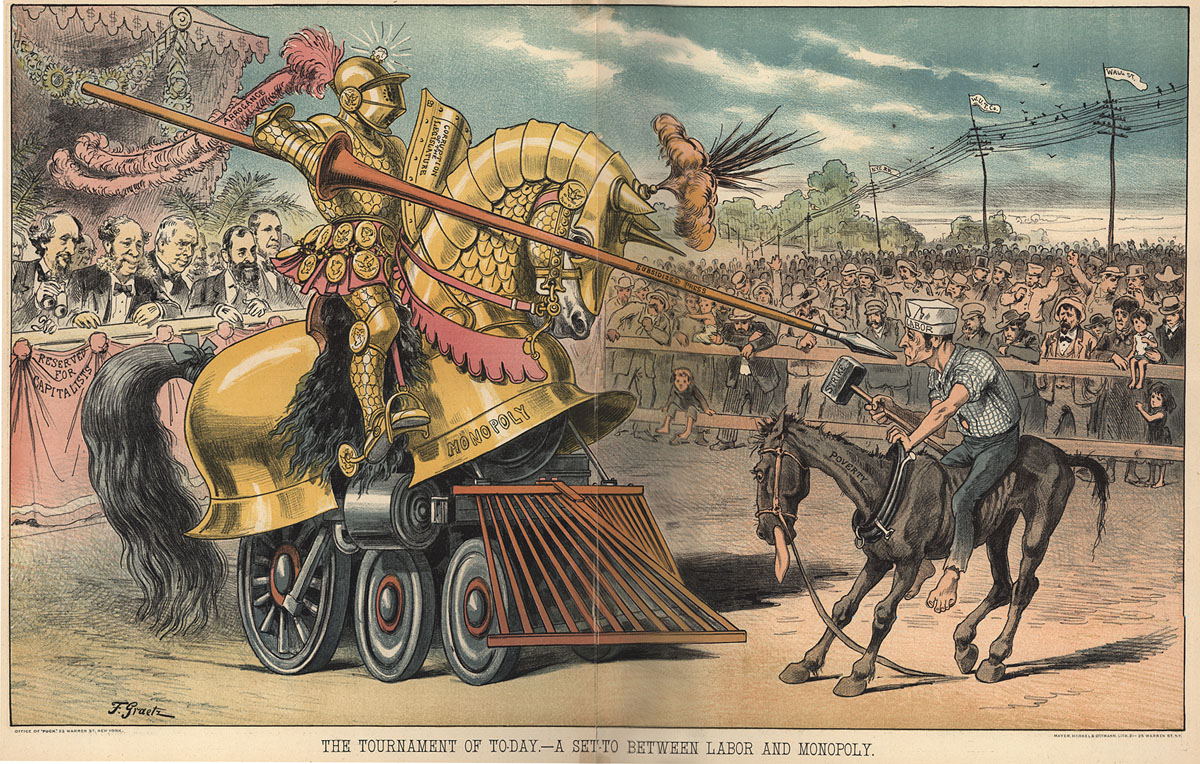
“Tournament of Today: A set-to between Labor and Monopoly,” Cartoon by Frederick Graetz, Puck Magazine, August 1, 1883 (from files of Georgia State University); click image for a larger view at Georgia State
Information on the cartoon, from SuperITCH: Frederick Graetz, a chromolithograph that was the center spread for Puck Magazine‘s issue of August 1, 1883. Monopolists portrayed are, from left to right, “businessman, financier and telecommunications pioneer Cyrus Field; railroad tycoon William Vanderbilt; shipbuilding magnate John Roach; financier, railroad mogul, and speculator Jay Gould; and an unknown monopolist.” Some might say that the “unknown monopolist” bears a striking resemblance to one of the Koch brothers, but that’s fanciful thinking.
Labor vs Monopoly – click on this image for a larger version of this historic Puck Magazine cartoon
Looking at my print copy I was struck that most of the “states” listed — really communities of people — have lost economic ground in the past decade. Average per capita incomes dropped for most groups.
Since 1980, income inequality has fractured the nation. Click each icon to see each of the dozen states, which counties belong to them and how median income has changed over the last 30 years.
The old income inequality monster rearing its ugly, ugly head again. America is losing ground. No wonder the Republicans are discouraged — but why don’t they understand that its their policies that create the trouble?
Stalking America and haunting the shadows of every capitol building in America today are people who would profess, if asked, that they fashion themselves in the mold of Herbert Hoover. Little Hoovers, we might call them. Unlike Hoover, and unlike the friendly “Little Hoover” phrase we might apply to them, the welfare of America is not their concern. We might worry about that.
President Harry Truman in 1947 appointed former President Herbert Hoover to head a commission on how to reform the federal government. I do not know of a high school history text that even mentions this effort today.
Herbert Hoover on the cover of Time Magazine, 1925
Hoover’s commission made 273 recommendations that were taken to heart, then taken to Congress. Many were enacted into law.
Several states followed the example, as in Utah and famously in California. These groups were often called “Little Hoover” commissions. In no case that I have found did any of these commissions ever recommend stripping union collective bargaining agreements out of any situation.
But again, this history is mostly lost. Hoover is remembered today for his failure to stop the Great Depression, for his seeming unwillingness to do what was necessary in great enough effort to relieve the nation’s serious hurts. That’s too bad, really.
Herbert Hoover was not opposed to government action to fix the depression on most counts. In his correspondence with Franklin Roosevelt, especially after Roosevelt replaced him in the presidency, Hoover often complained that Roosevelt’s actions were in the right vein, but too much.
We should remember this.
Are we in a Great Depression? Economically, technically, our nation is in “recovery.”
Realistically, our nation is teetering on the brink of great financial disaster. Sadly, most people ignore the lessons of history, and consequently, actions of many governmental units today seem driven to push the nation over the brink. Home prices have not recovered. Millions are out of work — millions of highly-trained workers cannot find jobs with pay adequate to support a family.
We appear not to have learned these lessons that should not have been forgotten:
Stimulus from the government creates demand, which fuels manufacturing recovery, and more jobs. Tax cuts, such as Hoover’s 1932 tax cut for the wealthy, drive us deeper into recession.
Labor unions form vital components of a healthy manufacturing segment; they stand up for worker health and safety, for fair pay and work conditions that spur productivity. When we ignore or fight unions, we damage economic productivity. When we work with unions, we make progress.
Cracking the whip may get a temporary reaction from workers that looks good. In the long run, if not immediately, such actions damage productivity and creativity.
Unions do not make the big financial decisions that cripple industry. Unions don’t decide the products to be produced. Unions cannot gamble a company’s future on ill-advised acquisitions or switches in corporate focus, usually. Union demands for restrooms improve the sanitation and health of our food supplies. Union demands for limited work hours lead to productive workers, better safety, and better products.
In almost every case where foreign corporations compete successfully with U.S. companies on high-tech and high-skill jobs, and take away U.S. jobs, the government of that foreign nation provides health care for all citizens, so that health care costs are not a cost of business. In the case of most industrial nations, foreign pension laws are much stiffer than U.S. laws, stiffer in protecting generous benefits for pensioners.
All workers benefit when unions gain, traditionally. It wasn’t Andrew Carnegie who invented the two-week vacation.
Workers can do more for consumers when they are treated well and listened to by company management.
I’m depressed at the nasty actions in so many places, in so many ways, designed to thwart progress to good ends, and instead drive our nation into mediocrity. I find it difficult to post when there is so much disaster looming in so many places.
When political movements from the right go after one group with hammer and tongs, we might do well to remember the old, wise words. With a full-on awareness of Godwin’s Law, we might do well to remember the words attributed to Martin Niemöller, and the moral of that story:
“Then they came for the trade unionists,
and I didn’t speak out because I wasn’t a trade unionist.”
What has Scott Walker done for anyone who makes less than $500,000 a year, anyway? So you should ask: What has Scott Walker ever done for you, or your family? If the bargaining rights of any union are removed, anywhere in the U.S., who will speak up for your vacation, pension, health care benefits, and job safety? OSHA? Are you sure?
The U.S. economy appears to be coming apart at the seams. Unemployment remains at nearly ten percent, the highest level in almost 30 years; foreclosures have forced millions of Americans out of their homes; and real incomes have fallen faster and further than at any time since the Great Depression. Many of those laid off fear that the jobs they have lost — the secure, often unionized, industrial jobs that provided wealth, security and opportunity — will never return. They are probably right.
Cover of Winner-Take-All Politics, by Jacob Hacker and Paul Pierson
And yet a curious thing has happened in the midst of all this misery. The wealthiest Americans, among them presumably the very titans of global finance whose misadventures brought about the financial meltdown, got richer. And not just a little bit richer; a lot richer. In 2009, the average income of the top five percent of earners went up, while on average everyone else’s income went down. This was not an anomaly but rather a continuation of a 40-year trend of ballooning incomes at the very top and stagnant incomes in the middle and at the bottom. The share of total income going to the top one percent has increased from roughly eight percent in the 1960s to more than 20 percent today.
This what the political scientists Jacob Hacker and Paul Pierson call the “winner-take-all economy.” It is not a picture of a healthy society. Such a level of economic inequality, not seen in the United States since the eve of the Great Depression, bespeaks a political economy in which the financial rewards are increasingly concentrated among a tiny elite and whose risks are borne by an increasingly exposed and unprotected middle class. Income inequality in the United States is higher than in any other advanced democracy and by conventional measures comparable to that in countries such as Ghana, Nicaragua, and Turkmenistan.
Be sure to see the story in the New York Times today. Obama administration “Race to the Top” money went to states who proposed to replace principals in failing schools. A problem in the strategy threatens the program: Not enough qualified people exist to replace all the “bad” ones.
Wrong-headed education “reformers” keep talking about “firing the bad ones,” teachers, administrators, or janitors. Without significantly raising the pay for teachers, without greatly increasing the number of teachers and administrators in the pipeline from teaching colleges or any other source, reformers can’t attract anyone better qualified than the people they wish to replace.
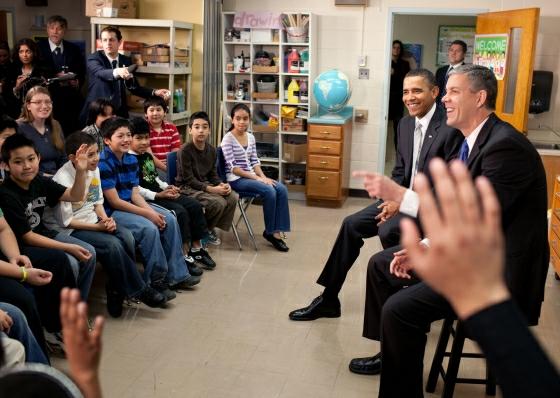
President Barack Obama and Education Secretary Arne Duncan took questions from a 6th grade class at Graham Road Elementary School in Falls Church, Virginia, January 18, 2010 – photo credit unknown
Maybe, just maybe, it’s time these reformers took a step back and did some study, perhaps from the quality gurus, Deming and Juran and Crosby, or from the heights of championship performance, in basketball, football, soccer, sailing (try the America Cup), horse racing or politics: No one can use firing as a chief tool to turn an organization around, nor to lead any organization to a championship. Threatening people’s jobs does not motivate them, nor make the jobs attractive to others.
How can we tell the fire-the-teachers-and-principals group is on the wrong track? See the article:
“To think that the same leader with a bit more money is going to accomplish tremendous change is misguided,” said Tim Cawley, a managing director at the Academy for Urban School Leadership, a nonprofit group that began leading turnaround efforts in Chicago when Mr. Duncan was the superintendent there.
“This idea of a light-touch turnaround is going to sully the whole effort,” Mr. Cawley added.
Tell that to Steve Jobs, who turned Apple around. Tell it to Jack Welch, the tough-guy boss from GE (who had his own peccadilloes about firing, but who emphasized hiring and pay, at least, as the way to create a succession plan for the vacancies). Tell it to any CEO who turned around his organization without falling on his own sword.
Any competent quality consultant would have foreseen this problem: Nobody wants to train for a job with little future, less money to do the job right, little authority to get the job done, and the sole promise that the exit door is always open.
Secretary of Education Arne Duncan should know better, intuitively. He used to play basketball, professionally. Surely he knows something about team building and team turnarounds. What caused his astounding, expensive amnesia?
Part of the issue identified in the article is training:
Because leading schools out of chronic failure is harder than managing a successful school — often requiring more creative problem-solving abilities and stronger leadership, among other skills — the supply of principals capable of doing the work is tiny.
Most of the nation’s 1,200 schools, colleges and departments of education do offer school leadership training. “But only a tiny percentage really prepare leaders for school turnaround,” said Arthur Levine, a former president of Teachers College who wrote a 2005 study of principal training.
That only contributes to the larger problem, that people in the positions are, often, the best ones for the job already; firing them damages turnaround efforts.
In Chicago, federal money is financing an overhaul of Phillips Academy High School. Mr. Cawley’s nonprofit trained Phillips’s new principal, Terrance Little, by having him work alongside mentor principals experienced at school makeovers.
“If we’re talking about turning around 700 schools, I don’t think you can find 700 principals who are capable of taking on the challenge of this work,” Mr. Little said. “If you could, why would we have this many failing schools?”
Education’s problems are many. Few of the problems are the result of the person at the chalkboard in the classroom. Firing teachers won’t help. W. Edwards Deming claimed that 85% of the problems that plague front-line employees, like teachers, are management-caused. Firing their bosses won’t solve those problems, either, but will just push the problems around. (What? “Deck chairs?” “Titanic?” What are you talking about?)
Did you hear? Texas plans to cut state funding to all education by at least 25% for next year, due to Gov. Rick Perry’s $25 billion deficit, which he worked so hard to conceal during last year’s election campaign.
Our nation is at risk. The educational foundations of our society are presently being eroded by a rising tide of mediocrity. If an unfriendly foreign power had attempted to impose on America the mediocre educational performance that exists today, we might well have viewed it as an act of war. We have, in effect, been committing an act of unthinking, unilateral educational disarmament. History is not kind to idlers.
When do we get political leaders who will swim against that tide instead of trying to surf it?
You can tell by the dates I’m not following this closely — it’s a Sarah Palin thing, after all, and we all hope it will go away.
Baking doughnuts before dawn at the Spudnut Shop, Richland Washington, Tri-City Herald photo by Kai-Huei Yau
Palin wasn’t content to just screw up the history of the phrase “Sputnik moment,” as noted earlier. Oh, no, she had to go deeper in dumb, and talk about Spudnut shops. If you’re not from Salt Lake City where the Spudnut HQ sign adorned Interstate 15 for many years, you may never have heard of Spudnuts, doughnuts made with potato dough.
If you’re wondering what in the world Spudnuts have to do with Sputnik, you’ve got more sense than Sarah Palin.
After screwing up the history, like a blind squirrel, Palin blundered on to talk about a vestige Spudnut shop in Richland, Washington. She found something we all applaud, a good doughnut shop. On one hand fans of the doughnut are happy to know of one of a tiny handful of such shops left. Plus, it’s great to boost a small shop in a small Washington town.
On the other hand, doughnuts, even Spudnuts, don’t come close to the movement to improve American education inspired by the Soviet launch of Sputnik. From just getting history horribly in error, Palin came close to ridiculing American business with her idea of meeting the challenges like space exploration, with doughnuts and coffee. Doughnuts and coffee will not lift student test scores, nor are they the answer to lifting our economy today and keeping the U.S. competitive and on top, in the future.
Others covered the topic better than I.
Stephen Stromberg in PostPartisan, a blog of the Washington Post: “In her rant, Palin wildly misconstrued the president’s argument, which was not about emulating the Soviets in the 1950s but instead about the Americans who responded to early Soviet success in space exploration by educating themselves and out-innovating the Soviets. Did she listen to the speech?”
Yes, that is what we need to get the economy back on track.
A bakery.
Not more expertise in math and science, engineering, technology, and developing enterprises that will allow us to compete with the rest of the world. A bakery, full of Real Americans.
Do you realize how this sounds? This is like if I were to say, “Hey, I think we need to take a course to familiarize ourselves with what actually caused the Soviet Union to collapse!” and you were to respond, “Anything can be solved with Hard Work, donuts, and the American Way!” It’s as if I were to say, “Let’s study geometry!” and you were to respond, “Let’s study Gia Spumanti, the red-blooded American protagonist of ‘A Shore Thing.'” “Those two sound similar, but are in no way comparable,” I would point out. And that’s what this is. It’s the kind of bizarre semi-sequitur that has always been a hallmark of your speaking style.
Stromberg got serious for a moment, and makes the case against Palin’s claims:
But in claiming that the Soviets incurred their consequential debts long before Reagan was president, Palin ends up arguing that the Gipper wasn’t nearly that responsible for the USSR spending itself to death. If a reverence for Reagan’s anti-Soviet spending inspired her narrative in the first place, then this is incoherent. If she’s just making this all up, then she’s really also claiming that the Reagan-brought-down-the-USSR narrative is overstated.
Palin appears to be lazily checking a lot of Fox News boxes. She wants to criticize Obama’s State of the Union address, so she grabs hold of the Sputnik line. She wants to make a point about debt, so she invents a history in which the USSR had a debt crisis decades before this inference could have made much sense. Even better — her argument sounds like an implicit vindication of Reagan, but that really just makes it either self-contradictory or hostile to Reagan’s legacy.
Even worse, it seems that Palin planned her rhetorical disaster, as she goes on to discuss the “Spudnut Shop,” a bakery in Washington State that’s succeeding without government support. Yet more evidence that her judgment in both what she says and who she has vetting it is pathetic. It’s not even cleverly manipulative. It’s just dreck.
The pen didn’t kill the book. The typewriter didn’t kill the book. The pencil didn’t kill the book. Radio didn’t kill the book. Movies didn’t kill the book. Television didn’t kill the book. Telephone didn’t kill the book. Personal computers didn’t kill the book (much to the chagrin, perhaps, of the designers of the Apple Lisa — and if you remember that, and it’s coming with all the works of Shakespeare loaded on the harddrive, you’re older than your colleagues think you are).
In “A Dangling Conversation,” recorded in 1966 by Simon and Garfunkel, Paul Simon’s lyrics say, “We speak of things that matter/With words that must be said./’Can analysis be worthwhile?/Is the theatre really dead?'” Some other questions are similarly and equally unstuck in time, and I think “Is the book dead?” is one of them.
So long as there are books, and readers who demand books, there is a need for a bookstore. They may move to our libraries, but we’ll still need and want them.
Spread the word; friends don't allow friends to repeat history.
That’s not just irresponsible and sloppy: Boortz clearly has a grudge and will tell any falsehood to push his agenda of hatred.
Birds of a feather: Texas deficit champion Rick Perry, who refused to talk about his $18 billion deficit in Texas, with Neil Boortz, who spread a hoax about Hillary Clinton in 2008, and now spreads old hoaxes about President Obama.
Boortz posts this at his site, probably as a warning for what his philosophy of reporting is:
“When plunder becomes a way of life for a group of men living together in society, they create for themselves in the course of time a legal system that authorizes it and a moral code that justifies it.”
Frederic Bastiat
Just before Thanksgiving last year, a J. P. Morgan official wrote a humorous piece of conjecture for his weekly newsletter — a week when most of the markets in the U.S. were closed, and so there was little news. Michael Cembalest, the chief investment officer for J. P. Morgan, without serious research wrote a piece wondering about what he saw as a lack of private sector experience in Obama’s cabinet in those positions in Cembalest’s view that are concerned most with job creation.
The spin meisters at American Enterprise Institute abused Cembalest’s rank conjectures as a “research report,” created a hoax saying Obama’s cabinet is the least qualified in history, and the thing went viral among otherwise ungainfully-employed bloggers (a lot like Neil Boortz).
Last year J.P. Morgan thought it might be interesting to look into the private sector experience of Obama’s Cabinet. America, after all, was in the middle of an economic disaster and the thought was that the president might actually look to some people with a record of success in the private sector for advice. So a study is done comparing Obama’s Cabinet to the cabinets of presidents going back to 1900. secretaries of State, Commerce, Treasury, Agriculture, Interior, Labor, Transportation, Energy and Housing and Urban Development were included. The J.P Morgan study looked at the percentages of cabinet members with prior private sector experience, and the results were amazing.
The presidential cabinet with the highest percentage of private sector experience was that of Dwight Eisenhower at around 58%. The lowest — until Obama — was Kennedy at about 28%. The average ran between 35% and 40% … until, as I said, Obama. Care to guess what percentage of Obama’s cabinet has prior private sector experience? Try 7%.
All totaled, Obama’s cabinet is one of the certifiably most brainy, most successful and most decorated of any president at any time. His cabinet brings extensive and extremely successful private sector experience coupled with outstanding and considerable successful experience in government and elective politics.
AEI’s claim that the cabinet lacks private sector experience is astoundingly in error, with 77% of the 22 members showing private sector experience — according to the [standards of the] bizarre chart [from AEI], putting Obama’s cabinet in the premiere levels of private sector experience. The chart looks more and more like a hoax that AEI fell sucker to — and so did others.
Boortz is eight months late, and the whole truth short. Shame on him.
Not just false stuff — old, moldy false stuff. Atlantans, and all Americans, deserve better reporting, even from hack commentators.
_____________
Coda: Sage advice, but . . .
Boortz includes this warning on his website:
ALWAYS REMEMBER
Don’t believe anything you read on this web page, or, for that matter, anything you hear on The Neal Boortz Show, unless it is consistent with what you already know to be true, or unless you have taken the time to research the matter to prove its accuracy to your satisfaction. This is known as “doing your homework.”
Great advice — but no excuse for sloppy reporting. He should follow his own rule. On this piece, Boortz didn’t do his homework in any fashion. He’s turning in somebody else’s crap, without reading it in advance, it appears.
Spread the word; friends don't allow friends to repeat history.
Just as a reminder about what we’re doing in education, I hope every teacher and administrator will take three minutes and view this video (that allows you some time to boggle).
Surely you know who Tom Peters is. (If not, please confess in comments, and I’ll endeavor to guide you to the information you need.)
“Follow the Money” is a video summarizing the results from the project by Northwestern University grad students Daniel Grady and Christian Thiemann. Using data from the website Where’s George?, they have been able to track the movement of U.S. paper currency. What can you learn from this? That there are natural borders within the U.S. that don’t necessarily follow state borders, and it can also be used to predict the spread of disease because it maps movement of people within the U.S.
From Maria Popova on BrainPickings.org: This may sound like dry statistical uninterestingness, but the video visualization of the results is rather eye-opening, revealing how money — not state borders, not political maps, not ethnic clusters — is the real cartographer drawing our cultural geography. The project was a winner at the 2009 Visualization Challenge sponsored by the National Science Foundation and AAA.
With these new Social Studies TEKS, TX students won’t know what such a
book is about.
Small bit of humor from a truly sad situation. One of the leaders of the Texas State Soviet of Education defended the evisceration and defenestration of social studies standards saying they didn’t need to listen to liberal college professors.
In economics, the professor was a conservative, well-respected economics professor from Texas A&M University, one of the most conservative state universities in the nation (with a Corps of Cadets numbering in the thousands and tradition deeper than Palo Duro Canyon and broader than the Gulf of Mexico). Calling these people “liberal” is tantamount to complaining about the communism espoused by Ronald Reagan and Dwight Eisenhower — that is, it demonstrates a divorce from reality and rationality.
In the grand scheme of things it’s not a huge problem, but it’s more than a trifle. It’s difficult, if not impossible, to fully comprehend market economics in the U.S. without understanding what capitalism is, and how it works. Teachers will be left to find their own materials to explain “free enterprise” and, if the students ever make it into a real economics course in college, they will discover “free enterprise” is a quaint, political term that is not discussed in serious economics circles. Texas students will, once again, be pushed to the hindmost by Don McLeroy’s odd views of America and what he doesn’t want Americans to know.
For example, look at the Council for Economic Education — while “capitalism” is not the only word they use for market-based economies, you’ll have a tougher time finding any definition of “free enterprise.” Or, more telling, look at the Advanced Placement courses, or the International Baccalaureate courses. AP and IB courses are the most academically rigorous courses offered in American high schools. The Texas TEKS step away from such rigor, however (while the Texas Education Agency rides Texas schools to add rigor — go figure). IB courses talk a lot about enterprise, but they don’t censor “capitalism,” nor do they pretend it’s not an important concept.
At the very conservative and very good Library of Economics and Liberty (which every social studies teacher should have bookmarked and should use extensively), a search for “free enterprise” produces 77 entries (today). “Capitalism” produces almost ten times as much, with more than 750 listings.
Which phrase do you think is more useful in studying American economics, history and politics?
Teachers will deal with it. It’s one more hurdle to overcome on the path to trying to educate Texas students. It’s one more roadblock to their learning what they need to keep the freedom in America.
Capitalism - Warren Buffett - BusinessWeek image
Free Enterprise - Bernie Madoff
The real difference? Literature on capitalism frequently address the issue of moral investments, and the need for some regulation to bolster the Invisible Hand in producing discipline to steer markets from immoral and harmful investments. The essential history politics economic question of the 20th and 21st centuries is, can economic freedom exist without political freedom, and which one is more crucial to the other? We know from every period of chaos in history when governments did not function well, but bandits did, that free enterprise can exist without either political freedom or economic freedom. I think of it like this:
Capitalism
Free Enterprise
Adam Smith
Blackbeard the Pirate
Warren Buffett
Bernie Madoff
Investing
Spending
Building institutions
Taking profits
Retail
Robbery
Wholesale
Extortion
Save for a rainy day
debt-equity swap
Antitrust enforcement to keep markets fair
Don’t get caught, hope for acquittal
Milton Friedman
P. T. Barnum
Ludwig von Mises
Charles Ponzi
Friedrich von Hayek
Richard Cheney, “deficits don’t matter”
Paul Krugman
Kato Kaelin
Stockholders
Victims and suckers
Spread the word; friends don't allow friends to repeat history.
You’re internet and culture savvy — you probably already know all about this stuff.
OK Go’s music appeals to many. The appeal convinced a major record label, Capitol/EMI, to sign the band to a deal. OK Go worked hard to promote the music of the band, including videos. Capitol looked at the videos, intensely creative works of art on their own, and pulled in the reins. Okay to show the vids, the label said, but don’t allow downloads . . .
Minor twist on the old band meets label, band wins label story: OK Go got out of the contract. They lost the label.
Now they’ve got an astounding new video to go viral, one that simply delights younger viewers and brings in older viewers with whispers of “shades of Rube Goldberg!” (Who was Rube Goldberg? Younger readers go here.)
After the overwhelming success of the video for its 2006 song “Here It Goes Again,” in which its four band members execute a tightly choreographed dance routine built around a handful of treadmills, OK Go has lofty standards to live up to. With roughly 50 million views on YouTube, “Here It Goes Again” stands as one of the most popular music videos of the Internet era.
Not one to shy away from a challenge, the band set about constructing a painstakingly executed two-story Rube Goldberg machine, set to trigger in time to the music for its latest video, “This Too Shall Pass.” Although it starts out small, with a toy truck knocking over some dominoes, the contraptions that make up the machine rapidly get larger and much more complex — pianos are dropped, shopping carts come crashing down ramps, and one band member is launched headlong through a wall of boxes. After assembling a team of dozens of engineers to construct the set, more than 60 takes were needed to get everything working just right during filming.
Toughest part? EMI, parent of Capitol, didn’t want to allow downloads of the music or video.
The band’s label, EMI, didn’t see things the same way. In an effort to maintain some control over the dissemination of the music video, EMI denied listeners the ability to embed it on their own Web sites and blogs. After receiving a deluge of complaints, the band eventually persuaded EMI to enable embedding. Soon afterward, however, OK Go parted ways with EMI to start its own record label, Paracadute.
Personal quandary: I’m not sure that I don’t like this version of the song, with the Notre Dame marching band, better than the Rube Goldberg version. What do you think?
Personal confession: Problems of mishearing lyrics abound. I listened probably a dozen times thinking the refrain was “When the money comes.” It makes more sense, and is much less cynical and wooish, with the real lyric, “When the morning comes.”
More:
OK Go’s website — with upcoming shows highlighted (Oh, to be in Salt Lake City on April 13, 2010, or St. Louis on April 18 . . .) (From the website: “PS… Oh, fine. More news now: If you can’t get to one of the thirty-plus shows on the upcoming tour, fear not: the boys will be on your TV. In the next month they’ll visit Carson Daly (4/16), David Letterman (4/28), Steven Colbert (4/29), and Jimmies Kimmel (4/1) and Fallon (5/4). They’ll also be at Bamboozle, Bonnaroo and Sasquatch. Some busy months ahead.”)
Media Check carries edited excerpts from a book by Daniel Gutstein from last year, Not A Conspiracy Theory: How Business Propaganda Hijacks Democracy (Key Porter, 2009) by Donald Gutstein, Key Porter (2009).
The problem with the coverage of the DDT issue and with the eco-imperialism charge is that they are based on falsehoods that the media did not investigate. Former CBC-TV National News anchor Knowlton Nash once said that “…our job in the media… is to… provide a searchlight probing for truth through the confusing, complicated, cascading avalanche of fact and fiction.” In this case, the media let their audiences down; fiction prevailed over fact.
Despite what the pro-DDT organizations alleged, DDT was not banned for use in mosquito control and could continue to be used in 25 countries in malarial regions. In these countries, limited amounts of DDT can be sprayed on the inside walls of houses to combat malaria-carrying mosquitoes. “The environmental community is collaborating with the World Health Organization to ensure that the phase-out of the remaining uses of DDT does not undermine the battle against malaria and the well-being of people living in malarial zones,” the United Nations Environmental Programme reported when the treaty came into force.
Has anyone read the book? Has anyone seen it? (So what if it’s aimed at Canada?)
More thoughts: Years ago, when Jan Brunvand first achieved some fame cataloging urban myths, it occurred to me that his books should be required reading in the very first survey classes in journalism school. Maybe they should be required reading in political science, rhetoric, and philosophy, too.
Gutstein’s book would be a good reader for a class on reporting, or investigative reporting, or science reporting, or political reporting. I’m not sure where it would fit in to a science curriculum, but I wish more scientists came out of undergraduate years aware that they can get hammered by these hoax-selling, axe-grinding disinformation machines. All those reports about how Rachel Carson is the “murderer of millions?” They coarsen dialog, they misinform, disinform and malinform the public. They do great disservice to citizenship and voters, and ultimately, to our democratic institutions.
It’s not enough to have a counter, good-information plan. These people must be convinced to stop.
Or, until that account is unsuspended by the forces supporting Donald Trump: Follow @FillmoreWhite, the account of the Millard Fillmore White House Library
We've been soaking in the Bathtub for several months, long enough that some of the links we've used have gone to the Great Internet in the Sky.
If you find a dead link, please leave a comment to that post, and tell us what link has expired.
Thanks!
Retired teacher of law, economics, history, AP government, psychology and science. Former speechwriter, press guy and legislative aide in U.S. Senate. Former Department of Education. Former airline real estate, telecom towers, Big 6 (that old!) consultant. Lab and field research in air pollution control.
My blog, Millard Fillmore's Bathtub, is a continuing experiment to test how to use blogs to improve and speed up learning processes for students, perhaps by making some of the courses actually interesting. It is a blog for teachers, to see if we can use blogs. It is for people interested in social studies and social studies education, to see if we can learn to get it right. It's a blog for science fans, to promote good science and good science policy. It's a blog for people interested in good government and how to achieve it.
BS in Mass Communication, University of Utah
Graduate study in Rhetoric and Speech Communication, University of Arizona
JD from the National Law Center, George Washington University


 Posted by Ed Darrell








 Millard Fillmore's Bathtub