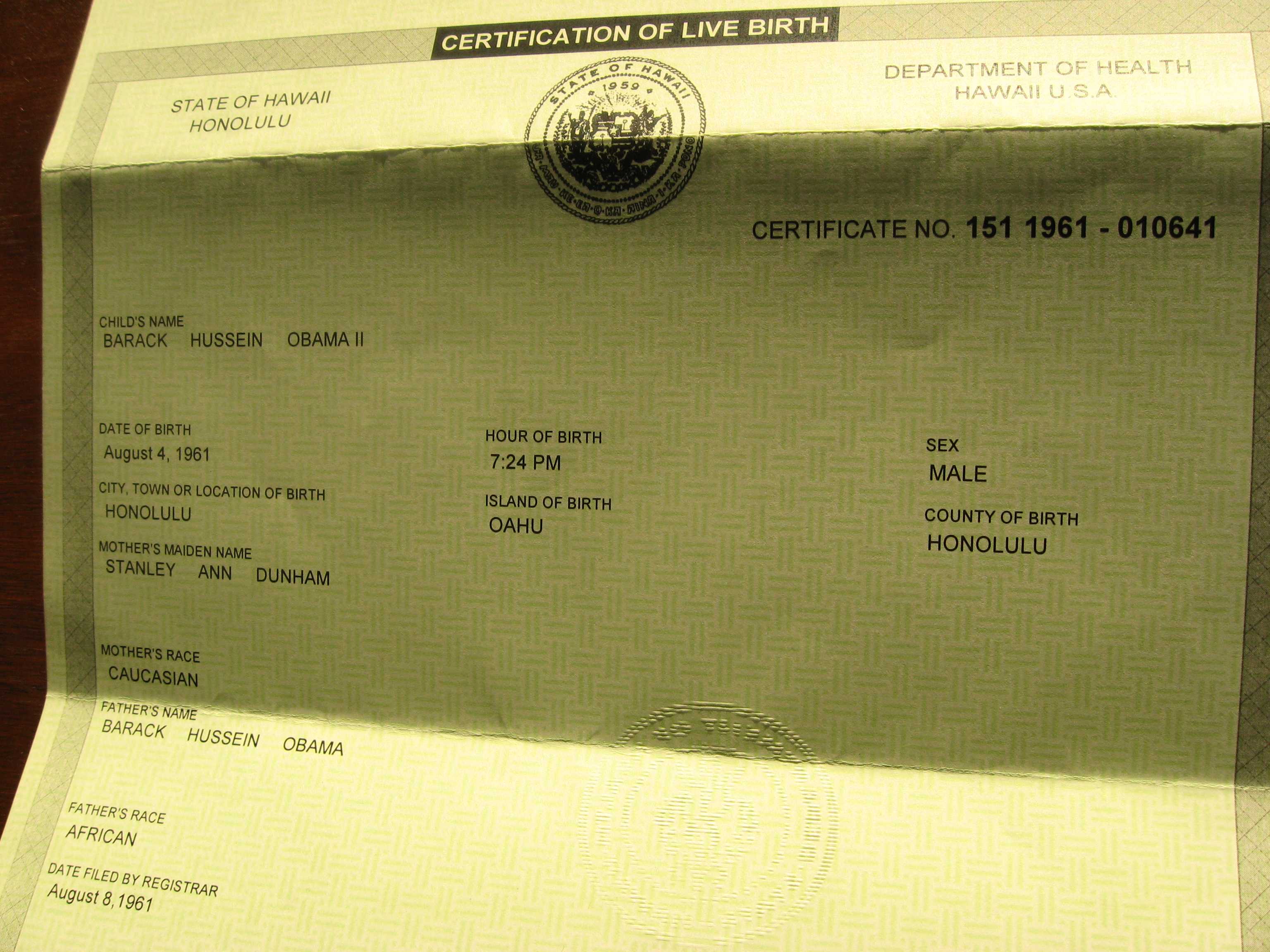
Obama’s birth certificate: Astrologers bring sound reason

November 30, 2008

Texas Darlin‘ and the bevy of sites who contest the authenticity of Barack Obama’s birth certificate need to come up for air once in a while.  When astrologers start using better science, logic and reason than those obsessed with Obama’s birth certificate, it’s time for those so obsessed to change their ways, don’t you think?

See also the six ways the arguments against Obama’s birth certificate fail.


6 ways challenges to Obama’s citizenship fail

November 27, 2008

Enough already.  Somebody’s putting LSD into the water conservatives and other wackoes are drinking — that’s the only rational explanation for continued complaints about Barack Obama’s birth eligibility for the presidency.

First, here’s the rational view of the issue, from FactCheck.org, “Born in the USA.”

Here are a few of the sites that seem to have lost all touch with reality, and continue to whine that Obama might somehow be ineligible for the presidency:

Conservatives expert advisor Leo C. Denofrio, from his seat at a Caesars Palace poker table

Do you trust your nation's future to this man? - Conservatives' expert advisor Leo C. Denofrio, from his seat at a Caesar's Palace poker table

Weird enough, irrational enough yet?  As odd as these sites are, sometimes the comments get even odder.  It doesn’t help the rationality quotient that so many of these bloggers block out or strike down comments that present an alternative case or rational answers.

And in fact, it’s partly because of Texas Darlin’s anti-rational-comment pose that I put this post up.  Somebody, somewhere, needs to suggest the rational foundations, and inject them into the discussion.

A commenter named Carlyle states the basic case of the birth-certificate-obsessed people (BCOs).  It’s a nutty case, ungrounded in fact or logic, but Texas Darlin’ won’t allow responses.  So, here are some of the things these people are not thinking about as they fold ever-thicker tinfoil hats.

Carlyle said:

But let me back up for a moment and lay out the two great truths. These are the things that are known without doubt and far above speculation.

1. FACT – Obama has never provided admissable auditible citizenship documentation to anybody. No complete birth certificate, no passport, no selective service registration, nothing, zero, nada, zippo. Nobody can produce any of this stuff – not DNC, FEC, DOJ, State SecStates, electors – nobody.

No, actually Carlyle is doing a lot of speculation there (as are other BCOs).  Almost all of these rants are based on speculation, wild speculation far outside of what is known.  The key questions would revolve around what sorts of evidence would be admissible as evidence in a court of law in the U.S.  Very few of these anti-Obama rants ever bother to touch ground on those issues.  The birth certificate issued by the State of Hawaii, posted by the Obama campaign for months, is the legally-admissible document.  The ranters have to ignore that to get on to the rest of their complaints.

Beyond the legally-admissible, there are logical cascades of events to which we can point, which strongly suggest the ranters are truly full of sound and fury signifying nothing.

First, in order to obtain a passport, for one example, one must provide “admissible, auditable citizenship documentation” to the U.S. Department of State. We know Obama has held a passport for many years, so we can be reasonably certain he provided that information originally (Do you have a passport?  How did you get it without a birth certificate?  I got a diplomatic speedy process, and I still had to provide a birth certificate . . .).

Propagandist-and-self-promoter-for-hire Jerome Corsi claims Obama didn’t travel on a U.S. passport, claiming results from an impossible Freedom of Information Act request to the U.S. State Department.

Obama’s passport is a matter of record (though privacy laws do not allow release of the passport itself, generally).  Without evidence to the contrary, this presents a rebuttable presumption that Obama is a citizen. Does anyone else have information that the birth certificate Obama gave State was wrong?  Obviously not — the BCOs don’t appear to have been aware such a thing was even required.

Second, one of the things State checked for when I applied for a passport (when I worked in the Senate) was my Selective Service Status.  Hypothetically, they don’t want to grant a passport to someone who is not registered.  Again, under the rules of civil procedure, we have a rebuttable presumption that Obama’s draft registration was fine when he traveled as a student.  If it was fine then, absent a showing from anyone that there was a later event that made the draft registration invalid, we should assume that State did their job.  As a pragmatic matter, the draft ended in the early 1970s, so there could be almost no issue that could have caused Obama’s draft status to change.  It’s pretty clear that his draft registration is valid.

Third, Obama is a lawyer.  In order to get a license to practice law, applicants must provide a certified copy of a birth certificate to the National Conference of Bar Examiners, in order to be eligible to take the bar exam. The National Conference then does a background investigation on all candidates, generally an investigation more thorough than the FBI’s checking for most federal appointees.  In the past, the Conference has reported issues like minor drug use, preventing people from becoming lawyers in several states.  Absent a showing by someone that the National Conference granted special waivers, or a showing of other irregularities, the fact that Obama held a license to practice law presents a rebuttable presumption that his birth certificate is valid exactly as he alleges, and that his draft status is legal. Obviously, the BCOs have no information to indicate any irregularity, since they were unaware of this check.  We should assume, therefore, that Obama has a valid birth certificate and draft registration, since the Illinois Bar got a recommendation from the National Conference of Bar Examiners that Obama was morally fit to be a lawyer.

Fourth, Obama is a U.S. Senator.  As a matter of standard operating procedure, the FBI does a thorough background check on every elected Member of Congress, to certify that they are eligible for top secret clearance, since every member will be seeing national secrets.  Occasionally these checks produce questions, which are usually resolved by the Rules Committee of each house.  There is no record of any proceeding dealing with any irregularity in the background check for Sen. Obama.  This means that there is a rebuttable presumption that the FBI was satisfied with Obama’s citizenship status, as well as his patriotism and ability to keep state secrets.

Furthermore, for members of the Armed Services, Intelligence oversight, and Foreign Relations Committees, there is a more thorough background check by the FBI, since many of these members will be seeing a lot of secrets, and many of them will be talking with foreign dignitaries and visiting foreign nations, and in other ways would have opportunities to pass state secrets to non-allies and even enemies of the U.S.  The simple fact that Obama sat on the Foreign Relations Committee and was, in fact, chairman of the NATO subcommittee (which deals with secrets of many of the allies of the U.S.), creates a fourth rebuttable presumption that Obama’s citizenship status, draft status, patriotism and ability to wave the flag and sing the “Star-Spangled Banner” are above reproach.

Obviously, BCOs don’t have any information to suggest there is any problem with this tougher security clearance, and in fact appear to be wholly unaware that such an investigation had been done, or could be done.

Fifth, since the November 4 election, Sen. Obama has been getting the daily National Security briefiing that President Bush gets.  This briefing includes our nation’s most precious secrets, and cannot be done, even for the president, without the CIA and Homeland Security verifying that the man is who he says he is.

BCOs have no information to overcome the several rebuttable presumptions that Obama’s credentials are in order, evidenced by their total lack of awareness that such procedures even exist.

So, in five ways, we have assurances that Obama is wholly legal and qualified to hold the office of the presidency.  Neither TD’s commenter Carlyle nor any other BCO has any basis to question these federal and state agencies, nor have they suggested any irregularity in any one of these processes which would lead to the irrational conclusion that Obama is not a natural-born U.S. citizen, or not eligible to be president.

Sixth, Obama posted his birth certificate in June, on-line [archived version here]. Are these people Google impaired?

2. FACT – Against numerous attempts by journalists and courts to ask for such information, Obama has uniformaly resisted. One might even say beligerently so.

One might say that, but one would be prevaricating, belligerently.  As noted above, Obama’s birth certificate is available on-line.  So much for resistance.   So far as we know, every reporter who asked was able to view the actual certificate with it’s stamp of authority from the State of Hawaii.  Such analyses have been done, written about, and posted on-line.  Are they Google AND Yahoo impaired?

Do the BCOs have any serious evidence of any problems that the U.S. State Department, the FBI, the National Conference of Bar Examiners, the State Bar of Illinois, the FBI again, the Rules Committee of the U.S. Senate, the CIA and the U.S. Department of Homeland Security missed?  What is their evidence?

We challenge them to be specific.  If they are claiming something like an aged grandmother’s testimony that Obama was born in Kenya, they should have the good sense not to waste the court’s time about such folderol unless unless have a sworn affidavit from the woman, taken down by a court reporter, and corroborating evidence (Corsi did not even bother to get statements, let alone sworn statements under oath, I understand — he’s asking a Supreme Court hearing for inadmissible hearsay).

And Joseph Farah, here’s my challenge to you:  Provide corroboration for your charges, provide affidavits where they would be required, provide evidence of error on the parts of these federal and state agencies, or shut up about it. Even scandal-sheet journalists have some responsibility to at least try to look like they care about accuracy.  Farah owes it to his readers to get things right.  He’s not living up to the duty he owes.

What do they have?

Why must we entertain cargo cultists in their dances?  We have two wars and a crashing economy to fix.  Can we get on with the transition, please?

Barack Obamas birth certificate, showing the states stamp of authenticity, from FactCheck.org

Barack Obama's birth certificate, showing the state's stamp of authenticity, from FactCheck.org

See Updates:

Please share the information.

Add to FacebookAdd to NewsvineAdd to DiggAdd to Del.icio.usAdd to StumbleuponAdd to RedditAdd to BlinklistAdd to TwitterAdd to TechnoratiAdd to Furl


Hoaxers promise to slam Obama to the end

November 2, 2008

The Economist, that august, conservative British publication about economics, endorsed Barack Obama for president. (I added highlights, below):

IT IS impossible to forecast how important any presidency will be. Back in 2000 America stood tall as the undisputed superpower, at peace with a generally admiring world. The main argument was over what to do with the federal government’s huge budget surplus. Nobody foresaw the seismic events of the next eight years. When Americans go to the polls next week the mood will be very different. The United States is unhappy, divided and foundering both at home and abroad. Its self-belief and values are under attack.

For all the shortcomings of the campaign, both John McCain and Barack Obama offer hope of national redemption. Now America has to choose between them. The Economist does not have a vote, but if it did, it would cast it for Mr Obama. We do so wholeheartedly: the Democratic candidate has clearly shown that he offers the better chance of restoring America’s self-confidence. But we acknowledge it is a gamble. Given Mr Obama’s inexperience, the lack of clarity about some of his beliefs and the prospect of a stridently Democratic Congress, voting for him is a risk. Yet it is one America should take, given the steep road ahead.

We face tough issues, and tough times.  The world’s economy is in a fix, America is involved in two protracted wars, our reputation internationally is at a low ebb for the past 125 years, and too many of America’s institutions just are not working.

Serious issues won’t stop the hoaxsters from trying to hoax Americans about Barack Obama right up to election day, and probably beyond.

For example, there’s a guy named Mitchell Langbert, who insists that there remains an issue about Barack Obama’s birth certificate.  He goes so far as to claim that Obama might be committing fraud merely by running for office, and then he stretches a biased assessment of U.S. election law to say Obama’s running is a violation of voters’ rights.  The birth certificate hoaxers roll on despite their nuisance lawsuits being dismissed solidly in at least two jurisdictions, and despite the complete lack of any cogent or coherent case that there is a problem with Obama’s citizenship.

Consider this:  Obama’s birth was recorded by the State of Hawaii, in Hawaii, in 1961.  As many newspapers did at the time, the Honolulu Advertiser listed births in the state, and it listed Barack Obama’s birth there.  This issue would have been checked again on at least three occasions.  First, when he applied for his own passport, the U.S. State Department would have required a showing of a birth certificate.  Second, when he applied for a law license, he had to make such a showing to the National Conference of Bar Examiners (as we all did); I haven’t checked, but Illinois may have required a separate confirmation.  And third, when he was elected to the U.S. Senate, the FBI would have checked the issue in their routine checkings of senators for top secret clearances (Obama is a member of the Foreign Relations Committee, where secret information is often passed to senators).

Finally, it is the duty of the state secretary of state (SOS) to verify that candidates are eligible for listing on the ballots.  I suspect most SOS offices take a certification from the candidate without much checking; however, what this means is that the SOS is the person who would have authority to challenge for citizenship.  Knowing that they have no case, none of the birth certificate hoaxers, not Langbert or Texas Darlin’, nor anyone else, has bothered to ask their SOS to check things out.

Other hoaxers are worse, creating whole cloth fictions, just for the sake of malice.  (See here, too, for a solid example of just plain malice in hoaxing.)

Remember the 7 Signs of Bogus History?  (You’ll find a link just under the masthead here.)  The first is that the work is conducted by press release, and not in the archives, or in serious searches for the facts.  Each of these anti-Obama hoaxes originates either with a press release or a blog post.  Not one has withstood scrutiny of any court, nor of any editor at any serious mass media outlet who seriously worries about libel, slander, or otherwise getting the facts straight.  That’s a serious indictment.

Gone are the days when one needed a printing press at least to make one’s views known broadly.  Web tools, like the blogging software and servers used by this blog, allow any fool (as I may well be) to throw his hat, brain too often included, into the public arena as a pundit.

The Economist conclude in their endorsement editorial:

He has earned it

So Mr Obama in that respect is a gamble. But the same goes for Mr McCain on at least as many counts, not least the possibility of President Palin. And this cannot be another election where the choice is based merely on fear. In terms of painting a brighter future for America and the world, Mr Obama has produced the more compelling and detailed portrait. He has campaigned with more style, intelligence and discipline than his opponent. Whether he can fulfil his immense potential remains to be seen. But Mr Obama deserves the presidency.

*  *  *  *  *  *  *  *

Update, November 2, 2008: Langbert appears to be censoring comments at his blog, as well – none of my responses other than my first post have been allowed to get through his personal filtering.  This is a pattern we’ve seen in many of the hoax blogs that complain about Obama, and the McCain sympathizer blogs that pose as disgruntled Democrat blogs.  Any post that offers serious criticism is dangerous to their posing as informed seekers of the truth — so posts that contain real information rebutting their claims are not allowed through their “moderation,” or are edited to say inane things.

For Obama voters, this confirms their fears that a McCain administration would probably continue the Bush administration’s suppression of views and filtering of helpful criticism.  Also, it means bloggers like Langbert are bullies who can’t take the hurly-burly of serious discussion.


Don’t vote. Don’t tell 5 friends. Just don’t

November 1, 2008

This one’s safe for work:

This one, not safe for work (profanity, usually mild – democratic ideas), but much funnier, and much more serious at the same time — I wish I’d known about it two months ago.  Not nearly enough people have watched these, according to the YouTube counts:

If I can get five readers of this post, we’re home free, right?

Tip of the old scrub brush to UBZonker.


Slinging mud, losing elections

November 1, 2008

Encouraging reports from North Carolina, not-so-encouraging reports from Kentucky.

In North Carolina, Sen. Elizabeth Dole’s campaign dived into negative campaigning, with a crude and inaccurate campaign ad against her rising-in-the-polls opponent, state Sen. Kay Hagan.  It appears many voters are disgusted with the negative ads.  In any case, the Charlotte Observer wrote an editorial condemning Dole’s ad and negative tone, “Dole’s desperate turn to Big Lie advertising.” Good on them.

In Kentucky, however, we learn that negative campaigning can still pack a punch among poorly educated or bigoted groups.  The Lexington Herald-Leader has a poll showing significant portions of Kentucky voters think Barack Obama is Muslim.

One might recall Dumas Malone’s description of the election of 1800, between John Adams and Thomas Jefferson.  Jefferson thought it beneath his dignity, and not part of American politics, to discuss a candidate’s religious faith.  Alexander Hamilton, on behalf of Adams, led a campaign of calumny in newspapers throughout the U.S. saying that because Jefferson was atheist, as president he’d send the army to confiscate Bibles.  Jefferson refused to respond.  Malone notes that on election day, fully half of all American voters were convinced Jefferson was atheist.

They voted for Jefferson anyway, rather than stick with the failed policies of Adams.  There’s a lesson in there somewhere.


Why we liked Obama then

October 31, 2008

On July 27, 2004, candidate for the U.S. Senate from Illinois, Barack Obama, delivered the keynote address to the National Democratic Convention.

It was a turning point speech.  Obama went on to win the Illinois senate race.  His candidate for president, John Kerry, lost.  But the power of his speech and its ready reception earned Obama consideration as a candidate for the presidency in 2008.

As the 2008 campaign winds down to election day next Tuesday, it’s interesting to revisit Obama’s debut on a national stage.  What was it that made his speech so well received?  What was it about the biographical portions that made Obama look like a potential president?

PBS’s Online Newshour described the speech:

Illinois Senate candidate Barack Obama introduced himself to Democrats and a national television audience Tuesday, giving the keynote address at the Democratic National Convention. Obama told the story of his working class family and urged the nation to elect Democratic presidential candidate John Kerry, saying he would ensure more educational and economic opportunities for all.

Here is the full text (borrowed from PBS), so you can see for yourself.

A YouTube capture of the CSPAN broadcast:

BARACK OBAMA: On behalf of the great state of Illinois, crossroads of a nation, land of Lincoln, let me express my deep gratitude for the privilege of addressing this convention. Tonight is a particular honor for me because, let’s face it, my presence on this stage is pretty unlikely. My father was a foreign student, born and raised in a small village in Kenya. He grew up herding goats, went to school in a tin-roof shack. His father, my grandfather, was a cook, a domestic servant.

But my grandfather had larger dreams for his son. Through hard work and perseverance my father got a scholarship to study in a magical place; America which stood as a beacon of freedom and opportunity to so many who had come before. While studying here, my father met my mother. She was born in a town on the other side of the world, in Kansas. Her father worked on oil rigs and farms through most of the Depression. The day after Pearl Harbor he signed up for duty, joined Patton’s army and marched across Europe. Back home, my grandmother raised their baby and went to work on a bomber assembly line. After the war, they studied on the G.I. Bill, bought a house through FHA, and moved west in search of opportunity.

And they, too, had big dreams for their daughter, a common dream, born of two continents. My parents shared not only an improbable love; they shared an abiding faith in the possibilities of this nation. They would give me an African name, Barack, or “blessed,” believing that in a tolerant America your name is no barrier to success. They imagined me going to the best schools in the land, even though they weren’t rich, because in a generous America you don’t have to be rich to achieve your potential. They are both passed away now. Yet, I know that, on this night, they look down on me with pride.

I stand here today, grateful for the diversity of my heritage, aware that my parents’ dreams live on in my precious daughters. I stand here knowing that my story is part of the larger American story, that I owe a debt to all of those who came before me, and that, in no other country on earth, is my story even possible. Tonight, we gather to affirm the greatness of our nation, not because of the height of our skyscrapers, or the power of our military, or the size of our economy. Our pride is based on a very simple premise, summed up in a declaration made over two hundred years ago, “We hold these truths to be self-evident, that all men are created equal. That they are endowed by their Creator with certain inalienable rights. That among these are life, liberty and the pursuit of happiness.”

That is the true genius of America, a faith in the simple dreams of its people, the insistence on small miracles. That we can tuck in our children at night and know they are fed and clothed and safe from harm. That we can say what we think, write what we think, without hearing a sudden knock on the door. That we can have an idea and start our own business without paying a bribe or hiring somebody’s son. That we can participate in the political process without fear of retribution, and that our votes will be counted — or at least, most of the time.

This year, in this election, we are called to reaffirm our values and commitments, to hold them against a hard reality and see how we are measuring up, to the legacy of our forbearers, and the promise of future generations. And fellow Americans — Democrats, Republicans, Independents — I say to you tonight: we have more work to do. More to do for the workers I met in Galesburg, Illinois, who are losing their union jobs at the Maytag plant that’s moving to Mexico, and now are having to compete with their own children for jobs that pay seven bucks an hour. More to do for the father I met who was losing his job and choking back tears, wondering how he would pay $4,500 a month for the drugs his son needs without the health benefits he counted on. More to do for the young woman in East St. Louis, and thousands more like her, who has the grades, has the drive, has the will, but doesn’t have the money to go to college.

Don’t get me wrong. The people I meet in small towns and big cities, in diners and office parks, they don’t expect government to solve all their problems. They know they have to work hard to get ahead and they want to. Go into the collar counties around Chicago, and people will tell you they don’t want their tax money wasted by a welfare agency or the Pentagon. Go into any inner city neighborhood, and folks will tell you that government alone can’t teach kids to learn. They know that parents have to parent, that children can’t achieve unless we raise their expectations and turn off the television sets and eradicate the slander that says a black youth with a book is acting white. No, people don’t expect government to solve all their problems. But they sense, deep in their bones, that with just a change in priorities, we can make sure that every child in America has a decent shot at life, and that the doors of opportunity remain open to all. They know we can do better. And they want that choice.

In this election, we offer that choice. Our party has chosen a man to lead us who embodies the best this country has to offer. That man is John Kerry. John Kerry understands the ideals of community, faith, and sacrifice, because they’ve defined his life. From his heroic service in Vietnam to his years as prosecutor and lieutenant governor, through two decades in the United States Senate, he has devoted himself to this country. Again and again, we’ve seen him make tough choices when easier ones were available. His values and his record affirm what is best in us.

John Kerry believes in an America where hard work is rewarded. So instead of offering tax breaks to companies shipping jobs overseas, he’ll offer them to companies creating jobs here at home. John Kerry believes in an America where all Americans can afford the same health coverage our politicians in Washington have for themselves. John Kerry believes in energy independence, so we aren’t held hostage to the profits of oil companies or the sabotage of foreign oil fields. John Kerry believes in the constitutional freedoms that have made our country the envy of the world, and he will never sacrifice our basic liberties nor use faith as a wedge to divide us. And John Kerry believes that in a dangerous world, war must be an option, but it should never be the first option.

A while back, I met a young man named Shamus at the VFW Hall in East Moline, Illinois. He was a good-looking kid, 6’2” or 6’3”, clear eyed, with an easy smile. He told me he’d joined the Marines and was heading to Iraq the following week. As I listened to him explain why he’d enlisted, his absolute faith in our country and its leaders, his devotion to duty and service, I thought this young man was all any of us might hope for in a child. But then I asked myself: Are we serving Shamus as well as he was serving us? I thought of more than 900 service men and women, sons and daughters, husbands and wives, friends and neighbors, who will not be returning to their hometowns. I thought of families I had met who were struggling to get by without a loved one’s full income, or whose loved ones had returned with a limb missing or with nerves shattered, but who still lacked long-term health benefits because they were reservists. When we send our young men and women into harm’s way, we have a solemn obligation not to fudge the numbers or shade the truth about why they’re going, to care for their families while they’re gone, to tend to the soldiers upon their return, and to never ever go to war without enough troops to win the war, secure the peace, and earn the respect of the world.

Now let me be clear. We have real enemies in the world. These enemies must be found. They must be pursued and they must be defeated. John Kerry knows this. And just as Lieutenant Kerry did not hesitate to risk his life to protect the men who served with him in Vietnam, President Kerry will not hesitate one moment to use our military might to keep America safe and secure. John Kerry believes in America. And he knows it’s not enough for just some of us to prosper. For alongside our famous individualism, there’s another ingredient in the American saga.

A belief that we are connected as one people. If there’s a child on the south side of Chicago who can’t read, that matters to me, even if it’s not my child. If there’s a senior citizen somewhere who can’t pay for her prescription and has to choose between medicine and the rent, that makes my life poorer, even if it’s not my grandmother. If there’s an Arab American family being rounded up without benefit of an attorney or due process, that threatens my civil liberties. It’s that fundamental belief — I am my brother’s keeper, I am my sisters’ keeper — that makes this country work. It’s what allows us to pursue our individual dreams, yet still come together as a single American family. “E pluribus unum.” Out of many, one.

Yet even as we speak, there are those who are preparing to divide us, the spin masters and negative ad peddlers who embrace the politics of anything goes. Well, I say to them tonight, there’s not a liberal America and a conservative America — there’s the United States of America. There’s not a black America and white America and Latino America and Asian America; there’s the United States of America. The pundits like to slice-and-dice our country into Red States and Blue States; Red States for Republicans, Blue States for Democrats. But I’ve got news for them, too. We worship an awesome God in the Blue States, and we don’t like federal agents poking around our libraries in the Red States. We coach Little League in the Blue States and have gay friends in the Red States. There are patriots who opposed the war in Iraq and patriots who supported it. We are one people, all of us pledging allegiance to the stars and stripes, all of us defending the United States of America.

In the end, that’s what this election is about. Do we participate in a politics of cynicism or a politics of hope? John Kerry calls on us to hope. John Edwards calls on us to hope. I’m not talking about blind optimism here — the almost willful ignorance that thinks unemployment will go away if we just don’t talk about it, or the health care crisis will solve itself if we just ignore it. No, I’m talking about something more substantial. It’s the hope of slaves sitting around a fire singing freedom songs; the hope of immigrants setting out for distant shores; the hope of a young naval lieutenant bravely patrolling the Mekong Delta; the hope of a mill worker’s son who dares to defy the odds; the hope of a skinny kid with a funny name who believes that America has a place for him, too. The audacity of hope!

In the end, that is God’s greatest gift to us, the bedrock of this nation; the belief in things not seen; the belief that there are better days ahead. I believe we can give our middle class relief and provide working families with a road to opportunity. I believe we can provide jobs to the jobless, homes to the homeless, and reclaim young people in cities across America from violence and despair. I believe that as we stand on the crossroads of history, we can make the right choices, and meet the challenges that face us. America!

Tonight, if you feel the same energy I do, the same urgency I do, the same passion I do, the same hopefulness I do — if we do what we must do, then I have no doubt that all across the country, from Florida to Oregon, from Washington to Maine, the people will rise up in November, and John Kerry will be sworn in as president, and John Edwards will be sworn in as vice president, and this country will reclaim its promise, and out of this long political darkness a brighter day will come. Thank you and God bless you.


Federal judge dismissed the challenge to Obama’s birth certificate

October 26, 2008

As expected, a federal judge in Philadelphia late Friday dismissed a challenge to the campaign of Barack Obama to produce yet another copy of his birth certificate. District Judge R. Barclay Surrick ruled that the plaintiff, screwball attorney Philip J. Berg, lacked standing to sue.

Appearing to take his inspiration from the Monty Python character, the Black Knight, Berg promised to appeal the decision to the Supreme Court of the U.S.

Among reputable media, only the Philadelphia Daily News took note of the dismissal early on:

Obama and the Democratic National Committee had asked Surrick to dismiss Berg’s complaint in a court filing on Sept. 24.

They said that Berg’s claims were “ridiculous” and “patently false,” that Berg had “no standing” to challenge the qualifications of a candidate for president because he had not shown the requisite harm to himself.

Surrick agreed.

In a 34-page memorandum and opinion, the judge said Berg’s allegations of harm were “too vague and too attenuated” to confer standing on him or any other voters.

Surrick ruled that Berg’s attempts to use certain laws to gain standing to pursue his claim that Obama was not a natural-born citizen were “frivolous and not worthy of discussion.”

The judge also said the harm Berg alleged did “not constitute an injury in fact” and Berg’s arguments to the contrary “ventured into the unreasonable.”

For example, Berg had claimed that Obama’s nomination deprived citizens of voting for Sen. Hillary Clinton in November. (Berg backed Clinton in the primaries.)

Berg could not be reached for comment last night.

Obama was born in Honolulu on Aug. 4, 1961, and the campaign posted a document issued by Hawaii on its Web site, fight thesmears.com, confirming his birth there.

Berg said in court papers that the image was a forgery.

The nonpartisan Web site FactCheck.org examined the original document and said it was legitimate.

Further, a birth announcement in the Aug. 13, 1961, Honolulu Advertiser listed Obama’s birth there on Aug. 4.

Dozens of bloggers bought new rolls of aluminum foil to make protective hats, and questioned the dismissal, or jumped to other equally unwarranted conclusions. Near total insanity.

Resources:

________

Update, 10-27-2008:  Here’s an example of how lunatic this issue is, and how bizarre are the arguments.  This blog argues that Judge Surrick had the decision dictated to him from someone else in the Obama camp — the same lunatic argument creationists made against the decision of Judge Jones in the Dover, Pennsylvania, “intelligent design” trial.  Could it be that all lunatics are creationists?  Or is it just that lunatics all stumble into the same lunatic arguments?


High cost of lipstick

October 24, 2008

Now we know why the McCain campaign has been so sensitive about mentions of lipstick.

At more than $600 a day for what Delbert McClinton would call lipstick, powder and paint, can the U.S. afford Sarah Palin?


Dad the Mechanic, vs. Joe the Plumber

October 22, 2008

Ms. Cornelius at A Shrewdness of Apes nails things down again. Tip of the old scrub brush, with extra bubbles, to JD2718.

My father tended to vote Republican, too.  For the first nine years of my life he remained a small business owner, in Burley, Idaho.  When the workers at J. R. Simplot went out on strike one November (1961 as I recall, but I was a child), it doomed several furniture stores in and around Cassia County, and my parents’ was just one.  For the rest of my life my father worked for other people, until he retired.

Still he voted Republican.  He even had a union card, from the old plumbers and pipefitters union in Los Angeles, from when he worked on Liberty Ships during World War II.  I never could figure it.

I do recall the stern lecture I got when I went to the Democrats’ mass meeting my first election, and then when I got elected as a delegate for McGovern and — the only one in my town, as I recall — I put up the McGovern bumpersticker (McGovern finished third in parts of Utah County, behind the American Party candidate).  My father told me that no one in the family had ever voted Democratic before.

It was a great comic scene, somthing right out of Woody Allen.  My father lecturing me about how voting Republican was rather a family duty, with my mother behind him shaking her head “no,” and mouthing “Don’t believe him.  Not true.  No.”

The only president I ever smuggled him in to see was Jimmy Carter.  Carter showed up in Salt Lake City, and spoke in the Latter-day Saints’ Tabernacle on Temple Square, as I recall.  I wangled the tickets, got Dad there and sat with him.  Better than Christmas.  Almost as good as when we watched Henry Mancini from nearly the same seats.

I don’t really know how my father would vote in this election, though.  He was nervous about the civil rights campaigns, about Martin Luther King, Jr.  He’d tell the stories about why he had problems with unions, about how the unions kept him from promoting African Americans he’d hire at United Cigar Stores in Los Angeles (before the Liberty Ship gig).  And he’d say that he wouldn’t have any problem voting for a black man who had a history of accomplishment in areas outside of civil rights, too.   He said he could vote for a black man from Harvard, someone who had the educational background of Kennedy, though he voted for Nixon against Kennedy (and Nixon twice more). Barack Obama might be the guy my father would have voted for.

Life sometimes imitates Thomas Kuhn’s observations about scientific revolutions.  Sometimes the children have to go vote the interests of the parents, especially when the parents don’t, or won’t.

My father voted against Lyndon Johnson, too — twice.  Johnson’s reforms of Social Security, designed to keep American senior citizens out of the county poor houses, kept my father out of poverty after he finally retired (at 75?  77?).  The Republican businessmen he’d put his faith in managed to squander the pension funds he might have had, or cheat him out of the share of the business that would have kept him from having to rely on Social Security.  My father put his faith in Republicans, but Lyndon Johnson rescued him.

I don’t know this “Joe the plumber.”  I knew my father, the former plumber and pipefitter, the erstwhile small business owner, the man who worked from the time he was 14 to help his family get enough education to get out of poverty, first his sisters in college, then his own family.  He never made enough to benefit from tax cuts for the rich.  My father was real, and deserved better.

Go read Mrs. Cornelius’s story.


Obama “most liberal,” McCain “most absent”

October 20, 2008

Anyone who has staffed Congress knows the various ratings of the votes of Members of Congress are most often skewed by the organizations that make them.  They pluck a dozen votes out of several hundred cast by a member in a year, to claim that special dozen can tell the character, or value, or liberalness or conservativeness of the member.

So when campaign surrogates claim that one of the candidates is “the most” whatever, it need be taken with a few grains of salt.

Presidential campaigns can wreak havoc on a members voting record — heck, reelection campaigns can do the same — because candidate forums and primary election dates almost always conflict with the work of Congress.  A candidate for president might be lucky to make even the major votes.

Obama missed several key votes, but got enough in to get rated.  According to one rating, by National Journal, Obama is “the most” liberal U.S. senator.  In today’s U.S. Senate, that’s not really saying much, since moderate Republicans have gone extinct there, and most of the liberal lions of the Democrats are at least retired, if not dead.

Listening to the Sunday talk shows today, I wondered why McCain’s people, always anxious to brand Obama as “most liberal,” don’t point to McCain’s own ranking.  Why not show the differences between the two on the issues, where it counts, in the votes?

So I checked.  John McCain missed more than half the votes in most areas rated by National Journal, and so could not be ranked. It looks worse when you look at the company McCain keeps in the “unranked” category.

Three senators do not have scores for 2007 because they missed more than half of the rated votes in an issue area: John McCain, R-Ariz., who was running for president; Tim Johnson, D-S.D., who was recuperating from a brain hemorrhage and returned to work on September 5, 2007; Craig Thomas, R-Wyo., who died on June 4, 2007; and John Barrasso, R-Wyo., who was appointed to succeed Thomas on June 22, 2007.

John McCain:  Most absent.


Should a teacher let students know her voting preferences?

October 14, 2008

Law professor Stanley Fish tackled the issues around teachers wearing campaign buttons in the classroom, at his blog with the New York Times.

Fish says teachers don’t have a free speech right to wear buttons supporting their favorite candidates.

My point is made for me by William Van Alstyne, past President of the AAUP and one of the world’s leading authorities on the first amendment. In a letter to current president Nelson, Van Alstyne corrects his view that faculty “have a first amendment right” to wear campaign buttons. “I have no doubt at all,” he declares, “that a university rule disallowing faculty members from exhibiting politically-partisan buttons in the classroom is not only not forbidden by the first amendment; rather, it is a perfectly well-justified policy that would easily be sustained against a faculty member who disregards the policy.”

Right! It’s no big deal. It’s a policy matter, not a moral or philosophical matter, and as long as the policy is reasonably related to the institution’s purposes, it raises no constitutional issues at all. On Oct. 10, the United Federation of Teachers filed suit to reverse the button ban, claiming that the free speech rights of teachers had been violated. If that’s their case, they’ll lose.

I think he’s right — check out his post, and tell us what you think.


Obama didn’t start the sub-prime mortgage crisis

October 12, 2008

The intensity of the rabid attacks on Barack Obama is troubling. The issues grow more bizarre, the links to Obama grow more tenuous, and the shouts more shrill.

And that’s from the reasonable opponents of Obama.

For example, over at the oddly-named IUSB Vision Weblog (Indiana University – South Bend), there is much yammering about how Barack Obama personally is responsible for the sub-prime mortgage industry collapse, because he represented an ACORN client in a redlining case and won the decision from the judge.

From there, the story trails off into a rabbit warren of wild conspiracy theories and the granting of supernatural powers to Obama (though the authors wouldn’t admit it’s supernatural). For example, there is this post about a letter Sen. McCain signed urging some action on oversight of federal mortgage refinancers.

The authors stoutly defend their bizarre claim that Congress is the agency responsible for the regulation of Fannie Mae and Freddie Mac through the OFHEO, Office of Federal Housing Enterprise Oversight. Congress maintains its usual oversight over the executive branch agency, but it is, after all, an executive branch agency. Think about your high school civics classes: Separation of Powers, Checks and Balances.

Congress is not the superintendent of OFHEO

Here is OFHEO’s mission statement — notice no reference to being in Congress’s chain of command:

OFHEO’s mission is to promote housing and a strong national housing finance system by ensuring the safety and soundness of Fannie Mae (Federal National Mortgage Association) and Freddie Mac (Federal Home Loan Mortgage Corporation). OFHEO works to ensure the capital adequacy and financial safety and soundness of two housing government-sponsored enterprises (GSEs) — Fannie Mae and Freddie Mac. Fannie Mae and Freddie Mac are the nation’s largest housing finance institutions. They buy mortgages from commercial banks, thrift institutions, mortgage banks, and other primary lenders, and either hold these mortgages in their own portfolios or package them into mortgage-backed securities for resale to investors. These secondary mortgage market operations play a major role in creating a ready supply of mortgage funds for American homebuyers. Combined assets and off-balance sheet obligations of Fannie Mae and Freddie Mac were $4.2 trillion at year-end 2005.

Fannie Mae and Freddie Mac are Congressionally-chartered, publicly-owned corporations whose shares are listed on the New York Stock Exchange. Under terms of their GSE charters, they are exempt from state and local taxation and from registration requirements of the Securities and Exchange Commission. Each firm has a back-up credit line with the U.S. Treasury.

OFHEO’s oversight responsibilities include:

Conducting broad based examinations of Fannie Mae and Freddie Mac; Developing a risk-based capital standard, using a “stress test” that simulates stressful interest rate and credit risk scenarios; Making quarterly findings of capital adequacy based on minimum capital standards and a risk-based standard; Prohibiting excessive executive compensation; Issuing regulations concerning capital and enforcement standards; and Taking necessary enforcement actions.

OFHEO is funded through assessments of Fannie Mae and Freddie Mac. OFHEO’s operations represent no direct cost to the taxpayer. In its safety and soundness mission, OFHEO has regulatory authority similar to such other federal financial regulators as the Federal Deposit Insurance Corporation, the Office of the Comptroller of the Currency, the Office of Thrift Supervision and the Board of Governors of the Federal Reserve System.

The legislation that established OFHEO also requires Fannie Mae and Freddie Mac to meet certain affordable housing goals set annually by the Secretary of Housing and Urban Development. These goals specify the share of mortgages that the two GSEs are required to purchase annually from low-income, moderate-income and central-city homebuyers.

And, explaining its role in mortgage refinance regulation:

OFHEO was established as an independent entity within the Department of Housing and Urban Development by the Federal Housing Enterprises Financial Safety and Soundness Act of 1992 (Title 13 of P.L. 102-550). The agency is headed by a Director appointed by the President for a five-year term.

OFHEO’s primary mission is ensuring the capital adequacy and financial safety and soundness of two government-sponsored enterprises, the Federal National Mortgage Association (Fannie Mae) and the Federal Home Loan Mortgage Corporation (Freddie Mac). Fannie Mae and Freddie Mac are congressionally-chartered, publicly-owned corporations whose shares are listed on the New York Stock Exchange.

Fannie Mae and Freddie Mac are the nation’s largest housing finance institutions. They buy mortgages from commercial banks, thrift institutions, mortgage banks, and other primary lenders, and either hold these mortgages in their own portfolios or package them into mortgage-backed securities for resale to investors. These secondary mortgage market operations play a major role in creating a ready supply of mortgage funds for American homebuyers. Combined assets and off-balance sheet obligations of Fannie Mae and Freddie Mac were more than $4.2 trillion at year-end 2005, which represents over 40 percent of mortgages outstanding.

In fulfilling its role in the secondary mortgage market, OFHEO promotes housing and a strong national housing finance system.

OFHEO’s oversight responsibilities include the following:
– Conducting broad-based and targeted examinations of Fannie Mae and Freddie Mac
– Making quarterly findings of capital adequacy based on a minimum capital standard and a risk-based capital standard
– Administering a risk-based capital standard, using a “stress test” that simulates interest rate and credit risk scenarios
– Prohibiting excessive executive compensation
– Issuing regulations concerning capital and enforcement standards
– Taking necessary enforcement actions
– Issuing an annual Report to Congress on the financial and operational condition of the Enterprises

OFHEO is funded through assessments on Fannie Mae and Freddie Mac. OFHEO’s operations represent no direct cost to the taxpayer.

The website for the agency is clear that it resides in the Department of Housing and Urban Development (HUD), though it is an independent agency whose director is appointed by the president for a five-year term. When I posted this information at IUSB Vision, however, it was censored. Instead, I got this charming response from the immoderator:

Ed – Stop lying,

You did not read the links. You need to start reading at OFHEO.gov and go and read the links I provided. OFHEO reports to Congress, not the administration. It is a fact. Deal with it. All you have to do is go read on their site THEY will tell you.

Charming fellow. He has censored all of my comments since then. At one point he was lecturing me that I didn’t know the organization. I pointed out to him that the Constitution makes clear the lines of organization in this case: OFHEO is an independent agency within the executive branch. It works closely with the Secretary of HUD. The organization charts show it is not a Congressional agency.

Similarly, this fellow is convinced that Obama, as a lawyer, made the federal courts dance to his tune. He appears to have no understanding for how federal courts work, nor for how a federal judge would regard any attorney acting as arrogantly as they claim Obama did.

Object lesson: You cannot reason a person out of a position he did not get to by reason in the first place.

Election, come soon!

Resources:


‘We don’t got no stinkin’ education. We don’t need no stinkin’ education!’

October 12, 2008

My family’s heritages are migrant and education. By that I mean that moving someplace else for a better life, and getting the kids into better schools, has been a tradition running back at least 6 generations. My paternal grandfather was a seaman in the British merchant marine. He married a woman in Guyana, then moved the family for a job in the stockyards in Kansas City, a better place to raise kids. His children became nurses, politicians, law enforcement officers, successful trucking magnates; his grandchildren are doctors, lawyers, nurses, business executives, and teachers — one Rhodes Scholar. I am second-generation American on my father’s side.

My maternal grandfather was a farmer of great skill. He moved from Provo, Utah, to the frontier town of Manila, Utah, then to Delta, then to Salt Lake City, in a quest for riches from farming. Deciding that wouldn’t work, he took a job with Utah Oil Co., a company that was eventually merged into Standard of Indiana and now, British Petroleum. His children all graduated from high school, except for the daughter lost in infancy. Several went on to college. They became construction company owners, contractors and engineers, railroad engineers, small company entrepreneurs and retailers. His grandchildren are physicians, lawyers, business executives, successful salesman, investors — and a couple of good old boys who scrape by (every family has some). My grandfather was second-generation from pioneers, people who moved their families west in wagons, or if necessary, on foot and pushcart. They were people who fought Indians sometimes, and died in those fights and in the migrations. They left legacies in the towns named after them, and in their records as educators — both my maternal grandparents were schoolteachers early on, many of their cousins were college professors, one a college president.

Education in our family was always viewed as a ladder to personal success, to a good life, if not always a key to economic well-being. Especially in the case of my maternal grandparents, there was great assistance from the Latter-day Saint emphasis on education.

If I had to typify their version of the American dream, certainly a huge part of that dream involved the kids getting educated well beyond their parents, and getting a better life as a result.

Education was a part of the American dream from pre-Revolution days. Foreign visitors often commented that in America the crudest of men read the newspapers and discussed politics with vigor and earnestness absent in other nations. Education was the cornerstone of freedom, in the view of Thomas Jefferson and James Madison, and as demonstrated by Benjamin Franklin, Alexander Hamilton, and George Washington.

Sometime in the 1980s, I think, the tide changed. Certainly the Reagan Revolution had something to do with it. Cuts in Pell Grants, the grants that got thousands of kids into college, were a signal that education was no longer valued as it once was. One by one the federal government stripped away some of the most important building blocks of our modern society, things like the GI Bill, which had provided America with a highly-trained, highly-skilled corps of engineers in the 1950s. Those engineers invented the infrastructure to our nation that now crumbles, and they invented the industrial processes, and sometimes the industries, that we now use daily. Transistors, which make computers possible on the scale we have today, were invented and developed into powerful “cogs” for machines that do what had not even been dreamed of 40 years earlier.

I can’t tell you exactly when the tide turned, but I can tell you when I first realized it had. After staffing the Senate Labor Committee for most of a decade, I escaped to the President’s Commission on Americans Outdoors, a good place for a budding environmental lawyer to work, I thought at the time. The chairman of the commission was Tennessee Gov. Lamar Alexander (now senator from Tennessee). Lamar had two big projects in Tennessee that he pinned his hopes for the state upon. Both were influenced in no small part by his work trying to recruit auto manufacturers to build production facilities in Tennessee.

Nissan and Toyota had levelled with him: Tennessee looked good, but for two things. First, there were few good ways to get products like automobiles out of the state to markets they needed to be sold in. Second, Tennessee’s education system wasn’t providing the highly-educated workers the car makers needed to run highly-sophisticated machinery in a fast-moving, just-in-time inventory system that produced high quality products at lowest cost.

Alexander responded with one initiative to build good roads out of Tennessee to major markets. He called that initiative “Good Roads.” He responded to the education needs with a program designed to plug money and support into Tennessee schools to improve education, bolstered by the report of the Excellence in Education Committee in 1983. He called that initiative “Good Schools.” In retrospect, those were good places to focus development efforts. Tennessee got at least one Japanese company to locate a plant there, and snagged the much-desired Saturn production plant of General Motors.

The Commission had some hearings in Tennessee. I was along on one of those hearings, and I was with Alexander when he was met by a Tennessee constituent who just wanted to talk to the governor. Alexander, being from Tennessee, hoping to keep his election chances good, and being a good governor, agreed to give the man and his wife a few minutes — I watched. The constituent complained about all the changes coming to Tennessee. He complained about the costs of the roads, and the costs of improving the schools. He worried about taxes, because, he said, he didn’t make a lot of money. Alexander assured him that his taxes would not rise much if any at all, and that especially the education part of the program would benefit all Tennesseans. “Do you have children?” Alexander asked the man.

He responded that he had two kids, both in their early teens. And then he said something that just stunned me: “You know, I’ve gotten by pretty good with my 8th grade education all these years, and I don’t see why my kids need to have any more than that. I’m not sure we need Good Schools.”

To Lamar Alexander’s everlasting credit — or shame, if you’re very cynical — he didn’t strike the man down. Alexander spent a few more minutes explaining the benefits the man’s children would have from better education, and he closed off telling about his meetings with car company executives who made it clear that they wanted to hire only good students who had graduated from good high schools, and maybe who had enough college that they could do the complex mathematics to run big machines. Alexander asked the man for his name and address, said his opinion was very important to him, and promised to get back in touch.

I suspect Alexander did contact the man later. His office tended to work very well on such matters as constituent contacts.

But I’ll wager he didn’t change the man’s opinion about education.

Sometime in the mid-1980s many Americans began to look on education as unnecessary, as expensive, and as “elitist” in a new, derogatory sense. Instead of education being something blue-collar workers hoped their children would earn, it became something blue collar workers felt oppressed by, somehow.

From that commission, I moved to the U.S. Department of Education, in Bill Bennett’s regime. Over the next few months I observed the same anti-education phenomenon playing out in debates about school reform in dozens of states. Then I got out of government and into private business, where education was demanded, and I only occasionally worried about the drama I had seen.

The past few weeks, especially since the nomination of Sarah Palin, have heightened my fears about the loss of the shared dream of better education for our children. It was part of the American psyche, woven into the fabric of our government from the “Old Deluder Satan” law in Massachusetts, which required towns of any size to set up some kind of school, through the Northwest Ordinances, which set aside sections of every township to be used for the benefit of public education, through the settlement of the west where nearly every town with a kid in it built a school — schools were built in Utah before many pioneers had houses to get them through the winter — through the dramatic rise of public education that helped knock out child labor, and that provided us with truly American armies and navies to get us out on top of two world wars.

Now comes conservative columnist David Brooks to explain how this process has been aided and abetted, if not intended, by the Republican Party, “The Class War Before Palin.”

In 1976, in a close election, Gerald Ford won the entire West Coast along with northeastern states like New Jersey, Connecticut, Vermont and Maine. In 1984, Reagan won every state but Minnesota.

But over the past few decades, the Republican Party has driven away people who live in cities, in highly educated regions and on the coasts. This expulsion has had many causes. But the big one is this: Republican political tacticians decided to mobilize their coalition with a form of social class warfare. Democrats kept nominating coastal pointy-heads like Michael Dukakis so Republicans attacked coastal pointy-heads.

Over the past 15 years, the same argument has been heard from a thousand politicians and a hundred television and talk-radio jocks. The nation is divided between the wholesome Joe Sixpacks in the heartland and the oversophisticated, overeducated, oversecularized denizens of the coasts.

What had been a disdain for liberal intellectuals slipped into a disdain for the educated class as a whole. The liberals had coastal condescension, so the conservatives developed their own anti-elitism, with mirror-image categories and mirror-image resentments, but with the same corrosive effect.

It’s a sobering piece. Please read it.

We remain a nation of migrants, a nation that migrates. We remain a nation that desires economic success and is willing to move to get it. Have we lost the good sense to remember that education improves our chances at success? Does Brooks explain the entire motivation for the War on Education?

What do you think?


What if Obama carried Alaska?

October 6, 2008

Just wondering, after reading the latest news from Mudflats:  “McCain Palin Rally vs. Obama Biden Rally in Anchorage!  The blow by blow.


Robert Reich: Prophet? Or just a very good observer?

September 21, 2008

Is Robert Reich a prophet, an economic and employment Jonah sent to Nineveh-on-the-Potomac?

Read Reich’s remarks, about the economics conditions of most Americans, including people in Pennsylvania, and Barack Obama’s observation that some people left behind by our economy are bitter.

Especially read the final three paragraphs, where he warns we are headed into even more turbulent economic waters.

Now notice the date of that piece.

What is your definition of “prophet?”