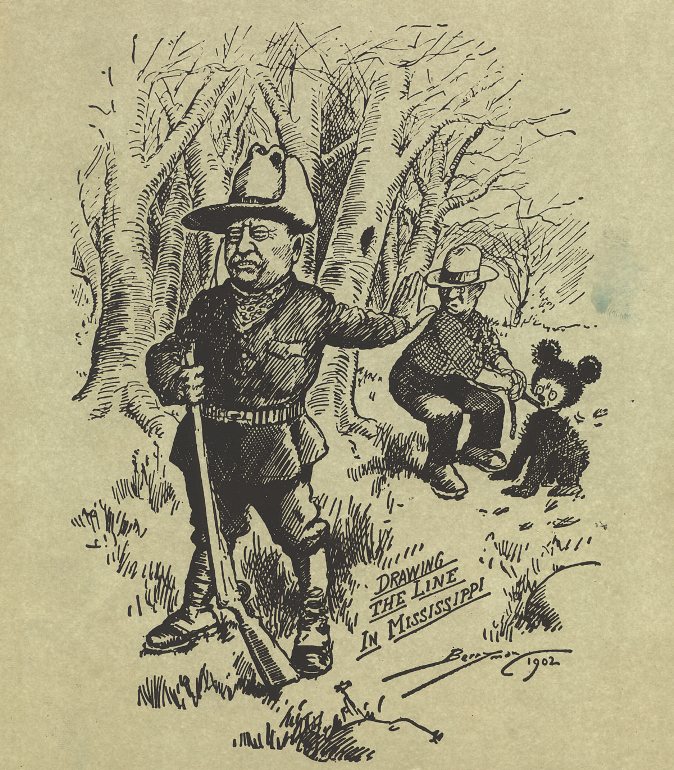
Cartoon of note: Berryman on TR and fair play

May 24, 2007

Clifford Berryman cartoon, "Drawing the Line in Mississippi, 1902"

Clifford Berryman cartoon, “Drawing the Line in Mississippi, 1902”

Berryman’s Bear: “Drawing the line in Mississippi.”

In 1902 Teddy Roosevelt hunted bear near Smedes, Mississippi. He didn’t get a bear, as he had hoped. Trip guides tracked a bear with dogs, clubbed it, and tied it up. The bear was offered to TR to shoot.

Teddy refused to shoot it, of course. It was tied up. It was not sporting, not fair, not a match — not the vigorous hunting Roosevelt wanted.

Clifford K. Berryman, a cartoonist for the Washington Post newspaper (he moved to the Washington Star in 1907), captured the moment in a drawing published November 16, 1902. This 1902 cartoon is among the most famous political cartoons ever done.

The good sportsmanship Roosevelt demonstrated echoed long and hard among Americans. His reputation for fair dealing and good sportsmanship increased his popularity immensely.

Candy store owners in New York City, Morris and Rose Michtom, made a stuffed bear, a “Teddy bear,” to commemorate the event. We still call them Teddy bears, today.

Berryman continued to use the bear cub in cartoons for the rest of his career.

Teddy Roosevelt cartoon sources:


Fighting history hoaxes

May 11, 2007

Daily Kos I don’t get to daily. But here’s a post I did see that all history teachers ought to read, if only to raise their consciousness about the frauds that plague us every day: Help Fight Fake History that Powers the American Right.

Fight fake historyChris Rodda needs help supporting her research against all the old dogs of history revisionism, and the post from Troutfishing goes through most of the dishonor roll: D. James Kennedy, David Barton, Catherine Millard, and Chuck Norris

Rodda’s blog series can be found at Talk2Action.

My interest in getting history done right was kindled when high school teachers mentioned early versions of David Barton’s work — stuff that showed up on tests, though anyone who had read our texts and had a passing knowledge of real history would have known was in error. As a staffer in the U.S. Senate I had to got to read letters from people who bought the Barton tales lock, stock, and monkey barrel, and who consequently felt that everyone else on Earth was lying to them.

I wish Rodda luck.


Digging deeper into history of the South and civil rights movement

May 2, 2007

Hurry over the New York Times site before the article goes into the “gotta-pay-to-see” bin, and read the story by Patricia Cohen about other stories beyond the classic race confrontations, from the South, during the Civil Rights Movement:  “Interpreting Some Overlooked Stories from the South.”

A new generation of historians is exploring some of the untold stories of the civil rights movement and its legacies: the experiences not of heroes or murderous villains, but of ordinary Southern whites. And their research is challenging some long-held beliefs about the nation’s political realignment and the origins of modern conservatism.

“You want to pry below these great narratives of good and evil and black and white,” said Jason Sokol, 29, who wrote “There Goes My Everything: White Southerners in the Age of Civil Rights, 1945-1975” (Alfred A. Knopf). “For those of us who didn’t live through it, there’s more of an effort to not simply celebrate the civil rights movement and how extraordinary it was, but to place it within the broader arc of the 20th century.”

Much history of the era remains to be written, especially local histories that students in high schools could get from local newspaper archives, from interviews, and other local sources.

This new wave of historians, many of them young, believe that one cannot understand today’s housing, schooling, economic development or political patterns without understanding the mostly apolitical white Southerners of that era. None of these scholars play down the inbred racism of the region, but they argue that the focus on race can obscure broader economic and demographic changes, like the dizzying corporate growth, the migration of white Northerners to the South and the shifting emphasis on class interests after legal segregation ended.


Typewriter of the moment: Ernie Pyle

May 1, 2007

This typewriter, a Corona (before the merger made Smith-Corona), belonged to Ernie Pyle, the columnist famous for traveling with the the foot soldiers of all services in World War II. Pyle won a Pulitzer Prize in 1944 for his columns in 1943, published collectively in the books Here is Your War and Brave Men. Pyle was killed covering the end of World War II in the Pacific, on an island named Ie Shima, on April 18, 1945.

The typewriter rests in the Albuquerque Museum. It comes with a story.

Ernie Pyle's typewriter, rescued from a foxhole in Italy in 1944; Albuquerque Museum From the Albuquerque Museum’s exhibit, “America’s Most Loved Reporter”:

[Quote] Ernie Pyle interviewed Sergeant Don Bell, a rodeo rider, in June or July 1944 outside of St. Lo, France. Bell recalled that the foxhole they shared caved in during German shelling. Pyle said, “I have my notes, but my little portable typewriter is buried in that hole.” They hurriedly abandoned the foxhole, leaving the typewriter behind.

Sgt. Bell later salvaged it, kept it through the war, and donated it to the Museum in 1990. A photograph of Pyle in Normandy, typing on an Underwood, may have been taken after this event.

Bell recalled the interview as comforting. He wrote, “…Ernie had taken my ma’s wisdom and turned it into a soldier’s lesson: to find strength in battle you take hold of strength you’ve known at home…and of the faith that underlies it.” [End quote]


PT Boat vets hold last meeting

April 30, 2007

Fading memories of World War II — In December it was the Pearl Harbor Veterans who held their last planned reunion — too many of the vets wer too old to think many could comfortably travel to another reunion. This week, it’s the PT boat veterans who held their last planned gathering, for the same reasons. Those who have the most vivid memories of the war dwindle in number to a precious few.

According to the Associated Press in the Navy Times:

The 16 elderly survivors — down from 21 last year — of Peter Tare, Inc., an organization for former officers of PT boats, lined up next to the boat Friday, taking one last sail down memory lane.

For them, World War II is really almost over now.

“It’s sort of pitiful the way the crowd has dwindled,” said William Paynter, 90, who commanded both a PT boat and a squadron in the South Pacific.

“The executive secretary is just getting over a stroke and it seemed like the best time to do it,” he said of this past week’s reunion.

The group, which began meeting in 1947, has better than $25,000 in assets, Paynter said. Originally the plan was to turn the assets over to the sole survivor, but as the years passed, that seemed impractical.

Of course, there’s a story about “Peter Tare,” too:  Read the rest of this entry »


Chess history: Rousseau vs. Hume

April 29, 2007

Certain corners of history hold records in great detail, going back long periods of time.

In the world of chess, for example, games several centuries old are documented, move by move, and available for analysis.

Here is a site that claims to have the record of a chess match between the philosophers David Hume and Jean-Jacques Rousseau.

Did such a game ever actually happen? Perhaps, in 1766, in England, before the two philosophers fell out.  The ChessGames.com site lists the date of the game as 1765, a date which I think would be impossible.

What sorts of records would we use to corroborate, or debunk? Rousseau’s Dog by David Edmonds and John Eidinow might be a book that answers the question — the two collaborated on an earlier book about chess in history, including Bobby Fischer Goes to War.

Tip of the old scrub brush to Daily Harold at Chicago Reader.


Who keeps score on presidential corruption?

April 19, 2007

A fellow approached me in church about a month ago to ask who I support in the 2008 presidential election (haven’t made up my mind yet; there are very good people running on both sides, though it would take a major tsunami to get me to vote Republican for president over any of the Democrats). In the course of the conversation he mentioned the “dozens” of convictions of officials in the Clinton administration, and expressing hope we didn’t ‘return to a time when many government officials make such a mess of things.’

I felt the cold hand of Santayana’s ghost on my shoulder as Santayana reached past me to slap the man into reality.

So, later, I tried to find a comparison I had seen of corruption investigations in presidential administrations, one that listed who was charged with what, and the result of the investigation. I can’t find it.

Is anyone keeping score? Please point me to the place, if there is one, where such scores are accurately kept. Read the rest of this entry »


History Carnival 51, from a different view

April 4, 2007

A Don’s Life hosts History Carnival 51, which is fun and informative if only because blog author Mary Beard offers a slightly different view of things, being several time zones and an ocean away from America.

This carnival features several entries related to the Battle of Thermopylae, especially surrounding the release of the Film “300,” and several entries pondering the history of slavery, coming just at the end of the commemoration of the end of slavery in the British Empire.  Both of these topics offer good material for enrichment for AP world history classes, and good information for anyone else wishing to avoid repeats of the errors of history.


Millard Fillmore: Still dead, still misquoted, 133 years later

March 8, 2007

Millard Fillmore wax head A wax likeness of Millard Fillmore’s head, appearing to be for sale for $950.00.

March 8, 2007, is the 133rd anniversary of Millard Fillmore’s death.

Manus reprints the text from the New York Times story a few days later:

Buffalo, N.Y., March 8 — 12 o’clock, midnight. — Ex-President Millard Fillmore died at his residence in this city at 11:10 to-night. He was conscious up to the time. At 8 o’clock, in reply to a question by his physician, he said the nourishment was palatable; these were his last words. His death was painless.

First, I wonder how the devil the writer could possibly know whether Fillmore’s death was painless?

And second, accuracy obsessed as I am, I wonder whether this is the source of the often-attributed to Fillmore quote, “The nourishment is palatable.” Several sources that one might hope would be more careful attribute the quote to Fillmore as accurate — none with any citation that I can find. Thinkexist and Brainyquote charge ahead full speed. Wikipedia lists it. Snopes.com says the quote is “alleged,” in a discussion thread.

I’ll wager no one can offer a citation for the quote. I’ll wager Fillmore didn’t say it.

Millard Fillmore: We’d protect his legacy, if only anyone could figure out what it is.


Student project sources: Influenza in Alaska

December 21, 2006

Here’s a post with a ready-made student project in it: “Alaska and Eskimo data in 1920 British report,” at Grassroots Science (Alaska).

This would be a good AP History project, or a cross-discipline project for history and biology.

The influenza pandemic of 1918 killed millions, between 20 million and 40 million people by good estimates — it is estimated that 16 million died in India, alone. Soldiers returning from Europe and World War I carried the plague to hundreds of towns and villages where it might not have gone otherwise. The flu was a particularly deadly one for some people, striking them dead within 24 hours of the onset of symptoms.

Public health issues are largely disregarded in most U.S. and world history texts. This story, of the 1918 flu pandemic, needs to be told and studied carefully, however, because of the danger that such a thing could occur again. Small villages and towns need to be ready to deal with the effects, to try to prevent further spread, and to handle the crisis that occurs when many people in a small community die.


Nominate a history book

December 4, 2006

Remember to nominate your favorite history books for the list of all-time great history books. You can do it most easily here, at the original post.


JFK assassination, 43 years on

November 24, 2006

Texas history teachers got either a reprieve or a roadblock, depending on their view, when most schools scheduled vacation during the week of the anniversary of the assassination of President Kennedy. Generally news outlets highlight the anniversary, and it becomes a good time to discuss the events in history classes.

Classroom discussion openings are available for a broad range of topics in social studies: general government, presidential succession, politics and history of the 1960s, Vietnam, Cuba, the Cold War, U.S. international relations, Lyndon Baines Johnson, racism, civil rights, etc., etc. I have not yet been able to arrange a field trip to the 6th Floor Museum during the week, but I still hope to do that some time.

The assassination and the rumors of conspiracies that have swirled for years offer a good opportunity to discuss the methods and tools of historians, and just how we know what we claim to know about history. It’s a good opportunity to discuss how science can be used to increase our knowledge of history, and it’s a great way to introduce kids to the sort of skepticism that keeps all academic inquiry honest.

How is the day commemorated in Dealey Plaza, the site of the attack? Generally there are no formal activities, though often a wreath is placed there or at the JFK memorial a block away. Tourists come. Vendors try to sell them stuff.

One of the oddest sets of vendors for any historical site, I think, is the “newspaper” hawkers who sell tabloids touting favorite conspiracy ideas. The Dallas Morning News featured a page 1 story on this strange business, on the Sunday prior to the anniversary. Vendors dodge cops because they are unlicensed — which also means that technically they cannot sell the papers, but must ask for donations.

Another key milestone is close to passing: Only one member of the Dallas Police Department remains who was on duty that day. Again, The Dallas Morning News carried the story. Sgt. Graham H. Pierce is not yet retired, but with 43 years on the force, he will be retiring soon.

History sources pass continually. Who will capture their stories for posterity? A class might make a year-long project of interviewing such a man, preparing a document to give him at retirement, to reside in local libraries, and to provide the grist for future historians looking into whatever wild conspiracy claims might be made in the next decade, or century.