Rape: A weapon of war

July 28, 2008

With very little fanfare U.S. Secretary of State Condoleeza Rice used her time at the UN recently to get a resolution through the Security Council that recognizes rape as an instrument of war (report from Global Sociology Blog).

UN Security Council (UN photo)

UN Security Council (UN photo)

Unfortunately the act got very little coverage in the U.S. press, so far as I can tell. (Please feel free to post links to articles you know about in comments.)

Mark this carefully, you’ll not read it often here: Kudos and thank you to Rice and the Bush Administration.

The UN News Centre reported:

In a resolution adopted unanimously after a day-long debate on women, peace and security, Council members said women and girls are consistently targeted during conflicts “as a tactic of war to humiliate, dominate, instil fear in, disperse and/or forcibly relocate civilian members of a community or ethnic group.”

The effect is to also prolong or deepen conflicts and to exacerbate already dire security and humanitarian conditions, particularly when the perpetrators of violent crimes against women go unpunished for their actions.

The resolution demands that all parties immediate stop sexual violence against civilians and begin taking measures, from the training of troops and upholding of military discipline procedures, to protect women and girls.

Sexual violence crimes should be excluded from amnesties reached at the end of conflicts, the 15-member Council added, calling on States to also strengthen their judicial and health-care systems to provide better assistance to victims of violence.

The resolution was adopted after dozens of speakers told the Council about the appalling effects of sexual violence during armed conflicts, with Secretary-General Ban Ki-moon saying the problem had reached “unspeakable and pandemic proportions” in some countries.

Mr. Ban announced he will soon appoint a UN envoy tasked entirely with advocating for an end to violence against women.

Opening today’s meeting, United States Secretary of State Condoleezza Rice said the truest test of the will of the international community was the protection it gave to the most vulnerable.

“When women and girls are raped, we cannot be silent… we must be their advocates,” Ms. Rice said.

See a second report here. Security Council report and resolution text here. The text of Resolution 1820 (2008) is listed below the fold.

International law develops quickly, but often out of sight of most people. This action is another in a long string of international agreements that build on the laws of war, and the laws of human rights. As part of the string of treaties including the Geneva Conventions on war, this offers a 21st century turn on the laws that gave rise to the International Red Cross, the rules of war, the war crimes trials following World War II, the drive for NATO and the UN to intervene in Bosnia, and it provides commentary on events and genocides in Turkey, World War II China and Europe, Cambodia, Guatemala, San Salvador, Rwanda, Congo and Darfur — and other places we don’t even know about yet. Each class will differ; these materials suggest topics for in-class debates about current issues seen through a lens of the experience of history.

The resolution and debates offer opportunities for Document Based Questions for AP and pre-AP course practice.

A look at some of the events in a reverse chronology of the issue, from the archives of the New York Times, reveals both the difficulty of getting this simple acknowledgement made, and the horrors of rape as a tactic or weapon.

Other Resources:

Read the rest of this entry »


Real dope on human evolution

July 24, 2008

Subtitle this one, “DBQs in prehistory, paleontology, and anthropology.”

Younger son James complained yesterday about . . . well, about stuff he wasn’t taught. His questions to me were about what was available in the history textbooks on the great advances in science in the 20th century.

Very little is available, really. What had set him off was his summer reading where he’s been introduced, for the first time, to particle physics of the past 30 years. History texts may mention Einstein’s letter to FDR which started the Manhattan project. An outstanding history and science student in a U.S. high school can pass through the experience without ever learning what Einstein’s equation, E=mc², actually means, or how it pertains to his letter to Roosevelt, or when and how Einstein came up with it, how Einstein’s papers changed physics, how Einstein’s ideas were tested, how Einstein’s pacifism and Jewish heritage drove him to the U.S., and so on. Great advances in particle physics, or even in practical applications like CAT scans and PET scans, have fallen out of the books and out of the curriculum. 21st century medicine, but 20th century science texts and 19th century history texts. It’s the David-Bartonization of American education.

The stuff wasn’t covered in his AP physics or AP chemistry classes (what’s up with that?!), nor were most of the great discoveries even mentioned in any of the AP history courses.

No wonder the head of the Texas State Board of Education knows so little about science. Cue the country/western version of the story, “Been dumb as a stump so long it looks like genius to me.”** Plus, this makes it clear why the versions of curricula the SBOE head favors must be resisted.

Texas standards and national standards in history ask that students be familiar with American inventions and innovation. In reality that translates to Eli Whitney and the cotton engine, because it’s a key factor in the rise of plantation economics in the South prior to the Civil War; maybe some mention of water-powered looms; Edison and the light bulb; Ford and the assembly line; and maybe a mention of radio or television, usually with regard to the effects on culture. I know a teacher who has a great unit for Texas history on barbed wire and the Colt .45. World history mentions James Watt and the steam engine.* The Wright brothers and the airplane get a couple of sentences. Humans going to the Moon gets a few sentences, but not as much as Sputnik, because, well because Sputnik scared the bejeebers out of some of the people who yelled loudest at Texas and Florida textbook meetings, I imagine.

I’m not going to fix all of that, not right now. It’s a subject that deserves more time in the cooker, I think.

But I’m also working on plans for this next year. Pre-history human migrations, geological development of the planet — and last night I discovered a group hitting the Bathtub for information about humans and evolution. Sheesh! Another place where the history and science texts short the glorious science, where a student is more likely to be struck by lightning waiting for the bus than to get decent coverage of human evolution in the classroom. (Hey. Do you know a teacher who covers human evolution well in any subject? Put it in comments, below — I want to congratulate her, or him. I also want to steal the lesson plans.)

Here’s a quick fix, using some seminal documents that are perfectly classroom usable: Go to the Nature magazine website, and specifically look for the section, “focus on human origins.” If your administrators aren’t fully versed on No Child Left Behind, you can claim these as “research-based” (they are purely research-based; the law asks that our pedagogical methods be research-based, though, not the content, and that’s impossible; most of what we do in the classroom is tradition-based unsupported by any significant research, and federal laws and state regulations generally require the opposite of what the research says . . . don’t get me started). But I digress.

Nature is one of the premier science journals, a peer-reviewed or juried journal that is the prime place for key research findings to be published (along with Science, the other science journal giant). Most of their material is hidden away on the internet, held in proprietary sites available to scientists whose research institutions spring for expensive subscriptions (no, these journals are generally NOT available through the databases most high schools and non-research colleges purchase). Much of the best research of the last century is unavailable to high school teachers or students. This is true of chemistry, physics, biology and geology. The textbooks tend to obfuscate and cover the stuff up — or in the case of particle physics, ignore the field.

Several years ago Nature pulled about a dozen of the seminal papers in human evolution studies out of their vaults, making them available for free. These papers include some of the real classics:

Frankly, I wouldn’t expect to see these in a real DBQ in anything except, perhaps, human geography — but I can dream, can’t I? You can certainly create outstanding DBQ exercises with exerpts from these and a few other sources. Or you can simply use these complete papers in your classes. Except for a select few debate students at the upper echelons of competitiveness, real research papers fall out of the curriculum, and it’s a shame.

There is drama in these papers. Some of them shake the Earth, but in coolly scientific words. Ironically, the papers are not written so technically that they are beyond the ken of most high school readers. These papers are real history, real science, and our students deserve to read them.

Nature deserves our thanks for making these papers available. I wish other seminal papers were available, from Nature, and from other science and history research journals. Students would benefit from reading real history about the fall of the Berlin Wall, or the development of public health to fight tuberculosis. Students could mightily use to read about physics, biology, meteorology, geology, and other sciences upon which we rely to save the human race.

_____________________

* James Rowland of Woodlands High School in the Conroe Independent School District led a group of us teachers in an exercise last week at Texas Christian University in Fort Worth, asking the question about who invented the steam engine and when. With six different AP or advanced world history texts, we came up with eight different answers, including two different years given for Watt’s work.

** Yes, from Richard Fariña’s 1966 novel, Been Down So Long It Looks Like Up to Me (finished two days before his fatal motorcycle accident), and the song (pay no attention to the Lee Hazelwood-Nancy Sinatra song, but remember the Doors’s version is probably unsuitable for classroom use).

Resources:


Atomic bomb madness: A real blast

July 23, 2008

Truly the lazy days of summer — I missed the anniversary of the Trinity Project, the first atomic bomb ever exploded, at White Sands, New Mexico, early on the morning of July 16, 1945. That was 63 years ago.

The Trinity atomic bomb test, culmination of the Manhattan Project, July 16, 1945

The Trinity atomic bomb test, culmination of the Manhattan Project, July 16, 1945

The New Mexico blast demonstrated that atomic bombs work. President Harry S Truman got the word of the successful test while attending the Potsdam Conference with Winston Churchill of England and Joseph Stalin of the Soviet Union.

The Potsdam Conference, July 1945 - Churchill, Stalin, and Truman at the table - Photo from the Truman

The Potsdam Conference, July 1945 – Churchill, Stalin, and Truman at the table – Photo from the Truman

Truman hoped to avoid a land invasion of Japan, which experts said would leave at least a million dead U.S. soldiers and five million dead Japanese. Truman was a soldier in World War I, who saw the trenches close up. He hoped to avoid anything similar for soldiers, and civilians. From Potsdam, Truman, Churchill and Stalin issued the Potsdam Declaration, ending with an ultimatum to Japan to surrender unconditionally or face terrible consequences.

Japan did not surrender. On August 6, 1945, the U.S. detonated the first atomic bomb used in warfare over Hiroshima, Japan, a city with large military support facilities. Within a few minutes, nearly 100,000 people were dead. When Japan failed to offer unconditional surrender even then, a second atomic device was detonated over Nagasaki, Japan, on August 9. (Had Japan not surrendered then a scramble would have been on — the U.S. had materials for about four more bombs, but they were not ready to go.)

1945 launched the world into the Atomic Age, by many accounts. The existence of atomic weaponry added to tensions on the planet played out during the Cold War. The creation of thermonuclear weapons, many times as powerful as a simple atomic bomb, only added to the tension. Perhaps we should call it the Atomic Angst Age.

Does that explain the fascination with photos of atomic blasts in recent days?

Wired’s online version noted the anniversary and included a slide show of atomic milestones, featuring a few blasts.

Then this post, from a blog named Picdit — “8 Insane Nuclear Explosions” rode the top of the popularity index of WordPress for the past couple of days. I’m not sure why these photos or the events they portray deserve to be called “insane.” I’m perplexed about why they are so popular.

These events around the creation, testing and use of nuclear arsenals resonate deeply with those of us who lived through any of these times. High school students have tested poorly on these issues during the past five years, however. Many of my history students do not know the significance of the classic mushroom cloud that marks an atomic blast.

I hope the curiosity is genuine curiosity for the historic events, that this curiosity leads to understanding of the destructive power of nuclear weapons, and that those tens of thousands who clicked on those images achieved an iota of understanding. I hope.

The First Bomb at Bikini, Charles Bittinger, 1946 - Captured at the peak of formation, this painting illustrates the classic mushroom cloud shape. The pink color of the cloud is due to the oxidation of nitrogen caused by high heat and radiation from the explosion. The rapidly cooling fireball is the cause of the red glow seen deep within the cloud. The blast wave created the massive waves and steam that engulfed the target fleet at the bottom.

The First Bomb at Bikini, Charles Bittinger, 1946 – “Captured at the peak of formation, this painting illustrates the classic mushroom cloud shape. The pink color of the cloud is due to the oxidation of nitrogen caused by high heat and radiation from the explosion. The rapidly cooling fireball is the cause of the red glow seen deep within the cloud. The blast wave created the massive waves and steam that engulfed the target fleet at the bottom.” From the Naval Historical Center Art Collection.

Check out:


“A house divided.” Lincoln, right?

May 12, 2008

You’re a good student of history. You know that when someone says, “a house divided,” they’re talking about Lincoln’s famous, troubling speech from June 1858. Right?

Look below the fold.

Read the rest of this entry »


Why Rats, Lice and History is a great book

April 7, 2008

Gerald Weissman wrote a solid review of Hans Zinsser’s Rats, Lice and History in the journal Emerging Infectious Diseases. The review appeared two years ago, but I just found it.

It’s hard nowadays to reread the work of de Kruif or Sinclair Lewis without a chuckle or two over their quaint locution, but Zinsser’s raffiné account of lice and men remains a delight. Written in 1935 as a latter-day variation on Laurence Sterne’s The Life and Opinions of Tristam Shandy, Zinsser’s book gives a picaresque account of how the history of the world has been shaped by epidemics of louseborne typhus. He sounded a tocsin against microbes in the days before antibiotics, and his challenge remains meaningful today: “Infectious disease is one of the few genuine adventures left in the world. The dragons are all dead and the lance grows rusty in the chimney corner. . . . About the only sporting proposition that remains unimpaired by the relentless domestication of a once free-living human species is the war against those ferocious little fellow creatures, which lurk in dark corners and stalk us in the bodies of rats, mice and all kinds of domestic animals; which fly and crawl with the insects, and waylay us in our food and drink and even in our love”

If you’ve not read Zinsser’s book, this review will give you lots of reasons why you should.  They don’t write history like this for high schools, though they should:

Despite the unwieldy subtitle “Being a study in biography, which, after twelve preliminary chapters indispensable for the preparation of the lay reader, deals with the life history of TYPHUS FEVER,” Rats, Lice and History became an international critical and commercial success. Zinsser’s romp through the ancient and modern worlds describes how epidemics devastated the Byzantines under Justinian, put Charles V atop the Holy Roman Empire, stopped the Turks at the Carpathians, and turned Napoleon’s Grand Armée back from Moscow. He explains how the louse, the ubiquitous vector of typhus, was for most of human history an inevitable part of existence, “like baptism, or smallpox”; its habitat extended from hovel to throne. And after that Murder in the Cathedral, the vectors deserted Thomas à Becket: “The archbishop was murdered in Canterbury Cathedral on the evening of the twenty-ninth of December [1170]. The body lay in the Cathedral all night, and was prepared for burial on the following day…. He had on a large brown mantle; under it, a white surplice; below that, a lamb’s-wool coat; then another woolen coat; and a third woolen coat below this; under this, there was the black, cowled robe of the Benedictine Order; under this, a shirt; and next to the body a curious hair-cloth, covered with linen. As the body grew cold, the vermin that were living in this multiple covering started to crawl out, and, as … the chronicler quoted, ‘The vermin boiled over like water in a simmering cauldron, and the onlookers burst into alternate weeping and laughter …'”

Add to FacebookAdd to NewsvineAdd to DiggAdd to Del.icio.usAdd to StumbleuponAdd to RedditAdd to BlinklistAdd to TwitterAdd to TechnoratiAdd to Furl


Quote of the moment: Abraham Lincoln: A war that’s gone on too long

February 24, 2008

Siege of Vera Cruz, U.S. Mexican War

Image: Battle of Vera Cruz, artist unknown by me.

U.S. Rep. Abraham Lincoln, Whig-Ill., speaking on the floor of the House of Representatives, January 12, 1848:

If the prossecution of the war has, in expenses, already equalled the better half of the country, how long it’s future prosecution, will be in equalling, the less valuable half, is not a speculative, but a practical question, pressing closely upon us. And yet it is a question which the President seems to never have thought of. As to the mode of terminating the war, and securing peace, the President is equally wandering and indefinite. First, it is to be done by a more vigorous prossecution of the war in the vital parts of the enemies country; and, after apparently, talking himself tired, on this point, the President drops down into a half despairing tone, and tells us that “with a people distracted and divided by contending factions, and a government subject to constant changes, by successive revolutions, the continued success of our arms may fail to secure a satisfactory peace[.]” Then he suggests the propriety of wheedling the Mexican people to desert the counsels of their own leaders, and trusting in our protection, to set up a government from which we can secure a satisfactory peace; telling us, that “this may become the only mode of obtaining such a peace.” But soon he falls into doubt of this too; and then drops back on to the already half abandoned ground of “more vigorous prossecution.[“] All this shows that the President is, in no wise, satisfied with his own positions. First he takes up one, and in attempting to argue us into it, he argues himself out of it; then seizes another, and goes through the same process; and then, confused at being able to think of nothing new, he snatches up the old one again, which he has some time before cast off. His mind, tasked beyond it’s power, is running hither and thither, like some tortured creature, on a burning surface, finding no position, on which it can settle down, and be at ease.

Again, it is a singular omission in this message, that it, no where intimates when the President expects the war to terminate. At it’s beginning, Genl. Scott was, by this same President, driven into disfavor, if not disgrace, for intimating that peace could not be conquered in less than three or four months. But now, at the end of about twenty months, during which time our arms have given us the most splendid successes–every department, and every part, land and water, officers and privates, regulars and volunteers, doing all that men could do, and hundreds of things which it had ever before been thought men could not do,–after all this, this same President gives us a long message, without showing us, that, as to the end, he himself, has, even an imaginary conception. As I have before said, he knows not where he is. He is a bewildered, confounded, and miserably perplexed man. God grant he may be able to show, there is not something about his conscious, more painful than all his mental perplexity!


Barbara Jordan

February 12, 2008

Rereading the Gettysburg Address and the Cooper Union speech of Lincoln, I wondered for a few moments whether there are others with similar gifts for words who might be on film or tape. It got me thinking about the vast gulf between religion on the one hand, and faith and justice on the other hand.

Then I got a notice of a link from this post about Barbara Jordan, at Firedoglake.

It’s a nice collection of links, a Barbara Jordan tribute all bundled up ready to unwrap. Sometimes truth does go marching on.

Who since Jordan?

(Thanks to Phoenix Woman at Firedoglake for the post, and for the link here.)

The Cooper Union speech of Lincoln was 148 years ago, on February 27.


SMU’s Martin Luther King Week

January 22, 2008

Southern Methodist University celebrates the life of Martin Luther King, Jr., all week long.

MLK talks with reporters at SMY, 3-17-1966

SMU has about an hour of tape of a speech Dr. King delivered at SMU in 1966. While the speech is not particularly noteworthy, it’s a good example of King’s rhetoric of the time. You can put it on your iPod.

It’s interesting SMU has made it available on-line, the first time the recording has been made available. Teachers will also want to check out the clip from the campus newspaper for DBQ questions, and printed excerpts from the speech.

It’s a real period piece — King in a southern, formerly segregated town, so soon after the Voting Rights Act. Real history, real people. Very interesting.

Photo of King speaking at SMU SMU has activities running all week long. Things change in 40 years.

(Check out the socks and ties of the men on stage — and where are the women?)

  • Photos from SMU, from the archives of the campus newspaper, The SMU Campus.

“Grave breaches” of the Geneva Conventions

January 2, 2008

I tell students to go to the source; if they read the original documents, that puts them ahead of 99% of the people who claim to know what they are doing, especially in history.

Do you know what is a “grave breach” under the Geneva Conventions? Below the fold, material from the International Committee of the Red Cross (ICRC), with links to more original document material. DBQ, anyone?

Read the rest of this entry »


Texas was thankful first

November 22, 2007

Thanksgiving? Texas had it first. No kidding (unless you count the Vinlanders, who probably were grateful to be out of Greenland, but left no records that they ever actually had a feast to say so — but see the comments in the posts linked at various places).

Mrs. Bathtub is in the hospital. Nothing major, but it appears the staff who should have signed her out yesterday all headed off for Turkey Day and may not return until mid-December, so Mrs. Bathtub languishes at the expense of the insurance companies because security is tight and there are only enough sheets to get her down two stories, and she’s on the third floor (and the people-with-unknown-fathers at the hospital have sealed the door to the balcony anyway — that’s got to get you thinking). So Mr. Bathtub is frantically reading the back of the Libby’s Pumpkin can, and you can imagine what antics are up in the kitchen today. Blogging will be sparse.

So it’s reprise post stuff, mostly, today. If you need more, go here:

Google's Thanksgiving logo, 2007

Here’s the main reprise post, text below (there were some good comments last year); Margaritas and nachos do sound good, don’t they?
___________________________
Patricia Burroughs has the story — you New Englanders are way, way behind.

Palo Duro Canyon in a winter inversion

Palo Duro Canyon during inversion, Winter 2001, site in 1541 of the first Thanksgiving celebration in what would become the United States. Go here: www.visitamarillotx.com/Gallery/index3.html, and here: www.tpwd.state.tx.us/park/paloduro/

Update, 11/27/2006: Great post here, “Top 10 Myths About Thanksgiving.”

_______________________

Resources for 2007:


What makes America worth defending

September 28, 2007

Anyone who wonders why the United States is worth defending should read the judge’s decision in the case of Brandon Mayfield.

Mayfield is the Oregon lawyer who was accused of being a participant in the al Quaeda-connected bombings of commuter trains in Madrid, Spain. The accusation appears to have been based mostly on Mr. Mayfield’s religious affiliation, and not on any evidence. Mayfield was arrested, charged and held in jail, until the charges were dismissed.

Mayfield’s suit points out that the government acted illegally against him, in violation of the Fourth Amendment of the Constitution, which bans searches without a valid warrant. It appears that Mr. Mayfield’s religion was the chief basis for the search warrants obtained.

In what other nation, in a time considered to be a time of war, could such a suit protecting a citizen against his own government be entertained? In what other nation could one judge declare such a major action of its government to be illegal, with any expectation that the government would obey such a ruling?

The case will probably be appealed.

Ed Brayton at Dispatches from the Culture Wars covers the issue well enough to make a lesson plan out of it for government or civics classes.

Also:


Former Arkansas teacher remembers, long before 1957

September 27, 2007

Poignant story from the Associated Press, via Teacher magazine, about the Emancipation Proclamation, picking cotton, Brown v. Board of Education, and education.


Historic maps: Florida and the Gulf of Mexico

September 21, 2007

Go to the University of Florida Smathers Library site, and admire the beauty of these old maps of Florida and the Gulf of Mexico. (While I think fair use would cover it, I’m holding back on posting an image until copyright permission comes through — you’re licensed to use them in the classroom, however.)

What else would you expect from a library named after Sen. George A. Smathers, who was part of that legendary 1950 Senate campaign in Florida?

The maps featured on the first page include Spanish, Dutch, English, Belgian, French and Italian maps of the early explorers, suitable certainly for Texas history courses, and also for Florida, Louisiana and U.S. history units on European exploration.

This site is quite Florida-centric, but it’s links also provide some interesting and valuable resources, such as the link to satellite imagery of the areas, like the NOAA map, below.

NOAA map of ocean water temperatures around Florida, satellite image

Tip of the old scrub brush to A Cracker Boy Looks at Florida


Barbara Jordan and Lyndon Johnson: An oral history

September 2, 2007

Barbara Jordan’s voice was distinctive, and commanding. “The voice of God,” Molly Ivins called it. After Jordan’s death, Francis X. Cline wrote what might be an even higher tribute, saying her voice was “as though Winston Churchill had been reincarnated as a black woman from Texas.” She spoke in complete paragraphs, usually, with words that seemed selected carefully to fit exactly the ideas she presented.

Barbara Jordan at the Johnson White House, prior to 1972 -- with Andy Biemiller, John Doar - LBJ Library photo

How delightful, then, to read (and perhaps to actually hear) Barbara Jordan describe her fear of stammering in her first meeting with President Lyndon Johnson. The LBJ Library in Austin has a series of oral histories, including this one:

I went up to what I now know was the Cabinet Room. There were other people assembled, people who were active in the civil rights movement. We sat and waited around a table for the President and the Vice President, Hubert Humphrey, to arrive. Well, as I sat there really at the far end of the table, I still said to myself, “Now, Lyndon Johnson probably doesn’t know who I am or what I am about, and my name probably just slipped in somehow and got into that [list].” So the President came in, everybody stood up. He sat down, we all sat down, and we started to discuss this legislation, fair housing legislation. And the conversation was going around the table. The President would call on first one person for a reaction and then another person for a reaction. Then he stopped and he looked at my end of the table, he said, “Barbara, what do you think?” Well, I just . . . in the first place, I’m telling you, I didn’t know the President knew me, and here he’s looking down here saying “Barbara” and then saying, “What do you think?” So that was my first exchange with Lyndon Johnson. I’m startled. I got myself organized, of course, not so that I wouldn’t stammer, since it is not my habit to stammer when talking, and I gave a response and then this conversation ensued.

That was my first contact personally with Lyndon Johnson.

The glories of oral histories. How can you use this in the classroom?

Read the rest of this entry »


Original Documents: Long history of DDT trouble, from U.S. Fish and Wildlife Service, 1945 and later

August 12, 2007

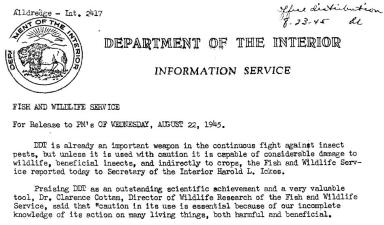
Header of FWS press release, Aug 22 1945

Archives of the U.S. Fish and Wildlife Service (FWS) reveal a long history of trouble with DDT, almost from the first uses of the chemical as an insecticide during World War II. You’ll find extensive links to historic press releases from FWS below the fold.

Critics of the various restrictions on DDT use often claim that DDT is a God-sent chemical that nearly eradicated malaria from the world (absolutely untrue) and which was banned only because of hysteria caused by Rachel Carson’s 1962 book, Silent Spring (untrue at both ends, hysteria and the power of Carson’s book). This is history revisionism at its worst, it is bogus history.

A careful study of the history of the use of DDT shows that scientists were concerned about its dangers from the first uses as a pesticide. The U.S. Fish and Wildlife Service reported dangers in a press release on August 22, 1945, just a week after the surrender of Japan ended World War II (VJ Day was August 15 in Tokyo, August 14 in Washington). In that release FWS noted the beneficial uses of DDT to fight insect and lice infestations that threatened troops and civilians with typhus and other diseases, but cautioned that such use should not become common, that more study was needed: Read the rest of this entry »