Henry F. Phillips — when do we celebrate?

August 10, 2007

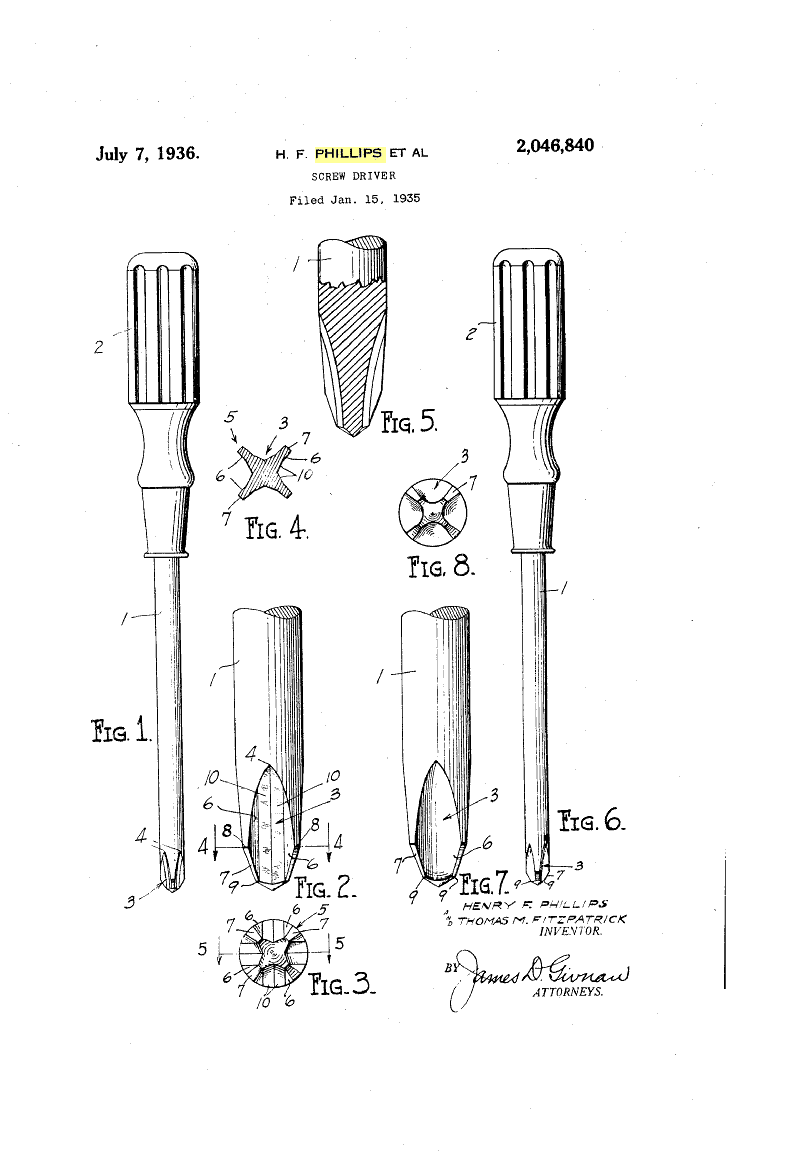
Herny Phillips' patent for the Phillips screw and screwdriver (Google Patents)

Patent drawings for the Phillips screw and screwdriver, 1936

Only Crook in Town was alerted to the work of Henry F. Phillips by an alert and helpful librarian (well — aren’t they all?). She worries –January 15 is Martin Luther King, Jr., Day, and July 7 is the middle of the summer — what day would be appropriate to celebrate the invention and patenting of the Phillips Screwdriver? (If image above does not display, click the thumbnail picture at the end of the post.)

Ah, history teachers, you noticed that the drawing comes from Google’s files of patent applications. And now you wonder: What other wonderful illustrations can we legally rip off to use in class? Wonderful question — what do you find?

The Phillips screwdriver came along in time for World War II and the mass assembly of aircraft, and aircraft instrument panels. The Phillips screw head helped aircraft assemblers keep from scratching the black metal of the rest of the panel while securing instruments into the forms.

Read the rest of this entry »


Oliver W. Hill, history maker, 100

August 6, 2007

Oliver W. Hill in 1999, when he was 92; lawyer in Brown v. Board case

Literally while writing the previous post about the importance of recording history before the witnesses leave us, I heard on KERA-FM, NPR reporter Juan Williams’ intimate, detailed and stirring story about Oliver W. Hill, one of the lawyers who brought one of the five cases that resulted in the historic 1954 reversal of U.S. law, in Brown v. Topeka Board of Education (347 U.S. 483).

Oliver W. Hill died Sunday, in Richmond, Virginia. He was 100.

In 1940, Mr. Hill won his first civil rights case in Virginia, one that required equal pay for black and white teachers. Eight years later, he was the first black elected to the Richmond City Council since Reconstruction.

A lawsuit argued by Mr. Hill in 1951 on behalf of students protesting deplorable conditions at their high school for blacks in Farmville became one of five cases decided under Brown.

That case from Farmville offers students a more personal view of their own power in life. The case resulted from a student-led demonstration at Moton High School in Farmville. Moton was an all-black school, with facilities amazingly inferior to the new white high school in Farmville — no indoor plumbing, for example. While the Virginia NAACP failed at several similar cases earlier, and while the organization had a policy of taking no more school desegregation cases, the students’ earnestness and sincerity swayed Oliver Hill to try one more time:

On May 23, 1951, a NAACP lawyer filed suit in the federal district court in Richmond, VA, on behalf of 117 Moton High School, Prince Edward County, VA, students and their parents. The first plaintiff listed was Dorothy Davis, a 14-year old ninth grader; the case was titled Dorothy E. Davis, et al. v. County School Board of Prince Edward County, Virginia, et. al. It asked that the state law requiring segregated schools in Virginia be struck down.

Davis was consolidated with four other cases, from the District of Columbia, Delaware, South Carolina, and Brown from Kansas; it was argued in 1953, but the Court deadlocked on a decision. When Chief Justice Arthur Vinson died and was replaced by the (hoped-to-be) conservative Chief Justice Earl Warren, Warren got the Court to re-hear the case. Because he thought it was such an important case in education, Warren worked to get a solid majority. The Court which was deadlocked late in 1953, in May 1954 issued the Brown decision unanimously, overturning the separate-but-equal rule from Plessy v. Ferguson (1896) (167 U.S. 537).

Brown was the big boulder whose rolling off the hill of segregation gave power to the civil rights movement of the 1950s and 1960s. That decision and the horrible murder of Emmett Till in Mississippi in the summer of 1955 inspired civil rights worker Rosa Parks to take a stand, and take a seat for human rights on a Montgomery, Alabama city bus in December of 1955, which led to the 1956 Montgomery Bus Boycott, led by the new preacher in town, a young man named Martin Luther King, Jr. When the Supreme Court again chose civil rights over segregation in the bus case, the wake of the great ship of history clearly showed a change in course.

Oliver Hill was there, one of the navigators of that ship of history.


Leo Rosten on Adam Smith

July 29, 2007

Leo Rosten writes clearly, concisely, and often with great humor. Consequently, his essays make good fodder for classroom use.

British bank note featuring Adam Smith

Rosten is probably most famous for the introduction he once gave to the comedian W. C. Fields, a spur-of-the-moment bon mots that so exactly described Fields comedian persona that it is often listed as a line Fields himself wrote: “Any man who hates dogs and children can’t be all bad.”

That story also tells us that Rosten looks at Adam Smith coolly, through no rose-colored glass.

The Adam Smith Institute carries Rosten’s essay on Smith in its entirety. Go read it:

It is a clumsy, sprawling, elephantine book. The facts are suffocating, the digressions interminable, the pace as maddening as the title is uninviting: An Inquiry into the Nature and Causes of the Wealth of Nations. But it is one of the towering achievements of the human mind: a masterwork of observation and analysis, of ingenious correlations, inspired theorizings, and the most persistent and powerful cerebration. Delightful ironies break through its stodgy surface:

“The late resolution of the Quakers [to free] their Negro slaves may satisfy us that their number cannot be very great …”

“The chief enjoyment of riches consists in the parade of riches.”

“To found a great empire for the sole purpose of raising customers [is] unfit for a nation of shopkeepers, but extremely fit for a nation whose government is influenced by shopkeepers.”

So comprehensive is its range, so perceptive its probings, that it can dance, within one conceptual scheme, from the diamond mines of Golconda to the price of Chinese silver in Peru; from the fisheries of Holland to the plight of Irish prostitutes in London. It links a thousand apparently unrelated oddities into unexpected chains of consequence. And the brilliance of its intelligence “lights up the mosaic of detail,” says Schumpeter, “heating the facts until they glow.” Sometimes.

Adam Smith published The Wealth of Nations in 1776 – not as a textbook, but as a polemical cannon aimed at governments that were subsidizing and protecting their merchants, their farmers, their manufacturers, against “unfair” competition, at home or from imports. Smith set out to demolish the mercantilist theory from which those politics flowed. He challenged the powerful interests who were profiting from unfree markets, collusive prices, tariffs and subsidies, and obsolete ways of producing things.

[More at the site of the Adam Smith Institute, including the continuation of this essay.]

Leo Rosten, publicity shot

Leo Rosten


World War II in Texas: Japanese internment

July 23, 2007

Girl Scouts at Japanese Doll Day celebration, in Crystal City, Texas, internment center, 1943-45

“Girl Scout drama presentation for Hinamatsuri (Doll’s Festival), on Japanese Girl’s Day, at the Crystal City, Texas, internment facility operated by the Justice Department, 1943-45.

Each of us has pockets of ignorance; some of the pockets are larger than others.

How did I miss that there were Japanese-American internees in Texas? If I stumbled across that fact before, it really didn’t register. Reviewing the website for the University of Texas – San Antonio’s Institute of Texas Cultures, I came across the Spring 2007 Newsletter, which is dedicated to the Crystal City internment facility.

Crystal City is unknown to many other Texans, too, I wager. Study of a list of the War Department “Relocation” camps shows nothing in Texas. Surprise! The U.S. Justice Department also operated camps of interned Americans of Japanese descent. The War Department rounded up Japanese Americans in west coast states and their neighbors; the Bureau of Immigration and Naturalization Services, the old INS which was rolled into the Department of Homeland Security after the 2001 attacks on New York and Washington, arrested and detained Japanese-Americans from the rest of the United States. INS operated at least four such camps in Texas. Read the rest of this entry »


Odessa Bible class case

July 20, 2007

In the continuing religious freedom/education drama in Texas, the school district in Odessa, Texas, approved a Bible study course using a curriculum indicted by the Texas Freedom Network’s expert-in-Bible-studies advisors as religious indoctrination rather than academically rigorous study. Citizens in Odessa sued the district to have that action declared unconstitutional.

The case is being readied for trial, with motions from plaintiffs and defendants flying back and forth. I should be watching it carefully, and I probably should be offering close coverage here for teachers, parents and administrators in Texas.

But I haven’t been able to dig into the stuff yet. In the interim, Ed Brayton at Dispatches from the Culture Wars has been following the case closely, and providing timely blog updates. He’s made connections with the legal teams on both sides and has access to the legal documents filed so far.

Don’t wait: Get on over to Dispatches from the Culture Wars and get updated on the case.

This would be a good topic for a civics class project, too, it seems to me. You may want to capture documents as they come out for DBQ exercises in the coming school year.


Quote of the moment: Immigration and economic growth

July 15, 2007

Immigrants’ Contribution to Economic Growth
“The pace of recent U.S. economic growth would have been impossible without immigration. Since 1990, immigrants have contributed to job growth in three main ways: They fill an increasing share of jobs overall, they take jobs in labor-scarce regions, and they fill the types of jobs native workers often shun. The foreign-born make up only 11.3 percent of the U.S. population and 14 percent of the labor force. But amazingly, the flow of foreign-born is so large that immigrants currently account for a larger share of labor force growth than natives (Chart 1).”

Foreign-born share of U.S. Labor Force and Labor Force Growth; Orrenius, Dallas FRB

Foreign-born share of U.S. Labor Force and Labor Force Growth; Orrenius, Dallas FRB

Foreign-born share of U.S. labor force and labor force growth

Pia M. Orrenius, senior economist in the Research Department of the Federal Reserve Bank of Dallas, Southwest Economy, Issue 6, November/December 2003, Federal Reserve Bank of Dallas


The story is the thing; tell the story in history

July 15, 2007

Son James and I spent July 4 in Taos, New Mexico, where we were working with Habitat for Humanity building homes (a project of the youth group at the church we attend, First Christian Church (Disciples of Christ) of Duncanville, Texas). We took that day off, saw Transformers, looked at the sights in Taos, and drove to Eagle Nest Lake to see fireworks.

Lincoln reading to son, Tad; LOC photo

At some point through the week I was discussing with others the stories that make history memorable, in my view, and we discovered that few others on the trip knew the story of the deaths of both John Adams and Thomas Jefferson on July 4, 1826, the 50th anniversary of the signing of the Declaration of Independence. It’s a story that is generally glossed over in U.S. history texts, but one that I make room for in U.S. history courses. My experience is that once kids get the story, that these two great men from such radically different backgrounds became great friends, then in presidential politics, great enemies, and then were reconciled, and then died on the exactly the same day which commemorated the event that both made them famous and that they made famous, kids don’t forget the story.

The story of their friendship is powerful and can be accompanied by readings from their letters in their later life (DBQ opportunity, teachers!). Generally, the story gets told in response to a question from a student. If I do it well, there will be sniffles from the class when we get to the part about Jefferson’s near-coma, awakening to ask whether it is the 4th of July, and then dying, and Adams’ death a few hours later, saying in error that “Jefferson still survives” (which is good that some students choke up, because it always gets me).

The story offers several mnemonic opportunities: 1826, the 50th year after the Declaration (1776); the presidencies of Adams and Jefferson, following one another; the fact that Adams and Jefferson were on the committee to write the Declaration, and that Adams nominated Jefferson as the better writer; the order of the terms of the presidency; the bitter politics at the end of Washington’s presidency (kids get interested in conflict, and the founding seems more vital to them when the controversies rear up); the reverence for law; Adams’ and Jefferson’s service as foreign ambassadors; and so on.

Once I’d told the story, others got the point. The story illustrates Mark Twain’s point about how much more difficult it is to write fiction. Fiction must stick with possibilities, Twain noted, while reality isn’t so constrained. If you wrote a screenplay with two heroes like Adams and Jefferson, and then had them die on the same day within a few hours of each other, hundreds of miles apart, you’d be criticized for being unrealistic. But it happened in history. It’s a true story, better than any lipsticked version Parson Weems could ever invent.

Study of history should never be a drudging trudge to memorize dates. The stories are what count, they are the things people remember. The stories tell people why history is important, and what mistakes to avoid, to satisfy Santayana’s ghost.

Such stories, especially about the founding of America, make history come alive and, often, grab students by the throat and make it memorable for them.  History is Elementary carries a nice story with the same message, though using Washington’s surprise attack on the Hessians from Trenton.  Teachers in need of such stories might do well to pick up a copy of David McCullough’s 1776, or Joseph Ellis’s Founding Brothers.

What other stories are there?  Well, the story about the scar on James Madison’s nose, and how it led to the cementing of the American Revolution (James Monroe, by the way, also died on July 4 — but in 1831).  The story of Lincoln’s trip to New Orleans; the story of Teddy Roosevelt’s capture of Mike Finnegan and two other outlaws, in the Dakotas; the story of Calvin Coolidge’s son’s death; the story of Robert Lincoln’s brushes with presidential assassinations; the story of the Civil War beginning in one man’s back-40 acres, and ending in his parlor; the story as Stephen Ambrose tells it of three men pinned down on a beach in Normandy on D-Day, and deciding the best course of action was to move forward to win the war; American history is rife with bizarre coincidences and seemingly minor events that go on to have great consequences.

I love to hear the story, especially told well.  Well told stories help students learn and retain history, and, I’ll wager, they boost the scores on standardized tests.


Japanese-American internment: Statesman-Journal web special

June 29, 2007

Looking for good sources on Japanese internment?

Editor & Publisher highlights the web version of a special series on Japanese internment during World War II, put together by the Statesman-Journal in Salem, Oregon. The series is featured in “Pauline’s Picks,” a feature by Pauline Millard showing off the best use of the web by old-line print publications.

Beyond Barbed Wire, photo by Salem Statesman-Journal

The Statesman-Journal’s web piece is “Beyond Barbed Wire,” featuring timelines, maps of the Tule Lake internment facility (closest to Oregon), stories about Japanese Americans in Oregon, especially in Salem, photos, video interviews, and a significant collection of original documents perfectly suited for document-based studies.

Texas kids test particularly badly in this part of U.S. history. Several districts ask U.S. history teachers and other social studies groups to shore up student knowledge in the area to overcome gaps pointed out in testing in the past three years, on the Texas Assessment of Knowledge and Skills (TAKS). In teacher training, I’ve noted a lot of Texas social studies teachers are a bit shaky on the history.

The Korematsu decision was drummed into my conscious working on civil rights issues at the Senate Labor and Human Resources Committee, and complemented by Constitutional Law (thank you, Mary Cheh) and other courses I was taking at the same time at George Washington University. It helped that Utah has a significant Japanese population and had “hosted” one of the internment camps; one of my tasks was to be sure committee Chairman Orrin Hatch was up on issues and concerns when he met with Japanese descendants in his constituencies in Utah. Hatch was a cosponsor of the bills to study the internment, and then to apologize to Japanese Americans affected, and pay reparations.
The internment was also a sore spot with my father, G. Paul Darrell, who witnessed the rounding up of American citizens in California. Many of those arrested were his friends, business associates and acquaintances. Those events formed a standard against which he measured almost all other claims of civil rights violations.

Because children were imprisoned with their parents, because a lot of teenagers were imprisoned, this chunk of American history strikes particular sympathetic chords with students of any conscience.  Dorothea Lange’s having photographed some of the events and places, as well as Ansel Adams and others, also leaves a rich pictorial history.

(I found this thanks to the RSS feed of headlines from Editor & Publisher at the Scholars & Rogues site.)


Hey, Britain! Duck! It’s another armada!

June 28, 2007

Gordon Brown may face a situation Tony Blair didn’t imagine: An invasion of ducks.

Plastic cuck similar to floating armada members - Times of London photo

Plastic ducks. An armada of ducks.

Quack! Quack!

Or, maybe more appropriately, “Rubber Ducky, you’re the one!”

Geography fans everywhere are salivating. History fans already recognize the ducks bear no resemblance to the Spanish Armada, but may be interested anyway.

Plastic duck toys, survivors from an original lot of about 30,000 knocked off a container ship in the north Pacific in 1992, could be drifting onto the shores of the British Isles this summer. A reward is offered for the first one found and reported to a scientist who has tracked the ducks from their accident, through currents in four of the world’s five oceans, to landfalls in North America, South America, Southeast Asia, Indonesia — and through the Arctic.

The Times of London carried a story today: Read the rest of this entry »