Honoring James Madison in 2025, the go-to guy, for his birthday, March 16

March 17, 2025

James Madison, the fourth President of the United States, and the Father of the Constitution, was born March 16, 1751, in the Tidewater area of Virginia.

Is it sinful that we do not celebrate his birthday with a federal holiday, fireworks, picnics and speeches and concerts?

Maybe you could fly your flag.  If neighbors ask why, tell them you’re flying it for freedom on James Madison’s birthday.  They’ll say, “Oh,” and run off to Google Madison.  You will have struck a blow for the education that undergirds democracy.

Journalists honor Madison on his birthday, and through the week in which his birthday occurs, with tributes to the First Amendment which he wrote, and celebrations of Freedom of Information Laws and press freedoms, two issues dear to Madison’s heart.

There is much, much to celebrate about him.

A few years ago I was asked to talk about freedom to a group of freedom lovers in North Texas.  I chose to speak about James Madison’s remarkable, and too-often unremarked-upon life. Later, when I started this blog, I posted it here, with an introduction.  All of that is below, in honor of the birth of James Madison.

Did you know that Madison is the shortest man ever to have been president?  His stature is measured in freedom, not in feet and inches.

(Originally a post on July 31, 2006)

James Madison, 1783, by Charles Wilson Peale. Library of Congress collection

James Madison, 1783, miniature by Charles Wilson Peale. Madison would have been 32. Library of Congress collection

I don’t blame students when they tell me they “hate history.”  Heaven knows, they probably have been boringly taught boring stuff.

For example, history classes study the founding of the United States. Especially under the topical restrictions imposed by standardized testing, many kids will get a short-form version of history that leaves out some of the most interesting stuff.

Who could like that?

Worse, that sort of stuff does damage to the history and the people who made it, too.

James Madison gets short shrift in the current canon, in my opinion. Madison was the fourth president, sure, and many textbooks note his role in the convention at Philadelphia that wrote the Constitution in 1787. But I think Madison’s larger career, especially his advocacy for freedom from 1776 to his death, is overlooked.

Madison was the “essential man” in the founding of the nation, in many ways. He was able to collaborate with people as few others could, in order to get things done, including his work with George Mason on the Virginia Bill of Rights, with George Washington on the Constitution and national government structure, Thomas Jefferson on the structure and preservation of freedom, Alexander Hamilton on the Constitution and national bank, and James Monroe on continuing the American Revolution.

We need to look harder at the methods and philosophy, and life, of James Madison. This is an opinion I’ve held for a long time. Here I reproduce a “sermon” I delivered to the North Texas Church of Freethought in November 2001.

James Madison White House portrait, John Vanderlyn, 1816

James Madison’s official White House portrait, by John Vanderlyn in 1816; in the White House collection

I have left this exactly as it was delivered, though I would change a few things today, especially emphasizing more the key role George Washington played in pushing Madison to get the Constitution — a view I came to courtesy of the Bill of Rights Insitute and their outstanding, week-long seminar, Shaping the Constitution: A View from Mount Vernon 1783-1789. The Bill of Rights Institute provides outstanding training for teachers, and this particular session, at Washington’s home at Mount Vernon, Virginia, is well worth the time (check with the Institute to see whether it will be offered next year — and apply!). I am especially grateful to have had the opportunity to discuss these times and issues with outstanding scholars like Dr. Gordon Lloyd of Pepperdine University, Dr. Adam Tate of Morrow College, and Dr. Stuart Leibiger of LaSalle University, during my stay at Mount Vernon.

My presentation to the skeptics of North Texas centered around the theme of what a skeptic might give thanks for at Thanksgiving. (It is available on the web — a misspelling of my name in the program carried over to the web, which has provided me a source of amusement for several years.)

Here is the presentation:

Being Thankful For Religious Liberty

As Presented at the November, 2001 Sunday Service of The North Texas Church of Freethought

Historians rethink the past at least every generation, mining history for new insights or, at least, a new book. About the founders of this nation there has been a good deal of rethinking lately. David McCullough reminds us that John Adams really was a good guy, and that we shouldn’t think of him simply as the Federalist foil to Thomas Jefferson’s more democratic view of the world. Jefferson himself is greatly scrutinized, and perhaps out of favor — “American Sphinx,” Joseph Ellis calls him. The science of DNA testing shows that perhaps Jefferson had more to be quiet about than even he confessed in his journals. While Jefferson himself questioned his own weakness in his not freeing his slaves in his lifetime, historians and fans of Jefferson’s great writings wrestle with the likelihood of his relationship with one of his own slaves (the old Sally Hemings stories came back, and DNA indicates her children were fathered by a member of the Jefferson clan; some critics argue that Jefferson was a hypocrite, but that was Jefferson’s own criticism of himself; defenders point out that the affair most likely was consensual, but could not be openly acknowledged in Virginia at that time). Hamilton’s gift to America was a financial system capable of carrying a noble nation to great achievement, we are told – don’t think of him simply as the fellow Aaron Burr killed in a duel. Washington is recast as one of the earliest guerrilla fighters, and in one book as a typical gentleman who couldn’t control his expenses. Franklin becomes in recent books the “First American,” the model after which we are all made, somehow.

Of the major figures of these founding eras, James Madison is left out of the rethinking, at least for now. There has been no major biography of Madison for a decade or more, not since Ralph Ketcham’s book for the University of Virginia press. Madison has a role in Joseph Ellis’s Founding Brothers, but he shares his spotlight with Hamilton and Jefferson. I think this is an oversight. As we enter into the first Thanksgiving season of the 21st century, we would do well to take a look back at Madison’s life. Madison gives us a model of reason, and more important, a model of action coupled to reason. America’s founding is often depicted as a time of great thunder — if not the thunder of the lightning Ben Franklin experimented with, an experiment he parlayed into worldwide respect for Americans, it is the thunder of the pronouncements of Thomas Jefferson in the Declaration of Independence, or of George Washington, just generally thundering through history.

The use of a bolt of lightning as a symbol for this group is inspired, I think. I’m a great fan of Mark Twain, and when I see that bolt of electricity depicted I think of Twain’s observation:

“Thunder is good; thunder is impressive. But it is lightning that does the work.”

Thunder at the founding is impressive; where was the lightning?

I’d like to point out two themes that run through Madison’s life, or rather, two activities that we find him in time and again. Madison’s life was marked by periods of reflection, followed by action as a result of that reflection.

We don’t know a lot about Madison’s youth. He was the oldest son of a wealthy Virginia planter, growing up in the Orange County area of Tidewater Virginia. We know he was boarded out for schooling with good teachers – usually clergymen, but occasionally to someone with expertise in a particular subject – and we know that he won admission to Princeton to study under the Rev. John Witherspoon, a recent Presbyterian transplant from across the Atlantic. Madison broke with tradition a bit in attending an American rather than an English school. And after completing his course of study he remained at Princeton for another year to study theology directly under Witherspoon, with an eye toward becoming a preacher.

Witherspoon is often held up as an example of how religion influenced the founders, but he was much more of a rationalist than some would have us believe. He persuaded the young Madison that a career in law and politics would be a great service to the people of Virginia and America, and might be a higher calling. After a year of this reflection, Madison returned to Virginia and won election to local government.

In his role as a county official Madison traveled the area. He inspected the works of government, including the jails. He was surprised to find in jail in Virginia people accused of — gasp! — practicing adult baptism. In fact Baptists and Presbyterians were jailed on occasion, because the Anglican church was the state church of Virginia, and their practicing their faith was against the common law. This troubled Madison greatly, and it directed an important part of his work for the rest of his life. In January of 1774, Madison wrote about it to another prominent Virginian, William Bradford:

“Poverty and Luxury prevail among all sorts: Pride ignorance and Knavery among the Priesthood and Vice and Wickedness among the Laity. This is bad enough. But it is not the worst I have to tell you. That diabolical Hell conceived principle of persecution rages among some and to their eternal infamy the Clergy can furnish their Quota of Imps for such business. This vexes me the most of any thing whatever. There are at this time in the adjacent County not less than 5 or 6 well meaning men in close Gaol for publishing their religious Sentiments which in the main are very orthodox. I have neither patience to hear talk or think of any thing relative to this matter, for I have squabbled and scolded abused and ridiculed so long about it, to so little purpose that I am without common patience. So I leave you to pity me and pray for Liberty of Conscience to revive among us.”

By April, Madison’s views on the matter had been boiled down to the essences, and he wrote Bradford again more bluntly:

“Religious bondage shackles and debilitates the mind and unfits it for every noble enterprise.”

Madison must have done a fine job at his county duties, whatever they were, because in 1776 when Virginia was organizing its government to survive hostilities with England, Madison was elected to the legislative body.

Madison was 25, and still raw in Virginia politics. He was appointed to the committee headed by George Mason to review the laws and charter of the colony. Another who would serve on this committee when he was back from Philadelphia was Thomas Jefferson. George Mason was already a giant in Virginia politics, and by the time Madison got to Williamsburg, Mason had already completed much of the work on a bill of rights to undergird the new Virginia government. Madison noted that freedom of religion was not among the rights enumerated in Mason’s version — but it was too late, Mason said. The work was done.

Madison quietly went to work on Mason, in committee, over dinner, during social occasions — noting the great injustice of jailing people solely because of their beliefs, and urging to Mason that it did Virginia no good to keep these fathers from providing for their families.

Mason ultimately agreed to accept the amendment.

The pattern was set.

Perhaps a better example of this reflection and action cycle occurred nearly a decade later. By 1785 the war was over, independence was won, but the business of government continued. While serving as governor of Virginia, Thomas Jefferson had drafted about 150 proposals for laws, really a blueprint for a free government. About half of these proposals had been passed into law. By 1785, Jefferson was away from Virginia, representing the Confederation of colonies in Paris. Jefferson had provided several laws to disestablish religion in Virginia, and to separate out the functions of church and state. With Jefferson gone, however, his old nemesis Patrick Henry sought to roll back some of that work. Henry proposed to bring back state support for the clergy, for the stated purpose of promoting education. (Yes, this is the same battle we fight today for church and state separation.) After Jefferson’s troubled term as governor, Virginia turned again to Henry – Henry ultimately served six terms as governor. His proposal was set for a quick approval in the Virginia assembly. It was late in the term, and everyone wanted to get home.

Henry was, of course, a thundering orator of great note. Madison was a small man with a nervous speaking style, but a man who knew the issues better than anyone else in almost any room he could be in. Madison came up with an interesting proposal. Picking the religion for the state was serious stuff, he said. A state doesn’t want to pick the wrong religion, and get stuck with the wrong god, surely — and such weighty matters deserve widespread support and discussion, Madison said. His motion to delay Henry’s bill until the next session, in order to let the public know and approve, was agreed to handily.

You probably know the rest of this story. With a year for the state to reflect on the idea, Madison wrote up a petition on the issue, which he called a “Memorial and Remonstrance.” In the petition he laid out 15 reasons why separation of church and state was a superior form of government, concluding that in the previous 1,500 years, every marriage of church and state produced a lazy and corrupt church, and despotic government. Madison’s petition circulated everywhere, and away from Patrick Henry’s thundering orations, the people of Virginia chose Madison’s cool reason.

When the legislature reconvened in 1786, it rejected Henry’s proposal. But Madison’s petition had been so persuasive, the legislature also brought up a proposal Thomas Jefferson had made six years earlier, and passed into law the Virginia Statue for Religious Freedom.

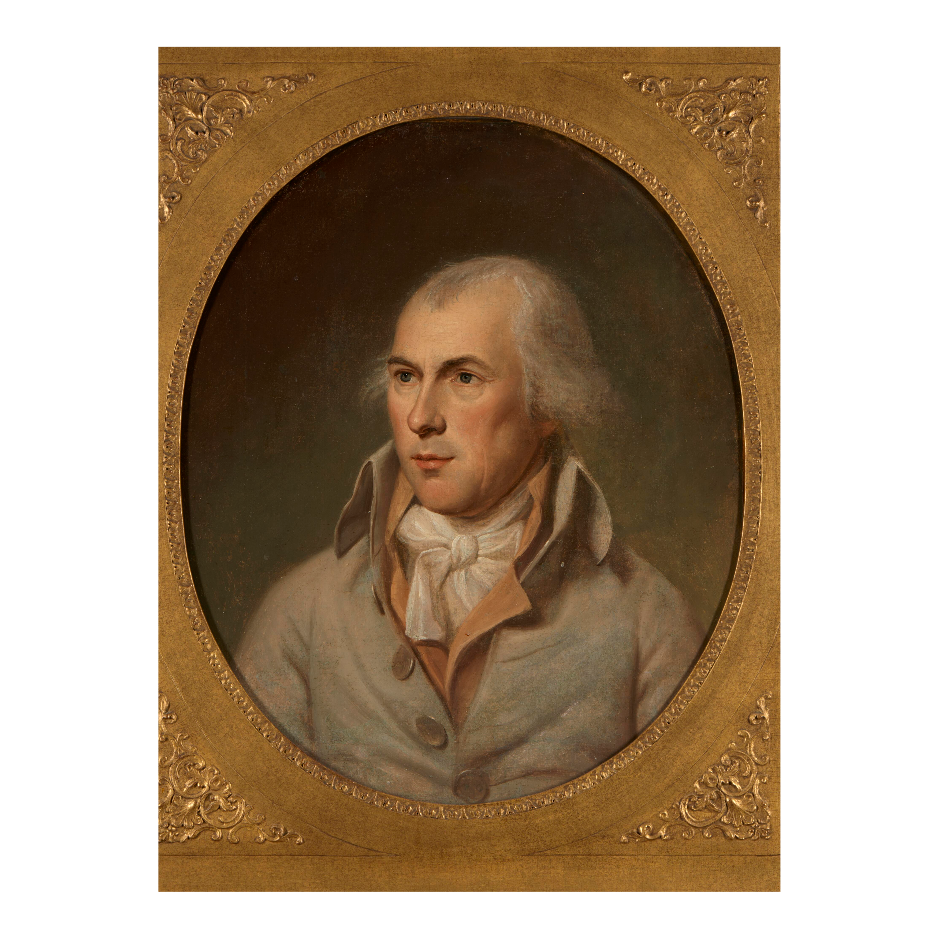
This was a great victory for Madison, and for Virginia. He celebrated by convening a convention to settle disputes between Virginia and Maryland about navigation on the Chesapeake Bay. Having reflected on the nature of this issue — a dispute between colonies — Madison had sought advice from others having the same problems, such as New York and New Jersey. In that effort he got the support of a New Yorker working on the same problems, Alexander Hamilton. In the course of these discussions Madison thought it clear that the difficulty lay with the form of government that bound the colonies together under the Articles of Confederation. Hamilton agreed, and they got their respective states and conferences to agree to meet in Philadelphia in 1787 to try to fix those problems. [Since I first wrote this, I’ve learned that it was George Washington’s desire to get a federal government, to facilitate the settling of the Ohio River Valley where Washington had several thousands of acres to sell, that prompted him to push Madison into the Annapolis Convention, and who made the introduction between Madison and Washington’s old aide and friend, Alexander Hamilton; Madison’s work with Washington runs much deeper than I orignally saw.] James Madison, by Charles Wilson Peale, 1792; Gilcrease Museum
Amending the Articles of Confederation was a doomed effort, many thought. The colonies would go their separate ways, no longer bound by the need to hang together against the Parliament of England. Perhaps George Washington could have got a council together to propose a new system, but Washington had stayed out of these debates. Washington’s model for action was the Roman general Cincinnatus, who went from his plow to lead the Romans to victory, then returned to his farm, and finding his plow where he had left it, took it up again.

Madison invited Washington, and persuaded Washington to attend. Washington was elected president of the convention, and in retrospect that election guaranteed that whatever the convention produced, the colonies would pay attention to it.

You know that history, too. The convention quickly decided the Articles of Confederation were beyond repair. Instead, they wrote a new charter for a new form of government. The charter was based in part on Jefferson’s Virginia Plan, with lots of modifications. Because the Constitution resembles so much the blueprint that Jefferson had written, and because Jefferson was a great founder, many Americans believe Jefferson was a guiding light at that Philadelphia convention. It’s often good to reflect that Jefferson was in Paris the entire time. While America remembers the thunder of Washington’s presiding, Franklin’s timely contributions and Jefferson’s ideas, it was Madison who did the heavy lifting, who got Washington and Franklin to attend the meeting Madison had set up, and got Jefferson’s ideas presented and explained.

It was Madison who decided, in late August of 1787, that the convention could not hang together long enough to create a bill of rights, and instead got approval for the basic framework of the U.S. government. In Virginia a few months later, while Patrick Henry thundered against what he described as a power grab by a new government, it was Madison who assembled the coalitions that got the Constitution ratified by the Virginia ratifying convention. And when even Jefferson complained that a constitution was dangerous without a bill of rights, it was Madison who first calmed Jefferson, then promised that one of the first actions of the new government would be a bill of rights. He delivered on that promise as a Member of the House of Representatives in 1789.

It is difficult to appreciate just how deeply insinuated into the creation of America was James Madison. In big ways and small, he made America work. He took the lofty ideas of Jefferson, and made them into laws that are still on the books, unamended and unedited, more than 200 years later.

When the ratification battle was won, when Madison had won election to the House over Patrick Henry’s strong objection, partly by befriending the man Henry had picked to defeat Madison, James Monroe, Madison could have savored the moment and been assured a place in history.

James Madison in 1804, by Gilbert Stuart

James Madison in 1804, by Gilbert Stuart. Colonial Williamsburg Foundation, Williamsburg, Virginia. Gift of Mrs. George S. Robbins

That’s not what a lightning bolt does. Journeying to New York for the opening of the First Congress and the inauguration of Washington as president, Madison stopped off at Mount Vernon to visit with Washington, apparently at Washington’s request. In what was a few hours, really, Madison wrote Washington’s inaugural address. While there at Mount Vernon, Madison stumbled into a discussion by several others on their way to New York, wondering what high honorific to apply to the new president. “Excellency” was winning out over “Your highness,” until Washington turned to Madison for an opinion. Madison said the president should be called, simply, “Mr. President.” We still do.

Once in New York, Madison saw to the organizing of the Congress, then to the organizing of the inauguration. And upon hearing Washington’s inauguration address — which Madison had ghosted, remember — Congress appointed Madison to write the official Congressional response.

Years later, in Washington, Madison engineered the candidacy of Thomas Jefferson for president, and after Jefferson was elected, Madison had the dubious honor as Secretary of State of lending his name to the Supreme Court case that established the Supreme Court as the arbiter of what is Constitutional under our scheme of government, in Marbury v. Madison.

Wherever there was action needed to make this government work, it seemed, there was James Madison providing the spark.

James Madison was the lightning behind the thunder of the founding of America. We should be grateful that he lived when he did, where he did, for we all share the fruits of the freedoms he worked to obtain. And in this Thanksgiving season, let us look for appropriate ways to honor his work.

James Madison circa 1829-1839, portrait by Chester Harding. Montpelier House, image by Builly Hathorn

James Madison, 1829, portrait by Chester Harding. Montpelier House, Billy Hathorn. “In 1829, Madison came out of retirement to attend a convention for revising Virginia’s constitution. While there, he posed for this portrait by the Massachusetts painter Chester Harding.”

The Madisonian model of thoughtful reflection leading to action is one that is solidly established in psychological research. It is the model for leadership taught in business schools and military academies.

I would compare religious liberty to a mighty oak tree, under which we might seek shade on a hot summer day, from which we might draw wood for our fires to warm us in winter, or lumber to build great and strong buildings. That big oak we enjoy began its life long before ours. We enjoy its shade because someone earlier planted the seed. We enjoy our freedoms today because of men like James Madison.

How do we give thanks? As we pass around the turkey to our family, our friends, we would do well to reflect on the freedoms we enjoy, and how we got them.

Finally, remembering that someone had to plant those seeds, we need to ask: What seeds must we plant now for those who will come after us? We can demonstrate our being grateful for the actions of those who came before us by giving to those who come after us, something more to be grateful for. A life like Madison’s is a rarity. Improving on the freedoms he gave us might be difficult. Preserving those freedoms seems to me a solemn duty, however. Speaking out to defend those freedoms is an almost-tangible way to thank James Madison, and as fate would have it, there is plenty of material to speak out about. A postcard to your senators and representative giving your reasoned views on the re- introduction of the Istook Amendment might be timely now – with America’s attention turned overseas for a moment, people have adopted Patrick Henry’s tactic of trying to undo religious freedom during the distraction. I have had a lot of fun, and done some good I hope, in our local school system by asking our sons’ science and biology teachers what they plan to teach about evolution. Whatever they nervously answer — and they always nervously answer that question — I tell them that I want them to cover the topic fully and completely, and if they have any opposition to that I would be pleased to lend my name to a suit demanding it be done. We might take a moment of reflection to ponder our views about a proposed Texas “moment of silence” bill to be introduced, and then let our state representatives have our thoughts on the issue.

Do you need inspiration? Turn to James Madison’s writings. In laying out his 15-point defense of religious freedom in 1785, Madison wrote that separation of church and state is essential to our form of government:

“The preservation of a free Government requires not merely, that the metes and bounds which separate each department of power be invariably maintained; but more especially that neither of them be suffered to overleap the great Barrier which defends the rights of the people.”

How can we express our gratitude for such a foundation for religious liberty? Let loose a few lightning bolts, in remembrance of Madison.

Copyright © 2001 and 2006 by Ed Darrell. You may reproduce with attribution. Links added in May 2013. Edited in 2025..

More:


What Democrats really stand for: “We stand together”

February 10, 2024

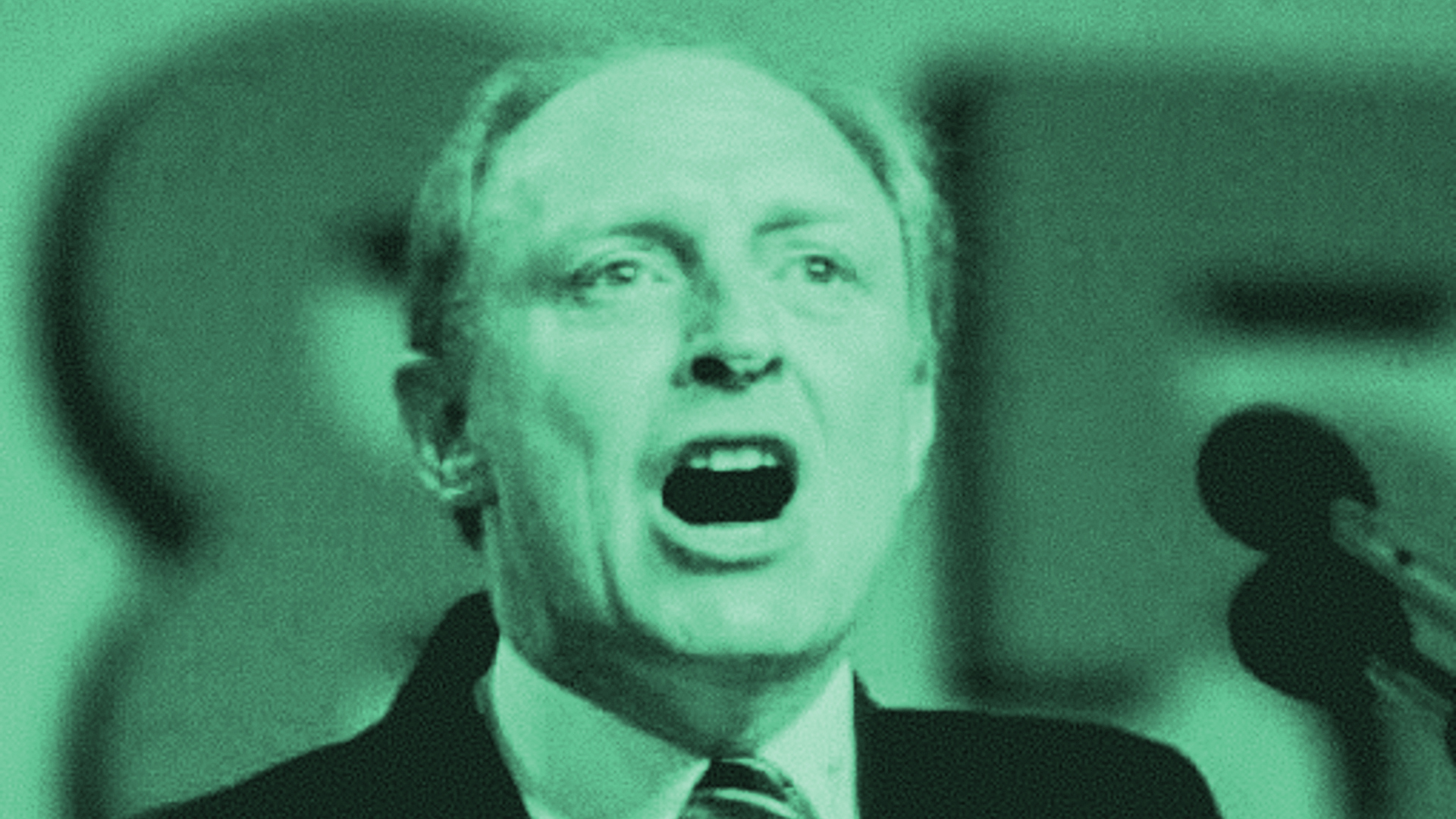
Neil Kinnock gave this speech in Wales. It’s true everywhere Democrats run in the U.S. Wherever Kinnock said “Mrs. Thatcher,” replace it with “the Republican Party,” and it still fits, terribly, awesomely, and eye-openingly.

Once upon a time a Democrat was driven from a presidential race for quoting this speech. We need to quote it now, and mean it.

Here it is, from Mr. Kinnock’s own website.

This is an edited version of Neil Kinnock’s speech to the Welsh Labour Party conference in Llandudno, May 15, 1987, in his first election as leader of the Labour Party.

We are democratic socialists. We care all the time. We don’t think it’s a soft sentiment, we don’t think it’s ‘wet’.

We think that care is the essence of strength.

And we believe that because we know that strength without care is savage and brutal and selfish.

Strength with care is compassion – the practical action that is needed to help people lift themselves to their full stature.

That’s real care – it is not soft or weak. It is tough and strong. But where do we get that strength to provide that care?

Do we wait for some stroke of good fortune, some benign giant, some socially conscious Samson to come along and pick up the wretched of the earth?

Of course we don’t.

We cooperate, we collect together, we coordinate so that everyone can contribute and everyone can benefit, everyone has responsibilities everyone has rights. That is how we put care into action. That is how we make the weak strong, that is how we lift the needy, that is how we make the sick whole, that is how we give talent the chance to flourish, that is how we turn the unemployed claimant into the working contributor.

We do it together. It is called collective strength, collective care. And its whole purpose is individual freedom.

When we speak of collective strength and collective freedom, collectively achieved, we are not fulfilling that nightmare that Mrs Thatcher tries to paint, and all her predecessors have tried to saddle us with.

We’re not talking about uniformity; we’re not talking about regimentation; we’re not talking about conformity -that’s their creed. The uniformity of the dole queue; the regimentation of the unemployed young and their compulsory work schemes. The conformity of people who will work in conditions, and take orders, and accept pay because of mass unemployment that they would laugh at in a free society with full employment.

That kind of freedom for the individual, that kind of liberty can’t be secured by most of the people for most of the time if they’re just left to themselves, isolated, stranded, with their whole life chances dependent upon luck!

Why am I the first Kinnock in a thousand generations to be able to get to university? Why is my wife, Glenys, the first woman in her family in a thousand generations to be able to get to university?

Was it because all our predecessors were ‘thick’? Did they lack talent – those people who could sing, and play, and recite and write poetry; those people who could make wonderful, beautiful things with their hands; those people who could dream dreams, see visions; those people who had such a sense of perception as to know in times so brutal, so oppressive, that they could win their way out of that by coming together?

Were those people not university material? Couldn’t they have knocked off all their A-levels in an afternoon?

But why didn’t they get it?

Was it because they were weak? Those people who could work eight hours underground and then come up and play football?

Weak? Those women who could survive eleven child bearings, were they weak? Those people who could stand with their backs and their legs straight and face the people who had control over their lives, the ones who owned their workplaces and tried to own them, and tell them, ‘No. I won’t take your orders.’ Were they weak?

Does anybody really think that they didn’t get what we had because they didn’t have the talent, or the strength, or the endurance, or the commitment?

Of course not. It was because there was no platform upon which they could stand; no arrangement for their neighbours to subscribe to their welfare; no method by which the communities could translate their desires for those individuals into provision for those individuals.

And now, Mrs Thatcher, by dint of privatisation, and means test, and deprivation, and division, wants to nudge us back into the situation where everybody can either stand on their own feet, or live on their knees.

She parades her visions and values, and we choose to contest them as people with roots in this country, with a future only in this country, with pride in this country. People who know that if we are to have and sustain real individual liberty in this country it requires the collective effort of the whole community.

I think of the youngsters I meet. Three, four, five years out of school. Never had a job. And they say to me “Do you think we’ll ever work?”

They live in a free country, but they do not feel free.

I think of the 55-year-old woman I meet who is waiting to go into hospital, her whole existence clouded by pain.

She lives in a free country, but she does not feel free.

I think of the young couple, two years married, living in Mam and Dad’s front room because they can’t get a home. They ask “Will we ever get a home of our own?”

They live in a free country, but they do not feel free.

And I think of the old couple who spend months of the winter afraid to turn up the heating, who stay at home because they are afraid to go out after dark, whose lives are turned into a crisis by the need to buy a new pair of shoes.

They live in a free country – indeed, they’re of the generation that fought for a free country but they do not feel free.

How can they and millions like them – have their individual freedom if there is not collective provision?

How can they have strength if they do not have care?

Now they cannot have either because they are locked out of being able to discharge responsibilities just as surely as they are locked out of being able to exercise rights.

They want to be able to use both.

They do not want feather-bedding, they want a foothold.

They do not want cotton-woolling, they want a chance to contribute.

That is the freedom they want.

That is the freedom we want them to have.

With a tip of the old scrub brush to Dave Weigel on Bluesky Social.


Election Day 2016: Fly your flag, and VOTE!

November 8, 2016

Saint Louis Art Museum, St. Louis, Missouri George Caleb Bingham (American, 1811–1879). The County Election, 1852. Oil on canvas. 38 x 52 in. (96.5 x 132.1 cm). Gift of Bank of America.

The County Election, 1852. Saint Louis Art Museum, St. Louis, Missouri George Caleb Bingham (American, 1811–1879).  Oil on canvas. 38 x 52 in. (96.5 x 132.1 cm). Gift of Bank of America.

Every polling place should be flying the U.S. flag today.  You may fly yours, too.  In any case, if you have not voted already, go vote today as if our future depends upon it, as if our nation expects every voter to do her or his duty.

Today the nation and world listen to the most humble of citizens.  Speak up, at the ballot box.

Did you notice?  In George Caleb Bingham’s picture, there are no U.S. flags.  You should fly yours anyway.

The whole world is watching.

More:

This is an encore post.

Yes, this is an encore post. Defeating ignorance takes patience and perseverance. And I really like Bingham’s painting.


History in cartoons: Joseph Keppler on the need for the 17th Amendment

September 26, 2016

From the Historian of the U.S. Senate, a Joseph Keppler cartoon from Puck Magazine,

From the Historian of the U.S. Senate, a Joseph Keppler cartoon from Puck Magazine, “The Making of a Senator.” Print by J. Ottmann Lith. Co. after Joseph Keppler, Jr., Puck. Lithograph, colored, 1905-11-15. Image with text measurement Height: 18.50 inches (46.99 cm) Width: 11.50 inches (29.21 cm) Cat. no. 38.00624.001

This is a lithograph after a cartoon by Joseph Keppler in Puck Magazine, November 15, 1905. Keppler’s cartoons kept on the heat for some legislative solution to continuing corruption in state legislatures and the U.S. Senate, driven by the ability of large corporations and trusts to essentially purchase entire states’ legislatures, and tell legislators who to pick for the U.S. Senate.

Described by the Historian of the U.S. Senate:

The “people” were at the bottom of the pile when it came to electing U.S. senators, when Joseph Keppler, Jr.’s cartoon, “The Making of a Senator, ” appeared in Puck on November 15, 1905. Voters elected the state legislatures, which in turn elected senators. Keppler depicted two more tiers between state legislatures and senators: political bosses and corporate interests. Most notably, he drew John D. Rockefeller, Sr., head of the Standard Oil Corporation, perched on moneybags, on the left side of the “big interests. ”

This cartoon appeared while muckraking magazine writers such as Ida Tarbell and David Graham Phillips were accusing business of having corrupted American politics. The muckrakers charged senators with being financially beholden to the special interests. Reformers wanted the people to throw off the tiers between them and directly elect their senators–which was finally achieved with ratification of the 17th Amendment in 1913.

Recent scuttlebutt about repealing the 17th Amendment seems to me wholly unconnected from the history. The 17th Amendment targeted corruption in the Senate and states. It largely worked, breaking the course of money falling from rich people and large corporations into the hands of everyone but the people, and breaking the practice of corporate minions getting Senate seats, to do the bidding of corporations and trusts.

Anti-corruption work was part of the larger Progressive Agenda, which included making laws that benefited people, such as clean milk and food, pure drugs, and banking and railroad regulation so small farmers and businessmen could make a good living. Probably the single best symbol of the Progressive movement was “Fighting Bob” LaFollette, Congressman, Governor and U.S. Senator from Wisconsin. LaFollette was a great supporter of the 17th Amendment

Again from the Senate Historian:

Nicknamed “Fighting Bob,” La Follette continued to champion Progressive causes during a Senate career extending from 1906 until his death in 1925. He strongly supported the 17th Amendment, which provided for the direct election of senators, as well as domestic measures advocated by President Woodrow Wilson’s administration, including federal railroad regulation and laws protecting workers rights. La Follette worked to generate wider public accountability for the Senate. He advocated more frequent and better publicized roll call votes and the publication of information about campaign expenditures.

Criticism of the 17th Amendment runs aground when it analyzes the amendment by itself, without reference to the democracy- and transparency-increasing components from the rest of the Progressive movements’ legislative actions from 1890 to 1930.

No one favors corruption and damaging secrecy in politics. By pulling the 17th out of context, critics hope to persuade Americans to turn back the clock to more corrupt times.

More:

Save

Save

Save

Save

Save

Save

Save


456 days of stonewall; Trump’s not a good neighbor

September 16, 2016

Couldn't believe the Germans were so upset about Trump not releasing his taxes for 456 days! Oh, Bundesstraße 456. Wikipedia image

Couldn’t believe the Germans were so upset about Trump not releasing his taxes for 456 days! Oh, Bundesstraße 456. Wikipedia image

Today September 15 is the 456th day since Donald Trump announced his candidacy for president, having promised to release his tax returns so American voters could discern and judge his openness, that Trump failed to deliver on that promise.

Word out of the Trump campaign today is Trump doesn’t want to release his taxes because he’s afraid people will look at them.

Sadly, that is not made up.

More:

By Scott5114 - Own work, CC BY-SA 3.0, https://commons.wikimedia.org/w/index.php?curid=3518260

Don’t give us that garbage, Don! New Mexico Highway 456. Wikimedia Commons photo; By Scott5114 – Own work, CC BY-SA 3.0

Save


455 with a rocket: Trump stonewalls American voters on taxes for 455 days

September 14, 2016

Rocket 455, an obscure band whose record cover reminds American voters Donald Trump failed to release his taxes for a world record 455th day. Did his dog eat them? (Image from Amoeba Records)

Rocket 455, an obscure band whose record cover reminds American voters Donald Trump failed to release his taxes for a world record 455th day. Did his dog eat them? (If only Trump were “safe, harmless.”) (Image from Amoeba Records)

Today is the 455th day since Donald Trump announced his candidacy for president, having promised to release his tax returns so American voters could discern and judge his openness, that Trump failed to deliver on that promise.

We may have clear indications of why Trump does not want Americans to see his taxes. Newsweek today published a story detailing Trump’s business dealings with crooked Russian oligarchs and other shady people, foreign interests which would probably scare away honest American voters, and quite a few in his handbasket of deplorable supporters as well. Trump’s foreign  businesses pose threats to U.S. national security.

Trump makes the

Trump makes the “cover” of electronic Newsweek, but he’s not happy. See the blurb, lower right, saying Trump’s business dealings threaten U.S. national security. BoingBoing image

So, American voters, you know now WHY Trump doesn’t want to release his taxes, and why it’s more important than ever to get him to release them. A man who wishes to follow the footsteps of FDR, Truman, Eisenhower, Reagan and Obama, needs to be transparent in dealings with foreign powers.

In contrast with Rocket 455, Trump is a complete cipher. Rocket 455 are better qualified to be president than Donald Trump, from their tax returns.

Poster for a concert by Rocket 455 and others; they lay out their souls in public. Trump should at least release his taxes. (His soul might darken the day; let's not go there.) Chris*Kro image

Poster for a concert by Rocket 455 and others; they lay out their souls in public. Trump should at least release his taxes. (His soul might darken the day; let’s not go there.) Chris*Kro image

More:


Signs of life: Be not like the snail, but vote for a clean environment

June 7, 2015

From a Tweet by @Tom_Peters:

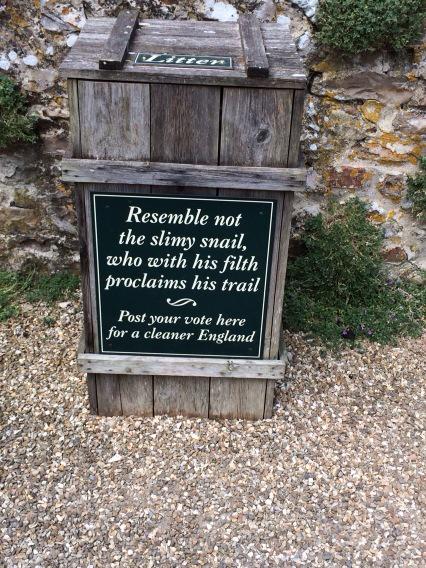
Uncaptioned photo from the Twitter feed of business excellence chronicler Tom Peters, @Tom_Peters

Uncaptioned photo from the Twitter feed of business excellence chronicler Tom Peters, @Tom_Peters

Sign on a litter receptacle:

Resemble not the slimy snail, who with his filth proclaims his trail.

Post your vote here for a cleaner England.

It’s not particularly flattering to the snail, and probably a bit off on the actual biology of snail trails.  I particularly like the emphasis on “voting” with action.  Reality is that we change the planet, for the better or for worse, with many small, individual acts every day, each one a vote on the future.

Anyone know where this can is? Are there many like it in England?


How do Texas’s voter ID laws hurt Texas voters? This film shows how

April 30, 2015

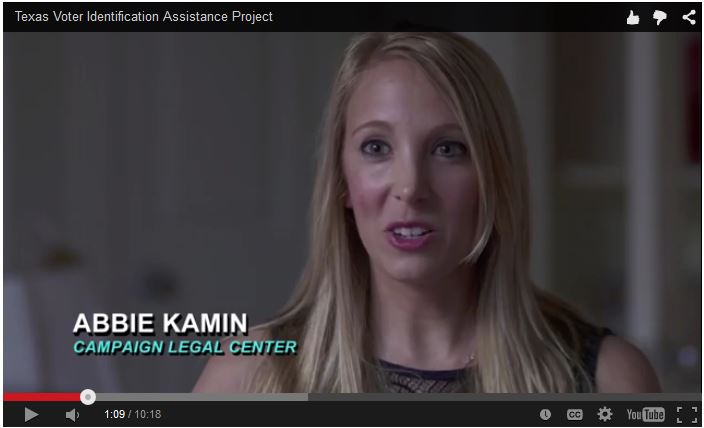
Abbie Kamin, a Houston lawyer assisting Texas voters keep their right to vote, explains how Texas's voter ID laws hurt Texans, and damage democracy in the U.S.

Abbie Kamin, a Houston lawyer assisting Texas voters keep their right to vote, explains how Texas’s voter ID laws hurt Texans, and damage democracy in the U.S.

Video you won’t see at 11.

From the Texas Voter Identification Assistance Project, at the Campaign Legal Center.

Description:
Published on Apr 24, 2015

Under Texas’ new restrictive photo/voter ID law, more than 600,000 Texans now lack sufficient identification to vote in elections, with little to no help from the State of Texas to resolve the problems. The Texas Voter Identification Assistance Project, coordinated by the Campaign Legal Center, a nonpartisan nonprofit, provided assistance to Texas voters who wished to vote but lacked the newly required identification, and thus were disenfranchised.

At the Campaign Legal Center’s site, there’s a press release on the video, released to correspond with arguments on voter identification issues at the Fifth Circuit Court of Appeals.

CLC FILM RELEASE: On Day of Fifth Circuit Oral Argument, Meet Victims of Texas Voter Photo ID Law

CLC Staff

Apr 28, 2015

Today, the Campaign Legal Center released a short film focusing on three lifelong voters disenfranchised by Texas’ voter photo ID law (SB 14), the most restrictive and burdensome voter ID law in the nation.  The ten-minute film produced by Firelight Media traces the efforts of the Campaign Legal Center’s Voter ID Project to assist registered voters to overcome the many hurdles erected by the new law in order to obtain the photo IDs required by SB 14.

Today in Veasey v. Abbott, oral arguments will be heard in a challenge to that law, in the U.S. Court of Appeals for the Fifth Circuit in New Orleans.  Attorneys at the Campaign Legal Center serve as co-counsel for plaintiffs Congressman Marc Veasey, LULAC, and a group of Texas voters.

Following a two-week trial last fall, U.S. District Court Judge Nelva Gonzales Ramos enjoined SB 14, finding that it was as an unconstitutional burden on the right to vote as well as an unconstitutional poll tax, had “an impermissible discriminatory effect against Hispanics and African-Americans, and was imposed with an unconstitutional discriminatory purpose.”  The state defendants immediately appealed Judge Ramos’ decision. In mid-October, the Fifth Circuit Court of Appeals stayed that decision solely to avoid confusion in the November 2014 elections, and the U.S. Supreme Court subsequently refused to vacate the Fifth Circuit’s stay.

The film released today traces the plight of three Texans who were victims of the Texas voter photo ID law and the massive effort required of many voters to exercise their right to vote under the new law.

“These longtime voters were had their voting rights violated because of SB 14 which the District Court found to be unconstitutional and in violation of the Voting Rights Act,” said J. Gerald Hebert, Executive Director of The Campaign Legal Center.  “The plight of these victims, who suffered a violation of their voting rights through no fault of their own, mirrors the evidence that prompted Judge Ramos to strike down Texas’ intentionally discriminatory, modern-day poll tax.”

The first challenge (Veasey v. Perry) to the Texas photo ID law was filed by the Campaign Legal Center and others in the summer of 2013 claiming that SB 14 violates the 1st, 14th, 15th and 24th Amendments to the Constitution, as well as Section 2 of the Voting Rights Act.  Several additional challenges were then brought against the Texas law (including one by the United States).  All of the cases were consolidated in the Southern District of Texas in Corpus Christi.

In addition to overseeing the Voter ID Project, the Campaign Legal Center is part of the legal team representing the Veasey-LULAC plaintiffs that includes Chad Dunn and K. Scott Brazil (Brazil & Dunn), Neil G. Baron, David Richards (Richards, Rodriguez & Skeith), Armand Derfner (Derfner & Altman), and Luis Roberto Vera, Jr. (LULAC).

To read the Legal Center’s Fifth Circuit brief, click here.

To read the District Court decision striking down the Voter ID law, click here.

Tip of Millard’s old scrub brush to Michael Li.


Election Day 2014: Fly your flag, and VOTE!

November 4, 2014

Saint Louis Art Museum, St. Louis, Missouri George Caleb Bingham (American, 1811–1879). The County Election, 1852. Oil on canvas. 38 x 52 in. (96.5 x 132.1 cm). Gift of Bank of America.

The County Election, 1852. Saint Louis Art Museum, St. Louis, Missouri George Caleb Bingham (American, 1811–1879).  Oil on canvas. 38 x 52 in. (96.5 x 132.1 cm). Gift of Bank of America.

Every polling place should be flying the U.S. flag today.  You may fly yours, too.  In any case, if you have not voted already, go vote today as if our future depends upon it, as if our nation expects every voter to do her or his duty.

Today the nation and world listen to the most humble of citizens.  Speak up, at the ballot box.

Did you notice?  In George Caleb Bingham’s picture, there are no U.S. flags.  You may fly yours anyway.

The whole world is watching.

More:

Yes, this is an encore post.

Yes, this is an encore post. I really like Bingham’s painting.


This guy is really lit! So are his bagpipes!

September 18, 2014

From the voting festivities in Scotland today, a very graphic demonstration of why one should never, never, never drink and play bagpipes.

From Twitter, Wall Street Journal's account:  Photos: Scotland votes in independence referendum | http://on.wsj.com/1ubZMTH

From Twitter, Wall Street Journal’s account: Photos: Scotland votes in independence referendum | http://on.wsj.com/1ubZMTH

In every other way, this vote should be closely watched.  Two nations pushed together by force of arms hundreds of years ago, discussing whether and how to split up.  No guns.  No tanks.  Lots of discussion, lots of fun, lots of ballots.  97% of eligible voters registered to vote, and indications are at least 90% of them turned out.

Can you imagine what would happen in U.S. elections if 90% of registered voters showed up at the polls, instead of 40%, or 30%?  Can you imagine if 97% of U.S. eligible voters bothered to register, instead of the less-than-50% we have now?

You bagpipes would flame, too.


Photo of the moment: India brilliantly demonstrating the error of Mao Zedong

May 12, 2014

You remember the quote, don’t you?

Every Communist must grasp the truth; “Political power grows out of the barrel of a gun.”

Mao Zedong, “Problems of War and Strategy” (November 6, 1938), Selected Works, Vol. II, p. 224.

Here is the 21st century response from India:

A man shows off his finger, marked with ink, to show he's voted in India's elections, 2014.   WSJ image

A man shows off his finger, marked with ink, to show he’s voted in India’s elections, 2014. WSJ Tweet: India’s weeks-long federal elections come to a close. Photos from the polling place: http://trib.al/SekkQd2 (EPA)

In a democratic regime, political power grows from the finger that rings the doorbell or dials the phone to invite a neighbor to vote, and to that same finger marking the ballot in the voting place.  In the 21st century, democratic revolutions are slower, cause less bloodshed, but are more deeply rooted in the will of the people, and last longer in the deep reforms they bring to a nation.

The finger is mightier than the gun.

Mao is dead.  Even his nation turns towards capitalism, and eventually, to personal political freedom.

O, Tempora! O, Mores!

To which I would add (hoping I get the grammar correct!):  Novae viae veteres malis eius conterendos.  Spes et patientia superare tyrannidis.  (New ways crush the old bad habits. Hope and determination overcome tyranny.)

Afterthought:   When Malcolm X preached “The Ballot or the Bullet,” he advocated the ballot. He knew.


Dallas hearing on Texas redistricting tomorrow, June 6, 2013

June 5, 2013

I get e-mail from Sen. Wendy Davis:

Texas State Sen. Wendy Davis, D-Fort Worth. Dallas Observer image

Texas State Sen. Wendy Davis, D-Fort Worth. Dallas Observer image

I wrote to you last week about the Special Session that Governor Perry has called to address redistricting. As you know, state leaders have dropped their challenges to the Senate district map, meaning that the current makeup of Senate District 10 should remain unchanged for the remainder of the decade. This is wonderful news for our community. We’ve faced this redistricting battle for the past two years and have finally earned an important victory that continues to hold us together.

Unfortunately, Governor Perry is also insisting that the Legislature adopt the interim congressional and State House maps, which include features that a federal court ruled are in violation of the U.S. Voting Rights Act. The people of our district certainly know how important it is to have fairly drawn maps that allow voters to elect the leaders of their choice. All Texans deserve that.

You have a chance to speak out against the unfair congressional and State House maps.

I hope you will join us tomorrow for a public hearing with the House Select Committee on Redistricting. It’s vital that we make our voices heard. Let’s tell our state leaders to keep Senate District 10 intact and then to draw fair congressional and State House districts.

PUBLIC HEARING – House Select Committee on Redistricting
Thursday, June 6 – 2:00 PM – 1401 Pacific Avenue, Dallas
 

The Committee will hear testimony from any member of the public until 7:00 PM.
Once again, I understand that this is extremely short notice. I wish that there were more opportunities for the people of North Texas to have their say on this critical issue, but this may be the only chance that we get. If you are able, please come stand with us in the fight for fair maps.

Your friend, and proudly, your state senator,

Wendy
Wendy Davis

Will you be there?

English: Seal of State Senate of Texas. Españo...

Seal of State Senate of Texas. Wikipedia image. (Are those dots the Illuminati dots Gov. Perry insisted on?)

It’s a lousy place for inexpensive parking, so you may want to take the train — it runs within a couple of blocks of the hearing site.  But it’s a vital topic.

One wearies of the Texas GOP ramming their views down the gullet of citizens as if voters were just geese to be fattened for foie gras.

More:


Quote of the Moment: Churchill’s Iron Curtain speech (encore)

March 5, 2013

March 5, 2013, is the 67th anniversary of Winston Churchill’s speech in Fulton, Missouri. He called the speech “Sinews of Peace,” but it is better known as the speech in which Churchill first used the phrase Iron Curtain to describe events in Eastern Europe after World War II.

Winston Churchill delivering the "Iron Curtain" speech, Westminster College, Fulton, Missouri, March 5, 1946 - Photo by George Skadding

Winston Churchill delivering the “Iron Curtain” speech, Westminster College, Fulton, Missouri, March 5, 1946 – Photo by George Skadding

“From Stettin in the Baltic to Trieste in the Adriatic, an iron curtain has descended across the Continent. Behind that line lie all the capitals of the ancient states of Central and Eastern Europe. Warsaw, Berlin, Prague, Vienna, Budapest, Belgrade, Bucharest and Sofia, all these famous cities and the populations around them lie in what I must call the Soviet sphere, and all are subject in one form or another, not only to Soviet influence but to a very high and, in many cases, increasing measure of control from Moscow.”

Sir Winston S. Churchill, in a speech at Westminster College, Fulton, Missouri, on March 5, 1946, titled “The Sinews of Peace.”

Some historians mark the beginning of the Cold War from this speech, in which a respected world leader first spelled out the enormous stakes at issue, and also pointed out that Russian, communist totalitarian governments were replacing more democratic governments in nations only recently freed from the spectre of Nazi rule, in World War II.

Last June son James and I stopped off in Fulton, on the way back from James’s graduation from Lawrence University in Appleton, Wisconsin.  We were treated royally by the people at the Churchill Centre, and got a chance to spend time in what is really a first rate museum.  More people should make Fulton a destination, or pause in their summer travels, for the sake of the kids.

This is an encore post; with a bit of time free, I may post more photographs of our trip.

Oh, why not: Below the fold is the speech in its entirety, from the transcript at the Churchill Centre. Read the rest of this entry »


Quote of the moment repeat: Robert C. Lieberman, “Why the Rich Are Getting Richer: American Politics and the Second Gilded Age”

February 20, 2013

What? You missed this, on February 20, 2011? Well, here it is again. Please pay attention this time.

The U.S. economy appears to be coming apart at the seams.  Unemployment remains at nearly ten percent, the highest level in almost 30 years; foreclosures have forced millions of Americans out of their homes; and real incomes have fallen faster and further than at any time since the Great Depression.  Many of those laid off fear that the jobs they have lost — the secure, often unionized, industrial jobs that provided wealth, security and opportunity — will never return.  They are probably right.

Cover of Winner-Take-All Politics, by Jacob Hacker and Paul Pierson

Cover of Winner-Take-All Politics, by Jacob Hacker and Paul Pierson

And yet a curious thing has happened in the midst of all this misery.  The wealthiest Americans, among them presumably the very titans of global finance whose misadventures brought about the financial meltdown, got richer.  And not just a little bit richer; a lot richer.  In 2009, the average income of the top five percent of earners went up, while on average everyone else’s income went down.  This was not an anomaly but rather a continuation of a 40-year trend of ballooning incomes at the very top and stagnant incomes in the middle and at the bottom.  The share of total income going to the top one percent has increased from roughly eight percent in the 1960s to more than 20 percent today.

This what the political scientists Jacob Hacker and Paul Pierson call the “winner-take-all economy.”  It is not a picture of a healthy society.  Such a level of economic inequality, not seen in the United States since the eve of the Great Depression, bespeaks a political economy in which the financial rewards are increasingly concentrated among a tiny elite and whose risks are borne by an increasingly exposed and unprotected middle class.  Income inequality in the United States is higher than in any other advanced democracy and by conventional measures comparable to that in countries such as Ghana, Nicaragua, and Turkmenistan.

Robert C. Lieberman, reviewing the book Winner-Take-All Politics:  How Washington Made the Rich Richer — and Turned Its Back on the Middle Class, by Jacob S. Hacker and Paul Pierson, Simon and Schuster, 2010, 368 pages.  $27.00.; review appears in Foreign Affairs, January/February 2011, pp. 154-158.

More:

Two years later, even more:


Election Day 2012: Fly the flag, vote

November 6, 2012

Saint Louis Art Museum, St. Louis, Missouri George Caleb Bingham (American, 1811–1879). The County Election, 1852. Oil on canvas. 38 x 52 in. (96.5 x 132.1 cm). Gift of Bank of America.

The County Election, 1852. Saint Louis Art Museum, St. Louis, Missouri George Caleb Bingham (American, 1811–1879).  Oil on canvas. 38 x 52 in. (96.5 x 132.1 cm). Gift of Bank of America.

Every polling place should be flying the U.S. flag today.  You may fly yours, too.  In any case, if you have not voted already, go vote today as if our future depends upon it, as if our nation expects every voter to do her or his duty.

Today the nation and world listen to the most humble of citizens.  Speak up, at the ballot box.

Did you notice?  In Bingham’s picture, there are no U.S. flags.  You may fly yours anyway.

The whole world is watching.

More: