Economist magazine goes free

July 12, 2007

Good news for economics teachers.

The venerable London-based magazine, The Economist, now provides content for the current issue, on-line, for free. After a time the content goes behind the proprietary wall, much like the New York Times. But for a week, at least, you can get the latest from this premium publication.

If you’re really into the magazine, you can sign up for the Economist screensaver, which will give you access to their compilation of economic statistics for the world, and quick access to the current issue.

The Economist, cover, July 12, 2007

I find the charts and articles each week provide a plethora of warm-up possibilities, project backup, or supplementary information to bring economics to life for students. It’s one of the more expensive magazines available, though, and I do wish they had significant discounts for educators or classroom use.


Economics: History of money

June 30, 2007

Texas standards for economics require students to learn the history of money.

Jennifer Dorman, writing at Cliotech, points to an on-line article by economist Robert Samuelson, “The Cashless Society Has Arrived,” and then she adds a series of links to other valuable articles covering the history of money, and she strings it together in a coherent story that will give you a couple of moments of worry about where our economy is headed.

Go beef up your links, and get the ideas for the lesson plan that will knock the kids’ socks off.


Fisking “Junk Science’s” campaign FOR the poison DDT, against Rachel Carson: Point #8, mosquito resistance to DDT

June 29, 2007

This is the second in a series of Fisks of “100 things you should know about DDT,” a grotesquely misleading list of factoids about DDT put up a site called JunkScience.com. While one would assume that such a site would be opposed, this particular site promotes junk science. I’m not taking the points in order.The “100 things” list is attributed to Steven Milloy, a guy who used to argue that tobacco use isn’t harmful, and who has engaged in other hoaxes such as the bizarre and false claim that Compact Fluorescent Lightbulbs (CFLs) can pose serious toxic hazards in your home (and therefore, you should continue to waste energy with less efficient bulbs); and to J. Gordon Edwards, a San Jose State University entomologist who, despite being a great entomologist, was a bit of a nut on some political things; Edwards assisted Lyndon Larouche’s group in their campaign against Rachel Carson before his death in 2004. (Did Edwards actually have a role in the development of this list?)

100 things you should know about DDT

Claim #8. Some mosquitoes became “resistant” to DDT. “There is persuasive evidence that antimalarial operations did not produce mosquito resistance to DDT. That crime, and in a very real sense it was a crime, can be laid to the intemperate and inappropriate use of DDT by farmers, especially cotton growers. They used the insecticide at levels that would accelerate, if not actually induce, the selection of a resistant population of mosquitoes.”

[Desowitz, RS. 1992. Malaria Capers, W.W. Norton & Company]

Cover of The Malaria Capers, by Robert S. Desowitz

Cover of The Malaria Capers, by Robert S. Desowitz

This was what Rachel Carson warned about. Indiscriminate use of DDT, such as broadcast application on crops to kill all insect, arthropod or other pests, would lead to mosquitoes and other dangerous insects developing resistance to the chemical. Of course, resistance developed as a result of overspraying of crops has exactly the same result, in the fight against malaria, as overuse in the fight against malaria.  Cover of The Malaria Capers, by Robert S. Desowitz

Worse, such overuse also killed predators of mosquitoes, especially birds. In an integrated pest management program, or in a well-balanced ecosystem, birds and other insect predators would eliminate a large number of mosquitoes, holding the population in check and preventing the spread of malaria. Unfortunately, when the predators are killed off, the mosquitoes have a population explosion, spreading their range, and spreading the diseases they carry.

Assuming Milloy quoted the book accurately, and assuming the book actually exists, this point says nothing in particular in favor of DDT; but it reaffirms the case Rachel Carson made in her 1962 book, Silent Spring. Contrary to suggestions from the campaign against Rachel Carson, she urged that we limit use of DDT to tasks like preventing malaria, around humans, to preserve the effectiveness of DDT and prevent overspraying.

And then, there is this: Milloy doesn’t bother to quote the first part of the paragraph he quotes, on page 214 of Malaria Capers. Here is what the paragraph actually says:

There were a number of reasons for the failure, not least that the anophaline vector mosquitoes were becoming resistant to the action of DDT both physiologically — they developed the enzymes to detoxify the insecticide — and behaviorally — instead of feeding and wall-resting, they changed in character to feed and then quickly bugger off to the great outdoors. [from this point, Milloy quotes correctly]

In other words, the DDT-based campaign against malaria failed because DDT failed; mosquitoes became resistant to it.  DDT’s declining ability to kill mosquitoes is one of the major reasons DDT use plunged after 1963, and continues to decline to no use at all.

To combat the dastardly campaign of calumny against Rachel Carson and science, you should also read: Deltoid, here, here and here, and the rest of his posts on the topic; Bug Girl, here, at least, and here, and the rest of her posts; denialism, here; and Rabett Run, here.

Save

Save


Pre-July 4 special: “English only” video insults U.S. flag

June 29, 2007

Okay. I’ve had five or six people send me links to a YouTube video of Ron and Kay Rivoli singing “Press One for English.” Ha. Ha.

It’s a rant about language accommodations. Some Americans, free marketeers for the most part, get all buggy when confronted with a free market in language choices. America is becoming more global, marketing more goods in more places, and getting visited by more people. This growth in commerce brings things like American Airlines’ Spanish language reservations center (Who would have thought? When they can make reservations in Spanish, Spanish speakers buy a lot more airplane tickets.)

And Ron and Kay Rivoli put these fears into a song. Funny.

Can we talk? Can I pick a bone? Ron and Kay Rivoli insult the U.S. flag. They may not mean to do it, they may have done it unthinkingly — but that’s the problem with the whole rant: It’s all unthinking.

Here are the flag insults:

  1. 44 seconds into the video three servicemen are shown saluting the U.S. flag, displayed with the flag of California and the POW-MIA flag. Contrary to the Flag Code and good flag etiquette, the U.S. flag is in the center, rather than to its own right. A center display would be acceptable if the center flag pole were higher than the others — but in this case the U.S. flag’s pole is lower than the other two. Two flag insults at once.
  2. At 2:59 into the video, the flag is shown as cut into an agricultural field of some kind. The Flag Code specifies that the flag is never to be displayed flat. The flag should fly free. Since this flag is cut into a crop on the ground, it cannot be displayed properly. Further, it is generally considered poor etiquette to make representations of the flag out of things other than cloth.

This is all highly ironic. At 1:37 into the video, a scroll of the famous Theodore Roosevelt quote on English as the only language scrolls by. “We have room for but one flag, the American flag,” Roosevelt said (oops — there goes the POW-MIA flag). “We have room but for one language, and that is the English language,” Roosevelt continues.

They use the flag they insult as a model for going for one language? This makes no sense.

Do I pick nits? No, I think that every educated American should know the flag code, and should avoid insult to the U.S. flag at least, if not honor it correctly. I am not pedantic about a lot of things, but this is one.

Ron and Kay Rivoli, you owe America and its flag apologies. Get straight with the flag, before you ask me to insult the traditional languages and free enterprise heritage of our nation. If you want my support, don’t tread on the American flag when you ask it.

The Rivolis owe apologies to the U.S. flag. Will we see it?


Hey, Britain! Duck! It’s another armada!

June 28, 2007

Gordon Brown may face a situation Tony Blair didn’t imagine: An invasion of ducks.

Plastic cuck similar to floating armada members - Times of London photo

Plastic ducks. An armada of ducks.

Quack! Quack!

Or, maybe more appropriately, “Rubber Ducky, you’re the one!”

Geography fans everywhere are salivating. History fans already recognize the ducks bear no resemblance to the Spanish Armada, but may be interested anyway.

Plastic duck toys, survivors from an original lot of about 30,000 knocked off a container ship in the north Pacific in 1992, could be drifting onto the shores of the British Isles this summer. A reward is offered for the first one found and reported to a scientist who has tracked the ducks from their accident, through currents in four of the world’s five oceans, to landfalls in North America, South America, Southeast Asia, Indonesia — and through the Arctic.

The Times of London carried a story today: Read the rest of this entry »


Quote of the Moment: Barry Commoner and presidential campaigns

June 19, 2007

Barry Commoner turned 90 on May 28. He is profiled in The New York Times Science section on June 19, 2007 (if your local newspaper has a science section half as good, I’d love to hear about it). Commoner is a plant physiologist and great eminence at Washington University in St. Louis for 34 years, now at Queens College. He was a key informant of public opinion during the rise of ecological awareness in the 1960s and 1970s, probably the nation’s best known “ecologist.”

Barry Commoner on cover of Time, 2-2-1970

In 1980 he helped found the Citizens’ Party, and ran for the presidency their ticket.

He explained to the Times:

The peak of the campaign happened in Albuquerque, where a local reporter said to me, “Dr. Commoner, are you a serious candidate or are you just running on the issues?”

Time Magazine cover from February 2, 1970; Time sells replicas of historic covers.


“Mister! Let’s watch a movie!”

June 13, 2007

Especially near the end of the school year, every teacher gets requests to “show a movie.” My collection of videos on specific history events is not what they have in mind. Short subjects related to the course don’t qualify, either.

The kids want an escape from classwork. I just can’t justify it.

But there have been times that I wondered whether a movie wouldn’t be appropriate to explain some part of history or economics. For example, in one economics class, the entire group was stumped by the concept of a “run on the bank,” of the sort that prompted President Franklin Roosevelt to declare the “bank holiday” in March 1933. I wished at that moment that I had a copy of “It’s a Wonderful Life,” to show both the economic conditions that prevailed in much of America at the time, and to show what a run on a bank looks like.

Then I started wondering about all the other stuff that movie could illustrate.

I’ve never used it.

But I stumbled on this site, Teach with Movies, which features a set of lesson plans and other material to use with “It’s a Wonderful Life.”

The site claims to have lesson plans for 270 movies. There is a membership charge, but it’s a charge clearly aimed at encouraging teachers to buy: $11.99.

I had a principal who complained about showing videos — which struck me as very odd — and his complaints escalated until he passed out copies of copyright rules. In discussion, it finally became clear to me that he was opposed to running Hollywood, entertainment movies in classes. He didn’t bother to distinguish between my showing of the life of Theodore Roosevelt from PBS from “Beverly Hills Cop” — but he’s gone. I find I share his general revulsion for just slapping in a Hollywood movie to keep the kids quiet.

In the last year I’ve been asked to step in to show “Hitch” in a business communication class, and “The Money Pit” in a Spanish class. “Iron Monkey” could be related to world geography. These exercises generally are wastes of time, and of course, money.

But I also was asked to monitor a showing of “Charley” for a psychology class, and “Napoleon” for a world history class. The psychology class had several questions to pursue closely related to the course; the kids were generally lulled to sleep by Napoleon.

But why not, with careful groundwork, show “It’s a Wonderful Life” in economics, as supplement to the units on banking, the depression, the creation of the Fed, and general history?

Teach with Movies? Great idea. Have you used this site? Anybody know how well it works?


Treat teachers like bankers?

June 7, 2007

A reader named Sam left this comment, in response to my post on teachers being overworked and underpaid, and I elevate it because it demonstrates, once again, how teachers get dumped on in ways that other professions don’t; Sam makes a good point:

It would be interesting to take into effect that teaching is one of the few jobs where people expend large quantities of their own money to do their job. I was a principal in a large urban district before I left education for a private sector consulting job. Part of the reason I left was the paper rationing that occurred during my last two years on the job. Our school district limited our teachers to three sheets of paper per student per week in an attempt to cut costs. Even the best, most engaging hands-on learning takes more than three sheets per week. Add in the lunch menus, report cards, and parent letters that need to go home and it would guarantee that our paper supply usually ran dry by March 1 or so and my teachers ending up buying their own paper.

Could you imagine the uproar that would occur in the mortgage department of a bank if suddenly employees were required to buy their own copy paper? Why is that acceptable for our teachers?

The U.S. Internal Revenue Service even has a specific standard deduction for teachers to use to cover the materials they take to the classroom, that would be supplied by other employers, that should be supplied by the schools. Isn’t it odd that we make provisions in the tax code to try to offset this error, rather than try to fix it?


Looking up to Finland

May 30, 2007

Commenter Bernarda sent a link to a Washington Post story by Robert Kaiser about Finland, a nation who redesigned its education system with rather dramatic, beneficial results. Among other things, the Finns treat teachers as valuable members of society, with high pay, great support, and heavy training.

Finland is a leading example of the northern European view that a successful, competitive society should provide basic social services to all its citizens at affordable prices or at no cost at all. This isn’t controversial in Finland; it is taken for granted. For a patriotic American like me, the Finns present a difficult challenge: If we Americans are so rich and so smart, why can’t we treat our citizens as well as the Finns do?

Why not? Why can’t we treat our citizens as well as the Finns? Their system boosts their economy and leads to great social progress — which part of that do we not want?


Utah voucher fight: Ball of confusion

May 25, 2007

It’s not clear who will win in the bloody vouchers war going on in Utah — it’s only clear that, once again, public education, students and teachers, lose.

Utah’s legislature, a bastion of Republican conservatism in the last decade or so, passed a voucher bill in its just-ended regular session. Conservative legislature, conservative governor — a law authorizing vouchers is what should be expected these days, no? What the advocates of vouchers failed to take into account has made this quite a drama.

Utah’s voters don’t like vouchers much, but love their public schools a lot.

So, the Utah state board of education opposed the measure. A hint of graft in existing alternatives to public schools angered many citizens. Opponents pointed to, among other things, the possibility that vouchers would vacuum funding from public schools — Utah is already dead last in per-pupil spending in the U.S.

It’s turned into a real donneybrook. [Bloody details below the fold.] Read the rest of this entry »


Mining the Internet Archive: Tobacco, history and controversy

May 22, 2007

European Union rules require member states to do something about indoor air pollution. European states are banning smoking in public places. Gone soon will be days when we can joke about Britons and their Player’s cigarettes, or the French and their Galois habits.

Every once in a while as I recount the great Tobacco/Health Wars, my kids remind me that they never saw a cigarette commercial on television. Once, we caught a showing of past ads, and I was truck nostalgic by Fred Flintstone’s testimony for Winston cigarettes — the kids gasped: “Fred Flintstone used to smoke!”

Everybody smoked, once upon a time, it seemed. 1940s and 1950s magazines have ads in which doctors and athletes claim cigarette smoking is either unharmful, sheer pleasure, or even health promoting. Got a cigarette cough? Switch to menthol cigarettes! Mouth burns? Try a filter cigarette.

Today, kids wonder why Virginia did so well selling tobacco to Britain — who in their right mind would have smoked? they ask.

The Internet Archive has an abundance of film material on tobacco. The films come from the University of California – San Francisco: Read the rest of this entry »


Quote of the moment: Lincoln on Labor

May 12, 2007

Abraham Lincoln, president-elect, on Feb. 23, 1861 - History Place

Labor is prior to, and independent of,capital.  Capital is only the fruit of labor, and could not have existed if labor had not first existed.  Labor is the superior of capital, and deserves much the higher consideration.

Lincoln in the Annual Message to Congress, December 3, 1861

The photograph shows Lincoln as president-elect; it is one of a series taken on February 23, 1861; from The History Place.


Global warming effects: More nasty bugs

May 1, 2007

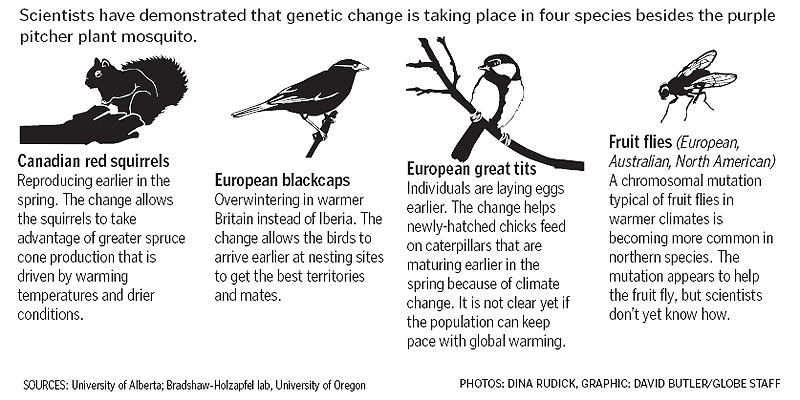
This news can fit into curricula in several ways, in several courses: Insects have already evolved in response to climate shifts due to global warming.

The Boston Globe has a series on global warming, and a recent article detailed how mosquitoes on the Maine frontier have already changed their breeding seasons in response to warming weather.

A mosquito that can barely fly is one of only five known species that scientists say have already evolved because of global warming. The unobtrusive mosquito’s story illustrates a sobering consequence of climate change: The species best suited to adapting may not be the ones people want to survive.

Such news enhances biology studies of genetics and insects, geography studies of climate, animal dispersal patterns and disease and pest ranges (a subject more technically known as biogeography), and the articles lend urgency to studies of how governments react to natural crises, a topic suitable for government classes, economics, and U.S. and world history.

Global Warming illustration Click on the thumbnail to see four examples of genetic change credited to global warming. (Graphic by David Butler of the Boston Globe staff.) Read the rest of this entry »


Get the kids outside

April 20, 2007

It’s almost over for this year, but the lesson plans at the site for National Environmental Education Week don’t have to be done in April only. Texas will have a new beefed up science requirement kick in, in a couple of years. Until then, however, this is a good set of ideas, even for social studies, especially if no other class is delivering the material well.

Environmental protection weaves science — biology, chemistry, geology, meteorology, and more — with applied social studies, especially history, economics and government, to make changes. For younger students studies of recycling can be a lot of fun and give students something to take with them for the rest of the life. Similarly, a study of migratory birds and the policy issues related to them (tall buildings, cellular communications towers, oil well sumps, lights in cities, hunting and the Treaty of 1948, etc., etc.) offers a lot of ways to get kids interested, if not excited, about these so-called dry topics. An advanced class in high school might analyze the Supreme Court decisions that brought down the price of shipping of recycled metals, making recycling economically feasible.

Whatever you do, don’t despair: International Migratory Bird Day is just a couple of weeks away.  Birding is one of the more fun areas one can use in discussions of climate change and global warming; the Roger Tory Peterson Institute of Natural History points the way to good resources.


Call for contributions: Fiesta de Tejas!

April 19, 2007

We have a couple of sterling contributions for the next Fiesta de Tejas!

More. We should have more submissions. Texas is a big state, with a lot of people, and a lot of entertaining history. We need more entries. Deadline for entries is end of day April 30, 2007 — I’m looking to publish on May 2.

You may e-mail entries to me at edarrellATsbcglobalDOTnet, or you can take advantage of the Blog Carnival entry form, which has the advantage that it makes copies to keep the thing going should I get hit by a speeding Indian Motorcycle on its way from Fort Worth to North Carolina. If you blog, too, please feel free to pass this call for submissions along to your readers.
Blog Carnival submission form - fiesta de tejas!

Last issue was the wildflower issue, but if you have photos of Texas wildflowers you would like to submit, please feel free to do that, too.

Pecan Tejas95a, from Texas A&M -- commercial since 1973 Pecan Tejas 95a, cultivar created at Texas A&M University in 1945, first fruited in 1949, released commercially in 1973.

Fiesta de Tejas! is a blog carnival celebrating Texas, Texas history and Texana. This blog focuses on education and social studies (though the focus wanders a bit sometimes). If you wonder whether a particular post might be useful to the Fiesta de Tejas!, simply ask whether you think more Texans ought to know about, especially Texas social studies teachers.

Whaddya know about Texas? Share it.