Just as a reminder about what we’re doing in education, I hope every teacher and administrator will take three minutes and view this video (that allows you some time to boggle).
Surely you know who Tom Peters is. (If not, please confess in comments, and I’ll endeavor to guide you to the information you need.)
You have the tools to compare the party platforms and determine for yourself which part supports education in Texas — I mean, really supports education, as opposed to using Doublespeak to profess support while angling to get a shiv in the back of education.
This post is seventh in a series on the education planks of the 2010 Texas Democratic Party Platform.
This is an unofficial version published in advance of the final version from the Texas Democrats, but I expect very few changes.
Generally I’ll not comment on these planks just yet, but I must say that I take delight in the perhaps unintentional commentary offered in the title of this plank. I suspect the intent was to point to the bias of the State Board of Education, an imbalance of political views, and not to the sanity of the board. But, I could be wrong — the title may be just an official Democratic labeling of the Board’s actions as unbalanced behavior.
REFORM OF THE UNBALANCED STATE BOARD OF EDUCATION
The right-wing Republican extremists who have dominated the State Board of Education have made a laughingstock of our state’s process for developing and implementing school curriculum standards that determine what our students learn. The damage they have done is no laughing matter. In rewriting the curriculum for social studies, English language arts, and science, they repeatedly have dismissed the sound advice of professional educators. Personal ideology, not high academic standards, has guided their work. Their skewed vision slights the contributions of racial and ethnic minorities. Their slanted versions of American history and of science mislead students and violate the separation of church and state. They use loaded language to favor the roles of right-wing organizations and activists. Led by a Rick Perry appointee as chair, this State Board of Education wants to indoctrinate, not educate, the schoolchildren of Texas. Their actions are unlikely to encourage a company to relocate and bring jobs to Texas. Any substantive changes to curriculum must be reviewed by non-partisan experts, and that review must be made public prior to any changes in curriculum by the State Board.
Texas Democrats will realign the State Board of Education with mainstream Texas values, will realign the state curriculum with objective reality and the facts of history and science, and will insist on the exercise of sober fiduciary responsibility for the Permanent School Fund, exposing and prohibiting conflicts of interest.
Spread the word; friends don't allow friends to repeat history.
Education issues suffered here at the Bathtub over the past several months. Confession: I don’t like to write while angry, and thinking about education generally gets me there quickly. When I write in anger, I like to sit on the stuff and edit when I’m cooled down. But when I get back to edit, I get angry again.
If you watched the follies from the Texas State Soviet of Education over social studies standards, you might understand some of my anger. I’m fortunate in some ways that my students don’t track the news more closely — they tended to miss the Soviet’s gutting of Hispanic history from Texas history standards, and so they didn’t get angry. More than 85% of my students are Hispanic, many related to the Texas heroes dropped from the standards because they were brown (“What’s Hispanic Heritage Month for, anyway?” the Soviet probably wondered.)
Power of Bubbling -- for a scary story, click on the image and go read it at TweenTeacher
Plus, time for thinking about these issues evaporated during the school year. Summer isn’t much better, though a bunch of us had eight great days with members of the history department at UT-Arlington focusing on the Gilded Age, Progressive Era, Age of Imperialism . . . even though reminded every day that the Texas Soviet doesn’t want us to teach that period as it is recorded in the history books. (No, there are not plans for a translation into Texas Soviet Speak, at least not soon. Teachers will have to make do.)
In one of our (too) many testing/oath-signing sessions this spring, a colleague cynically wondered what would be a good job for a kid who does well on the tests, a kid who has “demonstrated mastery of bubble-guessing.”
Bubble-guessing. Wow. Is that an apt description for what many schools teach these days!
I have a few days to put up the periscope and see what is going on out there. A couple of things I’ve noticed, that you may want to follow:
Education has a new god: data. It is believed to have the power to save American education and thus everything in education must be about data—collect more data about our children, evaluate teachers and administrators based on data, and reward and punish schools using data.
Sound familiar?
Zhao points to serious analyses of the Race to the Top applications and rejections which show, among other things, Pennsylvania was penalized for focusing on early childhood education, instead of collecting data.
Why was it we got into this swamp in the first place, and where did all these alligators come from?
Go read Zhao’s analysis, and maybe cruise around his blog. It’s worth your while. He’s a professor at Michigan State — University Distinguished Professor of Education. (One thing you should read there: Zhao’s slides from a recent speech. E-mail the link to your principal. Somebody find a YouTube version of that speech, please.) [Checker Finn, do you ever get over to this backwater? Zhao’s on to something. Zhao’s on to a lot of things.]
Race to the Top is the worst thing the Obama administration has done, in my opinion. It is aimed, or mis-aimed to give us a nation of bubble-guessers. My guess is that aim is unintentional. But the road to hell, or a Republican majority . . .
While we’re looking around, pay some attention to David Warlick’s 2¢ worth. That’s where I found the links to Zhao.
I could have shared some of these new ideas with her, but it would not have helped. The last time I helped my daughter prepare for a test, it was 8th grade and the unit test on the Civil War. When she walked into that classroom, she could talk about and write about the reasons for the war, what the North and the South wanted to achieve, the advantages that the North held and those of the South, as well as their disadvantages. She could tell you who won and who lost and why.
She made a 52 on the test because she couldn’t give the dates of the major battles of the war.
One of our mantras in the old Transportation Consulting Group at Ernst & Young was to understand that “You’re always ready to fight the last war.” For what we were doing, generally we had to change the technology for each assignment.
That’s doubly true in education, in social studies, I think. I constantly remind myself that my students don’t need the same things I got in high school. We shouldn’t equip students to fight the last war, but instead prepare them to understand they need to get ready for the next one.
And what about your tags? Warlick wonders. No answers, but good wonderings.
Spread the word; friends don't allow friends to repeat history.
It’s the sort of error you’d expect of a third-grade kid who hasn’t watched enough “Sesame Street.” Which of these fractions is larger? 1/5, or 1/6?
Is the judge really that dumb, or is this an elaborate, sarcastic hoax on the petitioner?
Math teachers, can you use this to show the importance of learning math well enough to do simple math functions mentally, without paper and calculator?
While you’re at Zeno’s place, Halfway There, look around. Zeno writes well, has good stories to tell, and you could learn a lot about a lot of things — you know, just by observing.
Spread the word; friends don't allow friends to repeat history.
I first met Ravitch a couple of decades ago when I worked for Checker Finn at the Office of Educational Research and Improvement. Ted Bell’s idea of a commission to look at education quality, and it’s 1983 report, saved the Reagan administration and assured Reagan’s reelection in 1984. She was one of the most prodigious and serious thinkers behind education reform efforts, then a close friend of Finn (who was Assistant Secretary of Education for Research) — a position that Ravitch herself held in the administration of George H. W. Bush.
Ravitch now criticizes the end result of all that turmoil and hard work, the No Child Left Behind Act, and the way it has distorted education to keep us in the crisis we were warned of in 1983. Then, the “rising tide of mediocrity” came in part because we didn’t have a good way to compare student achievement, state to state. Today, the mediocrity is driven by the tests that resulted from legislative efforts to solve the problem.
Conditions in education in America have changed. We still have a crisis after 27 years of education reform (how long do we have a crisis before it becomes the norm), but for the first time, Ravitch said, “There is a real question about whether public education will survive.” The past consensus on the value of public education and need for public schools, as I would put it, now is challenged by people who want to kill it.
“The new issue today: Will we have a public education system bound by law to accept all children.”
Ironic, no? The No Child Left Behind Act has instead created a system where many children could be forced to the rear.
I took an evening in the middle of a week of TAKS testing — the Texas Assessment of Knowledge and Skills. With ninth through twelfth grades, we had four days of testing which essentially requires the shutdown of the education for the week (we had Monday to review for the test). It was a week to reflect on just how far we have strayed from the good intentions of public education advocates who pushed the Excellence in Education Commission’s report in 1983.
Ravitch spoke for over an hour. I’ll have more to report as I get caught up, after a month of meetings, test prep, testing, and little sleep.
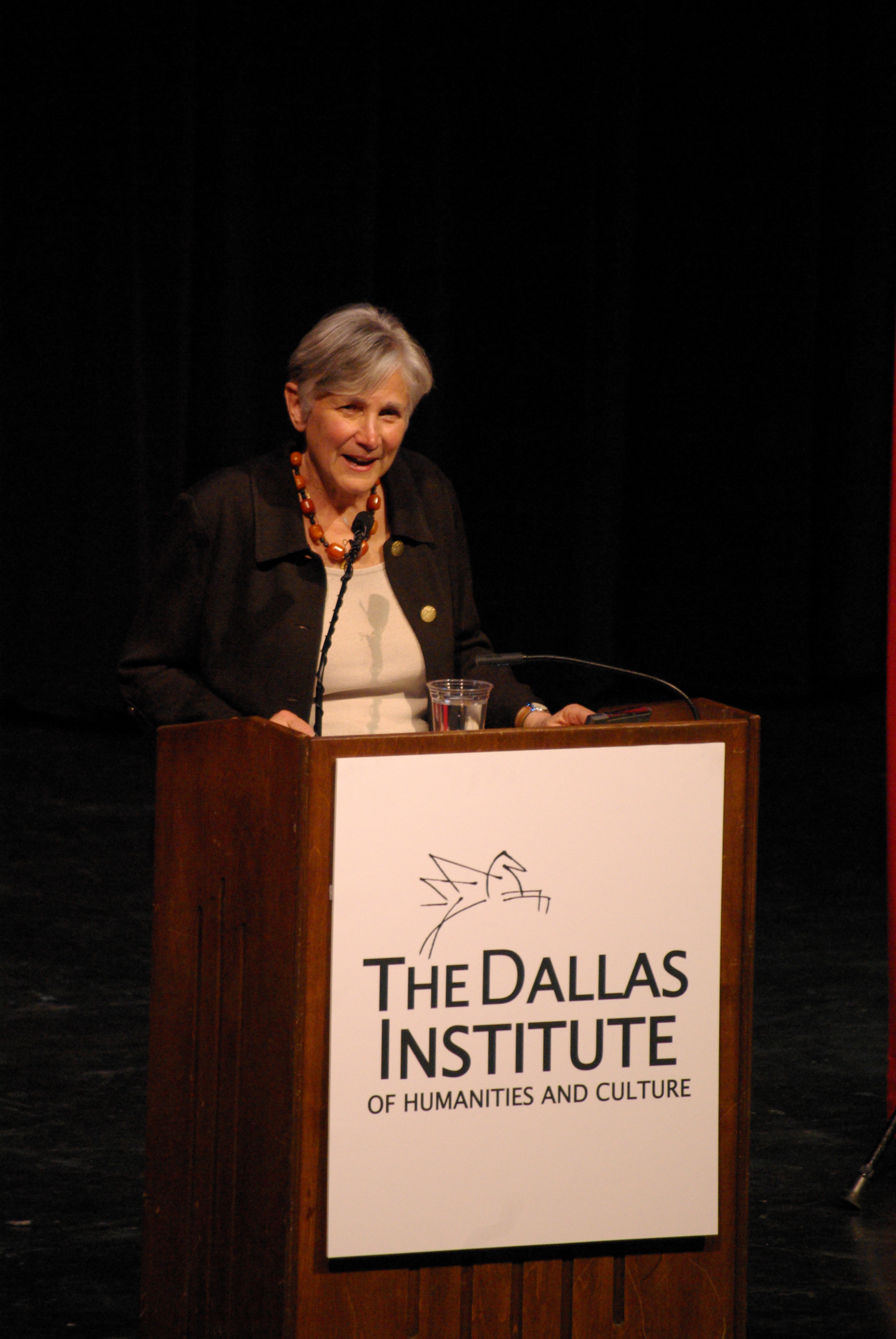
Dr. Diane Ravitch, one of the principal education theorists behind the No Child Left Behind Act, will speak twice in Dallas over the next two days — telling how NCLB is not working
Both public events, tonight at 7:00 p.m., and Thursday at the Dallas Institute of Culture and Humanities, are sponsored by the Dallas Institute.
Note that registration is required for tonight’s session:
To All Staff RE: The Dallas Institute of Culture and Humanities presents: Education Forum: What Makes a Good Education?
Two Public Events: Wednesday, April 28, at 7 p.m., and Thursday, April 29, at 7 p.m.
Wednesday, April 28, 2010, 7 p.m. Evening Forum and Book Signing at the Booker T. Washington High School for the Performing and Visual Arts Montgomery Arts Theater, 2501 Flora Street, Dallas, 75201
Keynote Speaker: Dr. Diane Ravitch, Education Historian
In this age of productivity models and minimum standards, the topic of a good education often
gets lost, but it evokes the century-long quarrel between the practical and the academic
curricula in our public discourse. Today, if we want to build a school system that will serve our
youth not only in their schooling but throughout life, we need to place what makes a good education
at the center of our discussion.
Beginning this conversation during our inaugural Education Forum are two noted authorities in the teaching profession: Dr. Diane Ravitch and Dr. Louise Cowan
Dr. Diane Ravitch, one of the nations leading education historians and author of the
#1 bestselling book on education, The Death and Life of the Great American School System: How Testing and Choice Are Undermining Education.
In it, Dr. Ravitch explains why she is recanting many of the views she held as U.S. Assistant Secretary of Education. Based on the data, she claimed in a recent interview on The Diane Rehm show, the remedies are not working and will not give us the educated citizens that we all want. Dr. Ravitch will explore what makes a good education and how to fulfill our commitment to a democratic future.
Dr. Louise Cowan, a Founding Fellow of the Dallas Institute and former dean at the University of Dallas, created the Institutes nationally recognized Teachers Academy programs from her vision of what makes a good education. For 27 years, these programs have challenged area school teachers to assume their full authority and responsibility as teaching professionals.
SEATING FOR THE EVENING FORUM IS LIMITED – ADMISSION BY RESERVATION ONLY
Teachers Admission – $15 / General Admission – $25
Deadline to register is noon, Wednesday, April 28.
Pulitzer Prize-winner Tom Toles in the Washington Post, March 19, 2010
It’s pretty embarrassing when the State Board of Education’s actions leave Texas open to jokes about whether Texans remember the Alamo. Remembering the Alamo is as much a Texas monument or icon as anything else — maybe moreso.
Tom Toles demonstrates why Texas should be embarrassed by the Texas State Board of Education’s work on social studies standards.
Spread the word; friends don't allow friends to repeat history.
Were I to advise Diane Ravitch right now, I’d tell her to change all her computer passwords and redouble the security on her servers. Why? After what happened to the scientists who study global warming, I expect many of the same wackoes are working right now to get her e-mails, knowing that the mere act of stealing them will be enough to indict her change of heart on education in America.
It’s much the same mob crowd in both cases. [I’m hopeful it’s not a mob.]
Dr. Ravitch thinks big thoughts about education. She stands in the vanguard of those people who are both academically astute in education, and who can make a case that appeals to policy makers. Working under Checker Finn at the old Office of Educational Research and Improvement, we quickly got familiar with Ravitch’s works and views. Finn and Ravitch, good friends and like-minded in education issues, were the running backs and sticky-handed receivers for any conservative education quarterback, back in the Day.
Finn was Assistant Secretary of Education for Research under Bill Bennett. Ravitch succeeded Finn, under Lamar Alexander. While Bennett and Alexander took troubling turns to the right, and Finn stayed much where he was, Ravitch has been looking hard at what’s working in schools today.
Once outspoken about the power of standardized testing, charter schools and free markets to improve schools, Dr. Ravitch is now caustically critical. She underwent an intellectual crisis, she says, discovering that these strategies, which she now calls faddish trends, were undermining public education. She resigned last year from the boards of two conservative research groups.
“School reform today is like a freight train, and I’m out on the tracks saying, ‘You’re going the wrong way!’ ” Dr. Ravitch said in an interview.
This is big stuff, and good news to teachers who, since I was at Education in 1987, have been telling policy makers the same things Ravitch is saying now.
David Gardner and Milton Goldberg wrote in the report of the Excellence in Education Commission in 1983 that America faces a “rising tide of mediocrity” because of bad decisions. That’s true of much education reform today, too.
Gardner and Goldberg also said that, had a foreign nation done that damage to us, we’d regard it as an act of war.
Maybe Ravitch’s turn can help mediate an end to the Right’s War on Education and pogroms against teachers.
Here in Texas the conservatives on the Texas State Board of Education didn’t like Ravitch’s views when she was in the conservative camp, so Texas has started, finally, to vote out commissioners who don’t get it, who prefer a state of war on Texas’s children to promoting public education
This isn’t exactly an error, but it creeps me out. Barton goes on at length about incorporating the views of a scholar of economics — but he never names the guy, and Barton seems overly affected and concerned about the guy’s residence and Jewishness.
See the section of Barton’s report talking about free enterprise (page 7). The real experts, the social studies teachers and professors whose work the Board appears to have rejected, suggested bringing the economic discussion into the 21st century and use “capitalism” instead of “free enterprise.” This would make the Texas curriculum correlate with the studies in the area done by social scientists, especially economists, and more accurately and precisely describe the system.
That is one reason given for rejecting their work, that the Board doesn’t want to mention capitalism. They don’t want to call capitalism by the name economists use.
But look at Barton’s suggestion. He veers off on a tangent about ethics in capitalism — I would venture that Barton never took any economics courses he can remember, and he’s never read Adam Smith, judging from the nature of his complaint (ethics is very much a discussion in economics). But it just gets weird. He refers to a paper, without citation, by a “Jewish economist” in the “Pacific Northwest.”
Barton doesn’t name the paper. He doesn’t say where it was published, nor offer any other citation by which it might be tracked down. Most creepily, he keeps referring to the “Jewish economist” as if his faith or ethnic background has any relevance, without ever naming the guy.
That isn’t scholarship. He almost makes a good point, but any valuable point is completely overcome by the bigoted lack of scholarship, the mere convention of naming the author of the paper and offering a citation.
Expert? No, certainly not in manifestation. That’s just creepy.
Here is the section I’m talking about:
Comment D: Free-Enterprise & Capitalism
Throughout the TEKS, the term “free enterprise” has been followed by the parenthetical “(free market, capitalism)”.By including the terms capitalism and free-market as synonyms for free-enterprise, perhaps it is now time to consider the merits of an observation concerning capitalism raised by a Jewish economist in the Pacific Northwest.
In previous generations, capitalism and the free-market system was universally operated on the unstated but unanimously assumed foundation of general societal virtue – there was a general set of assumed values and ethics that remained at the basis of transactions.
For example, to this day we assume that when a waiter brings us a glass of water that he did not spit in it before he delivered it to us. We assume that when we get the oil in our car changed that the mechanic actually changed the oil rather than just put a new sticker on the windshield. We make many Golden Rule type assumptions in the operation of the free-market system of capitalism.
When these general societal principles of ethics and morality are observed, the Free Enterprise System works as it should; but when these principles are ignored, the FreeEnterprise System breaks down and produces Bernie Madoff, Kenneth Lay, Jeffrey Skilling, Dennis Kozlowski, John Rigas, Joe Nacchio, Gregory Reyes, James McDermott, Sam Waskal, Sam Israel, Bernie Ebbers, and many others recently convicted of fraud, theft, corruption, and other white collar crimes that bilked clients of billions of dollars. The traditional Free Market System will not operate properly if the guiding premise is the egocentric Machiavellian principle that the end justifies the means.
We are now at a point in our history where we can no longer assume that the previously universally understood ethical basis of the Free Enterprise System will still be observed, understood, or embraced. Therefore, the Jewish economist in the Pacific Northwest has proffered that rather than using “Capitalism,” we instead begin using the term “Ethical Capitalism,” for it captures the historical import of the system and identifies an underlying principle without which the free-enterprise system will not work.
Therefore, I recommend that when we have the phrase “free enterprise (free market, capitalism)” that we instead consider using “free enterprise (free market, ethical capitalism).” It is an accurate recognition of what is one of the unspoken but indispensable elements of the free enterprise system. This change also reinforces the long-standing premise of political philosophers across the centuries that the continuation of a republic is predicated upon an educated and a virtuous citizenry.
Who is he talking about? What is he talking about?
More information:
Steve Schaffersman, the intrepid force behind Texas Citizens for Science, has a longer exposé of Barton’s odd claims and work to frustrate accurate history in Texas at Schaffersman’s Houston Chronicle hosted blog, EvoSphere. It’s well worth the read, just to see how intricately bizarre and erroneous Barton can be about simple facts of history, and how Barton chooses to misinterpret the Constitution, especially the First Amendment, and how he exaggerates little facts of history into gross distortions of the American story. I regret I failed to note this article here, in the first edition.
Like Brownsville last year, the state only recognized Aldine as an “acceptable” district, not a “recognized” or “exemplary” one. That could be for several reasons, but the best way to look at the difference between the state’s ranking and Aldine’s Broad Prize is that Aldine is showing substantial progress but still has a high mountain to climb before it’s on a par with suburban districts that do reach the exemplary level.
It doesn’t matter if your district has two of the top high schools in the nation on the Newsweek ratings, as Dallas ISD does. It doesn’t matter if 85% of a high school’s kids go to great colleges with lots of scholarship money. A school can get hammered by statistical flukes.
Too often teachers are pushed to focus on getting the subpar up to mediocre. A school gets no additional credit, in state rankings, for championship performance in the top tier of its students — and so some of the best performing schools in Texas have rankings less than they should have.
It’s nice that Aldine ISD got the Broad Prize. That prize recognizes outstanding achievement by students in many areas. But it counts for absolutely nothing in the state’s rankings of schools and districts.
For teachers in Texas, daily floggings will continue until teacher morale improves enough to push scores up. Or until someone in authority gets rid of the flogging (I was going to say “shoots the flogger,” but this is Texas; somebody might start shooting).
Spread the word; friends don't allow friends to repeat history.
(This issue has moved a bit since I first drafted this post — watch for updates.)
Ain’t it the way?
46 of the 50 states agreed to work for common education standards through a project of the National Governors Association (NGA) and the Council of Chief State School Officers. Texas is one of four states not agreeing. News comes from a report in the venerable Education Week (and to me directly via e-mail from Steve Schafersman at Texas Citizens for Science).
National standards for education are prohibited in the U.S. by law and tradition. Education standards traditionally have been set by each of the more than 15,000 local school districts. After the 1957 Sputnik education cleanup, and after the 1983 report of the Excellence in Education Commission, the nation has seen a drive to get at least state-wide standards, though a jealous regard for federalism still prevents national standards.
Almost all other industrialized nations have a set of national standards set by the national government, against which progress may be measured. All the industrialized nations who score higher than U.S. students in international education comparisons, have standards mandated by a national group.
So if it’s an internationally recognized way of improving education, as part of their continuing war on education, and their war on science and evolution theory, the Texas State Board of Education takes the Neanderthal stance, avoiding cooperation with the 92% of the states working to improve American education.
We’re closing out the year at Molina High School, and it’s busier than a blogger wants it to be. I’m way behind on blogging. Among notable things I’ve not written about:
Students at Molina made dramatic gains in scores on the Texas Assessment of Knowledge and Skills (TAKS). In fact, our kids jumped, from “academically unacceptable” to “recognized,” according to preliminary indications (Texas Education Agency (TEA) will post official results later in the summer). In any case the gains should be enough to get the school off of Texas Academic Death Row. Way to go, students.
We graduated the seniors last Saturday. Nice bunch of kids, really. Now we just have a couple of days of finals for the non-graduates left.
Dallas ISD is working to cut the funding for magnet schools and learning centers. Remember this kid? They want to cut his school. Why? Some wag thinks that the Elementary and Secondary Education Act requires that no school spend more per pupil than any other school. These magnets and learning centers were created originally to aid in desegregating Dallas schools. Nasty board meeting last week.
Dallas ISD is working to get rid of teachers with a rating system no one can explain. My 90%+ passing rate for students on the TAKS doesn’t count for squat. What does count? I have to keep my door unlocked, among other things. No kidding.
Dallas ISD needs money. So the district officials propose to charge PTAs for use of school buildings.
Perhaps fortunately, the State Lege died yesterday, at least in regular session. Alas, they didn’t get all the state programs funded. Special session is likely. No man’s life, liberty or property, etc.
You couldn’t make this up if you were trying to write a humor column.
More soon, I hope.
Spread the word; friends don't allow friends to repeat history.
Texas Freedom Network’s Insider blog reports that embattled chairman Don McLeroy is working to create a panel of experts to review studies curricula. The experts he has proposed so far are all well-known cranks in academia, people who bring their axes to grind on the minds of innocent children.
This panel is a bold insult to Texas’s community of economists, historians, and other practitioners of fields of social studies, not to mention educators. A more qualified panel of experts could be assembled in the coffee break rooms of the history departments at most of Texas’s lesser known state colleges and universities.
Why does Don McLeroy hate Texas so?
I’ve been buried in teaching, grading, planning and the other affairs of the life of a teacher, and had not paid much attention to the movement on this issue (“movement” because I cannot call it “progress”). My students passed the state tests by comfortable margins, more than 90% of them; this news from SBOE makes me despair even in the face of the news that our achievements are substantial in all categories.
The panel lacks knowledge and experience in economics, geography and history. The panel is grotesquely unbalanced — at least two of the panel members remind me of Ezra Taft Benson, who was Secretary of Agriculture for Dwight Eisenhower. When he resigned from that post, he complained that Eisenhower was too cozy with communism. Barton and Quist lean well to the right of Ezra Taft Benson. Quist has complained of socialist and Marxist leanings of Reagan administration education policy and policy makers.
House Bill 3 and Senate Bill 3, the two identical bills being considered in the Legislature now that will change Texas education laws for student assessment, tracking, documentation, and accountability, also affect high school graduation requirements. Unfortunately, anti-education lobbyists have been very successful and the HB3-SB3 bill as currently written delays the implementation of the 4×4 high school curriculum for many years. This will have a very deleterious effect on Texas science and math education, college readiness, allow continuation of the senior-year math and science layoff, and remove the need for a variety of 12th-grade capstone science and math courses.
Yes, you need to call your Texas representatives. Schafersman gives the numbers. Drop by his new blog, get details, get on the phone.
Or, until that account is unsuspended by the forces supporting Donald Trump: Follow @FillmoreWhite, the account of the Millard Fillmore White House Library
We've been soaking in the Bathtub for several months, long enough that some of the links we've used have gone to the Great Internet in the Sky.
If you find a dead link, please leave a comment to that post, and tell us what link has expired.
Thanks!
Retired teacher of law, economics, history, AP government, psychology and science. Former speechwriter, press guy and legislative aide in U.S. Senate. Former Department of Education. Former airline real estate, telecom towers, Big 6 (that old!) consultant. Lab and field research in air pollution control.
My blog, Millard Fillmore's Bathtub, is a continuing experiment to test how to use blogs to improve and speed up learning processes for students, perhaps by making some of the courses actually interesting. It is a blog for teachers, to see if we can use blogs. It is for people interested in social studies and social studies education, to see if we can learn to get it right. It's a blog for science fans, to promote good science and good science policy. It's a blog for people interested in good government and how to achieve it.
BS in Mass Communication, University of Utah
Graduate study in Rhetoric and Speech Communication, University of Arizona
JD from the National Law Center, George Washington University


 Posted by Ed Darrell






 Millard Fillmore's Bathtub