Would you even know a good teacher, if she pushed your kid to great achievement?

May 17, 2012

Yes, that’s Rod Serling‘s shadow, and that’s the “Twilight Zone” music you hear.

Consider the curious case of Carolyn Abbott in New York City (links added):

Carolyn Abbott was, in one respect, a victim of her own success. After a year in her classroom, her seventh-grade students scored at the 98th percentile of New York City students on the 2009 state test. As eighth-graders, they were predicted to score at the 97th percentile on the 2010 state test. However, their actual performance was at the 89th percentile of students across the city. That shortfall—the difference between the 97th percentile and the 89th percentile—placed Abbott near the very bottom of the 1,300 eighth-grade mathematics teachers in New York City.

How could this happen? Anderson is an unusual school, as the students are often several years ahead of their nominal grade level. The material covered on the state eighth-grade math exam is taught in the fifth or sixth grade at Anderson. “I don’t teach the curriculum they’re being tested on,” Abbott explained. “It feels like I’m being graded on somebody else’s work.”

The math that she teaches is more advanced, culminating in high-school level algebra and a different and more challenging test, New York State’s Regents exam in Integrated Algebra. To receive a high school diploma in the state of New York, students must demonstrate mastery of the New York State learning standards in mathematics by receiving a score of 65 or higher on the Regents exam. In 2010-11, nearly 300,000 students across the state of New York took the Integrated Algebra Regents exam; most of the 73 percent who passed the exam with a score of 65 or higher were tenth-graders.

Because student performance on the state ELA and math tests is used to calculate scores on the Teacher Data Reports, the tests are high-stakes for teachers; and because New York City uses a similar statistical strategy to rank schools, they are high-stakes for schools as well. But the tests are not high-stakes for the eighth-graders at Anderson.

By the time they take the eighth-grade tests in the spring of the year, they already know which high school they will be attending, and their scores on the test have no consequences. “The eighth-graders don’t care; they rush through the exam, and they don’t check their work,” Abbott said. “The test has no effect on them. I can’t make an argument that it counts for kids. The seventh-graders, they care a bit more.”

The state tests, she believes, are poorly equipped to assess real mathematical knowledge, especially for high-performing students. “They’re so basic; they ask you to explain things that are obvious if you’re three years ahead,” she says. The Anderson students “understand it at a different level. They want to explain with equations, not words.” But the scoring of the free-response items on the tests emphasizes a formulaic response, with the scoring instructions often looking for a single keyword in a response to garner credit.

“They’re not accepting answers that are mathematically correct,” Abbott notes, “and accepting answers that aren’t mathematically correct.” And the multiple-choice questions?  “Multiple-choice questions don’t test thinking,” she declares. Knowing how to answer them is “just an art.”

Ms. Abbott?  Oh, yes.  She is ranked the worst math teacher in New York City.

Read more of this fascinating, troubling case* at Aaron Palas’s blog at the Hechinger Report.

_____________

* Working hard to avoid using the term “colossal cluster f***.”


2nd day of school in Dallas: Student asks, “Do you believe in me?”

August 23, 2011

It’s the second day of classes here in the Dallas Independent School District (Dallas ISD, or DISD).  Already we experience great trials from the loss of funding across the board in Texas education, as Gov. Rick Perry encouraged the state legislature to cut more than $4 billion from schools.  Cuts will be larger next fall.

At Molina High School we have about 25% more students, with 10% fewer teachers.  Classes strain the seams of the school — classrooms are crowded, desks and chairs are in short supply.  Computers promised for teachers, supposed to be delivered eight months ago, still are not delivered.  Printers, printing supplies, and paper, stand in conservation mode.  There are so few technical support people that those few new computers delivered often are not set up to operate yet.

Teachers need encouragement.  Here’s a bit of it.

What follows is mostly encore post, from 2008.

_____________

Taylor Mali is one of my usual suspects for inspiring teachers. He does a great job, with just a tinge of profanity (appropriately placed, many teachers argue – if they ask for it, you have to give it to them).

This year’s inspiration for Dallas teachers comes from Dalton Sherman, a fifth grader at Charles Rice Learning Center. Here’s a YouTube video of the presentation about 20,000 of us watched last Wednesday, a small point that redeemed the annual “convocation” exercise, for 2008:

Sherman’s presentation rescued what had been shaping up as another day of rah-rah imprecations to teachers who badly wanted, and in my case needed, to be spending time putting classrooms together.

(By the way, at the start of his presentation, you can see several people leap to their feet in the first row — Mom, Dad, and older brother. Nice built-in cheering section.)

Staff at DISD headquarters put the speech together for Dalton to memorize, and he worked over the summer to get it down. This background is wonderfully encouraging.

First, it makes a statement that DISD officials learn from mistakes. Last year the keynote was given by a speaker out of central casting’s “classic motivational speaker” reserves. As one teacher described it to me before the fete last Wednesday, “It was a real beating.”

Second, DISD’s planning ahead to pull this off suggests someone is looking a little bit down the road. This was a four or five month exercise for a less-than-10 minute presentation. It’s nice to know someone’s looking ahead at all.

Third, the cynical teachers gave Dalton Sherman a warm standing ovation. That it was delivered by a 10-year-old kids from DISD made a strong symbol. But the content was what hooked the teachers. Superintendent Michael Hinojosa provided a death-by-PowerPoint presentation leading up to the speech, one that was probably not designed solely as contrasting lead in. In other words, Dalton Sherman’s speech demonstrated as nothing else the district has done lately that someone downtown understands that the teachers count, the foot soldiers in our war on ignorance and jihad for progress.

The kids came back Monday, bless ’em. School’s in session, to anyone paying attention.

Resources:

Read the rest of this entry »


Cracks appear in Rick Santorum’s personal constitution

August 6, 2011

Rick Santorum in Iowa, Huffington Post image

Rick Santorum in Iowa, Huffington Post image

Former Pennsylvania Sen. Rick Santorum’s reluctant grip on reality appeared to be vanishing fast in a stop in Iowa, Thursday.  He said America’s schools are for indoctrination of students, and he doesn’t like the current round of indoctrination.

Geeze, this ought to be in The Onion.  Is Santorum really this disconnected from America and life?  Are there actually people out there who don’t look around for the guys in the white clothes with straight jackets and nets when they hear him say this stuff?

I don’t generally cite to The Huffington Post, but when the warning claxons go off, you ought to see if there’s danger before dismissing them as error:

Rick Santorum woose voters in Orange City, Iowa - Des Moines Register photo

Rick Santorum woos voters in Orange City, Iowa - Des Moines Register photo

During a stop in Iowa on Thursday, Republican presidential candidate Rick Santorum said that “schools indoctrinate our children,” the Des Moines Register reports.

“You wonder why young people can vote and flock for a guy like Barack Obama and say, if you look at the surveys, that socialism is better than capitalism — well, that’s because they don’t understand America,” he explained, according to the Register. “I said ‘indoctrination’ and I meant it,” he said.

What survey does he have that claims any group in America, other than the Tea Party or the American Communist Party, say socialism is better than capitalism?  Since curricula in every state teach the opposite, the existence of such a poll would be powerful evidence of critical thinking powers in students that most teachers would not attest to.

Maybe more important, perhaps we should  worry about just what all those thousands of nice Baptist ladies are teaching our kids in Texas, eh?  Not to mention the Lutheran ladies in Iowa.  Santorum is sniping at teachers, but if you look at the demographics, it makes little sense.  Teachers are, like the rest of America, about 90% Christian, God-fearing, flag-waving American patriots.

Well, nothing Santorum says makes much sense, does it?  Santorum lent support to the War on Education.

Santorum argued that the country’s education system is leaving students with an insufficient grasp of history. His remarks come with the widely-anticipated Ames Straw poll — a table-setter event for next year’s Iowa caucuses — less than two weeks away.

What in the hell do the schools in Ames, Iowa, look like, that Santorum can say that stuff about them?

By the way, if people learned history accurately in high school, Rick Santorum wouldn’t stand a chance in any election today.  But I digress.

The Des Moines Register article adds the details that Santorum made note of recent testing that shows American kids don’t know enough about American history — always the case, by the way — and that a college prof from Kansas said he gives his students the test required of immigrants applying for citizenship, and most can’t pass the test.

I’m game:  Let’s give the test to Santorum.  If he doesn’t pass, though, we can’t deport him.  We have no vehicles capable of getting to Mars.

HP offers information that may explain Santorum’s insanity:  The same article notes he’s touring Iowa in two vans with his seven children.  In this heat?

Does the Iowa division of child protective services know about this?  How about the division that worries about children torturing their parents?


Save Our Schools: Teachers march on Washington, no pitchforks, torches, tar or feathers

July 29, 2011

Save Our Schools and other teacher groups organized a march on Washington, a four-day affair to get attention to problems in schools and gain support for education-favorable solutions.

Will their voices be heard over the debt ceiling hostage crisis?  Is it more than coincidence that many of the politicians attacking education lead the effort to ruin the nation’s credit and sink our economy?

Here’s an explanation from EDWeek’s  Politics K-12 blog:

Teachers Converging on Washington for 4-Day Schools Rally

By Michele McNeil on July 28, 2011 5:54 AM
By guest blogger Nirvi Shah

UPDATED

Today kicks off the four-day Save Our Schools March and National Call to Action, a gathering and rally in Washington, D.C., organized by teachers who say they are fed up with test-driven accountability for public schools—and, increasingly, for teachers.

The group, which maintains that it is a grassroots, from-the-ground-up organization, hopes to send a message to national and state policymakers about their displeasure, as well as highlight a variety of principles for improving public education. The group has developed a series of position papers outlining its views on high-stakes testing, equitable funding for all schools, unions and collective bargaining, and changes to curriculum, among other issues. For the most part, the position papers aren’t yet at the level of detail of formal policy prescriptions, and it remains to be seen whether such proposals will emerge from the gathering.

March organizer Sabrina Stevens Shupe said however that policy proposals aren’t necessarily the goal of the events. “What we’re talking about is creating the right conditions, not prescriptive policies,” she said.sosrally-tmb.gif “There’s no one silver bullet that’s going to save anything,” she added, referring to attempts to craft education reforms for the last 30 years.

The big event happens Saturday, when thousands of teachers and supporters of the cause are expected to rally and march at The Ellipse, near the White House. (About 1,000 people have indicated they’ll attend via the movement’s website, but registration is not required, and organizers believe 5,000 to 10,000 marchers will turn out.) The group will wrap up with a closed-door meeting Sunday at which participants will try to determine how to keep the momentum from the rally going. (Movement organizers haven’t disclosed the meeting’s location, and it is not open to press.)

Watch this blog and our issues page for developments from the movement’s events today and through the weekend.

The movement began with a small group of teachers, including Jesse Turner, who walked from Connecticut to the District of Columbia last August to protest the No Child Left Behind Act and Race to the Top. Their efforts predated actions by state legislatures across the country this spring to curb teachers’ collective bargaining powers and tenure, noted Bess Altwerger, a member of the movement’s organizing committee, who hosted a reception for Mr. Turner last summer. She said the shortcomings of the American public education system do not lie with teachers.

“This has been framed as somebody’s fault—either the parents’ fault or the teachers’ fault,” Ms. Altwerger said. “The fault lies with an education policy that does not work.”

Eventually, both of the nation’s largest teachers unions threw their financial and philosophical support behind the movement.

The American Federation of Teachers and National Education Association have donated about $25,000 each to the effort. The bulk of the rest of the donations have come from one-time gifts provided through the Save Our Schools website. Conference organizers estimated that they’d raised over $125,000. After this weekend, they will have to begin fundraising efforts anew to keep their work going.

Taking Message to Obama Administration

Three organizers of the SOS March met Wednesday for an hour with senior-level Education Department officials, including two press officers and the deputy chief of staff. U.S. Secretary of Education Arne Duncan was in attendance for about 10 minutes, and described the meeting as a “good conversation.” He added that “there is a lot of common ground out there.”

(Read the rest of the story from Politics K-12.)

With some luck, a few thousand teachers will show up.  With greater luck, a few thousand other people, concerned parents, perhaps, will join them.

In much of the nation teachers are still stuck fighting for jobs.  Here in Texas, for example, the Texas Lege didn’t get a budget out until June, including dramatically slashed funding for this coming school year.  In some Texas districts we still face layoffs before school starts in just over two weeks.  Many of us don’t have clear assignments, and many more of us will lose basics of teaching, like preparation time, breaks, classrooms, paper, books, and pencils.

Considering the trouble created by political attacks on education in state legislatures this year, much of the attacks wholly unnecessary, it’s a wonder the teachers don’t show up with pitchforks, torches, and tar and feathers.

It’s a crazy world out there.  Help make some sense somewhere, will you?


Bill Adkins: Art education boosts achievement, but needs administrator support to work

June 24, 2011

One of our very good art teachers at Moises Molina High School, William Adkins,  works with a group called Big  Thoughts.  Big Thoughts interviews teachers who work with the program about how arts education boosts student achievement in core areas, and how to leverage arts to improve the boost.  Adkins had some thoughts about how art really is a core part of education , and on the role of administrators in helping teachers:

You can view 74 videos from about 30 different people on the Big Thoughts menu at Vimeo.

Adkins’ students regularly win awards, often outperforming the many more students at our district’s arts magnets.  One of his students, Moses Ochieng, too the top prize at the state art meet this year for a brilliant sculpture he did.  Moses was my student in U.S. history, too — a great adventure, since he emigrated from Kenya just a few years ago, and he lacks the familiarity with so many American things that we, and the textbooks, and the state tests, take for granted that students know.  Ochieng’s art helped focus him on history.  It supplemented his studies so that he picked up two years of history work in just one year.

More:


Texas Citizens for Science, new Facebook page

June 23, 2011

One more way to connect with Texas Citizens for Science, the defenders especially of good science in public school classrooms:

Texas Citizens for Science logo

Are you a member?

Hello, Friends of Texas Citizens for Science,

If you haven’t done so yet, please visit the new TCS Facebook Page at <http://www.facebook.com/pages/Texas-Citizens-for-Science/220812611277400?sk=wall> and become a Friend. TCS is only four Friends short of reaching the number to use a shortened URL.

Also, please make a note of our new TCS email address.

The July State Board of Education meeting will be important for us. I will attend and live blog the important parts.

Thank you all very much.

Steven Schafersman, President
Texas Citizens for Science


Common Core of Errors and Nostalgia: Where is the future of education?

May 18, 2011

How do you plan for the future?

Oh, yeah, I know the old story about the ants and the grasshopper.  But it’s really a story about traditional agriculture and the need to look no more than a year ahead, as usually told.  In the classic Aesop version, the moral is about the need to prepare for “days of necessity.”    The story doesn’t say anything about how the ants planned for the advent of DDT, Dieldren or Heptachlor, nor for an invasion of immigrants from Argentina, nor for the paving of the forested field they lived in.

And that’s probably the point.  How do we plan for what we don’t know will happen, for what we cannot even imagine will happen?

In retrospect, much “planning” looks silly.  Bob Townsend, the former head of Avis and American Express, wrote a book years ago that I wish more educators would read today, Up the Organization.  In one of its brief chapters he talks about having been appointed poobah (vice president? managing director?) of “future planning” at one of those corporations, and how proud he was to have the title.  A few days after he got the job his bubble was burst in a most unusual way.  He got home for dinner, and his wife asked him, “What did you plan today?”

(I don’t do the story justice.  Go get a copy and read the story.)

Nancy Flanagan at Teacher in a Strange Land demonstrates the folly that Townsend’s wife brought to light, the folly in thinking we’ve got a good grip on what the future holds, and especially on what skills and education and training will be required to get there:  “Common Core Standards:  A though experiment.”

Soon after the report of the President’s Commission on Excellence in Education came out, and for some years after, there was much worry about just what was the “common core” of knowledge that a modern kid would need, both to be a successful student and prepare for a life of beneficial work, family raising, voting and tax paying.  Tradition and federal law had kept (and still keep) the federal government from writing a national curriculum, leaving that task to the states and local school boards — the 50 states, plus the District of Columbia, plus territories of the Virgin Islands, Guam and Puerto Rico, and the more than 15,000 local school boards.  There is no national curriculum in the U.S., nor is there agreement from state to state or district to district on just what should be taught.  State standards exist, but they were supposed to be the floor above which students could soar, instead of what they have become, the too-low target at which students really aim in their drive to be good bubble-guessers.

Flanagan has a sharp and entertaining fantasy about what would have happened, if:

So now the Common Core Everything movement is worried about whether schools’ technological capacity is up to the task of constant, computer-driven assessment–and Bill Gates and Pearson are developing the aligned on-line curriculum that you always knew was just around the corner. Soon–all the pieces will be in place, and we’ll be on our way to that One Unified System that we’ve been pursuing for decades. At last. Too bad it’s taken so long…

Just imagine what could be in place if Ronald Reagan had leveraged the political will engendered by the “Nation at Risk” report to get Congress to agree to a set of common standards and tests.

Is it a glorious future?  Well, consider the standards for students to learn about business and communications:

The business career rooms are outfitted with zippy Selectric typewriters and dictation machines–Williams sees girls transcribing the tapes. He is especially pleased with the broadcast studio, where students can read the morning announcements over the public address system, meeting the standard for broadcast media. A group of students is taking French IV via distance learning there, watching a TV lecture, then mailing off their homework and quizzes. Elmwood could only afford one language lab, so Mr. Williams has phased out Latin and Spanish, deciding to offer only French in a four-year block. Rationale: the French Club can travel to France–but his rural students were not likely to meet Spanish-speaking people in the future!

Flanagan’s view is entertaining, and enlightening, even in that short glimpse.  Go read the rest of her fantasy.  If you agree — and you will find it hard not to — can you think of ways to prevent the obvious problems?  Can you think of how we could have dealt with those problems, in 1983 and 1989?  Are we avoiding those problems with our curriculum standards today?

Did any state plan to educate kids on the ethics of real estate deals, so they’d be ready to avoid the real estate bubble, or its bursting?  It’s still true that we are “ready to fight the last war.”

I responded:

Generally I argue, against those who claim any beneficial change in schools is “socialism” and should be fought, that we compete against nations who do better than we do, at least as measured by the international comparison tests — and every nation ranked above the U.S. has a national curriculum. So, I argue, there doesn’t appear to be harm in a national curriculum, per se.

But as you demonstrate, there could indeed be harm in a national curriculum set in stone that is wrong — or even the wrong curriculum set in Jello.

When I did quality work and consulting with big corporations, way back in 19XX, I often used the story about the difference between Nissan and GM on robotics. Nissan was seen as the wave of the future with fancy auto plants with lots of big robots doing high quality work in assembling autos. GM, on the other had, was struggling. GM sank $5 billion or so into a robotized plant in Hamtramck, Michigan — and had to close it down. Couldn’t make it work.

What was the difference?

Nissan used to make fenders by having metalworkers pound them out by hand. Nissan took a few of those workmen, and asked them to search for machines that would make their work easier. Those guys found some stamp presses, got expert on them, and Nissan was off to the races on automation. At each step, the people who actually did the work were brought in to make the next improvements. I saw one interview of a guy running several massive robots, and the interviewer asked what sort of education he’d gotten to get to that point. He said he’d started out pounding fenders with a hammer and anvil, years earlier.

GM saw those robots in that plant, and bought a whole plantful of them. When the robots were installed in Michigan, they began the search for people to run the machines, unfortunately having to let go a lot of the people who ran the old stamping machines, because they lacked the “necessary background.”

What is the equivalent front line worker in education today? What is the “necessary background?” Impose that on your story, you could get some good results.

By the way, I was handicapped greatly by my high school education. We didn’t have enough advanced math students to get a calculus class going. So I couldn’t get calculus. But, the district said, they had purchased a brand new machine to get going in “computer math.” It was a card compiler. Students could learn to punch IBM computer cards, and that would give them a leg up in the computer world . . .

35 years later, my kids needed help with their calculus homework. They took some of my old debate cards, on old [computer] punch cards, to school for show and tell. Antiques. ( I didn’t have any programs to send — I couldn’t fit the computer math into the schedule opposite “student council;” my counselor advised me to drop out of student council for computer math, a decision I probably would have regretted in my years in Washington.)

I spoke with one of my high school English teachers last year — she’s the doyen of the computer lab today, an after-retirement job.  Turns out the computer lab really needed someone who could teach kids to write, someone who knows grammar and a bit about reading and judging sources for research papers.

What did you “plan” today?


Case study: How state legislatures and school administrators damage schools, the students they serve, and America

May 17, 2011

The bruises from my broken nose are fading — two black eyes eventually resulted — but the smarting remains.  Especially I’m smarting because we have been unable to move either of the students to places where they can be helped, and get educated.

But I don’t think that colors my view that this example, from JD 2718, demonstrates how much damage unthinking legislatures and administrators can do to a school, to students who attend the school, and our entire education system, quickly, and probably without recourse.  Nor is there much hope for recovery:

Superintendent threatens principal for offering teacher tenure

A good teacher, one we need to have in the classroom, was offered tenure as promised.

President Reagan’s Commission on Excellence in Education wrote about a “rising tide of mediocrity” in education.  They said that our students’ achievement levels were in trouble, and that it was our own fault.  Had a foreign nation done that damage to U.S. education, they wrote, we might consider it an act of war.

And so it is that the war continues on American education, a war conducted by home grown . . . administrators, and state legislators.

We have met the enemy, Pogo said, and he is us.


A Seussian fable, about how tests ruin school reform

April 7, 2011

Look, you really need to go to TeacherSabrina’s blog, Failing Schools, where she first posted this, and take a look at many of her posts.

But I can’t resist putting the video here, because I know a few old-timers would be confused by the link, and some people will think they don’t have the time to make two clicks instead of one.

So, here, in its Seussian glory and demand for Flash Animation, is TeacherSabrina’s story of D.C.’s late Queen of the Schools, Michelle Rhee, and her desire to get D.C.’s kids to score well on an increasing battery of tests  [Got a good joke about assault and battery we can insert here?]:  “Rhee the Reformer:  A Cautionary Tale.”

Tip of the old scrub brush to Accountable Talk.


War on education, war on teachers: A little historical perspective

March 16, 2011

A post from Nicholas Meier at Deborah Meier’s Blog:

Perennial Headlines on Education

Here are some Headlines from newspapers over the years. Can you guess when they were written?

1. “Attack Mounted on Dropouts/City Sets Standards for Schools”

2. “New York’s Great Reading Score Scandal”

3. “Diagnostic reading tests are being given this week to 150,000 high school students as the first step in a new program—the largest and most systematic ever. …We intend to follow through…to overcome deficiencies.”

4. “The University of California (Berkeley) found that 30 to 40 percent of entering freshmen were not proficient in English.”

5. “Hope for the Blackboard Jungle: … Every year New Yorkers’ performance had been getting a little worse, until by YEAR? only 32 percent of the city’s pupils [were] doing as well or better than the national average.”

6. “Even Boston’s ‘brightest students’ didn’t know ‘whether water expanded or contracted when it freezes.’ And while 70 percent of this elite group knew that the U.S. had imposed an embargo in 1812 only five knew what ’embargo’ meant.”

7. “Tougher Standards in Our High. The average freshman is a year and three months behind national standards in reading.”

8. “City Pupils Remain Behind … Official Asserts the Tests Suggest Difficulty in Early Grades. Last fall 40.1 percent were reported on grade level or above … but in March, 43 percent … were reading at grade level or above”; and “Bleak drop out stats are raising concern.”

9. “Our standard for high school graduation has slipped badly. Fifty years ago a high school diploma meant something. … We have misled our students. … and our nation.”

10, “During the past 40 or 50 years those who are responsible for education have progressively removed from the curriculum … the western culture which produced the modern democratic state.”

The quotes above come from mainstream publications over the past 150 years. The earliest is 1845, the latest . . .

[Answers below the fold]

Read the rest of this entry »


Can’t fire the bums to make a quality school: Principals division

February 8, 2011

Be sure to see the story in the New York Times today. Obama administration “Race to the Top” money went to states who proposed to replace principals in failing schools. A problem in the strategy threatens the program:  Not enough qualified people exist to replace all the “bad” ones.

Wrong-headed education “reformers” keep talking about “firing the bad ones,” teachers, administrators, or janitors.  Without significantly raising the pay for teachers, without greatly increasing the number of teachers and administrators in the pipeline from teaching colleges or any other source, reformers can’t attract anyone better qualified than the people they wish to replace.

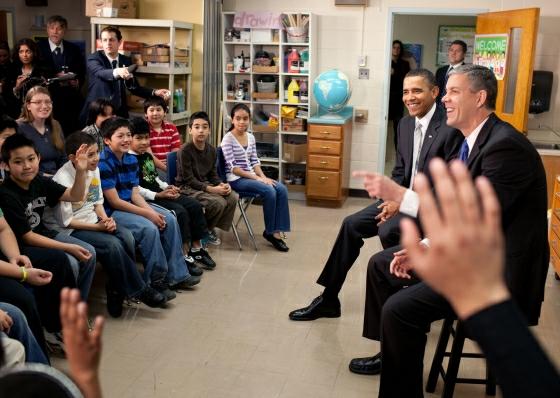
Pres. Obama and Sec. Duncan and the 6th grade at Graham Road Elementary, Falls Church, Virginia

President Barack Obama and Education Secretary Arne Duncan took questions from a 6th grade class at Graham Road Elementary School in Falls Church, Virginia, January 18, 2010 – photo credit unknown

Maybe, just maybe, it’s time these reformers took a step back and did some study, perhaps from the quality gurus, Deming and Juran and Crosby, or from the heights of championship performance, in basketball, football, soccer, sailing (try the America Cup), horse racing or politics:  No one can use firing as a chief tool to turn an organization around, nor to lead any organization to a championship.  Threatening people’s jobs does not motivate them, nor make the jobs attractive to others.

How can we tell the fire-the-teachers-and-principals group is on the wrong track?  See the article:

“To think that the same leader with a bit more money is going to accomplish tremendous change is misguided,” said Tim Cawley, a managing director at the Academy for Urban School Leadership, a nonprofit group that began leading turnaround efforts in Chicago when Mr. Duncan was the superintendent there.

“This idea of a light-touch turnaround is going to sully the whole effort,” Mr. Cawley added.

Tell that to Steve Jobs, who turned Apple around.  Tell it to Jack Welch, the tough-guy boss from GE (who had his own peccadilloes about firing, but who emphasized hiring and pay, at least, as the way to create a succession plan for the vacancies).  Tell it to any CEO who turned around his organization without falling on his own sword.

Any competent quality consultant would have foreseen this problem:  Nobody wants to train for a job with little future, less money to do the job right, little authority to get the job done, and the sole promise that the exit door is always open.

Secretary of Education Arne Duncan should know better, intuitively.  He used to play basketball, professionally.  Surely he knows something about team building and team turnarounds.  What caused his astounding, expensive amnesia?

Part of the issue identified in the article is training:

Because leading schools out of chronic failure is harder than managing a successful school — often requiring more creative problem-solving abilities and stronger leadership, among other skills — the supply of principals capable of doing the work is tiny.

Most of the nation’s 1,200 schools, colleges and departments of education do offer school leadership training. “But only a tiny percentage really prepare leaders for school turnaround,” said Arthur Levine, a former president of Teachers College who wrote a 2005 study of principal training.

That only contributes to the larger problem, that people in the positions are, often, the best ones for the job already; firing them damages turnaround efforts.

In Chicago, federal money is financing an overhaul of Phillips Academy High School. Mr. Cawley’s nonprofit trained Phillips’s new principal, Terrance Little, by having him work alongside mentor principals experienced at school makeovers.

“If we’re talking about turning around 700 schools, I don’t think you can find 700 principals who are capable of taking on the challenge of this work,” Mr. Little said. “If you could, why would we have this many failing schools?”

Education’s problems are many.  Few of the problems are the result of the person at the chalkboard in the classroom.  Firing teachers won’t help.  W. Edwards Deming claimed that 85% of the problems that plague front-line employees, like teachers, are management-caused.  Firing their bosses won’t solve those problems, either, but will just push the problems around.   (What?  “Deck chairs?”  “Titanic?”  What are you talking about?)

Did you hear?  Texas plans to cut state funding to all education by at least 25% for next year, due to Gov. Rick Perry’s $25 billion deficit, which he worked so hard to conceal during last year’s election campaign.

Santayana’s Ghost just dropped by to remind us, suitably the day after Ronald Reagan’s 100th birthday anniversary, of the Report of the Commission on Excellence in Education, the report that saved Reagan’s presidency and got him a second term:

Our nation is at risk. The educational foundations of our society are presently being eroded by a rising tide of mediocrity. If an unfriendly foreign power had attempted to impose on America the mediocre educational performance that exists today, we might well have viewed it as an act of war. We have, in effect, been committing an act of unthinking, unilateral educational disarmament. History is not kind to idlers.

When do we get political leaders who will swim against that tide instead of trying to surf it?


Dan Wasserman cartoon, Boston.com

Dan Wasserman, Boston Globe

See a small collection of  Dan Wasserman’s cartoons on Race to the Top, here.


“WTF?” Palin completely misunderstands what “Sputnik Moment” means

January 28, 2011

Vodpod videos no longer available.

“WTF?” Palin completely misunderstands what “S…, posted with vodpod

Some bloggers have sworn off comments on Sarah Palin. Good on them.

This fruit is too low-hanging.

Palin doesn’t appear to have a clue about what the phrase “Sputnik moment” refers to — and mistakes it with the much later financial difficulties of the Soviet Union.  You’d think, since she was so close to the U.S.S.R. in Alaska, she’d know something about Sputnik.

And what’s with the “WTF” on television?  Has she no composure, no decency?

Here, Sarah; a primer:

Sputnik was the first artificial satellite launched from Earth, in October 1957.  (Palin wasn’t born for another seven years . . . arguments about teaching history, anyone?)

Please note that the launch of the satellite scared the bejeebers out of Americans.  Most people thought — without knowing anything about how heavy a nuclear device might be, nor how hard it might be to target one — that if the Russians could orbit a satellite the size of a beach ball, they could certainly launch missiles with nuclear warheads to rain down on America.  Maybe, some thought, Russians had already orbited such nukes, which could just fall from space without warning.

That was the spooky, red scary part.  Then there was the kick-American-science-in-the-pants part.  A lot of policy makers asked how the Russians could surpass the U.S. in the race for space (wholly apart from the imported German rocket scientists used by both the U.S. and the U.S.S.R.).  Looking around, they found science and technology education in America sadly lacking.  Congress passed a law that called science education necessary for our defense, and appropriated money to help boost science education — the National Defense Education Act.

The Cold War stimulated the first example of comprehensive Federal education legislation, when in 1958 Congress passed the National Defense Education Act (NDEA) in response to the Soviet launch of Sputnik. To help ensure that highly trained individuals would be available to help America compete with the Soviet Union in scientific and technical fields, the NDEA included support for loans to college students, the improvement of science, mathematics, and foreign language instruction in elementary and secondary schools, graduate fellowships, foreign language and area studies, and vocational-technical training.

(See the Wikipedia entry on NDEA, too.)

The National Science Foundation (NSF) history points to the genuine advances in science the Soviets had made, and the need for the U.S. to quickly catch up:

Sputnik once again elevated the word “competition” in the language of government officials and the American public. Sputnik threatened the American national interest even more than the Soviet Union’s breaking of America’s atomic monopoly in 1949; indeed it rocked the very defense of the United States because Russia’s ability to place a satellite into orbit meant that it could build rockets powerful enough to propel hydrogen bomb warheads atop intercontinental ballistic missiles.  Perhaps more importantly, however, Sputnik forced a national self-appraisal that questioned American education, scientific, technical and industrial strength, and even the moral fiber of the nation. What had gone wrong, questioned the pundits as well as the man in the street. They saw the nation’s tradition of being “Number One” facing its toughest competition, particularly in the areas of science and technology and in science education.

With its ties to the nation’s research universities, the Foundation of course became a key player in the unfolding events during this trying time. An indication is shown by the large increase in Foundation monies for programs already in place and for new programs. In fiscal year 1958, the year before Sputnik, the Foundation’s appropriation had leveled at $40 million. In fiscal 1959, it more than tripled at $134 million, and by 1968 the Foundation budget stood at nearly $500 million. Highlights of this phase of the agency’s history cannot be told in a vacuum, however, but must be placed within the broad context of American political happenings.

The Congress reacted to Sputnik with important pieces of legislation and an internal reorganization of its own committees. Taken together, the action announced that America would meet the Soviet competition.  The National Aeronautics and Space Act, more than any other post-Sputnik law, had great impact on increasing federal funding of scientific research and development. Signed by the president in July 1958, the law created the National Aeronautics and Space Administration (NASA) and gave it responsibility for the technological advancement of the space program. NASA became a major contracting agency and boosted tremendously the extra mural research support of the federal government. NASA not only symbolized America’s response to the Soviet challenge, but also dramatized the federal role in support of science and technology.

Among other things, the National Science Foundation looked at science textbooks used in elementary and secondary schools, and found them badly outdated.  NSF and other organizations spurred the development of new, up-to-date books, and tougher academic curricula in all sciences.

So, when President Obama refers to a “Sputnik moment,” he isn’t referring to a foolish expenditure of money for space junk that bankrupts the nation.  He’s referring to that time in 1957 when America woke up to the fact that education is important to defense, and to preparing for the future, and did a lot about improving education.  Between the G.I. Bill’s education benefits and the NDEA, the U.S. became the world’s leader in science and technology for the latter half of the 20th century.

But we’ve coasted on that 1958 law for too long.  Now we are being lapped by others — India, China, France, Japan, and others — and it’s time to spur progress in education again, to spur progress and great leaps in science.

One gets the impression Palin does not think much of science, nor education, nor especially science education.  She could use some lessons in history, too.  Sputnik didn’t bankrupt the Soviet Union.  Ignoring Sputnik might have bankrupted the U.S.

Santayana’s Ghost is shaking his head in sad disbelief.  And he has a question for Sarah Palin:  Santayana’s Ghost wants to know from Ms. Palin, can the U.S. compete with the Russians?

Tip of the old scrub brush to P. Z. Myers and Pharyngula, and another shake to DailyKos.

More, resources:


Republicans and Tea Party usher in school segregation in Wake County, North Carolina

January 17, 2011

No comment here, just the facts:  Republican school board in N.C. backed by tea party abolishes integration policy


Where does your state, or nation rank? Advanced level of math proficiency

December 27, 2010

I had to turn the graphic on its side to fit it in here big enough that you can read it. Where does your state, or nation, rank in percentage of students achieving an advanced level of math proficiency? For U.S. citizens, this is not a pretty chart.

Source: The Atlantic, “Your Child Left Behind” and acccompanying charts, “Miseducation Nation,” November 2010.

Math proficiency, country and state comparisons, The Atlantic, 2010

Where does your state, or nation, rank?

Hey, at least we’re ahead of Tunisia and Kyrgyzstan.  Can your students find those nations on a map?  Do they know what continents to look in?

Tip of the old scrub brush to McLeod’s Cartoons.


Ohio news: No creationist right to burn crosses on junior high science students

December 1, 2010

Oops!  Update and correction, from NCSE, applies equally here:

Update and correction (December 1, 2010): The case is apparently not officially settled after all. What was approved was not the overall proposed settlement, but the terms of the settlement as it concerns Zachary Dennis (a minor) — the “James Doe” of the suit — and it was approved not by the judge presiding over the case, Gregory L. Frost of the Federal District Court for the Southern District of Ohio, but by Licking County Probate Judge Robert Hoover, acting in his role as Juvenile Court Judge for the county. The settlement still needs to be approved by Judge Frost.

John Freshwater’s side finally agreed to a settlement in the suit against him and the local school district prompted by his using an electrical device, a small Tesla coil testing device, to burn crosses on the arms of students.  Thus mostly ends one of the more bizarre stories of creationism and misguided religion in a public school classroom.

Here is the entire story in all its anticlimactic wonder, from the Mount Vernon (Ohio) News:

Judge approves settlement in civil lawsuit

NEWARK — Licking County Probate Judge Robert Hoover on Nov. 23 approved a settlement agreement with regard to the civil lawsuit filed on behalf of Zachary Dennis against suspended Mount Vernon Middle School teacher John Freshwater.

The lawsuit was originally filed in the U.S District Court on June 13, 2008, and included as defendants the Mount Vernon City Schools Board of Education and various school employees. The suit alleged that Freshwater violated the constitutional rights of Zachary Dennis and those of his parents, Stephen and Jennifer Dennis, by, among other things, displaying religious items in his classroom, by teaching intelligent design and by expressing his own religious beliefs to students in the classroom.

The board’s portion of the lawsuit was resolved on or about Aug. 26, 2009, and Freshwater was the sole remaining defendant.

With Judge Hoover’s ruling last Tuesday, the suit against Freshwater was officially settled. The settlement of $475,000 to the Dennis family includes $25,000 for attorney fees, $150,000 each to Stephen and Jennifer, and $150,000 to be used for an annuity for Zachary.

At Panda’s Thumb, Richard B. Hoppe’s complete covering of the case notes that we still await the decision of the referee in the proceeding of John Freshwater’s appeal of his firing, and school board action on that recommendation.

At length, then, officially, it’s a bad idea for a creationist science teacher to burn crosses on the arms of supposedly-willing students using a Tesla coil, in any configuration. Yet to be determined:  May a school board fire a teacher who does that anyway?

More: