Texas Republicans rammed through their radical budget cut program on April 3, 2011 — ironically on the anniversary of another legislative decision made in the depths of deficit spending.
Caption from Library of Congress: "Surrounded by members of Congress and his cabinet, on April 3, 1948, President Harry S Truman (1884-1972) signed the Foreign Assistance Act, the legislation establishing the Marshall Plan. His official statement said, "Few presidents have had the opportunity to sign legislation of such importance. . . . This measure is America's answer to the challenge facing the free world today." The Marshall Plan was a bipartisan effort--proposed by a Democratic president and enacted into law by a Republican Congress in a hotly contested presidential election year. The plan's supporters shown in the photograph are (l-r) Senator Arthur Vandenberg (R--Mich.), Treasury Secretary John Snyder, Representative Charles Eaton (R--N.J.), Senator Tom Connally (D--Tex.), Secretary of the Interior Julius A. Krug, Representative Joseph Martin (R--Mass.), Representative Sol Bloom (D--N.Y.),and Attorney General Tom Clark." Copyprint from The Marshall Plan at the Mid-Mark. Averell Harriman Papers, Manuscript Division
Profile America — Sunday, April 3rd. One of the major programs that helped to shape history after World War II was signed into law on this date in 1948. The European Recovery Program — far better known as the Marshall Plan, was suggested a year earlier by Secretary of State George Marshall. It had become clear that the economies of the nations battered by the war were not recovering on their own, and millions of people were not only jobless, but were also going hungry. The Marshall Plan lasted for four years, distributing some 130 billion in today’s dollars, and helped many nations on the road to recovery. Recently, the U.S. has given nearly $34 billion a year in economic aid and some $15.5 billion in military aid to countries around the world. Profile America is in its 14th year as a public service of the U.S. Census Bureau.
Sources: Chase’s Calendar of Events 2011, p. 204
Statistical Abstract of the United States 2011, t. 1298
Profile America is produced by the Public Information Office of the U.S. Census Bureau. These daily features are available as produced segments, ready to air, on a monthly CD or on the Internet at http://www.census.gov (look for “Multimedia Gallery” by the “Newsroom” button).
On that date in 1948, the U.S. faced the greatest deficits the nation had ever seen, leftover from World War II. Faced with the choice of deeper deficits or no Marshall Plan, Members of Congress chose to borrow the money to rebuild nations hammered by the war, including our enemies, Germany, Italy and Japan.
What would have happened had the U.S. said “we can’t afford a Marshall Plan?” Santayana’s Ghost shakes his head. The U.S. would not have had the aid of growing, free-market economics in France, Germany, Italy, England and Japan, during the Cold War. Advantages would have been conceded to the Soviet Union and communism, worldwide.
Notice the photograph includes Republicans and Democrats.
What are Texas and U.S. legislators thinking these days?
Where anyone can find an ice floe in Texas is a powerful question, but the search will be on to find some soon, if the budget approved by the Texas House of Representatives cannot be fixed.
Texas House Democrats sent out a notice shortly after the vote, explaining some of the cuts:
An hour ago, Texas House Republicans forced through some of the most destructive budget cuts in Texas history. On a party line vote, 101 House Republicans trampled on the priorities of regular, middle-class Texas families. [1]
Tonight, Republicans voted to:
Eliminate 335,000 Texas jobs in both the public and private sectors, threatening our fragile economic recovery [2]
Lay off up to 100,000 teachers and school support workers, crowding dozens of kids into unruly classrooms [3]
Kick 100,000 kids out of full day Pre-Kindergarten [4]
Close half of the state’s nursing homes, leaving thousands of seniors with no place to go [5]
Create a ripple effect that will force local governments like cities, counties and local school districts to raise taxes [6]
Cut off access to financial aid for thousands of graduating high school seniors [7], while forcing up college tuition through cuts. [8]
They didn’t have to cut this deeply into the priorities set by most Texas families. They chose to make the deepest cuts public education since the creation of our school finance system in 1949. [9]
For months, Republicans have been yelling “Cuts! Cuts!” and they have ignored the thousands of office visits, letters, emails and phone calls of average Texans protesting these hurtful cuts.
Democrats offered plenty of creative solutions that would keep schools open, spare nursing homes from closing, and keep our promise to graduating seniors who have worked hard for a chance to earn a college education. Republicans shot them down one by one in favor of deeper cuts.
Anybody can swing an axe and slash budgets across the board. Texas needs people who can lead, set priorities, and protect those priorities.
Remember, Republicans chose to make these cuts.Help us hold them accountable for costing jobs, hurting families, and for choosing to sacrifice the future of too many Texas kids.
Fewer teachers when more are needed, bigger classrooms when smaller classrooms are needed, less health care in the state with the largest uninsured population of any state, the highest proportion of uninsured people.
Texas Republicans chose the meat cleaver over the scalpel to try to balance Gov. Rick Perry's $27 billion deficit. Many cuts appear targeted to do the most damage possible to education and other "liberal" state functions. Cleaver prop from YourProps.com
Prisons, highways, state parks, and other programs suffered serious cuts, too.
Had a foreign power done this to Texas, it would be considered an act of war. How will Texas citizens respond?
Ready to start dialing? It’s time to dial to save your country.
MoveOn.org asks Texans to phone their U.S. senators for help:
Dear Ed,
Heads up: Congress is debating a budget plan that would be devastating to Texas. Will you pass this along?
Senators Kay Hutchison and John Cornyn need to hear from all of us about it right now, before they cut a deal in the next few days.
Please spread the word about all of these proposed cuts to Texas:
$98 million would be cut from federal funds for clean and safe water in Texas.1
12,000 Texas children would be immediately cut from Head Start, which provides comprehensive early childhood development services for at-risk children ages zero to five.2
$391 million would be cut from Pell Grants, affecting all 664,000 higher education students with those grants in Texas.3
Job training and employment services would be effectively eliminated for 5,800 dislocated workers, 99,000 low-income adults, and 16,000 youths age 14 to 21.4
$10 million would be cut from law enforcement assistance, taking cops off the beat.5
It’s especially galling when the same budget protects tax breaks for corporations like GE and the very rich.
Just last night the news broke that Congress may be close to striking a deal on the budget. Now is the only time we can influence the outcome.
Can you call Sens. Hutchison and Cornyn and ask them to oppose these cuts in the budget? You can pick one of the cuts in this list to highlight in your call.
Senator Kay Hutchison
Phone: 202-224-5922
Senator John Cornyn
Phone: 202-224-2934
Click to report your call. Then pass this email along locally!
The cuts that the Republicans are proposing would disproportionately hit those who can least afford it in Texas, and it’s up to us to stop them.
Thanks for all you do.
-Daniel, Amy, Milan, Tate, and the rest of the team
Sources:
1. “House Bill Means Fewer Children in Head Start, Less Help for Students to Attend College, Less Job Training, and Less Funding for Clean Water,” Center on Budget and Policy Priorities, March, 1, 2010 http://www.cbpp.org/cms/index.cfm?fa=view&id=3405
3. “House Bill Means Fewer Children in Head Start, Less Help for Students to Attend College, Less Job Training, and Less Funding for Clean Water,” Center on Budget and Policy Priorities, March, 1, 2010 http://www.cbpp.org/cms/index.cfm?fa=view&id=3405
4. Ibid
5. Ibid
Want to support our work? We’re entirely funded by our 5 million members—no corporate contributions, no big checks from CEOs. And our tiny staff ensures that small contributions go a long way. Chip in here.
Meanwhile, the Texas House of Representatives scheduled the start of debate on H. 1 for Friday, April 1 — the budget resolution that would gut Texas schools and higher education, and set Texas on a course of decline that will make California’s troubles look serene by comparison.
NEA’s Texas affiliate, the Texas State Teachers’ Association, asks teachers to call their Texas representatives to weigh in against the drastic budget cuts (and you can call, too):
March 30, 2011
House Bill 1 is an assault on the public schools!
This Friday, April 1, the Texas House of Representatives is scheduled to begin debate on House Bill 1, its version of the state budget for 2012-2013. If this bill were to become law in its present form, it would cut almost $8 billion from public education and, with it, tens of thousands of school district jobs.
Unfortunately, this is no April Fool’s joke.
It is, instead, the proposal of a state leadership that would rather plug a huge hole in the state budget by firing teachers, packing kids into overcrowded classrooms and closing neighborhood schools than by adequately investing in our state’s future.
NOW is the time to call your legislator and let him or her know what these budget cuts will mean in your classroom, your school and your community. We must stop House Bill 1, and your call is critical!
To contact your state representative, call 800-260-5444, and we will connect you [That’s the number for TSTA members, but try it — I’ll bet they’ll accept your help!]. You can call any time, day or night, but you need to call before Friday. Leaving a voice message with your representative’s office is just as good as talking to a staff member.
It is important to include the following points in your conversation or message:
Your name, that you are a TSTA member and that you live and vote in their district.
An overwhelming number of people in your community – parents, teachers and other taxpayers – oppose cuts that would harm public schools.
Your own story, how laying off educators, cramming children into crowded classrooms and closing neighborhood schools would have a harmful impact on your students and community.
Ask your representative to find the revenue necessary to avoid harmful budget cuts, restore full education funding and end this assault on our public schools.
This will take only a few minutes of your time, and it will be time well spent. Your representative needs to hear from you before Friday!
Pick up your telephone and strike a blow for freedom, democracy, education and sanity in government.
Spread the word; friends don't allow friends to repeat history.
In over 35 years of friendship and conversation, Walter Michaels and I have disagreed on only two things, and one of them was faculty and graduate student unionization. He has always been for and I had always been against. I say “had” because I recently flipped and what flipped me, pure and simple, was Wisconsin.
When I think about the reasons (too honorific a word) for my previous posture I become embarrassed. They are by and large the reasons rehearsed and apparently approved by Naomi Schaefer Riley in her recent op-ed piece “Why unions hurt higher education” (USA Today). The big reason was the feeling — hardly thought through sufficiently to be called a conviction — that someone with an advanced degree and scholarly publications should not be in the same category as factory workers with lunch boxes and hard hats. As Riley points out, even the American Association of University Professors (AAUP) used to be opposed to unionization because of “the commonly held belief that universities were not corporations and faculty were not employees.”
Teaching is a lonely profession, oddly enough. All too often teachers get stuck on an island away from other adults, away from socializing with colleagues even just a few feet away in the next room. Different from most other professions, teachers in most schools are required to function without basic support for much of what they do, or with minimal support.
Consequently, teachers organizing to support teachers is difficult and too rare.
Unions become vital organizations to fight against unhealthy social isolation, to fight for teachers, to fight for education.
On March 22 union teachers in New York will wear red as an expression of solidarity with and support for teachers under attack in Wisconsin, Tennessee, Texas, Ohio, Indiana, and dozens of other places that we don’t know much about because, after all, brutal legislative attacks on teachers and teaching are so commonplace these days — “dog bites man” stories.
I was asked to join a group of bloggers who will blog on the importance of teaching, the importance of education, and why we support teacher unions on March 22.
If you teach and blog, will you join us? If you had a teacher who made a difference in your life, and blog, will you join us?
As we all know, teachers and our unions, along with those of other public sector employees, face unprecedented attacks in the national media and from local and state governments. It is easy for politicians and the media to demonize the “unions” and their public faces; it is far more difficult to demonize the millions of excellent teachers who are proud union members. Those of us who are excellent teachers and who stand in solidarity with our unions are probably no stranger to the question “Well, why are you involved with the union if you’re a good teacher?” It’s time for us to stand up and answer that question loudly and clearly.
On Tuesday, March 22, teachers in NYC will wear red in solidarity with our brothers and sisters who are under attack in Wisconsin, Ohio, Indiana, Tennessee and elsewhere. We also stand with teachers in places like Idaho, California, and Texas who are facing massive layoffs. We would like to take this stand on the web as well. We encourage you to publish a piece on March 22 entitled “Why Teachers Like Me Support Unions.” In this piece, please explain your own reasons for being a proud union member and/or supporter. Including personal stories can make this a very powerful piece. It would be great to also explain how being a union member supports and enables you to be the kind of teacher that you are. We want these posts to focus not only on our rights, but also on what it takes to be a great teacher for students, and how unions support that.
After you have published your post, please share it through the form that will go live on March 22 at http://www.edusolidarity.us. Posts should also be shared on Twitter using the tag #edusolidarity.
Eric Brehm teaches in Wisconsin. Now you know the answers to any questions about bias you may have.
It’s been more than three weeks, and Mr. Brehm has gotten no answer from Wisconsin Gov. Scott Walker. It’s not exactly like Walker is a student who hasn’t done his homework, but it’s close enough.
On Saturday, February 19, 2011, I sent the following letter to Wisconsin Governor Scott Walker. It has since been reposted and blogged a number of times, for which I am grateful. However, this blog would not be complete unless I included a copy of it here. And so, here is where it all began:
To the Duly-Elected Governor of Wisconsin, Scott Walker (and anyone else who gives a hoot):
It has only been a week, and I grow weary of the political struggle that your Budget Repair Bill has caused. I am tired of watching the news, though I have seen many of the faces of those I hold dear as they march on the Capitol. I am tired of defending myself to those who disagree with me, and even a bit tired of fist-bumping those who do. I am tired of having to choose a side in this issue, when both sides make a certain degree of sense. And so I offer you this desultory (aimless or rambling) philippic (angry long-winded speech), because at the end of the day I find that though this issue has been talked to death, there is more that could be said. And so, without further ado, here are my points and/or questions, in no particular order.
1. You can have my money, but. . .. Ask any number of my students, who have heard me publicly proclaim that a proper solution to this fiscal crisis is to raise taxes. I will pay them. I have the great good fortune to live in a nation where opportunity is nearly limitless, and I am willing to pay for the honor of calling myself an American. Incidentally, Warren Buffett, the second richest man in the nation (and a Democrat) agrees with me. Your proposed Budget Repair Bill will cost me just under $3000 per year at my current salary, with the stated goal of saving $30 million this year on the state budget. I say, take it. You can have it. It will hurt me financially, but if it will balance the budget of the state that has been my home since birth, take it with my blessing. But if I may, before you do, I have some questions.
According to the 2009 estimate for the U.S. Census, 5,654,774 people live in the state of Wisconsin. Of those, 23.2% are under the age of 18, and presumably are not subject to much in the way of income tax. That still leaves about 4,342,867 taxpayers in the state of Wisconsin. If you wished to trim $30 million off of the budget, that works out to about $6.91 per Wisconsin taxpayer. So I must ask: Is it fair that you ask $3000 of me, but you fail to ask $6.91 of everyone? I know that times are tough, but would it not be more equitable to ask that each taxpayer in the state contribute an extra 13 cents a week?
Would you please, kindly, explain exactly how collective bargaining is a fiscal issue? I fancy myself to be a fairly intelligent person. I have heard it reported in the news that unless the collective bargaining portion of this bill is passed, severe amounts of layoffs will occur in the state. I have heard that figure given as 6,000 jobs. But then again, you’ve reportedly said it was 10,000 jobs. But then again, it’s been reported to be as high as 12,000 jobs. Regardless of the figure, one thing that hasn’t been explained to my satisfaction is exactly how or why allowing a union to bargain collectively will cost so much money or so many jobs. Am I missing something? Isn’t collective bargaining essentially sitting in a room and discussing something, collectively? Is there now a price tag on conversation? How much does the average conversation cost? I feel your office has been eager to provide doomsday scenarios regarding lost jobs, but less than willing to provide actual insight as to why that is the case. I would welcome an explanation.
Why does your concern over collective bargaining, pensions, and healthcare costs only extend to certain unions, but not all? Why do snow plow drivers and child care providers and teachers and prison guards find themselves in “bad” unions, but firefighters and state police and local police find themselves in unions that do not need to be effected by your bill? The left wing news organizations, of course, state that this is because these are unions that supported your election bid, while you seek to punish those unions that did not; I would welcome your response to such a charge. You have stated that the state and local police are too vital to the state to be affected. Can I ask how child care, or prison guards, or nurses or teachers are not vital? Again, I would welcome a response.
Though you are a state employee, I have seen no provision in your bill to cut your own pension or healthcare costs. The governor’s salary in Wisconsin was about $137,000 per year, last I checked. By contrast, I make about $38,000 per year. Somewhere in that extra $99,000 that you make, are you sure you couldn’t find some money to fund the state recovery which you seem to hold so dear? As you have been duly elected by the voters of Wisconsin, you will receive that salary as a pension for the rest of your life. I don’t mean to cut too deeply into your lifestyle, but are you sure you couldn’t live off $128,000 per year so that you could have the same 7% salary reduction you are asking certain other public employees to take?
2. Regarding teachers being overpaid and underworked. I don’t really have many questions in this regard, but I do have a couple of statements. If you haven’t already figured it out, I am a teacher, so you may examine my statement for bias as you see fit. I admit I find it somewhat suspect that teachers are mentioned so prominently in your rhetoric; those protesting at the Capitol are indeed teachers. But they are also students, and nurses, and prison guards, and plumbers, and firefighters, and a variety of other professions. If you could go back to “public sector employees,” I would appreciate it. But as far as being overpaid and underworked . . . I grant you, I have a week’s vacation around Christmas. I have a week off for Spring Break. I have about 10 weeks off for summer. With sick days and personal days and national holidays and the like, I work about 8.5 months out of every year. So perhaps I am underworked. But before you take that as a given, a couple of points in my own defense.
The average full-time worker puts in 40 hours per week, 50 weeks per year, with two weeks’ vacation time. That makes for a grand total of 2000 hours per year. Part of the teachers’ arguments regarding their time is that no one sees how many hours they work at home to grade papers, or create lesson plans, or things of that nature. I am in a rare state, in that I am not one of those teachers. I work an hour from where I live, and I like to keep my work at work. I, therefore, do not bring work home with me, but rather stay at school, or come in early, so that I can grade papers or create lesson plans while at school. So I am more prepared than most to explain the hours it takes to do my job. I also supervise an extra-curricular activity (as many teachers do), in that I serve as the Drama Coach for my school. The school year, so far, has lasted for 24 weeks. I have, in that time, averaged 78 hours per week either going to school, being at school, or coming home from school. If you remove my commute, of course, I still average 68 hours per week, thus far. That means I have put in 1,632 hours of work time this year, which works out to over 80% of what your average full time worker does in a calendar year. If you include my commute, I’m over 90%. If ikeep going at my current pace, I will work 2,720 hours this school year (or 3,120 hours if you include my commute). That means I work 136% to 156% as much as your average hourly worker.
As to underpaid — I’m not sure I am underpaid in general, though I do believe I am underpaid in terms of the educational level expected to do my job. I have two Bachelor’s Degrees, and will be beginning work toward my Master’s this summer. By comparison, sir, you never completed college, and yet, as previously stated, you outearn me by almost $100,000 per year. Perhaps that is an argument that I made the wrong career choice. But it is perhaps an argument that we need to discuss whether you and others like you are overpaid, and not whether teachers are.
3. Regarding the notion that teachers that are protesting, or legislators currently in Illinois, are hurting the state. Very briefly, if I may:
Teachers have been accused of shirking their duties by protesting for what they believe to be their rights instead of being in school. The argument has been, of course, that no lessons have been taught when classes aren’t in session. I must submit that lessons in protest, in exercise of the First Amendment right to peaceable assembly, in getting involved as a citizen in political affairs, have been taught these past few days. The fact that they haven’t been taught in the classroom is irrelevant. Ultimately a very strong duty of the school system is to help students become citizens — I think that has clearly happened this week.
As to the legislators, it seems to me as though they feel their constituents deserve to have a length of time to examine the proposed bill on its merits, not vote it straight up or down three days after it was presented. As the current budget does not expire until June, this seems to me like the only response left them in light of your decision to fast-track the bill without discussion. Give them another option, and perhaps they will come back. I can’t say that I agree with their decision, but I can say that I understand it.
4. Regarding the notion that protestors at the Capitol are rabble-rousers and/or thugs. Such name-calling on the part of conservatives in the state and the conservative media could be severely curtailed if you would speak out against it. True, most of the people protesting, if not all, are liberals. Historically, liberals have always tended to think that they have far more support than they actually do. They also (in my opinion) have a tendency to get extremely organized about three months too late, if at all. So you can fault them for their decision-making, but I would ask you to speak out against the notion of thuggery. Again, very briefly:
So far, 12 arrests have been made. Estimates say there were about 25,000 people at the Capitol today, and about 20,000 yesterday. Let’s be conservative (mathematically) and say that 40,000 people protested over two days. That would mean that officers arrested .0003% of all protestors. By almost any definition, that is an extremely peaceful demonstration, and of course you are aware that the U.S. Constitution guarantees the right of peaceable assembly for a redress of grievances. So in the main, these people have done nothing wrong.
5. If I may provide you with a sense of history. You work in the largest and most magnificiently appointed state capitol in the nation, built by Bob LaFollette (a Republican). You work in the same building where Phil LaFollette (a Republican) helped guide Wisconsin out of the Great Depression. You work in the same building where Gaylord Nelson (a Democrat) was the first in the nation to offer rights to unions of state employees, rights that you now seek to overturn. And you work in the same building where Tommy Thompson (a Republican) provided more state funding to education than any other governor before or since. Are your current actions truly how you would choose to be remembered?
6. Finally, Governor, a note of thanks. Whatever the outcome of the next several days, you deserve a certain degree of credit. As an educator, I understand how difficult it can be to get young people interested in politics. You have managed to do this in the space of one week. A number of Wisconsin’s youth support you. A number of them do not. But whatever else can be said of you, you have them paying attention, and thinking about voting, and walking around the Capitol, and turning out to be involved. You have taught your own lessons this week, Governor, and that has its own value.
Thank you for your time,
Eric Brehm
XXX North XXXXXX Street
Endeavor, WI 53930
While I recognize that the governor has many issues on his plate, I should note that I am still waiting for a response.
What do you want to bet Wisconsin Gov. David “Ahab” Walker will skip the conference with his son’s teacher next time?
(From the Wisconsin Democratic Party)
The woman, Leah Gustafson, is very brave. This is the sort of thing that invites local retaliation by administrators, without even consulting with the governor’s office. Let’s hope her district’s administrators have a clear understanding of the law, and will back her right to state her views.
Heck, let’s hope they agree with her views. If they don’t, they should get out of the business.
Tip of the old scrub brush to Michael A. Ryder.
Spread the word; friends don't allow friends to repeat history.
Does the headline pertain to Dallas ISD’s being closed for cold weather for the fifth day in eight, or does it refer to the situations in Austin, where Gov. Rick Perry insists Texas is better off than the rest of the nation with a $25 billion deficit it can’t close, and all education institutions being given solitary confinement or death penalties?
Photo by Ralph Barrera/Austin American-Statesman; Dallas Morning News caption: "Texas Gov. Rick Perry, with Lt. Gov. David Dewhurst after delivering the State of the State address Tuesday, said there are 'no sacred cows' in the strapped Texas budget." Reality caption: Texas Emperor Rick Perry gives thumbs up to the lions who will face education's representative, Hypatia, in the Lege Arena fight-to-the-death; Perry promised not to be present for the final moments of the fight.
Spread the word; friends don't allow friends to repeat history.
Be sure to see the story in the New York Times today. Obama administration “Race to the Top” money went to states who proposed to replace principals in failing schools. A problem in the strategy threatens the program: Not enough qualified people exist to replace all the “bad” ones.
Wrong-headed education “reformers” keep talking about “firing the bad ones,” teachers, administrators, or janitors. Without significantly raising the pay for teachers, without greatly increasing the number of teachers and administrators in the pipeline from teaching colleges or any other source, reformers can’t attract anyone better qualified than the people they wish to replace.
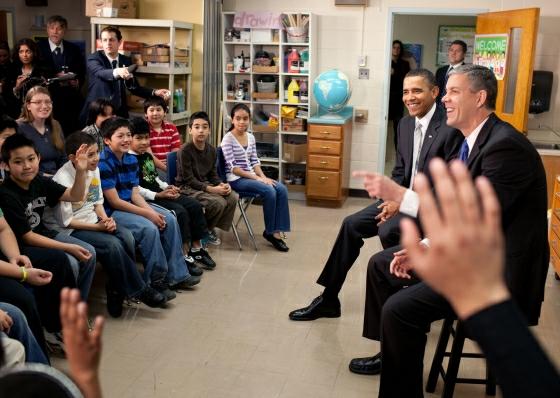
President Barack Obama and Education Secretary Arne Duncan took questions from a 6th grade class at Graham Road Elementary School in Falls Church, Virginia, January 18, 2010 – photo credit unknown
Maybe, just maybe, it’s time these reformers took a step back and did some study, perhaps from the quality gurus, Deming and Juran and Crosby, or from the heights of championship performance, in basketball, football, soccer, sailing (try the America Cup), horse racing or politics: No one can use firing as a chief tool to turn an organization around, nor to lead any organization to a championship. Threatening people’s jobs does not motivate them, nor make the jobs attractive to others.
How can we tell the fire-the-teachers-and-principals group is on the wrong track? See the article:
“To think that the same leader with a bit more money is going to accomplish tremendous change is misguided,” said Tim Cawley, a managing director at the Academy for Urban School Leadership, a nonprofit group that began leading turnaround efforts in Chicago when Mr. Duncan was the superintendent there.
“This idea of a light-touch turnaround is going to sully the whole effort,” Mr. Cawley added.
Tell that to Steve Jobs, who turned Apple around. Tell it to Jack Welch, the tough-guy boss from GE (who had his own peccadilloes about firing, but who emphasized hiring and pay, at least, as the way to create a succession plan for the vacancies). Tell it to any CEO who turned around his organization without falling on his own sword.
Any competent quality consultant would have foreseen this problem: Nobody wants to train for a job with little future, less money to do the job right, little authority to get the job done, and the sole promise that the exit door is always open.
Secretary of Education Arne Duncan should know better, intuitively. He used to play basketball, professionally. Surely he knows something about team building and team turnarounds. What caused his astounding, expensive amnesia?
Part of the issue identified in the article is training:
Because leading schools out of chronic failure is harder than managing a successful school — often requiring more creative problem-solving abilities and stronger leadership, among other skills — the supply of principals capable of doing the work is tiny.
Most of the nation’s 1,200 schools, colleges and departments of education do offer school leadership training. “But only a tiny percentage really prepare leaders for school turnaround,” said Arthur Levine, a former president of Teachers College who wrote a 2005 study of principal training.
That only contributes to the larger problem, that people in the positions are, often, the best ones for the job already; firing them damages turnaround efforts.
In Chicago, federal money is financing an overhaul of Phillips Academy High School. Mr. Cawley’s nonprofit trained Phillips’s new principal, Terrance Little, by having him work alongside mentor principals experienced at school makeovers.
“If we’re talking about turning around 700 schools, I don’t think you can find 700 principals who are capable of taking on the challenge of this work,” Mr. Little said. “If you could, why would we have this many failing schools?”
Education’s problems are many. Few of the problems are the result of the person at the chalkboard in the classroom. Firing teachers won’t help. W. Edwards Deming claimed that 85% of the problems that plague front-line employees, like teachers, are management-caused. Firing their bosses won’t solve those problems, either, but will just push the problems around. (What? “Deck chairs?” “Titanic?” What are you talking about?)
Did you hear? Texas plans to cut state funding to all education by at least 25% for next year, due to Gov. Rick Perry’s $25 billion deficit, which he worked so hard to conceal during last year’s election campaign.
Our nation is at risk. The educational foundations of our society are presently being eroded by a rising tide of mediocrity. If an unfriendly foreign power had attempted to impose on America the mediocre educational performance that exists today, we might well have viewed it as an act of war. We have, in effect, been committing an act of unthinking, unilateral educational disarmament. History is not kind to idlers.
When do we get political leaders who will swim against that tide instead of trying to surf it?
At Davos, Switzerland, Bill Clinton answered a question from former White House advisor David Gergen, I gather. American is exceptional, Clinton said — but those who insist on making “American Exceptionalism” a political mantra seriously risk making America unexceptional, and putting us into decline, he argues.
Texas Gov. Rick Perry’s ears are stinging on the issue of unbalanced state budgets.
William Jefferson “Bill” Clinton was the 42nd President of the United States, serving from 1993 to 2001. At 46 he was the third-youngest president. He became president at the end of the Cold War, and was the first baby boomer president. His wife, Hillary Rodham Clinton, is currently the United States Secretary of State. Each received a Juris Doctor (J.D.) from Yale Law School.
If the Chinese did this to us, we’d declare war. When Gray Davis proposed much smaller cuts in California, Californians recalled him from office.
But it’s Rick Perry and the Republicans. Can anyone think of a good reason to treat them better?
Recall petition on Rick Perry, anyone?
Here’s the reaction from Dallas Independent School District Superintendent Michael Hinojosa:
A message from Superintendent of Schools Michael Hinojosa
First Budget Numbers Look Grim
The Texas Legislature convened this week and provided the first look at how the state’s budget crunch could impact public education. Unfortunately, things do not look good, and that is putting it mildly.
In fact, the scenario that was presented is even worse than was initially projected. Prior to this week’s legislative session, budget analysts had predicted that public education statewide would undergo cuts of approximately $5 billion during the next biennium. The number just presented to the Texas House of Representatives is closer to $9.8 billion.
Right now, various programs that have been fully or partially funded through state grants such as prekindergarten, summer school, teacher performance incentives, and technology infrastructure are not included in the new budget. In addition, current estimates place cuts to Dallas ISD at a staggering $180-$200 million during the next two years. Because 85 percent of the district’s budget goes to personnel, this means that we will have to look at reducing payroll.
Please note that this memorandum is not written to cause a panic. It is important, however, for you to understand that the state’s budget outlook is anything but rosy and funding for education will likely be reduced. It is too early to speculate where cuts in payroll will need to take place, but everything will likely be on the table.
Next week, the Senate will present its version of the budget, and it will likely be similar. At this point, the House version does not include tapping into the state’s Rainy Day Fund, which is still an option to lawmakers. It may be a couple of months before a clearer picture will emerge of how public education will be impacted by the budget.
Please know that I will make every effort to keep you informed throughout the budget process. I also can assure you that our trustees and I will do everything we can to impress upon lawmakers the important work that you do for the children of the Dallas Independent School District.
Thank you for your continued work on behalf of Dallas ISD students.
Spread the word; friends don't allow friends to repeat history.
Zeno at Halfway There describes a terrible situation in California community colleges — not unlike the situation Texas high schools face. Don’t tell Texas Republicans, they’ll want to adopt it for community colleges, too.
State senator Carol Liu is the author of SB 1143, a measure which would somehow incorporate course completion rates in the formula for computing state funding for community colleges. Think about that for a moment. (Try giving it more thought than our legislators do.) Colleges that pass more students through their curriculum will get more funding. Colleges that pass fewer will get less. At first blush, that might seem reasonable.
Liu forgot, however, to include any quality standards in her bill. Schools that are willing to become diploma mills will prosper under her dollars for scholars program. The pressure to lower standards will be intense.
Spread the word; friends don't allow friends to repeat history.
You have the tools to compare the party platforms and determine for yourself which part supports education in Texas — I mean, really supports education, as opposed to using Doublespeak to profess support while angling to get a shiv in the back of education.
This post is tenth in a series on the education planks of the 2010 Texas Democratic Party Platform.
This is an unofficial version published in advance of the final version from the Texas Democrats, but I expect very few changes.
COMMUNITY COLLEGES
Democrats recognize and support the essential role of Texas community colleges, where almost 60% of Texas post-secondary students are enrolled. By combining affordability, high quality and responsiveness to community needs, these institutions provide an education to those who would be otherwise excluded.
Republicans have drastically reduced funding for community colleges and that burden has been shifted onto students, their families and property taxpayers. A significant funding increase would be needed just to restore Republican cuts to the 2002-3 state funding level, without adjusting for inflation. Not only do the Governor and Republican politicians again want to shift hundreds of millions of dollars in additional costs for employees’ group insurance onto students and local property taxpayers, they have already cut funding by 5% this year. And they are asking for an additional 10% in cuts to Republican budgets that currently allow only 4% of students eligible for Texas Equal Opportunity Grants to receive grants designated for community college students. To maintain community colleges’ role in providing lifelong education, we endorse:
full formula funding of the cost of instruction and of the growth in student enrollments;
fully state-funded full time employee group health insurance and proportional health benefits for adjunct instructors;
funding for new campuses and program expansions, especially in critical need programs, sufficient to meet Closing the Gaps goals;
rolling back tuition and fees that have increased over 50% under Republican control;
sufficient financial aid to cover 260,000 community college students who are eligible for grant assistance but receive none because state funding is inadequate; and
elimination of financial aid rules that penalize students who transfer to universities from community colleges.
To prevent further erosion of community colleges’ ability to serve their communities, Texas Democrats oppose:
proposals for “proportionality” that would shift group insurance costs onto students and property taxpayers;
shifting the basis of formula funding away from actual costs; and
“incentive programs that would discriminate against colleges and programs serving disadvantaged and non-traditional students or against non-degree skill-building and retraining programs.
Spread the word; friends don't allow friends to repeat history.
This post is ninth in a series on the education planks of the 2010 Texas Democratic Party Platform.
This is an unofficial version published in advance of the final version from the Texas Democrats, but I expect very few changes.
HIGHER EDUCATION
Texas Democrats believe all Texans should have the opportunity and be encouraged to pursue affordable higher education at public universities, community colleges, and technical schools. Republican “tuition deregulation” – cleverly named to imply an easing of burdens – has dramatically increased the financial burden and forced many students from middle income families to take on substantial debt to avoid being priced out of college. Tuition policies threaten our ability to meet state “Closing the Gaps” goals essential to our economic future. To offer affordable access to higher education, we support:
restoration of formula contact hour funding to the level prior to Republican cuts, adjusted for inflation and student growth;
legislative rollback of tuition and fees to affordable levels to reflect the restored funding;
federal income tax credits for college tuition;
full funding of TEXAS Grants and reforming and reopening the mismanaged state Prepaid Tuition Program, to provide higher education to more Texans without excessive debt burden;
legislation to reduce the inordinately high costs of college textbooks, technical manuals and other instructional materials;
adequate compensation, security, professional status, and benefits for all faculty and fair market wages for college employees;
weapon-free institutes of higher education;
higher education research funding to spur economic development, including sufficient funding to locate a Tier 1 research and teaching university in every region of the state;
collaborative public/higher education partnerships from pre-K-16 to enhance learning and teacher preparation;
enhanced, equitable funding for Prairie View A&M and Texas Southern University and for higher education in South Texas and all border communities;
efforts to place a voting student regent on the appointed governing board of each state supported four-year institution of higher education; and
the continuation of the Texas DREAM Act.
Spread the word; friends don't allow friends to repeat history.
Or, until that account is unsuspended by the forces supporting Donald Trump: Follow @FillmoreWhite, the account of the Millard Fillmore White House Library
We've been soaking in the Bathtub for several months, long enough that some of the links we've used have gone to the Great Internet in the Sky.
If you find a dead link, please leave a comment to that post, and tell us what link has expired.
Thanks!
Retired teacher of law, economics, history, AP government, psychology and science. Former speechwriter, press guy and legislative aide in U.S. Senate. Former Department of Education. Former airline real estate, telecom towers, Big 6 (that old!) consultant. Lab and field research in air pollution control.
My blog, Millard Fillmore's Bathtub, is a continuing experiment to test how to use blogs to improve and speed up learning processes for students, perhaps by making some of the courses actually interesting. It is a blog for teachers, to see if we can use blogs. It is for people interested in social studies and social studies education, to see if we can learn to get it right. It's a blog for science fans, to promote good science and good science policy. It's a blog for people interested in good government and how to achieve it.
BS in Mass Communication, University of Utah
Graduate study in Rhetoric and Speech Communication, University of Arizona
JD from the National Law Center, George Washington University


 Posted by Ed Darrell







 Millard Fillmore's Bathtub