Daily Flogging of Teachers Dept., Alabama Division: ‘Bible says no teacher raises’

February 4, 2012

Borrowed completely from ThinkProgress — I’m too flabbergasted to add more at the moment:

Alabama State Senator Thinks Increasing Teacher Pay Goes Against A ‘Biblical Principle’

By Amanda Peterson Beadle on Feb 1, 2012 at 2:15 pm

Tool for flogging teachers?

According to Alabama state Sen. Shadrack McGill (R), the Bible says that increasing teacher salaries would only lead to less-qualified teachers. McGill said at a prayer breakfast that doubling teachers’ salaries — starting pay for Alabama teachers begins at $36,144 — would not help education. In fact, he said that keeping teacher pay low is a “Biblical principle“:

If you double a teacher’s pay scale, you’ll attract people who aren’t called to teach.

“To go in and raise someone’s child for eight hours a day, or many people’s children for eight hours a day, requires a calling. It better be a calling in your life. I know I wouldn’t want to do it, OK?

“And these teachers that are called to teach, regardless of the pay scale, they would teach. It’s just in them to do. It’s the ability that God give ‘em. And there are also some teachers, it wouldn’t matter how much you would pay them, they would still perform to the same capacity.

“If you don’t keep that in balance, you’re going to attract people who are not called, who don’t need to be teaching our children. So, everything has a balance.”

McGill found justification in the Bible for not increasing teacher pay, but he evidently found nothing in scripture preventing him from approving a 67 percent pay increase for legislators in 2007, which increased annual salaries for the part-time legislators from $30,710 to $49,500. He said that the higher pay helped to stop corruption.

A 2011 report showed that while Alabama teachers have the highest starting salaries in the nation, the state lags far behind the national average for teacher pay. Currently, a part-time legislator in Alabama is making more than a full-time teacher with a Master’s degree and 15 years of experience.

If we don’t increase teacher pay, we get less than the best for our children.  Which should we sacrifice, our children, or this brain-dead legislator’s complete misinterpretation of the Bible?

Somebody help me out here:  Where in scriptures is there any suggestion that teachers shouldn’t get fair pay for fair work?

These guys are making a mighty effort to prove that prayer breakfasts are dangerous, anti-social gatherings that should be avoided by patriotic Americans and legislators.

Related articles suggested by Zemanta:


Oregon’s special election: Democrat Bonamici took 54% of the vote, heads to Congress

February 1, 2012

Suzanne Bonamici won the Congressional seat for Oregon’s North Coast in a special election Tuesday, Oregon Congressional District 1.  She had 54% of the vote, in an area that often votes Democrat and supported Barack Obama in 2008.

She will replace Rep. David Wu, a Democrat who resigned after he was accused of making sexual advances towards a daughter of a campaign donor. Bonamici must stand for election in November, too.

Check out the results from The Daily Astorian, one of the finer small daily papers left in America, a paper that still does real news reporting.

Watch one of her last campaign ads:

Is this a bellwether?  Democrats had a scandal-plagued representative, but won anyway.  The area traditionally votes Democratic.  Portents of November results appear rather dim.

More: 

Tip of the old scrub brush to Brenda Penner.


Boys’ Life on YouTube, February issue preview

January 21, 2012

Every time I pick up an issue of Boys’ Life I think how much better students could perform if they just looked that this magazine once a month; you don’t have to be a Scout to subscribe, but why not live the adventures, too?

Will 30-second montages sell more magazines?  What more could/should Boys’ Life do on the web?

Here’s an example of the sorts of skills I wish my students had, again from the Boys’ Life YouTube offerings.  In “Cache Me If You Can,” these are young Scouts, I’m guessing ages 11 to about 13 from a Troop 6 somewhere in Colorado, out navigating a path through the woods using GPS and hand-held ham radios.  I fear most of my 16-18-year-old students would be challenged to do the stuff these younger kids are doing, if they could do it at all.

Of course, while those skills would make them better students more able to understand and use maps and charts, very little of those skills are listed in the Texas Essential Knowledge and Skills.  I’m given neither time nor resources to teach them.

More, resources: 

  • A feature at the Boys’ Life site I really like is the “Wayback Machine,” which allows viewing of many issues of the magazine dating back to 1911 — actualy from March 1911 through December 2009.  Alas, the features uses Google Books, so viewing at the site is about all you can do — no copying of the great covers by Boy Scouts of America art director Norman Rockwell, no copying of articles with teachable skills for use as illustrations in lessons.   This would be a good research site for high school history projects — Scouts in time of war, Scouting and education, map use, youth in exploration, etc.

Fruits of the Republican War on Education

January 16, 2012

You didn’t think it was working already?

This story appeared in the Los Angeles Times, which is why Republicans discourage newspaper publishing, and why they discourage programs to teach people to read well and remember history.

In South Carolina, a discrepancy on federal spending

Campaigning Republicans draw cheers with their calls for cuts to government programs. But the state benefits from such programs to a greater extent than many others.

By Alana Semuels, Los Angeles Times

January 14, 2012, 7:55 p.m.

Reporting from Beaufort, S.C.—

When Rick Santorum stood in front of voters at a yacht club in this small town and pledged to slash government spending, especially entitlement programs, Nancy Garvin knew she had found her candidate.

Garvin, 54, said she was sick of seeing government squander money through agencies that don’t do anything, and wants expenditures cut “in half.”

Washington is throwing money away through a lot of wasteful spending,” she said, sitting at a picnic table beneath trees draped in graying Spanish moss.

But Garvin, whose husband, a carpenter, has been out of work for four years, depends on the very government she wants to see cut back. She collects disability insurance — it is what she and her husband have survived on as he’s looked for work. Her mother is on Social Security. Garvin herself used to work as a nurse at a hospital where many patients paid for services through Medicaid, another program using federal money.

Garvin’s views are similar to those of many Republican voters in this conservative state, where candidates pledging to cut government spending were met with resounding applause last week, and where former Gov. Mark Sanford tried to refuse federal stimulus funding on principle.

South Carolina and its residents benefit from government spending, more so than many other states. For every dollar the state pays in federal taxes, it receives $1.35 in federal government benefits. By contrast, California receives only 78 cents for every dollar it pays in taxes.

“We get more back from the federal government than we send in terms of revenue,” said Doug Woodward, an economics professor at the University of South Carolina. “But I’m not sure that a lot of voters would even care if they heard that. When they say they want to see less spending in the state, they’re referring to entitlement programs.”

Much of the money spent in South Carolina goes to the programs that make up a big chunk of the federal budget — defense, Social Security and Medicaid. The state has seven military bases, and received $7 billion in Defense Department spending in 2010. One in five residents in South Carolina receives Social Security benefits — compared with just 13% in California. As an aging state, South Carolina will be more dependent on federal programs such as Social Security in the coming decade, according to AARP.

“People want to see lower government spending, especially on the Republican side,” said Karen Kedrowski, a politics professor at Winthrop University in Rock Hill, S.C. “But when they’re asked specifically about high-dollar items, including Social Security and defense, they are not willing to accept significant cuts.”

Kedrowski’s university recently polled South Carolina Republicans to ask about reducing the deficit by making cuts to government programs: 73% of voters said they weren’t willing to have their current Social Security or Medicare benefits reduced to address budget concerns. More than half said they weren’t willing to cut defense spending either.

It’s not just wealthy Republican voters in the Palmetto State who say they eschew entitlement programs, Kedrowski said.

“There’s also a disproportionate number of low-income people who vote Republican because they respond to the populist messages, even when it is against their economic interests to do so,” she said.

Sheila Barton, 56, runs a floral shop in Pickens, a town that Rick Perry visited recently to stroll down Main Street and shake hands with store owners and residents.

“Americans don’t want a government that’s playing a bigger role in their lives,” Perry had said at a speech earlier that morning. “No one’s ever come up to me and said, ‘We sure need to have more government in our lives.'”

Barton agrees — in principle.

“There’s a lot of things that are wasteful,” she said, but when pressed to name some, she said she couldn’t really think of any off the top of her head. Defense spending should be increased, she said, and people who have paid into Social Security should receive their benefits. And local government programs need more funding, she said — she’s currently a guardian for local children through the court system.

There is some evidence that South Carolina’s opposition to government spending might further strangle the state’s already weak economy — if it leads to cuts in Social Security. Roberto Gallardo of the Southern Rural Development Center says that economies in many small towns in South Carolina are increasingly dependent on Social Security payments.

The percentage of total personal income in South Carolina coming from Social Security’s Old-Age, Survivors and Disability Insurance programs was 7.6% in 2009, up from 3.8% in 1970. South Carolina ranks eighth in the nation on the group’s Social Security Dependency Index, which measures how reliant local economies are on Social Security payments for job creation and consumer spending. Neighboring North Carolina ranked 23rd.

That means candidates have to walk a fine line here — promising to cut government to alleviate voters’ fears, while still preserving the programs that require most of the spending. How else to appeal to such voters as Clifton Anderson of Camden, who went to see Rick Santorum speak in a diner in Ridgeway?

“His ideas of downsizing government are most important to me,” said Anderson, about Santorum. He continued, in the next breath: “I also like his idea about strengthening defense.”

alana.semuels@latimes.com

Copyright © 2012, Los Angeles Times


Missing the point: Finland’s education success built on no tests, no teacher floggings, no school choice

January 6, 2012

Our local newspaper, The Dallas Morning News, climbed on the Finland-does-it-right bandwagon a couple of years ago, with several long dispatches from reporter Jim Landers on the education system in Finland, and how well it works (sadly, all those articles are behind paywalls with terrible search engines now).

In meetings and discussions with educators around Dallas, I have found almost no one who remember seeing the series, and none who can remember any lessons from it.

Government officials flock to Finland today.  OECD ratings put Finland near the top of education achievement, on a near-equal footing with Singapore and Shanghai.  That this is done with public schools causes brief flurries of hope.

But I gather the policymakers look at Finland, conclude that the lessons cannot be repeated in the U.S., and then move on to find new and better cats-o-nine tails to flog teachers with.  Nothing ever seems to come from looking at Finland.

In the current Atlantic Monthly, an article looks at this phenomenon, “What Americans keep ignoring about Finland’s school success,” by Anu Partanen:

So there was considerable interest in a recent visit to the U.S. by one of the leading Finnish authorities on education reform, Pasi Sahlberg, director of the Finnish Ministry of Education’s Center for International Mobility and author of the new book Finnish Lessons: What Can the World Learn from Educational Change in Finland? Earlier this month, Sahlberg stopped by the Dwight School in New York City to speak with educators and students, and his visit received national media attention and generated much discussion.

We even have the book, now!  How can we miss the lessons?

Sadly, we do.

From his [Sahlberg’s] point of view, Americans are consistently obsessed with certain questions: How can you keep track of students’ performance if you don’t test them constantly? How can you improve teaching if you have no accountability for bad teachers or merit pay for good teachers? How do you foster competition and engage the private sector? How do you provide school choice?

The answers Finland provides seem to run counter to just about everything America’s school reformers are trying to do.

For starters, Finland has no standardized tests. The only exception is what’s called the National Matriculation Exam, which everyone takes at the end of a voluntary upper-secondary school, roughly the equivalent of American high school.

Instead, the public school system’s teachers are trained to assess children in classrooms using independent tests they create themselves. All children receive a report card at the end of each semester, but these reports are based on individualized grading by each teacher. Periodically, the Ministry of Education tracks national progress by testing a few sample groups across a range of different schools.

As for accountability of teachers and administrators, Sahlberg shrugs. “There’s no word for accountability in Finnish,” he later told an audience at the Teachers College of Columbia University. “Accountability is something that is left when responsibility has been subtracted.”

For Sahlberg what matters is that in Finland all teachers and administrators are given prestige, decent pay, and a lot of responsibility. A master’s degree is required to enter the profession, and teacher training programs are among the most selective professional schools in the country. If a teacher is bad, it is the principal’s responsibility to notice and deal with it.

And while Americans love to talk about competition, Sahlberg points out that nothing makes Finns more uncomfortable. In his book Sahlberg quotes a line from Finnish writer named Samuli Puronen: “Real winners do not compete.” It’s hard to think of a more un-American idea, but when it comes to education, Finland’s success shows that the Finnish attitude might have merits. There are no lists of best schools or teachers in Finland. The main driver of education policy is not competition between teachers and between schools, but cooperation.

Finally, in Finland, school choice is noticeably not a priority, nor is engaging the private sector at all. Which brings us back to the silence after Sahlberg’s comment at the Dwight School that schools like Dwight don’t exist in Finland.

“Here in America,” Sahlberg said at the Teachers College, “parents can choose to take their kids to private schools. It’s the same idea of a marketplace that applies to, say, shops. Schools are a shop and parents can buy what ever they want. In Finland parents can also choose. But the options are all the same.”

Herein lay the real shocker. As Sahlberg continued, his core message emerged, whether or not anyone in his American audience heard it.

Decades ago, when the Finnish school system was badly in need of reform, the goal of the program that Finland instituted, resulting in so much success today, was never excellence. It was equity.

School reform?  We’re not even asking the right questions, let alone getting the right answers. “How can we learn to flog teachers better from Finland, when they don’t flog teachers at all?”  the policy makers may ask.

Read the story in The Atlantic.

Do you agree?  Why or why not?

Maybe we should change to daily flogging of state legislators and administrators, from the daily flogging of teachers.  Maybe the morale problem is up, not down.

Tip of the old scrub brush to inkbluesky.

More: 

Another clip from “The Finland Phenomenon”:


MITx launches — new model for post-secondary learning?

December 22, 2011

We get press releases in the e-mail:

MIT launches online learning initiative

MIT launches online learning initiative

MITx‘ will offer courses online and make online learning tools freely available.

December 19, 2011

Share

MIT today announced the launch of an online learning initiative internally called “MITx.” MITx will offer a portfolio of MIT courses through an online interactive learning platform that will:

  • organize and present course material to enable students to learn at their own pace
  • feature interactivity, online laboratories and student-to-student communication
  • allow for the individual assessment of any student’s work and allow students who demonstrate their mastery of subjects to earn a certificate of completion awarded by MITx
  • operate on an open-source, scalable software infrastructure in order to make it continuously improving and readily available to other educational institutions.

MIT expects that this learning platform will enhance the educational experience of its on-campus students, offering them online tools that supplement and enrich their classroom and laboratory experiences. MIT also expects that MITx will eventually host a virtual community of millions of learners around the world.

MIT will couple online learning with research on learning

MIT’s online learning initiative is led by MIT Provost L. Rafael Reif, and its development will be coupled with an MIT-wide research initiative on online teaching and learning under his leadership.

“Students worldwide are increasingly supplementing their classroom education with a variety of online tools,” Reif said. “Many members of the MIT faculty have been experimenting with integrating online tools into the campus education. We will facilitate those efforts, many of which will lead to novel learning technologies that offer the best possible online educational experience to non-residential learners. Both parts of this new initiative are extremely important to the future of high-quality, affordable, accessible education.”

Offering interactive MIT courses online to learners around the world builds upon MIT’s OpenCourseWare, a free online publication of nearly all of MIT’s undergraduate and graduate course materials. Now in its 10th year, OpenCourseWare includes nearly 2,100 MIT courses and has been used by more than 100 million people.

MIT President Susan Hockfield said, “MIT has long believed that anyone in the world with the motivation and ability to engage MIT coursework should have the opportunity to attain the best MIT-based educational experience that Internet technology enables. OpenCourseWare’s great success signals high demand for MIT’s course content and propels us to advance beyond making content available. MIT now aspires to develop new approaches to online teaching.”

OCW will continue to share course materials from across the MIT curriculum, free of charge.

MITx online learning tools to be freely available

MIT will make the MITx open learning software available free of cost, so that others — whether other universities or different educational institutions, such as K-12 school systems — can leverage the same software for their online education offerings.

“Creating an open learning infrastructure will enable other communities of developers to contribute to it, thereby making it self-sustaining,” said Anant Agarwal, an MIT professor of electrical engineering and computer science and director of MIT’s Computer Science and Artificial Intelligence Laboratory (CSAIL). “An open infrastructure will facilitate research on learning technologies and also enable learning content to be easily portable to other educational platforms that will develop. In this way the infrastructure will improve continuously as it is used and adapted.” Agarwal is leading the development of the open platform.

President Hockfield called this “a transformative initiative for MIT and for online learning worldwide. On our residential campus, the heart of MIT, students and faculty are already integrating on-campus and online learning, but the MITx initiative will greatly accelerate that effort. It will also bring new energy to our longstanding effort to educate millions of able learners across the United States and around the world. And in offering an open-source technological platform to other educational institutions everywhere, we hope that teachers and students the world over will together create learning opportunities that break barriers to education everywhere.”

Read frequently asked questions about MITx

Tip of the old scrub brush to James Darrell.


Bored in class? Do some math, for fun.

December 22, 2011

This is a good video that all math teachers ought to see (heck, I can figure out how to use it as a bell ringer in social studies, I think).

I had to mention it, just because of Michael Tobis’s wonderful headline at Planet 3.0:  “Bored in class?  Do some math instead.”

I confess to being caught doing math instead, in English, in history — and in art we often made mathematical games to create patterns.  From the stuff I see on walls in schools, that’s still popular.

Some time ago I ordered a poster from Max Temkin, the brilliant poster propagandist/artist.  It says that the universe is easy to understand if you speak its language, and that language is mathematics.  True.

Also true that in most of the disciplines that work into classes we call social studies, we do not have the ability to discern the cool patterns like Fibonacci numbers in pine cones, pineapples and sunflower blossoms.  People look for those pattersn in history anyway, and that poses a key problem to policy makers.  People want to see a pattern, expect to see a pattern, and historians cannot meet that expectation, other than quoting Santayana.

Maybe one of my students will be the one who discerns a key pattern.  It’ll be one of the slackers, if it happens.


Tom Peters’s new book close: Don’t forget why you’re here

December 20, 2011

Tom Peters reminds people to remember their noble intentions

Tom Peters reminds people to remember their noble intentions

Tom Peters offers advice to lawyers, businessmen, politicians, teachers, education administrators, journalists, fathers, mothers, husbands, wives, and friends from his book, The Littel BIG Things audio edition; go listen:

Click this headline:  Tom Peters – Don’t forget why you’re here!

Tom Peters logo


Bill of Rights Day, Thursday, December 15, 2011

December 8, 2011

I get e-mail from friends — especially for you, teachers:

Hi Ed,

As you get ready for the holidays, I wanted to send you a few reminders to wrap up the semester.

First – Bill of Rights day in next Thursday, December 15th! Be sure to check out the variety of fun and engaging activities to help you celebrate on our website! Resources include our new SMART Board activity, Fight For Ur Rights; a classroom pledge to read the Bill of Rights; rank your rights activity; free classroom lessons; trivia questions; and a quiz about the Constitution and Bill of Rights; and more!

Second – Registration for our spring one-day seminars is underway! Locations include Albuquerque, Phoenix, Newark, New York, Boston, and more; visit our website for a complete schedule with our dates and locations this spring, and to register.  Space is limited so register today!

Third – Did you know we have stocking stuffers? Give the gift of knowledge in stocking-sized Pocket Constitutions, Bill of Rights Wallet Cards, and our newest resource, America: The Quiz Game. Hurry! Order by December 16th to receive by Christmas.

Fourth – Remember all Being an American Essay Contest submissions are due on December 15th!

Happy Holidays,

Jason

Jason Ross, Ph.D.
Vice President of Education Programs
Bill of Rights Institute


Religious freedom for students in public schools — what is the law?

December 7, 2011


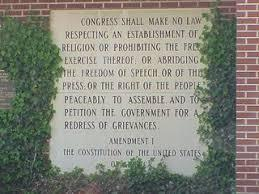
It's engraved in stone. The First Amendment, at the entrance to the Bremen Public Library in Bremen, Indiana. The Bremen Public Library serves the citizens of German Township in Marshall County, Indiana. Photo from Bremen Library.

It’s engraved in stone. The First Amendment, at the entrance to the Bremen Public Library in Bremen, Indiana. The Bremen Public Library serves the citizens of German Township in Marshall County, Indiana. Photo from Bremen Library.


President Clinton directed the Secretary of Education and the Attorney General to inform  each school district in America about the law on religious freedom in public schools.  This was the law in 2000 when Clinton left office, and it still is the law.  This statement is still accurate. [And if that site stays weird or doesn’t work for you, check it out here at the 5th Circuit U.S. Court of Appeals.]

UNITED STATES DEPARTMENT OF EDUCATION
THE SECRETARY


“…Schools do more than train children’s minds. They also help to nurture their souls by reinforcing the values they learn at home and in their communities. I believe that one of the best ways we can help out schools to do this is by supporting students’ rights to voluntarily practice their religious beliefs, including prayer in schools…. For more than 200 years, the First Amendment has protected our religious freedom and allowed many faiths to flourish in our homes, in our work place and in our schools. Clearly understood and sensibly applied, it works.”

President Clinton
May 30, 1998


Dear American Educator,

Almost three years ago, President Clinton directed me, as U.S. Secretary of Education, in consultation with the Attorney General, to provide every public school district in America with a statement of principles addressing the extent to which religious expression and activity are permitted in our public schools. In accordance with the President’s directive, I sent every school superintendent in the country guidelines on Religious Expression in Public Schools in August of 1995.

The purpose of promulgating these presidential guidelines was to end much of the confusion regarding religious expression in our nation’s public schools that had developed over more than thirty years since the U.S. Supreme Court decision in 1962 regarding state sponsored school prayer. I believe that these guidelines have helped school officials, teachers, students and parents find a new common ground on the important issue of religious freedom consistent with constitutional requirements.

In July of 1996, for example, the Saint Louis School Board adopted a district wide policy using these guidelines. While the school district had previously allowed certain religious activities, it had never spelled them out before, resulting in a lawsuit over the right of a student to pray before lunch in the cafeteria. The creation of a clearly defined policy using the guidelines allowed the school board and the family of the student to arrive at a mutually satisfactory settlement.

In a case decided last year in a United States District Court in Alabama, (Chandler v. James) involving student initiated prayer at school related events, the court instructed the DeKalb County School District to maintain for circulation in the library of each school a copy of the presidential guidelines.

The great advantage of the presidential guidelines, however, is that they allow school districts to avoid contentious disputes by developing a common understanding among students, teachers, parents and the broader community that the First Amendment does in fact provide ample room for religious expression by students while at the same time maintaining freedom from government sponsored religion.

The development and use of these presidential guidelines were not and are not isolated activities. Rather, these guidelines are part of an ongoing and growing effort by educators and America’s religious community to find a new common ground. In April of 1995, for example, thirty-five religious groups issued “Religion in the Public Schools: A Joint Statement of Current Law” that the Department drew from in developing its own guidelines. Following the release of the presidential guidelines, the National PTA and the Freedom Forum jointly published in 1996 “A Parent’s Guide to Religion in the Public Schools” which put the guidelines into an easily understandable question and answer format.

In the last two years, I have held three religious-education summits to inform faith communities and educators about the guidelines and to encourage continued dialogue and cooperation within constitutional limits. Many religious communities have contacted local schools and school systems to offer their assistance because of the clarity provided by the guidelines. The United Methodist Church has provided reading tutors to many schools, and Hadassah and the Women’s League for Conservative Judaism have both been extremely active in providing local schools with support for summer reading programs.

The guidelines we are releasing today are the same as originally issued in 1995, except that changes have been made in the sections on religious excusals and student garb to reflect the Supreme Court decision in Boerne v. Flores declaring the Religious Freedom Restoration Act unconstitutional as applied to actions of state and local governments.

These guidelines continue to reflect two basic and equally important obligations imposed on public school officials by the First Amendment. First, schools may not forbid students acting on their own from expressing their personal religious views or beliefs solely because they are of a religious nature. Schools may not discriminate against private religious expression by students, but must instead give students the same right to engage in religious activity and discussion as they have to engage in other comparable activity. Generally, this means that students may pray in a nondisruptive manner during the school day when they are not engaged in school activities and instruction, subject to the same rules of order that apply to other student speech.

At the same time, schools may not endorse religious activity or doctrine, nor may they coerce participation in religious activity. Among other things, of course, school administrators and teachers may not organize or encourage prayer exercises in the classroom. Teachers, coaches and other school officials who act as advisors to student groups must remain mindful that they cannot engage in or lead the religious activities of students.

And the right of religious expression in school does not include the right to have a “captive audience” listen, or to compel other students to participate. School officials should not permit student religious speech to turn into religious harassment aimed at a student or a small group of students. Students do not have the right to make repeated invitations to other students to participate in religious activity in the face of a request to stop.

The statement of principles set forth below derives from the First Amendment. Implementation of these principles, of course, will depend on specific factual contexts and will require careful consideration in particular cases.

In issuing these revised guidelines I encourage every school district to make sure that principals, teachers, students and parents are familiar with their content. To that end I offer three suggestions:

First, school districts should use these guidelines to revise or develop their own district wide policy regarding religious expression. In developing such a policy, school officials can engage parents, teachers, the various faith communities and the broader community in a positive dialogue to define a common ground that gives all parties the assurance that when questions do arise regarding religious expression the community is well prepared to apply these guidelines to specific cases. The Davis County School District in Farmington, Utah,is an example of a school district that has taken the affirmative step of developing such a policy.

At a time of increasing religious diversity in our country such a proactive step can help school districts create a framework of civility that reaffirms and strengthens the community consensus regarding religious liberty. School districts that do not make the effort to develop their own policy may find themselves unprepared for the intensity of the debate that can engage a community when positions harden around a live controversy involving religious expression in public schools.

Second, I encourage principals and administrators to take the additional step of making sure that teachers, so often on the front line of any dispute regarding religious expression, are fully informed about the guidelines. The Gwinnett County School system in Georgia, for example, begins every school year with workshops for teachers that include the distribution of these presidential guidelines. Our nation’s schools of education can also do their part by ensuring that prospective teachers are knowledgeable about religious expression in the classroom.

Third, I encourage schools to actively take steps to inform parents and students about religious expression in school using these guidelines. The Carter County School District in Elizabethton, Tennessee, included the subject of religious expression in a character education program that it developed in the fall of 1997. This effort included sending home to every parent a copy of the “Parent’s Guide to Religion in the Public Schools.”

Help is available for those school districts that seek to develop policies on religious expression. I have enclosed a list of associations and groups that can provide information to school districts and parents who seek to learn more about religious expression in our nation’s public schools.

In addition, citizens can turn to the U.S. Department of Education web site (http://www.ed.gov) for information about the guidelines and other activities of the Department that support the growing effort of educators and religious communities to support the education of our nation’s children.

Finally, I encourage teachers and principals to see the First Amendment as something more than a piece of dry, old parchment locked away in the national attic gathering dust. It is a vital living principle, a call to action, and a demand that each generation reaffirm its connection to the basic idea that is America — that we are a free people who protect our freedoms by respecting the freedom of others who differ from us.

Our history as a nation reflects the history of the Puritan, the Quaker, the Baptist, the Catholic, the Jew and many others fleeing persecution to find religious freedom in America. The United States remains the most successful experiment in religious freedom that the world has ever known because the First Amendment uniquely balances freedom of private religious belief and expression with freedom from state-imposed religious expression.

Public schools can neither foster religion nor preclude it. Our public schools must treat religion with fairness and respect and vigorously protect religious expression as well as the freedom of conscience of all other students. In so doing our public schools reaffirm the First Amendment and enrich the lives of their students.

I encourage you to share this information widely and in the most appropriate manner with your school community. Please accept my sincere thanks for your continuing work on behalf of all of America’s children.

Sincerely,


Richard W. Riley
U.S. Secretary of Education


RELIGIOUS EXPRESSION IN PUBLIC SCHOOLS

Student prayer and religious discussion: The Establishment Clause of the First Amendment does not prohibit purely private religious speech by students. Students therefore have the same right to engage in individual or group prayer and religious discussion during the school day as they do to engage in other comparable activity. For example, students may read their Bibles or other scriptures, say grace before meals, and pray before tests to the same extent they may engage in comparable nondisruptive activities. Local school authorities possess substantial discretion to impose rules of order and other pedagogical restrictions on student activities, but they may not structure or administer such rules to discriminate against religious activity or speech.

Generally, students may pray in a nondisruptive manner when not engaged in school activities or instruction, and subject to the rules that normally pertain in the applicable setting. Specifically, students in informal settings, such as cafeterias and hallways, may pray and discuss their religious views with each other, subject to the same rules of order as apply to other student activities and speech. Students may also speak to, and attempt to persuade, their peers about religious topics just as they do with regard to political topics. School officials, however, should intercede to stop student speech that constitutes harassment aimed at a student or a group of students.

Students may also participate in before or after school events with religious content, such as “see you at the flag pole” gatherings, on the same terms as they may participate in other noncurriculum activities on school premises. School officials may neither discourage nor encourage participation in such an event.

The right to engage in voluntary prayer or religious discussion free from discrimination does not include the right to have a captive audience listen, or to compel other students to participate. Teachers and school administrators should ensure that no student is in any way coerced to participate in religious activity.

Graduation prayer and baccalaureates: Under current Supreme Court decisions, school officials may not mandate or organize prayer at graduation, nor organize religious baccalaureate ceremonies. If a school generally opens its facilities to private groups, it must make its facilities available on the same terms to organizers of privately sponsored religious baccalaureate services. A school may not extend preferential treatment to baccalaureate ceremonies and may in some instances be obliged to disclaim official endorsement of such ceremonies.

Official neutrality regarding religious activity: Teachers and school administrators, when acting in those capacities, are representatives of the state and are prohibited by the establishment clause from soliciting or encouraging religious activity, and from participating in such activity with students. Teachers and administrators also are prohibited from discouraging activity because of its religious content, and from soliciting or encouraging antireligious activity.

Teaching about religion: Public schools may not provide religious instruction, but they may teach about religion, including the Bible or other scripture: the history of religion, comparative religion, the Bible (or other scripture)-as-literature, and the role of religion in the history of the United States and other countries all are permissible public school subjects. Similarly, it is permissible to consider religious influences on art, music, literature, and social studies. Although public schools may teach about religious holidays, including their religious aspects, and may celebrate the secular aspects of holidays, schools may not observe holidays as religious events or promote such observance by students.

Student assignments: Students may express their beliefs about religion in the form of homework, artwork, and other written and oral assignments free of discrimination based on the religious content of their submissions. Such home and classroom work should be judged by ordinary academic standards of substance and relevance, and against other legitimate pedagogical concerns identified by the school.

Religious literature: Students have a right to distribute religious literature to their schoolmates on the same terms as they are permitted to distribute other literature that is unrelated to school curriculum or activities. Schools may impose the same reasonable time, place, and manner or other constitutional restrictions on distribution of religious literature as they do on nonschool literature generally, but they may not single out religious literature for special regulation.

Religious excusals: Subject to applicable State laws, schools enjoy substantial discretion to excuse individual students from lessons that are objectionable to the student or the students’ parents on religious or other conscientious grounds. However, students generally do not have a Federal right to be excused from lessons that may be inconsistent with their religious beliefs or practices. School officials may neither encourage nor discourage students from availing themselves of an excusal option.

Released time: Subject to applicable State laws, schools have the discretion to dismiss students to off-premises religious instruction, provided that schools do not encourage or discourage participation or penalize those who do not attend. Schools may not allow religious instruction by outsiders on school premises during the school day.

Teaching values: Though schools must be neutral with respect to religion, they may play an active role with respect to teaching civic values and virtue, and the moral code that holds us together as a community. The fact that some of these values are held also by religions does not make it unlawful to teach them in school.

Student garb: Schools enjoy substantial discretion in adopting policies relating to student dress and school uniforms. Students generally have no Federal right to be exempted from religiously-neutral and generally applicable school dress rules based on their religious beliefs or practices; however, schools may not single out religious attire in general, or attire of a particular religion, for prohibition or regulation. Students may display religious messages on items of clothing to the same extent that they are permitted to display other comparable messages. Religious messages may not be singled out for suppression, but rather are subject to the same rules as generally apply to comparable messages.

THE EQUAL ACCESS ACT

The Equal Access Act is designed to ensure that, consistent with the First Amendment, student religious activities are accorded the same access to public school facilities as are student secular activities. Based on decisions of the Federal courts, as well as its interpretations of the Act, the Department of Justice has advised that the Act should be interpreted as providing, among other things, that:

General provisions: Student religious groups at public secondary schools have the same right of access to school facilities as is enjoyed by other comparable student groups. Under the Equal Access Act, a school receiving Federal funds that allows one or more student noncurriculum-related clubs to meet on its premises during noninstructional time may not refuse access to student religious groups.

Prayer services and worship exercises covered: A meeting, as defined and protected by the Equal Access Act, may include a prayer service, Bible reading, or other worship exercise.

Equal access to means of publicizing meetings: A school receiving Federal funds must allow student groups meeting under the Act to use the school media — including the public address system, the school newspaper, and the school bulletin board — to announce their meetings on the same terms as other noncurriculum-related student groups are allowed to use the school media. Any policy concerning the use of school media must be applied to all noncurriculum-related student groups in a nondiscriminatory matter. Schools, however, may inform students that certain groups are not school sponsored.

Lunch-time and recess covered: A school creates a limited open forum under the Equal Access Act, triggering equal access rights for religious groups, when it allows students to meet during their lunch periods or other noninstructional time during the school day, as well as when it allows students to meet before and after the school day.

Revised May 1998


List of organizations that can answer questions on religious expression in public schools

Religious Action Center of Reform Judaism
Name: Rabbi David Saperstein
Address: 2027 Massachusetts Ave., NW, Washington, DC 20036
Phone: (202) 387-2800
Fax: (202) 667-9070
Web site: http://www.rj.org/rac/
American Association of School Administrators
Name: Andrew Rotherham
Address: 1801 N. Moore St., Arlington, VA 22209
Phone: (703) 528-0700
Fax: (703) 528-2146
Web site: http://www.aasa.org
American Jewish Congress
Name: Marc Stern
Address: 15 East 84th Street, New York, NY 10028
Phone: (212) 360-1545
Fax: (212) 861-7056
National PTA
Name: Maribeth Oakes
Address: 1090 Vermont Ave., NW, Suite 1200, Washington, DC 20005
Phone: (202) 289-6790
Fax: (202) 289-6791
Web site: http://www.pta.org
Christian Legal Society
Name: Steven McFarland
Address: 4208 Evergreen Lane, #222, Annandale, VA 22003
Phone: (703) 642-1070
Fax: (703) 642-1075
Web site: http://www.clsnet.com
National Association of Evangelicals
Name: Forest Montgomery
Address: 1023 15th Street, NW #500, Washington, DC 20005
Phone: (202) 789-1011
Fax: (202) 842-0392
Web site: http://www.nae.net
National School Boards Association
Name: Laurie Westley
Address: 1680 Duke Street, Alexandria, VA 22314
Phone: (703) 838-6703
Fax: (703) 548-5613
Web site: http://www.nsba.org
Freedom Forum
Name: Charles Haynes
Address: 1101 Wilson Blvd, Arlington, VA 22209
Phone: (703) 528-0800
Fax: (703) 284-2879
Web site: http://www.freedomforum.org

-###-


Office not the place to get work done? Maybe school is not the place to learn

November 28, 2011

I do like the work of business and management gurus who tend to look at things oddly, and ask the odd, just-right questions.

Jason Fried’s work found that most people, when they “need to get work done,” don’t go to an office.

Listen to his TEDS Talk, and consider, dear teacher or education administrator:  What if schools are not the places to teach, or worse, not places to learn?

Now:  Who the heck is Jason Fried?


“John Brown’s Body” becoming “The Battle Hymn of the Republic”: Managing expectations of a nation during a civil war

November 27, 2011

Our textbooks and curriculum guides too often fail to make clear the links between the bloody conflicts in the Kansas Territory and the Civil War, between the conflicts engaged in by men like John Brown in Kansas, and later at Harper’s Ferry, Virginia, and the conflicts of the Civil War.

We might make the history more vivid and clear with the use of Julia Ward Howe’s “Battle Hymn of the Republic,” an epic war song based closely on a folk tune favored by Union troops of the time, conscripted specifically because of that affinity by Howe to serve the greater action of repurposing the war from merely saving the Union to freeing people from bondage.  It’s a study in propaganda earlier than we usually think of it.

Prof. R. Blakeslee Gilpin’s essay explaining those links, and exposing the substantial and usually hidden role Julia Ward Howe’s husband played in Brown’s raid on Harper’s Ferry, appears in the New York Times’s coverage of the 150th anniversary of the Civil War.  As identified at the NYT website, Gilpin is a visiting assistant professor of history at the University of South Carolina, and the author of a book on the issue, John Brown Still Lives!: America’s Long Reckoning With Violence, Equality, and Change.

Early lyric sheet for "Battle Hymn of the Republic," by Julia Ward Howe, Library of Congress via New York Times

An early lyric sheet for "Battle Hymn of the Republic," by Julia Ward Howe, Library of Congress via New York Times

Most of my students claim not to know the song, “John Brown’s Body,” and an astonishing number of the students say they don’t know “The Battle Hymn of the Republic.”  It’s a chance to bore them — or instruct them, if the planets and stars align — using a bit of music (a teacher should be able to find a copy of the Mormon Tabernacle Choir’s version of the “The Battle Hymn” with little difficulty; it appears in the hymnals of most Protestant sects, so you can get a copy of the lyrics; you’ll have to do a search to find a good copy of  “John Brown’s Body,” though; I’ve not found one I like to use in class).

It might be a short lesson, an adjunct to a lesson, or a project for a student with some choir training.

Gilpin wrote:

Even if Howe’s song spoke to a different understanding of the war, her efforts to transform “John Brown’s Body” into a national patriotic text meant that, much like Brown’s afterlife, people would end up using and abusing “Battle Hymn” as they saw fit. What Howe observed in that Union camp outside of Washington in 1861 was just the beginning of a war of clashing agendas and endlessly obscured meanings. To be sure, those north and south of the Mason-Dixon Line knew that the developing war was being fought over slavery – its brutal realities, its political volatility and especially its uncertain future – but even in its opening months, commentary about the war was already cloaked in the bland language of preserving the Union or defending states’ rights. Assessing the war itself, Howe later wrote that “its cruel fangs fastened upon the very heart of Boston and took from us our best and bravest.”

For Howe and generations of Americans, the cruelty of war demanded a providential overseer. Despite her urge to celebrate noble-hearted men like Brown, “Battle Hymn” helped to take responsibility for the Civil War out of the brutal and clumsy hands of ordinary mortals. To be sure, Brown his death would help to make his nation holy and especially to make all men free, but his radical extremism was frightening to most Americans. Soon enough, the Civil War would be transformed by songs like Howe’s into a conflict of necessity and destiny – a providential trial by fire. That narrative, of a harrowing but essential national adolescence, would eventually be at the expense of those Brown had died for, and whose fate the war was being fought to settle.

More links and a couple of original documents can be found at the NYT site — I would encourage all U.S. history teachers to subscribe to the paper’s coverage of the sesquicentennial of the war.


Rhodes Scholars for 2012

November 21, 2011

On November 19, 2011, the Rhodes Trust announced the 32 winners of Rhodes Scholarships for the United States for 2012.

These young people are among the smartest and most accomplished people of their generation.  Under the will of Cecil Rhodes, the developer of African railroads and colonist, Rhodes Scholars must demonstrate leadership and service, and they must be well-rounded, which usually means they are accomplished athletes in one area in addition to their academic acumen.

One of this year’s winners will have to bail out on the second year of his Teach for America commitment — one hopes TFA will understand.  Joshua Carpenter, a 2010 graduate of the University of Alabama-Birmingham, taught writing, math and economics in Marion, Alabama.

Past American Rhodes Scholarship winners include former Sen. Bill Bradley of New Jersey, the late Sen. J. William Fulbright of Arkansas, musician and actor Kris Kristofferson, MSNBC host Rachel Maddow, former President Bill Clinton, late Secretary of State Dean Rusk, Sen. Richard Lugar of Indiana, physician and Pulitzer-winning author Siddhartha Mukherjee, U.S. Ambassador to the UN Susan Rice, and author Naomi Wolf.  Here’s the press release from the Trust:

WASHINGTON, DC/November 19, 2011 – Elliot F. Gerson, American Secretary of the Rhodes Trust, today announced the names of the thirty-two American men and women chosen as Rhodes Scholars representing the United States. Rhodes Scholarships provide all expenses for two or three years of study at the University of Oxford in England, and may allow funding in some instances for four years. Mr. Gerson called the Rhodes Scholarships,” the oldest and best known award for international study, and arguably the most famous academic award available to American college graduates.” They were created in 1902 by the Will of Cecil Rhodes, British philanthropist and African colonial pioneer. The first class of American Rhodes Scholars entered Oxford in 1904; those elected today will enter Oxford in October 2012.

Rhodes Scholars are chosen in a two-stage process. First, candidates must be endorsed by their college or university. This year over 2000 students sought their institution’s endorsement; 830 were endorsed by 299 different colleges and universities.

Committees of Selection in each of 16 U.S. districts then invite the strongest applicants to appear before them for interview. Gerson said, “applicants are chosen on the basis of the criteria set down in the Will of Cecil Rhodes. These criteria are high academic achievement, integrity of character, a spirit of unselfishness, respect for others, potential for leadership, and physical vigor. These basic characteristics are directed at fulfilling Mr. Rhodes’s hopes that the Rhodes Scholars would make an effective and positive contribution throughout the world. In Rhodes’ words, his Scholars should ‘esteem the performance of public duties as their highest aim.'”

Applicants in the United States may apply either through the state where they are legally resident or where they have attended college for at least two years. The district committees met separately, on Friday and Saturday, November 18 and 19, in cities across the country.  Each district committee made a final selection of two Rhodes Scholars from the candidates of the state or states within the district. Two-hundred ten applicants from 99 different colleges and universities reached the final stage of the competition, including 15 that had never before had a student win a Rhodes Scholarship. Gerson also reported, “in most years, we elect a winner from a college that had never before had a Rhodes Scholar, even after more than a century. This year we are pleased to announce first-time winners from Bard College and from California State University, Long Beach.”

The thirty-two Rhodes Scholars chosen from the United States will join an international group of Scholars chosen from fourteen other jurisdictions around the world. In addition to the thirty-two Americans, Scholars are also selected from Australia, Bermuda, Canada, the nations of the Commonwealth Caribbean, Germany, Hong Kong, India, Jamaica, Kenya, New Zealand, Pakistan, Southern Africa (South Africa, plus Botswana, Lesotho, Malawi, Namibia and Swaziland), Zambia, and Zimbabwe. Approximately 80 Scholars are selected worldwide each year, usually including several who have attended American colleges and universities but who ae not U.S. citizens and who have applied through their home country.

With the elections announced today, 3,260 Americans have won Rhodes Scholarships, representing 314 colleges and universities. Since 1976, women have been eligible to apply and 458 American women have now won the coveted scholarship. And for the fourth time since 1976, more women (17) than men (15) were elected. Men constituted 58% of the applicant pool and 60% of those who reached the final stage of the competition. More than 1,800 American Rhodes Scholars are living in all parts of the U.S. and abroad.

The value of the Rhodes Scholarship varies depending on the academic field and the degree (B.A., master’s, doctoral) chosen. The Rhodes Trust pays all college and university fees, provides a stipend to cover necessary expenses while in residence in Oxford as well as during vacations, and transportation to and from England. Mr. Gerson estimates that the total value of the Scholarship averages approximately US$50,000 per year, and up to as much as US$200,000 for Scholars who remain at Oxford for four years in certain departments.

The full list of the newly elected United States Rhodes Scholars, with the states from which they were chosen, their home addresses, and their American colleges or universities, follows. Brief profiles follow the list.

Selectees are listed here first by the state from which they competed, and then by the college they attended — note that the college may not be in the state from which the candidate competed.

American Rhodes Scholars-elect for 2012
(Subject to ratification by the Rhodes Trustees after acceptance by one of the colleges of Oxford University)

District 1

New Hampshire, Yale University
Ms. Helen E. Jack
Hanover, New Hampshire

Rhode Island Brown University
Ms. Emma F. LeBlanc
Manchester, New Hampshire

District 2

Massachusetts, Princeton University
Ms. Elizabeth W. Butterworth
Auburn, Massachusetts

Massachusetts, Brown University
Mr. David S. Poritz
Amherst, Massachusetts

District 3

New York, Princeton University
Ms. Miriam Rosenbaum
Bronx, New York

New York, Harvard College
Ms. Brett A. Rosenberg
Chappaqua, New York

District 4

Pennsylvania, Bryn Mawr College
Ms. Nina R.W. Cohen
Newton, Massachusetts

Pennsylvania, University of Pittsburgh
Mr. Cory J. Rodgers
Somerset, Pennsylvania

District 5 

Rhodes Scholar Brandon Turner, of Fontana, California, Wake Forest University

Rhodes Scholar Brandon Turner, of Fontana, California, Wake Forest University


Maryland/DC, Yale Law School and Bard College
Mr. Ronan S. Farrow
Washington, D.C.

North Carolina, Wake Forest University
Mr. Brandon E. Turner
Winston-Salem, North Carolina

District 6

Georgia, Stanford University
Mr. Ishan Nath
Atlanta, Georgia

Virginia, Brown University
Mr. Nabeel N. Gillani
Glen Allen, Virginia

District 7

Alabama, University of Alabama at Birmingham
Mr. Joshua D. Carpenter
Florence, Alabama

Tennessee, Sewanee: The University of the South
Ms. Carrie H. Ryan
Sewanee, Tennessee

District 8

Texas, Stanford University
Ms. Aysha N. Bagchi
Austin, Texas

Texas, Stanford University
Mr. Anand R. Habib
Houston, Texas

District 9

Indiana, Princeton University
Mr. Mohit Agrawal
West Lafayette, Indiana

Rhodes Scholar Victor Yang, of Lexington, Kentucky (Harvard University)

Victor Yang, from Lexington, Kentucky (Harvard University)

Kentucky, Harvard College
Mr. Victor Yang
Lexington, Kentucky

District 10

Rhodes Scholar Sarah Smierciak, Northwestern University - Chicago Tribune photo

Chicago Tribune photo - Northwestern University student and new Rhodes Scholar Sarah Smierciak speaks with the media on the Northwestern University campus in Evanston today. (StaceyWescott / Chicago Tribune / November 20, 2011)

Illinois, Northwestern University
Ms. Sarah N. Smierciak
Lemont, Illinois

Michigan, Harvard College
Mr. Spencer B.L. Lenfield
Paw Paw, Michigan

District 11

New Rhodes Scholar Alexis Brown, University of Wisconsin

New Rhodes Scholar Alexis Brown, University of Wisconsin

Wisconsin, University of Wisconsin-Madison
Ms. Alexis K. Brown
Madison, Wisconsin

Wisconsin, Princeton University
Ms. Astrid E. M. L. Stuth
Hubertus, Wisconsin

District 12

Kansas, University of Kansas
Ms. Kelsey R. Murrell
Kearney, Missouri

South Carolina, Stanford University
Ms. Katherine Niehaus
Columbia, South Carolina

District 13

Colorado, United States Air Force Academy
Mr. Zachary A. Crippen
Bala Cynwyd, Pennsylvania

USAFA Rhodes Scholar Zachary Crippen at Aspen Institute with Brent Scowcroft and others - USAFA photo

Aspen Institute Left to right; Cadet 1st Class Zachary Crippen (Rhodes Scholar), Cadet Squadron 12; retired Lt. Gen. Brent Scowcroft, co-chairman of the Aspen Strategy Group; Dr. Schuyler Foerster, the Academy’s Brent Scowcroft professor for national security studies; Cadet 1st Class Peter Lind, CS15; and Cadet 1st Class Nathan Betcher, CS25, pose for a photo at the Aspen Institute Saturday (date not designated) (U.S. Air Force Photo)

Colorado, Harvard College
Mr. Samuel M. Galler
Boulder, Colorado

District 14

Washington, University of Washington
Mr. Byron D. Gray
Post Falls, Idaho

Washington, University of Washington
Mr. Cameron W. Turtle
Pullman, Washington

District 15

California, Brown University
Ms. Brianna R. Doherty
Carmichael, California

California, Stanford University
Ms. Tenzin Seldon
Albany, California

District 16

California, California State University, Long Beach
Ms. Stephanie Bryson
San Diego, California

California, Massachusetts Institute of Technology
Ms. Stephanie Lin
Irvine, California

More details may be available at the Rhodes Trust website for the American group.

Profiles of Rhodes 2012 winners below the fold.

News coverage:

Why isn’t this a bigger deal in American news outlets?

Read the rest of this entry »


Daily Floggings of Teachers Dept.: Utah

November 17, 2011

Sign on the door of the mishipmen’s mess:  “The daily floggings will continue until morale improves.”

In an effort to raise teacher morale to a level at least as high as that of the British Navy back in the day when everyday brought “flog and grog” — though, admittedly, we work in education today without the grog — policy makers continue in their efforts to blame teachers for every problem of education, and they pledge to “hold teachers accountable” regardless the issue.

In November 16th’s Deseret News from Salt Lake City:

Utah senator says teacher morale is low and lawmakers need to address teacher perceptions

SALT LAKE CITY — A freshman state senator, who held a series of tell-all meetings with Utah school teachers, relayed to his colleagues Wednesday a common theme among public educators: Teacher morale is low.

“They are discouraging new teachers from entering the profession. … They feel classroom size is an issue. … They feel that they don’t have the professional development support they need,” said Sen. Aaron Osmond, R-South Jordan, at an Education Interim Committee meeting. “That’s what they feel. I’m not validating it or invalidating it. I’m communicating it to this group.

Osmond went to teachers to get feedback on his controversial proposal that would make it easier to fire teachers. His legislation would dismantle current state orderly termination laws that require districts to have a specific, documented cause when firing teachers and allow teachers a chance for recourse. The proposal would also give more control to local districts so they can develop termination policies based on what works for them and institute one- to five-year contracts at the end of which schools could let teachers go without cause.

Osmond held four meetings where public school educators could give him a piece of their mind. Hundreds of teachers attended.

“Our public employees feel that there is a major morale problem in education,” he said.

No kidding?


Teach for America: Savior of Dallas schools?

November 15, 2011

Lead editorial in today’s Dallas Morning News (page 14A):

Retaining Teachers

DISD should redouble efforts to support Teach for America recruits

In 2009, the Dallas Independent School District welcomed 80 Teach for America teachers to its campuses. These newly minted teachers were part of a competitive program that sends top college graduates to work in urban and rural public schools.

Two years later, only 45 teachers from that inaugural class remain in the district.

Where did the others go? DISD can’t say for sure.

Teach for America teachers make a two-year commitment. So, after fulfilling that obligation, they’re free to pursue other teaching opportunities, graduate school or entirely different careers.

Losing 43 percent of the first TFA class is somewhat troubling — particularly because that’s higher than the program’s national attrition rate in high-poverty schools. But that fact alone doesn’t mean that DISD and Teach for America aren’t a good fit.

One number doesn’t tell the whole story, and DISD would benefit from additional data as subsequent TFA classes complete their two-year stints. It would be useful for the district and Teach for America to know more about why these teachers are leaving and whether they are seeking out teaching jobs in other districts.

Still, the attrition rate raises important questions about what more DISD can do to support these young teachers — and encourage them to stay.

TFA is supplying the Dallas school district with teachers who were high achievers and leaders on their college campuses. And while they’re new to teaching, many are distinguishing themselves quickly. In 2010, DISD reported that the district’s TFA teachers were outperforming their peers in educating students in reading and math.

Even Teach for America’s critics, who often complain that TFA corps members don’t stay long enough to make a difference, would agree that these teachers will become even more effective with additional years of experience.

With all this in mind, DISD should refocus its efforts to ensure that TFA teachers who spend two years at a Dallas public school consider extending their stay. While this is still a relatively new program in DISD, the early numbers suggest that the district has not been a particularly welcoming place.

DISD should bolster its mentoring efforts and consider what other strategies could be employed to help TFA teachers succeed — and feel motivated to continue teaching.

There’s no doubt that some TFA corps members enter the program planning to teach only two years before embarking on another career. But Teach for America’s hope is that some will be inspired to continue in education.

Other districts with similar challenges have had more success retaining TFA corps members.

DISD should seize this opportunity to mentor and develop a unique group of teachers — instead of simply watching them walk out the door.

I work alongside several Teach for America people — to a person, great colleagues.  Some of them faced the same barriers to entry I did — Dallas was unhappy with my recommendations, for example, and held out my hiring for a few weeks because they didn’t want to take the recommendation of the chairman of the U.S. Senate Committee which deals with education policy, for whom I worked for a decade, but instead insisted I get a teacher  or someone from a local education establishment to write the letter (I got a person who assigned substitutes in a local district to comment — we knew each other on the phone).  Why they wouldn’t take the word of someone who knows me over someone in education, I don’t know — but there is a moral in that morass, somewhere.

Dallas ISD is generally not a teacher-friendly place these days.  After two rounds of layoffs, we have all been informed clearly that we are all on the maybe-needs-firing line.  TFA teachers can stay above that only partly — the poisonous atmosphere infects all faculty meetings and department tete-a-tetes.

There is a big difference between TFA teachers and others:  TFA is tough (sometimes stupidly too tough), but they let every one of their people know that each one is valuable, and expected to do great things.

Dallas ISD tried to do that once.  We had a kid give a great motivational speech at the fall welcome-back-teachers ball.

Then the district announced it had goofed, and a few hundred teachers would have to go.  Then word got out that the mother of the kid who gave the speech — a teacher — was on the chopping block.  Then word got out that the whole program the kid was in, was on the chopping block. Yeah, we believe in you, kid — we just don’t believe in education any more.

Is TFA the answer to Dallas’s woes?  What’s your view?  I’m still thinking about an appropriate, and informative response.

Also see this at the Dallas Morning News site:

Sidebar:

What is Teach for America?

Teach for America is an organization that works to recruit high-achieving college graduates for two-year teaching stints in urban and rural public schools. The hope is that many will continue to work in the field of education or an area that impacts student achievement.

The selection process is competitive — only 11 percent of this year’s 48,000 applicants were accepted.

The chart shows the number of Teach for America teachers in DISD, broken down by the school year they arrived. Many of those who started in 2009-10, the inaugural year in DISD, left after serving their two-year commitment.

School year TFA members received In DISD as of Sept. 26
2009-10 80 45
2010-11 107 102
2011-12 45 45
Total 232 192

SOURCES: Dallas ISD; Dallas Morning News research