Annals of global warming: Al Gore didn’t invent it, Isaac Asimov explained in 1989

June 8, 2011

Amber Jenkins wrote over at NASA’s site:

I stumbled upon this video earlier today. It’s Isaac Asimov, famous science fiction writer and biochemist, talking about global warming — back in January 1989. If you change the coloring of the video, the facial hair style, and switch out Asimov for someone else, the video could pretty much have been made today.

Asimov was giving the keynote address at the first annual meeting of The Humanist Institute. “They wanted me to pick out the most important scientific event of 1988. And I really thought that the most important scientific event of 1988 will only be recognized sometime in the future when you get a little perspective.”

What he was talking about was the greenhouse effect, which, he goes on to explain, is “the story everyone started talking about [in 1988], just because there was a hot summer and a drought.” (Sound familiar, letting individual weather events drive talk of whether the Earth’s long-term climate is heating up or cooling down??)

The greenhouse effect explains how certain heat-trapping (a.k.a. “greenhouse”) gases in our atmosphere keep our planet warm, by trapping infrared rays that Earth would otherwise reflect back out into space. The natural greenhouse effect makes Earth habitable — without our atmosphere acting like an electric blanket, the surface of the earth would be about 30 degrees Celsius cooler than it is now.

The problem comes in when humans tinker with this natural state of affairs. Our burning of fossil fuels (coal, oil and gas) constantly pumps out carbon dioxide — a heat-trapping gas — into the atmosphere. Our cutting down of forests reduces the number of trees there are to soak up some of this extra carbon dioxide. All in all, our atmosphere and planet heats up, (by about 0.6 degrees Celsius since the Industrial Revolution) with the electric blanket getting gradually thicker around us.

“I have been talking about the greenhouse effect for 20 years at least,” says Asimov in the video. “And there are other people who have talked about it before I did. I didn’t invent it.” As we’ve stressed here recently, global warming, and the idea that humans can change the climate, is not new.

As one blogger notes, Asimov’s words are as relevant today as they were in 1989. “It’s almost like nothing has happened in all this time.” Except that Isaac Asimov has come and gone, and the climate change he spoke of is continuing.

Asimov’s full speech can be seen here.

Scientists have been on the job that long, yes.  Al Gore didn’t invent global warming or climate change, contrary to the working beliefs of much of the “no human warming” crowd.

One of the commenters at Jenkins’ blog put things in perspective:

Jim
January 8, 2011 – 10:22 PST

Interestingly, 1988 was
• the last year that we were not in ecological overshoot
• the last year we were at 350 Parts per million CO2
• the publication date of Joseph Tainter’s he Collapse of Complex Societies http://intersci.ss.uci.edu/wiki/index.php/The_Collapse_of_Complex_Societies


Quote of the moment: Why does the Clean Air Act mention “climate?” – Naomi Oreskes

June 3, 2011

From “The Invention of Lying” at the American Prospect:

This is ultimately about regulation — its’ about the proper role of government — and what we’re seeing in Congress right now is nothing new. We saw it back in the Newt Gingrich years. It’s about gutting the regulatory structure of the federal government and the main agenda now is to gut the EPA. The Supreme Court ruled very clearly that the EPA does have legal authority — not just authority, legal responsibility — to regulate carbon dioxide under the Clean Air Act.

You know, no journalist has ever asked me why the Clean Air Act, signed in 1973, mentions climate.

Q:  Why does the Clean Air Act mention climate?

Thank you. Because people already knew back in the 1960s that pollution could change the climate.

– Naomi Oreskes to Robert S. Eshelman, “The Invention of Lying,” The American Prospect, June 3, 2011


From the Presbyterian Church to environmental activism

June 1, 2011

Potomac Presbyterian Church, Potomac, Maryland, photo by Sarah Beth Hensley

Breeding ground for environmentalists? Potomac Presbyterian Church, Potomac, Maryland, photo by Sarah Beth Hensley, courtesy Potomac Patch

Shouldn’t this make the self-appointed, self-appointed Christians, anti-environmentalists, and global warming . . . um . . . disbelievers howl?

According to an environmental historian I know, the ranks of the Presbyterians have produced many of this country’s well-known environmentalists: John Muir, Rachel Carson, Edward Abbey, the list goes on.

Just think:  Environmentalism as the result of a Christian upbringing?  How could such a thing be?

The fawning John Galt Fan Club will similarly be disamused.  They claim environmentalists come from Stalin and the communists, not from Presbyterians.

What will the neighbors say?

Could it be true?


Chronic drought complicated by chronic denialism

May 26, 2011

Which is worse:  To be in the depths of a drought, or to deny drought where it exists?

I ask the question because, as one cannot tear one’s eyes away from a train wreck about to occur, I watch Steve Goddard’s blog.  Occasionally Steve or one of his fellow travelers says something so contrary to reality or fact that I can’t resist pointing it out.

In some discussion over there, Goddard suggested that because there is above-average snowpack around Salt Lake City and in Northern Utah, Lake Powell’s decade-long struggle with extreme drought is over.  Therefore, to Goddard, global warming does not exist.

(No, I’m not really exaggerating.  Seriously.  Go look.  No one there seems to have ever had a course in logic, nor in English composition and essay writing.  If Al Gore got svelte, one suspects half the commenters there would never be able to speak again.)

It is true that this year, contrary to the past decade, snowpack is high along the Wasatch Front and in the Uinta Mountains of Utah, and in Wyoming and Colorado areas that drain into the Green and Colorado Rivers.  Consequently, forecasters say that Lake Powell may gain a few feet of depth this year.  Powell is down about 50 feet, however, and even a record snowpack won’t erase the effects of drought on the lake.  (Yeah, I know:  The Wasatch doesn’t drain into the Colorado system — it drains to the Great Salt Lake, as indeed do many of the streams that have great snowpack in Utah — so a lot of the record snowpack won’t get within 400 miles of Lake Powell.  That’s geography, and it would be one more area that commenters would embarrass themselves in.  Don’t ask the pig to sing if you aren’t going to spend the time to teach it; if you need the aphorism on teaching pigs to sing, look it up yourself.)

Since Lake Powell won’t lose a lot of elevation this year, the Goddardites (Goddardians?  Goddards?  Goddardoons?) pronounce the U.S. free of drought.

Right.

Check it out for yourself, Dear Reader.  Here’s an animation from the National Drought Center, showing drought measurements in the contiguous 48 states plus Alaska and Hawaii, over the past 12 weeks:

Drought in the U.S., 12 weeks ending May 17, 2011, National Drought Mitigation Center, U of Nebraska-Lincoln

Drought in the U.S., 12 weeks ending May 17, 2011, National Drought Mitigation Center, U of Nebraska-Lincoln - click on map for a larger version at the Drought Monitor site.

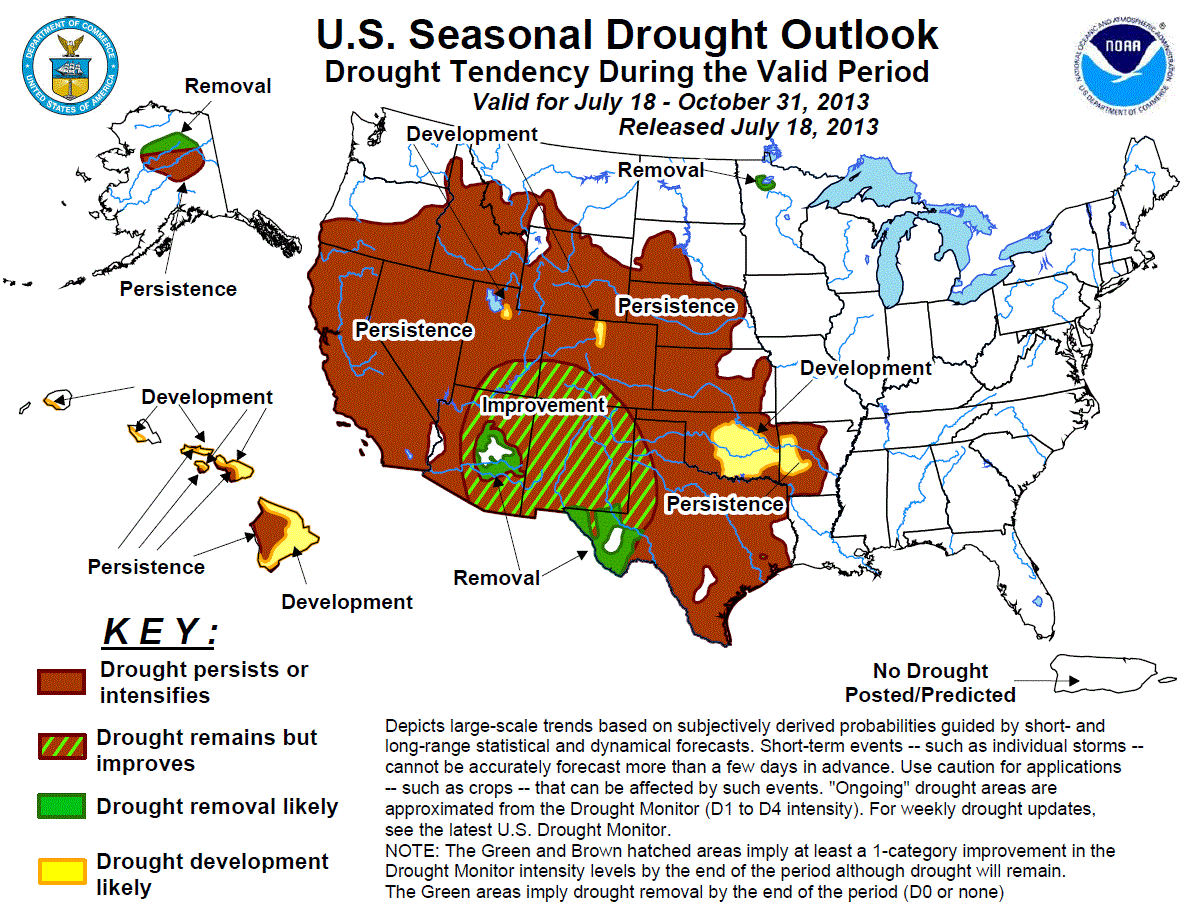
Here’s the drought outlook map from the Climate Prediction Center at NOAA:

U.S. Seasonal Drought Outlook Map, released May 19, 2011, NOAA and the Climate Prediction Center

U.S. Seasonal Drought Outlook Map, released May 19, 2011, NOAA and the Climate Prediction Center - click image for a larger version at NOAA's site.

It would be wonderful were these droughts to break soon.  But that is very unlikely.

So, why would anyone deny it?

Then, just to indicate the bait-and-switch logic these guys use, Goddard came back with a claim that the 1956 drought in Texas was worse, as if that means the current drought doesn’t exist.  Fore reasons apparent only to those whose heads get pinched by tinfoil hats, he also notes the CO2 levels for 1956.  I think I know what point he’s trying to make, but someone should tell him that apples are not oranges, and comparing apples and oranges to pomegranates doesn’t increase the supply of tennis balls.

Let’s just stick to the facts.  The experts who must operate the dams and lakes and get water to Mexico on schedule say the drought along the Colorado persists.  Who are we to gainsay them?

Resources:  

GEOSat photos of Lake Powell and drought, 2000 to 2004 - Dr. Paul R. Baumann, SUNY - Oneonta College

GEOSat photos of Lake Powell and drought, 2000 to 2004 - Dr. Paul R. Baumann, SUNY - Oneonta College