Quote of the Moment: Barry Commoner and presidential campaigns

June 19, 2007

Barry Commoner turned 90 on May 28. He is profiled in The New York Times Science section on June 19, 2007 (if your local newspaper has a science section half as good, I’d love to hear about it). Commoner is a plant physiologist and great eminence at Washington University in St. Louis for 34 years, now at Queens College. He was a key informant of public opinion during the rise of ecological awareness in the 1960s and 1970s, probably the nation’s best known “ecologist.”

Barry Commoner on cover of Time, 2-2-1970

In 1980 he helped found the Citizens’ Party, and ran for the presidency their ticket.

He explained to the Times:

The peak of the campaign happened in Albuquerque, where a local reporter said to me, “Dr. Commoner, are you a serious candidate or are you just running on the issues?”

Time Magazine cover from February 2, 1970; Time sells replicas of historic covers.


How many WorldNet Daily hoaxes does it take to change a light bulb?

June 6, 2007

Earlier I pointed to a hoax article foisted by WorldNet Daily, claiming families would face exorbitant hazardous waste clean up costs if they broke a compact fluorescent lightbulb (CFLs).

Not only did WorldNet Daily never apologize to its readers, the paper is at it again, campaigning in favor of pollution and global warming, trying to scare people who switch to lights other-than-tungsten.

Hoaxmeister Joseph Farah uses an over-the-top, breathless tone: HEAT OF THE MOMENT
Light-bulb ban craze exceeds disposal plans
Facts about CFLs, heir to incandescents, downplayed in government-enviro push”

Could anyone take that seriously? As Dave Barry used to say, “I could not make this up,” the “danger” from CFLs shows up in serious discussion forums. This forum, inaptly titled “Straight Talk,” demonstrates that people really do believe such hoaxes, especially about things they know very little about, like mercury poisoning.

Folks, five will get you ten, if you told these people about massive mercury poisoning that really exists in the Hudson River, and warned them against eating fish caught there, they’d claim you were an alarmist tree-hugger and laugh it off — though the mercury levels and potential for health-damaging exposure are both significantly greater for fish caught in some rivers, like the Hudson, than they are for broken CFLs.

But just try to suggest a small way to work against global warming, and they’ll pull out that same mercury poisoning argument to justify doing nothing and letting pollution win.

A warning to these people to “use your head” goes completely unheeded, heads having been lost some time earlier.

Here’s an example of just how far Farah twists the facts in order to make his hoax case against CFLs. First, Farah all but calls CFLs a communist plot (he claims the move to use them started in Cuba, under Castro — a dubious claim at best, and funny any way you cut it). Then he points to a Swedish firm marketing the bulbs in the U.S. — them furriners can’t be trusted, Farah implies. The firm is IKEA — never mind they are fine examples of capitalism run rampant. Third, Farah cites an editorial in Waste News , but makes it appear the publication said something the opposite of what it said.

Here’s what Farah wrote:

Those who really care about this problem right now are those involved in the waste industry.

“Most agree more energy-efficient light bulbs can significantly curb air pollution, but fewer people are talking about how to deal with them at the end of their lives,” explained a page 1 story in the April 2 issue of Waste News. It goes on to explain “there is no plan to address air and water pollution concerns that could develop if consumers improperly dispose of the mercury-containing devices.”

Gee, that’s pretty dire. No plans at all for disposal? Are we getting a pig in a poke?

Waste News actually said the bulbs are a “significant” environmental improvement. They point out weaknesses in current recycling, but they stop way short of urging people not switch to CFLs — here, read for yourself, the conclusion Waste News draws is quite a bit at odds with Joseph Farah’s version.

Managing CFL endgame
Waste News, April 02, 2007

Compact fluorescent light bulbs are a hot environmental trend these days, and with good reason. They require substantially less energy than traditional incandescent bulbs and last several times longer. Used on a large scale they can dramatically reduce our energy needs and therefore the pollution we create. With their longer life they’re ultimately an economical choice as well.

But CFL bulbs aren’t perfect. They contain mercury, albeit a small amount compared with mercury thermometers, automotive switches and the standard 4-foot fluorescent lamp. Still, there’s no large-scale plan in place to manage the end-of-life handling of these bulbs, and having the mercury end up in the environment certainly is undesirable.

Strong warnings about the need for proper disposal could dissuade customers from buying CFLs, which most people believe are far better environmentally even with their mercury – an element essential to their energy efficiency. Consumers also could get confused about what types of bulbs to throw away and pitch ones with higher mercury. Broken bulbs also pose multiple health risks to waste haulers. Meanwhile, more governments are moving to ban mercury from disposal.

Pressure will be on manufacturers to take responsibility for this. Sylvania is one lighting company that has started to do so, offering take-back programs that involve a fee for consumers. And several lighting companies have agreed to voluntarily limit the mercury content of lower wattage CFL bulbs.

Lighting producers need to continue on this course, and do so sooner rather than later, even though the issue may be years away because sales are still small and the bulbs’ long life makes wide-scale disposal relatively distant. But a sound plan for the products’ end will remove a potentially big obstacle to a significant environmental improvement.

Hello? I thought there were no plans to do anything, according to Waste News — but when I read the article, it says Sylvania already has a program and others are ready to go. Is there no standard of ethics at WorldNet Daily?

Update June 10: More information at these sites:

Update May 10, 2008: The Ellsworth, Maine, newspaper’s environmental reporter tells what should have happened, on his blog.


Green light bulbs, and World Net Daily trying to make a hoax

May 18, 2007

World Net Daily’s inaccuracies and blatant, fact-bending bias would be the source of much great humor, if so many gullible conservatives did not take the thing seriously.

Recently WND featured a story about the impossibility of changing light bulbs to save energy, alleging that doing so might turn one’s home into a toxic waste dump that costs $2,000 per bulb to clean up. Was anyone suckered in by the story?

According to Snopes.com, both Fox News and the Financial Post also got suckered, probably from the WND story.

Chiefly, that these news outlets got suckered is evidence they need better copy editors and fact checkers. Time for such news organizations to raise the pay of their “morgue” keepers and librarians, to get the facts straight. Read the rest of this entry »


War on science: Spinning DDT, slandering the dead

May 17, 2007

What rational person would have thought irrationality could be in such surplus?

My post on the silly opposition to naming a post office after Rachel Carson produced a minor response. Reader Electratig took me to task at his blog.

Criticism is based on interesting claims that millions have died unnecessarily because the entire planet was driven to ban DDT, which is really not toxic to humans, and which really is the panacea that would rid the world of malaria. I’m surprised that DDT isn’t implicated as a cure for the designated hitter rule, too. The criticisms don’t hold so much water as the critics claim, I find. Read the rest of this entry »


GOP war on science victim: Rachel Carson

May 14, 2007

Some people do things that are so stupid that one wonders how they manage to shave or put make-up on the next morning, having to look at their own face.

Mugshot of Utah Rep. Rob Bishop

Mugshot of Utah Rep. Rob Bishop

53 Republican representatives voted against naming the post office in Springdale, Pennsylvania, after Rachel Carson, the scientist who wrote Silent Spring, generally considered one of the most important or most influential scientists of the 20th century. No kidding. Springdale is Carson’s hometown.

2007 is the centennial of Carson’s birth — her birthday was May 27. (The bill, H.R. 1434, passed, 334-53.)

Why did the Wacky 53 vote against the honor for Carson, who got the Presidential Medal of Freedom in 1980? In an earnest ritual of voodoo science, they claim that bans on DDT kill millions, and that DDT is harmless. No, I’m not making this uphere’s the story from the Salt Lake Tribune, which covers territory represented by Rep. Rob Bishop and Rep. Chris Cannon, both R-Utah:

They contend that Carson’s actions – which led to a ban on the chemical DDT used to kill pests – actually has caused more deaths because of malaria and other diseases spread by insects. DDT, Carson wrote, was detrimental to the environment and to humans. Some scientists say DDT led to the California condor’s near-extinction.

Read the rest of this entry »


Willow death

May 12, 2007

Hundreds of thousands, perhaps millions, of trees have died in spring storms this year, from dramatically powerful wind bursts, tornadoes, or drowning or uprooting in floods. We lost only a small branch from our greatest red oak, but locally we lost hundred-year-old eastern red cedars, sizable live oaks, and dozens of hackberries (good riddance in most cases there!).

P. Z. Myers lost a massive branch from an even more massive weeping willow, up in Morris, Minnesota. In fear of the entire tree crashing down, with some sadness Myers had the tree removed. Willows are pretty trees in full health, but they are generally soft wood and a mess to have in an average yard. That the Myers willow grew so large is probably rare among willows. We should mourn such losses.

Trees are great things, providing us with shade and cooler microclimates in the summer, windbreaks, beauty in autumn and winter, sinks for our pollution, habitat for birds, etc., etc. I couldn’t help but think of Myers’ tree when I stumbled on this children’s book Regarding the Trees: A splintered saga rooted in secrets. The cover shows what must be a willow, under which a hundred people enjoy a grand party (click the image for a larger view from Amazon.com). Cover of Regarding the Trees

This book and others by the same author and illustrator, the Klises, offer fine mysteries for elementary level readers to solve. They look like fun.

Arbor Day Foundation logo with Jefferson Quote


Global warming effects: More nasty bugs

May 1, 2007

This news can fit into curricula in several ways, in several courses: Insects have already evolved in response to climate shifts due to global warming.

The Boston Globe has a series on global warming, and a recent article detailed how mosquitoes on the Maine frontier have already changed their breeding seasons in response to warming weather.

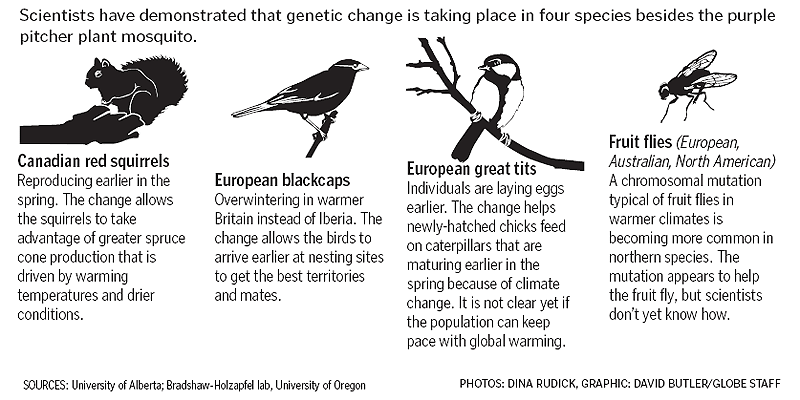
A mosquito that can barely fly is one of only five known species that scientists say have already evolved because of global warming. The unobtrusive mosquito’s story illustrates a sobering consequence of climate change: The species best suited to adapting may not be the ones people want to survive.

Such news enhances biology studies of genetics and insects, geography studies of climate, animal dispersal patterns and disease and pest ranges (a subject more technically known as biogeography), and the articles lend urgency to studies of how governments react to natural crises, a topic suitable for government classes, economics, and U.S. and world history.

Global Warming illustration Click on the thumbnail to see four examples of genetic change credited to global warming. (Graphic by David Butler of the Boston Globe staff.) Read the rest of this entry »


Interactive disaster maps for geography

April 15, 2007

Would tracking disasters add more than a little interest to your geography units?

Cliotech, a blog by a Pennsylvania social studies teacher, gives pointers to Alertmap, a group based in Budapest (hey, that’s a geography lesson right there!). Alertmap charts disasters — fires, floods, earthquakes, etc. — and what student is not interested in disaster?

Be careful not to unnecessarily scare students — but do point out that the world is full of danger, and natural and man-made disasters continue to plague mankind the world over.


Chief victim of global warming today: The U.S.

April 3, 2007

The Earth Policy Institute looks at numbers of people running from the effects of global warming and concludes that the U.S. has more global warming refugees than any other nation today, ironically. The U.S. is also the largest emitter of greenhouse gases blamed for the human component of global warming.

EPI estimates at least 250,000 people fled New Orleans and surrounding areas after Hurricane Katrina, in the single largest migration prompted by the effects of global warming.

In a press release, EPI’s president Lester R. Brown said:

Those of us who track the effects of global warming had assumed that the first large flow of climate refugees would likely be in the South Pacific with the abandonment of Tuvalu or other low-lying islands. We were wrong. The first massive movement of climate refugees has been that of people away from the Gulf Coast of the United States.

Hurricane Katrina, which made landfall in late August 2005, forced a million people from New Orleans and the small towns on the Mississippi and Louisiana coasts to move inland either within state or to neighboring states, such as Texas and Arkansas. Although nearly all planned to return, many have not.

Financial markets act as if global warming is a fact, even with a few deniers still hanging on and the Bush administration’s not moving very fast as if it were concerned: Insurance companies refuse to issue new policies for homes for people living in certain hurricane-prone areas.

The market has spoken: Global warming is a problem we need to act against.

Tip of the old scrub brush to Stolen Moments: A green digest.


Quote of the moment: W. C. Lowdermilk, soil erosion

March 20, 2007

Soil erosion in Virginia, photo by W. C. Lowdermilk

Soil erosion in Virginia, photo by W. C. Lowdermilk “Figure 15. — A formerly productive field in Virginia that has been cut to pieces by gully erosion. About 50 million acres of good farm land in the United States have been ruined for further practical cultivation by similar types of erosion.”


From Conquest of the Land through 7,000 Years, by W. C. Lowdermilk, its first director, a soil conservation publication of the U.S. Soil Conservation Service, first issued in about 1939:

When in Palestine in 1939, I pondered the problems of the use of the land through the ages. I wondered if Moses, when he was inspired to deliver the Ten Commandments to the Israelites in the Desert to establish man’s relationship to his Creator and his fellow men — if Moses had foreseen what was to become of the Promised Land after 3,000 years and what was to become of hundreds of millions of acres of once good lands such as I have seen in China, Korea, North Africa, the Near East, and in our own fair land of America — if Moses had foreseen what suicidal agriculture would do to the land of the holy earth — might not have been inspired to deliver another Commandment to establish man’s relation to the earth and to complete man’s trinity of responsibilities to his Creator, to his fellow men, and to the holy earth.

When invited to broadcast a talk on soil conservation in Jerusalem in June 1939, I gave for the first time what has been called an “Eleventh Commandment,” as follows: Thou shalt inherit the Holy Earth as a faithful steward, conserving its resources and productivity from generation to generation. Thou shalt safeguard thy fields from soil erosion, thy living waters from drying up, thy forests from desolation, and protect thy hills from overgrazing by thy herds, that thy descendants may have abundance forever. If any shall fail in this stewardship of the land, thy fruitful fields shall become sterile stony ground and wasting gullies, and thy descendants shall decrease and live in poverty or perish from off the face of the earth.


Leroy Lee, exposer of “phantom forests” hoax

February 21, 2007

For a decade of my life I was deeply involved in the fight to get compensation for downwind victims (most from Utah) of the fallout from U.S. atomic bomb tests at the Nevada Test Site. In the course of that time I saw a variety of amazing fibs told by the government — hoaxes that injured and killed people. I grew to respect those whistleblowers who had the guts and patriotism to cry foul on the hoaxes.

Leroy Lee died about a month ago in Santa, Idaho. He was a seasonal government worker, a timber stand examiner — a tree counter. As low guy on the totem pole, it was not his job to take the global view. Still, he noted that there were fewer growing trees in the forests than the U.S. Forest Service claimed, and much more cleared land, too, clearcut.

The Forest Service was lying to Congress about millions of dollars of harvests on public lands. Lee blew the whistle. Officials had hoaxed up on paper, forests that didn’t exist, in 15 of the west’s National Forests.

It wasn’t a big scandal as scandals go, but the Kootenai National Forest still works to straighten things out, mostly in litigation. Most hoaxes are exposed by honest, hard-working people like Leroy Lee. They are heroes of our republic. Many of them remain unsung, like Lee.

In his “day job,” Lee taught physics, chemistry and biology at St. Maries High School, St. Maries, Idaho.

More information:


Wolf cry

February 7, 2007

Wolf reintroduction to several places in the United States has been such a success that the federal government is planning to remove the wolf from the endangered species list. (Ralph Maughn’s Wildlife News blog covers this issue in detail.)

As if in a bad melodrama, some states are rubbing their hands in glee, planning hunts to more than decimate the wild populations, once the delisting is complete. In its excellent science section yesterday, the New York Times explained the issue, and featured wonderful photos of wolves.

For anyone interested, the issues with elk are also covered at Maughn’s blog, with an photo showing some of the serious mismanagement of elk that may be alleviated with introduction of wild wolves as predators.

Wolf in Yellowstone national Park, NPS photo

In my several trips through Yellowstone National Park dating back to the 1950s, I had never seen a wolf until our last foray in 2003. At the same time, there are significant changes in the Park’s natural environment plainly visible. To my delight some prime moose habitat has returned in recent years. Grassy areas in some stream and river bottoms are turning back into more mixed plants, with willows and bushes intruding. This makes it more difficult to see wildlife, sometimes.

But it’s a good effect, and it’s a result of the introduction of the wolves. Elk graze in those areas, and they eat the willows and other bushes, keeping the river bottoms more like prairies than forest. Wolves love to hunt elk in those places, however, and the presence of wolves has put the elk on alert. Elk spend less time grazing the brush back, and the brush grows, providing habitat for a number of other animals, habitat that had been in serious decline.

One might wonder if some people are serious about these issues at all.


Free Inconvenient Truth for teachers

December 23, 2006

    Update: As of February 11, 2007, all 50,000 free copies have been given away. You may register for other giveaways and contests of Participate.net

.

Participate.net is giving away 50,000 copies of the movie on climate change, An Inconvenient Truth.

First 50,000 teachers who ask. Go here: http://www.participate.net/educators/pub_files/ait-block_dvd.jpg

One more way Al Gore is ahead of his time.


More atomic history: Uranium tailings

December 20, 2006

DOE installs permeable reactive barrier in MonticelloPhoto at left shows work to install a permeable reactive barrier (PRB) to help clean up contamination from arsenic, molybdenum, nitrate, vanadium and uranium wastes at an EPA Superfund Site managed by the U.S. Department of Energy near Monticello, Utah. The cleanup was done under the Comprehensive Environmental Response, Compensation and Liability Act (CERCLA), the law better known as Superfund. (DOE photo)

GOAT, the blog of High Country News, carried a short story that brought me nasty flashbacks.

Families in Monticello, Utah, wonder whether there is a connection between local clusters of leukemia the old, abandoned uranium works at the edge of town.

“Each depth had its own color. If the sun was just right, it was really pretty.” That’s how Steve Pehrson described the ponds he and his friends swam in as kids, as told to the Grand Junction Daily Sentinel. He and other Monticello, Utah, kids commonly cooled off in the tailings ponds at the uranium mill that sat on the edge of town. The kids also dug into the tailings piles, and the tailings were used in gardens and even sandboxes. Now, people in Monticello are looking into the link between these habits and cases of leukemia and other diseases that have cropped up amongst the citizenry.

If you follow that link to the Grand Junction (Colorado) Daily Sentinel, you find more stories, and more horrifying stories. Read the rest of this entry »