New Boy Scout merit badge: Sustainability

July 25, 2013

It’s Eagle required, too — well, Scouts can choose either Environmental Science or Sustainability, but must earn one or the other to earn Eagle rank.

Image of the Sustainability merit badge, from MeritBadge.org

Image of the Sustainability merit badge, from MeritBadge.org

Requirements for the new Sustainability merit badge were released on July 16, concurrent with the 2013 National Scout Jamboree at the Summit.  A lot of people missed the announcement, I’ll wager.

It’s good news.  Conservation and nature-related merit badges have suffered a decline in Scouting, it seems to me.  The conservation series was very much the keystone of a trek to Eagle when I was a Scout, at least as important as the citizenship series.  But I don’t see that emphasis in Scouting today, sadly.

BSA recently created a Mining merit badge, which created some quiet grumbles among conservationists — this new, Eagle-path badge more than makes up for that, I think (though mining is a great topic for Scouts, especially in the western U.S., I think).  This will not set well with the anti-conservation, anti-Agenda 21 crowd and their merry hoaxsters.  But nothing BSA does is removed from political criticism from the right any more (see this odd photo choice for the Sustainability badge notice at the radical right-wing Daily Caller site).

This announcement gives me hope.

More:

Below the fold, the requirements and announcement from Bryan on Scouting, at Scouting Magazine’s site, verbatim and in total.

Read the rest of this entry »


Again: Why do we worry about global warming? It ain’t the climate, it’s the people

July 15, 2013

This is almost entirely an encore post, repeated for the benefit of the millions who missed it the first time who make fools of themselves when they argue we don’t need to save trees.  It’s not about trees.

Kids hiking in a forest. These are the humans environmentalists worry about, these four, and a few billion like them.  Photo from American Forests.

Kids hiking in a forest. These are the humans environmentalists worry about, these four, and a few billion like them. Photo from American Forests.

Alun Salt gave great advice about not bothering to engage idiots, pigs, denialists or trolls (here, among other places).  He said I should avoid lengthy answers to blogs that have little audience.

This is probably one of those occasions.

But in a running attempt to stimulate serious thought at a denialist blog, I got a question that has been rather common, and a question which indicates the deep serious misunderstanding denialists and even some well-meaning, overly-skeptical sensible people have:

Why worry about  climate change, since the climate is changing all the time?  Especially, why are people like Al Gore urging that we stop climate change, when CO2 has no great direct effect on human health?  Shouldn’t environmentalists be cheering climate change on, since it’s a “natural process?”

The answer is lost on the other blog, as Mr. Salt predicted it would be.  But since I’ve gotten some version of the question repeatedly in the last month, I may as well repeat the answer here, for the record.

The short answer to why we worry about climate change is that, as with almost all environmental protection, we are worried first about the quality of life of humans, and ultimately about the ability of human life to survive at all.

Here’s the question put to me there:

Ed I’m a little confused. I thought we were talking about the effect of co2 on the climate not the effect of co2 on human health. Co2 is not a toxic gas and would have no effect on human health. The fact that humans weren’t around when co2 was 10-20 times higher has absolutely nothing to do with its effect on climate.
Ed there was no runaway greenhouse effect [link added here] or climate catastrophe. The planet was fine during the phanerazoic. There is actually a lack of co2 in the atmopshere comapred to that time.

Here’s my answer, with a few more links than their format would allow:

No, you’re not a little confused.  You’re a lot confused, greatly misinformed, and not thinking hard.

We worry about CO2’s effects on climate only because we worry about the future of humanity.  Many of us who have children and wish them the same blessings of having children and grandchildren, have thought through the truth of the matter that we don’t possess and rule the Earth for ourselves, but instead act only as stewards for future generations.

No Earth, no humans; but at the same time, no habitable Earth, no humans.  In the long run, Earth doesn’t care.  It’ll do fine — without humans.

We can’t damage the planet.  We can only damage its habitability for humans.

I don’t know what sort of dystopian Randian future you and other Do Nothings hope for, but it’s a future contrary to human life, American values, and all known religions.

We’re talking about the future of humans.  I tell “skeptics,” “If you don’t care, butt out.  You’ll be dead in the short run anyway, but that’s no reason to stand in the way of action not to ensure a livable planet for our grandchildren.”

You also fail to understand chemistry, pollution, and how the world works.  CO2 is indeed a toxic gas.  For about a century now we’ve had indoor air standards that require air circulation to keep CO2 down below concentrations of about 500 5000 ppm [see comments], because at that level it starts to have dramatic effects on humans working.  It clouds their thinking and causes drowsiness.  CO2 is a conundrum, in that it is also necessary to trigger mammalian breathing.  If CO2 drops too low, we don’t take in enough oxygen and may pass out.  Too much oxygen in place of CO2 is a problem in that regard.  A substance can be both essential and a  pollutant, at the same time. (This has vexed food safety experts for years, especially after the 1958 Delaney Clause; substances we know to be essential nutrients can be carcinogenic, in the same concentrations, or in the same concentrations with a slight twist in chemical formula — how do we regulate that stuff?)

English: Main symptoms of carbon dioxide toxic...

Main symptoms of carbon dioxide toxicity (See Wikipedia:Carbon_dioxide#Toxicity). References: Toxicity of Carbon Dioxide Gas Exposure, CO2 Poisoning Symptoms, Carbon Dioxide Exposure Limits, and Links to Toxic Gas Testing Procedures By Daniel Friedman – InspectAPedia Davidson, Clive. 7 February 2003. “Marine Notice: Carbon Dioxide: Health Hazard”. Australian Maritime Safety Authority. Model: Mikael Häggström. To discuss image, please see Template talk:Häggström diagrams (Photo credit: Wikipedia)

CO2 is toxic in much greater proportions — it was a CO2 cloud that killed thousands in Cameroon 30 years ago or so, if you know history.

Clearly you did not know that we’ve regulated indoor CO2 for decades.  Clearly you haven’t looked at the medical journals‘ discussion on CO2 — and I’ll wager you’d forgotten the Cameroon incident, if you ever knew about it.

CO2 is a toxic gas (the dose is the poison); CO2 has dramatic effects on human health — too little and we die, too much and we die.

The fact that humans were not around when CO2 was much higher is exactly the point.  That was presented here, as it is in most venues, as support for a claim that we don’t need to worry about CO2 pollution.  Well, that’s right — if we don’t care about a habitable Earth.  But when CO2 was higher, life for humans was impossible.

I think it’s reckless to run an experiment on what would happen with higher CO2 levels, using the entire planet as a testing place, and testing the hypotheses on just how much CO2 will kill us all off, and how.

How about a control group, at least?

In the past, massive CO2 created massive greenhouse effects that would devastate us today — not as a toxic gas, but as a result of the warming that greenhouse gases do.

Let us understand the physical conundrum of CO2 here:  Without the greenhouse effect from the human-historic levels of CO2, this would be an ice planet.  Our lives today depend on the greenhouse effects of CO2.

Consequently, anyone who claims there is no greenhouse effect fails to understand physics, chemistry, biology and history.  (Heck, throw in geology, too.)  Life would be impossible but for the greenhouse effect.  Life is impossible without water, too, but you can’t live totally surrounded by water.

Can it be true that there can never be too much of a good effect, with regard to greenhouse gases?  Ancient Greek ideas of “all things in moderation” applies here.  We need a Goldilocks amount of CO2 in our atmosphere — not to much, not too little; not too hot, not too cold.

To the extent that higher CO2 levels didn’t produce a total runaway greenhouse effect, as some hypothesize exists on Venus, we know that was due to other feedbacks.  Early on, for example, CO2 began to be reduced by photosynthesizing life.  Animal life today would be impossible but for that occurrence.  Few if any modern chordates could breathe the very-low oxygen atmosphere of the early Earth, and live.  Those feedbacks and limiting situations do not exist today.

Greenhouse Effect

Greenhouse Effect. Wikipedia image

So now we face a double or triple whammy.  The reduction in CO2 in the air was accomplished through a couple billion years of carbon sequestration through plants.  In fact, a lot of carbon was sequestered in carbon-rich fossils, stuff we now call coal and oil.  Oxygen replenishment was accomplished with massive forests, and healthy oceans, with a great deal of photosynthesis.  This created a rough CO2 equilibrium (with fluctuations, sure) that existed we know for at least the last 50,000 years, we’re pretty sure for the last 100,000 years (we know that from carbon-dating calibration exercises).

Today we have removed fully 30% of the forests that used to replenish oxygen and lock up a lot of CO2 (some estimates say 50% of the forests are gone); modern plant communities cannot pluck CO2 out fast enough.  Plus, we’re releasing a lot of that old, sequestered carbon in coal and oil — at rates unprecedented in human history.

Will more CO2 warm the planet?  We know from the fact that the planet is warm enough for life, that more CO2 will warm the planet more.  Anyone who says differently does not know physics and chemistry, nor history.

Is there anything that can stop that effect?  Sure — healthy, massive forests, and healthy oceans.  Reducing carbon emissions could help a lot, too.  But we’re committed for about a century.  CO2 in the atmosphere doesn’t fall to the ground like particulate pollution.  it drifts until it is incorporated into something else, either through photosynthesis or other chemical reactions.  It takes a mole of CO2 a couple of centuries to come out of the air.  We’re stuck with elevated and elevating CO2 regardless our actions, for a century or two, even if we are wildly successful in reining in emissions and creating sequestration paths.

What happens when CO2 levels get higher than 350 ppm?  History, physics and chemistry tells us glaciers will melt, rainfall patterns will alter dramatically, sea levels will rise, carbon will be absorbed by the seas in increasing amounts (causing acidification — simple chemistry).  [See the counter in the right column of this blog; by July 2013, CO2 temporarily climbed above 400 ppm in a spike, and rested dangerously close to 400 ppm constantly.]

It’s a very exciting experiment.  The entire human race is at stake. How much CO2 will it take to produce the effects that kill us all?  It’s likely that changing rainfall patterns and rising sea levels will produce wars over resources, long before CO2 itself starts being physically toxic.  That’s what the Pentagon’s big thinkers say.  That’s what the Chinese big thinkers say, which is why they are working to reduce emissions even without an enforceable treaty.

As experiments go, I think it’s immoral to use humans in experimentation without getting their consent, and without passing the entire experiment through the Institutional Review Board to make sure the experiment is useful, necessary, and done ethically.

Do you have those consent statements?  All seven billion of them?  Have you got approval from the research overseers of the institution?

If you don’t have permission to proceed with this progeny-killing experiment, why do you propose to proceed?  Many people believe that, if the courts on Earth don’t get us, a higher court will.

How will you plead wherever the call to justice is delivered?

More:


Doubt climate change? Here, have a cigarette . . .

July 9, 2013

Colorado River runs dry, Peter McBried, Smithsonian

From Smithsonian Magazine: The Colorado River Runs Dry A boat casts a forlorn shadow in a dry river channel 25 miles from the river’s historical end at the Gulf of California. Photo by Peter McBride (Go see the entire slide show; spectacular and troubling images)

As John Mashey has been quietly but consistently warning us for some time . . .

From ClimateRealityProject.org:

Join us and stand up for reality. http://climaterealityproject.org – This film exposes the parallels between Big Tobacco‘s denial of smoking’s cancer-causing effects and the campaign against the science of climate change — showing that not only are the same strategies of denial at work, but often even the same strategists.

If you watched that all the way through, odds are high you’re not a denier.  If you can’t watch it, you really should think about it, hard.

More, and useful resources:


One more time: Basic climate science with Bill Nye

July 4, 2013

What year is this? 2013?

Shouldn’t the Sputnik Revolution in science education have obviated the need for this video, like 30 years ago?

One more time, the basics of climate change/global warming, with Bill Nye the Science Guy explaining; from the ClimateRealityProject.org:

http://vimeo.com/climatereality/climate101

climate change, CO2, global warming, science, Bill Nye, environmental protection, Clean Air, Air Pollution

More:

Newsweek, March 4, 1957,

Cover of Newsweek Magazine, from March 4, 1957; notice this concern about U.S. science competency came seven months before Sputnik was launched by the Soviet Union. Science deniers then delayed action until after the Soviets demonstrated clearly that the U.S. was behind. (Image from Computer History.org)


Annals of global warming: Keeling Curve gone vertical

June 22, 2013

What is the Keeling Curve?

What does it look like now?  See this graphic from the New York Times:

Keeling Curve graph and grahic, New York Times, May 11, 2013

New York Times, May 11, 2013

See the daily update of the Keeling Curve at the Scripps Institute site, University of California at San Diego.

More:


Rachel Carson project won first at National History Day competition

June 19, 2013

News from the San Ramon (California) Express [links added here, except for reporter’s contact]:

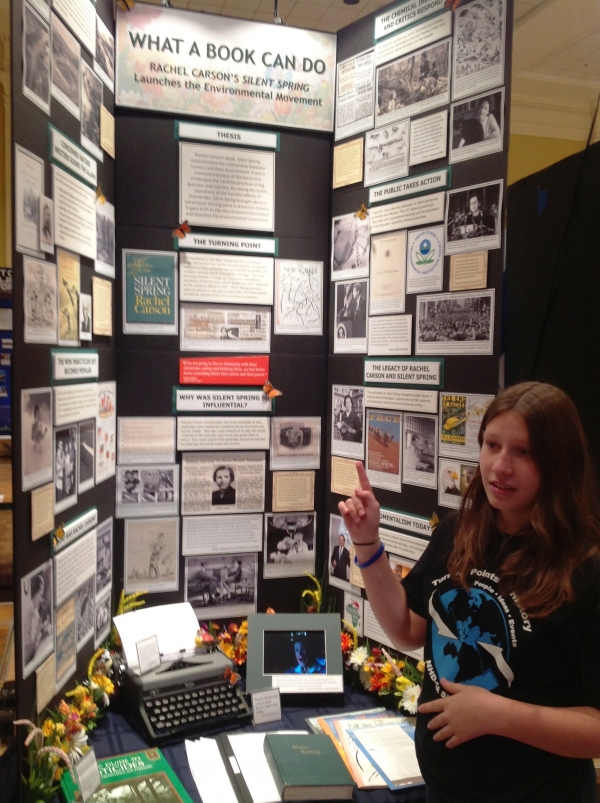
Julienne Sauer in front of her project,

Julienne Sauer in front of her project, “What a book can do — Rachel Carson‘s Silent Spring Launches the Environmental Movement.” (© 2013 San Ramon Express)

San Ramon student takes first at National History Day contest

by Jessica Lipsky

Windemere Ranch Middle School student was one of 30 recognized by the National Endowment for the Humanities (NEH) for their impressive use of historic newspapers in projects presented at National History Day.

Julienne Sauer, who graduated from eighth grade last week, took first place in NEH’s individual exhibit junior division for her project titled “What a book can do — Rachel Carson’s Silent Spring Launches the Environmental Movement.” This year’s National History Day theme was “Turning Points in History: People, Ideas, Events.”

Julienne was also named a National Endowment Humanities Scholar.

The annual event is the culmination of a year-long academic program in which students in middle and high school conduct original historical research for papers, exhibits, websites, documentaries and public performances. Each year more than 600,000 students compete in local, regional and state competitions for a chance to win a spot at the national finals.

This year was the first time NEH awarded prizes to students who incorporated into their projects research using Chronicling America, a free online database of 5 million pages of historic US newspapers dating from 1836 to 1922, digitized through a partnership between NEH and the Library of Congress.

Julienne won a national finalist award at the 2011 National History Day exhibit for her exhibit titled “The Cable Car Wars: A City Debates to Preserve its Character.”

Carson’s work was good enough that, even 49 years after her death, 51 years after the publication of Silent Spring, Carson and the book still inspire students to heights of excellence in study.

More:


How about another cup of coffee? (Global Warming Conspiracy and Starbucks Cup #289)

June 19, 2013

Encore post from September 17, 2007, and August 2009 — maybe more appropriate today than ever before.

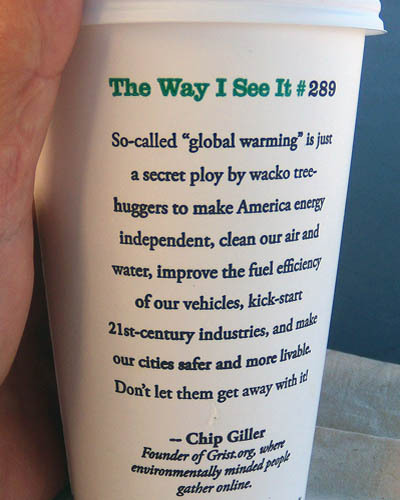
Found this on my coffee cup today (links added here):

The Way I See It #289

So-called “global warming” is just

a secret ploy by wacko tree-

huggers to make America energy

independent, clean our air and

water, improve the fuel efficiency

of our vehicles, kick-start

21st-century industries, and make

our cities safer and more livable.

Don’t let them get away with it!

Chip Giller
Founder of Grist.org, where
environmentally-minded people
gather online.

Starbucks Coffee Cup, The Way I See It #289 (global warming)

Look! Someone found the same cup I found!

I miss those old Starbucks cups — but then, they killed the Starbucks in our town.  I don’t buy the 100 cups of Starbucks coffee I used to get in a year.

More:

Save


Querying the Rachel Carson Critics (who turned out the light?)

June 19, 2013

Another question of mine that will probably never see the light of day.  This group has no answer, so why would they allow the question?

I stumbled across a blog-looking page from the American Council on Science and Health, an industry apologist propaganda site, on World Malaria Day, which was April 25.  You may recognize the name of the group as one of the industry-funded sites that constantly attacks Rachel Carson, and often the World Health Organization, with the unscientific and false claims that environmentalists bannned DDT and thereby condemned millions of Africans to die from malaria — which, ASCH claims, could have easily been eradicated with more DDT poisoning of Africa.

On World Malaria Day, ASCH took note, flirted with the facts (that DDT doesn’t work as it once was thought to work), but then backed away from the facts — that the ban on DDT in the U.S. came years AFTER WHO suspended the malaria eradication campaign in Africa when it was discovered DDT couldn’t kill DDT-adapted mosquitoes, already subject to years of abuse of DDT by agriculture and other industries.  ASCH said:

DDT kills mosquitoes, although not as well as it did 60 years ago. But it also irritates them and repels them, so the small amount sprayed inside homes effectively reduces the transmission of the malarial microbe substantially. The banning of DDT, based upon political anti-chemical bureaucrats and “environmentalists” inspired by Carson’s “Silent Spring” who ran our EPA in 1972, helped to impede the malaria control program led by the UN’s WHO.

Impede?  Impossible for a 1972 ban to have been responsible for the earlier suspension of the WHO campaign, not to mention EPA’s ban ended at the U.S. borders.  So I asked:

Screen capture of query to ACSH on how EPA's ban "impeded" WHO's campaign against malaria, ended years earlier.

Screen capture of query to ACSH on how EPA’s ban “impeded” WHO’s campaign against malaria, ended years earlier.

Ed Darrell Reply

June 19, 2013 at 5:16 am

Your comment is awaiting moderation.

I would be very interested in just how the 1972 ban on DDT in the U.S. “impeded” the UN’s antimalaria campaign, which stopped using DDT heavily seven years earlier, and was suspended in 1969.

After the ban on U.S. use of DDT, all of U.S. manufacture was dedicated to export to Africa and Asia, which greatly increased DDT supplies available there.

How did this impede?

Want to wager a guess as to whether they’ll ever allow the comment to see the light of day at their site, let alone answer it?

More:

Wall of Shame – Sites that continue to spread the pro-DDT hoax as fact:

DDT is good for me advertisement

“DDT is good for me advertisement” from circa 1955.  Photo image from the Crossett Library Bennington College.  This ad today is thought to be emblematic of the propaganda overkill that led to environmental disasters in much of the U.S. and the world.  DDT cleanups through the Superfund continue to cost American taxpayers millions of dollars annually.


Once again, the Earth Day/Lenin hoax trotted out: Earth Day honors Earth, our majestic home — not Lenin (2013 version)

April 22, 2013

This is mostly an encore post, repeated each year on April 22 — sad that it needs repeating.

You could write it off to pareidolia, once. Like faces in clouds, some people claimed to see a link. The first Earth Day, on April 22, 1970, coincided with Lenin’s birthday. There was no link — Earth Day was scheduled for a spring Wednesday. Now, years later, with almost-annual repeats of the claim from the braying right wing, it’s just a cruel hoax.

No, there’s no link between Earth Day and the birthday of V. I. Lenin:

One surefire way to tell an Earth Day post is done by an Earth Day denialist: They’ll note that the first Earth Day, on April 22, 1970, was an anniversary of the birth of Lenin.

Coincidentally, yes, Lenin was born on April 22 (new style calendar; it was April 10 on the calendar when he was born — but that’s a digression for another day).

It’s a hoax. There is no meaning to the first Earth Day’s falling on Lenin’s birthday — Lenin was not prescient enough to plan his birthday to fall in the middle of Earth Week, a hundred years before Earth Week was even planned.

About.com explains why the idea of a link between Earth Day and Lenin is silly:

Does Earth Day Promote Communism?
Earth Day 1970 was initially conceived as a teach-in, modeled on the teach-ins used successfully by Vietnam War protesters to spread their message and generate support on U.S. college campuses. It is generally believed that April 22 was chosen for Earth Day because it was a Wednesday that fell between spring break and final exams—a day when a majority of college students would be able to participate.

U.S. Sen. Gaylord Nelson, the guy who dreamed up the nationwide teach-in that became Earth Day, once tried to put the whole “Earth Day as communist plot” idea into perspective.

“On any given day, a lot of both good and bad people were born,” Nelson said. “A person many consider the world’s first environmentalist, Saint Francis of Assisi, was born on April 22. So was Queen Isabella. More importantly, so was my Aunt Tillie.”

April 22 is also the birthday of J. Sterling Morton, the Nebraska newspaper editor who founded Arbor Day (a national holiday devoted to planting trees) on April 22, 1872, when Lenin was still in diapers. Maybe April 22 was chosen to honor Morton and nobody knew. Maybe environmentalists were trying to send a subliminal message to the national subconscious that would transform people into tree-planting zombies. One birthday “plot” seems just about as likely as the other. What’s the chance that one person in a thousand could tell you when either of these guys were born.

My guess is that only a few really wacko conservatives know that April 22 is Lenin’s birthday (was it ever celebrated in the Soviet Union?). No one else bothers to think about it, or say anything about it, nor especially, to celebrate it.

Gaylord Nelson, Living Green image

Inventor of Earth Day teach-ins, former Wisconsin Governor and U.S. Senator Gaylord Nelson

Wisconsin’s U.S. Sen. Gaylord Nelson, usually recognized as the founder and father of Earth Day, told how and why the organizers came to pick April 22:

Senator Nelson chose the date in order to maximize participation on college campuses for what he conceived as an “environmental teach-in.” He determined the week of April 19–25 was the best bet; it did not fall during exams or spring breaks, did not conflict with religious holidays such as Easter or Passover, and was late enough in spring to have decent weather. More students were likely to be in class, and there would be less competition with other mid-week events—so he chose Wednesday, April 22.

In his own words, Nelson spoke of what he was trying to do:

After President Kennedy’s [conservation] tour, I still hoped for some idea that would thrust the environment into the political mainstream. Six years would pass before the idea that became Earth Day occurred to me while on a conservation speaking tour out West in the summer of 1969. At the time, anti-Vietnam War demonstrations, called “teach-ins,” had spread to college campuses all across the nation. Suddenly, the idea occurred to me – why not organize a huge grassroots protest over what was happening to our environment?

I was satisfied that if we could tap into the environmental concerns of the general public and infuse the student anti-war energy into the environmental cause, we could generate a demonstration that would force this issue onto the political agenda. It was a big gamble, but worth a try.

At a conference in Seattle in September 1969, I announced that in the spring of 1970 there would be a nationwide grassroots demonstration on behalf of the environment and invited everyone to participate. The wire services carried the story from coast to coast. The response was electric. It took off like gangbusters. Telegrams, letters, and telephone inquiries poured in from all across the country. The American people finally had a forum to express its concern about what was happening to the land, rivers, lakes, and air – and they did so with spectacular exuberance. For the next four months, two members of my Senate staff, Linda Billings and John Heritage, managed Earth Day affairs out of my Senate office.

Five months before Earth Day, on Sunday, November 30, 1969, The New York Times carried a lengthy article by Gladwin Hill reporting on the astonishing proliferation of environmental events:

“Rising concern about the environmental crisis is sweeping the nation’s campuses with an intensity that may be on its way to eclipsing student discontent over the war in Vietnam…a national day of observance of environmental problems…is being planned for next spring…when a nationwide environmental ‘teach-in’…coordinated from the office of Senator Gaylord Nelson is planned….”

Nelson, a veteran of the U.S. armed services (Okinawa campaign), flag-waving ex-governor of Wisconsin (Sen. Joe McCarthy’s home state, but also the home of Aldo Leopold and birthplace of John Muir), was working to raise America’s consciousness and conscience about environmental issues.

Lenin on the environment? Think of the Aral Sea disaster, the horrible pollution from Soviet mines and mills, and the dreadful record of the Soviet Union on protecting any resource. Lenin believed in exploiting resources, not conservation.

So, why are all these conservative denialists claiming, against history and politics, that Lenin’s birthday has anything to do with Earth Day?

Can you say “propaganda?”  Can you say “political smear?”

2013 Resources and Good News:

Good information for 2012:

Good information from 2011:

Good information from 2010:

2013 Wall of Shame:

Wall of Lenin’s Birthday Propaganda Shame from 2012:

Wall of Lenin’s Birthday Propaganda Shame from 2011:

Wall of Lenin’s Birthday Propaganda Shame from 2010:

Spread the word.  Have you found someone spreading the hoax, claiming Earth Day honors Lenin instead?  Give us the link in comments.


Rachel Carson/DDT hoaxing from the Ayn Rand Institute

April 21, 2013

Welcome, refugees and truth-seekers from WUWT:  If this site seems a little unusual to you, you should know that at Millard Fillmore’s Bathtub we try to stick to science, and we don’t censor opposing opinions.  Genuinely interested in the DDT/Malaria issue?  See this collection.

______________

A couple of physicists get together in a podcast from the Ayn Rand Institute, Poke in Your Eye to Eye, and demonstrate that they don’t know biology well, they know less about history, but they don’t hesitate to tell whoppers about Rachel Carson and the value of DDT“Silent Spring 50 Years Later [a special Earth Day podcast].

English: An image of the main entrance of Rach...

A better indication of the legacy of Rachel Carson: Schools across America named after the woman, to inspire children to explore science, and to read and write. Here, the main entrance of Rachel Carson Middle School in Herndon, Virginia. (Photo: Wikipedia)

Earth Day must be coming up.  The usual suspects trot out their usual disinformation and hoax campaigns — and it will continue through Earth Day on April 22, International Malaria Day on April 25, through Rachel Carson’s birthday, and probably all summer.

Mencken warned us that hoaxes, once out of the bottle, can’t be put back.  Twain (and others) remind us that whopping falsehoods travel around the world “while truth is getting its boots on.”  Amanda Maxham, who is listed as an astrophysicist at the Rand site, interviewed physicist Keith Lockitch — and they repeat almost all the hoary old false fables invented by Gordon Edwards and Steven Milloy about malaria, DDT, and Rachel Carson.

A few of the errors committed by the polemicists at the Ayn Rand Institute:

  • ‘DDT doesn’t breed mosquitoes more resistant to the stuff, but instead weakens the population through reducing diversity.’  Absolutely wrong.  Turns out the new alleles mosquitoes pick up that makes them resistant and immune to DDT, are ALSO the alleles that make mosquitoes resistant to the whole class of chemicals, and thereby foul up efforts to develop new pesticides.

    Tanzania - Removing DDT

    Cleaning up DDT in Africa: 40 tons of 50 year old DDT were found in Menzel Bourguiba Hospital, Tanzania – FAO photo

  • ‘Rachel Carson didn’t account for the value of DDT in eradicating malaria.’  They start out claiming DDT ended malaria in the U.S. (it didn’t; CDC had won the fight will just mop up operations left, by 1939; DDT wasn’t even available for another seven years), and run through the false claim that DDT alone had almost eradicated malaria from Sri Lanka, but listening to Rachel Carson, the nation stopped spraying and malaria roared back (the nation stopped ALL of its malaria fighting efforts due to costs and civil war; when the fight was taken up again, DDT was not useful; largely without DDT, Sri Lanka has once again nearly wiped out malaria).
  • ‘Because of a lack of DDT use, malaria continues to ravage the world killing a million people a year.’  Actually, malaria is at the lowest level in human history, killing less than a million a year, with great progress being made against the disease using the methods Rachel Carson urged in 1962.  Had we listened to Carson earlier, we could have saved a few million more lives, and perhaps have eradicated malaria already.  Also, it’s important to remember that DDT was never banned in Africa nor Asia; the ban on use of DDT on cotton crops in the U.S. did not cause any increase in malaria anywhere; since the ban on DDT use in the U.S. malaria has constantly declined in incidence and deaths.
  • ‘DDT is very effective because it’s ALSO repellent to mosquitoes, after it ceases to kill them.’  So in the end, they urge the use of a poisonous-to-wildlife, mildly carcinogenic substance, because it repels mosquitoes?  Bednets are more effective, cheaper, not-poisonous to wildlife, and they aren’t even suspected of causing cancer.

Rachel Carson’s life is a model for budding scientists, aspiring journalists, and teachers of ethics.  That so many people spend so much time making up false claims against her, in favor of a deadly toxin, and against science, tells us much more about the subrosa intentions of the claim fakers than about Rachel Carson.

Want the facts about Rachel Carson?  Try William Souder’s marvelous biography from last year, On a Farther Shore.  Want facts on DDT?  Try EPA’s official DDT history online (or look at some of the posts here at Millard Fillmore’s Bathtub). Want the facts about malaria?  Check with the world’s longest running, most ambitious malaria fighting campaign operated by the good people at the World Health Organization, Roll Back Malaria,  or see Sonia Shah’s underappreciated history, The FeverHow malaria has ruled mankind for 500,000 years.

More:

Roll Back Malaria, World Malaria Day logo for 2013

Roll Back Malaria, World Malaria Day logo for 2013

Wall of Shame (hoax spreaders to watch out for this week):


What news organizations need to know about “no-fly” zones over disaster areas

April 4, 2013

Lots of chatter around the internet today on the discovery that the Federal Aviation Agency posted a notice making the area over the oil spill in Arkansas off limits to aircraft.

Some people claimed they were certain that it was because Exxon-Mobil paid to get a special favor; others wondered why the government would be complicit in such a deal. Several of the comments linked to aerial photos of the spill, and said ‘obviously’ Exxon Mobil doesn’t want photos of the severity  of the spill to get out.  Bill McKibben’s tweet alerted me to the controversy (take a look at that video, too).

Actually, it’s common procedure to make sport flying and other unnecessary flying over disasters, off limits — FAA has a special set of regulations for that.  Rescuers and disaster fighters, and relief workers,  don’t want sight-seers on visual flight rules posing hazards to flights necessary to work on disaster relief or clean up of a spill of a toxic or hazardous substance.

But this doesn’t mean that news organizations cannot fly — in fact, there is a special regulation to ALLOW news aircraft over the zone, for photography and other reports.

Here’s the notice at FAA’s website (I’m sure that link will be unworkable in a few weeks):

FAA notification, NOTAMs notice of Mayflower, Arkansas, temporary flight restrictions; screen grab April 3, 2013.

FAA notification, NOTAMs notice of Mayflower, Arkansas, temporary flight restrictions; screen grab April 3, 2013.

Most announcements of restrictions of any public activity by a federal agency contain a notice of from where the agency draws that authority; I didn’t include it in the screen grab, but FAA notes the authority flows from Title 14 CFR section 91.137(a)(2).  That’s the Code of Federal Regulations, the set of volumes that list all the regulations the federal government has.  This was also published in the Federal Register — and I suspect the NOTAMs is also published there — but CFR is the more permanent set of books for finding government rules.

In the interests of open government, of course the FAA makes these rules available online.  They are available at several sites.  Here’s the meat of the regulation:

Section 2. Temporary Flight Restrictions in the Vicinity of Disaster/Hazard Areas (14 CFR Section 91.137)

19-2-1. PURPOSE

This section prescribes guidelines and procedures regarding the management of aircraft operations in the vicinity of disaster/hazard areas in accordance with 14 CFR Section 91.137. TFRs issued under this section are for disaster/hazard situations that warrant regulatory measures to restrict flight operations for a specified amount of airspace, on a temporary basis, in order to provide protection of persons or property in the air or on the ground.

19-2-2. RATIONALE

TFRs in accordance with 14 CFR Section 91.137 are issued when necessary to:

a. 14 CFR 91.137(a)(1) – Protect persons and property on the surface or in the air from an existing or imminent hazard associated with an incident on the surface when the presence of low flying aircraft would magnify, alter, spread, or compound that hazard.

b. 14 CFR 91.137(a)(2) – Provide a safe environment for the operation of disaster relief aircraft.

c. 14 CFR 91.137(a)(3) – Prevent an unsafe congestion of sightseeing and other aircraft above an incident or event that may generate a high degree of public interest.

NOTE-
This provision applies only to disaster/hazard incidents of limited duration that would attract an unsafe congestion of sightseeing aircraft.

Specific  rules of restrictions, who in the FAA declares them, who can grant waivers, and to who the restrictions apply, get spelled out following that  part.

Notice that, generally, these restrictions apply only to flights below 1,000 feet.  A good camera in a television station’s helicopter can get a lot of great shots from 1,000 feet out (three football fields) — this is a distance often seen in the videos of police car chases.  So it’s not a complete ban.

Savvy news organizations will know how to get news photos using the specific exemption for news aircraft, with procedures spelled out so the FAA knows it’s a news gathering operation; I’ve put the critical clauses in red:

c. Section 91.137(a)(3). Restrictions issued in accordance with this section prohibit all aircraft from operating in the designated area unless at least one of the following conditions is met:

1. The operation is conducted directly to or from an airport within the area, or is necessitated by the impracticability of VFR flight above or around the area due to weather or terrain, and the operation is not conducted for the purpose of observing the incident or event. Notification must be given to the ATC facility that was specified in the NOTAM for coordination with the official in charge of the activity.

2. The aircraft is operating under an ATC approved IFR flight plan.

3. The aircraft is carrying incident or event personnel, or law enforcement officials.

4. The aircraft is carrying properly accredited news representatives and, prior to entering that area, a flight plan is filed with FSS or the ATC facility specified in the NOTAM. Flight plans must include aircraft identification, type, and color; radio frequencies to be used; proposed times of entry to and exit from the TFR area; the name of news media or organization and purpose of flight.

Well-run news organizations already know this; in an age when more and more news rooms operate on a shoe string, it may be that this information about how to cover disasters is not passed along in the newsroom, though.  So I’m reposting it here, so you’ll know, so news organizations now, so environmental reporters can get a copy of the regulations  to carry with them when they head out to cover spills, fires, floods, and other disasters.

I’m waiting, too.  It’s only a matter of time until somebody figures out a local kid has a good radio control helicopter, and it can carry a GoPro camera; or until a local news station invests in a news-gathering drone.  Here in Texas, we’ve already had one environmental disaster uncovered by a drone operated by a guy just checking on real estate.

If you see some footage of the disaster filmed on or after April 3, would you let us know, in comments?

And spread the word to any reporters you know.

More:

Amateur video of the spill:


Punchline too brutal for work: Why it is that environmentalists are the real humanitarians (a necessary encore)

March 1, 2013

I wish it weren’t true.  I wish people didn’t appear to be getting stupider, less scientifically literate, and less knowledgeable of history (see Santayana‘s thoughts in the upper right-hand corner of the blog . . .).  My e-mail box is filling today with notes from people claiming environmentalists want to rid the Earth of humans, urging that we should oppose them and let poisoning of our air and water continue . . . oblivious to the irony of the claim coupled with their supposed opposition to the idea.  Here’s the truth, in large part, an encore post from several months ago (I apologize in advance for the necessary profanity):

The fictional but very popular memes that environmentalists hate humans, humanity and capitalism wouldn’t bother me so much if they didn’t blind their believers to larger truths and sensible policies on environmental protection.

One may argue the history of the environmental movement, how most of the originators were great capitalists and humanitarians — think Andrew Carnegie, Laurance Rockefeller, Theodore Roosevelt, Gifford Pinchot, and all the early medical doctors who warned of the dangers of pollution-caused diseases — but it falls on deaf ears on the other sides.

Here’s the 30-second response, from Humon, in cartoon form (or here, at Humon Comics):

First panel of cartoon by Humon at Deviant Art

Mother Gaia explains why environmental protection is important, from Humon at Deviant Art

Facts of life and environmental protection – from Humon at Deviant Art

Tip of the old scrub brush to P. Z. Myers, and Mia, whoever she is.  Myers noted, “Environmentalism is actually an act of self defense.”

More:

Wall of Shame; sites that don’t get it, or intentionally tell the error:

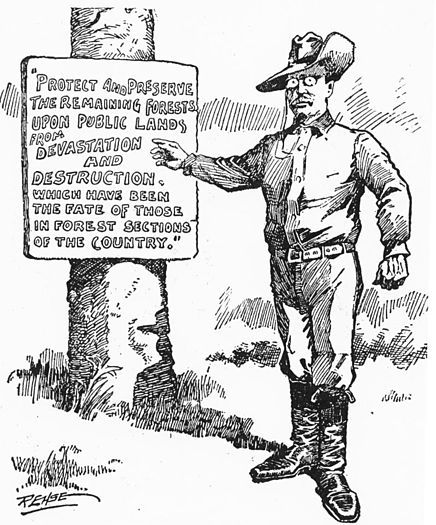
1908 editorial cartoon of President Theodore Roosevelt as “A Practical Forester.”  Source: St. Paul Minnesota “Pioneer Press”. Via GPO's Government Book Talk blog.

1908 Rense editorial cartoon of President Theodore Roosevelt as “A Practical Forester.” Source: St. Paul Minnesota “Pioneer Press”. Via GPO’s Government Book Talk blog.


Hog wild in Texas: Ranchers, guns, and science working against environmental disaster

February 25, 2013

Unusual?  No, this is really a typical marriage of agriculture, government agencies, science and hunters, working on problems of wildlife management, feral hogs in this case.

Notes from Texas Parks & Wildlife:

Feral hogs are running wild across Texas, at great cost to farmers, ranchers, and native wildlife. Hunters are helping, but science may prove critical to controlling the invasion on a broader scale. For more information on feral hogs and feral hog control, visit: http://www.tpwd.state.tx.us/huntwild/…

When it comes to feral hogs, every Texan turns environmentalist.

More:    

English: Sign for Texas Parks and Wildlife Dep...

Sign for Texas Parks and Wildlife Department headquarters – Wikipedia image


Sounds of the Yellowstone in winter will haunt you, lovingly

February 14, 2013

This is a heckuva research project: What is the sound ecosystem of the Yellowstone?

Film from Yellowstone National Park:

The film was produced by Emily Narrow for NPS, with financial assistance from the Yellowstone Association.

From NPS:

Published on Jul 13, 2012

Many people come to Yellowstone to see the fantastic landscapes. Wise visitors also come to experience the amazing soundscapes. This video provides some insight into the value of natural sounds in wild places and how the park is monitoring those sounds as well as the sounds created by humans.

Nothing matches the sound of a western river, to my mind.  I love the sound of the tumbling waters, and it was on one of those roaring creeks that we scattered the ashes of my Yellowstone-loving oldest brother Jerry Jones.

Poster for Yellowstone National Park, Wyoming/...

Classic, vintage poster for Yellowstone National Park, Wyoming/Montana, USA (Photo credit: Wikipedia)

Other sounds will captivate you.  The rush and gush of the geysers, and the gurgle and plop of heated pools rivets you for a while.  Once you hear the chuff of an interested grizzly bear, you don’t forget it.  And while it can be scary if you’re relatively alone on the trail, the howl of the wolf tells you about the wilderness in a way no other sound ever can.  The honks of the geese, the trumpets of the swans, the grunts of the bison, the scolding of the many different squirrels and chipmunks, the slap of a trout jumping out of the river — these are all worth making the trip.

After you go, these sounds will lovingly haunt your life.  You’ll smile when you remember them.

I hope you can go soon.  (I hope I can go, soon.)

Sad note:  Only 1,553 people have watched this video since last July.  Can you spread the word a bit?

More:


Anthony Watts’s political push poll, “Gore or Obama?”

February 9, 2013

Al Gore and Barack Obama together in Detroit, June 2012, Rebecca Cook photo for Reuters, via NBC News photo

Al Gore and Barack Obama don’t appear to be on the opposite side of most issues, especially not climate change. Here they appear together in Detroit, circa June 11, 2012 – Rebecca Cook photo for Reuters, via NBC News photo

Anthony Watts strays farther and further from science with every passing day, and most of his new posts.

At the moment he’s got a doozy of a post, citing a bovine excrement question on a CFACT billboard, and offering a push-poll with three choices designed to push Watts’s preferred political answer, that ‘Obama and Gore go in different directions on global warming and climate change, and maybe they are both wrong.’   The end message Watts pushes is wrong, as you can see in the full texts below.(Morgan, here’s the link so you don’t have to flounder around with Google.)

Who do you believe?

◊  Barack Obama
◊  Neither one
◊  Al Gore

It’s based on these two quote mine products from the CFACT billboard:

WHAT DO YOU BELIEVE?

“Hurricane Sandy is a disturbing sign of things to come.”  — Al Gore, 10/30/2012

“We can’t attribute any particular weather event to global warming.”  — Barack Obama, 11/14/2012

Lying with quotes, demonstrated by CFACT

Propaganda group CFACT’s quote mining billboard, on which Anthony Watts’s push-poll is based.

Watts doesn’t offer a “both correct” choice.  That would be the accurate answer.

Gore’s comment at his blog on October 30, 2012, noted that while we can’t attribute the formation of Sandy to climate change, the effects of the storm were magnified by climate change.  Gore called that “disturbing.”

Obama, noting that while we can’t say for certain that any particular storm is caused entirely from human-created global warming, the long-term effects clearly have human causation and we need to act to stop it.

In short, Gore and Obama take the same side on this issue, the side of science and making sound public policy.  Watts works the old tobacco company strategy, suggesting that wherever studies showing health harms from tobacco differ from each other in the slightest jot or tittle, that means scientists can’t decide whether tobacco is harmful — substitute “human-caused climate change” for tobacco in that argument, and you see what Watts is trying to do.

Meanwhile, the Earth still warms:

Gore’s blog post in full:

Statement on Hurricane Sandy October 30, 2012 : 1:21 PM

This week, our nation has anxiously watched as Hurricane Sandy lashed the East Coast and caused widespread damage–affecting millions. Now more than ever, our neighbors need our help. Please consider donating or volunteering for your local aid organizations.

The images of Sandy’s flooding brought back memories of a similar–albeit smaller scale– event in Nashville just two years ago. There, unprecedented rainfall caused widespread flooding, wreaking havoc and submerging sections of my hometown. For me, the Nashville flood was a milestone. For many, Hurricane Sandy may prove to be a similar event: a time when the climate crisis—which is often sequestered to the far reaches of our everyday awareness became a reality.

While the storm that drenched Nashville was not a tropical cyclone like Hurricane Sandy, both storms were strengthened by the climate crisis. Scientists tell us that by continually dumping 90 million tons of global warming pollution into the atmosphere every single day, we are altering the environment in which all storms develop. As the oceans and atmosphere continue to warm, storms are becoming more energetic and powerful. Hurricane Sandy, and the Nashville flood, were reminders of just that. Other climate-related catastrophes around the world have carried the same message to hundreds of millions.

Sandy was also affected by other symptoms of the climate crisis. As the hurricane approached the East Coast, it gathered strength from abnormally warm coastal waters. At the same time, Sandy’s storm surge was worsened by a century of sea level rise. Scientists tell us that if we do not reduce our emissions, these problems will only grow worse.

Hurricane Sandy is a disturbing sign of things to come. We must heed this warning and act quickly to solve the climate crisis. Dirty energy makes dirty weather.

President Obama’s statement, excerpted from his November 14, 2012, press conference:

THE PRESIDENT:  Mark Landler.  Where’s Mark?  There he is right in front of me.

Q    Thank you, Mr. President.  In his endorsement of you a few weeks ago, Mayor Bloomberg said he was motivated by the belief that you would do more to confront the threat of climate change than your opponent.  Tomorrow you’re going up to New York City where you’re going to, I assume, see people who are still suffering the effects of Hurricane Sandy, which many people say is further evidence of how a warming globe is changing our weather.  What specifically do you plan to do in a second term to tackle the issue of climate change?  And do you think the political will exists in Washington to pass legislation that could include some kind of a tax on carbon?

THE PRESIDENT:  As you know, Mark, we can’t attribute any particular weather event to climate change.  What we do know is the temperature around the globe is increasing faster than was predicted even 10 years ago.  We do know that the Arctic ice cap is melting faster than was predicted even five years ago.  We do know that there have been extraordinarily — there have been an extraordinarily large number of severe weather events here in North America, but also around the globe.

And I am a firm believer that climate change is real, that it is impacted by human behavior and carbon emissions.  And as a consequence, I think we’ve got an obligation to future generations to do something about it.

Now, in my first term, we doubled fuel efficiency standards on cars and trucks.  That will have an impact.  That will take a lot of carbon out of the atmosphere.  We doubled the production of clean energy, which promises to reduce the utilization of fossil fuels for power generation.  And we continue to invest in potential breakthrough technologies that could further remove carbon from our atmosphere.  But we haven’t done as much as we need to.

So what I’m going to be doing over the next several weeks, next several months, is having a conversation, a wide-ranging conversation with scientists, engineers, and elected officials to find out what can — what more can we do to make a short-term progress in reducing carbons, and then working through an education process that I think is necessary — a discussion, a conversation across the country about what realistically can we do long term to make sure that this is not something we’re passing on to future generations that’s going to be very expensive and very painful to deal with.

I don’t know what either Democrats or Republicans are prepared to do at this point, because this is one of those issues that’s not just a partisan issue; I also think there are regional differences.  There’s no doubt that for us to take on climate change in a serious way would involve making some tough political choices.  And understandably, I think the American people right now have been so focused, and will continue to be focused on our economy and jobs and growth, that if the message is somehow we’re going to ignore jobs and growth simply to address climate change, I don’t think anybody is going to go for that.  I won’t go for that.

If, on the other hand, we can shape an agenda that says we can create jobs, advance growth, and make a serious dent in climate change and be an international leader, I think that’s something that the American people would support.

So you can expect that you’ll hear more from me in the coming months and years about how we can shape an agenda that garners bipartisan support and helps move this agenda forward.

Q    Sounds like you’re saying, though, in the current environment, we’re probably still short of a consensus on some kind of attack.

THE PRESIDENT:  That I’m pretty certain of.  And, look, we’re still trying to debate whether we can just make sure that middle-class families don’t get a tax hike.  Let’s see if we can resolve that.  That should be easy.  This one is hard — but it’s important because one of the things that we don’t always factor in are the costs involved in these natural disasters; we just put them off as something that’s unconnected to our behavior right now.  And I think what — based on the evidence we’re seeing, is that what we do now is going to have an impact and a cost down the road if we don’t do something about it.

In context, can you point to any points of conflict between what Al Gore said in October, and what President Obama said a couple of weeks later?  To me it looks as if they’re singing very much from the the same hymnal or songbook, and they’re in harmony, if not unison, especially in what I’ve turned into red-letter text.

Here’s the video of the entire Obama press conference (climate question comes at 42:19 in the video transcript):

More: