“How do you figure that, Hawkeye?” Father Mulcahy, screen capture from video snippet of M.A.S.H.
Our correspondents Jameses, Stanley and Kessler, alerted me months ago to this exchange in the old television show, “M.A.S.H.” In a discussion of the First Battle of Bull Run, we discussed war as hell.
Hawkeye: Exactly. There are no innocent bystanders in Hell. War is chock full of them — little kids, cripples, old ladies. In fact, except for some of the brass, almost everybody involved is an innocent bystander.
Deep thinking, maybe wisdom, from a mobile operating room filtered through sit-com writers.
February 15th is Shoulders of Giants Day (unless you’re still on the Julian calendar).
Or should be.
Famous quotations often get cited to the wrong famous person. ‘Somebody said something about standing on the shoulders of giants — who was it? Edison? Lincoln? Einstein? Jefferson?’ It may be possible someday to use Google or a similar service to track down the misquotes.
The inspiration, perhaps
Robert Burton, melancholy scholar at Oxford
A dwarf standing on the shoulders of a giant may see farther than a giant himself.
Robert Burton (February 8, 1577-January 25, 1640), vicar of Oxford University, who wrote The Anatomy of Melancholy to ward off his own depressions
The famous quote
Sir Isaac Newton, by Sir Godfrey Keller, 1689
If I have seen further (than you and Descartes) it is by standing on the shoulders of Giants.
Sir Isaac Newton, letter to Robert Hooke, February 5, 1675, Julian/February 15, 1676, Gregorian
Newton consciously paid tribute to others who had plowed his science fields before, even if he came up with different crops, er, answers. All science is based on something that comes before it, and in the modern world science advances, oddly, by trying to disprove what scientists thought happened before.
But the sentiment applies equally well in business, in politics, in raising children. We are products of what we learn, and what we learn is a result of culture, which is a result of history. We all stand on the shoulders of those who came before us.
It’s our job to try to see farther, and not just look down, at how far up we are.
Someone will ask (since we so often discuss it), ‘can we fly our flags today?’
Of course you may fly your U.S. flag today. It’s not a day designated by law, but you may fly it in honor of Sir Isaac Newton’s letter if you wish. The U.S. flag code suggests times Americans may fly their flags, but does not require it, nor does law forbid flying the flag for other occasions, or just for every day.
Maybe better, climb to the top of the flag pole. What can you see, aided by a giant’s height?
Wikipedia chases the quote back to the 12th century — The metaphor of dwarfsstanding on the shoulders of giants (Latin: nanos gigantum humeris insidentes) expresses the meaning of “discovering truth by building on previous discoveries”.[1] This concept has been traced to the 12th century, attributed to Bernard of Chartres. Its most familiar expression in English is by Isaac Newton in 1676: “If I have seen further, it is by standing on the shoulders of giants.”[2]
“I am the greatest. I said that even before I knew I was. I figured that if I said it enough, I would convince the world that I really was the greatest.”
Can you guess? It’s difficult to pin down a solid attribution for the quote. I have little doubt he said it — but can someone say where?
Save
Spread the word; friends don't allow friends to repeat history.
Texas Gov. Ann Richards in the Governor’s Office, with the motorcycle she got on her birthday. Texas State Library image.
Sarah Weddington wrote:
Ann now rests at the Texas State Cemetery in Austin. Her grave marker reads,“Today we have a vision of a Texas where opportunity knows no race, no gender, no color—a glimpse of what can happen in government if we simply open the doors and let the people in.”
Texas Gov. Ann Richards’s grave marker in the Texas State Cemetery, Austin, Texas, reverse. Quote comes from her 1991 inaugural address. Image from Findagrave.com
Timothy J. Campbell, Congressman from New York; photo from Mathew Brady negative circa 1870; Library of Congress, Prints and Photographs Division, http://www.loc.gov/pictures/item/2005691716/
What’s the Constitution between friends?
–Timothy J. Campbell (1840-1904), Attributed, circa 1885
Mrs. Rosa Parks asked a question of the policeman who arrested her for refusing to move to the back of the bus on December 1, 1955. In 2016, it is again, and still, a chilling question, to which we have no good answer.
Mrs. Parks being fingerprinted in Montgomery, Alabama; photo from New York World-Telegram & Sun Collection, Library of Congress
Rosa Parks: “Why do you push us around?”
Officer: “I don’t know but the law is the law and you’re under arrest.”
From Rosa Parks with Gregory J. Reed, Quiet Strength
(Grand Rapids, MI: Zondervan Pub. House, 1994), page 23.
On the evening of December 1, 1955, Rosa Parks, an African American, was arrested for disobeying an Alabama law requiring black passengers to relinquish seats to white passengers when the bus was full. Blacks were also required to sit at the back of the bus. Her arrest sparked a 381-day boycott of the Montgomery bus system and led to a 1956 Supreme Court decision banning segregation on public transportation.
Rosa Parks made a nearly perfect subject for a protest on racism. College-educated, trained in peaceful protest at the famous Highlander Folk School, Parks was known as a peaceful and respected person. The sight of such a proper woman being arrested and jailed would provide a schocking image to most Americans. Americans jolted awake.
Often lost in the retelling of the story are the threads that tie together the events of the civil rights movement through the 1940s, 1950s and 1960s. As noted, Parks was a trained civil rights activist. Such training in peaceful and nonviolent protest provided a moral power to the movement probably unattainable any other way. Parks’ arrest was not planned, however. Parks wrote that as she sat on the bus, she was thinking of the tragedy of Emmet Till, the young African American man from Chicago, brutally murdered in Mississippi early in 1955. She was thinking that someone had to take a stand for civil rights, at about the time the bus driver told her to move to allow a white man to take her seat. To take a stand, she kept her seat.
African Americans in Montgomery organized a boycott of the Montgomery bus system. This was also not unique, but earlier bus boycotts are unremembered. A bus boycott in Baton Rouge, Louisiana, earlier in 1955 did not produce nearly the same results.
The boycott organizers needed a place to meet, a large hall. The biggest building in town with such a room was the Dexter Street Baptist Church. At the first meeting on December 5, it made sense to make the pastor of that church the focal point of the boycott organizing, and so the fresh, young pastor, Rev. Dr. Martin Luther King, Jr., was thrust into civil rights organizing as president, with Ralph Abernathy as program director. They called their group the Montgomery Improvement Association (MIA). When their organizing stretched beyond the city limits of Montgomery, the group became the Southern Christian Leadership Conference.
Litigation on the boycott went all the way to the Supreme Court (Browder v. Gale). The boycotters won. The 381-day boycott was ended on December 21, 1956, with the desegregation of the Montgomery bus system.
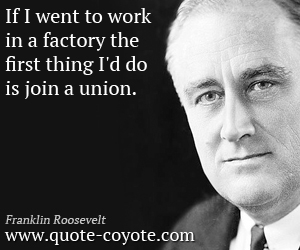
I demurred, and pointed out instead that Walker went after the unions despite their having NOT struck, that Walker refused to bargain in good faith, or bargain at all. I pointed out that Walker had failed in his duty, in the view of FDR.
President Franklin Delano Roosevelt, in 1936 (Checking to see whether, when and where FDR said that; Robert Reich says he did.)
It’s a good way to send wags packing on Twitter, I’ve learned. They don’t like to read or think, and they certainly don’t want anyone pointing out that they may have misinterpreted something. Anything.
NFFE had invited Roosevelt to speak at their Twentieth Jubilee Convention; Roosevelt sent a letter declining the invitation. In declining, Roosevelt noted he opposed strikes by government employees. No doubt there is more history there that deserves our attention. We can get to it later.
Here’s the meat of FDR’s letter:
Particularly, I want to emphasize my conviction that militant tactics have no place in the functions of any organization of Government employees. Upon employees in the Federal service rests the obligation to serve the whole people, whose interests and welfare require orderliness and continuity in the conduct of Government activities. This obligation is paramount. Since their own services have to do with the functioning of the Government, a strike of public employees manifests nothing less than an intent on their part to prevent or obstruct the operations of Government until their demands are satisfied. Such action, looking toward the paralysis of Government by those who have sworn to support it, is unthinkable and intolerable. It is, therefore, with a feeling of gratification that I have noted in the constitution of the National Federation of Federal Employees the provision that “under no circumstances shall this Federation engage in or support strikes against the United States Government.”
What do you think Roosevelt would have made of the current and last “do nothing” GOP blocs in Congress? (Or should we say “blocks?”)
Doesn’t this describe Republicans in Congress today?
” . . . intent on their part to prevent or obstruct the operations of government until their demands are satisfied. Such action, looking toward the paralysis of Government by those who have sworn to support it, is unthinkable and intolerable.”
Is it too much to ask Republicans in Congress to be at least as loyal to the U.S. as the unionized government employees who pledged not to shut down the government?
FDR was pro-union, for very good reasons. Patriots should be, too.
John Adams, by By John Trumbull, 1793. National Portrait Gallery, Smithsonian Institution
“The Second Day of July 1776 will be the most memorable Epocha, in the History of America. . . . It ought to be solemnized with Pomp and Parade, with Shews, Games, Sports, Guns, Bells, Bonfires, and Illuminations from one End of this Continent to the other from this Time forward forever more.” — John Adams to Abigail Adams, July 3, 1776
Surely John Adams knew that July 4 would be Independence Day, didn’t he?
In writing to his wife Abigail on July 3, John Adams committed one of those grand errors even he would laugh at afterward. We’ll forgive him when the fireworks start firing.
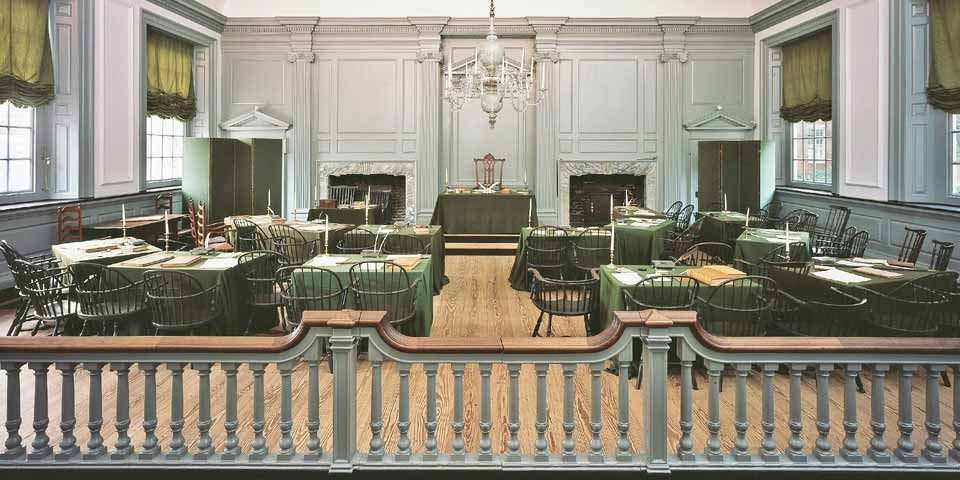
Scene of the crime — Independence Hall in Philadelphia, where the Second Continental congress approved the resolution to declare the colonies independent from Britain – (Photo credit: National Park Service)
Two days later, that same Congress approved the wording of the document Thomas Jefferson had drafted to announce Lee’s resolution to the world.
Today, we celebrate the date of the document Jefferson wrote, and Richard Henry Lee is often a reduced to a footnote, if not erased from history altogether.
Who can predict the future?
(You know, of course, that Adams and Jefferson both died 50 years to the day after the Declaration of Independence, on July 4, 1826. In the 50 intervening years, Adams and Jefferson were comrades in arms and diplomacy in Europe, officers of the new government in America, opposing candidates for the presidency, President and Vice President, ex-President and President, bitter enemies, then long-distance friends writing almost daily about how to make a great new nation. Read David McCullough‘s version of the story, if you can find it.)
The Lee Resolution, passed by the Second Continental Congress on July 2, 1776 – Wikipedia image (Wait a minute: Are those numbers added correctly? What are they?)
Rare color photograph of President John Kennedy addressing a crowd in the then-divided city of Berlin, June 26, 1963
Let us remember ties that bind our nations in brotherhood with other nations, including especially the memorable speech of U.S. President John F. Kennedy on this day, in Berlin, in 1963.
In West Berlin, President John F. Kennedy delivers the famous speech in which he declares, “Ich bin ein Berliner.” Meaning literally “I am a citizen of Berlin,” the statement shows U.S. solidarity with democratic West Berlin, surrounded by communist territory.
Kennedy’s entire speech was good. It was well drafted and well delivered, taking advantage of the dramatic setting and the dramatic moment. John Kennedy well understood how to give a speech, too.
Below is most of the speech, nearly five minutes’ worth, from a YouTube file — another indication that schools need to open up their filters to allow at least some of the best YouTube material through:
President John F. Kennedy at the ground breaking of the Robert Frost Library at Amherst College, Massachusetts, October 26, 1963
“We must never forget that art is not a form of propaganda; it is a form of truth.”
Remarks at Amherst College upon receiving an Honorary Degree (439),” October 26, 1963, Public Papers of the Presidents: John F. Kennedy, 1963. Via JFK Library
The statue of Churchill (1973) by Ivor Roberts-Jones in Parliament Square, London. Wikipedia image. Photo by Eluveitie.
In late 1941, at the height of Britain’s troubles as the sole surviving, able-to-fight exponent of democratic government in Europe, Winston Churchill paid a visit to his old school, to hear the students sing and join them in song. He was asked to speak.
It was a short speech, wholly extemporaneous, but one phrase went on to become one of the most-quoted parts of any speech ever given, anywhere.
Never give in, never give in, never, never, never, never — in nothing, great or small, large or petty — never give in except to convictions of honour and good sense!
A Tweet from Tim Fargo reminded me of a collection of leadership quotes I put together years ago, and of the digging I did on one particular quote urging action rather than capitulation:
That was the quote I got to, but it’s only attributed to to Zapata so far as I know. I started with the quote cited to Franklin Roosevelt’s speech when he got an honorary Doctor of Laws from Oxford in 1941, when Britain badly needed such inspiration to fight on, in a war for freedom in which the U.S. was not yet actively engaged:
We, too, born to freedom, and believing in freedom, are willing to fight to maintain freedom. We, and all others who believe as deeply as we do, would rather die on our feet than live on our knees.
One of a set of ten postcards printed by the Spanish Red Cross, the subjects shown, favor the republican cause. | Spanish. | Wolfsonian Exhibit: Library Vestibule Complement to: Revolutionary Tides, the Art of the Political Poster, 1914-1989; February 25 – August 24, 2006. [Untranslated from Spanish:] Dolores Ibarruri (Pasionaria): Representante de Asturias en el Parlamento de España y figura destacadísima entre las mujeres de la Revolución; Spain Cruz Roja. | Garcia, A. (illustrator.) | Edit. R. Molero (publisher)
When I checked it in the then-current Bartlett’s Quotations I learned it was a common expression during the Spanish Civil War, and attributed to a radio propagandist on the Republican side. It’s likely FDR and his research aides knew that.
It is better to die on your feet than to live on your knees.
Checking that one out, I found a reference to Mexico’s revolutionary Zapata, whose work was likely familiar to the Spanish Republicans.
Mejor morir a pie que vivir en rodillas.
Men of the South! It is better to die on your feet than to live on your knees!
Emiliano Zapata (c. 1877-1919), attributed
That’s as far as I took it 20 years ago. Can we get a better attribution, or find Zapata’s likely inspiration, if there is one?
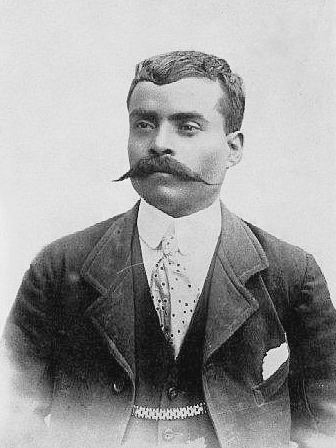
Mexico revolutionary Emiliano Zapata, studio portrait perhaps in 1914. Wikipedia image
N.B.: Looked for a photo of FDR at Oxford, but quickly discovered he was nowhere near England on June 19, 1941 — hadn’t thought he would be with the Battle of Britain not really over. Found references to Watson’s delivering of the speech at Harvard, but little else. Good people at the FDR Library’s Pare Lorentz Center confirm that FDR was at the White House the entire day. There’s a story there, about the awarding of the degree.
This is one of the classic stories of public health, an issue that most U.S. history and world history texts tend to ignore, to the detriment of the students and the classroom outcomes.
In the 1850s a Hungarian doctor and professor of obstetrics named Ignaz Semmelweis [pictured at left] ordered his interns at the Viennese Lying-in Hospital to wash their hands after performing autopsies and before examining new mothers. The death rate plummeted from 22 out of 200 to 2 out of 200, prompting the following reception from one of Europe’s most respected medical practitioners:
“It may be that it [Semmelweis’ procedure] does contain a few good principles, but its scrupulous application has presented such difficulties that it would be necessary, in Paris for instance, to place in quarantine the personnel of a hospital during the great part of a year, and that, moreover, to obtain results that remain entirely problematical.”
– Dr. Charles Dubois (Parisian obstetrician), memo to the French Academy September 23, 1858
Semmelweiss’ superiors shared Dubois’ opinion; when the Hungarian physician insisted on defending his theories, they forced him to resign his post on the faculty.
Gotta wonder what Dr. Dubois would make of the suits and sanitation procedures required today for health professionals who treat Ebola victims.
What would John Adams have said about charter schools?
Adams was quite clear, during his lifetime, that a nation should be known by the good people its good schools produce. No, not private schools: Adams insisted the schools must be open to the public, and funded by the people. Public schools, not private contractors brought in at public expense.
Do you think Adams changed his mind after his death?
Here’s the letter Adams sent to a regular correspondent, John Jebb, on September 10, 1785, 230 years ago today. Capitalization, spelling punctuation, insertions and grammar, as in the original; highlighting added:
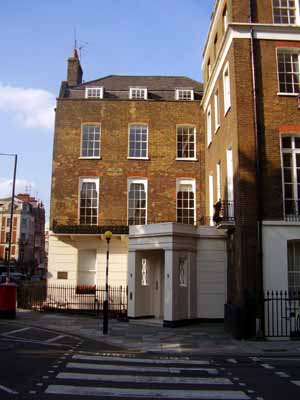
John Adams’ residence at Grosvenor Square, in London; presumably, his letter to John Jebb took form in this house. Long in use by U.S. Ambassadors to England, it is in 2015 the office complex of former British Prime Minister Tony Blair, envoy for The Quartet. Image from London Cyberpunk Tourist Guide
the social science will never be much improved untill the People unanimously know and Consider themselvs as the fountain of Power and untill they shall know how to manage it Wisely and honestly. reformation must begin with the \Body of the/ People which can be done only, to affect, in their Educations. the Whole People must take \upon/ themselvs the Education of the Whole People and must be willing to bear the expences of it. there should not be a district of one Mile square without a school in it, not founded by a Charitable individual but maintained at the expence of the People themselv[s] they must be taught to reverence themselvs instead of adoreing their servants their Generals Admirals Bishops and Statesmen — Instead of Admiring so extravegantly a Prince of Orange, we Should admire the Botavian Nation which produced him. Instead of Adoring a Washington, Mankind should applaud the Nation which Educated him. If Thebes owes its Liberty and Glory to Epaminandas, She will loose both when he dies, and it would have been as well if she had never enjoyed a taste for either: but if the Knowledge the Principles the Virtues and Capacities of the Theban Nation produced an Epaminandas, her Liberties and Glory will remain when he is no more: and if an analogous system of Education is Established and Enjoyed by the Whole Nation, it will produce a succession of Epaminandas’s, the Human Mind naturally exerts itself to form its Character according to the Ideas of those about it.
♦ Letter from John Adams to John Jebb, September 10, 1785, from Grosvenor Square, London
It’s a warning from the past: Do we like freedom? Then we must educate our children well, in public schools, to understand the public interest and their role in preserving and bettering the state. Can any presidential candidate expound on the issue, let alone the man, with any sing of erudition?
Even with his creative spelling, Adams knew who Epaminondas was, though he’s much forgotten from history courses in the U.S. today; a general of Thebes who reformed the Theban government and threw off the yoke of Sparta, in the 4th century BCE
John Adams High School, a public school in South Bend, Indiana. According to the Michiana Schools site, ” John Adams High School is a public school located in South Bend, Indiana right across the street from Indiana University South Bend. Adam’s mascot is the eagle and their school colors are scarlet, blue and white. Adams has a very successful mock trail team. The school was established in 1940. They have around 2,000 students every year, making it the second largest school in the Michiana area.”
Or, until that account is unsuspended by the forces supporting Donald Trump: Follow @FillmoreWhite, the account of the Millard Fillmore White House Library
We've been soaking in the Bathtub for several months, long enough that some of the links we've used have gone to the Great Internet in the Sky.
If you find a dead link, please leave a comment to that post, and tell us what link has expired.
Thanks!
Retired teacher of law, economics, history, AP government, psychology and science. Former speechwriter, press guy and legislative aide in U.S. Senate. Former Department of Education. Former airline real estate, telecom towers, Big 6 (that old!) consultant. Lab and field research in air pollution control.
My blog, Millard Fillmore's Bathtub, is a continuing experiment to test how to use blogs to improve and speed up learning processes for students, perhaps by making some of the courses actually interesting. It is a blog for teachers, to see if we can use blogs. It is for people interested in social studies and social studies education, to see if we can learn to get it right. It's a blog for science fans, to promote good science and good science policy. It's a blog for people interested in good government and how to achieve it.
BS in Mass Communication, University of Utah
Graduate study in Rhetoric and Speech Communication, University of Arizona
JD from the National Law Center, George Washington University


 Posted by Ed Darrell











 Millard Fillmore's Bathtub