Quote of the moment: Carl Sagan, on perspective on our own lives

September 14, 2013

You’ve heard the news by now: Voyager I has left the system.

What are we to think of that?
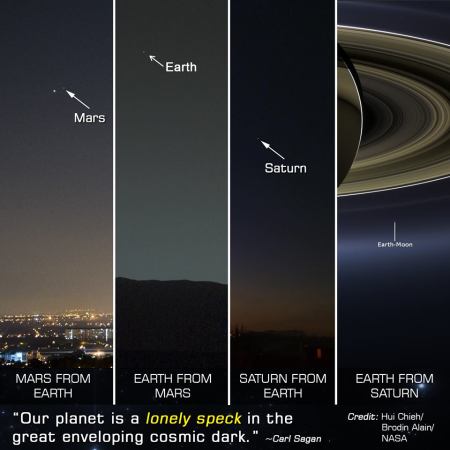
perspective-mars-earth-saturn

Earth, Moon, Mars, Jupiter – What you see depends on where you are, in reality as well as metaphorically. Images from NASA

” . . . astronomy is a humbling and character-building experience.”

Carl Sagan on how images of Earth from space change our perspective

Sagan’s words in the full passage impart a larger message, about caring for our planet and our neighbors on it.

From this distant vantage point, the Earth might not seem of any particular interest. But for us, it’s different. Consider again that dot. That’s here. That’s home. That’s us. On it everyone you love, everyone you know, everyone you ever heard of, every human being who ever was, lived out their lives. The aggregate of our joy and suffering, thousands of confident religions, ideologies, and economic doctrines, every hunter and forager, every hero and coward, every creator and destroyer of civilization, every king and peasant, every young couple in love, every mother and father, hopeful child, inventor and explorer, every teacher of morals, every corrupt politician, every “superstar,” every “supreme leader,” every saint and sinner in the history of our species lived there – on a mote of dust suspended in a sunbeam.

The Earth is a very small stage in a vast cosmic arena. Think of the rivers of blood spilled by all those generals and emperors so that in glory and triumph they could become the momentary masters of a fraction of a dot. Think of the endless cruelties visited by the inhabitants of one corner of this pixel on the scarcely distinguishable inhabitants of some other corner. How frequent their misunderstandings, how eager they are to kill one another, how fervent their hatreds. Our posturings, our imagined self-importance, the delusion that we have some privileged position in the universe, are challenged by this point of pale light. Our planet is a lonely speck in the great enveloping cosmic dark. In our obscurity – in all this vastness – there is no hint that help will come from elsewhere to save us from ourselves.

The Earth is the only world known, so far, to harbor life. There is nowhere else, at least in the near future, to which our species could migrate. Visit, yes. Settle, not yet. Like it or not, for the moment, the Earth is where we make our stand. It has been said that astronomy is a humbling and character-building experience. There is perhaps no better demonstration of the folly of human conceits than this distant image of our tiny world. To me, it underscores our responsibility to deal more kindly with one another and to preserve and cherish the pale blue dot, the only home we’ve ever known.

Carl SaganPale Blue Dot: A Vision of the Human Future in Space, 1997 reprint, pp. xv–xvi

In other words, we’re on our own.  What are we going to do about that?

Tip of the old scrub brush to Hashem Al-ghaili for making this image! https://www.facebook.com/ScienceNaturePage, and to All Science, All the Time.

It would be good to have better photo credits, including the genius who put together the montage.

More:

Voyager I photo of the Earth from outside Jupiter's orbit - the Pale Blue Dot photo

This is the photo that inspired Sagan’s reflection, as opposed to the photos in the poster mashup above. Via Wikipedia, with captions. ¶Seen from about 6 billion kilometers (3.7 billion miles), Earth appears as a tiny dot (the blueish-white speck approximately halfway down the brown band to the right) within the darkness of deep space. ¶This narrow-angle color image of the Earth, dubbed ‘Pale Blue Dot’, is a part of the first ever ‘portrait’ of the solar system taken by Voyager 1. The spacecraft acquired a total of 60 frames for a mosaic of the solar system from a distance of more than 4 billion miles from Earth and about 32 degrees above the ecliptic. From Voyager’s great distance Earth is a mere point of light, less than the size of a picture element even in the narrow-angle camera. Earth was a crescent only 0.12 pixel in size. Coincidentally, Earth lies right in the center of one of the scattered light rays resulting from taking the image so close to the sun. This blown-up image of the Earth was taken through three color filters – violet, blue and green – and recombined to produce the color image. The background features in the image are artifacts resulting from the magnification.

Save


Quiz answer: Who ratted out the Republicans like this, and when?

September 3, 2013

I said earlier that you may wish to file this under o tempora, o mores; or perhaps under plus ça change.  

These words seem oddly, perhaps astonishingly appropriate to political discussion today.  They come from the past, from more than a half-century ago, but they refer to issues that have not yet been solved, and to issues that were resolved, but have come undone, or just come around again.

GOP vs. Dems. Image from Addicting Information.

GOP vs. Dems. Image from Addicting Information, “15 differences between Democrats and Republicans.”

I posed this a quiz in a post a couple of days ago.

Does history repeat itself?  George Santayana said history repeats for those who forget what happened before.

Here’s a political speech given in Minnesota.  Without hitting Google, can you tell who said this, and when?

Democracy does not work that way. Democracy is a matter of faith–a faith in the soul of man–a faith in human rights. That is the kind of faith that moves mountains–that’s the kind of faith that hurled the Iron Range at the Axis and shook the world at Hiroshima.

Faith is much more than efficiency. Faith gives value to all things. Without faith, the people perish.

Today the forces of liberalism face a crisis. The people of the United States must make a choice between two ways of living–a decision, which will affect us the rest of our lives and our children and our grandchildren after us.

On the other side, there is the Wall Street way of life and politics. Trust the leader! Let big business take care of prices and profits! Measure all things by money! That is the philosophy of the masters of the Republican Party.

Well, I have been studying the Republican Party for over 12 years at close hand in the Capital of the United States. And by this time, I have discovered where the Republicans stand on most of the major issues.

Since they won’t tell you themselves, I am going to tell you.

They approve of the American farmer-but they are willing to help him go broke.

They stand four-square for the American home–but not for housing.

They are strong for labor–but they are stronger for restricting labor’s rights.

They favor a minimum wage–the smaller the minimum the better.

They indorse educational opportunity for all–but they won’t spend money for teachers or for schools.

They think modern medical care and hospitals are fine–for people who can afford them.

They approve of social security benefits-so much so that they took them away from almost a million people.

They believe in international trade–so much so that they crippled our reciprocal trade program, and killed our International Wheat Agreement.

They favor the admission of displaced persons–but only within shameful racial and religious limitations.

They consider electric power a great blessing-but only when the private power companies get their rake-off.

They say TVA is wonderful–but we ought never to try it again.

They condemn “cruelly high prices”–but fight to the death every effort to bring them down.

They think the American standard of living is a fine thing–so long as it doesn’t spread to all the people.

And they admire the Government of the United States so much that they would like to buy it.

Now, my friends, that is the Wall Street Republican way of life. But there is another way–there is another way–the Democratic way, the way of the Democratic Party.

Of course, the Democratic Party is not perfect. Nobody ever said it was. But the Democratic Party believes in the people. It believes in freedom and progress, and it is fighting for its beliefs right now.

In the Democratic Party, you won’t find the kind of unity where everybody thinks what the boss tells him to think, and nothing else.

But you will find an overriding purpose to work for the good of mankind. And you will find a program–a concrete, realistic, and practical program that is worth believing in and fighting for.

Now, I call on all liberals and progressives to stand up and be counted for democracy in this great battle. I call on the old Farmer-Labor Party, the old Wisconsin Progressives, the Non-Partisan Leaguers, and the New Dealers to stand up and be counted in this fight.

What clues does that passage contain that it wasn’t said in the past year?  Or was it?

I’ll post the answer in a day or so — take a guess in comments.

James said it was Harry Truman, and indeed it was.

President Harry S Truman, image from UCSB American Presidency Project

President Harry S Truman, image from UCSB American Presidency Project

Truman spoke to a crowd in Minnesota, in the St. Paul Municipal Auditorium, on October 13, 1948, about three weeks before the 1948 election in which he “upset” New York Gov. Thomas Dewey.  This was part of Truman’s famous Whistle Stop speaking tour of the U.S.

If the words look like they could have been said today, perhaps we should pay attention to them today, no?

Surely someone has a photograph of Truman speaking in St. Paul — but I haven’t found it yet.

More:


Quote of the moment: Mark Twain, “death was an exaggeration”

September 3, 2013

Words of encouragement in tough times, from Samuel Clemens, writing as Mark Twain:

” . . . the report of my death was an exaggeration.” Mark Twain

The note was published in the New York Journal, June 2, 1897.  While it’s true that Twain wrote this, most popular citations have added and rearranged words.

Text of the note:

James Ross Clemens, a cousin of mine was seriously ill two or three weeks ago in London, but is well now.  The report of my illness grew out of his illness, the report of my death was an exaggeration.

Mark Twain with kitten, in 1907 - Wikipedia image

Mark Twain with kitten, in 1907 – Wikipedia image

Save

Save


Who ratted out the Republicans like this, and when?

September 2, 2013

You may wish to file this under o tempora, o mores; or perhaps under plus ça change.  

GOP vs. Dems. Image from Addicting Information.

GOP vs. Dems. Image from Addicting Information, “15 differences between Democrats and Republicans.”


Does history repeat itself?  George Santayana said history repeats for those who forget what happened before.

Here’s a political speech given in Minnesota.  Without hitting Google, can you tell who said this, and when?

Democracy does not work that way. Democracy is a matter of faith–a faith in the soul of man–a faith in human rights. That is the kind of faith that moves mountains–that’s the kind of faith that hurled the Iron Range at the Axis and shook the world at Hiroshima.

Faith is much more than efficiency. Faith gives value to all things. Without faith, the people perish.

Today the forces of liberalism face a crisis. The people of the United States must make a choice between two ways of living–a decision, which will affect us the rest of our lives and our children and our grandchildren after us.

On the other side, there is the Wall Street way of life and politics. Trust the leader! Let big business take care of prices and profits! Measure all things by money! That is the philosophy of the masters of the Republican Party.

Well, I have been studying the Republican Party for over 12 years at close hand in the Capital of the United States. And by this time, I have discovered where the Republicans stand on most of the major issues.

Since they won’t tell you themselves, I am going to tell you.

They approve of the American farmer-but they are willing to help him go broke.

They stand four-square for the American home–but not for housing.

They are strong for labor–but they are stronger for restricting labor’s rights.

They favor a minimum wage–the smaller the minimum the better.

They indorse educational opportunity for all–but they won’t spend money for teachers or for schools.

They think modern medical care and hospitals are fine–for people who can afford them.

They approve of social security benefits-so much so that they took them away from almost a million people.

They believe in international trade–so much so that they crippled our reciprocal trade program, and killed our International Wheat Agreement.

They favor the admission of displaced persons–but only within shameful racial and religious limitations.

They consider electric power a great blessing-but only when the private power companies get their rake-off.

They say TVA is wonderful–but we ought never to try it again.

They condemn “cruelly high prices”–but fight to the death every effort to bring them down.

They think the American standard of living is a fine thing–so long as it doesn’t spread to all the people.

And they admire the Government of the United States so much that they would like to buy it.

Now, my friends, that is the Wall Street Republican way of life. But there is another way–there is another way–the Democratic way, the way of the Democratic Party.

Of course, the Democratic Party is not perfect. Nobody ever said it was. But the Democratic Party believes in the people. It believes in freedom and progress, and it is fighting for its beliefs right now.

In the Democratic Party, you won’t find the kind of unity where everybody thinks what the boss tells him to think, and nothing else.

But you will find an overriding purpose to work for the good of mankind. And you will find a program–a concrete, realistic, and practical program that is worth believing in and fighting for.

Now, I call on all liberals and progressives to stand up and be counted for democracy in this great battle. I call on the old Farmer-Labor Party, the old Wisconsin Progressives, the Non-Partisan Leaguers, and the New Dealers to stand up and be counted in this fight.

What clues does that passage contain that it wasn’t said in the past year?  Or was it?

I’ll post the answer in a day or so — take a guess in comments.


Quote of the moment: Potter Stewart, on the freedom to procreate without government intrusion

August 31, 2013

Justice Potter Stewart, official portrait in the U.S. Supreme Court. Artist: Ruth A. Nestor Hamilton. Oyez image.

Justice Potter Stewart, official portrait in the U.S. Supreme Court. Artist: Ruth A. Nestor Hamilton. Oyez image.

Several decisions of this Court make clear that freedom of personal choice in matters of marriage and family life is one of the liberties protected by the Due Process Clause of the Fourteenth Amendment. […] As recently as last Term, in Eisenstadt v. Baird, 405 U. S. 438, 405 U. S. 453, we recognized “the right of the individual, married or single, to be free from unwarranted governmental intrusion into matters so fundamentally affecting a person as the decision whether to bear or beget a child.” That right necessarily includes the right of a woman to decide whether or not to terminate her pregnancy.

Potter Stewart (1915-1985) US Supreme Court Justice (1959-81)
Roe v. Wade, 410 U.S. 113, 169-170 (1973) [Concurring]
(Source)

Links added here, except “Source.”  Handing the scrub brush to WIST, so WIST may tip it to itself.


Quote of the moment: James Madison, education, or farce and tragedy

August 31, 2013

James Madison Building, Library of Congress -- the official Madison Memorial

James Madison Building of the Library of Congress, the official James Madison Memorial for the nation

A popular Government, without popular information, or the means of acquiring it,
is but a Prologue to a Farce or a Tragedy; or perhaps both.
Knowledge will forever govern ignorance.

And a people who mean to be their own governours,
must arm themselves with the power which knowledge gives.

— James Madison in a letter to W. T. Barry, August 4, 1822

This is an encore post, partly.

Photo of inscription to the left (north) of the main entrance on Independence Ave., of the James Madison Building, Library of Congress, Washington, D.C.

Photo of inscription to the left (north) of the main entrance on Independence Ave., of the James Madison Building, Library of Congress, Washington, D.C.

More:  


Exact spot – a place to dream

August 28, 2013

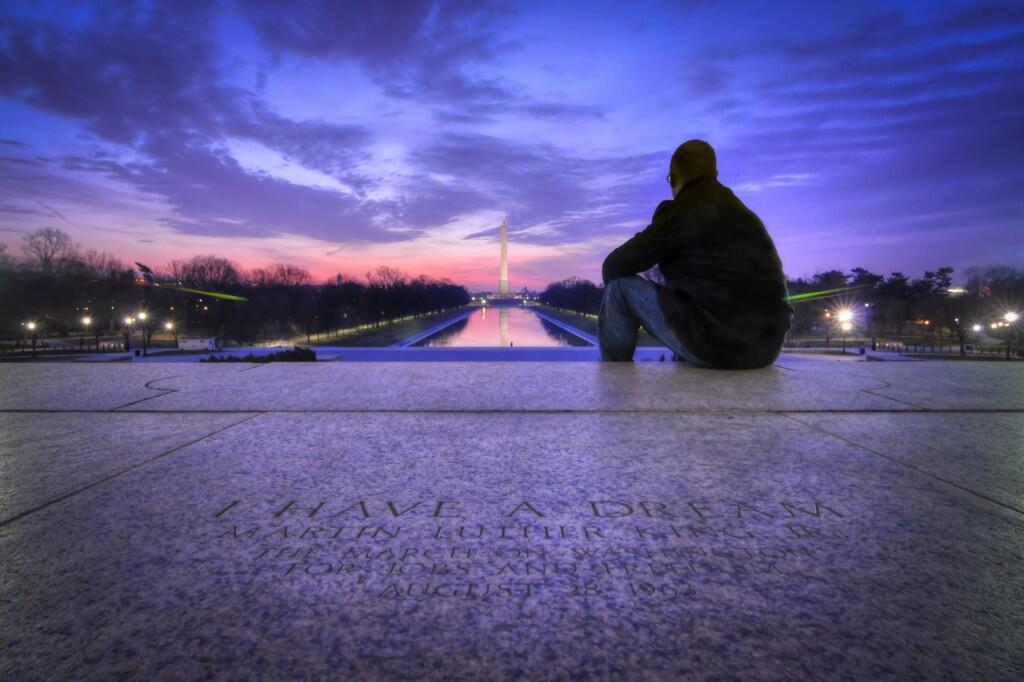
Pic Tweet from the National Park Service: Beautiful photo of the exact spot Dr. King delivered his

Pic Tweet from the National Park Service: Beautiful photo of the exact spot Dr. King delivered his “I Have a Dream speech” 50 years ago today. #MLKdream50 pic.twitter.com/MHwWsY7Hwp

Nice photo from the Lincoln Memorial looking toward the Washington Monument across the length of the Reflecting Pool.

This photo was taken at least several months ago, before the scaffolding went up on the Washington Monument for repairs for damage from the 2011 earthquake.  It’s a winter or fall picture, I’m guessing from the bare trees, and taken early in the morning, as the sun rises in the east over the Capitol and Washington Monument.  That is one of the best times to be at the Lincoln Memorial, in my experience.  The man in the photo has the historic spot very much to himself at that time.

Engraving on the stone says:

I HAVE A DREAM
MARTIN LUTHER KING, JR.
THE MARCH ON WASHINGTON
FOR JOBS AND FREEDOM
AUGUST 28, 1963

More:


Will Rogers and Wiley Post crashed in Alaska, August 15, 1935

August 15, 2013

Will Rogers, images from Will Rogers Museums, Oklahoma

Will Rogers, images from Will Rogers Museums, Oklahoma

August 15, the Ides of August, hosted several significant events through the years.  In 1935, it was a tragic day in Alaska, as an airplane crash took lives of Will Rogers and Wiley Post.  To refresh your memory, an encore post, with a few edits and additions.

After Mark Twain died, America found another great humorist, raconteur, story-teller, who tickled the nation’s funny-bone and pricked the collective social conscience at the same time. Will Rogers is most famous today for his sentiment that he never met a man he didn’t like. In 1935, he was at the height of his popularity, still performing as a lariat-twirling, Vaudeville comedian who communed with presidents, and kept his common sense. He wrote a daily newspaper column that was carried in 500 newspapers across America.  Rogers was so popular that Texas and Oklahoma have dueled over who gets the bragging rights in claiming him as a native son.

Will Rogers ready to perform.  Photo taken prior to 1900 - Wikimedia

Will Rogers ready to perform. Photo taken prior to 1900 – Wikimedia

Wiley Post was known as one of the best pilots in America. He gained fame by being the first pilot to fly solo around the world. Post was famous for his work developing new ways to fly at high altitudes. Post was born in Texas and moved to Oklahoma. He lost an eye in an oil-field accident in 1924, then used the settlement money to buy his first airplane. He befriended Will Rogers when flying Rogers to an appearance at a Rodeo, and the two kept up their friendship literally to death.

Post asked Rogers to come along on a tour of the great unknown land of Alaska, where Post was trying to map routes for mail planes to Russia. Ever adventurous, Rogers agreed — he could file his newspaper columns from Alaska by radio and telephone. On August 15, 1935, their airplane crashed near Point Barrow, Alaska, killing them both.

Wiley Post, first to fly solo around the world, in an early pressure suit for high-altitude flying - Wikimedia photo

Wiley Post, first to fly solo around the world, in an early pressure suit for high-altitude flying – Wikimedia photo

On August 15, 2008, a ceremony in Claremore, Oklahoma, honored the two men on the 73rd anniversary of their deaths. About 50 pilots from Oklahoma, Missouri, Kansas and Arkansas will fly in to the Claremore Airport for the Will Rogers-Wiley Post Fly-In Weekend. Oklahoma Lt. Gov. Jari Askins will offer a tribute.

Rogers was 56, leaving behind his wife, Betty, and four children. Post, 36, left a widow.

Rogers’ life is really quite legendary. Historian Joseph H. Carter summed it up:

Will Rogers was first an Indian, a cowboy then a national figure. He now is a legend.

Born in 1879 on a large ranch in the Cherokee Nation near what later would become Oologah, Oklahoma, Will Rogers was taught by a freed slave how to use a lasso as a tool to work Texas Longhorn cattle on the family ranch.
As he grew older, Will Rogers’ roping skills developed so special that he was listed in the Guinness Book of Records for throwing three lassos at once: One rope caught the running horse’s neck, the other would hoop around the rider and the third swooped up under the horse to loop all four legs.

Will Rogers’ unsurpassed lariat feats were recorded in the classic movie, “The Ropin’ Fool.”

His hard-earned skills won him jobs trick roping in wild west shows and on the vaudeville stages where, soon, he started telling small jokes.

Quickly, his wise cracks and folksy observations became more prized by audiences than his expert roping. He became recognized as being a very informed and smart philosopher–telling the truth in very simple words so that everyone could understand.

After the 10th grade, Will Rogers dropped out of school to become a cowboy in a cattle drive. He always regretted that he didn’t finish school, but he made sure that he never stopped learning–reading, thinking and talking to smart people. His hard work paid off.

Will Rogers was the star of Broadway and 71 movies of the 1920s and 1930s; a popular broadcaster; besides writing more than 4,000 syndicated newspaper columns and befriending Presidents, Senators and Kings.

During his lifetime, he traveled around the globe three times– meeting people, covering wars, talking about peace and learning everything possible.

He wrote six books. In fact he published more than two million words. He was the first big time radio commentator, was a guest at the White House and his opinions were sought by the leaders of the world.

Inside himself, Will Rogers remained a simple Oklahoma cowboy. “I never met a man I didn’t like,” was his credo of genuine love and respect for humanity and all people everywhere. He gave his own money to disaster victims and raised thousands for the Red Cross and Salvation Army.

Post’s legacy is significant, too. His employer, Oklahoma oil man F. C. Hall, encouraged Post to push for aviation records using Hall’s Lockheed Vega, and Post was happy to comply. Before his history-making trip around the world, he had won races and navigation contests. NASA traces the development of the space-walking suits worn by astronauts to Post’s early attempts for flight records:

For Wiley Post to achieve the altitude records he sought, he needed protection. (Pressurized aircraft cabins had not yet been developed.) Post’s solution was a suit that could be pressurized by his airplane engine’s supercharger.

First attempts at building a pressure suit failed since the suit became rigid and immobile when pressurized. Post discovered he couldn’t move inside the inflated suit, much less work airplane controls. A later version succeeded with the suit constructed already in a sitting position. This allowed Post to place his hands on the airplane controls and his feet on the rudder bars. Moving his arms and legs was difficult, but not impossible. To provide visibility, a viewing port was part of the rigid helmet placed over Post’s head. The port was small, but a larger one was unnecessary because Post had only one good eye!

Last photo of Will Rogers (in the hat) and Wiley Post, in Alaska in 1935 (from Century of Flight)

Last photo of Will Rogers (in the hat) and Wiley Post, in Alaska in 1935 (from Century of Flight)

Tip of the old scrub brush to Alaska bush advocate Pamela Bumsted.

Resources:


Edward Tufte channels Richard Feynman

August 6, 2013

Tufte writes at great length — well, writes and demonstrates — about yellow warning signs.  (Yes, that Edward Tufte.)

In one of his demonstrations, the art comes from the ideas and sayings of Richard Feynman.

Edward Tufte makes art out of Feynman's ideas.

Edward Tufte makes art out of Feynman’s ideas. Sorta. Edward Tufte, Nature Cannot Be Fooled, print on canvas, 78″ x 27 ½”, edition of 3

This guy makes money doing that? What kind of charmed life is that?

More:

Just how fitting is it that Tufte uses the words of Feynman, probably more famous for Feynman diagrams than the work that got him a Nobel?

English: Picture of a Feynman diagram, inscrib...

“Picture of a Feynman diagram, inscribed by Richard P. Feynman to me [who MFB has not identified], in my copy of Volume 3 of his Feynman Lectures on Physics (Quantum Mechanics). Picture taken by self. if you can’t read the symbols, they are \gamma_\mu to \gamma_\mu and 1/q^2 .” Wikipedia image

English: Edward Tufte giving a class and holdi...

Edward Tufte giving a class and holding a scanned copy of a first edition book by Galileo. Wikipedia image


“Damn the torpedoes” Day, Battle of Mobile Bay, August 5, 1864

August 5, 2013

Julius O. Davidson's painting (published by Louis Prang) of the Battle of Mobile Bay, August 5, 1864.

Julius O. Davidson’s painting (published by Louis Prang) of the Battle of Mobile Bay, August 5, 1864.

Especially with the excellent help of Tom Petty, whose 1979 album “Damn the Torpedoes” propelled him to stardom, the phrase “Damn the torpedoes!” remains one of the most used out of history.

Just try to find someone who can tell you who first said it, and what the circumstances were. It’s a sign that history instruction is not what it should be on some matters.

August 5 marks the 149th anniversary of the Battle of Mobile Bay in 1864, when the Union Navy under the command of Admiral David Farragut took Mobile from Confederate forces.

U.S. Heritage Protection Services — a division of the National Park Service — gives a straight up, unemotional description of the fight, which was a key victory for the Union, shutting down much of the Confederacy’s ability to trade with foreign nations and supply its army:

Photograph from circa 1855-1865 of then-Rear Admiral David Glasgow Farragut, the commander of the Union forces at the Battle of Mobile Bay, and the man to who is attributed the famous line,

Photograph from circa 1855-1865 of then-Rear Admiral David Glasgow Farragut, the commander of the Union forces at the Battle of Mobile Bay, and the man to who is attributed the famous line, “Damn the Torpedoes!”

Other Names: Passing of Forts Morgan and Gaines

Location: Mobile County and Baldwin County

Campaign: Operations in Mobile Bay (1864)

Date(s): August 2-23, 1864

Principal Commanders: Adm. David G. Farragut and Maj. Gen. Gordon Granger [US]; Adm. Franklin Buchanan and Brig. Gen. Richard L. Page [CS]

Forces Engaged: Farragut’s Fleet (14 wooden ships and 4 monitors) and U.S. army forces near Mobile [US]; Buchanan’s Flotilla (3 gunboats and an ironclad), Fort Morgan Garrison, Fort Gaines Garrison, and Fort Powell Garrison [CS]

Estimated Casualties: 1,822 (US 322; CS 1,500)

Description: A combined Union force initiated operations to close Mobile Bay to blockade running. Some Union forces landed on Dauphin Island and laid siege to Fort Gaines. On August 5, Farragut’s Union fleet of eighteen ships entered Mobile Bay and received a devastating fire from Forts Gaines and Morgan and other points.  After passing the forts, Farragut forced the Confederate naval forces, under Adm. Franklin Buchanan, to surrender, which effectively closed Mobile Bay. By August 23, Fort Morgan, the last big holdout, fell, shutting down the port. The city, however, remained uncaptured.

Results(s): Union victory

World War I recruiting poster showing Admiral David Farragut lashed to the mast of his ship, and offering the quote for which Farragut is famous.

World War I recruiting poster showing Admiral David Farragut lashed to the mast of his ship, and offering the quote for which Farragut is famous. Image from the collection of the Library of Congress, via Wikipedia

Nota bene:

  • Was Farragut lashed to the rigging? Wikipedia’s listing:An anecdote of the battle that has some dramatic interest has it that Farragut was lashed to the mast during the passage of Fort Morgan. The image it brings to mind is of absolute resolve: if his ship were to be sunk in the battle, he would go down with her. The truth is more prosaic; while he was indeed lashed to the rigging of the mainmast, it was a precautionary move rather than an act of defiance. It came about after the battle had opened and smoke from the guns had clouded the air. In order to get a better view of the action, Farragut climbed into Hartford‘s rigging, and soon was high enough that a fall would certainly incapacitate him and could have killed him. Seeing this, Captain Drayton sent a seaman aloft with a piece of line to secure the admiral. He demurred, saying, “Never mind, I am all right,” but the sailor obeyed his captain’s orders, tying one end of the line to a forward shroud, then around the admiral and to the after shroud.[50]Later, when CSS Tennessee made her unsupported attack on the Federal fleet, Farragut climbed into the mizzen rigging. Still concerned for his safety, Captain Drayton had Flag-Lieutenant J. Crittenden Watson tie him to the rigging again.[51] Thus, the admiral had been tied to the rigging twice in the course of the battle.
  • Did Farragut actually say, “Damn the torpedoes, full speed ahead?  Mobile Bay had been mined by the Confederates, to hold off exactly the sort of Union attack Farragut mounted. Mines, in that time, were known as “torpedoes,” not the underwater-missiles made famous by World War II movies.  Farragut had an iron-clad ship, Tecumseh, under his command leading the attack; legend holds that other ships slowed to allow Tecumseh to cross them and move ahead.  Farragut asked why the attack was slowing, and upon hearing that they feared torpedoes (mines), he later was reputed to have said “Damn the torpedoes,” and urged moving at all speed.  Did he say, “full speed ahead?”  Accounts differ on that, even in legend.  In one version he shouted to the ship Brooklyn, “Go ahead!”  That’s unlikely in the din of sailing, coupled with the din of battle.  Another account has him shouting (vainly) to the Hartford, “Four bells, Captain Drayton.”  Yet another version, that almost makes sense, has him shouting to the Metacomet, which was lashed to the Hartford’s side, “Go ahead, Jouett, full speed.”  The entire quote must be listed as attributed, and the only part most versions agree on is “Damn the torpedoes.”  A World War I recruiting poster probably inscribed the quote into history (see the poster in this post).  Alas, Tecumseh hit a torpedo early in the battle, and sank, killing most of its crew.
  • Political importance:  Coupled with Gen. William Tecumseh Sherman‘s March Across Georgia, and the Fall of Atlanta, the Battle of Mobile Bay gave credence to the idea that the fortunes of the Civil War had turned in the Union’s favor.  This victory probably contributed greatly to the re-election of President Abraham Lincoln against opponents who urged simply ending the war without victory.
  • Mobile Bay was an important port? Mobile Bay stands as a monument to poor soil conservation practices, today.  Maps of the battle show a much larger bay than exists today; since 1864, silting from the river has filled in the bay, making it much less useful, and much less important to shipping.
H. H. Lloyd & Co's 1861 map of Mobile Bay, Alabama

1861 map of Mobile Bay: “H.H. Lloyd & Co’s Campaign Military Charts Showing The Principal Strategic Places Of Interest. Engraved Expressly To Meet A Public Want During The Present War. Compiled From Official Data By Egbert L. Viele, Military and Civil Engineer; and Charles Haskins. Published Under The Auspices Of The American Geographical And Statistical Society. Entered … 1861 by H.H. Lloyd & Co. H.H. Lloyd & Co’s Military Charts. Sixteen Maps On One Sheet.”

LandSat image of Mobile Bay, from NASA, 2003 (via Wikipedia)

LandSat image of Mobile Bay, from NASA, 2003 (via Wikipedia).  The Northern Bay is almost completely silted in by the Mobile River and others.

Whether Admiral David G. Farragut actually said, “Damn the torpedoes!” the phrase remains an often-used quotation to urge action in the face of uncertainty, hopefully, to victory.  Farragut’s forces won the Battle of Mobile Bay on August 5, 1864, a key maritime battle of the Civil War.  Whatever he said, it must have been inspiring.

More:


How about another cup of coffee? (Global Warming Conspiracy and Starbucks Cup #289)

June 19, 2013

Encore post from September 17, 2007, and August 2009 — maybe more appropriate today than ever before.

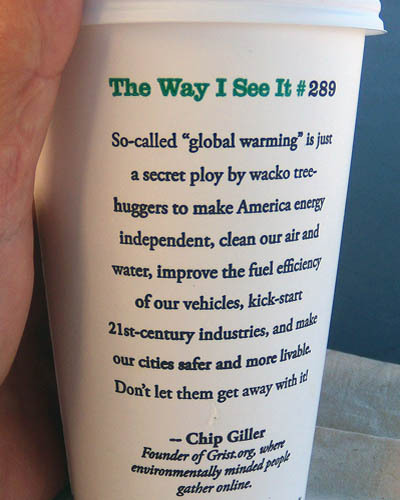
Found this on my coffee cup today (links added here):

The Way I See It #289

So-called “global warming” is just

a secret ploy by wacko tree-

huggers to make America energy

independent, clean our air and

water, improve the fuel efficiency

of our vehicles, kick-start

21st-century industries, and make

our cities safer and more livable.

Don’t let them get away with it!

Chip Giller
Founder of Grist.org, where
environmentally-minded people
gather online.

Starbucks Coffee Cup, The Way I See It #289 (global warming)

Look! Someone found the same cup I found!

I miss those old Starbucks cups — but then, they killed the Starbucks in our town.  I don’t buy the 100 cups of Starbucks coffee I used to get in a year.

More:

Save


Quote of the moment: Eisenhower’s astonishing D-Day leadership example, “Blame . . . is mine alone”

June 6, 2013

Eisenhower's unused statement on the failure of D-Day

Eisenhower’s contingency statement, in case D-Day failed – image from the National Archives

This quote actually isn’t a quote. It was never said by the man who wrote it down to say it. It carries a powerful lesson because of what it is.

In preparing for the D-Day invasion, Supreme Allied Commander Dwight Eisenhower carefully contemplated what would happen if the invasion failed.  What if the Germans repulsed the Allies, and no foothold was established to re-take the main body of Europe from the Germans?

Ike’s answer is a model of leadership:  He would take the blame.  Regardless what happened, Ike took full responsibility for the failure, giving credit to the soldiers who would have sacrificed in vain, perhaps their lives.

The Bathtub recently posted Gen. Dwight Eisenhower’s “order of the day” to the troops about to conduct the Allied invasion of Normandy — D-Day — to establish the toehold in Europe the Allies needed to march to Berlin, and to end World War II in Europe. As a charge to the troops, it was okay — Eisenhower-style words, not Churchill-style, but effective enough. One measure of its effectiveness was the success of the invasion, which established the toe-hold from which the assaults on the Third Reich were made.

eisenhower-with-paratrooper-eve-of-d-day.jpg

Photo shows Eisenhower meeting with troops of the 101st Airborne Division, 502nd Parachute Infantry Regiment, on the eve of the invasion. It was these men whose courage he lauded.

When Eisenhower wrote his words of encouragement to the troops, and especially after he visited with some of the troops, he worried about the success of the operation. It was a great gamble. Many of the things the Allies needed to go right — like weather — had gone wrong. Victory was not assured. Defeat strode the beaches of Normandy waiting to drive the Allies back into the water, to die.

Eisenhower wrote a second statement, a shorter one. This one was directed to the world. It assumed the assault had failed. In a few short sentences, Eisenhower commended the courage and commitment of the troops who, he wrote, had done all they could. The invasion was a chance, a good chance based on the best intelligence the Allies had, Eisenhower wrote. But it had failed.

The failure, Eisenhower wrote, was not the fault of the troops, but was entirely Eisenhower’s.

He didn’t blame the weather, though he could have. He didn’t blame fatigue of the troops, though they were tired, some simply from drilling, many from war. He didn’t blame the superior field position of the Germans, though the Germans clearly had the upper hand. He didn’t blame the almost-bizarre attempts to use technology that look almost clownish in retrospect — the gliders that carried troops behind the lines, sometimes too far, sometimes killing the pilots when the gliders’ cargo shifted on landing;  the flotation devices that were supposed to float tanks to the beaches to provide cover for the troops (but which failed, drowning the tank crews and leaving the foot soldiers on their own); the bombing of the forts and pillboxes on the beaches, which failed because the bombers could not see their targets through the clouds.

There may have been a plan B, but in the event of failure, Eisenhower was prepared to establish who was accountable, whose head should roll if anyone’s should.

Eisenhower took full responsibility.

Our landings in the Cherbourg-Havre area have failed to gain a satisfactory foothold and I have withdrawn the troops. My decision to attack at this time and place was based upon the best information available. The troop, the air [force] and the navy did all that bravery and devotion to duty could do. If any blame or fault attaches to the attempt, it is mine alone.

Who in the U.S. command would write such a thing today?  Who else in history would have written such a thing?  Is there any indication that Julius Caesar, Alexander the Great, Attila the Hun, Genghis Khan, or any other commander of a great army in  a world-turning invasion, considered how to save and perhaps salve the reputation of his troops, though they had failed?

Leadership is more than just positive thinking.

  • The message may also be viewed here. Yes, it’s incorrectly dated July 5 — should have been June 5.  In history, little is perfect.  We can excuse his slip of the pen, considering what he had on his mind.

This is much of an encore post.

More:

General Eisenhower speaks with members of the ...

Another  angle of the meeting with the troops:  General Eisenhower speaks with members of the 101st Airborne Division on the evening of 5 June 1944.  Wikipedia image


Quote of the moment: Reorganization creates illusion of progress, and demoralization – Charlton Ogburn

May 31, 2013

Historian and birder Charlton Ogburn, right.

Historian and birder Charlton Ogburn, right.

We trained hard, but it seemed that every time we were beginning to form up into teams we would be reorganized. Presumably the plans for our employment were being changed. I was to learn later in life that, perhaps because we are so good at organizing, we tend as a nation to meet any new situation by reorganizing; and a wonderful method it can be for creating the illusion of progress while producing confusion, inefficiency, and demoralization.

This quotation is often misattributed to one Greek philosopher or another, or to the Roman Petronius.

Cover of "The Marauders"

Cover of The Marauders

Ogburn’s magazine article became the basis for his book, The Marauders. In turn, that was the basis for a movie, Merrill’s Marauders.  In the book, the quote is different:

As a result, I suppose, of high-level changes of mind about how we were to be used, we went though several reorganizations. Perhaps because Americans as a nation have a gift for organizing, we tend to meet any new situation by reorganization, and a wonderful method it is for creating the illusion of progress at the mere cost of confusion, inefficiency and demoralization.

  • The Marauders (1959), chapter 2, page 60 (attributed)

My old friend Frank Hewlett had been a correspondent in the South Pacific and Southeast Asia, including Burma, during World War II.  Frank told me that he had been the first to call the American group “Merrill’s Marauders” in a war news dispatch on the progress the group made.  He did not get any credit for the book or movie title, but he said it was great that any group of soldiers that worked that well got popular attention for their work.  I’ve never found Hewlett’s dispatches from that period, but I’ve never found anything else he told me to be inaccurate.

In serious corporate reorganizations, or in corporate culture change operations, this quote is usually trotted out in opposition to whatever the proposed change may be.  Generally reorganizers will dismiss the thing as fictional, in at least one case claiming that renegade corporate leader Bob Townsend made it up.

In our work at Committing to Leadership at American Airlines, CEO Bob Crandall actually read the full quote (misattributed at the time), and observed that it was probably true — but not a good reason to stop a needed reorganization.  Crandall pointed to the last sentence, and said that a good manager’s job is to make sure that reorganization creates real success, not just an illusion of action, and that any good manager will recognize that reorganizations offer the danger of demoralization and confusion.  Those are problems to be managed, Crandall said, not fates that cannot be avoided.

Do you find Ogburn’s snippet of wisdom to be true? So what?

More:

Merrill's Marauders (film)

Advertising poster for Merrill’s Marauders; Wikipedia image


Remedial economics, remedial U.S. history

May 20, 2013

I should set a threshold — five e-mails, or a dozen Facebook posts, and a response will be given.

But then some idiot would work to make the threshold.

You’ve seen this, of course:

5 misleading truths

“5 Truths You CANNOT Disagree With”

It was past the threshold, so I responded:

More truths:

  1. You cannot legislate poverty away by laws that send all the wealth generated by the working poor, to the rich.
  2. What one person receives without working for in capital gains, or productivity increases, another person worked for, without receiving. It is unjust to give the benefits of the sweat of one woman, to another man.
  3. Government subsidies create wealth in nations; most great enterprises have found their roots in government funding, from irrigation in Babylon, to farming along the Yellow River, through Columbus’s voyage of (accidental) discovery, the Transcontinental Railroad, and settlement of America.
  4. When opportunities exist for the poor, hard work makes much wealth. A society is wealthy, and an economy is sound, when the poor spend money. Rich guys spending money doesn’t work — there are not enough rich guys.
  5. When the rich tiny percentage of the people get the idea that they do not have to work, but that the work of others is ALSO their property and the poor will take care of them, then we have conditions for financial collapse (see the Panic of 1908, or 1837, or the Great Depression — or any other); those conditions often lead to revolution, sometimes violent (see Russia in 1917, Germany in 1922, Shay’s Rebellion, the French Revolution — when the rich get the rewards the hard-working man created, it is the beginning of the end of any nation. Some smart nations fix those problems when they occur.

When hard work no longer gets you ahead, and when hard work no longer will feed, clothe and educate your family, you may get angry.

“Those who make peaceful revolution impossible, make violent revolution inevitable,” John Kennedy said. He was pretty smart for a young, rich guy.

(Links added above, other than the YouTube video; I hope the JFK Library has video of Kennedy actually saying that.)

People who post these “5 truths” without irony must have slept through ALL of economics in high school, and forgotten everything they may have ever learned about American history in the 20th century.  Income distribution is a serious issue — maldistribution and misdistribution of wealth leads to trouble, either economic calamity, or violent revolution, or both.

It’s fun to say that no person should get ahead on the earnings of another person; it’s more realistic when we understand that a system rigged to give financial players yachts, and working people debt, is the unfairness that those worriers should worry about.

John F. Kennedy waves to a crowd in front of Cobo Hall, in Detroit

Presidential candidate John F. Kennedy waves to a crowd in front of Cobo Hall, in Detroit, during the 1960 American Legion Convention. Image from Walter Reuther Library

More:


Another great speech of the 21st century: Kiwi MP Williamson on the effects of gay marriage

April 20, 2013

Two great legislative speeches in about two months!  (Here’s the other one, from Colorado State Sen. Mike Johnston.)

Maurice Williamson

Maurice Williamson (Photo credit: nznationalparty)

My faith in humanity’s ability to invent rhetoric to cause us to rise to an occasion is in danger of being restored.

Here’s New Zealand Member of Parliament Maurice Williamson, National-Pakuranga, making a case for a national law recognizing gay marriage (on April 17, 2013, I think):

The bill to recognize marriage between homosexual partners passed, 77-44.

New Zealand’s National Party is described as “center-right,” or like a U.S. Republican.  Can you imagine any member of the GOP in the U.S. House or the U.S. Senate having both the guts and the wit to make this speech?

Pakuranga is also leading the polls as the most humorous name for a political district, potentially displacing Cleveland for the first time.  It’s a Maori word, actually, with a beautiful definition, from Maori lore:  “Battle of the Sunlight.”

Tip of the old scrub brush to correspondent Devona Wyant, for finding the thing and sending a link.

More: