Quote of the moment: Hemingway, writers need “shock-proof, [excrement] detector”

July 30, 2012

Ernest Hemingway and cat Cristobal, Cuba; JFK Library collection

Ernest Hemingway with his cat, Cristobal, at his home, Finca Vigia, San Francisco de Paula, Cuba.  Date unknown (circa 1955?) Photo from Ernest Hemingway Collection, John F. Kennedy Presidential Library and Museum, Boston. (Copyright status unknown)

Was Ernest Hemingway the greatest writer in English of the 20th century?  Fortunately we don’t have to choose.  We can read Hemingway, and Faulkner (with whom he had a few bones to pick), and Hammett, and Parker, and Feynman, and Vonnegut, Bellow, Morrison, dos Passos,  Shaw, Kipling, Ford, Conrad and a dozen more, enjoying each for the gifts she or he demonstrated so well on a page.

Any way you stack it, though, Hemingway was a great one.

In an interview with George Plimpton, published in the Paris Review in 1958, Hemingway talked about what it takes to be a great writer.  Maybe it’s something one needs to be born with:

The most essential gift for a good writer is a built-in, shock-proof, shit detector. This is the writer’s radar and all great writers have had it.

If we could make a machine to substitute for that, a solid-gold, built-in, shock-proof [excrement] detector, we could improve writing, politics, government, business, and a hundred other fields of endeavor.

If we had a just and appropriately skeptical world, everyone would have one, a “solid gold, built-in, shock-proof [excrement] detector.”

What an enormous If.

Also at Millard Fillmore’s Bathtub:


Sourced quote of the moment: Tax, or mandate? Lincoln said . . .

June 28, 2012

In light of this morning’s Supreme Court ruling on the Affordable Health Care Act, and questions about whether the law is a “mandate” or a “tax,” we might look to history to see whether the question matters, and what it is.

Lincoln probably had it right, as we noted here many months ago.  So, an encore post:

It’s a delightful story I’ve heard dozens of times, and retold a few times myself: Abraham Lincoln faced with some thorny issue that could be settled by a twist of language, or a slight abuse of power, asks his questioner how many legs would a dog have, if we called the dog’s tail, a leg. “Five,” the questioner responds confident in his mathematical ability to do simple addition.

Sunrise at the Lincoln Memorial; photo by Matthew Cavanaugh, EPA

“No,” Lincoln says. “Calling a dog’s tail a leg, doesn’t make it a leg.”

But there is always the doubt: Is the story accurate? Is this just another of the dozens of quotes that are misattributed to Lincoln in order to lend credence to them?

I have a source for the quote: Reminiscences of Abraham Lincoln by distinguished men of his time / collected and edited by Allen Thorndike Rice (1853-1889). New York: Harper & Brothers Publishers, 1909. This story is found on page 242. Remarkably, the book is still available in an edition from the University of Michigan Press. More convenient for us, the University of Michigan has the entire text on-line, in the Collected Works of Abraham Lincoln, an on-line source whose whole text is searchable.

However, Lincoln does not tell the story about a dog — he uses a calf.

Rice’s book is a collection of reminiscences of others, exactly as the title suggests. Among those doing the reminiscing are ex-president and Gen. U. S. Grant, Massachusetts Gov. Benjamin Butler (also a former Member of Congress), Charles A. Dana the editor and former Assistant Secretary of War, and several others. In describing Lincoln and the Emancipation Proclamation, George W. Julian relates the story. Julian was a Free-Soil Party leader and a Member of Congress during Lincoln’s administration. Julian’s story begins on page 241:

Few subjects have been more debated and less understood than the Proclamation of Emancipation. Mr. Lincoln was himself opposed to the measure, and when he very reluctantly issued the preliminary proclamation in September, 1862, he wished it distinctly understood that the deportation of the slaves was, in his mind, inseparably connected with the policy. Like Mr. Clay and other prominent leaders of the old Whig party, he believed in colonization, and that the separation of the two races was necessary to the welfare of both. He was at that time pressing upon the attention of Congress a scheme of colonization in Chiriqui, in Central America, which Senator Pomeroy espoused with great zeal, and in which he had the favor of a majority of the Cabinet, including Secretary Smith, who warmly indorsed the project. Subsequent developments, however, proved that it was simply an organization for land-stealing and plunder, and it was abandoned; but it is by no means certain that if the President had foreseen this fact his preliminary notice to the rebels would have been given. There are strong reasons for saying that he doubted his right to emancipate under the war power, and he doubtless meant what he said when he compared an Executive order to that effect to “the Pope’s Bull against the comet.” In discussing the question, he used to liken the case to that of the boy who, when asked how many legs his calf would have if he called its tail a leg, replied, ” Five,” to which the prompt response was made that calling the tail a leg would not make it a leg.

I believe it is fair to call the story “confirmed.” It’s not an exact quote, but it’s an accurate story.

_____________

So, is it a tax, or a mandate?  If it’s the right thing to do, does it matter what we call it?  A rose by any other name . . .

Update:  There remains the very strong danger that critics of the Affordable Healthcare Act can’t tell the difference between a calf’s tail and a calf’s leg, or ear, or any other part of the anatomy.


Quote of the moment: What if D-Day had failed? IKE said, ‘blame me’

June 11, 2012

Eisenhower's unused statement on the failure of D-Day

Eisenhower’s contingency statement, in case D-Day failed – image from the National Archives

This quote actually isn’t a quote. It was never said by the man who wrote it down to say it. It carries a powerful lesson because of what it is.

The Bathtub recently posted Gen. Dwight Eisenhower’s “order of the day” to the troops about to conduct the Allied invasion of Normandy — D-Day — to establish the toehold in Europe the Allies needed to march to Berlin, and to end World War II in Europe. As a charge to the troops, it was okay — Eisenhower-style words, not Churchill-style, but effective enough. One measure of its effectiveness was the success of the invasion, which established the toe-hold from which the assaults on the Third Reich were made.

When Eisenhower wrote his words of encouragement to the troops, and especially after he visited with some of the troops, he worried about the success of the operation. It was a great gamble. Many of the things the Allies needed to go right — like weather — had gone wrong. Victory was not assured. Defeat strode the beaches of Normandy waiting to drive the Allies back into the water, to die. [Photo shows Eisenhower meeting with troops of the 101st Airborne Division, 502nd Parachute Infantry Regiment, on the eve of the invasion. It was these men whose courage he lauded. Update: Someone “took hostage” the photo I linked to — a thumbnail version is appended; I leave the original link in hopes it might be liberated] eisenhower-with-paratrooper-eve-of-d-day.jpg

Eisenhower wrote a second statement, a shorter one. This one was directed to the world. It assumed the assault had failed. In a few short sentences, Eisenhower commended the courage and commitment of the troops who, he wrote, had done all they could. The invasion was a chance, a good chance based on the best intelligence the Allies had, Eisenhower wrote. But it had failed.

The failure, Eisenhower wrote, was not the fault of the troops, but was entirely Eisenhower’s.

He didn’t blame the weather, though he could have. He didn’t blame fatigue of the troops, though they were tired, some simply from drilling, many from war. He didn’t blame the superior field position of the Germans, though the Germans clearly had the upper hand. He didn’t blame the almost-bizarre attempts to use technology that look almost clownish in retrospect — the gliders that carried troops behind the lines, sometimes too far, sometimes killing the pilots when the gliders’ cargo shifted on landing; the flotation devices that were supposed to float tanks to the beaches to provide cover for the troops (but which failed, drowning the tank crews and leaving the foot soldiers on their own); the bombing of the forts and pillboxes on the beaches, which failed because the bombers could not see their targets through the clouds.

There may have been a plan B, but in the event of failure, Eisenhower was prepared to establish who was accountable, whose head should roll if anyone’s should.

Eisenhower took full responsibility.

Our landings in the Cherbourg-Havre area have failed to gain a satisfactory foothold and I have withdrawn the troops. My decision to attack at this time and place was based upon the best information available. The troop, the air [force] and the navy did all that bravery and devotion to duty could do. If any blame or fault attaches to the attempt, it is mine alone.

Do you think anyone in the U.S. command would write such a thing today?  I have several candidates.  Who do you think is leader enough to shoulder the blame for such a massive, hypothetical debacle?

  • The message may also be viewed here. Yes, it’s incorrectly dated July 5 — should have been June 5.

This is an encore post.


Quote of the moment: John Adams, necessity of public schools to make the nation work

May 30, 2012

Capitalization, spelling punctuation, insertions and grammar, as in the original; highlighting added:

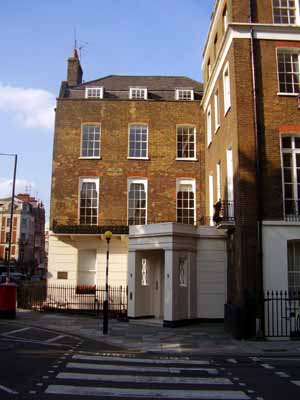
John Adams' residence at Grosvenor Square, in London

John Adams’ residence at Grosvenor Square, in London; presumably, his letter to John Jebb took form in this house. Long in use by U.S. Ambassadors to England, it is in 2015 the office complex of former British Prime Minister Tony Blair, envoy for The Quartet.  Image from London Cyberpunk Tourist Guide

the social science will never be much improved untill the People unanimously know and Consider themselvs as the fountain of Power and untill they shall  know how to manage it Wisely and honestly. reformation must begin with the \Body of the/ People which can be done only, to affect, in their Educations. the Whole People must take \upon/ themselvs the Education of the Whole People and must be willing to bear the expences of it. there should not be a district of one Mile square without a school in it, not founded by a Charitable individual but maintained at the expence of the People themselv[s] they must be taught to reverence themselvs instead of adoreing their servants their Generals Admirals Bishops and Statesmen — Instead of Admiring so extravegantly a Prince of Orange, we Should admire the Botavian Nation which produced him. Instead of Adoring a Washington, Mankind should applaud the Nation which Educated him. If Thebes owes its Liberty and Glory to Epaminandas, She will loose both when he dies, and it would have been as well if she had never enjoyed a taste for either: but if the Knowledge the Principles the Virtues and Capacities of the Theban Nation produced an Epaminandas, her Liberties and Glory will remain when he is no more: and if an analogous system of Education is Established and Enjoyed by the Whole Nation, it will produce a succession of Epaminandas’s, the Human Mind naturally exerts itself to form its Character according to the Ideas of those about it.

♦  Letter from John Adams to John Jebb, September 10, 1785, from Grosvenor Square, London

Tip of the old scrub brush to Diane Ravitch’s Blog.


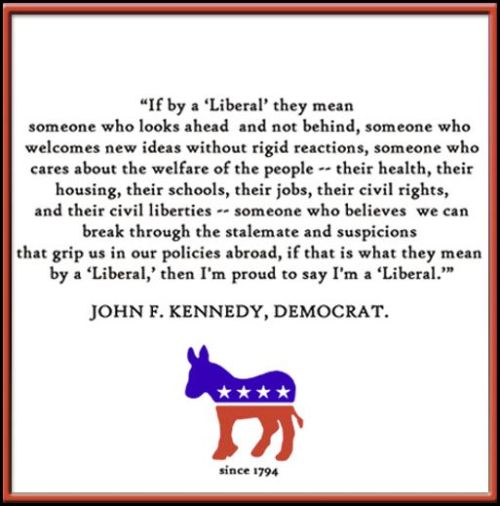
Proud to be a liberal, JFK

May 5, 2012

Somebody made a poster out of it:

JFK, proud to be a liberal

Quote from Sen. John F. Kennedy, September 14, 1960

You can read the entire original speech by Sen. John F. Kennedy here, at Millard Fillmore’s Bathtub.  There’s more defense of his being considered a liberal, and the good that liberals do.  It’s almost quaint the way he defends Adlai Stevenson.

Why do you wave the flag, help old ladies cross busy streets, keep children safe, and sing the “Star Spangled Banner?”

Tip of the old scrub brush to MoveOn.org, PBS and American Experience, and everyone who sent me a link to this today.


Quote of moment: Will Rogers on motivating students to learn

March 28, 2012

Thomas Jefferson urged a Constitutional amendment to institutionalize education as a federal function, part of his grander scheme to lift humanity out of the muck with education as the skyhook.

Will Rogers pointing into camera, Will Rogers Museum image

Will Rogers, photo courtesy the Will Rogers Museum

Will Rogers said:

Why don’t they pass a Constitutional Amendment prohibiting anybody from learning anything? If it works as good as Prohibition did, in five years we will have the smartest people on earth.

♥ The Quotable Will Rogers, Joseph H. Carter and Larry Gatlin, Gibbs Smith 2005, page 35.

Rogers probably read Mark Twain a lot, including The Adventures of Tom Sawyer, don’t you think?

Joseph H. Carter heads the Will Rogers Museum in Claremore, Oklahoma.  Larry Gatlin is the performer, who did show on Will Rogers that inspired the book.  This collection of Rogers’ quotes is loaded with information, but citations are not easy to get.  We trust that these two guys would be unlikely to misreport — but I’d still like to get a better citation on this quote.  Among other problems for scholars, in his lifetime Rogers wrote about a newspaper column each day, and he often collected columns into books that sold well but are now out of print.

Perhaps the amazing thing is that more bon mots are not misattributed to Will Rogers, especially the funny ones.

More:

Sculpture of Will Rogers on a horse on the gro...

Sculpture of Will Rogers on horseback, on the grounds of the Will Rogers Museum in Claremore, Oklahoma. This is a nice place to pause for a couple of hours on a drive along Interstate 44, a bit northeast of Broken Arrow. Wikipedia image


The anti-teacher, anti-lawyer, anti-education, anti-math, anti-civil rights truth behind “Kill all the lawyers”

March 10, 2012

Mostly an encore post — something we shouldn’t have to repeat, but thoughts that deserve a place in everyone’s mind in an election year.  I originally posted this back in 2006.

Poster from Michael Boyd's 2000 production of Henry VI, Part II, at Stratford

All this murder of lawyers, teachers, accountants, education and civil rights, is bloody business. Poster from Michael Boyd’s 2000 production of Henry VI, Part II, at Stratford; PBS image via Wikipedia

In an otherwise informative post about a controversy over alternative certification for school administrators, at EdWize, I choked on this:

The Department leaders, Klein, Seidman and Alonso, lawyers all (perhaps Shakespeare was correct), are rigid ideologues who have alienated their work force as well as the parents of their constituents

Did you catch that? Especially the link to the Shakespeare line, “The first thing we do, let’s kill all the lawyers?”

This is not exactly history we’re fisking here — it’s drama, I suppose. Still, it falls neatly into the category of debunkings, not too unlike the debunking of the story of Millard Fillmore’s bathtub.

The line from Shakespeare is accurate. It’s from Henry VI, Part II. But it’s not so much a diatribe against lawyers as it is a part of a satirical indictment of those who would overthrow government, and oppress the masses for personal gain.

It is Dick the Butcher who says the line. Jack Cade has just expressed his warped view that he should be king, after having attempted a coup d’etat and taken power, at least temporarily. Cade starts in with his big plans to reform the economy — that is, to let his friends eat cheap or free, while other suffer and starve.

Dick chimes in to suggest that in the new regime, the lawyers ought to be the first to go — they protect rights of people and property rights, and such rights won’t exist in Cade’s imagined reign. Cade agrees. The purpose of killing the lawyers, then, is to perpetuate their rather lawless regime.

At that moment others in Cade’s conspiracy enter, having captured the town Clerk of Chatham. The man is put on trial for his life, accused of being able to read and keep accounts. Worse, he’s been caught instructing young boys to read.

There is no saving the poor Clerk at that point.  Cade orders the Clerk to be hanged, “with his pen and inkhorn around his neck” (even the pen was considered dangerous!).

Thus Shakespeare relates how terrorists of old steal government and rights, by killing the lawyers, the educated, and especially the teachers.

It’s still true today. Those who would steal rights from people, those who would oppress others, assault the rule of law, education, and those who spread learning. Beware those who urge death to law and learning; they are related to Dick the Butcher, philosophically, at least.  (No offense to honest butchers, I hope — especially to members of the UFCW.  Dick the Butcher was not a member of any butcher’s union.)

Here is the text, from the site “William Shakespeare — the Complete Works”:

CADE
Be brave, then; for your captain is brave, and vows
reformation. There shall be in England seven
halfpenny loaves sold for a penny: the three-hooped
pot; shall have ten hoops and I will make it felony
to drink small beer: all the realm shall be in
common; and in Cheapside shall my palfrey go to
grass: and when I am king, as king I will be,–

ALL
God save your majesty!

CADE
I thank you, good people: there shall be no money;
all shall eat and drink on my score; and I will
apparel them all in one livery, that they may agree
like brothers and worship me their lord.

DICK
The first thing we do, let’s kill all the lawyers.

CADE
Nay, that I mean to do. Is not this a lamentable
thing, that of the skin of an innocent lamb should
be made parchment? that parchment, being scribbled
o’er, should undo a man? Some say the bee stings:
but I say, ’tis the bee’s wax; for I did but seal
once to a thing, and I was never mine own man
since. How now! who’s there?

(Enter some, bringing forward the Clerk of Chatham)

Smith the Weaver and Dick the Butcher seize the Clerk of Chatham, Bunbury print of Henry VI, Part II scene

Smith the Weaver and Dick the Butcher seize the Clerk of Chatham, in Act IV, scene ii of Henry VI, Part II. Engraving by Henry William Bunbury, from collection of the Folger Shakespeare Library; original published by Thos. Macklin Poets Gallery, London, 1795

SMITH
The clerk of Chatham: he can write and read and
cast accompt.

CADE
O monstrous!

SMITH
We took him setting of boys’ copies.

CADE
Here’s a villain!

SMITH
Has a book in his pocket with red letters in’t.

CADE
Nay, then, he is a conjurer.

DICK
Nay, he can make obligations, and write court-hand.

CADE
I am sorry for’t: the man is a proper man, of mine
honour; unless I find him guilty, he shall not die.
Come hither, sirrah, I must examine thee: what is thy name?

CLERK
Emmanuel.

DICK
They use to write it on the top of letters: ’twill
go hard with you.

CLERK
Sir, I thank God, I have been so well brought up
that I can write my name.

ALL
He hath confessed: away with him! he’s a villain
and a traitor.

CADE
Away with him, I say! hang him with his pen and
ink-horn about his neck.

>Exit one with the Clerk

More, Resources (some from Zemanta):


Quote of the moment: Abraham Lincoln on job creators, ‘labor is the superior of capital’

February 16, 2012

Abraham Lincoln as working man, Charles Turzak woodcut - Abraham Lincoln Presidential Library & Museum

Abraham Lincoln as working man, woodcut by Charles Turzak circa 1933 – Abraham Lincoln Presidential Library & Museum; caption on this image at the Lincoln Library site notes that Turzak portrayed Lincoln as the working man Lincoln himself never aspired to be, though he well respected those who did labor.

Labor is prior to and independent of capital. Capital is only the fruit of labor, and could never have existed if labor had not first existed.

Labor is the superior of capital, and deserves much the higher consideration.

President Abraham Lincoln, Annual Message to Congress, December 3, 1861 (the “State of the Union”)

Abraham Lincoln took great inspiration from Americans and their striving to move up in the world.  He admired inventions and inventors, he admired working people and their drive to become their own managers and proprietors of their own businesses.  Lincoln had been there himself.

By the time he stopped at the Wisconsin State Fair in 1859 — a full year before his campaign for the presidency — Lincoln was a relatively wealthy lawyer, a good trial lawyer whose better-paying clients included the largest industrial companies of the day, railroads.  Lincoln grew up on hard-scrabble farms, though, and he had been a shopkeeper and laborer before he studied law and opened his practice.  Lincoln also owned a patent — a device to float cargo boats higher in the Sangamon River that served Sangamon County where he lived, the better to make the entire area a figurative river of free enterprise.

Lincoln was invited to comment on “labor,” at an exhibit showing new machines to mechanize America’s farms.  At the Wisconsin fair Lincoln complimented farmers, inventors, inventions, and all laborers.  Just over 24 months later, excerpts from that speech showed up at the close of his State of the Union declaration, his December 3 remarks delivered to Congress as the Constitution required.  Lincoln probably did not deliver the remarks as as a speech, but they appear in the Congressional Record as a speech, and it is often cited that way.  He spoke something like these words in Wisconsin, and they were his views at the end of the first year of the Civil War, expressing yet again his hope that the union would survive, and continue to prosper, for all working people.

Below is a more complete quoting of his remarks from the Message to Congress.

It continues to develop that the insurrection is largely, if not exclusively, a war upon the first principle of popular government– the rights of the people. Conclusive evidence of this is found in the most grave and maturely considered public documents, as well as in the general tone of the insurgents. In those documents we find the abridgment of the existing right of suffrage and the denial to the people of all right to participate in the selection of public officers except the legislative boldly advocated, with labored arguments to prove that large control of the people in government is the source of all political evil. Monarchy itself is sometimes hinted at as a possible refuge from the power of the people.

In my present position I could scarcely be justified were I to omit raising a warning voice against this approach of returning despotism. It is not needed nor fitting here that a general argument should be made in favor of popular institutions, but there is one point, with its connections, not so hackneyed as most others, to which I ask a brief attention. It is the effort to place capital on an equal footing with, if not above, labor in the structure of government. It is assumed that labor is available only in connection with capital; that nobody labors unless somebody else, owning capital, somehow by the use of it induces him to labor. This assumed, it is next considered whether it is best that capital shall hire laborers, and thus induce them to work by their own consent, or buy them and drive them to it without their consent. Having proceeded so far, it is naturally concluded that all laborers are either hired laborers or what we call slaves. And further, it is assumed that whoever is once a hired laborer is fixed in that condition for life.

Now there is no such relation between capital and labor as assumed, nor is there any such thing as a free man being fixed for life in the condition of a hired laborer. Both these assumptions are false, and all inferences from them are groundless.

Labor is prior to and independent of capital. Capital is only the fruit of labor, and could never have existed if labor had not first existed.

Labor is the superior of capital, and deserves much the higher consideration. Capital has its rights, which are as worthy of protection as any other rights. Nor is it denied that there is, and probably always will be, a relation between labor and capital producing mutual benefits. The error is in assuming that the whole labor of community exists within that relation. A few men own capital, and that few avoid labor themselves, and with their capital hire or buy another few to labor for them. A large majority belong to neither class–neither work for others nor have others working for them. In most of the Southern States a majority of the whole people of all colors are neither slaves nor masters, while in the Northern a large majority are neither hirers nor hired. Men, with their families–wives, sons, and daughters,–work for themselves on their farms, in their houses, and in their shops, taking the whole product to themselves, and asking no favors of capital on the one hand nor of hired laborers or slaves on the other. It is not forgotten that a considerable number of persons mingle their own labor with capital; that is, they labor with their own hands and also buy or hire others to labor for them; but this is only a mixed and not a distinct class. No principle stated is disturbed by the existence of this mixed class.

Again, as has already been said, there is not of necessity any such thing as the free hired laborer being fixed to that condition for life. Many independent men everywhere in these States a few years back in their lives were hired laborers. The prudent, penniless beginner in the world labors for wages awhile, saves a surplus with which to buy tools or land for himself, then labors on his own account another while, and at length hires another new beginner to help him. This is the just and generous and prosperous system which opens the way to all, gives hope to all, and consequent energy and progress and improvement of condition to all. No men living are more worthy to be trusted than those who toil up from poverty; none less inclined to take or touch aught which they have not honestly earned. Let them beware of surrendering a political power which they already possess, and which if surrendered will surely be used to close the door of advancement against such as they and to fix new disabilities and burdens upon them till all of liberty shall be lost.

From the first taking of our national census to the last are seventy years, and we find our population at the end of the period eight times as great as it was at the beginning. The increase of those other things which men deem desirable has been even greater. We thus have at one view what the popular principle, applied to government through the machinery of the States and the Union, has produced in a given time, and also what if firmly maintained it promises for the future. There are already among us those who if the Union be preserved will live to see it contain 200,000,000. The struggle of to-day is not altogether for to-day; it is for a vast future also. With a reliance on Providence all the more firm and earnest, let us proceed in the great task which events have devolved upon us.

[Excerpted here from the online Classic Literature Library, Writings of Abraham Lincoln Vol. 5; the complete Message to Congress of December 3, 1861, begins here; the section quoted above can be found on pages 143 and 144.]

See Also:

Related articles (from Zemanta)


Quote of the moment: “Shoulders of giants” (February 15)

February 15, 2012

February 15th is Shoulders of Giants Day (unless you’re still on the Julian calendar).

Or should be.  See this mostly encore post:

Famous quotations often get cited to the wrong famous person. ‘Somebody said something about standing on the shoulders of giants — who was it? Edison? Lincoln? Einstein? Jefferson?’  It may be possible someday to use Google or a similar service to track down the misquotes.

The inspiration, perhaps

Robert Burton, author of "Anatomy of Melancholy"

Robert Burton, melancholy scholar at Oxford

A dwarf standing on the shoulders of a giant may see farther than a giant himself.

Robert Burton (February 8, 1577-January 25, 1640), vicar of Oxford University, who wrote The Anatomy of Melancholy to ward off his own depressions

The famous quote

Sir Isaac Newton, by Sir Godfrey Keller, 1689

Sir Isaac Newton, by Sir Godfrey Keller, 1689

If I have seen further (than you and Descartes) it is by standing on the shoulders of Giants.

Sir Isaac Newton, letter to Robert Hooke, February 5, 1675, Julian/February 15, 1676, Gregorian

Other references:


Quote of the moment: Una Mulzac, ‘learn, teach’

February 11, 2012

From her obituary in the New York Times, Sunday February 5, 2012:

Ms. Mulzac’s profession was selling books at Liberation Bookstore, a Harlem landmark that for four decades specialized in materials promoting black identity and black power.  On one side of the front door, a sign declared,

“If you don’t know, learn.”

On the other:

“If you know, teach.”

Ms. Mulzac died at a hospital in Queens on January 21, at the age of 88.

Sign of Liberation Bookstore, Harlem, founded by Una Mulzac (1923-2012)

Una Mulzac at the door of Liberation Bookstore, in Harlem.  Harlem World image

Una Mulzac at the door of Liberation Bookstore, in Harlem. Harlem World image

More:


Quote of the moment: Gold standard a “barbarous relic” – Keynes

January 18, 2012

Portrait of John Maynard Keynes as a younger man

Portrait of John Maynard Keynes as a younger man (who is the artist? where does it hang?)

  • In truth, the gold standard is already a barbarous relic.
    • John Maynard Keynes, Monetary Reform (1924), p. 172

    Did Keynes foresee the rise of Ron Paul, even in 1924?

    Gold Key, weighing one kilogram is used to acc...

More, resources:


Encore quote of the moment: Robert Kennedy on what really matters

December 18, 2011

This is borrowed from Harry Clarke (with a few minor corrections in the text):

Robert F. Kennedy speech at the University of Kansas, Lawrence, March 18, 1968

Robert F. Kennedy speech at the University of Kansas, Lawrence, March 18, 1968 - Photo by George Silk, Time-Life Pictures/Getty Images

RFK said this in 1968. In a speech I heard today it was quoted and it stirred me.

Too much and for too long, we seem to have surrendered personal excellence and community value in the mere accumulation of material things. Our Gross National Product, now, is over eight hundred billion dollars a year, but that GNP — if we judge the United States of America by that — that GNP counts air pollution and cigarette advertising and ambulances to clear our highways of carnage. It counts special locks for our doors and the jails for the people who break them. It counts the destruction of the redwoods and the loss of our natural wonder in chaotic sprawl. It counts napalm and it counts nuclear warheads, and armored cars for the police to fight the riots in our cities. It counts Whitman’s rifle and Speck’s knife, and the television programs which glorify violence in order to sell toys to our children.

Yet the Gross National Product does not allow for the health of our children, the quality of their education, or the joy of their play. It does not include the beauty of our poetry or the strength of our marriages, the intelligence of our public debate or the integrity of our public officials. It measures neither our wit nor our courage, neither our wisdom nor our learning, neither our compassion nor our devotion to our country; it measures everything, in short, except that which makes life worthwhile. And it can tell us everything about America except why we are proud that we are Americans.

Kennedy delivered these words in an address at the University of Kansas, Lawrence, Kansas, on March 18, 1968.

Here’s a video production from the Glaser Progress Foundation which includes an audio recording of the speech:

More resources:

Most of this post appeared originally here in 2009.  We need the reminder.


Gettysburg Address – again, “No casino, please”

November 21, 2011

Yet another version of readings of the Gettysburg Address — this time by actors, historians, and a winner of the Medal of Honor, in a campaign to prevent the construction of a casino next door to the battlefield monuments:


Springfield, Illinois area residents recite Lincoln’s Gettysburg Address

November 20, 2011

A short feature put together by the Springfield State Journal-Register:


November 19th, 1863: Mr. Lincoln at Gettysburg

November 19, 2011

A mostly encore post about today’s anniversary of Lincoln’s speech at Gettysburg.

Prior to 2007, this was the only known photo of Lincoln at Gettysburg, on the day of his address - Library of Congress

148 years ago today, Abraham Lincoln redefined the Declaration of Independence and the goals of the American Civil War, in a less-than-two-minute speech dedicating part of the battlefield at Gettysburg, Pennsylvania, as a cemetery and final resting place for soldiers who died in the fierce battle fought there the previous July 1 through 3.

Now in 2011, we’re in the “150th anniversary” years of the Civil War.  Maybe some will look back to the time our nation worked hard to tear itself asunder, and learn lessons that might help us keep from doing that in the 21st century.  Some might find inspiration, or aspiration, in Lincoln’s words at Gettysburg.

Interesting news for 2007: More photos from the Library of Congress collection may contain images of Lincoln. The photo above, detail from a much larger photo, had been thought for years to be the only image of Lincoln from that day. The lore is that photographers, taking a break from former Massachusetts Sen. Edward Everett’ s more than two-hour oration, had expected Lincoln to go on for at least an hour. His short speech caught them totally off-guard, focusing their cameras or taking a break. Lincoln finished before any photographer got a lens open to capture images.

Images of people in these photos are very small, and difficult to identify. Lincoln was not identified at all until 1952:

The plate lay unidentified in the Archives for some fifty-five years until in 1952, Josephine Cobb, Chief of the Still Pictures Branch, recognized Lincoln in the center of the detail, head bared and probably seated. To the immediate left (Lincoln’s right) is Lincoln’s bodyguard, Ward Hill Lamon, and to the far right (beyond the limits of the detail) is Governor Andrew G. Curtin of Pennsylvania. Cobb estimated that the photograph was taken about noontime, just after Lincoln arrived at the site and before Edward Everett’s arrival, and some three hours before Lincoln gave his now famous address.

On-line, the Abraham Lincoln Blog covered the discovery that two more photographic plates from the 1863 speech at Gettysburg may contain images of Lincoln in his trademark stove-pipe hat. Wander over to the story at the USA Today site, and you can see just how tiny are these detail images in relation to the photographs themselves. These images are tiny parts of photos of the crowd at Gettysburg. (The story ran in USA Today last Thursday or Friday — you may be able to find a copy of that paper buried in the returns pile at your local Kwikee Mart.) Digital technologies, and these suspected finds of Lincoln, should prompt a review of every image from Gettysburg that day.

To the complaints of students, I have required my junior U.S. history students to memorize the Gettysburg Address (though, not yet in this school year). In Irving I found a couple of students who had memorized it for an elementary teacher years earlier, and who still could recite it. Others protested, until they learned the speech. This little act of memorization appears to me to instill confidence in the students that they can master history, once they get it done.

To that end, I discovered a good, ten-minute piece on the address in Ken Burns’ “Civil War” (in Episode 5). On DVD, it’s a good piece for classroom use, short enough for a bell ringer or warm-up, detailed enough for a deeper study, and well done, including the full text of the address itself performed by Sam Waterson.

Embedded video from CNN VideoIn 1863 Edward Everett, the former Massachusetts senator and U.S. secretary of state, was regarded as the greatest orator of the time. A man of infinite grace, and a historian with some sense of events and what the nation was going through, Everett wrote to Lincoln the next day after their speeches:

“I should be glad, if I could flatter myself that I came as near the central idea of the occasion in two hours, as you did in two minutes.”

Interesting note: P. Z. Myers at Pharyngula notes that the Gettysburg Address was delivered “seven score and four years ago.” Of course, that will never happen again. I’ll wager he was the first to notice that odd juxtaposition on the opening line.

Do you have a favorite performance of this address you’d commend for internet bloggers?  Let us know where to find it, in comments.

Tip of the old scrub brush to Chamblee54 for reminding us about the anniversary, today.

Resources for students and teachers: