Fly your flag today: Veterans Day 2009

November 11, 2009

Fly your U.S. flag today — thank a veteran.  We have a lot to thank veterans for, and veterans need a little more appreciation today.

Veterans Day Poster, 2009, U.S. Department of Veterans Affairs

US Veterans Administration tells the history of celebrating Veterans Day on November 11:

World War I – known at the time as “The Great War” – officially ended when the Treaty of Versailles was signed on June 28, 1919, in the Palace of Versailles outside the town of Versailles, France. However, fighting ceased seven months earlier when an armistice, or temporary cessation of hostilities, between the Allied nations and Germany went into effect on the eleventh hour of the eleventh day of the eleventh month. For that reason, November 11, 1918, is generally regarded as the end of “the war to end all wars.”

In November 1919, President Wilson proclaimed November 11 as the first commemoration of Armistice Day with the following words: “To us in America, the reflections of Armistice Day will be filled with solemn pride in the heroism of those who died in the country’s service and with gratitude for the victory, both because of the thing from which it has freed us and because of the opportunity it has given America to show her sympathy with peace and justice in the councils of the nations…”

The original concept for the celebration was for a day observed with parades and public meetings and a brief suspension of business beginning at 11:00 a.m.

The United States Congress officially recognized the end of World War I when it passed a concurrent resolution on June 4, 1926, with these words:

Whereas the 11th of November 1918, marked the cessation of the most destructive, sanguinary, and far reaching war in human annals and the resumption by the people of the United States of peaceful relations with other nations, which we hope may never again be severed, and

Whereas it is fitting that the recurring anniversary of this date should be commemorated with thanksgiving and prayer and exercises designed to perpetuate peace through good will and mutual understanding between nations; and

Whereas the legislatures of twenty-seven of our States have already declared November 11 to be a legal holiday: Therefore be it Resolved by the Senate (the House of Representatives concurring), that the President of the United States is requested to issue a proclamation calling upon the officials to display the flag of the United States on all Government buildings on November 11 and inviting the people of the United States to observe the day in schools and churches, or other suitable places, with appropriate ceremonies of friendly relations with all other peoples.

An Act (52 Stat. 351; 5 U. S. Code, Sec. 87a) approved May 13, 1938, made the 11th of November in each year a legal holiday—a day to be dedicated to the cause of world peace and to be thereafter celebrated and known as “Armistice Day.” Armistice Day was primarily a day set aside to honor veterans of World War I, but in 1954, after World War II had required the greatest mobilization of soldiers, sailors, Marines and airmen in the Nation’s history; after American forces had fought aggression in Korea, the 83rd Congress, at the urging of the veterans service organizations, amended the Act of 1938 by striking out the word “Armistice” and inserting in its place the word “Veterans.” With the approval of this legislation (Public Law 380) on June 1, 1954, November 11th became a day to honor American veterans of all wars.

Later that same year, on October 8th, President Dwight D. Eisenhower issued the first “Veterans Day Proclamation” which stated: “In order to insure proper and widespread observance of this anniversary, all veterans, all veterans’ organizations, and the entire citizenry will wish to join hands in the common purpose. Toward this end, I am designating the Administrator of Veterans’ Affairs as Chairman of a Veterans Day National Committee, which shall include such other persons as the Chairman may select, and which will coordinate at the national level necessary planning for the observance. I am also requesting the heads of all departments and agencies of the Executive branch of the Government to assist the National Committee in every way possible.”

  • Click here for the 2007 poster from the Veterans Administration, or for posters dating back to 1978.
  • Veterans Day Teacher Resource Kit, for lesson plans and activities
  • veteransday09 Google

    Google's 2009 tribute to Veterans Day

    Remind others to fly their flags, too:

    Add to FacebookAdd to NewsvineAdd to DiggAdd to Del.icio.usAdd to StumbleuponAdd to RedditAdd to BlinklistAdd to TwitterAdd to TechnoratiAdd to Furl


    All U.S. flags at half-staff until Veterans Day, Obama orders

    November 7, 2009

    President Obama issued a directive ordering all federal facilities to fly the national flag at half-staff from now until Veterans Day (November 11), to honor the soldiers and civilians felled at Fort Hood, Texas.

    “It is an act of violence that would have been heartbreaking had it occurred anyplace in America,” Obama said. “It is a crime that would have horrified us had its victims been Americans of any background. But it’s all the more heartbreaking and all the more despicable because of the place where it occurred and the patriots who were its victims.”

    The president said he met Friday with FBI Director Robert Mueller, Defense Secretary Robert Gates and others to discuss their continuing investigation into the attack, which also injured at least 30.

    Obama also expressed his condolences to the victims’ families and recognized those who helped the wounded after the shooting at the base’s Soldier Readiness Processing Center. The center is where soldiers go to have their teeth checked and medical records updated before deploying overseas.

    “These are the men and women we honor today. These are the men and women we’ll honor on Veterans Day,” Obama said. “And these are the men and women we shall honor every day, in times of war and times of peace, so long as our nation endures.”  (from the Virginian-Pilot, in Norfolk, Virginia)

    Obama’s directive follows Texas Gov. Rick Perry’s order for flags in Texas to be flown half-staff until Monday.

    Flag etiquette reminder: When flown at half-staff, the U.S. flag should be raised quickly to full staff, then lowered slowly to half-staff.

    President Obama addressed the tragedy in his weekly radio and television message:

    Vodpod videos no longer available.
    (More about “Weekly Address: Tragedy at Fort Hood …“, posted with vodpod)
    Obama’s statement and proclamation can be found at the White House website.

    Texas flags at half-staff today, remembering Fort Hood

    November 6, 2009

    Texas Gov. Rick Perry has ordered flags in Texas to be flown at half-staff through Sunday, November 8, in remembrance of the victims of the shootings at Fort Hood.  The statement from Perry’s office follows.

    AUSTIN – Gov. Rick Perry today issued the following statement regarding the shootings at Fort Hood:

    “The Texas family suffered a significant loss today with the tragedy at Fort Hood. Along with all Texans, Anita and I are keeping those affected by today’s incidents in our thoughts and prayers.

    “We are deeply saddened by today’s events, but resolve to continue supporting our troops and protecting our citizens.

    “To honor those who lost their lives today, I have ordered that all Texas flags be lowered to half-staff until Sunday, and ask all Texans to pray for the victims, their families and the extended Fort Hood community.”

    The governor has been in contact with military and state law enforcement officials. To provide support at Fort Hood, Gov. Perry directed the deployment of a variety of state resources to the area, including Texas Department of Public Safety troopers, Texas Rangers and helicopters, to assist in securing the perimeter of the base and provide other support as necessary.

    The governor’s flag order applies to all U.S. and Texas flags under the control of the state. Flags will be lowered to half-staff on the State Capitol Building, flag displays in the Capitol Complex, and upon all public buildings, grounds and facilities beginning immediately until sunset on Sunday, November 8th.

    Individuals, businesses, municipalities, counties and other political subdivisions are encouraged to fly the flag at half-staff for the same length of time as a sign of respect.

    To view text of the governor’s remarks, please visit http://governor.state.tx.us/news/speech/13905/.

    Add to FacebookAdd to NewsvineAdd to DiggAdd to Del.icio.usAdd to StumbleuponAdd to RedditAdd to BlinklistAdd to TwitterAdd to TechnoratiAdd to Furl


    Veterans Day 2009 – Here’s the poster

    November 1, 2009

    Veterans Day Poster, 2009, U.S. Department of Veterans Affairs

    Veterans Day Poster, 2009, U.S. Department of Veterans Affairs - Click on poster for link to high-quality version

    Get ready to fly your flag on Veterans Day, November 11.

    Information


    Fly your flag for labor today: Labor Day 2009

    September 7, 2009

    Labor Day, 2009

    Fly your U.S. flag today. This is one of the dates designated in law as a permanent date for flag flying.

    Miners and their children celebrate Labor Day, Littleton, Colorado, 1940 - Library of CongressMiners and their children celebrate Labor Day, Littleton, Colorado, 1940 – Library of Congress
    Here are some past posts on labor, and Labor Day:

    History-minded people may want to look at the history of the holiday, such as the history told at the Department of Labor’s website.

    The First Labor Day

    The first Labor Day holiday was celebrated on Tuesday, September 5, 1882, in New York City, in accordance with the plans of the Central Labor Union. The Central Labor Union held its second Labor Day holiday just a year later, on September 5, 1883.

    In 1884 the first Monday in September was selected as the holiday, as originally proposed, and the Central Labor Union urged similar organizations in other cities to follow the example of New York and celebrate a “workingmen’s holiday” on that date. The idea spread with the growth of labor organizations, and in 1885 Labor Day was celebrated in many industrial centers of the country.

    Or this history at the more academic Library of Congress site:

    On September 5, 1882, some 10,000 workers assembled in New York City to participate in America’s first Labor Day parade. After marching from City Hall to Union Square, the workers and their families gathered in Reservoir Park for a picnic, concert, and speeches. This first Labor Day celebration was initiated by Peter J. McGuire, a carpenter and labor union leader who a year earlier cofounded the Federation of Organized Trades and Labor Unions, a precursor of the American Federation of Labor.

    McGuire had proposed his idea for a holiday honoring American workers at a labor meeting in early 1882. New York’s Central Labor Union quickly approved his proposal and began planning events for the second Tuesday in September. McGuire had suggested a September date in order to provide a break during the long stretch between Independence Day and Thanksgiving. While the first Labor Day was held on a Tuesday, the holiday was soon moved to the first Monday in September, the date we continue to honor.

    American Memories at the Library of Congress has several photos of Labor Day celebrations in Colorado, in the mining country.

    What do the unions say?  Among other parts of history, the AFL-CIO site has a biography of Walter Reuther, the legendary organizer of automobile factory workersSeptember 1 is the anniversary of Reuther’s birthday (he died in an airplane crash on the way to a union training site, May 10, 1970).

    We’re glad to have the day off.  Working people made this nation, and this world, what it is today.  We should honor them every day — take a few minutes today, give honor to workers.  Tomorrow, it’s back to work.

    Resources:

    Below the fold:  Statistics about working Americans, from the U.S. Census Bureau.

    Urge others to fly their flags for working people, too:

    Add to FacebookAdd to NewsvineAdd to DiggAdd to Del.icio.usAdd to StumbleuponAdd to RedditAdd to BlinklistAdd to TwitterAdd to TechnoratiAdd to Furl


    Don’t “dip” the American flag

    August 14, 2009

    So far I’ve been able to learn that Joe Bruni is a firefighter.  Beyond that, I don’t know much other than his YouTube series on flag etiquette is very good — not perfect, but very, very good.

    In this episode he talks about carrying a flag.  I wish he’d discussed it in terms of a flag ceremony, but he gets the basics right.

    Younger Scouts, Cub Scouts, Brownies and Bluebirds will have difficulty holding a large flag and pole vertical — get a flag harness to help them out (usually less than $25.00 at Scout supply shops).

    He’s got a bunch of these.  I’ll pass them along as I get a chance to view them.

    (Joe Bruni — who are you?)


    Star-spangled voodoo history

    July 16, 2009

    Star-spangled Banner and the War of 1812 - The original Star-Spangled Banner, the flag that inspired Francis Scott Key to write the song that would become our national anthem, is among the most treasured artifacts in the collections of the Smithsonian’s National Museum of American History in Washington, D.C.

    Star-spangled Banner and the War of 1812 – The original Star-Spangled Banner, the flag that inspired Francis Scott Key to write the song that would become our national anthem, is among the most treasured artifacts in the collections of the Smithsonian’s National Museum of American History in Washington, D.C.

    (Hey, Dear Reader; this post got an update many months later — you may want to check it out for better links and more information.)

    Every school kid learns the story of the “Star-Spangled Banner,” or should.

    During the War of 1812, Georgetown lawyer Francis Scott Key, stood aboard a British ship in Baltimore Harbor to negotiate the release of his friend, Dr. William Beanes, who had been taken prisoner while the British stormed through Bladensburg, Maryland, after burning Washington, D.C.  Key witnessed the British shelling of Fort McHenry, the guardian of Baltimore’s harbor.  Inspired when he saw the U.S. flag still waving at dawn after a night of constant shelling, Key wrote a poem.

    Key published the poem, suggested it might be put to the tune of “Anachreon in Heaven” (a tavern tune popular at the time) — and the popularity of the song grew until Congress designated it the national anthem in 1931.  In telling the story of the latest restoration of that garrison flag now housed at the Smithsonian Museum of American History, Smithsonian Magazine repeated the story in the July 2000 issue:  “Our Flag Was Still There.”

    It’s a wonderful history with lots of splendid, interesting details (Dolley Madison fleeing the Executive Mansion clutching the Gilbert Stuart portrait of George Washington, the guy who had introduced Dolley to James Madison and then snubbed them after they were married; the British troops eating the White House dinner the Madisons left in their haste; the gigantic, 42 by 30 foot flag sewn by Mary Pickersgill, a Baltimore widow trying to support her family; the rag-tag Baltimore militia stopping cold “Wellington’s Invicibles;” the British massing of 50 boats and gunships; and much more).

    It’s a grand and glorious history that stirs the patriotic embers of the most cynical Americans.

    And it’s all true.

    So it doesn’t deserve the voodoo history version, the bogus history created by some person preaching in a church (I gather from the “amens”) that is making the rounds of the internet, stripped of attribution so we cannot hunt down the fool who is at fault.

    We got this in an e-mail yesterday; patriots save us, there must be a hundred repetitions that turn up on Google, not one correcting this horrible distortion of American history.

    Horrible distortion of American history

    (The full version is a mind-numbing 11 minutes plus.  Some people have put it on other sites.)

    Why do I complain?

    1. It was the War of 1812, not the Revolutionary War — there were 15 states, not 13 colonies.
    2. There was no ultimatum to to Baltimore, nor to the U.S., as this fellow describes it.
    3. Key negotiated for the release of one man, Dr. Beanes.  There was no brig full of U.S. prisoners.
    4. It’s Fort McHenry, not “Henry.”  The fort was named after James McHenry, a physician who was one of the foreign-born signers of the Constitution, who had assisted Generals Washington and Lafayette during the American Revolution, and who had served as Secretary of War to Presidents Washington and Adams.
    5. Fort McHenry was a military institution, a fort defending Baltimore Harbor.  It was not a refuge for women and children.
    6. The nation would not have reverted to British rule had Fort McHenry fallen.
    7. There were 50 ships, not hundreds.  Most of them were rafts with guns on them.  Baltimore Harbor is an arm of Chesapeake Bay; Fort McHenry is not on the ocean.
    8. The battle started in daylight.
    9. Bogus quote:  George Washington never said “What sets the American Christian apart from all other people in this world is he will die on his feet before he will live on his knees.”  Tough words.  Spanish Civil War.  Not George Washington.  I particularly hate it when people make up stuff to put in the mouths of great men.  Washington left his diaries and considerably more — we don’t have to make up inspiring stuff, and when we do, we get it wrong.
    10. The battle was not over the flag; the British were trying to take Baltimore, one of America’s great ports.  At this point, they rather needed to since the Baltimore militia had stunned and stopped the ground troops east of the city.  There’s enough American bravery and pluck in this part of the story to merit no exaggerations.
    11. To the best of our knowledge, the British did not specifically target the flag.
    12. There were about 25 American casualties.  Bodies of the dead were not used to hold up the flag pole — a 42 by 30 foot flag has to be on a well-anchored pole, not held up by a few dead bodies stacked around it.

    You can probably find even more inaccuracies (please note them in comments if you do).

    The entire enterprise is voodoo history.  The name of Key is right; the flag is right; almost everything else is wrong.

    Please help:  Can you find who wrote this piece of crap?  Can you learn who the narrator is, and where it was recorded?

    I keep finding troubling notes with this on the internet: ‘My school kids are going to see this to get the real story.’  ‘Why are the libs suppressing the truth?’  ‘I didn’t know this true story before, and now I wonder why my teachers wouldn’t tell it.’

    It’s voodoo history, folks.  It’s a hoax.  The real story is much better.

    If Peter Marshall and David Barton gave a gosh darn about American history, they would muster their mighty “ministries” to correct the inaccuracies in this piece.  But they are silent.

    Clearly, it’s not the glorious history of this nation they love.

    More:

    Please share that voodoo, as you do so well:

    Add to FacebookAdd to NewsvineAdd to DiggAdd to Del.icio.usAdd to StumbleuponAdd to RedditAdd to BlinklistAdd to TwitterAdd to TechnoratiAdd to Furl

    Save

    Save


    Michigan flags at half-staff tomorrow

    July 7, 2009

    Michigan Gov. Jennifer Granholm continues to notify people when to fly flags at half-staff in honor of Michigan’s fallen soldiers.  Tomorrow, for example, flags in Michigan fly half-staff in honor of Staff Sgt. Timothy A. David, of Gladwin, Michigan; he served in the 2nd Battalion, 5th Cavalry Regiment, 1st Brigade Combat Team, 1st Cavalry Division, Fort Hood, Texas.

    (Texas could fly flags at half-staff, too — where are you, Texas Gov. Rick Perry?)

    What caught my eye was this:  It was Sgt. David’s sixth tour of duty in war, fourth in Iraq, with two in Afghanistan. This has been a very long period of war for the U.S.

    Condolences to his family and friends.  You may fly your flag at half-staff whether you are in Michigan or not.

    July 7, 2009

    Flags to be Flown Half-Staff Wednesday for Staff Sgt. Timothy A. David of Gladwin

    LANSING – Governor Jennifer M. Granholm today ordered United States flags throughout the state of Michigan and on Michigan waters lowered for one day on Wednesday, July 8, 2009, in honor of Staff Sgt. Timothy A. David of Gladwin, who died June 28 in Sadr City, Iraq, while on active duty supporting Operation Iraqi Freedom. Flags should return to full-staff on Thursday, July 9.

    Staff Sgt. David, age 28, died from injuries sustained earlier in Baghdad , when an improvised explosive device detonated near his vehicle.  He was assigned to the 2nd Battalion, 5th Cavalry Regiment, 1st Brigade Combat Team, 1st Cavalry Division, Fort Hood, Texas .

    This was Staff Sgt. David’s 6th tour of duty, having previously served twice in Afghanistan and was completing his 4th tour of duty in Iraq .  Funeral services will be held at Beaverton High School in Beaverton, Michigan, on Wednesday with burial in St. Andrews Cemetery in Saginaw.  He was the son of Michael and Linda David of Beaverton.

    Under Section 7 of Chapter 1 of Title 4 of the United States Code, 4 USC 7, Governor Granholm, in December 2003, issued a proclamation requiring United States flags lowered to half-staff throughout the state of Michigan and on Michigan waters to honor Michigan servicemen and servicewomen killed in the line of duty.  Procedures for flag lowering were detailed by Governor Granholm in Executive Order 2006-10 and included in federal law under the Army Specialist Joseph P. Micks Federal Flag Code Amendment Act of 2007 (Public Law 110-41).

    When flown at half-staff or half-mast, the United States flag should be hoisted first to the peak for an instant and then lowered to the half-staff or half-mast position.  The flag should again be raised to the peak before it is lowered for the day.

    When a member of the armed services from Michigan is killed in action, the governor will issue a press release with information about the individual(s) and the day that has been designated for flags to be lowered in his or her honor.  The information will also be posted on Governor Granholm’s Website at www.michigan.gov/gov in the section titled “Spotlight.”

    # # #


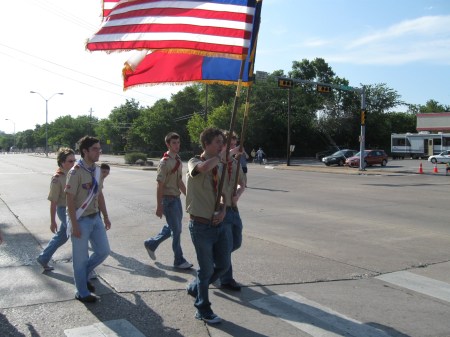
    Scouts show the colors, Duncanville, Texas

    July 4, 2009

    Scouts from Troop 355 and Pack 494 carry the colors in the Duncanville, Texas, 4th of July parade

    Scouts from Troop 355 and Pack 494 carry the colors in the Duncanville, Texas, 4th of July parade


    Proper flag display, on the way to Monticello

    July 4, 2009

    U.S. flag displayed over Virginia Route 53, the road to Monticello, Jeffersons home in Virginia, 2008 - Photo by Emory

    U.S. flag displayed over Virginia Route 53, the road to Monticello, Jefferson's home in Virginia, 2008 - Photo by Emory

    Properly displayed, by the way.  The field is in the “northwest” position.


    Fly your flag today, July 4, 2009

    July 4, 2009

    Soldiers raise the U.S. flag at a base in Afghanistan, 2003

    Soldiers raise the U.S. flag at a base in Afghanistan, 2003

    It’s the 233rd anniversary of the announcement of the Declaration of Independence.  The resolution calling for independence of the 13 colonies passed the Continental Congress on July 2, 1776.  The Declaration would be Thomas Jefferson’s crowning achievement, outshining even his presidency and the Louisiana Purchase.   John Adams wrote to his wife, Abigail, that July 2 would forever be marked by patriotic displays.

    But the Declaration, which gave teeth to the resolution, was adopted on July 4.  Adams didn’t miss a beat.  Who quibbles about a couple of days when the celebrating is so good?

    Adams and Jefferson were two of the five-member committee the Congress had tasked to write a declaration.  Adams and Ben Franklin quickly determined to leave it up to Jefferson, who had a grand flair with words, and who had just written a couple of stirring documents for Virginia.  Roger Sherman and Robert Livingston, the other two members, went along.

    Adams and Jefferson became friends only later, when they both served the nation at war as ambassadors to France, and then for Adams, to England.  A widower, Jefferson was taken in by Abigail Adams who worried about him.  After the war, Jefferson was in England when Adams was to meet King George III in a grand ceremony in which the king would accept the credentials of all the ambassadors of foreign nations to England.  As the king strode down the line, each ambassador or delegation would bow, the king would acknowledge them, the papers would be passed, and the king would move on.  Adams and Jefferson bowed.  King George moved on, ignoring them completely.

    In such a case of such a snub, the snubbed foreigners usually made a quick exit.  Adams and Jefferson did not.  They stood at attention as if the king had treated them like all the rest, reversing the snub.

    Back in America in peacetime, Adams and Jefferson fell out.  Jefferson favored a more limited federal government; Adams favored a more powerful one.  By the end of Washington’s second term, party politics had been well developed.  Adams defeated Jefferson in the election of 1796.  As was the law then, Jefferson was vice president; but Adams kept Jefferson out of all government affairs.  Perhaps because he didn’t have Jefferson to help, Adams’s presidency did not go well.  In the rematch election in 1800, one of  the bitterest fights ever, Jefferson’s party defeated Adams.  The gleeful Democratic-Republican electors all voted one ballot for Jefferson, the presidential candidate, and one ballot for Aaron Burr, the party’s vice presidential candidate.

    Alas, that produced a tie vote in the electoral college.  Adams’s party, the Federalists, still held the House of Representatives before the new Congress came in.  A tie vote goes to the House for decision.  They could not bring themselves to vote for Jefferson, and the deadlock continued for 37 ballots.  Finally Jefferson’s arch enemy Alexander Hamilton intervened, explaining that Burr was clearly the greater scoundrel, and the House elected Jefferson.  Adams slunk out of town, avoiding the inauguration.

    It wasn’t until after 1809 when Benjamin Rush hoodwinked Jefferson into writing to Adams, and Adams to Jefferson, that the two became friendly again.  For the next 17 years Jefferson and Adams carried on perhaps the greatest series of correspondence in history between two great minds.  Letters went out almost daily.  They discussed the weather, their families, old times, farming — but especially the republic they had been most instrumental in creating, and how it might be preserved, and prosper.  Eventually the letters became harder to read, both because their eyesight was failing, and because their penmanship deteriorated, too.

    The ideas, however, flowed like a river.

    Both men took ill early in 1826.  This was a landmark year, 50 years since the Declaration of Independence.  In Massachusetts, a grand display of fireworks was to cap off a day of feasting and celebration.  Adams hoped he might attend.  In Virginia, a week before, it became clear Jefferson was too ill to venture even as close as Charlottesville for the celebration.  Jefferson slept through most of July 3, but awoke about 9:00 p.m., and asked, “This is the fourth?”  It was not.  These are the last significant, recorded words of Jefferson.  He awoke at about 4:00 a.m. on the Fourth of July, 1826, but could not make a rally.  He died at 12:50 in the afternoon.

    Adams, too, was too ill to attend the celebrations.  In the late afternoon or early evening of the Fourth, he awoke, and heard the celebration in the town.  Almost as if he had worked just to live to see that particular day, he checked the date.  Realizing he was near the end, happy that he’d seen 50 years after the Declaration, and unaware of the events earlier that day in Virginia, Adams said, “Thomas Jefferson still survives.”

    Fly your flag today. Remember John Adams and Thomas Jefferson.  Remember their great work in creating the nation that protects our freedoms today.  Remember their great friendship.  Write a letter to a good friend you’ve not written to lately.

    It’s the Fourth of July.  Their spirit survives in us, as we celebrate, and as we remember why we celebrate.


    Flag Day, 2009 – Fly your flag today

    June 14, 2009

    June 14th marks the anniversary of the resolution passed by the Second Continental Congress in 1777, adopting the Stars and Stripes as the national flag.

    Fly your flag today.  This is one of the score of dates upon which Congress suggests we fly our flags.

    Flag Day 1916, parade in Washington, D.C. - employees of National Geographic Society march - photo by Gilbert Grosvenor

    Flag Day 1916, parade in Washington, D.C. - employees of National Geographic Society march - photo by Gilbert Grosvenor

    The photo above drips with history.  Here’s the description from the National Geographic Society site:

    One hundred and fifty National Geographic Society employees march in the Preparedness Parade on Flag Day, June 14, in 1916. With WWI underway in Europe and increasing tensions along the Mexican border, President Woodrow Wilson marched alongside 60,000 participants in the parade, just one event of many around the country intended to rededicate the American people to the ideals of the nation.

    Not only the anniversary of the day the flag was adopted by Congress, Flag Day is also the anniversary of President Dwight Eisenhower’s controversial addition of the words “under God” to the Pledge of Allegiance in 1954.

    (Text adapted from “:Culture: Allegiance to the Pledge?” June 2006, National Geographic magazine)

    The first presidential declaration of Flag Day was 1916, by President Woodrow Wilson.  Wilson won re-election the following November with his pledge to keep America out of World War I, but by April of 1917 he would ask for a declaration of war after Germany resumed torpedoing of U.S. ships.  The photo shows an America dedicated to peace but closer to war than anyone imagined.  Because the suffragettes supported Wilson so strongly, he returned the favor, supporting an amendment to the Constitution to grant women a Constitutional right to vote.  The amendment passed Congress with Wilson’s support and was ratified by the states.

    The flags of 1916 should have carried 48 stars.  New Mexico and Arizona were the 47th and 48th states, Arizona joining the union in 1913.  No new states would be added until Alaska and Hawaii in 1959.  That 46-year period marked the longest time the U.S. had gone without adding states, until today.  No new states have been added since Hawaii, more than 49 years ago.  (U.S. history students:  Have ever heard of an essay, “Manifest destiny fulfilled?”)

    150 employees of the National Geographic Society marched, and as the proud CEO of any organization, Society founder Gilbert H. Grosvenor wanted a photo of his organization’s contribution to the parade.  Notice that Grosvenor himself is the photographer.

    I wonder if Woodrow Wilson took any photos that day, and where they might be hidden.

    History of Flag Day from a larger perspective, from the Library of Congress:

    Since 1916, when President Woodrow Wilson issued a presidential proclamation establishing a national Flag Day on June 14, Americans have commemorated the adoption of the Stars and Stripes by celebrating June 14 as Flag Day. Prior to 1916, many localities and a few states had been celebrating the day for years. Congressional legislation designating that date as the national Flag Day was signed into law by President Harry Truman in 1949; the legislation also called upon the president to issue a flag day proclamation every year.

    According to legend, in 1776, George Washington commissioned Philadelphia seamstress Betsy Ross to create a flag for the new nation. Scholars debate this legend, but agree that Mrs. Ross most likely knew Washington and sewed flags. To date, there have been twenty-seven official versions of the flag, but the arrangement of the stars varied according to the flag-makers’ preferences until 1912 when President Taft standardized the then-new flag’s forty-eight stars into six rows of eight. The forty-nine-star flag (1959-60), as well as the fifty-star flag, also have standardized star patterns. The current version of the flag dates to July 4, 1960, after Hawaii became the fiftieth state on August 21, 1959.

    Fly your flag with pride today.

    Elmhurst Flag Day 1939, DuPage County Centennial - Posters From the WPA

    Elmhurst Flag Day 1939, DuPage County Centennial - Posters From the WPA

    Elmhurst flag day, June 18, 1939, Du Page County centennial / Beauparlant.
    Chicago, Ill.: WPA Federal Art Project, 1939.
    By the People, For the People: Posters from the WPA, 1936-1943


    Rush Limbaugh’s ally against Obama — and oops!

    June 6, 2009

    Cartoon from Lisa Benson at the Washington Post Writers Group, via the Orange County Register:

    From the Washington Post Writers Group via Orange County Register

    From the Washington Post Writers Group via Orange County Register

    Wouldn’t that same caption work for Rush Limbaugh?  How about for Newt Gingrich?  Mitch McConnell?

    I also note that, for a display in the U.S., the U.S. flag is on the wrong side.


    D-Day: 65 years ago today

    June 6, 2009

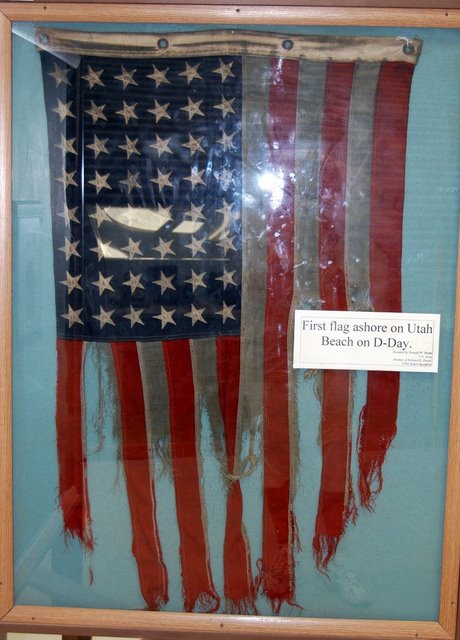
    First Flag on Utah Beach, June 6, 1944

    First U.S. flag on Utah Beach, Normandy, D-Day, June 6, 1944; Pima Air Museum, Tucson, Arizona

    This mostly an encore post.  A reader sent an e-mail with a question:  Does U.S. law suggest the flying of the U.S. flag on the anniversary of D-Day?

    Today is the 65th anniversary of the Invasion of Normandy in World War II, a date generally called D-DayNo, you don’t have to fly your flag. This is not one of the days designated by Congress for flag-flying.

    But you may, and probably, you should fly your flag.  If you have any D-Day veterans in your town, they will be grateful, as will their spouses, children, widows and survivors. A 22-year-old soldier on the beach in 1944 would be 87 today, if alive.  These men and their memories of history fade increasingly fast.  Put your flag up.  You may be surprised at the reaction.

    If you do run into a D-Day veteran, ask him about it.  Keep a record of what he says.

    First Wave at Omaha:  The Ordeal of the Blue and the Gray by Ken Riley:  Behind them was a great invasion armada and the powerful sinews of war. But in the first wave of assault troops of the 29th (Blue and Gray) Infantry Division, it was four rifle companies landing on a hostile shore at H-hour, D-Day -- 6:30 a.m., on June 6, 1944. The long-awaited liberation of France was underway. After long months in England, National Guardsmen from Virginia, Maryland and the District of Columbia found themselves in the vanguard of the Allied attack. In those early hours on the fire-swept beach the 116th Infantry Combat Team, the old Stonewall Brigade of Virginia, clawed its way through Les Moulins draw toward its objective, Vierville-sur-Mer. It was during the movement from Les Moulins that the battered but gallant 2d Battalion broke loose from the beach, clambered over the embankment, and a small party, led by the battalion commander, fought its way to a farmhouse which became its first Command post in France. The 116th suffered more than 800 casualties this day -- a day which will long be remembered as the beginning of the Allies Great Crusade to rekindle the lamp of liberty and freedom on the continent of Europe.  Image from National Guard Heritage series, from which the caption was borrowed.

    "First Wave at Omaha: The Ordeal of the Blue and the Gray" by Ken Riley: Behind them was a great invasion armada and the powerful sinews of war. But in the first wave of assault troops of the 29th (Blue and Gray) Infantry Division, it was four rifle companies landing on a hostile shore at H-hour, D-Day -- 6:30 a.m., on June 6, 1944. The long-awaited liberation of France was underway. After long months in England, National Guardsmen from Virginia, Maryland and the District of Columbia found themselves in the vanguard of the Allied attack. In those early hours on the fire-swept beach the 116th Infantry Combat Team, the old Stonewall Brigade of Virginia, clawed its way through Les Moulins draw toward its objective, Vierville-sur-Mer. It was during the movement from Les Moulins that the battered but gallant 2d Battalion broke loose from the beach, clambered over the embankment, and a small party, led by the battalion commander, fought its way to a farmhouse which became its first Command post in France. The 116th suffered more than 800 casualties this day -- a day which will long be remembered as the beginning of the Allies' "Great Crusade" to rekindle the lamp of liberty and freedom on the continent of Europe. Image from National Guard Heritage series, from which the caption was borrowed.


    Memorial Day 2009 – Fly your flag today

    May 25, 2009

    Please fly your flag today. Flag at half-staff, from Veterans Affairs Dept

    Memorial Day, traditionally observed on May 30, now observed the last Monday in May, honors fallen veterans of wars. Traditionally, family members visit the cemetery where loved ones are interred and leave flowers on the grave.

    On Memorial Day itself, flags on poles or masts should be flown at half-staff from sunrise to noon. At noon, flags should be raised to full-staff position.

    When posting a flag at half-staff, the flag should be raised to the full-staff position first, with vigor, then slowly lowered to half-staff; when retiring a flag posted at half-staff, it should be raised to the full staff position first, with vigor, and then be slowly lowered. Some people attach black streamers to stationary flags, though this is not officially recognized by the U.S. Flag Code.

    Got another week of school? Here’s a quiz about the history of Memorial Day that might make a warm-up, provided by Carolyn Abell writing in the Tifton (Georgia) Gazette:

    1. Memorial Day was first officially proclaimed by a general officer. His name was: A. Robert E. Lee; B. John A. Logan; C. Douglas MacArthur D. George Washington.

    2. The first state to officially recognize Memorial Day was A. Virginia; B. Rhode Island; C. New York; D. Georgia.

    3. The use of poppies to commemorate Memorial Day started in A. 1870 B. 1915 C. 1948; D. 1967.

    4. The original date of Memorial Day was A. May 30; B. July 4; C. May 28; D. Nov 11.

    5. Which U.S. Senator has tried repeatedly to pass legislation that would restore the traditional day of Memorial Day observance? A. John McCain B. Ted Kennedy C. Saxby Chambliss D. Daniel Inouye.

    The answers, again provided by the Tifton Gazette:

    OK, now for the answers. General John Logan, national commander of the Grand Army of the Republic, proclaimed May 30, 1968 as Memorial Day in his General Order Number 11, issued on May 5, 1868. The purpose was to honor the dead from both sides in the War Between the States. Subsequently flowers were placed on the graves of both Union and Confederate soldiers in Arlington National Cemetery on May 30 of that year.

    New York was the first state to officially recognize the Memorial Day, in 1873. Southern states, though paying tribute to their dead on separate dates, refused to use May 30 as the official date until after World War I, when the holiday was broadened to honor those who died in any war.

    In 1915 a woman named Moina Michael, inspired by the poem, “In Flanders Fields,” (by Canadian Colonel John McRae) began wearing red poppies on Memorial Day to honor our nation’s war dead. The tradition grew and even spread to other countries. In 1922 the VFW became the first veterans’ organization to sell the poppies made by disabled veterans as a national effort to raise funds in support of programs for veterans and their dependents. In 1948 the US Post Office issued a red 3-cent stamp honoring Michael for her role in founding the national poppy movement.

    As stated above, May 30 was the original Memorial Day. In 1971, with the passage of the national Holiday Act, Congress changed it so that Memorial Day would be celebrated on the last Monday of May. Some citizens feel that turning it into a “three-day weekend” has devalued the importance and significance of this special holiday. In fact, every time a new Congress has convened since 1989, Senator Daniel Inouye of Hawaii has introduced a bill to the Senate calling for the restoration of May 30th as the day to celebrate Memorial Day.

    In his 1999 introductory remarks to the bill, Senator Inouye declared:

    “Mr. President, in our effort to accommodate many Americans by making the last Monday in May, Memorial Day, we have lost sight of the significance of this day to our nation. Instead of using Memorial Day as a time to honor and reflect on the sacrifices made by Americans in combat, many Americans use the day as a celebration of the beginning of summer. My bill would restore Memorial Day to May 30 and authorize the flag to fly at half mast on that day.

    In addition, this legislation would authorize the President to issue a proclamation designating Memorial Day and Veterans Day as days for prayer and ceremonies honoring American veterans. This legislation would help restore the recognition our veterans deserve for the sacrifices they have made on behalf of our nation.” (from the 1999 U.S. Congressional Record).

    Flat at half-staff, U.S.Capitol in background - from Flag Bay

    Other sources:

    Image of flag and U.S. Capitol from Flags Bay.