Mining the Internet Archive: Tobacco, history and controversy

May 22, 2007

European Union rules require member states to do something about indoor air pollution. European states are banning smoking in public places. Gone soon will be days when we can joke about Britons and their Player’s cigarettes, or the French and their Galois habits.

Every once in a while as I recount the great Tobacco/Health Wars, my kids remind me that they never saw a cigarette commercial on television. Once, we caught a showing of past ads, and I was truck nostalgic by Fred Flintstone’s testimony for Winston cigarettes — the kids gasped: “Fred Flintstone used to smoke!”

Everybody smoked, once upon a time, it seemed. 1940s and 1950s magazines have ads in which doctors and athletes claim cigarette smoking is either unharmful, sheer pleasure, or even health promoting. Got a cigarette cough? Switch to menthol cigarettes! Mouth burns? Try a filter cigarette.

Today, kids wonder why Virginia did so well selling tobacco to Britain — who in their right mind would have smoked? they ask.

The Internet Archive has an abundance of film material on tobacco. The films come from the University of California – San Francisco: Read the rest of this entry »


Global warming effects: More nasty bugs

May 1, 2007

This news can fit into curricula in several ways, in several courses: Insects have already evolved in response to climate shifts due to global warming.

The Boston Globe has a series on global warming, and a recent article detailed how mosquitoes on the Maine frontier have already changed their breeding seasons in response to warming weather.

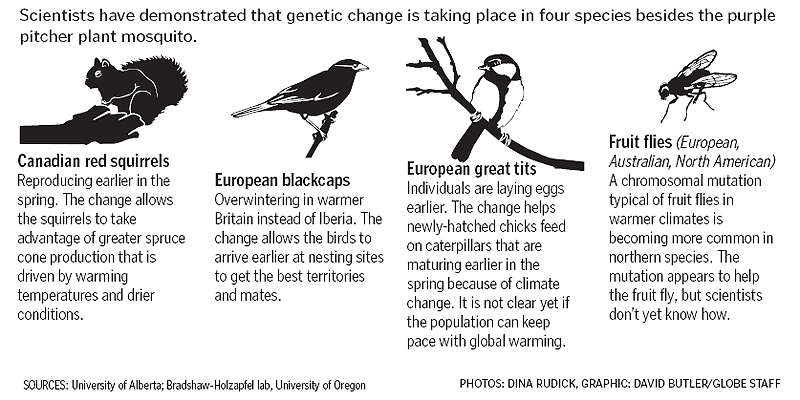
A mosquito that can barely fly is one of only five known species that scientists say have already evolved because of global warming. The unobtrusive mosquito’s story illustrates a sobering consequence of climate change: The species best suited to adapting may not be the ones people want to survive.

Such news enhances biology studies of genetics and insects, geography studies of climate, animal dispersal patterns and disease and pest ranges (a subject more technically known as biogeography), and the articles lend urgency to studies of how governments react to natural crises, a topic suitable for government classes, economics, and U.S. and world history.

Global Warming illustration Click on the thumbnail to see four examples of genetic change credited to global warming. (Graphic by David Butler of the Boston Globe staff.) Read the rest of this entry »


Marfa lights — seriously, does anyone know what they are?

April 30, 2007

Another of the great quirks that makes Texas, Texas, is the Marfa lights. Marfa is in far west Texas — alone, a tiny city in a very arid area. It’s desolate enough that Hollywood thought it would be a great place to film much of the movie “Giant,” which needed to use part of Godforsaken* County to make a point about how desolate Texas can be.

And way out there, there is a hill where one can stop after sundown, and watch the mysterious dancing of lights coming from the not-too-distant hills. So far as I can tell, no good explanation exists for what the lights might be. Physicists have ruled out mirages, and the lights were there long before auto headlights anyway.

Marfa hosts the “Mystery Lights Festival” over Labor Day Weekend (as the story cited above notes, the same weekend as Alpine, Texas, hosts its balloon festival — two West Texas happenings in one trip, perhaps).

Marfa lights, 2004 photo by Julie McConnell

Do you know of a good explanation? Anybody got one?

  • * No, there is not really a Godforsaken County among Texas’s 254 counties. Teachers wishing to use this in the classroom may want to be aware that there is a very short video of the Marfa lights mystery on “Texas Country Reporter’s” DVD collection commemorating 25 years of stories. Texas Country Reporter also has a DVD collection of visits to Texas State Parks, which is a good source of information about Texas geography. I suspect other DVDs from this company would offer other good geography and history supplements (Texas Country Reporter is broadcast on Channel 8 in the Dallas area, and on other television stations throughout the state).

Get the kids outside

April 20, 2007

It’s almost over for this year, but the lesson plans at the site for National Environmental Education Week don’t have to be done in April only. Texas will have a new beefed up science requirement kick in, in a couple of years. Until then, however, this is a good set of ideas, even for social studies, especially if no other class is delivering the material well.

Environmental protection weaves science — biology, chemistry, geology, meteorology, and more — with applied social studies, especially history, economics and government, to make changes. For younger students studies of recycling can be a lot of fun and give students something to take with them for the rest of the life. Similarly, a study of migratory birds and the policy issues related to them (tall buildings, cellular communications towers, oil well sumps, lights in cities, hunting and the Treaty of 1948, etc., etc.) offers a lot of ways to get kids interested, if not excited, about these so-called dry topics. An advanced class in high school might analyze the Supreme Court decisions that brought down the price of shipping of recycled metals, making recycling economically feasible.

Whatever you do, don’t despair: International Migratory Bird Day is just a couple of weeks away.  Birding is one of the more fun areas one can use in discussions of climate change and global warming; the Roger Tory Peterson Institute of Natural History points the way to good resources.


Call for contributions: Fiesta de Tejas!

April 19, 2007

We have a couple of sterling contributions for the next Fiesta de Tejas!

More. We should have more submissions. Texas is a big state, with a lot of people, and a lot of entertaining history. We need more entries. Deadline for entries is end of day April 30, 2007 — I’m looking to publish on May 2.

You may e-mail entries to me at edarrellATsbcglobalDOTnet, or you can take advantage of the Blog Carnival entry form, which has the advantage that it makes copies to keep the thing going should I get hit by a speeding Indian Motorcycle on its way from Fort Worth to North Carolina. If you blog, too, please feel free to pass this call for submissions along to your readers.
Blog Carnival submission form - fiesta de tejas!

Last issue was the wildflower issue, but if you have photos of Texas wildflowers you would like to submit, please feel free to do that, too.

Pecan Tejas95a, from Texas A&M -- commercial since 1973 Pecan Tejas 95a, cultivar created at Texas A&M University in 1945, first fruited in 1949, released commercially in 1973.

Fiesta de Tejas! is a blog carnival celebrating Texas, Texas history and Texana. This blog focuses on education and social studies (though the focus wanders a bit sometimes). If you wonder whether a particular post might be useful to the Fiesta de Tejas!, simply ask whether you think more Texans ought to know about, especially Texas social studies teachers.

Whaddya know about Texas? Share it.


Water to the Arctic

April 19, 2007

It didn’t start out to be such an odd question. “How does water get to the Arctic Ocean,” the kid asked. I’d just dropped on them a warm-up noting the designation of a fifth ocean, the Southern Ocean. They were working on maps, some coloring them in. To some of the students, it was news that we have more than one ocean on the planet.

“Water seeks its own level,” I explained. “Rivers carry waters to the oceans.”

He was really confused. Puzzling over Canada especially, he was venting. I was stupid, and not getting his question. “How come rivers don’t flow north?” he asked.  Read the rest of this entry »


Searching for origins of life in Yellowstone’s hot springs

April 17, 2007

A few hours ago I posted a notice on satellite studies of the uplifting of a part of the Yellowstone Caldera, and I suggested some (weak) links to how to use it in the classroom. In passing I noted that the volcanic rock site southwest of Yellowstone, the Craters of the Moon National Monument, had been used to show astronauts what the Moon would be like when they landed Apollo missions there.

Yellowstone and especially its volcanic features also provided dramatic insights to the origins of life on Earth, especially the rise of life in hot water. These findings advanced the science we now call astrobiology, or the search for life on other planets.

This evening I stumbled across an interesting feature: A full text of a classic 1978 book on thermophilic life in Yellowstone, explaining in greater detail the research conducted there and its significance in astrobiology and evolution. Thomas D. Brock’s book, Thermophilic microorganisms and life at high temperatures (Springer-Verlag, New York, 1978; 465 pages) is just sitting there, online, for anyone to read. Thermophilic microorganisms, book cover
In this book there is more real science to this one tiny facet of the study of the evolution of life than there is in the entirety of the intelligent design political movement.

I wonder what other gems there may be in that digital collection at the University of Wisconsin.

Below the fold: The frontispiece. Read the rest of this entry »


Yellowstone caldera swelling

April 16, 2007

This is a story about space technology and why we orbit satellites, geography, geology, the risks of living in certain places, and the fun, and perhaps life-saving value, of finding things out. Uplift in the Yellowstone Caldera - USGS image

This is the kind of science news that excites normal kids and lends outcroppings on which to hang a lesson plan or class warm up: The Yellowstone Caldera is uplifting, according to new satellite measurements. Don’t worry. Yet. Read the rest of this entry »


Interactive disaster maps for geography

April 15, 2007

Would tracking disasters add more than a little interest to your geography units?

Cliotech, a blog by a Pennsylvania social studies teacher, gives pointers to Alertmap, a group based in Budapest (hey, that’s a geography lesson right there!). Alertmap charts disasters — fires, floods, earthquakes, etc. — and what student is not interested in disaster?

Be careful not to unnecessarily scare students — but do point out that the world is full of danger, and natural and man-made disasters continue to plague mankind the world over.


Chief victim of global warming today: The U.S.

April 3, 2007

The Earth Policy Institute looks at numbers of people running from the effects of global warming and concludes that the U.S. has more global warming refugees than any other nation today, ironically. The U.S. is also the largest emitter of greenhouse gases blamed for the human component of global warming.

EPI estimates at least 250,000 people fled New Orleans and surrounding areas after Hurricane Katrina, in the single largest migration prompted by the effects of global warming.

In a press release, EPI’s president Lester R. Brown said:

Those of us who track the effects of global warming had assumed that the first large flow of climate refugees would likely be in the South Pacific with the abandonment of Tuvalu or other low-lying islands. We were wrong. The first massive movement of climate refugees has been that of people away from the Gulf Coast of the United States.

Hurricane Katrina, which made landfall in late August 2005, forced a million people from New Orleans and the small towns on the Mississippi and Louisiana coasts to move inland either within state or to neighboring states, such as Texas and Arkansas. Although nearly all planned to return, many have not.

Financial markets act as if global warming is a fact, even with a few deniers still hanging on and the Bush administration’s not moving very fast as if it were concerned: Insurance companies refuse to issue new policies for homes for people living in certain hurricane-prone areas.

The market has spoken: Global warming is a problem we need to act against.

Tip of the old scrub brush to Stolen Moments: A green digest.


Yee Haw! The first Fiesta de Tejas! is on the web! 2007 Wildflower edition

April 2, 2007

Bluebonnet from Ft. Worth Army Corps of Engineers

No apologies, but thanks to Bob Wills, of course, whose holler that the “Texas Playboys are on the air!” should be an inspiration to everybody. Bob Wills and the Texas Playboys at Casa Mana, California, 1943

Just what in the world is Fiesta de Tejas!? This is the inaugural — and we hope, not last — edition of a monthly collection of weblog postings about Texas history, Texas geography, Texana and other things Texas. We’re finding our way as we go, much as pioneers got to Texas first, and only then began to realize that they didn’t know exactly where they were, and that they didn’t know exactly what they had.

This is a carnival of Texas blogs. Texas is big, vigorous, and in need of exploration on the World Wide Web. My hope is to bring together sources on Texas history, politics, economics, arts, geography and sciences, in a place that promotes the general dissemination of knowledge about the state. My hope is that teachers of 7th grade Texas history will find a lot here to supplement and improve their teaching of the course, that teachers of history and geography in other places will also find material to enrich their own teaching about Texas, that students will find information to make their projects and papers into rewarding explorations of Texas’ unique persona.

I dubbed it a fiesta, because “carnival” seems too commonplace a term for a place where people can buy macaroni in the shape of the state. I used the older form of the word, “Tejas,” both to reflect the historical focus, and to avoid confusion and copyright issues with established things called Fiesta of Texas. “Tejas” is the original, probably Caddoan word meaning “friend” that Spanish explorers misunderstood to mean the name of the people and the place, and whose spelling quickly metamorphosed into Texas with an “x.”

Texas is the second largest state in the United States, physically (next to Alaska) and in population (next to California). Texas occupies a unique place in U.S. history and lore, and it deserves its own history carnival.

Getting this one off the ground has not been a cakewalk, however, not by any stretch. Inspired by other state historians’ efforts, particularly those of Georgia (thank you, David), I have been unhappily surprised by a dearth of self-nominated entries by Texas historians. I am hopeful this is a momentary hiccough, and that Texas historians will step across this particularly line in the sand to expose their unique writings about their unique state. (And thank you, too, Clio Bluestocking, and ElementaryHistoryTeacher, whose contributions are noted below.)

Still, there is plenty to see. So let’s get to it.

The bluebonnets bloom along Interstate Highway 20, which stretches across Texas from Louisiana to an intersection with Interstate 10 a hundred miles or so east of El Paso. They probably started blooming two weeks ago farther south, but this is the season of Texas wildflowers, which will run in full glory well into June in most of the state. The photo at the top of this post shows bluebonnets (Lupinis texensis) from Ft. Worth, in an Army Corps of Engineers tract. More photos of Texas wildflowers come to us from an Austin gardener who blogs about “Hill Country Wildflowers” at Digging. The drought hampered blooms in 2006; rains in 2007 helped much of the state’s wildflowers, though we’re still underwatered.

Texas wildflowers used to be mowed down by highway maintenance crews. First Lady Ladybird Johnson took on a campaign to protect and promote wildflowers during her husband’s presidency, however, and now Texas and many other states actively promote wildflowers. Texas A&M University and other institutions support and promote wildflower planting, and the Ladybird Johnson Wildflower Center resides near Austin, leading research and promotion of wildflowers worldwide.

North Dakota poet Mark Phillips writes about that West Texas plague, tumbleweeds (Salsola kali), in his poem, “Rootless!”. I defy you to say this isn’t Texas. [I also defy you to make that link work to get to that poem; here, try this link.]

Spring stirs the wild animals of Texas, too — including skunks. The Nature Writers of Texas tell us about skunk romance.

Hey, where’s the history? Start here: Georgians are so fired up not to be outdone by a Texas history carnival, that they even swipe Texas history to blog about! Elementaryhistoryteacher explains Georgia’s contributions to the Texas Revolution, at Georgia On My Mind. See her exposition of “A Few Good Men.” And then note her follow-up, explaining one more Texas debt to Georgia, “A Georgian Gave the Lone Star to Texas.”

“Honoring Texas History Is Nothing To Be Ashamed Of,” at DallasBlog — a contribution from Texas’ 27th Land Commissioner, Jerry Patterson. Don’t stop there — go to Patterson’s agency’s site, and notice the dozens of historic Texas maps available for sale — at least one specific to your Texas town or county: General Land Office (GLO) maps.

Texas is proud of being big, different, and Texas. Millard Fillmore’s Bathtub earlier discussed the Texas Pledge to the Texas flag — mainly a political blog, A Capitol Annex warns us all, “Don’t Mess With the Texas Pledge.” Texas homeschooler Sprittibee informs us of “Six Flags and Texas snobbery.

Word didn’t get out to some of us of the educator persuasion, but March was Texas History Month. Abilene Reporter-News columnist Glenn Dromgoole gave quick reviews of recent books about Texas history.

The Top Shelf, a blog by a Texas school district’s director of library services, gives a substantial list of on-line Texas history resources selected by Michelle Davidson Ungarait at the Texas Education Agency, in “March is Texas History Month.”

Mug Shots features a coffee mug created for Texas’ sesquicentennial in 1986, featuring historic comic strips relating Texas history. Whew! A lot of commemorating there — one post of several commemorating Texas History Month. Texas Sesquicentennial Mug, from Mug Shots

This is Texas Music says farewell to the band Cooder Graw, who called it quits early this year. It’s a short post, with doorways to a lot more about music. Texas music is an enormous topic, much bigger than most people appreciate. Just how deep? Consider this tribute piece, and alert to a new CD from, Texas musician Joe Ely, from Nikkeiview, by Gil Asakawa. Texas’ diversity in influences, perspectives and admirers fairly drips from that one.

While Texas officially celebrates diversity in music, in other arts, and in business, diversity is not greatly celebrated in all corners of Texas, nor is it accurate that diversity was always celebrated. Texas history recounts many cases where disputes were chiefly between people of different ethnic or racial groups. How should that history be handled in classrooms, in boardrooms, and in government? An interview with an author raises that question, and offers resources for study, at the History News Network, in an article by Rick Schenkman:

Elliot Jaspin, a winner of the Pulitzer Prize (1979), is the author of the just-published book, Buried in the Bitter Waters: The Hidden History of Racial Cleansing in America (Basic Books), the March HNN Book of the Month.

Serious thought is given also to the divide between religious and secular in America, using our Hollywood view of Texas as a jumping off point and traipsing through the misconceptions about the trial of John T. Scopes (who lived much of his post-trial life as a petroleum geologist in Houston, Texas), at Adventus, “Return to Never Was.”

Another Texas-flavored mug from Mug Shots.

History is politics, and politics is history, in some parts of Texas all of the time, and in all of Texas part of the time. Do you remember the Digger Barnes character in the old “Dallas” television series? He was fiction. The fictional Digger Barnes can hold no candle to the real Ben Barnes, however, and the political blog, Burnt Orange Report, carried a two-part series (Part I, Part II) explaining the importance of Barnes and covering much of his history, starting in February. Another Texas political blog, Rick Perry vs. the World, interviewed Barnes — part I, here.

Kay Bell at Don’t Mess With Taxes reprints a letter from Bum Phillips about what it means to be from Texas, and in Texas. [Catch the subtle pun on a common Texas slogan? I didn’t, at first . . .)

Texas is rich in science and natural history. Monkeys In the News notes the recent description of ancient primates, near Laredo. (Thanks to Dear Kitty for that one.)

Texas is rich in food, too. Hey, I have to get one of my own posts in here, don’t I? 2007 is the 100th anniversary of the founding of the dairy processor in Brenham, Texas, that produces Bluebell Ice Cream, among the best ice creams in the world. You can read it here, “Blue Bell Ice Cream, a tastier part of Texas History.”

If you don’t want ice cream? As Davy Crockett told Tennessee, you may just go to hell — I’m going to Texas. Any fan of ice cream would say the same.A mug from the Bob Bullock Museum, with a famous Davy Crockett quote.

A parting shot, from Mug Shots.

The gates are open for submissions to the next Fiesta de Tejas! scheduled for May 2, 2007. You may e-mail entries to me at edarrell AT sbcglobal DOT net, or take advantage of the Blog Carnival listing, which will create a back-up copy of your entry for us. We need a logo, something appropriate to Texas. Also, if you would like to host a future session of the Fiesta, please drop me a note. These things work better with different eyes and ears working on them from time to time.

If you found something of value here, let me know in comments. And then, spread the word that the carnival is up and running. Yeeeeee haaawwww!


Quote of the moment: W. C. Lowdermilk, soil erosion

March 20, 2007

Soil erosion in Virginia, photo by W. C. Lowdermilk

Soil erosion in Virginia, photo by W. C. Lowdermilk “Figure 15. — A formerly productive field in Virginia that has been cut to pieces by gully erosion. About 50 million acres of good farm land in the United States have been ruined for further practical cultivation by similar types of erosion.”


From Conquest of the Land through 7,000 Years, by W. C. Lowdermilk, its first director, a soil conservation publication of the U.S. Soil Conservation Service, first issued in about 1939:

When in Palestine in 1939, I pondered the problems of the use of the land through the ages. I wondered if Moses, when he was inspired to deliver the Ten Commandments to the Israelites in the Desert to establish man’s relationship to his Creator and his fellow men — if Moses had foreseen what was to become of the Promised Land after 3,000 years and what was to become of hundreds of millions of acres of once good lands such as I have seen in China, Korea, North Africa, the Near East, and in our own fair land of America — if Moses had foreseen what suicidal agriculture would do to the land of the holy earth — might not have been inspired to deliver another Commandment to establish man’s relation to the earth and to complete man’s trinity of responsibilities to his Creator, to his fellow men, and to the holy earth.

When invited to broadcast a talk on soil conservation in Jerusalem in June 1939, I gave for the first time what has been called an “Eleventh Commandment,” as follows: Thou shalt inherit the Holy Earth as a faithful steward, conserving its resources and productivity from generation to generation. Thou shalt safeguard thy fields from soil erosion, thy living waters from drying up, thy forests from desolation, and protect thy hills from overgrazing by thy herds, that thy descendants may have abundance forever. If any shall fail in this stewardship of the land, thy fruitful fields shall become sterile stony ground and wasting gullies, and thy descendants shall decrease and live in poverty or perish from off the face of the earth.


Strong hints that “Texas Chainsaw Massacre” is fiction

March 14, 2007

The DVD release of the Texas Chainsaw Massacre’s latest cinema episode is probably driving the traffic to the post I did a while ago noting that the movies are not based on any Texas incidents (see “Based on a true story, except . . .). The original movie, in 1974, was billed as “based on a true story.” “The film which you are about to see is an account of the tragedy which befell a group of five youths, in particular Sally Hardesty and her invalid brother, Franklin,” the Narrator says opening the film.

The latest enfilmations apparently carry the same claim (I say apparently because I have never seen any of them through, and only a few snippets on television of any of them — I go by what I hear and see from others).

We have the testimony of the author of the original screenplay that it is fiction, loosely based on a famous case in Wisconsin which was also, very loosely, the basis for Alfred Hitchcock’s Psycho and the later, more horrifying Silence of the Lambs. Other internet sites say it’s fiction, such as Snopes.com (a favorite and very good hoax and error debunking site).

Still, the kids ask.

Why not turn this into a geography and/or history exercise? Read the rest of this entry »


Teacher and student history resources, from the Feds

March 13, 2007

Federal Resources for Educational Excellence (FREE) is a great idea. Federal agencies are loaded with information useful to teachers and students, formerly available in print if one could find the appropriate phone number or get lucky with a mail sweepstakes. Now a lot of the information is compiled specifically for education, and the U.S. Department of Education has compiled a user-congenial site to help educators find the stuff.

FREE image from home page

Under “U.S. History and Topics” you may find a good deal of support for most social studies disciplines. The Women’s History Month focus highlights two topics from the Library of Congress and two from the National Endowment for the Humanities.   Read the rest of this entry »


Archeaology sources: Four Stone Hearth 7

January 22, 2007

High school history courses tend to brush over “prehistory” in America, that part of history between the arrival of the first humans in the Americas and the arrival of Europeans with quill and paper to record what they saw and what they did. For a few kids this would be the most exciting part of the course; for all kids, my experience is that textbooks tend to short change what we know, and especially how we know it.

A key problem for the non-archaeologist high school history teacher is just where to find information about prehistory.

A few archaeologists are blogging, and bitten by the meme virus of the moment, they gather together the better posts of recent weeks into a “carnival.” Four Stone Hearth is a carnival of archaeology. Four Stone Hearth 7, hosted by Aardvarchaeology, has several posts that can provide good information for history classes.

Students should learn skepticism in history classes, why to doubt fantastic claims and just-so stories, and how to evaluate sources of information and find good ones. Students often brought in stories intended to debunk standard histories, often involving UFOs or supernatural claims. Hot Cup of Joe’s entry, “Forbidden Archaeology? Some So-called Out of Place Artifacts,” explains the problems of OOPAs — out-of-place artifacts — often claimed to show that most archaeologists or other scientists withhold information that would confirm some of the more wacko ideas about history and prehistory. In the explanation he casts righteous doubt on a bizarre book that is wildly popular among conspiracy buffs, Atlantis Rising.

Students might also be interested in a report from Remote Central on objects found under glacial deposits in Minnesota which have some appearances of being knapped stone tools. This story could form a neat exercise in a series of lessons on what we know about history, and how we know it.