Lost expedition? Where’s the photos of the “new” Peruvian waterfall?

August 28, 2008

You’d think someone like National Geographic Society would hustle down there to find it.

Whatever happened to the expedition that took off on the trek to photograph what was rumored to be a world-class waterfall newly discovered in Peru?  The cataract was rumored to be among the world’s tallest.

Perhaps a reader who reads Spanish might find some news in the South American newspapers.  Has anyone seen any news?


Yo! History and geography teachers: Free state maps!

August 23, 2008

In the summer of my 8th year, after my uncle, Roland Christian*, sent me his collection of “official” state maps from his latest cross-country drive, several of us kids tried to collect maps of all 50 states. Considering we were in Burley, Idaho, it’s amazing that we could accumulate 36 different states, just by our badgering local gasoline stations for the free ones. We got on our bicycles and visited the stations, one after the other.

Free educational materials: A memory from a distant past.

I haven’t seen a free map from a gas station in years, maybe two decades. My love of geography, my love of chasing odd city names, strange routes, great sights, and history, was spurred by that map collection, I’m sure.

Today, though oil companies have gotten out of the tourism and driving promotion business, state tourism offices, or state road departments typically issue free maps. How to find them all?

To the rescue comes Less Than a Shoestring, with a list of the places to ask in each state, to get a free road map of the state. These maps are great helps for students doing a “project” on a different state. For the history class on your own state, if your school offers such a course, I think such maps are indispensable.

We teach Texas state history and geography in 7th grade. When I taught that course, one of the best classroom aids I had was a collection of the official map of Texas — a year old, but I got a couple dozen copies from the state’s tourism promotion group. They were anxious to get rid of the old maps, and I was very happy to have them.

Here’s something curious: The site, Less Than a Shoestring,  doesn’t list a place to get a map from the District of Columbia — Washington, D.C. You’d think that a town that depends so much on tourism would have an office to promote tourism that would pass out maps to make tourists’ trips easier. Is this just an indication of the great dysfunction of the D.C. government, or did we miss finding the site? Let me know in comments.

Tip of the old scrub brush to the Business Blog @ Capital Active.

____________________________

* Uncle Roland was a minister for the 7th-Day Adventists, and he traveled to preach around the country. Stuck in a small Idaho town for my first nine years, I thought Roland was a great world traveler. He always stopped to spend a night when he was within a state or two — he was a minister trying to travel on a shoestring, after all — and with his wonderful, deep, preacher’s voice, he had wonderful stories to tell. I miss him still, more than two decades after his death. Which of your nieces and nephews can you influence as Roland did?

Read the rest of this entry »


Teddy Roosevelt at the Minnesota State Fair

August 21, 2008

It’s state fair time!

Which state fair has the most fried foods? Which state fair has the oddest fried foods? You can make nominations in comments.

State fairs drive local economies, sometimes, and occasionally a bit of history gets made there. Certainly they are places where culture and history are on display.

Minnesota’s State Fair is so good even Teddy Roosevelt visited — it’s been an almost annual event since 1859. I’ll bet Roosevelt had a good time, though I wonder if the Fair served him a bag of their famous mini-donuts — 388,000 bags of donuts served last year (do they rival corny dogs?).

Then Vice President Theodore Roosevelt tell Americans our foreign policy should be to

Then Vice President Theodore Roosevelt tell Americans our foreign policy should be to “speak softly, and carry a big stick!” September 3, 1901. President William McKinley was shot on September 6, and died just over a week later; Roosevelt was sworn in as president on September 14.

Check out Minnesota’s State Fair with this 21-question interactive quiz by Dave Braunger at the Minneapolis Star-Tribune — see how well you know or can guess Minnesota history, and compare it to your own state fair if you’re not in Minnesota.

Corny dog, called a Pronto Pup, at the Minnesota State Fair. Pronto Pups are wan copies of Fletcher's Corny Dogs, from the Texas State Fair. Image from Travel.Garden.Eat

Corny dog, called a Pronto Pup, at the Minnesota State Fair. Pronto Pups are wan copies of Fletcher’s Corny Dogs, from the Texas State Fair. Image from Travel.Garden.Eat


Disaster at Arches National Park

August 10, 2008

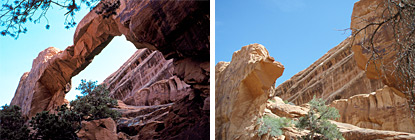
Wall Arch, 12th largest, one of the better-known and most-seen natural arches in Arches National Park, Utah, collapsed.

Wall Arch, before and after collapse - National Park Service photos

Wall Arch, before and after collapse – National Park Service photos

“Not being a geologist, I can’t get very technical but it just went kaboom,” [Arches NP] Chief Ranger Denny Ziemann said. “The middle of the arch just collapsed under its own weight. It just happens.”

Wall Arch, located along the popular Devils Garden Trail, was 71 feet tallwide and 33 1/2 feet widetall, ranking it 12th in size among the known arches inside the park. Lewis T. McKinney first reported and named Wall Arch in 1948.

No one reported observing the arch collapse and there were no visitor injuries, the National Park Service said.

Read the report from the Salt Lake Tribune.

Some tourist on Sunday, August 3, or Monday, August 4, got the last photograph of Wall Arch still standing. Was it you? Were you close? Give us a shout in the comments if so.

Other resources:

x

Other blogs and later reports:


Particle physics rap: Making the Large Hadron Collider sing

July 30, 2008

In the tradition of Richard Feynman’s ode to orange juice, but spiced with actual information: Tommaso Dorigo at A Quantum Diaries Survivor found a video on YouTube showing a rap about the Large Hadron Collider (LHC).

Katie McAlpine, on temporary assignment to CERN, put the rap and video together in her spare time. (CERN is the European Organization for Nuclear Research)

The video fills an educational need. It explains some of the work in high-energy particle physics going on there on the border between France and Switzerland.

Will it quiet the internet worries about whether the creation of tiny, disappearing black holes might accidentally lead to the end of the planet? Don’t bet on it.

This video could make a key part of a geography warm-up, noting research in the European Union. CERN’s premier position in nuclear particle research is due to the cancellation in 1993 of the Superconducting Super Collider, which was then under construction near Waxahatchie, Texas. A little bit of digging could produce a lesson plan on government funding of research, especially in nuclear physics, or on geography of such massive cyclotrons, or on the history of particle physics, black holes, or uses for atom splitting.

Other resources:


Music about America, for the road, for the classroom

July 16, 2008

NPR’s series, “Road Trip: Songs to Drive By,” featured five classical and jazz tunes about specific places in the U.S., some from larger works, in the June 10 program. Each of these works should be featured in U.S. history classes, at least. They represent music forms and tunes students should be familiar with.

How can you use this music in your classes?

Programming and descriptions below from Naomi Lewin at WGUC – Cincinnati. Go to the NPR site of the program to listen to the music she notes, or to purchase the music. Perhaps your library or media center would have some of this music available?

Orchestral Works

“On the Trail”

Artist: Various

Album: Grofé: Orchestral Works

Song: Grand Canyon Suite, for orchestra

At this time of year, you have to get up around 4 a.m. to experience the full effect of sunrise over the Grand Canyon. When Ferde Grofé saw it as a young musician on the road, he was so bowled over that he sat down and wrote “Sunrise,” the first movement of what turned into his “Grand Canyon Suite.” Grofé had something interesting in common with Aaron Copland — both of them were New York City natives who became famous for composing music about the American West. The best-known movement of Grofé’s Grand Canyon Suite, “On the Trail,” is a different kind of road trip: The loping gait of the music describes the ride down to the bottom of the Canyon on the back of a mule.

The Plow that Broke the Plains

“Cattle” & “The Homesteader”

Artist: Angel Gil-Ordóñez

Album: Virgil Thompson: The Plow that Broke the Plains; The River

Song: The Plow That Broke the Plains, film score

Nothing brings home how vast this country is quite like driving across the Great Plains, an area that was devastated during the Great Depression. In the middle of the Depression, the U.S. Department of Agriculture put out a half-hour documentary about the dust bowl called “The Plow That Broke the Plains” — the first government film produced for commercial release. Director Pare Lorentz shot footage in Montana, Wyoming, Colorado, Texas, and Kansas, and he got a suitable composer to write the score for the film: Virgil Thomson, who was born in Kansas City, Mo.

Piano Works

A Breeze from Alabama, march & ragtime two-step for piano

Artist: Dick Hyman

Album: Joplin:Piano Works

Song: A Breeze from Alabama

No one’s exactly sure where Scott Joplin was born. It was probably in northeast Texas, but Texas wasn’t a state back then. After Joplin became a pianist, he started traveling, mostly around the Midwest, as far north as Chicago — and eventually even to New York. “A Breeze from Alabama” is one of Joplin’s quieter rags. You can practically smell the camellias.

World Premieres and First Editions

“Putnam’s Camp”

Artist: Various

Album: The Orchestral Music of Charles Ives: World Premieres and First Editions

Song: Orchestral Set No. 1: Three Places in New England, for orchestra, S. 7 (K. 1A5)

Charles Ives was the quintessential New Englander, growing up in Danbury, Conn., in the late 1800s, when Danbury was the hat-making capitol of the country. In this piece, Ives paints three unique musical portraits of a spot in Connecticut, and two in neighboring Massachusetts. The middle portrait, “Putnam’s Camp, Redding,” describes a Fourth of July picnic in Redding, Conn., where General Israel Putnam and his men made camp during the American Revolution — and where Ives had a summer home. It’s full of raucous quotations, including Ives’ own “Country Band March” and his “Overture and March 1776.”

Serenade after Plato's Symposium; Fancy Free; On the Town Dance Episodes

On the Town–“Times Square”

Artist: Leonard Bernstein

Album: Bernstein: Serenade after Plato’s Symposium; Fancy Free; On the Town Dance Episodes

Song: On the Town: “Times Square”

Leonard Bernstein may have been born in New England, but it didn’t take him long to move to New York. No one epitomized the energy of the City — or captured it in his music — more than he did. Bernstein’s ballet Fancy Free, about three sailors on shore leave in New York, became the Broadway Musical On the Town. If New York is the pulse of the East Coast, then Times Square is the pulse of New York, and you can hear all the madness of midtown Manhattan in “Times Square,” the last of Bernstein’s Three Dance Episodes from On the Town.


India, 100 years ago

June 30, 2008

World history and geography teachers take note: This site, Chat and Chai, has an interesting slide show of what appear to be stereoscope and post card photos from India, 100 years ago. The link may be useful for on-line demonstrations — you may be able to use the images in other presentations.

The slides show people in a lot of everyday activities, providing good, visual examples of how people lived then. An instructive comparison: Can your students find photos of Indians carrying out similar activities today? How has India changed, for how much of its population? I suspect you can find cases where Some Indians have leaped into the 21st century, and other examples where the lives of many millions of people have not changed all that much.

Several of the photos remind that they were taken 40 years or more before India won independence from Britain. These may pertain to discussions of empires and imperialism, and other economic issues, too.

One commenter asked the blogger to share the slides, but I don’t see a positive response.

Don’t ask me to explain the music the blogger selected for the slides.

Here is the actual slide show.

Vodpod videos no longer available.

more about “India 100 Years Ago “, posted with vodpod


Geography hidden in plain sight

June 18, 2008

Strange Maps features federally-owned lands. Those of us who grew up in the west tramping those federal lands, and those of us who worked policy for those lands rarely think they should be listed as “strange” maps. Beautiful land maps, perhaps. God’s Country. It’s funny others regard it as so strange.

But we get clues. In comments at Strange Maps I noted a corporate meeting where I was chastised and ostracized for making a simple statement of fact about the ownership of lands in the west. Other than we veterans of the Sagebrush Rebellion (on all sides), ranchers, miners, and members of the Sierra Club, Wilderness Society, National Recreation and Parks Association (NRPA) [Barry Tindall? Are you still out there?], National Parks Conservation Association (NPCA), and enrolled tribal members, who pays attention to that stuff?

Too few in government pay enough attention. Fewer people outside government pay attention, especially if they don’t live in states in which the federal lands reside.

Public lands are all around us, yet we don’t see them as anything much different from any other land. Too often we don’t even see them for the resources they are. It’s as if we had a treasure of diamonds, rubies and gold, and we put it on display, and no one could see it.

For example, there was a major decision in federal district court on an issue of federalism last Friday — did you hear of it in your local newspaper, or on your local television or radio news? Nor are most people familiar with the move to amend the 1872 Mining Act, nor could most Americans describe for you what the 1872 Mining Act is or why it’s worth billions of dollars annually to the federal government, state governments, and mining corporations.

Strange Maps showed only the amount of land in federal hands in each state. Below is a map that shows where are the actual federal holdings, from the online National Atlas (nationalatlas.gov) — a map of federal lands and Indian Reservations. (A .gif preview is below; below that is a link to a .pdf file you can download.) The light green is National Forest land; the yellow is Bureau of Land Management land. The red plots are Indian reservations. Click on the map for the enlargement, you can see that Nevada, for example, has just thin threads of private lands (in white), mostly along U.S. Highway 50, and around Las Vegas.

All Federal Lands and Indian Reservations; NationalAtlas.gov, now archived at USGS

All Federal Lands and Indian Reservations; NationalAtlas.gov, now archived at USGS


Flip the pages of most geography texts, however, and you’ll find little clue of the role federal lands play in modern America, let alone the historical roles played.

History?

Sure. Notice that most of the public lands held today are in 13 western states, generally the last states allowed into the union (not exactly; Oklahoma is a 20th century admission — but it has Indian reservations; read on). Outside the 13 original colonies, which became the 13 original states, and Vermont (#14), all the land in the U.S. was held by the federal government at one time. Much of the territory between the 13 original states and the Mississippi was ceded to the U.S. by Britain in the Treaty of Paris, which ended the American Revolution. Americans thought the land useful for farming, chiefly, so the intention was to devise the lands to private holders. To that end the various Northwest Ordinances (e.g., 1785, 1786, 1787 and later) established systems to sell off the lands into private hands.

Disposal of the lands required the creation of a bureau to do the job. The General Land Office was created in 1812, and remained part of the federal government until it was folded into the new Bureau of Land Management in 1946.

That some of the lands might have national value, and should be held in federal title, did not surface as a complete idea until the Progressive Era, with the emphasis on land stewardship, under Teddy Roosevelt, Taft, and their successors. Even then, the general idea was to get most of the lands into private ownership. Roosevelt worked to preserve the most scenic and most unique lands.

Beginning with the Northwest Ordinances, the federal government set aside two sections in every township for the benefit of education. Local governments sold the tracts and put the money to school construction, or put the schools on those sections. Some of the tracts in the far western states are still there, unsold and providing no benefits to the schools. In some cases this is because the tracts are stuck inside federally-held tracts, in National Forests, in National Parks. Texas dedicated some of its state lands to provide funding for the University of Texas. Fortunately, these tracts happened to be on a pool of oil. When oil development took off, Texas’s university systems benefited (the Texas A&M System got a third of the rights along the way).

Poster advertising lands in Nebraska and Iowa

Development of the Transcontinental Railroad was financed by massive grants of land to the railroad companies. Even today the fortunes of the old Burlington Northern Railroad (now BNSF) are swelled by coal on land granted to the original companies building the rails, land the company has held for all these years. The thin line of private land across northern Nevada originally was the route of the Central Pacific Railroad — now it is approximately the route of U.S. Highway 50, “America’s Loneliest Highway.”

President Abraham Lincoln signed the Homestead Act on May 20, 1862. Under the Act, any American could lay claim to public lands for a small fee, and if he could live on the land for five years, title was vested in that citizen. This explanation comes from a lesson plan at the National Archives:

The new law established a three-fold homestead acquisition process: filing an application, improving the land, and filing for deed of title. Any U.S. citizen, or intended citizen, who had never borne arms against the U.S. Government could file an application and lay claim to 160 acres of surveyed Government land. For the next 5 years, the homesteader had to live on the land and improve it by building a 12-by-14 dwelling and growing crops. After 5 years, the homesteader could file for his patent (or deed of title) by submitting proof of residency and the required improvements to a local land office.

When I was a child in southern Idaho, customers at my parents’ furniture store included many people who were still trying to make a go of things on homesteads north of Burley, Idaho, on “the North Side.” Much of the land granted this way could not support a family, and the failure rate of these homesteads in the 1950s and 1960s was probably more than 50 percent (I’m swagging the figure — if you have better statistics, send them along).

Overall, the Homestead Act shaped America’s character as a home for entrepreneurs:

By 1934, over 1.6 million homestead applications were processed and more than 270 million acres—10 percent of all U.S. lands—passed into the hands of individuals. The passage of the Federal Land Policy and Management Act of 1976 repealed the Homestead Act in the 48 contiguous states, but it did grant a ten-year extension on claims in Alaska.

Much of the land that open for homesteading was desert, unsuitable for farming. It was available for grazing cows and sheep, though, and much of it was overgrazed. (Grazing alone wouldn’t meet the homestead requirements.) It was not until the 1970s that people outnumbered sheep in Utah, for example. In the first three decades of the 20th century enormous flocks of sheep grazed much of what is now considered Utah’s western desert territory, flocks of thousands of sheep, or tens of thousands.

These lands, too arid for farming, too hilly for much of anything else, too far away from settlements for other commerce, eventually formed the core of lands held by the Bureau of Land Management (BLM) in the Department of Interior. BLM manages 264 million acres of land, far and away the biggest land management agency in the federal government. Much of the land was severely overgrazed by 1930, and after the harsh lessons of the Dustbowl, Congress tried to rope in grazing and set it up in a rational scheme in the Taylor Grazing Act of 1934, one of the lesser noted chunks of the New Deal era.

The major federal land management agencies today include the Department of Interior’s BLM, National Park Service, Fish and Wildlife Service, Bureau of Reclamation, and to a lesser and more complicated degree, the Bureau of Indian Affairs; the Department of Agriculture’s National Forest Service; and the Department of Defense, especially in the western public lands states (think Nevada gunnery range, Skull Valley and Dugway Proving Grounds, Utah, and Area 51).

Each area of land management policy is controversial to some degree, but even these controversies rarely rise to the level of public acknowledgment. The latest starlet’s sexcapades will grab headlines away from the major effort to overhaul mining law, for example. In the 1980s, Alaska voted on a proposal to secede from the union, but the issue barely got three paragraphs in the Washington Post or New York Times, two of the newspapers that are generally very good in covering such issues. This post barely scratches the surface of these issues.

(Digression: I first encountered Molly Ivins when she reported for the NY Times out of the Denver bureau; as a Scout I had hiked and traveled much of Utah and the west; as a Senate staffer to a western senator, I was intimately familiar with most of the land in Utah especially. Ivins wrote a story on a protection issue on a chunk of land and a formation I’d not been familiar with, and in sparring with her about the article, it became very clear that she had pulled out sources we didn’t know about, and that she knew the stuff about as well as we did. Anyone who bothers to give a damn about western lands can earn my respect with such careful research.)

As a side note, Strange Maps suggested that the District of Columbia was all federal lands, but most of the District has been devised into private property, and commenters noted that. Here is a map of the District showing its federally-maintained lands.

District of Columbia and Federal Lands; NationalAtlas.gov (now at USGS)

District of Columbia and Federal Lands; NationalAtlas.gov (now at USGS)

Other resources:

Other related posts at the Bathtub:


The $7 million dogwood blossom

April 29, 2008

Not perfect — there is a brown spot on it; but beautiful, surpassingly rare, a creature of the serendipity of nature, it is a natural dogwood blossom in Dallas County, Texas:

Dogwood blossom in Dogwood Canyon, Texas


What we came to see – the magical dogwood blossoms.

On April 5 Kathryn and I joined David Hurt and a jovial band of hikers for a trip into Dogwood Canyon in Cedar Hill, Texas. The physical formation of Cedar Hill upon which the city of the same name and several others stand, is one of the highest spots between the Mississippi River and the Rocky Mountains. It is an outcropping of chalk, a formation known as the Austin Chalk, that runs from Austin, north nearly to the Oklahoma border.

This rock formation creates a clear physical marker of the boundary between East and West. Dallas is east of the line, Fort Worth, Gateway to the Old West, is 30 miles farther west. On this outcropping is married the plains of the west with the oaks and forests of the east. Within a few miles of the line, the botanical landscape changes, cowboy prairie lands one way, forest lands the other.

On the chalk itself, the soil is thin and alkaline. The alkalinity is a function of the chemical composition of the chalk underneath it.

Dogwoods love the forests of East Texas with their acidic soils. Early spring produces fireworks-like bursts of white dogwood blossoms in the understory of East Texas forests. Dogwoods die out well east of Dallas as the soil changes acidity; driving from Dallas one can count on 30 to 60 miles before finding a dogwood.

Except in Dogwood Canyon. There, where entrepreneur David Hurt originally planned to build a family hideout and getaway, he found a stand of dogwoods defying botanists and the Department of Agriculture’s plant zone maps, blooming furiously in thin alkaline soil atop the Austin Chalk.

(continued below the fold)

Read the rest of this entry »


Baltimore’s orgy of cartography and geography

March 22, 2008

The ad says “Come visit Utopia in Baltimore.” With an orgy of maps like that planned, it should be a Utopia for somebody: Geographers, cartographers, historians, and anyone interested in travel.

Baltimore’s Walters Art Museum hosts an outstanding exhibit of world-changing maps through June 8, a Festival of Maps; the entire town appears to have gone ga-ga on the idea. Baltimore will be Map Central for a few weeks, at least.

The Baltimore Sun (one of the truly great newspapers in America) described some of the cartographic gems on display:

Among the treasures is a huge and beautiful map of the fossil-embedded geological strata that underlie England and Wales. That masterpiece, published in 1815 by a pioneering geologist named William Smith, offered evidence used to support Darwin’s theory of evolution and set the stage for creation-vs.-evolution debates that still rage.

Then there’s the map researched by a doctor named John Snow in the 1850s. It allowed him to trace the source of a cholera outbreak in London to a well used by residents of a single neighborhood.

And there will be charts prepared by geographer Marie Tharp of the Mid-Oceanic Ridge, a mountainous rise in the mid-Atlantic seabed, based on data gathered by American submarines during World War II and later used to provide evidence of how the Earth’s crust has evolved through geological time.

The Smith and Snow maps anchor key events in science, the origin of paleontology and one of the greatest examples of public health sleuthing. To have both of those maps in one exhibition is a great coup for the Walters, and for Baltimore.

The exhibit also features a map of Utopia drawn by Sir Thomas Moore. Other maps were drawn by Benjamin Franklin, J. R. R. Tolkein, and Leonardo da Vinci.

Here’s a video description of one of the more remarkable pieces on view, a map of London, on a glove:

Vodpod videos no longer available. from www.baltimore.org posted with vodpod

♦ ♦ ♦ ♦ ♦ ♦ ♦ ♦ ♦

Surely there is material here for the Strange Maps blog.  Here’s a still of the glove, from the collection of The National Archives, UK:

Glove map, from London's 1851 Exposition

Below the fold, a partial list of some of the other exhibits and events planned in and around Baltimore, which will convince you, I hope, that it is indeed an orgy worth getting a ticket to see.

Baltimore remains one of my favorite towns, despite the loss of my Johnny Unitas-led Colts, despite the Orioles’ recent mediocrity; it’s a place of great history, great neighborhoods, and good food. Crabcakes from several sites, dinner at Sabatino’s, maps in the museums. Utopia indeed.

Read the rest of this entry »


Europe is a country? Whom the gods destroy . . .

February 15, 2008

No.  Europe is not a country.
Was it Euripides who said, “Whom the gods destroy, they first make mad?”  Does stupid count as mad?  We might have some concerns for our nation.
I’ve told my history students they’d better know the answer to this one.  It will show up on the test. 

Also, see this story in the New York Times, “Dumb and Dumber:  Are Americans hostile to knowledge?”

Tip of the old scrub brush to the Wayback Machine.


Geography revolution, next wave: Ready in your classroom?

February 15, 2008

Depression presents a serious occupational hazard, moving back and forth between the classroom and business, classroom and internet. When do administrators and legislators get serious about catching up education?

Microsoft plans a product announcement at the end of this month. Rumors claim it’s a new version of Photosynth. Photosynth mades “3D” touring by computer possible for almost any destination.

I’ll wager not a single classroom in the nation is ready to make this work. If you disagree, I’d love to hear about the class that can make use of it.

System requirements for Photosynth won’t tax the computers that most high school gamers use, but they are beyond most of the classroom computers I’ve seen in the last five years.

Probably more to the point, curriculum designers in public schools don’t even have Google Earth on their horizons. Photosynth? I’ll wager it’s not even on the radar screens of GIS users in the nation’s Council of Governments (COGS).

Geography is an exploding discipline. GIS and computerized map programs make cell phone companies go, not to mention oil and gas exploration, coal mining, air pollution monitoring (for building new power plants, for example), and road building. GPS helps drive express shipping, and all other shipping. RFI and GPS together are revolutionizing retail.

You must know how to read a map just to get a job delivering pizza.

But 9th grade geography classes? The exciting stuff is absent today.

At the Texas Education Agency (TEA), officials fret about how to stop science from being taught in science classes, for fear the facts will skew the religious beliefs of their children. They need to worry about their children not even getting hired by the pizza delivery company for being ignorant of nature and science, and the maps that show them. In a competitive, technologically savvy world, inaction, dithering and damaging action by the TEA mean our kids won’t even have a prayer.

Relevant posts:


Indians and energy: Public symposium on history, economics, politics and culture in the Four Corners

February 13, 2008

Norman Rockwell's painting, Glen Canyon Dam

Glen Canyon Dam
by Norman Rockwell (1894-1978)
Oil on canvas, 51″ x 77″
Glen Canyon Dam, Colorado River Storage Project, northern Arizona. Image courtesy of the Bureau of Reclamation.

Southern Methodist University’s Clements Center for Southwest Studies will host a high-powered symposium in April, “Indians and Energy: Exploitation and Opportunity in the American Southwest.”

The symposium is set for Saturday, April 12, 2008, at McCord Auditorium in SMU’s Dallas Hall, 8:30 a.m. to 5:00 p.m. Teachers and community college professors may earn up to 7 hours CEU credits. Registration is available on-line. The $20.00 fee includes a luncheon; conference-only registration is an amazingly inexpensive $5.00.

Conference organizers are looking at a second wave of energy resource development in the Four Corners region, especially, following on earlier development of uranium ore extraction, and coal-fired power generation.

The symposium and the resulting book of essays will provide an historical context for energy development on Native American lands and put forth ideas that may guide future public policy formation. Collectively, the presentations will make the case that the American Southwest is particularly well-suited for exploring how people have transformed the region’s resources into fuel supplies for human consumption. Not only do Native Americans possess a large percentage of the region’s total acreage, but on their lands reside much of the nation’s oil, coal, and uranium resources. Regional weather patterns have also enabled native people to take advantage of solar and wind power as effective sources of energy. Although presentations will document histories of resource extraction and energy development as episodes of exploitation, paternalism, and dependency, others will show how energy development in particular has enabled many Indians to break from these patterns and facilitated their social, economic, and political empowerment.

My second job out of high school, and through much of my undergraduate days, took me to Farmington, New Mexico, and far around the area for the Air Pollution Laboratory at the University of Utah’s Engineering Experiment Station, to measure air quality and effects of air pollution resulting from the Four Corners Power Plant, as the San Juan Generating Station was under construction.

I’m planning to attend the symposium.

Especially after last Saturday’s sessions for history teachers at SMU (the Stanton Sharp Symposium), I highly recommend these programs for their ability to charge up high school teachers to better classroom work. This is history, and economics, at its best, looking to improve public policy and help people.

Planned presentations are listed below the fold, copying the information from the website for the symposium.

Read the rest of this entry »


Kosovo: Running it up the flagpole

February 10, 2008

Living through history: Independence for Kosovo looks more likely; residents work to pick a flag for the new nation. Several serious hurdles remain; Russia promises to block UN action to support Kosovo independence from Serbia, in the Security Council.

Proposed flag for Kosovo

That flag chart on your wall could be obsolete in the near future. What do your geography and world history students know about the new nation of Kosovo?

  • Image: One proposal for the new flag of Kosovo, with no national symbols, no Albanian red, no double-headed eagle; image from New Kosova Report

Resources:


2008 economy: 8 views

February 9, 2008

The Christian Science Monitor presented a series of eight different views of the world economy for 2008: 2008, a look ahead. Since the Monitor is one of the better newspapers on Earth, the series presents outstanding reporting with important insights into economics.

Photo of Chinese corn farmer, Christian Science Monitor

These are custom made for warm-ups and student projects:

  1. Why the era of cheap food is over
  2. Global elections watch: All eyes on U.S. race
  3. Global flash points: How to spot signs of peace
  4. As oil passes $100, the question: will it stop?
  5. The Olympics in China: a moment for pride – and world scrutiny
  6. As violence ebbs, the next hurdle for Iraq is political progress
  7. Will nations build on climate-change momentum of 2007?
  8. How a credit crunch may hurt the world economy