Cuccinelli Witch Project

May 3, 2010

So, you didn’t think the opposition to global warming was political?  You thought “skeptics” were just out to make a scientific case?

Virginia Attorney General Ken Cuccinelli - campaign photo

Virginia Attorney General Ken Cuccinelli - campaign photo

As the Hook explains, Virginia Attorney General Ken Cuccinelli has ordered the University of Virginia to turn over all records they have of research done by Michael Mann while he was at the UVA (he left five years ago for Penn State). (Civil Investigative Demand, here)

It’s a fishing expedition, the very definition of a witch hunt.  Also, as I read the Virginia Fraud Against Taxpayers Act upon which Cuccinelli bases his actions [see comments — better source here], it’s probably outside the statute of limitations.

Research that Cuccinelli has targeted to investigate  includes work Mann did with the National Oceanographic and Atmospheric Administration (NOAA) and the National Science Foundation (NSF).  Cuccinelli probably lacks jurisdiction for much of the stuff he wants, trumped by those federal agencies.

Mann is the guy who put together the chart of all the different threads of research that show warming climate, commonly known as the “hockey stick” after Al Gore’s years of presentations on the chart and the movie, “Inconvenient Truths.”  Mann also is among those scientists in U.S. and England whose private e-mails were exposed in the breach of the e-mail servers at England’s Hadley Climate Research Unit.

Three different investigations have put Mann in the clear so far (Penn State’s .pdf of investigation results; response to Texas U.S. Rep. Joe Barton’s assault) — odd that stolen e-mails would produce doubts about the victims of the theft, but ethical standards in science research are indeed that high.  Caesar’s wife couldn’t be considered for research grants.

Why do I think the statute of limitations may apply?  Look at the law, linked above, the Fraud Against Taxpayers Act:

§ 8.01-216.9. Procedure; statute of limitations.

A subpoena requiring the attendance of a witness at a trial or hearing conducted under this article may be served at any place in the Commonwealth.

A civil action under § 8.01-216.4 or 8.01-216.5 may not be brought (i) more than six years after the date on which the violation is committed or (ii) more than three years after the date when facts material to the right of action are known or reasonably should have been known by the official of the Commonwealth charged with responsibility to act in the circumstances, but in that event no more than ten years after the date on which the violation is committed, whichever occurs last.

In any action brought under § 8.01-216.5, the Commonwealth shall be required to prove all essential elements of the cause of action, including damages, by a preponderance of the evidence.

Research at a major research institution like a big, public university involves many layers of regulation and bureaucratic checking.  Generally the university’s research office will require adherence to the school’s ethical code and all state laws up front, and then the auditors check the money flow and research activities through the project.  There is a final sign off at most schools, which would qualify as “the date when facts material to the right of action are known or reasonably should have been known by the official of the Commonwealth charged with responsibility to act in the circumstances.”

Cuccinelli is sending a clear signal to researchers that they are unwelcome in Virginia if their research doesn’t square with his politics — and his politics are weird. Watch to see what the response of the University is, especially if their delivery of documents doesn’t put this witch hunt to bed.

[Update notice:  The text of the law noting the statute of limitations was updated on May 5, to show application to § 801-216.4 as well as § 801-216.5]

Other sources to check:

Add to FacebookAdd to NewsvineAdd to DiggAdd to Del.icio.usAdd to StumbleuponAdd to RedditAdd to BlinklistAdd to TwitterAdd to TechnoratiAdd to Furl


Making up stuff on the internet

May 3, 2010

Here’s the Dilbert cartoon Virginia Attorney General Ken Cuccinelli should have viewed before he went fishing:

Add to FacebookAdd to NewsvineAdd to DiggAdd to Del.icio.usAdd to StumbleuponAdd to RedditAdd to BlinklistAdd to TwitterAdd to TechnoratiAdd to Furl


Debunking Monckton’s “no warming” hoax, Part 2

April 17, 2010

So, Maggie Thatcher, his boss, also rejected Christopher Monckton’s preposterous claims against the science of climate change?

Who knew?

It’s clear Christopher Monckton doesn’t know . . . much of value.

Sorta disappointed Peter Sinclair didn’t go after Monckton’s preposterous insults of Jackie Kennedy and Rachel Carson, but there’s only so much debunking one can do in a limited period of time, and so much of Monckton’s work requires debunking, even cries out for debunking.

Is there anything Monckton claims which is not hoax?


EPA’s Earth Month Tip of the Day, April 13

April 13, 2010

One day doesn’t cut it anymore — there’s enough fouling of our planet to require an entire month of concern.  Some say that’s not enough.

Here’s EPA’s Tip of the Day for today, April 13, with information on how you can listen to EPA podcasts and subscribe to the Tip of the Day feature:

Tread lightly! Use public transportation, carpool, walk, or bike whenever possible to reduce air pollution and save on fuel costs. Leaving your car at home just two days a week will reduce greenhouse gas emissions by an average of 1,600 pounds per year. If you can work from home, you’ll reduce air pollution and traffic congestion – and save money.
Play the podcast (MP3, 788KB, runtime 0:47) | Reduce your carbon footprint.

Want more tips? Visit EPA’s Earth Day site to learn more about Earth Day, the US Environmental Protection Agency, and what you can do to help protect human health and the environment.  http://www.epa.gov/earthday/tips2.htm


Parliament’s investigation: Stolen e-mails reveal no wrong-doing by climate scientists

March 31, 2010

As Galileo might have said, “Still the planet warms.”

A committee of England’s Parliament released its report on Hadley Climate Research Unit’s (CRU) stolen e-mails earlier today.  The reports you heard that the scientific case showing global warming with human causation had died, were exaggerated, significantly in error, and hoaxes themselves.

The report comes from the House of Commons’ Science and Technology Committee.  Press release with links and previous releases from the Committee, below:

The disclosure of climate data from the Climatic Research Unit at the University of East Anglia


Report publishedThe Committee published ‘The disclosure of climate data from the Climatic Research Unit at the University of East Anglia‘, HC 387-I, its Eighth Report of Session 2009-10, on Wednesday 31 March 2010. Volume II, the oral and written evidence, was published the same day.

CLIMATE SCIENCE MUST BECOME MORE TRANSPARENT SAY MPs

The Science and Technology Committee today publishes its report on the disclosure of climate data from the Climatic Research Unit (CRU) at the University of East Anglia. The Committee calls for the climate science community to become more transparent by publishing raw data and detailed methodologies.

Phil Willis MP, Committee Chair, said:

“Climate science is a matter of global importance. On the basis of the science, governments across the world will be spending trillions of pounds on climate change mitigation. The quality of the science therefore has to be irreproachable. What this inquiry revealed was that climate scientists need to take steps to make available all the data that support their work and full methodological workings, including their computer codes. Had both been available, many of the problems at CRU could have been avoided.”

The focus on Professor Jones and CRU has been largely misplaced. On the accusations relating to Professor Jones’s refusal to share raw data and computer codes, the Committee considers that his actions were in line with common practice in the climate science community but that those practices need to change.

On the much cited phrases in the leaked e-mails—”trick” and “hiding the decline”—the Committee considers that they were colloquial terms used in private e-mails and the balance of evidence is that they were not part of a systematic attempt to mislead.

Insofar as the Committee was able to consider accusations of dishonesty against CRU, the Committee considers that there is no case to answer.

The Committee found no reason in this inquiry to challenge the scientific consensus as expressed by Professor Beddington, the Government Chief Scientific Adviser, that “global warming is happening [and] that it is induced by human activity”. But this was not an inquiry into the science produced by CRU and it will be for the Scientific Appraisal Panel, announced by the University on 22 March, to determine whether the work of CRU has been soundly built.

On the mishandling of Freedom of Information (FoI) requests, the Committee considers that much of the responsibility should lie with the University, not CRU. The leaked e-mails appear to show a culture of non-disclosure at CRU and instances where information may have been deleted to avoid disclosure, particularly to climate change sceptics. The failure of the University to grasp fully the potential damage this could do and did was regrettable. The University needs to re-assess how it can support academics whose expertise in FoI requests is limited.


Committee announcementOn 22 January the Science and Technology Committee announced an inquiry into the disclosure of climate data from the Climatic Research Unit at the University of East Anglia.  Commenting on the material which the Committee has received since the announcement the Chairman, Phil Willis MP, said:

The Committee has been receiving a steady stream of contributions to the inquiry, for which it is grateful.  I would like to take this opportunity to emphasise that the focus of the inquiry is the implications of the disclosures for the integrity of scientific research and the terms of reference and scope of the Independent Review announced on 3 December 2009 by UEA.  It is not an inquiry into global warming. In the time remaining before the General Election the Committee would not have time to carry out such an inquiry.


Terms of Reference
The Science and Technology Committee today announces an inquiry into the unauthorised publication of data, emails and documents relating to the work of the Climatic Research Unit (CRU) at the University of East Anglia (UEA). The Committee has agreed to examine and invite written submissions on three questions:—What are the implications of the disclosures for the integrity of scientific research?

—Are the terms of reference and scope of the Independent Review announced on 3 December 2009 by UEA adequate (see below)?

—How independent are the other two international data sets?

Background

On 1 December 2009 Phil Willis, Chairman of the Science and Technology Committee, wrote to Professor Edward Acton, Vice-Chancellor of UEA following the considerable press coverage of the data, emails and documents relating to the work of the Climatic Research Unit (CRU). The coverage alleged that data may have been manipulated or deleted in order to produce evidence on global warming. On 3 December the UEA announced an Independent Review into the allegations to be headed by Sir Muir Russell.

The Independent Review will:

1. Examine the hacked e-mail exchanges, other relevant e-mail exchanges and any other information held at CRU to determine whether there is any evidence of the manipulation or suppression of data which is at odds with acceptable scientific practice and may therefore call into question any of the research outcomes.

2. Review CRU’s policies and practices for acquiring, assembling, subjecting to peer review and disseminating data and research findings, and their compliance or otherwise with best scientific practice.

3. Review CRU’s compliance or otherwise with the University’s policies and practices regarding requests under the Freedom of Information Act (‘the FOIA’) and the Environmental Information Regulations (‘the EIR’) for the release of data.

4. Review and make recommendations as to the appropriate management, governance and security structures for CRU and the security, integrity and release of the data it holds .

Submissions

The Committee invited written submissions from interested parties on the three questions set out above by  Wednesday 10 February. The deadline has now passed.


Written correspondence

10 December 2009

Letter from the Vice-Chancellor of the University of East Anglia to the Chairman of the Committee


Oral evidencePrevious session:

Monday 1 March 2010
The Rt Hon the Lord Lawson of Blaby, Chairman, and Dr Benny Peiser, Director, Global Warming Policy Foundation; Richard Thomas CBE, former Information Commissioner; Professor Edward Acton, Vice-Chancellor, University of East Anglia and Professor Phil Jones, Director of the Climatic Research Unit; Sir Muir Russell, Head of the Independent Climate Change E-Mails Review; Professor John Beddington, Government Chief Scientific Adviser, Professor Julia Slingo OBE, Chief Scientist, Met Office, and Professor Bob Watson, Chief Scientist, Defra


Press notices31/03/10 Report published
22/01/10 Inquiry announced

Tip of the old scrub brush to P. Z. Myers at Pharyngula and Watching the Deniers.

______________________

Update March 31, 20101: Is this a surprise?  Contrarians, dissenters and deniers say the report errs.

Update April 5, 2010: A little slower than I had imagined, Watts Up With That denies the accuracy of the report — but the denial is a doozy of denialist argument from authority.  It’s a “guest editorial” by S. Fred Singer. Among other things, Singer’s piece reveals why we don’t let partisan politicians run investigations.  He’s miffed because the investigation didn’t give Singer, nor any other denialist, a chance to malign Hadley CRU.  In listing reasons to put fingers in his ears and not listen, Singer said of the House of Commons report, “It did not take direct testimony from scientifically competent skeptics.” There’s no good reason Commons should have take direct testimony from “scientifically competent skeptics,” it wasn’t a news article where false balance was desired.  Instead, the question was whether Hadley’s scientists had done anything wrong.  Singer can’t know, since he has no direct involvement in Hadley’s work, nor would the biased claims of a denialist be able to shed any more light.  Perhaps critically, Singer can’t know whether the Commons committee took direct testimony from claimed skeptics or not.  That the report doesn’t mention the claims doesn’t mean the question wasn’t raised.   It means that in the end, it wasn’t relevant, and not supported by the facts.

Update April 6, 2010: Singer’s in error.  McIntyre has his say in Appendix 10 of the report.  How many other contrarians, denialists and self-proclaimed “skeptics” are in the report?


While thieves and COP15 fiddled, the world’s burning continued . . .

March 18, 2010

A friend wrote me the other day wondering what I thought about the global warming hoax.  I told him I thought denialists and contrarians have acted shamefully claiming that warming is not occurring.

My friend wrote back puzzled.  He had meant, what did I think about the collapse of the false claims of warming?  He said he had understood that almost all the claims of warming were hoaxes cast by a cabal of conspiratorialist scientists who had gotten fat government contracts only on the condition that they claimed there is warming.

It’s actually been about two weeks since I got that message, but it’s a common thought around the world.  The thieves who stole e-mails from scientists did what Shakespeare termed worse: They stole the good names of scientists.  The thieves’ accomplices, especially in blogs but also in brazen journals of bias like The Australian and The Daily Mail, successfully transplanted a stick they claimed was the end of warming science, and they’ve managed to keep it spray-painted green to convince careless observers that it’s alive.

That tree won’t flower.  God’s earth doesn’t care about such falsehoods, but goes on cycling as Darwin noted.  In that cycling, warming continues faster than apace, burning our future and our children’s futures in bits noted only by careful scientists.

While Anthony Watts and other denialists gloated about heavy snows — we’re still cleaning up broken trees and destroyed groves and forests here in Dallas — fact is the North American west suffered from a snow drought.  You may have seen part of it if you watched the Olympics from Vancouver.  It was unseasonably warm, and until the second week there was a great shortage of natural snow for snow events.

We may forget about the ecological chains that weather actually push.  Over at Ralph Maughan’s Wildlife News I found a story about the annual count of elk in Wyoming/Montana/Idaho.  Ralph tracks all sorts of wildlife news, but especially news about wolves and wolf reintroductions.  Wolf packs prey on elk when they can.  The health of elk herds affects the health of wolf packs.

In January I heard there would be no elk count this year because the lack of snow made counting pretty much impossible. I’m glad the amount of snow increased because these numbers are important. Gaps in the data are harmful.

How much have you heard about snowfall shortages in the west, other than the Olympics?  The drought is pretty bad up there.  Much of the Mountain west, on both sides of the Rockies, gets water from the melting snows.  It doesn’t rain much in the spring and summer, but melting snows supply rivers throughout the year.  One reader commented at Maughan’s blog:

I have been in the back country of Montana, Idaho and Washington in the last 3 months and I can tell you, there is no snow to really speak of, the place I stay in Montana normally has about 5-6 feet of snow on the ground in January and when I returned around the first part of January, it had about a foot, Bozeman was very low snow as was Great Falls and Billings, Sandpoint has flowers blooming already, the Columbia River Gorge area up in the Mountains above the Gorge is greening up real well, no snow and Mount Hood has not had much snow either.

Right now, it looks very bleak for river levels this year, My wife was on the phone with her cousin in Florence, MT and Her Uncle in Lincoln, MT this week and they are saying the snow is just not there this year and expects that fishing this year will be very poor due to low water levels and higher river temps, one lives on the Blackfoot and the other on the Bitterroot..

Looks like unless we have a strong spring rain season, things could get dicey this year..

Anecdotal news, just one spot of rather amorphous data, right?

No.  It’s widespread.

Snow Drought in Interior Northwest - USA Today graphic

Snow Drought in Interior Northwest – USA Today graphic

Surely not all the droughts nor drought effects can be blamed on warming — but the rolling disasters of dead forests, especially from pine borers and pine bark beetles, across North America, can be fairly attributed to global warming.  Average winters would kill the insects — where average winters now are a rarity, forests that have stood at least since Columbus are dying out.  Many of the dying forests predate the coming of all humans to the Americas, 37,000 years ago or so.

Housing prices will rise.  Wildfires will increase.  Water emergencies will be declared, and restrictions on development in water-strapped counties and states will be enacted.

Humans can deny warming and human causation.  But even the Rockies cry out.

Who will listen?

US Drought Monitor, March 16, 2010

US Drought Monitor, March 16, 2010 – Click image for updated maps


A carrot for a nose: Healing newtism among climate contrarians

March 18, 2010

Peter Sinclair takes some claims from climate denialists too seriously.  I hope.

On the other hand, he thoroughly shreds some of the more hoary claims of the denialists.  Plus he includes clips of everybody’s favorite movie, Monty Python and the Holy Grail.  Give it a watch, “Flogging the Scientists”:

Gee.  Here in Texas we could use a Peter Sinclair film on history, economics and other social studies.  Quick!

Tip of the old scrub brush to Tim Lambert at Deltoid.

http://www.buy-collectibles-store.com/collectibles-store-blog/271/collectible-thomas-kinkade-white-christmas-animated-snowman-figurine-christmas-decor/comment-page-1/


Boulder and Fort Collins: Wise city action prevents global warming? WUWT misreports the story

March 15, 2010

This is a story of two cities located within 100 miles of each other in Colorado, in that paradise created by close mountain recreation, clean and clear western vistas, and local, great universities.  The question is, does this story tell a tale of urban growth that mistakenly shows up as global warming, or is it a story of wise planning that avoids the harms of global warming — or something else in between, or completely different?

Boulder at twilight - Wikipedia Image by Phil Armitage

Boulder, Colorado at twilight, at the foot of the Rockies – Wikipedia Image by Phil Armitage

Anthony Watts complained that I don’t read his blog closely enough, or often enough.  He may rue the day he made that complaint.

Browsing over there I found a post hidden under a headline, “A UHI Tale of Two Cities.” I say “hidden” because Watts once again falls victim to the Dunning-Kruger syndrome of using an acronym, UHI, which sounds sciency but is in fact confusing to anyone not following the debate closely.  I’m science literate, I’ve done research, I’ve done air pollution research, I’ve served state, federal and local governmental bodies working on environmental issues, and “UHI” didn’t ring any bells with me.  It’s a MEGO phrase, in other words:  My Eyes Glaze Over.

It took five clicks, but I discovered UHI is “urban heat island,” the well-worried-over effect of cities, with all their concrete, asphalt and steel, holding heat longer than surrounding countryside.  In some cases, it is hypothesized that these urban heat islands affect or create their own weather.  In the airline industry we worried about late afternoon thunderstorms that continued well past historical evening limits (and I suspect airline meteorologists and flight schedulers still worry about the issue, but I’ve been out of it for well over a decade).

For the study of global warming, the issues are simple but important:  Do temperature measures made in or near big cities inaccurately show warming that is wholly local, and mislead scientists into thinking there is global warming?  Or is some of the supposed heat island effect instead due to global warming?  And, if it the urban heat island effect is mostly local, should we worry about it when developing policies to combat global warming and preserve our forests, wildlands and wildlife, wildernesses. oceans, rivers, farmlands and urban areas, and modern life?

Southwest quadrant of Boulder Colorado, showing greenbelt and trails - image from city website with information on greenbelt use and open space regulations, and maps.

Southwest quadrant of Boulder Colorado, showing greenbelt and trails – image from city website with information on greenbelt use and open space regulations, and maps. Boulder’s greenbelt open space and wild lands may get more visitors than nearby Rocky Mountain National Park.

In the post at Watts’s site, this is stated (from Watts?  from someone else?  Who can tell?):

Conclusion:

We have two weather stations in similarly sited urban environments. Until 1965 they tracked each other very closely.  Since then, Fort Collins has seen a relative increase in temperature which tracks the relative increase in population. UHI is clearly not dead.

Watts misses much of the story.

In the middle 1960s and into the early 1970s Boulder, Colorado, made conscious and careful attempts to preserve its environmental quality.  In 1967 Boulder created a greenbelt plan that started the processes to preserve an open space belt around the city, to preserve wild lands and to provide a sink for air pollutants and other effects of the city.  In the early 1970s the city limited city growth to assure environmental quality.

Alternatives to Growth Oregon (AGO) featured an excerpt from a book detailing several growth-controlling actions by American cities as well and succinctly as anything else I’ve found (excerpted from Better Not Bigger by Eben Fodor)

In 1967, Boulder voters approved one of the nation’s first locally funded greenbelt systems. They used a local sales tax increase of 0.4 percent to finance open space land acquisitions. As of 1998, Boulder had raised $116 million and acquired 33,000 acres of greenways and mountain parks. The greenbelt system serves as a natural growth boundary, defining the limits of the city with open space and parkland. This natural boundary helps to block urban sprawl and “leapfrog” development. The greenbelt has also helped protect the quality of life in Boulder as the city has grown. It is said that more people use the greenbelt system each year than visit nearby Rocky Mountain National Park. As an added measure, Boulder established a building height limitation of 55 feet in 1971 to preserve the view of the Rockies. The city and surrounding county have cooperated on planning and growth-management policies and jointly adopted the Boulder Valley Comprehensive Plan. A city-county study in 1970 showed the area’s population doubling in 20 years to 140,000. This projection alarmed many residents and prompted discussions about optimum population size. A public opinion survey found that more than 70 percent of respondents favored population stabilization near the 100,000 level.

In November, 1971 Boulder citizens set another first when they placed an initiative on the ballot to create a charter amendment setting a maximum population limit for the city. Voters narrowly defeated the initiative. The defeat may have been partly due to an alternative referendum placed on the same ballot by the city council. This second referendum was approved by 70 percent of voters and directed local government to “take steps necessary to hold the rate of growth in the Boulder Valley to a level substantially below that experiences in the 1960’s.” This important decision has led to a number of experimental growth-management policies that are still being fine-tuned today.

More information on greenbelts, how they work and why they are such a great idea, can be found from the Trust for Public Lands (also here), among other sources.

Fort Collins is a college town, like Boulder, and loaded with people interested in preserving the environment.  Colorado State is the state’s Land Grant College (Morrill Act), the official repository of studies of protecting and wisely using the lands of Colorado.  But Fort Collins did not create a green belt.  Development in Fort Collins follows rules, but rules set by more traditional zoning and protection regulations than Boulder’s green belt.

Exploring Old Town Fort Collins by bicycle - City of Fort Collins photo

Exploring Old Town Fort Collins by bicycle – City of Fort Collins photo

Watts’s blog lays the differences in temperatures between Boulder and Fort Collins since 1965 entirely at the feet of rising population, and an assumption that rising population means more concrete, asphalt and steel (Watts writing, or someone else?).  Analysis of population growth from any serious statistical viewpoint, comparing Fort Collins-Loveland SMSA against the Boulder MSA (or Denver-Boulder SMSA) is lacking.  This is probably more a reminder that Watts’s blog is not engaged in serious scientific analysis global warming from a global view — nor even a national, state or regional view.  The comparison is simple, on population and temperature, and probably not sustainable to the point Watts suggests he wants to take it.

The population of the City of Boulder grew less than the population of the City of Fort Collins grew.  That appears to be enough for Watts.

Check with the public officials of Boulder, especially those in charge of development and zoning.  They’ll let you know in a hurry that Boulder’s slower-than-Fort-Collins growth is intentional.  While the Boulder plan technically has no upper limit, it slows growth so that environmental quality can be maintained, especially the greenbelt, with its manifold recreation opportunities.

Fort Collins has a lot of good recreation, too.  The Cache de Poudre River offers great river running within 40 minutes of downtown in the summer, and the local National Forests and other public lands offer camping, hiking, hunting, fishing, and I imagine, snowmobiling in winter.  There are bike paths through Fort Collins — but not the green, automobile-free style of trails available all around Boulder.

Scouts climbing at Camp Ben DelaTour, outside of Fort Collins - Longs Peak Council BSA photo

Scouts climbing at Camp Ben DelaTour, outside of Fort Collins – Longs Peak Council BSA photo

Perhaps most important, Fort Collins experiences “leapfrog” development that Boulder specifically spurned 40 years ago.  New businesses cluster along roads into town, frequently just out of the city limits and beyond the zoning rules of the city, at least until the city annexes the land and its problems.  This is the traditional growth model for American cities.  What it ensures is urban sprawl and suburban growth.  It also virtually guarantees that there will be no preserved greenlands around the city.  Green land, rural or more wild, get developed in sprawl.

Here’s the question Watts and his collaborators don’t deal with:  How much of Boulder’s cooler climate is due to the greenbelt, and how much due to the striving for wise development instead of sprawl?  Considering Boulder’s proximity to Denver and explosive growth there, the fact that Boulder’s climate is cooler than Fort Collins’s, according to Watts, suggests even more strongly that tough protection of the environment can work wonders, if not near-miracles.

Who is Anthony Watts to claim that Boulder’s cooler climate is not the result of careful planning to preserve the environment, initiated by Boulder’s visionaries 50 years ago?

Perhaps more critically:  Doesn’t Boulder demonstrate that planning that stops global warming, is feasible, practical, economical, and perhaps, preferable?  Doesn’t the greenbelt, and lower temperatures, suggest that we can kill the urban heat island effect, to the betterment of local living standards?

There is a moral to the story of development in Fort Collins and Boulder, Colorado.  That moral has very little, if anything, to do with heat islands.  It is instead a model to tell us that planning to avoid environmental disaster is the wise thing to do.  Anthony Watts has the charts to prove it.

Notes:

  • A serious study of the effects of the greenbelt, or effects of population growth, on local climate, or on global warming, in the area along the Front Range in Colorado and Wyoming would probably be strengthened with analysis of Greeley and Denver thrown in.  Denver is big enough to contain a couple of universities; Greeley is home to Northern Colorado University (as Fort Collins and Boulder are homes to Colorado State and the University of Colorado, respectively).  Growth in Greeley, a prairie, farming and beef ranching town (and former utopian destination of easterners headed west), differs markedly from Fort Collins, founded as a military outpost to protect the Overland Trail and other commerce routes through the Rockies, and Boulder, largely a mining town.  Similarities and differences between the cities could be instructive, especially considering the proximity of each to the others.
  • Boulder gets its water from a glacier, a point that shouldn’t be lost in discussions of global warming
  • City of Boulder’s officials and advisors, and Copenhagen 15 — the city took what it regarded as an active role to combat warming
  • Watts visited Boulder to check out its weather stations; his photos show the station, near the NOAA headquarters, close to the green belt.  “Sometimes people smack into the truth, and then pick themselves up and walk off as if nothing had happened.”  Watts said construction near the site demonstrated “expansion pressures.”
  • From Boulder, it’s 38 miles to Fort Collins, and 38 miles to Greeley.  Greeley and Fort Collins are 19 miles apart.  From Denver it’s 26 miles to Boulder, 47 to Greeley and 55 to Fort Collins.
  • Two-needled ponderosa pines live outside of Fort Collins, to the northwest.  Most pines have odd numbers of needles, and ponderosa typically have five needles.

Update, James Madison Day (3-16-2010): Watts still doesn’t get it.  In a post today he wrote:

My last few posts have described a new method for quantifying the average Urban Heat Island (UHI) warming effect as a function of population density, using thousands of pairs of temperature measuring stations within 150 km of each other. The results supported previous work which had shown that UHI warming increases logarithmically with population, with the greatest rate of warming occurring at the lowest population densities as population density increases.

Comparing Fort Collins with Boulder, and noting that Fort Collins grew faster, is an inadequate explanation for more warming in Fort Collins, about 40 miles north of Boulder.  Boulder has a greenbelt designed to frustrate global warming, locally and globally.  To fail to account for the effect of a massive green belt of 33,000 acres — more than double the size of the city’s 16,000 acres — is a failure of science.  If Watts’s methodology misses such factors that slap an unbiased viewer in the face, you’ve gotta wonder what else he’s missing.  If he can’t see a greenbelt twice the size of the city, surrounding the city, what else has he overlooked?

Plus there is this:  Assume for a moment that he proves a heat island effect exists (a proposal unquestioned in meteorology and atmospheric sciences for a generation, by the way) — the question he’s seeking to prove is that urban heat islands skew official temperature readings enough to falsely indicate global warming.  To skew measurements that include thousands of at-sea sensing devices, and rural areas around the world, there would have to be an massive effect that would be immediately obvious in the cities causing the effect:  They would melt.

Flatirons rock formations, on Green Mountain, near Boulder, Colorado - Wikimedia photo by Jesse Varner

Flatirons rock formations, on Green Mountain, near Boulder, Colorado – Wikimedia photo by Jesse Varner

Help others find wisdom for their cities:

Add to FacebookAdd to NewsvineAdd to DiggAdd to Del.icio.usAdd to StumbleuponAdd to RedditAdd to BlinklistAdd to TwitterAdd to TechnoratiAdd to Furl


Warming and science denialists stuck with political egg on their predictions

March 14, 2010

If they are honorable people, they wish they could take it back.

John Hinderaker at Powerline, November 23, 2009:

At the end of 2008, the scientists at East Anglia predicted that 2009 would be one of the warmest years on record:

On December 30, climate scientists from the UK Met Office and the University of East Anglia projected 2009 will be one of the top five warmest years on record. Average global temperatures for 2009 are predicted to be 0.4∞C above the 1961-1990 average of 14 ∫ C. A multiyear forecast using a Met Office climate model indicates a rapid return of global temperature to the long-term warming trend, with an increasing probability of record temperatures after 2009.

We know now that the alarmists’ prediction for 2009 didn’t come true. What’s interesting is that in January of this year, another climate alarmist named Mike MacCracken wrote to Phil Jones and another East Anglia climatologist, saying that their predicted warming may not occur . . .

Hinderaker quoting Anthony Watts’ chest thumping at Watts Up With That. In November, with cool weather in the local forecasts, they thought that 2009 would turn out to be a cold year, climate wise, and so they were demanding that climate scientists retract predictions and claims based on the data at hand.  Watts was averaging his thermometer readings before they thermometers had been read.

Oops.

Here’s what actually happened:

NASA, Goddard Institute for Space Studies, Saturday, Jan. 21, 2010

2009 was tied for the second warmest year in the modern record, a new NASA analysis of global surface temperature shows. The analysis, conducted by the Goddard Institute for Space Studies (GISS) in New York City, also shows that in the Southern Hemisphere, 2009 was the warmest year since modern records began in 1880.

Global warming map from NASA, showing the decade 2000 to 2009

From NASA: "This map shows the 10-year average (2000-2009) temperature anomaly relative to the 1951-1980 mean. The largest temperature increases are in the Arctic and the Antarctic Peninsula. (Image credit: NASA/GISS)"

I’ve been hunting for retractions from Powerline and WUWT, but haven’t found them yet.  Has anyone else seen the retractions from these guys, for accuracy’s sake, for the record?  Hinderaker blogged the issue as recently as February 2, but mistook the continued warmness as a ‘lack of additional warming.’  Really.  Hinderaker’s consistency in error is profound, with six or more posts on the issue since November 23, and not one noting his glaring error, each one assuming his error does not exist.  It is a consistency striven for only by hobgoblins of no mind.

Hinderaker said in that November post:

Climate science is in its infancy, and every proposition is controversial. What climate scientists like those at East Anglia don’t know dwarfs what they do know. They can produce a model for every occasion, but are the models any good? If so, which one? One thing we know for sure is that they don’t generate reliable predictions. In every scientific field other than global warming, a scientific hypothesis that generates false predictions is considered disproved. When it comes to global warming, however, there is no such thing as falsification. Which is the ultimate evidence that the alarmist scientists are engaged in a political enterprise, not a scientific one.

Really?  Political commentary on climate science is in its infancy, and every proposition is controversial, even those that should not be. What ill-informed and sometimes ignorant, belligerent pundits  like those at Powerline and Watts Up don’t know dwarfs what they do know. They can’t produce a model for any occasion, but they will ask as if they had anything to add other than heckling, “are the models any good? If so, which one?” One thing we know for sure is that they don’t generate accuracy in reporting or trustworthy claims. In every scientific field other than global warming, a scientific hypothesis that generates false predictions is considered disproved. When it comes to global warming’s critics and outright denialists, however, there is no such thing as falsification. There is, so far,  no such thing as an honorable confession of error, either.  In political commentary, anyone who makes a prediction in late November that is exactly wrong when the numbers are tallied two months later, should have the grace to make a concession speech.  These ravings, and failure to strive for accuracy when error is apparent, provide ultimate evidence that the contrarians and denialists are not scientists, and are engaged in a political enterprise, not a scientific one.  Hinderaker and Watts give their readers voodoo science at its most voodoo.  They could not fail to know what they post is hoax, even if they were sucked in at first.

Even if they read this and understand it’s true and accurate, I’ll wager you won’t see any errata notices from either Watts or Hinderaker.

More, I’ll wager no one would take such a wager, not even their defenders.

Do all climate contrarians all take their marching orders from the faxes and e-mails from the GOP National Committee?

Not one of the contrarian’s work could survive half the scrutiny Phil Jones or Michael Mann has had since their server was broken into.

P.S.: These guys at Powerline have a very twisted streak, you know?

Steve [Hayward] is also the author of the annual Index of Leading Environmental Indicators. The fourteenth edition of the Index was published in April by the Pacific Research Institute to coincide with Earth Day and Lenin’s birthday; it is accessible in PDF here.”

Why is the Pacific Research Institute timing a report to coincide with Lenin’s birthday?  Why would Hinderaker even joke about it?  No scientist is checking that date.  No Democrat is.  It’s like these guys study the old communists and fascists, not as a learning exercise to find mistakes to avoid as Santayana urged, but to steal the methods of the Stalinists and fascists. More snark than sense, more snark than science, at Powerline and the Pacific Research Institute.

Ask others to join the campaign for accurate science:

Add to FacebookAdd to NewsvineAdd to DiggAdd to Del.icio.usAdd to StumbleuponAdd to RedditAdd to BlinklistAdd to TwitterAdd to TechnoratiAdd to Furl


Arctic Ocean gives up more methane than scientists predicted

March 4, 2010

Here’s another point of science that will give rational people concern, and which cannot in any way be explained as “no problem” by stolen e-mails:  Methane releases from the floor of the East Siberian Arctic are much larger than predicted.

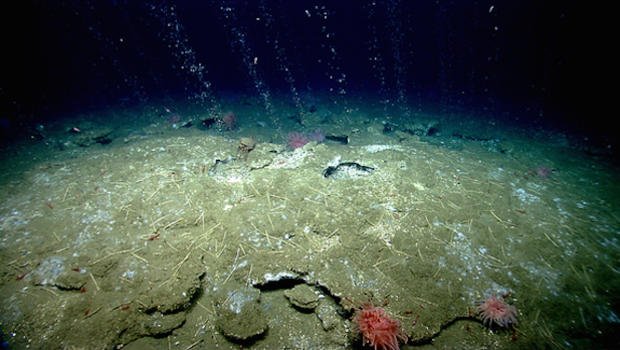
Methane hydrates releasing methane gas in bubbles in the ocean - i.treehugger image

Underwater methane gas plumes, Photo: NOAA Okeanos Explorer Program, 2013

Methane is a more powerful greenhouse gas than carbon dioxide.  Frozen forms of methane dot the bottoms of our oceans.  Warming of the oceans might be able to trigger an explosive thawing of the methane hydrates, as the frozen forms are known, seriously adding to our worldwide greenhouse gas problems.

Story here at Global ChangeScience article on which that post is based, here.

Cool SONAR pictures of methane bubbling up from the floor of the Arctic Ocean, but scary once you realize what they are, at this vintage post at Millard Fillmore’s Bathtub.

Is there any chance this research will merit a mention at the climate denialist blogs?


Annals of global warming: Glaciological map of Antarctica’s Palmer Land Area, 1947-2009

March 3, 2010

Are the ice fields of Antarctica increasing or decreasing?  How do we know?

U.S. Geological Survey released a study of the change in glaciation in Antarctica between 1947 and 2009.  Serious student of climate change will heed what the maps show — better bookmark the site.  The study and publication were done in a joint effort of USGS, the British Antarctic Survey, the Scott Polar Research Institute, and the Bundesamt für Kartographie und Geodäsie (same page, in English, here).

Coastal-Change and Glaciological Map of the Palmer Land Area, Antarctica: 1947—2009

By Jane G. Ferrigno,1 Alison J. Cook,2 Amy M. Mathie,3 Richard S. Williams, Jr.,4 Charles Swithinbank,5 Kevin M. Foley,1 Adrian J. Fox,2 Janet W. Thomson,6  and Jörn Sievers

Introduction

Cover of USGS publication, Coastal-Change and Glaciological Map of the Palmer Land Area, Antarctica: 1947—2009

Cover of USGS publication, Coastal-Change and Glaciological Map of the Palmer Land Area, Antarctica: 1947—2009

Reduction in the area and volume of the two polar ice sheets is intricately linked to changes in global climate, and the resulting rise in sea level could severely impact the densely populated coastal regions on Earth. Antarctica is Earth’s largest reservoir of glacial ice. Melting of the West Antarctic part alone of the Antarctic ice sheet would cause a sea-level rise of approximately 6 meters (m), and the potential sea-level rise after melting of the entire Antarctic ice sheet is estimated to be 65 m (Lythe and others, 2001) to 73 m (Williams and Hall, 1993). The mass balance (the net volumetric gain or loss) of the Antarctic ice sheet is highly complex, responding differently to different climatic and other conditions in each region (Vaughan, 2005). In a review paper, Rignot and Thomas (2002) concluded that the West Antarctic ice sheet is probably becoming thinner overall; although it is known to be thickening in the west, it is thinning in the north. The mass balance of the East Antarctic ice sheet is thought by Davis and others (2005) to be positive on the basis of the change in satellite-altimetry measurements made between 1992 and 2003.

Measurement of changes in area and mass balance of the Antarctic ice sheet was given a very high priority in recommendations by the Polar Research Board of the National Research Council (1986), in subsequent recommendations by the Scientific Committee on Antarctic Research (SCAR) (1989, 1993), and by the National Science Foundation’s (1990) Division of Polar Programs. On the basis of these recommendations, the U.S. Geological Survey (USGS) decided that the archive of early 1970s Landsat 1, 2, and 3 Multispectral Scanner (MSS) images of Antarctica and the subsequent repeat coverage made possible with Landsat and other satellite images provided an excellent means of documenting changes in the cryospheric coastline of Antarctica (Ferrigno and Gould, 1987). The availability of this information provided the impetus for carrying out a comprehensive analysis of the glaciological features of the coastal regions and changes in ice fronts of Antarctica (Swithinbank, 1988; Williams and Ferrigno, 1988). The project was later modified to include Landsat 4 and 5 MSS and Thematic Mapper (TM) images (and in some areas Landsat 7 Enhanced Thematic Mapper Plus (ETM+) images), RADARSAT images, aerial photography, and other data where available, to compare changes that occurred during a 20- to 25- or 30-year time interval (or longer where data were available, as in the Antarctic Peninsula). The results of the analysis are being used to produce a digital database and a series of USGS Geologic Investigations Series Maps (I-2600) (Williams and others, 1995; Swithinbank and others, 2003a,b, 2004; Ferrigno and others, 2002, 2005, 2006, 2007, 2008, and in press; and Williams and Ferrigno, 2005) (available online at http://www.glaciers.er.usgs.gov).

The paper version of this map is available for purchase from the USGS Store.

What’s the condition of glaciers in Antarctica?  Now you can look it up.

The pamphlet accompanying the maps says under “Discussion”:

The most noticeable and dramatic changes that can be seen on the Palmer Land area map are the retreat of George VI, Wilkins, Bach, and northern Stange Ice Shelves. The northern ice front of George VI Ice Shelf was at its farthest extent during our period of observation between 1966 and 1974. It retreated, losing 906 km2 between 1974 and 1992 and 87 km2 between 1992 and 1995. After 1995, it retreated an additional 1 km to more than 6 km by 2001. The southern George VI ice front retreated considerably from 1947 to the late 1960s. From the late 1960s to 1973, there was additional substantial retreat, the greatest during the period of measurements.  From 1973 to 2001, there was overall noticeable retreat.

Wilkins Ice Shelf had four ice fronts up till 2009; all retreated during the time period of our study, but Wilkins “a” and “b” have had the most dramatic change, including extensive calving in 2009 that eliminated ice front “b” and threatened the future of the ice shelf. During the period of observation, the Bach Ice Shelf front maintained a fairly consistent profile, and advanced or retreated at the same time along the entire ice front. The overall trend of Bach Ice Shelf is retreat. On the northern Stange Ice Shelf during the period of observation, the 1947, 1965–66, 1973, and 1986 ice fronts were more advanced, and the 1997 and 2001 ice fronts were more in retreat. However, the earlier data are less accurate geographically, and it is difficult to quantitatively analyze them. The later satellite images are more accurate, and it is possible to measure overall advance from 1986 to 1989, then retreat from 1989 to 1997 and from1997 to 2001; the net result was retreat.

The three coastal-change and glaciological maps of the Antarctic Peninsula (I–2600–A, –B, and –C) portray one of the most rapidly changing areas on Earth. The changes exhibited in the region are widely regarded as among the most profound and unambiguous examples of the effects of global warming yet seen on the planet.

Resources:


Climate skeptics right! A titanic win from leaked documents . . .

March 1, 2010

Titanic sinking, an artist's rendering

RMS Titanic sank? No one alive today saw it sink. According to Salt's site, iIntercepted memoranda raise doubts about alleged boat's alleged sinking, and alleged engineering and design errors.

Alun Salt has the full story:

I don’t know about you but I’ve been absolutely riveted by the recent release of records from a break-in at the White Star line. No really, it’s not just a stream of bilge from people who may not be experts but reckon something. Frankly I can’t get enough of hearing about the same claim that one memo by one of the workers on the Titanic project clearly confirms the ship was ‘unsinkable’. This should finally put to rest the biggest hoax of the 20th century, that the Titanic sunk in the North Atlantic. Still there’s always someone who isn’t going to find a bit of a memo quoted out-of-context convincing so it’s worth recapping the clear evidence that the ’sinking’ of the Titanic is a scam.

Specifics, with applause by Anthony Watts and Joanne Nova, at Archaeoastronomy.  (Well, no, not really;  neither Watts nor Nova would link to such a reasonable site as Salt’s.)


Libertarians for junk science

February 21, 2010

Yeah, I agree — but ask yourself, you who call yourselves “libertarian” or “skeptic,” why you’re not asking the same questions?

From the Murph Report, “Libertarians for junk science.”  From a guy named Kevin Carson, a self-described anarchist — and voice in the wilderness.

He discusses the unthinking acceptance political libertarians and conservatives give to all stories against  doing something about global warming, and about DDT’s problems.


Annals of global warming: Columbia Glacier, Alaska (by James Balog)

February 20, 2010

Actual observations of the world show global warming.  Time-lapse photos of the destruction of the Columbia Glacier, in Alaska, by James Balog, should make any person start wondering how to control warming processes.

It’s a film documenting warming, a film that Joanne Nova and Anthony Watts hope you will never see.*

James Balog, at TEDS, explains the stuff in under 20 minutes:

From National Geographic’s site:

© 2008 James Balog/Extreme Ice Survey

This remarkable image sequence captures a series of massive calving events at Columbia Glacier near Valdez, Alaska. Composed of 436 frames taken between May and September of 2007, it shows the glacier rapidly retreating by about half a mile (1.6 kilometers), a volume loss of some 0.4 cubic miles (1.67 cubic kilometers) of ice or 400 billion gallons (1.5 trillion liters) of water.

The time-lapse was taken as part of the ongoing Extreme Ice Survey (EIS), an ambitious project to capture global warming-induced glacial retreat in the act. Beginning in December 2006, photographer James Balog and his colleagues set up 26 solar-powered cameras at glaciers in Greenland, Iceland, Alaska, the Alps, and the Rocky Mountains. Each unit will take a photograph every daylight hour until fall 2009.

In 2008, Balog’s team began to return to each of the camera sites to collect images. In the end, they will have more than 300,000 images to analyze and stitch together to produce more dramatic videos like this one.

This kind of multiyear effort, says Balog, is necessary to “radically alter public perception of the global warming issue.”

Don’t miss: Extreme Ice a NOVA/National Geographic Television special airing on PBS March 24, 2009 at 8:00 p.m.

Resources:

_____________

Am I too harsh?  Go over to those blogs and see if you can find the WordPress pingback listed in the comments to those posts, for this post’s link to them.  No?  Then they’ve gone in and deleted the message.  It’s automatic on WordPress, and it works wonderfully.  But if they have the readership they claim, and if they are so certain of their views, why do they fear Millard Fillmore’s Bathtub?


Joanne Nova can’t stand the heat

February 19, 2010

Oh, it’s a piffle in the grand scheme of things.  But it’s indicative of the inherent, apparently congenital dishonesty in warming contrarians and denialists.

At Joanne Nova’s site, I’ve dropped quite a few information bombs, in comments.  Well, they treat information as if it would kill them, and I have hopes it might at least leak through into their minds, so I continued for a couple of days.

But it’s like “teaching the old pig to sing” joke.  The punchline says that it’s a waste of time because the pig will never sing well, you can really knock yourself out trying, and it annoys the pig.

I got a ping on a follow-up message.  Some guy commented that he couldn’t figure the site out, because after I post something with solid scientific information, they dismiss it, ignore it, and generally pick themselves up after running into the facts, and run the other way as if nothing had happened.

machina.sapiens

<!––>February 18th, 2010 at 10:04 pm<!––>

I just read through a large part of this turgid “debate”.

It’s astounding stuff.

Ed Darell provides case after case after case of detailed references from the scientific and legal debates and the rest of you run around squawking “show us the evidence” over and over again as if you don’t understand that what he is writing IS providing the evidence.

Do none of you actually speak english? Can’t you read? Do you not understand the concept of providing evidence, or are you not bothering to comprehend, just shouting him down? That’s about the only conclusion I can draw.

And then the person who runs this blog leaps in and bans people for refusing to agree with her… Well, I suppose it’s her blog and her ball and if you don’t play by her rules, you can just go home…
Unbelievable, really.

I should have known a kommitted kommissar like Nova couldn’t let my earlier post go without twisting it.  She responded:

Joanne Nova said:

Joanne Nova
–>February 19th, 2010 at 2:54 am<!––>

Machina,
I see you’re faking it right from the start. If you’d read the whole “debate” you’d know that Ed has been pinged for many things, including relying on the PSBG, and even had to apologize for baseless insults.

Ed:

““OK, I recognize that any cause of warming would melt glaciers, change weather patterns, and shift crops etc etc. None of these things is evidence that carbon is the cause of that warming. I was mixing up cause and effect. Point taken. Sorry for calling you drunk or dense or suggesting you have a mental disease.”

Time to let the pig go back to its mud, eh?  That wasn’t my intent.  I copied her words, but noted where I disagreed (you can read it here, perhaps, if she lets it stand.)

So I responded:

Ed Darrell

<!—->: Your comment is awaiting moderation.
<!––>February 19th, 2010 at 6:02 am<!––>

I clearly should have been more clear.

I didn’t mean to imply mental disease where it doesn’t exist. However, denialism may well be a symptom of disease. Warming denialism is like all tinfoil hattery, not so much a political stand as a symptom of something underlying. Mental disease? Perhaps.

Yes, any cause of global warming would melt glaciers, change weather patterns, and shift crops. None of this is, alone, evidence that carbon causes the warming. However, there is no more likely culprit than the set of greenhouse gases that cause such global warming. Cause and effect are not necessarily the same thing — the scientific evidence points to the increase in human-caused emissions of greenhouse gases as creating the mess we’re heading into.

Sorry for calling you drunk if you’re not. Sorry for implying you have disease if you don’t. That leaves only genuine skepticism, not politically motivated, or stupidity, or evil intent. Drunk or dense might be the better and more polite excuse, but Nova doesn’t believe it.

I got here on a link showing the astounding lies of Christopher Monckton about Rachel Carson, Jackie Kennedy and DDT. Since I can’t say Monckton was drunk or diseased, and since he lacks the science or history chops to be an informed skeptic, we must assume him to be evil. Why Nova promotes his statements escapes me.

I apologized for baseless insults, but cannot apologize for those with firm foundation.

As you can see from the note on moderation, they  pounced on my remarks and closed them off from view.

YODA – Moderator

<!––>February 19th, 2010 at 6:37 am<!––>

Ed Darrell,

Your latest comment has been put into moderation. Jo will review it and make a decision accordingly

YODA – Moderator

If only it were Yoda instead of someone short, with a desire to be magical, but no light sabre or serious Jedi training.

They can’t defend Monckton’s insults of America and Jackie Kennedy, nor his ignorant insults of Rachel Carson.  They know that.  Censorship is the only way out for them.

Is that also true for warming?  Nova doesn’t encourage discussion in any fashion.  (It is rather sobering to see so many willing to give up their fleeces and follow along, though, isn’t it?)

My sole defender said:

machina.sapiens
<!––>February 19th, 2010 at 9:08 am<!––>

A couple of responses – although I have no intention of engaging in this discussion on a sustained basis. Life is too short. I don’t have the patience – unlike Ed Darrell, who seems to have limitless reserves of patience and politeness in dealing with the frequently abusive and nonsensical responses to his calm, respectful, logical, and evidence-based comments.

Farmer Dave says that I “seem a little upset” – an interesting rhetorical trope – place yourself in a superior, condescending position and devalue your opponent’s words by implying that they are the result of excessive emotion rather than rationality – it’s a flavour of ad hominem technique, I suppose. That trope certainly seems to get a substantial use in this arena – maybe it’s in someone’s “Big book of hints on how to derail discussion when you have no actual arguments” – like the one that goes “ignore any evidence that anyone provides and just keep chanting ’show us the evidence’”.

You (jonova)say that

Ed has been pinged for many things, including relying on the PSBG, and even had to apologize for baseless insults.

(I presume you mean the PBSG) – I guess if relying on the statements of actual scientific bodies is a justification for blocking someone, i shouldn’t be expecting rationality… I haven’t read all of the discussion – but I see no evidence of you blocking anyone other than people who disagree with you, no matter how abusive and irrelevant your supporters get. When discussion gets mildly robust, it always leaves scope to fabricate those sort of charges against those who disagree with you, while ignoring the sins of your own supporters. I guess it’s easy to get away with that kind of patent intellectual dishonesty when you’re only singing to the choir.

Roy Hogue, one of the main sty denizens there, claimed that nameless and faceless European bureaucrats were threatening his freedom.  I asked him how, and here’s his latest tally of his loss of freedom, showing up just after my latest banning:

It’s now quite illegal to sell or install CFCs in the United States. It’s a federal crime with penalties attached.

So there you have it, folks.  If you allow the warming warnings to take effect and let us try to make cleaner air to save our planet, you’ll have to pay the incredibly stiff penalty of . . . changing your refrigerant.

That’s a penalty any of us should be happy to pay.  That these guys see that as a serious infringement of their freedom only demonstrates how blinded they are, perhaps by the slipping tinfoil hats.

Are we burning that bridge?  With a bit of sadness, perhaps.  They may need that bridge to save their tails someday.

It’s unlikely they’d know it, though.

My comment is still in “moderation.”  When telling the truth needs to be “moderated,” the problem isn’t with the facts of the matter.

If they can’t stand the heat, maybe they should let the policy makers do something about the warming, eh?

Update: I’m up early, gotta do some hard thinking about Woodrow Wilson for a seminar today, and I find this posted over at Nova’s site:

Joanne Nova

<!—->:
<!––>February 20th, 2010 at 3:57 pm<!––>

Ed Darrell, I’m getting help to manage the hundreds of comments coming in. We’re still working out a system, so your comment has been released from moderation.

You however still appear irrational.

I think I have to agree with Alexander Pope on that issue:

All seems infected that the infected spy, As all looks yellow to the jaundiced eye.

Nova again:

You make assumptions we have asked you back up:
“the scientific evidence points to the increase in human-caused emissions of greenhouse gases as creating the mess we’re heading into.

You cannot provide any other evidence other than climate simulations, and I have already explained why these are inadequate. We need empirical evidence.

I make assumptions?  I make assumptions?

I don’t assume, as your prophet Monckton claims, that Jack Kennedy came back from the dead to appoint his “good friend,” William Ruckelshaus, to head the EPA, an agency created seven years after Kennedy’s death, as Nova apparently does (Nova hasn’t defended any of the DDT insanity from Monckton — she can’t, of course, so she’s trying to deflect).  I don’t assume anything, except some degree of intelligence and civility in most people — an assumption Nova is doing her best to batter.

Nova dismisses out of hand the papers by Australian scientists showing how and why Australia’s wildfires are results of greenhouse-gas-caused climate change.  If all the evidence is ruled out of bounds, then she’s right.

Try to post a serious argument there.

Remember, my sole point was that Monckton can’t be trusted, a claim I make based on his astounding and continuing falsehoods about DDT, malaria and the environmental movement.  Nova contests none of that, but accuses me of not providing evidence to other points.

Were I to be so cruel as Monckton, I’d ask whether she had to chew through the leather restraints to post that.  But I won’t.

Before you can post again, please explain:
1. Are you still calling us “deniers”

She’s defending a guy who regularly calls scientists, Nobel winners, and anyone who questions anything he does “bed wetters” and is proud of it.

Am I pointing out you deny the evidence, Nova?  Damn straight.

Does that make you a “denier?”  I think it’s indicative of a syndrome.  Over here in the U.S., when public figures get caught like that, they often head off to an alcohol abuse treatment program.  Among the first steps of abuse correction is confession.

If I call you a “denier,” where does that description go awry, Ms. Nova?  You won’t accept the science I post, and now you won’t let me post unless I swear fealty to your odd brand of nonsensescience.

Why should anyone regard you as a major denier, lost in depths of denialism?   Where is there any indication that you accept any part of science?

If “yes” then you may not post again since this is delusional as you cannot provide any evidence we deny and have not acknowledged that your past effort to provide evidence was woefully inadequate.

I was unaware pigs wanted to sing.  I still see no evidence of it.  It’s that denialism thing, I think.  A pig denying it is Sus domesticus might be deluded into thinking it should be able to sing.

Nova’s explanation for why the Australian scientists were wrong about wildfires in Australia was an answer along the lines of “everyone knows” Australian fires are caused by Smokey the Bear’s overmanagement of wildlands.  No citation to anything at all, not even a newspaper article.

And she accuses me of providing no evidence.

Jack Rhodes explained the difficulties of coaching champion debate teams.  First a team has to learn to beat the average teams.  Then they must learn to beat the really good teams.  Finally, and most difficult, they must learn to defeat the really bad teams.  In the logical and evidence-laden world of intercollegiate debate at the time, a really bad team’s disorganized thoughts and fumbling arguments could draw good debaters off the track.

Nova’s tried to draw me off the track there.  She’s demonstrating a moral failure in her support of the serial and continuing falsehoods of Christopher Monckton.  Wholly apart from whether I could offer evidence of global warming to pass Nova’s jaundiced eye, it is a moral failure of Nova to support the falsehoods of the man, promote them as truths, and then engage in attacks on those who point out the errors.

It’s not an evidence failure we see at Nova’s blog so much as a failure of backbone, a moral failure to distinguish the dross that can mislead the masses from the gold that we need for policy.

I’m assuming Nova’s bright enough to make that distinction, of course.  She could shuffle off to an evidence abuse program and claim bright light addiction or somesuch.  But if we assume she’s not crazy or stupid, then her failing here is purely moral.  She refuses to entertain the idea that she might be wrong in any sense, crazy, stupid, or just not yet sufficiently evidenced.  If we believe her that far, moral failing is the only alternative.

If Nova wants to be seen as a serious non-denialist, she ought to act that way.

If “not” then talk of deniers applies to some other group, it’s not appropriate here. Go talk there.
2. You may apologise for wasting my time, and posting comments of sub-par logic along with baseless insults.

I regret your moderation is unfair, your characterizations of me inaccurate, and your science so poor as to be practically non-existent.  Should I be sorry for that?  Okay, I’m sorry your moderation is unfair, your characterizations wrong, and your beliefs unfounded.

I don’t think I should be apologizing for you, Joanne.  You have to do that yourself.

You may not post again until we resolve this. Unfortunately I have to discriminate against the mentally deficient who throw insults. There is only one of me, I’m trying to lift standards on logic and reason and cannot offer free therapy for those who are simply, possibly due to no fault of their own, unable to reason.

I can and will post freely wherever reasonable discussion is obtainable, Joanne.  I regret that is not your site.  Alas, again, I cannot do your apologies for you.

Dear Readers, you may head over to Nova’s site and try to educate the hard-headed Aussies and others there.  Don’t set your sites on long life on those boards.  I gather most of the rational Aussies avoid the place.  I wonder where sensible Aussies hang out?  [Roy Hogue?  Are you a troll or do you have serious questions?  If the latter, post the questions here.  I’ll work to answer them.]

Joanne Nova may wish to decorate Millard Fillmore for his contributions to sanitary science in the White House, especially his personal plumbing of the first bathtub there.  It’s her right.  It’s not history, it’s not science, it’s not accurate, it’s not appropriate.  But it’s her right.