Climate hoax|hoax author speaks

November 11, 2007

He did it to expose the climate change skeptics.

Nature‘s blog has the interview, here.

Why did you decide to construct the fake website? Was it purely a joke or did you set out to make people taking your paper at face value look foolish?

Its purpose was to expose the credulity and scientific illiteracy of many of the people who call themselves climate sceptics. While dismissive of the work of the great majority of climate scientists, they will believe almost anything if it lends support to their position. Their approach to climate science is the opposite of scepticism.

Are you surprised at the pick up your coverage has generated?

Not really. Equally ridiculous claims – like those in the paper attached to the “Oregon Petition” or David Bellamy’s dodgy glacier figures – have been widely circulated and taken up by the ‘sceptic’ community. But you can explain this until you are blue in the face. To get people to sit up and listen, you have to demonstrate it. This is what I set out to do.

Still waiting for someone to back up junk science purveyor Steve Milloy’s claim that the hoax was exposed by the skeptics it was aimed at. The hoaxer doesn’t think so.

[Yeah, I know — Nature is a British publication, and they use the British spelling for “skeptic.”]


Global warming a piffle by comparison

October 26, 2007

Plant in drought-riven soil

Here’s the word from Bob Parks’ great e-letter, “What’s New,”October 26, 2007 edition; I’ve highlighted some stuff:

2. ENVIRONMENT: MAJOR U.N. REPORT SAYS IT’S “UNSUSTAINABLE.” According to a story in the New York Times this morning, a report issued by the United Nations yesterday in Paris is so frightening that French President Nicolas Sarkozy immediately put $1.4 billion into new energy sources and biodiversity. Unsustainable consumption of resources and population growth is taking Earth beyond the point of no return. As an example, the report says, two and a half times as many fish are being caught as the oceans can produce in a sustainable manner. No word yet from Washington on the U.S. response. No steps taken to protect the environment will help in the long run if population continues to grow.

Denialists will start whining in just a few seconds. Three . . . two . . . one . . .

Considering the weather (everywhere), fires in California, droughts in Georgia, the Nobel Peace Prize this year, you’d think this would be front page news.  Where did it run in your local paper?

Sources:


Starbucks controversy: The Way I See It #289 (global warming)

September 17, 2007

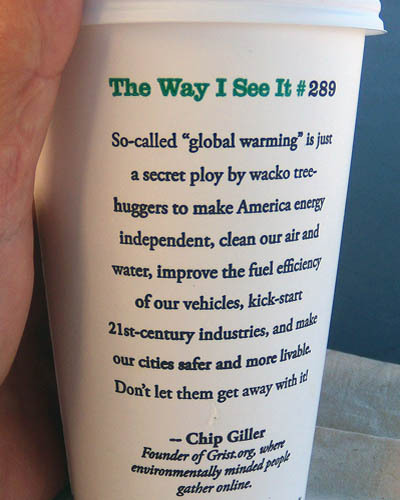
Found this on my coffee cup today:

The Way I See It #289

So-called “global warming” is just

a secret ploy by wacko tree-

huggers to make America energy

independent, clean our air and

water, improve the fuel efficiency

of our vehicles, kick-start

21st-century industries, and make

our cities safer and more livable.

Don’t let them get away with it!

Chip Giller
Founder of Grist.org, where
environmentally-minded people
gather online.

Starbucks Coffee Cup, The Way I See It #289

Add to FacebookAdd to NewsvineAdd to DiggAdd to Del.icio.usAdd to StumbleuponAdd to RedditAdd to BlinklistAdd to TwitterAdd to TechnoratiAdd to Furl

Save


Tipping point: Greenland ice melt shakes Earth

September 8, 2007

Stephen Leahy’s headline sounds almost hysterical: “Greenland Ice Collapse Producing Earthquakes.”

Here’s the article in The Guardian with the backup data.

Something to think about.

Greenland is melting; photo showing ice sheets breaking up

Read the rest of this entry »


Blog for the environment: Blog Action Day, October 15

September 8, 2007

Blog Action Day, October 15: Organizers hope to have as many as 10,000 blogs writing about environmental issues and environmental action.

Blog Action Day 2007, the environment

If you blog, perhaps you could join in. If you read and comment only, feel free to urge others to join in.

It’s headed up by a bunch from downunder. U.S., Canadian and Mexican bloggers haven’t got on the bandwagon a lot, yet. As the organizers describe it:

On October 15th – Blog Action Day, bloggers around the web will unite to put a single important issue on everyone’s mind.

In its inaugural year, Blog Action Day will be co-ordinating bloggers to tackle the issue of the environment.

What Each Blogger Will Do

Bloggers can participate on Blog Action Day in one of two ways:

  1. Publish a post on their blog which relates to an issue of their own choice pertaining to the environment.For example: A blog about money might write about how to save around the home by using environmentally friendly ideas. Similarly a blog about politics might examine what weight environmental policy holds in the political arena.Posts do not need to have any specific agenda, they simply need to relate to the larger issue in whatever way suits the blogger and readership. Our aim is not to promote one particular viewpoint, only to push the issue to the table for discussion.
  2. Commit to donating their day’s advertising earnings to an environmental charity of their choice. There is a list of “official” Blog Action Day charities on the site, however bloggers are also free to choose an alternate environmental charity to donate to if they wish.

And that’s it.

A gentle nudge to a better planet. Seems like a good idea to me.

Tip of the old scrub brush to Meeyauw.


Shooting past skepticism: Solutions to global warming

August 21, 2007

It’s been about a week since some global warming skeptic pointed me toward a recent piece from Freemon Dyson, claiming that if Dyson didn’t believe in global warming, no one should. Tip of the old scrub brush to whoever that skeptic was.

Dyson’s piece is online at The Edge, dated August 8, 2007:  “Heretical Thoughts about Science and Society.” (If you are unfamiliar with Dyson, you should at least check out his biography there.  A more comprehensive biography at Wikipedia reveals why you should be familiar with him as a great father, good physicist and astronomer who tends to work well in groups, and winner of the Templeton Prize.  Then, next time you see the Star Trek: The Next Generation episode that deals with Dyson Spheres, you can nod your head as if you understand what’s going on.)

I read Dyson’s piece, and while he’s cranky, he’s not denying global warming. A good chunk of his piece discusses how to capture carbon dioxide to prevent further warming, or perhaps even reverse current atmospheric trends. Skeptics of warming who seize on Dyson’s piece as a rebuttal make a common error among the scentifically unquestioning ranters: They assume any criticism of part of an argument is a refutation of the whole. Dyson suggests we should spend time and money on figuring out how to get the microbiota in the soil to capture more CO2.

Much of the rest of the piece is hopeful.  Dyson disagrees with hysteric concerns about melting glaciers; he doesn’t think they’ll all melt or cause dramatic rises in sea level.  At the same time, he urges caution and study, noting the holes in our knowledge that most arm-chair global warming skeptics want to ignore, including the possibilities that global warming itself would trigger a dramatic shift to a new ice age, which would be at least as catastrophic.

We can separate the climate cranks from the true skeptics if we look for similar flights of reality from people:  The true skeptics will note how difficult it is to predict climate and weather, but do not deny the need to act against pollutants which are thought to cause climate change.  This is a crucial difference.  Bush administration officials originally denied the existence of global warming as an excuse to do nothing about air pollution; now they claim to recognized global warming, but still do little that might control human dumping into the air.  In sharp contrast, Dyson proposes a partly-neglected sink of CO2 and urges that we work hard to increase its effectiveness.

In the past year I have posed that question in several climate discussions:  Do you oppose controlling air pollution?  The question quickly separates cranks from others; while the scientifically literate may argue about whether we can predict human effects on weather, few argue that we should continue our present trends of dumping.

In short, regardless the science, Melissa Etheridge is right.  It’s time to wake up.