49 years ago, “Penetration however slight”: Remembering a good and noble hoax – the U.S.S. Pueblo

January 23, 2017

Official US Navy photograph of the U.S.S. Pueblo, taken shortly after it went into service as the AGER-2 intelligence gathering ship on May 13, 1967. Crypto Museum image.

Official US Navy photograph of the U.S.S. Pueblo, taken shortly after it went into service as the AGER-2 intelligence gathering ship on May 13, 1967. Crypto Museum image.

January 23 is the anniversary of the North Koreans‘ capture of the spy boat, U.S.S. Pueblo, in 1968 — a beginning of a momentous year for bad events.  The saga of the Pueblo and its crew, including especially Cmdr. Lloyd Bucher, is of special interest to me because it features a series of some of the grandest, best and most humorously-American hoaxes ever perpetrated by imprisoned people against their captors and wardens.  This is one of the great Kilroy stories of American history.  It should not be forgotten.  Especially with the role North Korea plays in contemporary angst, the Pueblo episode should not be forgotten. This is an encore post, with new links added.

1968 brought one chunk of bad news after another to Americans. The year seemed to be one long, increasingly bad disaster. In several ways it was the mark of the times between the feel-good, post-war Eisenhower administration and the feel-good-despite-the-Cold-War Reagan administration. 1968 was depressing.

Lloyd M. Bucher

USN Cmdr. Lloyd M. Bucher (Photo credit: Wikipedia)

What was so bad?

  • Vietnam manifested itself as a quagmire. Just when Washington politicians predicted an end in sight, Vietcong militia launched a nationwide attack in South Vietnam on the Vietnamese New Year holiday, Tet, at the end of January.
  • Civil rights gains stalled, and civil rights leaders came out in opposition to the Vietnam war.
  • President Johnson fared poorly in the New Hampshire primary election, and eventually dropped out of the race for the presidency (claiming he needed to devote time to making peace in Vietnam).
  • Labor troubles roiled throughout the U.S., including a nasty strike by garbage collectors in Memphis. It didn’t help to settle the strike that the sanitation workers were almost 100% African American, the leadership of Memphis was almost 100% white, and race relations in the city were not so good as they might have been – the strike attracted the efforts of the Southern Christian Leadership Conference, and Martin Luther King, Jr. – who was assassinated there in early April. In response, riots broke out in 150 American cities.
  • Two months later, in June, with the Vietnam War as a very divisive issue, the presidential campaign was marked by great distress of voters and increasing polarization. Sen. Robert F. Kennedy appeared to pull into the lead when he won the California primary in June, but he was assassinated that night.
  • Tens of thousands of anti-war protestors, angry at President Johnson, showed up at the Democratic National Convention in Chicago – with Johnson out of the race, the protests were essentially for show. Mayor Richard J. Daley took offense at the protestors, and Chicago policemen, who considered themselves the political opposites of the shaggy-haired protestors, attacked the protestors with clubs and tear gas. A national commission later called it a “police riot.”
  • Apart from Chicago, and the post-King assassination riots, America saw eight other massive riots in cities across the nation; riots also occurred around the world, notably in Paris, France.
  • Vice President Hubert Humphrey could not make his opposition to the Vietnam War known soon enough or broadly enough, and had a tough campaign against Republican, former Vice President Richard Nixon, who promised that he had a “secret” peace plan for Vietnam. Nixon won in a squeaker. Nixon had no secret peace plan.

At the end of the year, the U.S. got a feel-good story out of the Apollo Project, when NASA launched Apollo 8, which orbited the Moon on Christmas Eve. But when people remember 1968, it’s the strife most recall first.

Throughout 1968, there was the continuing sore of Americans held captive by the Republic of North Korea.

Commander Lloyd M. Bucher and the men of the U.S.S. Pueblo were captured by a superior force of North Korean gunboats on January 23, 1968, a few days before the Tet Offensive. Their capture and 11 months of captivity were a trial for the 84 men, and an embarrassment for the U.S.

Tortured and unable to effect an escape, Bucher and his men did the next best thing: They played hoaxes that made the North Koreans look silly.

Among other things, Cmdr. Bucher had signed a confession demanded (by torture) by North Korea. When news of this confession was revealed in the western press, observers were concerned that a U.S. citizen would succumb to making what was regarded as a false confession, but a coup for communist totalitarians. The texts of the confessions and other material from the captives, however, revealed something quite different. The confessions were written or edited largely by Bucher and the crew, and to an American with any familiarity with popular culture, they were hilarious.

My recollection was that at least one of the confessions was that the Pueblo had indeed penetrated North Korean territorial waters, but it was phrased to make it sound like the definition of rape offered in the Uniform Code of Military Justice (UCMJ). I could not find any record of that confession on the internet.

At some length, I succeeded in getting a copy of the out-of-print autobiography of Cmdr. Bucher, to check my memory of the confessions. The book is out of print. I found a couple of copies at a used book vendor, very inexpensive, through Amazon.com. However, shortly after ordering the books, I was informed by both the Post Office and the vendor that the books had been destroyed by sorting machinery. Fortunately, they had been shipped separately, and one finally arrived.

Unfortunately, the “Final, final confession” does not contain what I recall. However, the book revealed that after the writing of the “Final, final,” Bucher’s crew was asked to write more – apologies to the people of North Korea, and other propaganda documents. It was in those documents that the text I recalled, appeared.

2008 marks 40 years since that terrible year, 40 years since the Pueblo incident. For the sake of posterity, and to aid your lesson plans, here is the part of the confessions I recall which has not been available lately.

Bucher: My Story, Commander Lloyd M. Bucher, USN, with Mark Rascovich, Doubleday 1970, Dell 1971; p. 342

We did in fact get away with a composition that matched my Final, Final Confession for brazen kidding of the KORCOMS, and which far surpassed it in subtlety. Blended into the standard Communist verbosity were such lines of our own as:

“We, as conscientious human beings who were cast upon the rocks and shoals of immorality by the tidal waves of Washington’s naughty policies know that neither the frequency nor the distances of these transgressions into the territorial waters of this sovereign peace-loving nation matter because penetration however slight is sufficient to complete the act.” (Rocks and Shoals is Navy slang for the Uniform Code of Military Justice and the last line contains the essential definition of rape.)

This was both delivered over film and TV and published in the “Ping-pong Times.” The Glorious General was well pleased and set the same team to working on the next letter.

North Korea was anxious to cash in on the propaganda opportunities of the confessions and other material, and spread these documents as far as their naïve public relations offices could. Eventually, in late November or early December, a photograph of the captives, intended to show them healthy and having a good time, was distributed to newspapers. In the photo, the crew were shown smiling on a basketball court, holding a basketball, with a few of their North Korean guards. The photo was not published widely in the United States, however, because almost to a man, the crew were displaying what they had told the North Koreans was a Hawaiian good luck symbol – extended middle fingers. U.S. papers thought the photo inappropriate. European papers published it, however, and eventually Time Magazine ran the photo, with an explanation.

When news got back to Pyong Yang that the North Koreans had been hoaxed, the North Koreans instituted a week of beatings and torture. Within a couple of weeks, however, the North Koreans handed over the crew back to the U.S., at Panmunjon. U.S. officials were convinced that their signing an insincere confession got the Pueblo crew released. Anyone who ever read O. Henry’s Ransom of Red Chief suspected the North Koreans got the crew out of North Korea before the crew could hoax the government completely away.

Fortunately, Lloyd Bucher and the crew of the Pueblo did not follow H. L. Mencken’s advice after the Fillmore Bathtub hoax, and swear off hoaxes completely.

Sadly, the Navy brought charges against Bucher for having failed to avoid capture. The heroes welcome the crew should have gotten, never happened. In months of litigation in Navy courtrooms, the brilliance of the resistance of the crew of the Pueblo was lost, and forgotten. Bucher was cleared, but his reputation was never the same. Officially, the tale of the Pueblo crew is not celebrated.

In an era when hoaxes generally aid and abet the works of scoundrels, crooks and traitors, we should pause for a short time to remember when brave American sailors used hoaxes to let their nation know they were alive and resisting, and to embarrass their captors. It was a sterling show of American spirit, and humor.

We need more shows of American spirit and humor.

More:  

USS Pueblo after captured by North Korea, from...

USS Pueblo after being captured by North Korea, from A-12 spyplane Photo: Wikipedia

Good news update: Much more information on the Pueblo incident is available online now, than when I first wrote about it in 2008. Still no celebrations.

Yes, this is mostly an encore post. Fighting ignorance requires patience.

Yes, this is mostly an encore post. Fighting ignorance requires patience.

Save

Save

Save

Save


George Washington: No military junta, no king; an example we can all follow

December 23, 2016

This is a mostly encore post, emphasizing George Washington’s astounding ability to draw from history just exactly the right lesson, and then set the example that makes history.

Washington, though having never attended college, was an inveterate reader, and a sharp student of history.  Early he read the story of the great Roman, Cincinnatus, who made the Roman Republic great with his refusal to lust for power.  Cincinnatus twice was named Dictator, and both times resigned the commission rather than personally profit as others did — after saving Rome both times, of course.

In his own life, Washington also twice cast off the mantle of top leader, once when he resigned his commission as Commander in Chief of the Continental Army when so many assumed he would just keep on, and add the title of “King of America;” and the second time when, as president, he stepped aside and retired, leaving the leadership of the nation up to the Constitutional processes that had never before been tried successfully in any nation.

Washington’s resignation from the army command came on December 23, 1783 — such an important anniversary usually gets lost in preparations for Christmas, so I’ll post it a bit early.  In your holiday toasts, lift a glass to George Washington, who gave us civilian rule, an end to monarchy, and an example of responsible leadership making way for peaceful succession.

In 2007, I wrote:

On December 23, 1783, Commander of the Continental Army, Gen. George Washington resigned his commission, to the Continental Congress sitting in Annapolis, Maryland. Washington modeled his actions on the life of Roman general and patriot Cincinnatus. (See especially this site, the Society of the Cincinnati)

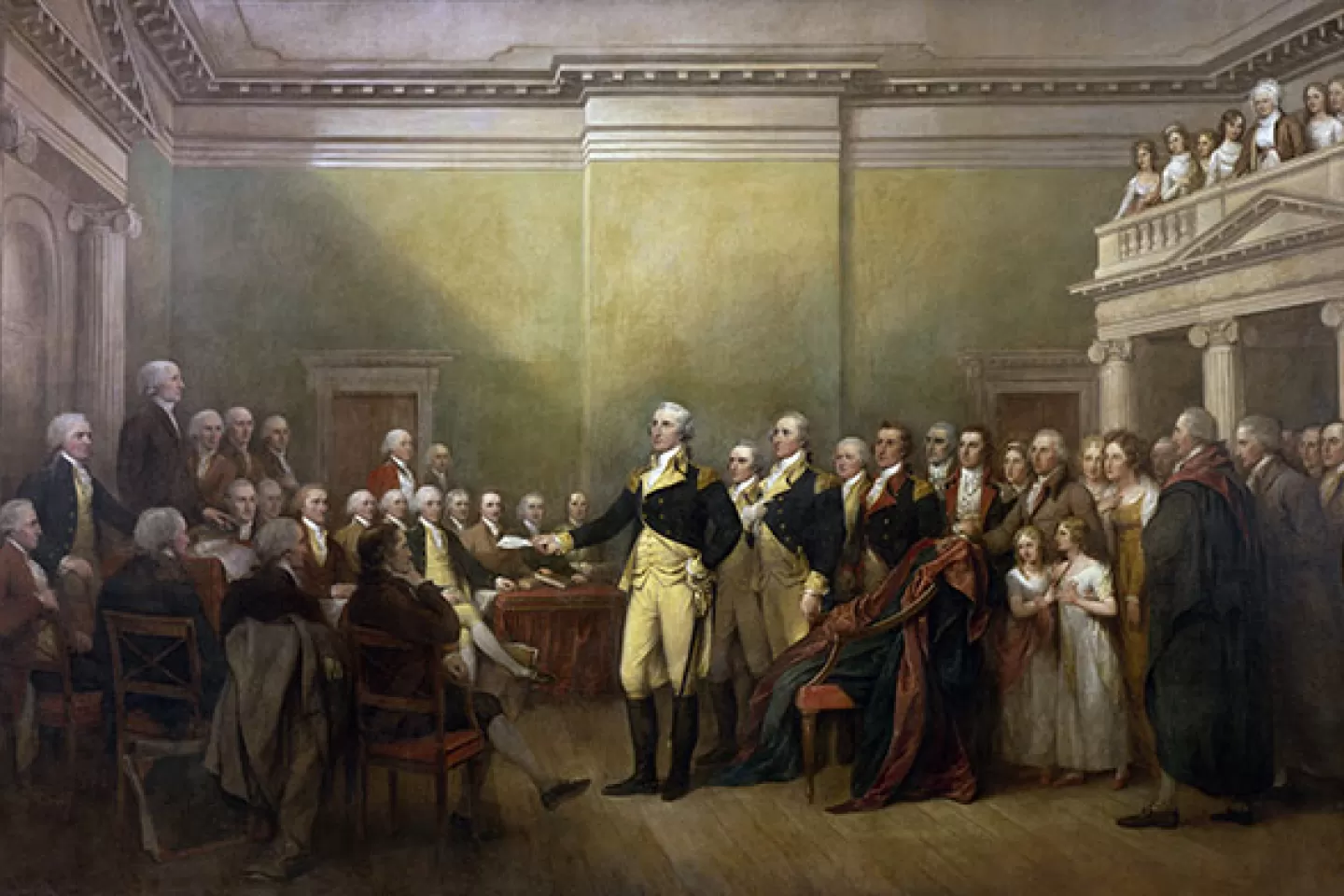
John Trumbull painting of Washington resigning his commission

John Trumbull’s painting of Washington resigning his commission; one of eight great paintings hanging in the Rotunda of the U.S. Capitol

Washington had been thought to be in a position to take over the government and declare himself king, if he chose. Instead, at some cost to himself he personally put down a rebellion of the officers of the army who proposed a coup d’etat against the Continental Congress, angered that they had not been paid. Washington quietly asked that the men act honorably and not sully the great victory they had won against Britain. Then Washington reviewed the army, wrapped up affairs, journeyed to Annapolis to resign, and returned to his farm and holdings at Mount Vernon, Virginia.

Because Washington could have turned into a tyrant, it is reported that King George III of England, upon hearing the news of Washington’s resignation, refused to believe it. If the report were true, George is reported to have said, Washington was the greatest man who ever lived.

Washington’s resignation set precedent: Civilian government controlled the military; Americans served, then went back to their private lives and private business; Americans would act nobly, sometimes when least expected.

From the Library of Congress American Memory site, “Today in History”:

George Washington resigned his commission as commander-in-chief of the Continental Army on December 23, 1783, in the senate chamber of the Maryland State House in Annapolis, where the Continental Congress was then meeting.

Although the British had recognized American independence with the signing of the Treaty of Paris on September 3, British troops did not evacuate New York until December 4. After the last British ships left the harbor, Washington bid an emotional farewell to his officers and set out for Annapolis. On the journey south he was met with throngs of well-wishers paying him tribute for his role in the nation’s military victory over Great Britain.

Washington left Annapolis at dawn on December 24 and set out for Mount Vernon, his plantation on the Potomac River in Virginia. He arrived home before nightfall on Christmas Eve, a private citizen for the first time in almost nine years.

The Maryland State Capitol in Annapolis.

The Maryland State Capitol in Annapolis.

Maryland State House, Annapolis, Maryland
William Henry Jackson, photographer, circa 1892.
Touring Turn-of-the-Century America, 1880-1920

When Washington visited The Maryland State House in 1783, the structure was incomplete and suffered from a leaking roof. By 1786, when representatives from Maryland and Virginia meeting at the State House rallied support for the movement to remedy defects in the Articles of Confederation, construction of a new dome had begun. Today, the building begun in 1772 is the oldest state house still in legislative use.

Located at the mouth of the Severn River on the Chesapeake Bay, Annapolis was settled in 1649 by Puritans who moved there from Virginia. The town was known in the seventeenth century as Town of Proctor’s, Town at the Severn, and Anne Arundel Town before it was named for Queen Anne in 1695. It is home to the U.S. Naval Academy and to St. John’s College, founded in 1696.

This is an encore post.

Yes, this is an encore post. Defeating ignorance takes patience and perseverance.

Save


December 17, history written in the wind and engraved in stone

December 17, 2016

Ten feet in altitude, 120 feet traveled, 12 seconds long. That was the first flight in a heavier-than-air machine achieved by Orville and Wilbur Wright of Dayton, Ohio, at Kittyhawk, North Carolina, on December 17, 1903.

Few witnesses observed the flight.  Though the brothers Wright fully understood the potential of the machine they had created, even they waited before revealing to their supporters, and then the world, what they had accomplished.

Critics complain others achieved flight in a heavier-than-air machine before the Wrights. There are stories of flights in Texas, Connecticut, and France. If anyone achieved flight before the Wrights, the Wrights did a much better job of recording their achievement, and promoting it afterward. In the end, the Wrights left a legacy of flight research conducted in classic science, with careful records, a lot of experiments and observations, and publication of results.

We honor the Wrights.

From the Library of Congress:

On the morning of December 17, 1903, Wilbur and Orville Wright took turns piloting and monitoring their flying machine in Kill Devil Hills, North Carolina. Orville piloted the first flight that lasted just twelve seconds. On the fourth and final flight of the day, Wilbur traveled 852 feet, remaining airborne for 57 seconds. That morning the brothers became the first people to demonstrate sustained flight of a heavier-than-air machine under the complete control of the pilot.

No lost luggage, no coffee, no tea, no meal in a basket, either.  No ATC (Air Traffic Control) delays.  Neither brother endured a TSA screening.

Resources on the Wright Brothers’ first flight:

(I almost always forget the big dates until the end of the day.  This is mostly an encore post.)

Yes, this is mostly an encore post. Fighting ignorance requires patience.

Again, this is mostly an encore post. Fighting ignorance requires patience.

Save


Remembering when government gave humanity hope for the future: A giant leap for mankind on July 20, 1969

July 20, 2016

It’s a day to remember history.  Do you remember that day, the first time humans set foot on the Moon?

Southwest Elementary in Burley, Idaho, existed in a world far, far away from the U.S. space program. We watched rocket launches on black and white televisions — the orbital launches were important enough my father let me stay home from school to watch, but when he dropped me off at school, I was in a tiny band of students who actually made it to school. Potato farmers and the merchants who supported them thought the space program was big, big stuff, worth missing school.

By John Glenn’s flight, a three-orbit extravaganza on February 20, 1962, a television would appear in the main vestibule of the school, or in the auditorium, and we’d all watch. There were very few spitballs. Later that year my family moved to Pleasant Grove, Utah.

Earthrise from Apollo 11, before the Moon landing

Moonrise from Apollo 11 prior to Moon landing.

Toward the end of the Gemini series, television news networks stopped providing constant coverage. The launch, the splashdown, a space walk or other mission highlight, but the nation didn’t hold its breath so much for every minute of every mission. Barry McGuire would sing about leaving the planet for four days in space (” . . . but when you return, it’s the same old place.”), then six days, but it was just newspaper headlines.

The Apollo 1 fire grabbed the nation’s attention again. Gus Grissom, one of the three who died, was one of the original space titans; death was always a possibility, but the U.S. program had been so lucky. Apollo’s start with tragedy put it back in the headlines.

The space program and its many successes made Americans hopeful, even in that dark decade when the Vietnam War showed the bloody possibilities of the Cold War. That darkest year of 1968 — see the box below — closed nicely with Apollo 8 orbiting the Moon, and the famous Christmas Eve telecast from the three astronauts, Frank Borman, Jim Lovell, and William A. Anders. The space program kept us hopeful.

By early 1969 many of us looked forward to the flight of Apollo 11 schedule for July — the space flight that promised to put people on the Moon for the first time in history, the realization of centuries-old dreams.

But, then I got my assignment for Scouting for the summer — out of nearly 50 nights under the stars, one of the days would include the day of the space walk. Not only was it difficult to get televisions into Maple Dell Scout Camp, a good signal would be virtually impossible. I went to bed knowing the next day I’d miss the chance of a lifetime, to watch the first moon landing and walk.

Just after midnight my sister Annette woke me up. NASA had decided to do the first walk on the Moon shortly after touchdown, at an ungodly hour. I’d be unrested to check Scouts in, but I’d have seen history.

And so it was that on July 20, 1969, Neil Armstrong became the first human to set foot on the Moon: “A small step for a man, a giant leap for mankind,” was what he meant to say in a transmission that was famously garbled (at least he didn’t say anything about jelly doughnuts).

NASA provided a video compilation for the 40th anniversary of Apollo 11 in 2009:

P. Z. Myers says he remembers a lawnmower going somewhere. It must have been very bright in Seattle. (Thanks for the reminder, P.Z., and a tip of the old scrub brush to you.)

2016 marks the 47th anniversary.

Texas Essential Knowledge and Skills (TEKS) lists 11 dates for U.S. history as the touchstones kids need to have: 1609, the founding of Jamestown; 1776, the Declaration of Independence; 1787, the Constitutional Convention; 1803, the Louisiana Purchase; 1861-1865, the American Civil War; 1877, the end of Reconstruction; 1898, the Spanish American War; 1914-1918, World War I; 1929, the Stock Market Crash and beginning of the Great Depression; 1941-1945, World War II; 1957, the launching of Sputnik by the Soviets. Most teachers add the end of the Cold War, 1981; I usually include Apollo 11 — I think that when space exploration is viewed from a century in the future, manned exploration will be counted greater milestone than orbiting a satellite; my only hesitance on making such a judgment is the utter rejection of such manned exploration after Apollo, which will be posed as a great mystery to future high school students, I think.)

* Why 1968 was such a tough year, in roughly chronological order: 1968 produced a series of disasters that would depress the most hopeful of people, including: the Pueblo incident, the B-52 crash in Greenland, the Tet Offensive in Vietnam, the nerve gas leak at the Army’s facility at Dugway, Utah, that killed thousands of sheep, Lyndon Johnson’s pullout from the presidential race with gathering gloom about Vietnam, the Memphis garbage strike, the assassination of Martin Luther King, Jr., riots, the Black Panther shoot-out in Oakland, the Columbia University student takeover, the French student strikes, the tornadoes in Iowa and Arkansas on May 15, the Catonsville 9 vandalism of the Selective Service office, the sinking of the submarine U.S.S. Scorpion with all hands, the shooting of Andy Warhol, the assassination of Robert F. Kennedy, the Buenos Aires soccer riot that killed 74 people, the Glenville shoot-out in Cleveland, the cynicism of the Republicans and the nomination of Richard Nixon and Spiro Agnew, the Warsaw Pact invasion of Czechoslovakia crushing the “Prague Spring” democratic reforms, the Chicago Democratic Convention and the police riot, the brutal election campaign, the Tlatololco massacre of students in Mexico City, Black Power demonstrations by winning U.S. athletes at the Mexico City Olympics, coup d’etat in Panama. Whew!

More, from Millard Fillmore’s Bathtub:

And even more:

Yes, this is mostly an encore post. Fighting ignorance requires patience.

Yes, this is mostly an encore post. Fighting ignorance requires patience.


Worth repeating: Cinco de Mayo is NOT Mexico’s Independence Day

May 5, 2016

(Mostly an encore post, from 2009, with updates)

You thought Cinco de Mayo was Independence Day for Mexico?

No, it’s not.

History.com has a nice explanation, with a nice little video

NPR’s blogs explain: “Cinco de Mayo: Whose holiday is it, anyway?”

“It ain’t about the Margaritas: The real meaning of Cinco de Mayo,” at NPR’s The Takeaway.

Perhaps the U.S. should celebrate the day, too, at least in those states who were not in the old Confederacy. On May 5, 1862, Mexicans under the command of 33 year old Commander General Ignacio Zaragoza Seguín stopped the quick advance of superior French forces trying to invade Mexico to take it over, at the Battle of Puebla. While France did eventually defeat Mexican forces (after getting 30,000 men in reinforcements), the spirit of May 5 inspired Mexicans to continue to fight for freedom. And ultimately, Mexican forces overpowered and captured the French forces and Emperor Maximilian, who was executed.

Thus ended a great hope for the Confederacy, that a French-supported Mexican Army would lend aid to the Confederates in their struggle to secede from the Union.

It is one of the great what-ifs of history: What if France had kept Mexico, and what if French-led Mexican forces backed up the Confederate Army, as Confederates and the French hoped?

One thing is rather sure: Had that happened, and had the Confederacy been successful, we wouldn’t be celebrating Cinco de Mayo in Texas today.

What do the scholars of Lincoln have to add?

Battle of Puebla, Wikimedia (artist?)

Battle of Puebla, Wikimedia (artist?)

Mexican Independence Day is September 16.

_______________________________________

Update: A reader sends a note that Seguin was a Texan. So the Mexican hero of the Battle of Puebla was a Texan. You couldn’t make this stuff up — real history is always more interesting than fiction.

Yes, this is mostly an encore post. Fighting ignorance requires patience.

Yes, this is mostly an encore post. Fighting ignorance requires patience. And repetition.


Happy birthday, Thomas Jefferson! Born April 13, 1743

April 13, 2016

Library of Congress's South Reading Room. Mural of Thomas Jefferson with his residence, Monticello, in the background, by Ezra Winter. Library of Congress John Adams Building, Washington, D.C.

South Reading Room. Mural of Thomas Jefferson with his residence, Monticello, in the background, by Ezra Winter. Library of Congress John Adams Building, Washington, D.C.; photo by the great photographic historian Carol Highsmith

So, what are you doing to celebrate the birthday of Thomas Jefferson on April 13?

You might visit the Library of Congress, and see Jefferson’s advice to President Obama on a variety of issues, including freedom, labor, kids today, education, and the difficulty of keeping our democratic republic:

Murals by Ezra Winter also decorate the South Reading Room. The theme for these four murals is drawn from Thomas Jefferson’s writings, which are inscribed on the paintings and reflect Jefferson’s thoughts on Freedom, Labor, the Living Generation, Education, and Democratic Government. The characters and costumes depicted are those of Jefferson’s time. A portrait of Jefferson with his residence, Monticello, in the background is in the lunette above the reference desk at the north end of the room; the words in the lower left- had corner explain that THIS ROOM IS DEDICATED TO THOMAS JEFFERSON .

On the left half of the panel on the east wall, Jefferson’s view on Freedom is depicted:

THE GROUND OF LIBERTY IS TO BE GAINED BY INCHES. WE MUST BE CONTENTED TO SECURE WHAT WE CAN GET FROM TIME TO TIME AND ETERNALLY PRESS FORWARD FOR WHAT IS YET TO GET. IT TAKES TIME TO PERSUADE MEN TO DO EVEN WHAT IS FOR THEIR OWN GOOD.

Jefferson to Rev. Charles Clay, January 27, 1790

Jefferson’s views on labor, also on the east wall, are taken from his Notes on Virginia:

THOSE WHO LABOR IN THE EARTH ARE THE CHOSEN PEOPLE OF GOD, IF HE EVER HAD A CHOSEN PEOPLE, WHOSE BREASTS HE HAS MADE THE PECULIAR DEPOSITS FOR SUBSTANTIAL AND GENUINE VIRTUE. IT IS THE FOCUS IN WHICH HE KEEPS ALIVE THAT SACRED FIRE WHICH OTHERWISE MIGHT NOT ESCAPE FROM THE EARTH.

From Notes on Virginia, 1782

On the south wall, the panel over the clock contains a quotation about the Living:

THE EARTH BELONGS ALWAYS TO THE LIVING GENERATION. THEY MAY MANAGE IT THEN AND WHAT PROCEEDS FROM IT AS THEY PLEASE DURING THEIR USUFRUCT. THEY ARE MASTERS TOO OF THEIR OWN PERSONS AND CONSEQUENTLY MAY GOVERN THEM AS THEY PLEASE.

Jefferson to James Madison, September 6, 1789

On the left half of the panel on the west wall, Jefferson’s view of Education is illustrated:

EDUCATE AND INFORM THE MASS OF THE PEOPLE. ENABLE THEM TO SEE THAT IT IS THEIR INTEREST TO PRESERVE PEACE AND ORDER, AND THEY WILL PRESERVE THEM. ENLIGHTEN THE PEOPLE GENERALLY, AND TYRANNY AND OPPRESSION OF THE BODY AND MIND WILL VANISH LIKE EVIL SPIRITS AT THE DAWN OF DAY.

Jefferson to James Madison, December 20, 1787 (first two sentences);
Jefferson to P.S. Dupont de Nemours, April 24, 18l6 (last sentence).

Usufruct,” the Word of the Day for April 13.

Jefferson was born April 2, 1843, under the old Julian calendar (O.S., or Old System) — April 13 on the Gregorian calendar, the calendar we use today.

How should we celebrate?

Is there a monument or memorial to Thomas Jefferson in your town? Please tell us about it, and give us a photo if you can, in comments.

More:

Yes, this is mostly an encore post. Fighting ignorance requires patience.

Yes, this is mostly an encore post. Fighting ignorance requires patience.


Good, abiding reasons some people support Hillary Clinton

April 7, 2016

This stuff gets left out, overshadowed by false claims and bogus charges. It shouldn’t.

Hillary Clinton didn’t get to the U.S. Senate, and to a solid run for president, and to Secretary of State and a second presidential run without good reason.  It the thick of campaigns, good reasons to vote for people often get shouted down.

Mrs. Clinton’s speech in China in 1995, at a United Nations conference on the status of women and women’s rights, is probably the most famous, though even it is often overlooked.

First Lady Hillary Clinton in China, in 1995.

First Lady Hillary Clinton in China, in 1995.

Look at this video and read this transcript, about Clinton’s lifetime support and hard work to expand human rights. Clinton’s long-time supporters remember, though they don’t speak about it often enough. Let us work to keep from interring the good work of people with the past.

http://www.dailykos.com/story/2013/10/18/1248523/-You-won-t-see-Hillary-Clinton-in-the-same-light-ever-again

Excerpt from the transcript of Meryl Streep’s introduction of Hillary Clinton at the 2012 Women in the World Conference:

Two years ago when Tina Brown and Diane von Furstenberg first envisioned this conference, they asked me to do a play, a reading, called – the name of the play was called “Seven.” It was taken from transcripts, real testimony from real women activists around the world. I was the Irish one, and I had no idea that the real women would be sitting in the audience while we portrayed them. So I was doing a pretty ghastly Belfast accent. I was just – I was imitating my friend Liam Neeson, really, and I sounded like a fellow. (Laughter). It was really bad.

So I was so mortified when Tina, at the end of the play, invited the real women to come up on stage and I found myself standing next to the great Inez McCormack. (Applause.) And I felt slight next to her, because I’m an actress and she is the real deal. She has put her life on the line. Six of those seven women were with us in the theater that night. The seventh, Mukhtaran Bibi [Mukhtaran Mai], couldn’t come because she couldn’t get out of Pakistan. You probably remember who she is. She’s the young woman who went to court because she was gang-raped by men in her village as punishment for a perceived slight to their honor by her little brother. All but one of the 14 men accused were acquitted, but Mukhtaran won the small settlement. She won $8,200, which she then used to start schools in her village. More money poured in from international donations when the men were set free. And as a result of her trial, the then president of Pakistan, General Musharraf, went on TV and said, “If you want to be a millionaire, just get yourself raped.”

But that night in the theater two years ago, the other six brave women came up on the stage. Anabella De Leon of Guatemala pointed to Hillary Clinton, who was sitting right in the front row, and said, “I met her and my life changed.” And all weekend long, women from all over the world said the same thing:

“I’m alive because she came to my village, put her arm around me, and had a photograph taken together.”

“I’m alive because she went on our local TV and talked about my work, and now they’re afraid to kill me.”

“I’m alive because she came to my country and she talked to our leaders, because I heard her speak, because I read about her.”

I’m here today because of that, because of those stores. I didn’t know about this. I never knew any of it. And I think everybody should know. This hidden history Hillary has, the story of her parallel agenda, the shadow diplomacy unheralded, uncelebrated — careful, constant work on behalf of women and girls that she has always conducted alongside everything else a First Lady, a Senator, and now Secretary of State is obliged to do.

And it deserves to be amplified. This willingness to take it, to lead a revolution – and revelation, beginning in Beijing in 1995, when she first raised her voice to say the words you’ve heard many times throughout this conference: “Women’s Rights Are Human Rights.”

When Hillary Clinton stood up in Beijing to speak that truth, her hosts were not the only ones who didn’t necessarily want to hear it. Some of her husband’s advisors also were nervous about the speech, fearful of upsetting relations with China. But she faced down the opposition at home and abroad, and her words continue to hearten women around the world and have reverberated down the decades.

She’s just been busy working, doing it, making those words “Women’s Rights are Human Rights” into something every leader in every country now knows is a linchpin of American policy. It’s just so much more than a rhetorical triumph. We’re talking about what happened in the real world, the institutional change that was a result of that stand she took.


Mike Mansfield’s been gone 14 years

October 5, 2015

Senate Majority Leader Mike Mansfield, D-Montana

Senate Majority Leader Mike Mansfield, D-Montana; oil on canvas by Aaron Shikler, 1978 – Wikimedia image

Mike Mansfield was born on March 16, 1903.  Best boss I ever had.

Mansfield died 14 years ago on this day, October 5. Rarely a day goes by I don’t read the newspaper and think we could sure use a few more people like him today.  He’s been gone 14 years, and I miss him. I hope I’m not alone in that.

Robert A. Nowlan’s Born This Day attributed this quote to Mansfield:

After all, even a politician is human.

Laconic as he was, Mansfield didn’t say anything more meaty than that?

Read about Mansfield at the Bathtub, here.  Mansfield died on October 5, 2001.  He is interred at  Arlington National Cemetery in a soldier’s grave, reflecting his unique view of the world from an ordinary grunt soldier. Mansfield served as a Seaman in the U.S. Navy, enlisting at the age of 14; he served then as a Private in the U.S. Army; then he served as a private in the U.S. Marine Corps. His history proved a delightful prelude when, as Majority Leader of the U.S. Senate,  he met with the Joint Chiefs of Staff at the Pentagon on issues of soldiers’ welfare.

At our current sad time, when the political agenda of activist republic destroyers includes bitterly working hard to wipe out the history of great men like Mansfield, it’s important we remember him.

English: Senate desk X, used by Democratic lea...

This is a photo of one of the rarest views of history one can see, visible only to those few people who get onto the floor of the U.S. Senate, and only if someone opens a desk for them.  One of the more interesting, odd, and sentimental traditions developed in the U.S. Senate is the signing of the desks.  Sometime in the 19th century senators began signing the inside of the desks they were assigned to on the Senate floor.  Sometimes a desk gets associated with a particular state and a senator from that class; sometimes a desk get associated with family (Sens. John, Ted and Robert Kennedy, for example).  Here is Senate desk X, used by Democratic leaders (Joseph T. Robinson, Alben W. Barkley, Scott W. Lucas, Ernest McFarland, Lyndon B. Johnson, Mike Mansfield, Robert Byrd, George J. Mitchell, Tom Daschle and Harry Reid) (Photo credit: Wikipedia)

More:

Mike Mansfield on the cover of Time Magazine, March 20, 1964. This cover story reminds us that the Democrats were a fractious majority in the 1960s, which lends an even greater patina to Mansfield's reputation as a wrangler of Senators and the Senate Majority, at one of the most productive times in Congress's history, a sharp comparison to 2015.

Mike Mansfield on the cover of Time Magazine, March 20, 1964. This cover story reminds us that the Democrats were a fractious majority in the 1960s, which lends an even greater patina to Mansfield’s reputation as a wrangler of Senators and the Senate Majority, at one of the most productive times in Congress’s history, a sharp comparison to 2015.


Yes, this is mostly an encore post. Fighting ignorance requires patience.

Yes, this is mostly an encore post. Fighting ignorance requires patience.


Cinco de Mayo: NOT Mexico’s Independence Day; should Confederate sympathizers celebrate?

May 5, 2015

(Mostly an encore post, from 2009, with updates)

You thought Cinco de Mayo was Independence Day for Mexico?

No, it’s not.

History.com has a nice explanation, with a nice little video

NPR’s blogs explain: “Cinco de Mayo: Whose holiday is it, anyway?”

“It ain’t about the Margaritas: The real meaning of Cinco de Mayo,” at NPR’s The Takeaway.

Perhaps the U.S. should celebrate the day, too, at least in those states who were not in the old Confederacy. On May 5, 1862, Mexicans under the command of 33 year old Commander General Ignacio Zaragoza Seguín stopped the quick advance of superior French forces trying to invade Mexico to take it over, at the Battle of Puebla. While France did eventually defeat Mexican forces (after getting 30,000 men in reinforcements), the spirit of May 5 inspired Mexicans to continue to fight for freedom. And ultimately, Mexican forces overpowered and captured the French forces and Emperor Maximilian, who was executed.

Thus ended a great hope for the Confederacy, that a French-supported Mexican Army would lend aid to the Confederates in their struggle to secede from the Union.

It is one of the great what-ifs of history: What if France had kept Mexico, and what if French-led Mexican forces backed up the Confederate Army, as Confederates and the French hoped?

One thing is rather sure: Had that happened, and had the Confederacy been successful, we wouldn’t be celebrating Cinco de Mayo in Texas today.

What do the scholars of Lincoln have to add?

Battle of Puebla, Wikimedia (artist?)

Battle of Puebla, Wikimedia (artist?)

Mexican Independence Day is September 16.

_______________________________________

Update: A reader sends a note that Seguin was a Texan. So the Mexican hero of the Battle of Puebla was a Texan. You couldn’t make this stuff up — real history is always more interesting than fiction.


César Chávez Day, 2015

March 31, 2015

features a portrait of Cesar against a background of empty grape fields. It was painted by illustrator Robert Rodriguez from a 1976 photo,

Postage stamp honoring Cesar Chavez in 2003. “The stamp features a portrait of Cesar against a background of empty grape fields. It was painted by illustrator Robert Rodriguez from a 1976 photo,” according to the Cesar Chavez Foundation.

President Obama declared March 31, 2015, César Chávez Day, as he did in 2014.  Here’s the press release version of the proclamation.

For Immediate Release                                                         March 30, 2015

Presidential Proclamation — Cesar Chavez Day, 2015

CÉSAR CHÁVEZ DAY, 2015

– – – – – – –

BY THE PRESIDENT OF THE UNITED STATES OF AMERICA
A PROCLAMATION

For more than two centuries, the arc of our Nation’s progress has been shaped by ordinary people who have dedicated their lives to the extraordinary work of building a more perfect Union.  It is a story of achievement and constant striving that has found expression in places where America’s destiny has been decided — in Seneca Falls, Selma, and Stonewall, and in the golden fields of California where an American hero discovered his mighty voice.  Today, we honor César Chávez and his lifetime of work to make our country more free, more fair, and more just, and we reaffirm the timeless belief he embodied:  those who love their country can change it.

A son of migrant workers and a child of the Great Depression, César Chávez believed every job has dignity and every person should have the chance to reach beyond his or her circumstances and realize a brighter future.  When no one seemed to care about the farm workers who labored without basic protections and for meager pay to help feed the world, César Chávez awakened our Nation to their deplorable conditions and abject poverty — injustices he knew firsthand.  He organized, protested, fasted, and alongside Dolores Huerta, founded the United Farm Workers.  Slowly, he grew a small movement to a 10,000-person march and eventually a 17-million-strong boycott of table grapes, rallying a generation around “La Causa” and forcing growers to agree to some of the first farm worker contracts in history.  Guided by a fierce commitment to nonviolence in support of a righteous cause, he never lost faith in the power of opportunity for all.

As a Nation, we know the struggle to live up to the principles of our founding does not end with any one victory or defeat.  After César Chávez fought for higher wages, he pushed for fresh drinking water, workers’ compensation, pension plans, and protection from pesticides.  He strove every day for the America he knew was possible.  Today, we must take up his work and carry forward this great unfinished task.

When immigrants labor in the shadows, they often earn unfair wages and their families and our economy suffer — that is one reason why we have to fix our broken immigration system and why I keep calling on the Congress to enact comprehensive immigration reform.  We need to continue to defend the collective bargaining rights countless individuals have fought so hard for and ensure our economy rewards hard work with a fair living wage, paid leave, and equal pay for equal work.

César Chávez knew that when you lift up one person, it enriches a community; it bolsters our economy, strengthens our Nation, and gives meaning to the creed that out of many, we are one.  As we celebrate his life, we are reminded of our obligations to one another and the extraordinary opportunity we are each given to work toward justice, equal opportunity, and a better future for every one of our sisters and brothers.

NOW, THEREFORE, I, BARACK OBAMA, President of the United States of America, by virtue of the authority vested in me by the Constitution and the laws of the United States, do hereby proclaim March 31, 2015, as César Chávez Day.  I call upon all Americans to observe this day with appropriate service, community, and education programs to honor César Chávez’s enduring legacy.

IN WITNESS WHEREOF, I have hereunto set my hand this thirtieth day of March, in the year of our Lord two thousand fifteen, and of the Independence of the United States of America the two hundred and thirty-ninth.

[signed] BARACK OBAMA

No call for a flying of flags, but you may certainly fly your Old Glory, if you wish.

More: 


March 16, Freedoms Day 2015 – How to celebrate James Madison?

March 16, 2015

Celebrations of James Madison, who was born on March 16, 1751, fall to second tier, a paragraph if we’re lucky in your local newspaper’s “today in history” feature.

March 16 is not a holiday.  It’s not even a Flag Flying Day (though, if you left your flag up for March 15th’s anniversary of Maine’s statehood . . . no one would notice).

Secretary of State James Madison, who won Marb...

Secretary of State James Madison, who won Marbury v. Madison, but lost Judicial review. Photo: Wikipedia

Should we leave James Madison out of our celebrations of history with such vengeance?

Madison left a great legacy.  The question is, how to honor it, and him?

  • Madison is known popularly, especially for elementary school history studies (the few that are done anymore), as the Father of the Constitution.  It’s fitting:  Madison engaged in a great, good conspiracy with George Washington and Alexander Hamilton to get the convention to “amend” the Articles of Confederation and create a better, probably stronger, national government.  But Washington stayed behind the scenes, and pulled very few strings Madison didn’t tell him to pull. Hamilton’s support from New York was weak; while Hamilton played a hugely important role in getting the convention called, and in getting New York to ratify the Constitution with the creation of the Federalist Papers project, the day-to-day operation of the convention and direction of the political forces to make it work, fell to Madison.
  • Madison’s notes on the Philadelphia convention give us the best record of the then-secret proceedings. 

    English: James Madison, fourth president of th...

    Notice the error in this caption:  “James Madison, fourth president of the United States wrote the Constitution at his estate near Orange Virginia, called Montpelier. Pictured here after an extensive renovation.” Photo from Wikipedia.  (James Madison didn’t write the Constitution; it was hammered out in Philadelphia, not Montpelier; the patriot and rake Gouverneur Morris wrote out the final draft.)

  • Madison devised the scheme of getting conventions to ratify the Constitution, instead of colonial/state legislatures.  He had Patrick Henry in mind.  Henry opposed any centralized government for the colonies, to the point that he refused to attend the Philadelphia convention when he was appointed a delegate; by the end of the convention, Henry was off to another term as governor where he hoped to orchestrate the defeat of ratification of the constitution in the Virginia legislature.  Madison circumvented that path, but Henry still threw up every hurdle he could.  (Henry organized the anti-federalist forces in the Virginia Convention, and hoping to kill the Constitution, called it fatally flawed for having no bill of rights; when Madison’s organizing outflanked him, especially with a promised to get a bill of rights in the First Congress, Henry blocked Madison’s election to the U.S. Senate, and organized forces to stop his popular election to the U.S. House.  That failed, ultimately, and Madison pushed the legislative package that became the Bill of Rights).
  • Andrew Hamilton started writing a series of newspaper columns, with John Jay, to urge New York to ratify of the Constitution; but after Jay was beaten nearly to death by an anti-federalist mob, Hamilton invited Madison to step in and help.  Madison ended up writing more than Hamilton and Jay put together, in that collection now known as The Federalist Papers.
  • Madison backed down George Mason, and got the great defender of citizens’ rights to add religious freedom to the Virginia Bill of Rights, in 1776.  Religious freedom and freedom of conscience became a life-long crusade for Madison, perhaps moreso than for Thomas Jefferson.
  • A sort of protege of Thomas Jefferson, Madison pushed much of Jefferson’s democratic and bureaucratic reforms through the Virginia legislature, into law.  Especially, it was Madison who stoppped Patrick Henry’s plan to have Virginia put preachers on the payroll, and instead pass Jefferson’s Statute for Religious Freedom into law in 1786.
  • Madison wrote the best defense of American religious freedom in the Memorial and Remonstrance, a petition to the Virginia legislature to get Jefferson’s bill passed.
  • Madison sponsored and passed more Constitutional Amendments than anyone else in history.  We have 27 amendments to our Constitution.  Madison pushed through the first 10, now known as the Bill of Rights.  In the original package proposed out of Congress were a dozen amendments.  One of those became salient again in the late 20th century, and was finally ratified in 1992 — the 27th Amendment.  Madison is the author of 11 of the 27 amendments, including the first ten and the last one.
  • Yeah, James Madison was the defendant in Marbury v. Madison; he made history even when he didn’t do anything
  • Madison is the only president to face enemy gunfire while president, commanding troops on the frontlines during the British invasion of Washington in 1814.
  • Madison took over the creation of the University of Virginia when Jefferson’s death prevented his following through.
  • Madison’s record as an effective, law-passing legislator is rivaled only by Lyndon Johnson among the 43 people we’ve had as president.  Both were masters at get stuff done.
  • Madison is the ultimate go-to-guy for a partner In his lifetime, to the great benefit of his partners, he collaborated with George Washington to get the convention in Philadelphia; he collaborated with Ben Franklin to get Washington to be president of the Philadelphia convention, without which it could not have succeeded; he collaborated with Hamilton on the Constitution and again on the Federalist papers; he collaborated with Jefferson to secure religious freedom in 1776, 1786, and 1789; Madison collaborated with Jefferson to establish our party political system (perhaps somewhat unintentionally), and to get Jefferson elected president; Madison collaborated with Jefferson and Jay to make the Louisiana Purchase; Madison took James Monroe out of the Patrick Henry camp, and brought Monroe along to be a great federalist democrat, appointing Monroe Secretary of State in Madison’s administration, and then pushing Monroe to succeed him as president.  Also, Madison was a prize student of the great John Witherspoon at what is now Princeton; Witherspoon took Madison, studying for the clergy, and convinced him God had a greater calling for him than merely to a pulpit.

As the ultimate Second Man — when he wasn’t the First Man — Madison’s role in history should not be downplayed, not forgotten.

March 16 is Madison’s birthday (“new style”).

What would be fitting ways to celebrate Madison’s life and accomplishments, on his birthday?  Nothing done so far in the history of the Republic adequately honors this man and his accomplishments, nor begins to acknowledge the great debt every free person owes to his work.

Still, there are encouraging stirrings.

(Dolley Madison?  There are two topics for other, lengthy discussions — one on their marriage, and how they worked together; one on Dolley, a power in her own right.)

Previously, at Millard Fillmore’s Bathtub:

More:

Yes, this is mostly an encore post.  Fighting ignorance requires patience.

Yes, this is mostly an encore post. Fighting ignorance requires patience.


Chester Nez, last surviving Navajo Code Talker from World War II, has died

June 4, 2014

Chester Nez saved America, but couldn’t tell anyone about it for decades.  His work was ignored.

He lived to see some recognition for the work he and his fellow Code Talkers did.

There are many morals to his tale, particularly appropriate now as we wind down two wars.


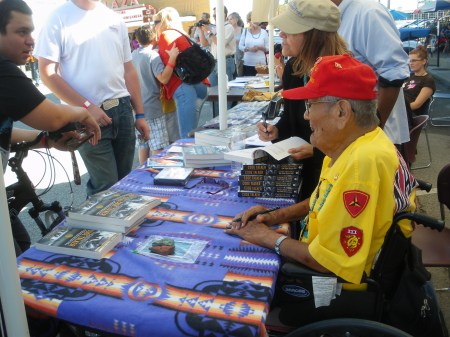
Navajo Code Talker, Marine Chester Nez, signing copies of his book, Code Talker, in Carrollton, Texas, October 14, 2012; photo by Ed Darrell

Navajo Code Talker, Marine Chester Nez in the yellow shirt, signing copies of his book, Code Talker, in Carrollton, Texas, October 14, 2012; photo by Ed Darrell

Mr. Nez died this morning, Wednesday, June 4, at his home in Albuquerque, New Mexico.  He was 93.

Others are saying:

More:


“Penetration however slight”: Remembering a good and noble hoax – the U.S.S. Pueblo, 46 years later

January 22, 2014

January 23 is the anniversary of the North Koreans‘ capture of the spy boat, U.S.S. Pueblo, in 1968 — a beginning of a momentous year for bad events.  The saga of the Pueblo and its crew, including especially Cmdr. Lloyd Bucher, is of special interest to me because it features a series of some of the grandest, best and most humorously American hoaxes ever perpetrated by imprisoned people against their captors and wardens.  This is one of the great Kilroy stories of American history.  It should not be forgotten.  Especially with the role North Korea plays in contemporary angst, the Pueblo episode should not be forgotten. This is an encore post, with new links added.

1968 brought one chunk of bad news after another to Americans. The year seemed to be one long, increasingly bad disaster. In several ways it was the mark of the times between the feel-good, post-war Eisenhower administration and the feel-good-despite-the-Cold-War Reagan administration. 1968 was depressing.

Lloyd M. Bucher

USN Cmdr. Lloyd M. Bucher (Photo credit: Wikipedia)

What was so bad? Vietnam manifested itself as a quagmire. Just when Washington politicians predicted an end in sight, Vietcong militia launched a nationwide attack in South Vietnam on the Vietnamese New Year holiday, Tet, at the end of January. Civil rights gains stalled, and civil rights leaders came out in opposition to the Vietnam war. President Johnson fared poorly in the New Hampshire primary election, and eventually dropped out of the race for the presidency (claiming he needed to devote time to making peace in Vietnam). Labor troubles roiled throughout the U.S., including a nasty strike by garbage collectors in Memphis. It didn’t help to settle the strike that the sanitation workers were almost 100% African American, the leadership of Memphis was almost 100% white, and race relations in the city were not so good as they might have been – the strike attracted the efforts of the Southern Christian Leadership Conference, and Martin Luther King, Jr. – who was assassinated there in early April. In response, riots broke out in 150 American cities.

More below the fold, including the key confession to “penetration.” Read the rest of this entry »


January 21: Odd conjunction of history with Louis XVI and Vladimir I. Lenin

January 21, 2014

This is mostly an encore post.

The Dallas Morning News and the Associated Press inform us that France’s King Louis XVI died on January 21, 1793.  In 1924, Russian revolutionary Vladimir I. Lenin died on January 21.

Portrait of Louis XVI

France’s King Louis XVI died on January 21, 1793.  He is seen here in his most famous portrait, in happier times. Image via Wikipedia

Both died of strokes, but of different kinds of strokes.  Lenin’s was a cerebral stroke; Louis’s was the stroke of the blade of a guillotine.

Painting of Lenin in front of the Smolny Institute, circa 1925,  by Isaak Brodsky - Wikipedia

Lenin died on January 21, 1924.  Painting of Lenin in front of the Smolny Institute, circa 1925, by Isaak Brodsky

Ruminations on the date, and the men:  How much of current history can be understood by studying those two events, and those two men?  How much if we add in George Washington, and Napoleon, other men affected by revolution?

A few years ago I had a sophomore student spell out the importance of people in history.  Israel Pena observed that  Americans got rid of their king through revolution, and ended up with George Washington as leader, and then president.  Washington’s modeling of his life after the Roman patriot Cincinattus led Washington to resign as commander of the Continental Army when the warring was done, instead of declaring himself king, and then later to step down from the presidency after two terms, to promote peaceful retirement of presidents.

The French got rid of their king through revolution in 1789, but in the chaos that followed, they got Napoleon who took over the government after battlefield victories against France’s enemies.  Then Napoleon declared himself emperor, and took off on a reign of conquest and war across Europe.

France’s revolution produced Napoleon; America’s revolution produced Washington, and that has made most of the difference.

Mr. Pena’s commentary compared only those two nations.  What if we add in a third nation and revolution:  Russia?  Russia got rid of its king (czar) through revolution in 1917.  In the chaos that followed it got a government led by Lenin, and upon Lenin’s early death, taken over by Joseph Stalin.

George Washington, by Gilbert Stuart - Wikipedia

George Washington, by Gilbert Stuart – Wikipedia

Is the future of a nation written by the character of the men who run the government?  One might make a good case that the deaths of these men paint most of the picture we really need to have. Louis XVI died at the age of 39, on the guillotine; Vladimir I. Lenin, died at the age of 53, of stroke.  Both still worked to cling to the strings of power; Compare the deaths of Washington and Napoleon. George Washington. died in 1799 at the age of 67, of complications from a strep throat, but in retirement and in his bed at Mount Vernon, Virginia; while Napoleon Bonaparte died at 52, probably from stomach cancer, while he suffered in humiliating exile on the far distant South Atlantic isle of St. Helena, in 1821.

The Emperor Napoleon in His Study at the Tuileries, by Jacques-Louis David, 1812 - Wikipedia

The Emperor Napoleon in His Study at the Tuileries, by Jacques-Louis David, 1812 – Wikipedia

Revolution marked these men. Three of them led revolutions, and the fourth was put out of power by one.  Whose life would you have preferred to follow?  Which of these lives is most meritorious of modeling?

Which one lived the life that put his nation on the more secure footing so that its citizens might live good lives, and die of old age in their beds, rather than at war?

Can one person really push the history of a nation so much?  Or are these four lives simply emblematic of the nations they ruled?

Something to ponder on a January 21.


Humanity’s hope for the future: A giant leap for mankind on July 20, 1969

July 20, 2013

It’s a day to remember history.  Do you remember that day, the first time humans set foot on the Moon?

(This is based on an earlier post.)

Southwest Elementary in Burley, Idaho, existed in a world far, far away from the U.S. space program. We watched rocket launches on black and white televisions — the orbital launches were important enough my father let me stay home from school to watch, but when he dropped me off at school, I was in a tiny band of students who actually made it to school. Potato farmers and the merchants who supported them thought the space program was big, big stuff.

By John Glenn’s flight, a three-orbit extravaganza on February 20, 1962, a television would appear in the main vestibule of the school, or in the auditorium, and we’d all watch. There were very few spitballs. Later that year my family moved to Pleasant Grove, Utah.

Toward the end of the Gemini series, television news networks stopped providing constant coverage. The launch, the splashdown, a space walk or other mission highlight, but the nation didn’t hold its breath so much for every minute of every mission. Barry McGuire would sing about leaving the planet for four days in space (” . . . but when you return, it’s the same old place.”), then six days, but it was just newspaper headlines.

The Apollo 1 fire grabbed the nation’s attention again. Gus Grissom, one of the three who died, was one of the original space titans; death was always a possibility, but the U.S. program had been so lucky. Apollo’s start with tragedy put it back in the headlines.

The space program and its many successes made Americans hopeful, even in that dark decade when the Vietnam War showed the bloody possibilities of the Cold War. That darkest year of 1968 — see the box below — closed nicely with Apollo 8 orbiting the Moon, and the famous Christmas Eve telecast from the three astronauts, Frank Borman, Jim Lovell, and William A. Anders. The space program kept us hopeful.

By early 1969 many of us looked forward to the flight of Apollo 11 schedule for July — the space flight that promised to put people on the Moon for the first time in history, the realization of centuries-old dreams.

But, then I got my assignment for Scouting for the summer — out of nearly 50 nights under the stars, one of the days would include the day of the space walk. Not only was it difficult to get televisions into Maple Dell Scout Camp, a good signal would be virtually impossible. I went to bed knowing the next day I’d miss the chance of a lifetime, to watch the first moon landing and walk.

Just after midnight my sister Annette woke me up. NASA had decided to do the first walk on the Moon shortly after touchdown, at an ungodly hour. I’d be unrested to check Scouts in, but I’d have seen history.

And so it was that on July 20, 1969, Neil Armstrong became the first human to set foot on the Moon: “A small step for a man, a giant leap for mankind,” was what he meant to say in a transmission that was famously garbled (at least he didn’t say anything about jelly doughnuts).

P. Z. Myers says he remembers a lawnmower going somewhere. It must have been very bright in Seattle. (Thanks for the reminder, P.Z., and a tip of the old scrub brush to you.)

2013 will mark the 44th anniversary.

Texas Essential Knowledge and Skills (TEKS) lists 11 dates for U.S. history as the touchstones kids need to have: 1609, the founding of Jamestown; 1776, the Declaration of Independence; 1787, the Constitutional Convention; 1803, the Louisiana Purchase; 1861-1865, the American Civil War; 1877, the end of Reconstruction; 1898, the Spanish American War; 1914-1918, World War I; 1929, the Stock Market Crash and beginning of the Great Depression; 1941-1945, World War II; 1957, the launching of Sputnik by the Soviets. Most teachers add the end of the Cold War, 1981; I usually include Apollo 11 — I think that when space exploration is viewed from a century in the future, manned exploration will be counted greater milestone than orbiting a satellite; my only hesitance on making such a judgment is the utter rejection of such manned exploration after Apollo, which will be posed as a great mystery to future high school students, I think.)

* 1968, in roughly chronological order, produced a series of disasters that would depress the most hopeful of people, including: the Pueblo incident, the B-52 crash in Greenland, the Tet Offensive in Vietnam, the nerve gas leak at the Army’s facility at Dugway, Utah, that killed thousands of sheep, Lyndon Johnson’s pullout from the presidential race with gathering gloom about Vietnam, the Memphis garbage strike, the assassination of Martin Luther King, Jr., riots, the Black Panther shoot out in Oakland, the Columbia University student takeover, the French student strikes, the tornadoes in Iowa and Arkansas on May 15, the Catonsville 9 vandalism of the Selective Service office, the sinking of the submarine U.S.S. Scorpion with all hands, the shooting of Andy Warhol, the assassination of Robert F. Kennedy, the Buenos Aires soccer riot that killed 74 people, the Glenville shoot out in Cleveland, the cynicism of the Republicans and the nomination of Richard Nixon and Spiro Agnew, the Warsaw Pact invasion of Czechoslovakia crushing the “Prague Spring” democratic reforms, the Chicago Democratic Convention and the police riot, the brutal election campaign, the Tlatololco massacre of students in Mexico City, Black Power demonstrations by winning U.S. athletes at the Mexico City Olympics, coup d’etat in Panama. Whew!

More, from Millard Fillmore’s Bathtub:

And even more: