Four Stone Hearth, archaeology not quite ready for Social Security

February 23, 2009

Four Stone Hearth #60 is up, hosted by Middle Savagery.

Yes, I know, I’ve been remiss in carnivalling lately.  Heck, I’ve been remiss in posting.  The water in the Bathtub is actually too cold for bathing at the moment, as I’m away metaphorically, working on serious curriculum matters.

So, it’s a good time to take a look at something like the best archaeology blog carnival around.  It’s up to edition Number 60?  Great news, really, that there is so much material to cover.  There is some delightful morsel in every edition.

Bad Death Ritual - See the entire post at Ideophone: A bad death ritual in Ghanas Volta Region. On the village cemetery, relatives of a man who died in a hunting accident listen anxiously to a woman who is possessed by the spirit of the deceased. The hunters, who have just brought the spirit home from the place of the accident deep in the jungle, keep their distance. Red is the colour of danger, black that of death.  Photo by Mark Dingemanse

Bad Death Ritual - See the entire post at Ideophone: "A 'bad death' ritual in Ghana's Volta Region. On the village cemetery, relatives of a man who died in a hunting accident listen anxiously to a woman who is possessed by the spirit of the deceased. The hunters, who have just brought the spirit home from the place of the accident deep in the jungle, keep their distance. Red is the colour of danger, black that of death." Photo by Mark Dingemanse

FSH #60 is heavy on photos — grist for your better slide presentations, no?

Zenobia, Empress of the East looks at a project that used lasers to scan a bas relief on a rock in the 3rd century A.D. Parthian empire — er, maybe Persian — but wait!  Is that Greek influence in that carving?

This extraordinary relief is carved on a huge limestone boulder at the cliff edge of a remote, not to say ‘hidden’ valley in the rugged mountains of northeastern Khuzistan [at the southwestern edge of the Iranian plateau, sharing a border with southern Iraq (= the big red blob on the map, below right)]. In ancient times, this was the heartland of Elymais, sometimes a small empire, more often a vassal to more powerful states.

21st century technology and science applied to help solve a 700-year-old mystery.  Does archaeology get much better than that?

Especially if you’re inclined to study Neanderthals, or for a great sidebar on the value of biodiveristy, take a look at Remote Central’s post on the last stand of Neanderthal, on Gibralter.

There is much more in Four Stone Hearth #60.


Box of surprises

January 29, 2009

HistoryBox.com?

Check it out — there be good stuff.

For example, abundant sources of information and especially images on the history of New York City can be found here.  It’s in directory form, so you may need to click once more to get what you need — but so far, everything I’ve clicked works, and it always seems to go to a good site.

New York state resources, here.

The U.S. history portion is not working yet.


Who invented Santa Claus, and the Night Before Christmas?

December 24, 2008

An encore post from 2007

Thomas Nast invented Santa Claus? Clement C. Moore didn’t write the famous poem that starts out, “‘Twas the night before Christmas, and all through the house . . . ?”

The murky waters of history from Millard Fillmore’s Bathtub soak even our most cherished ideas and traditions.

But isn’t that part of the fun of history?

Santa Claus delivers to Union soldiers, "Santa Claus in Camp" - Thomas Nast, Harper's Weekly, Jan 3, 1863

Thomas Nast’s first published drawing featuring Santa Claus; for Harper’s Weekly, “A Journal of Civilization,” January 3, 1863 Nast portrayed the elf distributing packages to Union troops: “Santa Claus in camp.” Nast (1840-1904) was 23 when he drew this image.

Yes, Virginia (and California, too)! Thomas Nast created the image of Santa Claus most of us in the U.S. know today. Perhaps even more significant than his campaign against the graft of Boss Tweed, Nast’s popularization of a fat, jolly elf who delivers good things to people for Christmas makes one of the great stories in commercial illustration. Nast’s cartoons, mostly for the popular news publication Harper’s Weekly, created many of the conventions of modern political cartooning and modeled the way in which an illustrator could campaign for good, with his campaign against the graft of Tammany Hall and Tweed. But Nast’s popular vision of Santa Claus can be said to be the foundation for the modern mercantile flurry around Christmas.

Nast is probably ensconced in a cartoonists’ hall of fame. Perhaps he should be in a business or sales hall of fame, too.  [See also Bill Casselman’s page, “The Man Who Designed Santa Claus.]

Nast’s drawings probably drew some inspiration from the poem, “Account of a Visit from St. Nicholas,” traditionally attributed to Clement C. Moore, a New York City lawyer, published in 1822. The poem is among the earliest to describe the elf dressed in fur, and magically coming down a chimney to leave toys for children; the poem invented the reindeer-pulled sleigh.

Modern analysis suggests the poem was not the work of Moore, and many critics and historians now attribute it to Major Henry Livingston, Jr. (1748-1828) following sleuthing by Vassar College Prof. Don Foster in 2000. Fortunately for us, we do not need to be partisans in such a query to enjoy the poem (a complete copy of which is below the fold).

The Library of Congress still gives Moore the credit. When disputes arise over who wrote about the night before Christmas, is it any wonder more controversial topics produce bigger and louder disputes among historians?

Moore was not known for being a poet. The popular story is that he wrote it on the spur of the moment:

Moore is thought to have composed the tale, now popularly known as “The Night Before Christmas,” on December 24, 1822, while traveling home from Greenwich Village, where he had bought a turkey for his family’s Christmas dinner.

Inspired by the plump, bearded Dutchman who took him by sleigh on his errand through the snow-covered streets of New York City, Moore penned A Visit from St. Nicholas for the amusement of his six children, with whom he shared the poem that evening. His vision of St. Nicholas draws upon Dutch-American and Norwegian traditions of a magical, gift-giving figure who appears at Christmas time, as well as the German legend of a visitor who enters homes through chimneys.

Again from the Library of Congress, we get information that suggests that Moore was a minor celebrity from a well-known family with historical ties that would make a good “connections” exercise in a high school history class, perhaps (”the link from Aaron Burr’s treason to Santa Claus?”): (read more, below the fold)

Clement Moore was born in 1779 into a prominent New York family. His father, Benjamin Moore, president of Columbia University, in his role as Episcopal Bishop of New York participated in the inauguration of George Washington as the nation’s first president. The elder Moore also administered last rites to Alexander Hamilton after he was mortally wounded in a tragic duel with Aaron Burr.

A graduate of Columbia, Clement Moore was a scholar of Hebrew and a professor of Oriental and Greek literature at the General Theological Seminary in Manhattan. [See comment from Pam Bumsted below for more on Moore.] He is said to have been embarrassed by the light-hearted verse, which was made public without his knowledge in December 1823. Moore did not publish it under his name until 1844.

Tonight, American children will be tucked in under their blankets and quilts and read this beloved poem as a last “sugarplum” before slipping into dreamland. Before they drift off, treat them to a message from Santa, recorded by the Thomas Edison Company in 1922.

Santa Claus Hides in Your Phonograph
By Arthur A. Penn, Performed by Harry E. Humphrey.
Edison, 1922.
Coupling date: 6/20/1922. Cutout date: 10/31/1929.
Inventing Entertainment: The Motion Pictures and Sound Recordings of the Edison Companies

Listen to this recording (RealAudio Format)

Listen to this recording (wav Format, 8,471 Kb)

But Henry Livingston was no less noble or historic. He hailed from the Livingtons of the Hudson Valley (one of whose farms is now occupied by Camp Rising Sun of the Louis August Jonas Foundation, a place where I spent four amazing summers teaching swimming and lifesaving). Livingston’s biography at the University of Toronto site offers another path for a connections exercise (”What connects the Declaration of Independence, the American invasion of Canada, the famous poem about a visit from St. Nick, and George W. Bush?”):

Henry Livingston Jr. was born in Poughkeepsie, New York, on Oct. 13, 1748. The Livingston family was one of the important colonial and revolutionary families of New York. The Poughkeepsie branch, descended from Gilbert, the youngest son of Robert Livingston, 1st Lord of Livingston Manor, was not as well off as the more well-known branches, descended from sons Robert and Philip. Two other descendants of Gilbert Livingston, President George Walker Herbert Bush and his son, President-Elect George W. Bush, though, have done their share to bring attention to this line. Henry’s brother, Rev. John Henry Livingston, entered Yale at the age of 12, and was able to unite the Dutch and American branches of the Dutch Reformed Church. At the time of his death, Rev. Livingston was president of Rutgers University. Henry’s father and brother Gilbert were involved in New York politics, and Henry’s granduncle was New York’s first Lt. Governor. But the law was the natural home for many of Henry’s family. His brother-in-law, Judge Jonas Platt, was an unsuccessful candidate for governor, as was his daughter Elizabeth’s husband, U.S. Supreme Court Justice Smith Thompson. Henry’s grandson, Sidney Breese, was Chief Justice of the Illinois Supreme Court.

Known for his encyclopedic knowledge and his love of literature, Henry Livingston was a farmer, surveyor and Justice of the Peace, a judicial position dealing with financially limited criminal and civil cases. One of the first New Yorkers to enlist in the Revolutionary Army in 1775, Major Henry Livingston accompanied his cousin’s husband, General Montgomery, in his campaign up the Hudson River to invade Canada, leaving behind his new wife, Sarah Welles, and their week-old baby, on his Poughkeepsie property, Locust Grove. Baby Catherine was the subject of the first poem currently known by Major Livingston. Following this campaign, Livingston was involved in the War as a Commissioner of Sequestration, appropriating lands owned by British loyalists and selling them for the revolutionary cause. It was in the period following Sarah’s early death in 1783, that Major Livingston published most of his poems and prose, anonymously or under the pseudonym of R. Ten years after the death of Sarah, Henry married Jane Patterson, the daughter of a Dutchess County politician and sister of his next-door neighbor. Between both wives, Henry fathered twelve children. He published his good-natured, often occasional verse from 1787 in many journals, including Political Barometer, Poughkeepsie Journal, and New-York Magazine. His most famous poem, “Account of a Visit from St. Nicholas,” was until 2000 thought to have been the work of Clement Clarke Moore (1779-1863), who published it with his collected poems in 1844. Livingston died Feb. 29, 1828.

More on Henry Livingston and his authorship of the Christmas poem here.

Thomas Nast, Merry Old Santa Claus, Harper's Weekly, Jan 1, 1881


Our views of Santa Claus owe a great deal also to the Coca-Cola advertising campaign. Coca-Cola first noted Santa’s use of the drink in a 1922 campaign to suggest Coke was a year-round drink (100 years after the publication of Livingston’s poem). The company’s on-line archives gives details:

In 1930, artist Fred Mizen painted a department store Santa in a crowd drinking a bottle of Coke. The ad featured the world’s largest soda fountain, which was located in the department store of Famous Barr Co. in St. Louis, Mo. Mizen’s painting was used in print ads that Christmas season, appearing in The Saturday Evening Post in December 1930.

1936 Coca-Cola Santa cardboard store display

  • 1936 Coca-Cola Santa cardboard store display

Archie Lee, the D’Arcy Advertising Agency executive working with The Coca-Cola Company, wanted the next campaign to show a wholesome Santa as both realistic and symbolic. In 1931, The Coca-Cola Company commissioned Michigan-born illustrator Haddon Sundblom to develop advertising images using Santa Claus — showing Santa himself, not a man dressed as Santa, as Mizen’s work had portrayed him.
1942 original oil painting - 'They Remembered Me'

  • 1942 original oil painting – ‘They Remembered Me’

For inspiration, Sundblom turned to Clement Clark Moore’s 1822 poem “A Visit From St. Nicholas” (commonly called “‘Twas the Night Before Christmas”). Moore’s description of St. Nick led to an image of Santa that was warm, friendly, pleasantly plump and human. For the next 33 years, Sundblom painted portraits of Santa that helped to create the modern image of Santa — an interpretation that today lives on in the minds of people of all ages, all over the world.

Santa Claus is a controversial figure. Debates still rage among parents about the wisdom of allowing the elf into the family’s home, and under what conditions. Theologians worry that the celebration of Christmas is diluted by the imagery. Other faiths worry that the secular, cultural impact of Santa Claus damages their own faiths (few other faiths have such a popular figure, and even atheists generally give gifts and participate in Christmas rituals such as putting up a decorated tree).

For over 100 years, Santa Claus has been a popular part of commercial, cultural and religious life in America. Has any other icon endured so long, or so well?

Add to FacebookAdd to NewsvineAdd to DiggAdd to Del.icio.usAdd to StumbleuponAdd to RedditAdd to BlinklistAdd to TwitterAdd to TechnoratiAdd to Furl

________________________
Below:
From the University of Toronto Library’s Representative Poetry Online

Major Henry Livingston, Jr. (1748-1828)

Account of a Visit from St. Nicholas

1 ‘Twas the night before Christmas, when all thro’ the house,
2 Not a creature was stirring, not even a mouse;
3 The stockings were hung by the chimney with care,
4 In hopes that St. Nicholas soon would be there;
5 The children were nestled all snug in their beds,
6 While visions of sugar plums danc’d in their heads,
7 And Mama in her ‘kerchief, and I in my cap,
8 Had just settled our brains for a long winter’s nap –
9 When out on the lawn there arose such a clatter,
10 I sprang from the bed to see what was the matter.
11 Away to the window I flew like a flash,
12 Tore open the shutters, and threw up the sash.
13 The moon on the breast of the new fallen snow,
14 Gave the lustre of mid-day to objects below;
15 When, what to my wondering eyes should appear,
16 But a miniature sleigh, and eight tiny rein-deer,
17 With a little old driver, so lively and quick,
18 I knew in a moment it must be St. Nick.
19 More rapid than eagles his coursers they came,
20 And he whistled, and shouted, and call’d them by name:
21 “Now! Dasher, now! Dancer, now! Prancer, and Vixen,
22 “On! Comet, on! Cupid, on! Dunder and Blixem;
23 “To the top of the porch! to the top of the wall!
24 “Now dash away! dash away! dash away all!”
25 As dry leaves before the wild hurricane fly,
26 When they meet with an obstacle, mount to the sky;
27 So up to the house-top the coursers they flew,
28 With the sleigh full of Toys — and St. Nicholas too:
29 And then in a twinkling, I heard on the roof
30 The prancing and pawing of each little hoof.
31 As I drew in my head, and was turning around,
32 Down the chimney St. Nicholas came with a bound:
33 He was dress’d all in fur, from his head to his foot,
34 And his clothes were all tarnish’d with ashes and soot;
35 A bundle of toys was flung on his back,
36 And he look’d like a peddler just opening his pack:
37 His eyes — how they twinkled! his dimples how merry,
38 His cheeks were like roses, his nose like a cherry;
39 His droll little mouth was drawn up like a bow.
40 And the beard of his chin was as white as the snow;
41 The stump of a pipe he held tight in his teeth,
42 And the smoke it encircled his head like a wreath.
43 He had a broad face, and a little round belly
44 That shook when he laugh’d, like a bowl full of jelly:
45 He was chubby and plump, a right jolly old elf,
46 And I laugh’d when I saw him in spite of myself;
47 A wink of his eye and a twist of his head
48 Soon gave me to know I had nothing to dread.
49 He spoke not a word, but went straight to his work,
50 And fill’d all the stockings; then turn’d with a jerk,
51 And laying his finger aside of his nose
52 And giving a nod, up the chimney he rose.
53 He sprung to his sleigh, to his team gave a whistle,
54 And away they all flew, like the down of a thistle:
55 But I heard him exclaim, ere he drove out of sight –
56 Happy Christmas to all, and to all a good night.

Election Day 2008: Fly the flag, vote

November 4, 2008

Saint Louis Art Museum, St. Louis, Missouri George Caleb Bingham (American, 1811–1879). The County Election, 1852. Oil on canvas. 38 x 52 in. (96.5 x 132.1 cm). Gift of Bank of America.

Saint Louis Art Museum, St. Louis, Missouri George Caleb Bingham (American, 1811–1879). The County Election, 1852. Oil on canvas. 38 x 52 in. (96.5 x 132.1 cm). Gift of Bank of America.

Every polling place should be flying the U.S. flag today.  You may fly yours, too.  In any case, if you have not voted already, go vote today as if our future depends upon it, as if our nation expects every voter to do her or his duty.

Today the nation and world listen to the most humble of citizens.  Speak up, at the ballot box.

The whole world is watching.


Harappa and Mohenjodaro sources

October 5, 2008

The Maharajah of Cashmere  The Illustrated London News  December 18, 1875  [From a longer story on the Prince of Wales visit to India in 1875.] With regard to the Maharajah of Cashmere, whose residence and political relations, beneath the Himalayas and in the Valley of the Upper Indus, are very remote from Bombay, we defer any notice of him till the Prince of Wales goes to visit him in Cashmere. The portrait of this Maharajah is from a photograph by Messrs. Bourne and Shepherd, of India.
The Maharajah of Cashmere The Illustrated London News December 18, 1875 (From a longer story on the Prince of Wales visit to India in 1875.) – “With regard to the Maharajah of Cashmere, whose residence and political relations, beneath the Himalayas and in the Valley of the Upper Indus, are very remote from Bombay, we defer any notice of him till the Prince of Wales goes to visit him in Cashmere. The portrait of this Maharajah is from a photograph by Messrs. Bourne and Shepherd, of India.”

World history teachers, bookmark this site:  Harappa.com

It’s a rich site about India and Pakistan, and includes information and images about the Harappa and Mohenjo-Daro civilizations.

Great images for your classrooms, or for your students’ projects.

Tip of the old scrub brush to John Maunu teaching AP World History in Grosse Ile, Michigan.

(Full text of description of site from the Asian Studies WWW Monitor below the fold.)

Read the rest of this entry »


Railroad maps!

September 30, 2008

Atchison, Topeka & Santa Fe Railroad, 1899 - from the Library of Congress

Atchison, Topeka & Santa Fe Railroad, 1899 - from the Library of Congress

American Memory at the Library of Congress features dozens of historic railroad maps of U.S. railroads.

This is a great collection for U.S. history presentations on development of the railroads, or on settlement of the west, in particular.

The Railroad maps represent an important historical record, illustrating the growth of travel and settlement as well as the development of industry and agriculture in the United States. They depict the development of cartographic style and technique, highlighting the achievement of early railroaders. Included in the collection are progress report surveys for individual lines, official government surveys, promotional maps, maps showing land grants and rights-of-way, and route guides published by commercial firms.

Heck, if nothing else, these make great backgrounds for PowerPoint presentations.

Bookmark the site — kids working on projects specific to a state or region should have a field day with these things.


Rock and Roll Hall of Fame lesson plans

July 16, 2008

Just found this source, courtesy of Woodlands High School’s James Rowland:  Rock and Roll Hall of Fame and Museum, Summer Teacher Institute lesson plans.

Seriously.  Consider these:

  • Lesson 2: Langston Hughes and the Blues
  • Lesson 4: The Vietnam War: A Popular Music Approach
  • Lesson 9: Woody Guthrie and The Grapes of Wrath
  • Lesson 27: I Went to the Crossroads: The Faust Theme in Music, Film and Literature
  • Lesson 30: Trouble for the United States in the Middle East: The Reagan-Bush Years

Independence Day! Fly your flag

July 3, 2008

Remember to fly the flag on July 4, 2008, the 232nd anniversary of the Declaration of Independence. (Postcard above, from 1907, from collection of James R. Heintze)

Flags may be flown sun-up to sun-down. The U.S. flag should be run up the pole quickly, and be left to fly unfettered in the breeze. The flag may be left flying after sundown, if it is lighted.

Resources:


Good though: Folksinger, Storyteller, Railroad Tramp Utah Phillips Dead at 73

May 27, 2008

Utah Phillips died Friday. He was 73. He died at his home in Nevada City, California.

Wonderful tribute at Fifteen Iguana.

Utah Phillips publicity shot

Utah Phillips (publicity photo via Bluegrass Today)

Phillips’s website lists planned tributes, memorials and the funeral in Nevada City, California. KVMR Radio’s site has an obit and links to other tributes.

Read the rest of this entry »


‘Twas the 18th of April in ’75 . . . (Paul Revere’s Ride)

April 19, 2008

Paul Revere — tonight’s the anniversary of his famous ride.

John Copley's painting of Paul Revere

Paul Revere, 1768, by John Singleton Copley (1738-1815)

John Copley painted all the bigwigs of revolutionary Boston, including this portrait of the famous horse-mounted alarm before he turned older and grayer.

And as April 18 is the anniversary of Revere’s ride, April 19 is the anniversary of the “shot heard ’round the world.”

Both events are celebrated in poetry; April is National Poetry Month. This could be a happy marriage for history and English classrooms.

National Poetry Month 2008 poster


Renaissance shadow over contemporary art: Penultimate suppers

April 11, 2008

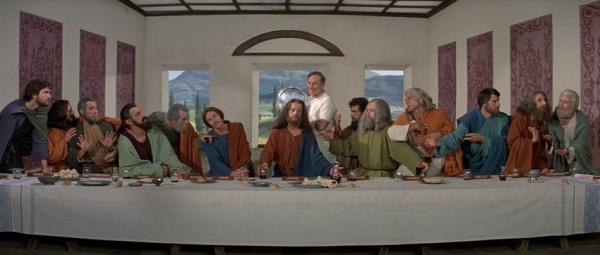
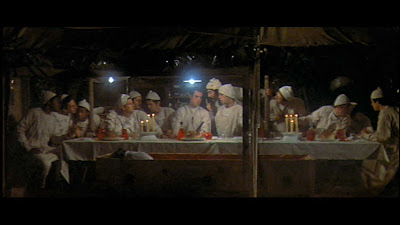
Jeremy Barker at Popped Culture assembled more than 30 versions of contemporary recastings of DaVinci’s painting of “The Last Supper.” There’s the Simpsons version, the cartoon version with Disney and Warner Bros. characters. There’s the Sopranos version, and the Battlestar Galactica version.

For example, the Robert Altman version, from M*A*S*H:

If you need a 20 minute lesson on the influence of Renaissance art on contemporary art, this is one many high school kids may find interesting, if not amazingly historically informative. I suspect there is a great lesson plan hiding in there about 20th century history as reflected in parody art.

It’s a brilliant and subtle demonstration of the power of DaVinci’s art that there are so many copy cat pictures, don’t you think?

I did notice, however, that Barker left out the Mel Brooks version, from “History of the World, Part I.” It may not fit the meme.

Mel Brooks'

Resources:


Baltimore’s orgy of cartography and geography

March 22, 2008

The ad says “Come visit Utopia in Baltimore.” With an orgy of maps like that planned, it should be a Utopia for somebody: Geographers, cartographers, historians, and anyone interested in travel.

Baltimore’s Walters Art Museum hosts an outstanding exhibit of world-changing maps through June 8, a Festival of Maps; the entire town appears to have gone ga-ga on the idea. Baltimore will be Map Central for a few weeks, at least.

The Baltimore Sun (one of the truly great newspapers in America) described some of the cartographic gems on display:

Among the treasures is a huge and beautiful map of the fossil-embedded geological strata that underlie England and Wales. That masterpiece, published in 1815 by a pioneering geologist named William Smith, offered evidence used to support Darwin’s theory of evolution and set the stage for creation-vs.-evolution debates that still rage.

Then there’s the map researched by a doctor named John Snow in the 1850s. It allowed him to trace the source of a cholera outbreak in London to a well used by residents of a single neighborhood.

And there will be charts prepared by geographer Marie Tharp of the Mid-Oceanic Ridge, a mountainous rise in the mid-Atlantic seabed, based on data gathered by American submarines during World War II and later used to provide evidence of how the Earth’s crust has evolved through geological time.

The Smith and Snow maps anchor key events in science, the origin of paleontology and one of the greatest examples of public health sleuthing. To have both of those maps in one exhibition is a great coup for the Walters, and for Baltimore.

The exhibit also features a map of Utopia drawn by Sir Thomas Moore. Other maps were drawn by Benjamin Franklin, J. R. R. Tolkein, and Leonardo da Vinci.

Here’s a video description of one of the more remarkable pieces on view, a map of London, on a glove:

Vodpod videos no longer available. from www.baltimore.org posted with vodpod

♦ ♦ ♦ ♦ ♦ ♦ ♦ ♦ ♦

Surely there is material here for the Strange Maps blog.  Here’s a still of the glove, from the collection of The National Archives, UK:

Glove map, from London's 1851 Exposition

Below the fold, a partial list of some of the other exhibits and events planned in and around Baltimore, which will convince you, I hope, that it is indeed an orgy worth getting a ticket to see.

Baltimore remains one of my favorite towns, despite the loss of my Johnny Unitas-led Colts, despite the Orioles’ recent mediocrity; it’s a place of great history, great neighborhoods, and good food. Crabcakes from several sites, dinner at Sabatino’s, maps in the museums. Utopia indeed.

Read the rest of this entry »


Return to normalcy

March 14, 2008

For at least one hour this past week, the Bathtub got more than 11,000 hits. Who could have foreseen that a post about an ancient piece of pseudo-animation would catch the fancy of so many? I gather that the word “animation” played a key role in the enormous popularity of the post.

In two days the Bathtub got more than 100,000 hits; that’s big blog territory, about where WordPress phones and suggests it’s time to move to a paid format. The first day was chiefly driven by Reddit; the second day by Digg. At this point traffic is coming from about five different flagging services.

I wish other, more serious posts would merit such attention. In the real world, People magazine sells a lot more than Time, and a lot more than Natural History, and those magazines throw away an equivalent of the entire press run of The Journal of the Air Pollution Control Association just because of a crease in one page. Content quality bears no correlation to total circulation. But that’s my judgment; who can say that my judgment is better than the crowd’s? Santayana’s Ghost is a more amicable companion, but Galton’s Ghost haunts us, too.

So, some observations:

1. Archaeologists and anthropologists need to flack their finds better. The animated .gif was created in 2004 as best I can determine. I picked up the story from a tiny note in a monthly archaeology newsletter Kris Hirst’s blog at from Ask.com, which picked the story up from a note on a piece of controversy about the bowl (regarding whether it was the Assyrian Tree of Life depicted or not). The bowl was found, depending on the source, in the 1970s or 1980s (surely someone knows which date would be correct).

In other words, this “news” has been kicking around for a quarter to a third of a century. What other magnificent archaeological finds would people find fascinating, if they only knew about them?

This is a constant problem. News gatekeepers — editors — generally do a good job, but the volume of news means many things people would find intriguing, get overlooked. Some day I’ll write up my experiences as a press secretary, telling how editors would repeatedly reject tips as “not news,” then run the items months later when the item came in through a different source, or a different route. (“She came in through the bathroom window,” the Beatles sang, and every press secretary understands why; the door and the grand staircase were occupied.)

The problem is compounded by the internet and computers. Most people who looked at the post did not start out the day wondering what had happened recently in archaeological digs in Iran. News reader filters for our “interests” may shut out things we really would be interested to see. I called it “animation,” and 100,000 people crowded to see. There’s nothing like an old fashioned newspaper to pique our interest in odd items we were not looking for at all, on pages where we read other stuff we were looking for.

2. We all need to marry the cyber world to the real world. I still know precious little about the artifact in question. Where can I find information on it? I don’t have access to archaeology journals. Without knowing exactly where to look on the internet, we are all at a loss as to where to turn. What museum is this piece in, if any? (If it’s not in a museum, Iran or its owners could auction it off at a pretty good price right now, I’ll bet.) Who were the Italians who found it? Where can we find the papers describing it? What about the 11-minute film mentioned in the press releases — where is that film, how can we see it? Those people who hold this information appear not to be plumbed into the tubes of the internets, or the spigots are turned off. There is an information vacuum here, and good, real information is difficult to find to fill it.

3. Most of us know precious little about the world; the internet is often limited in the help it can offer to cure our ignorance. Several commenters seemed to have some knowledge about Iran’s archaeological heritage. Most of us had never heard of the Burnt City, most of us still couldn’t find it on a map, and most of us don’t know where to go to get the next chunk of fascinating information. The internet is a great institution, but in these matters, it’s still hit or miss for people who really want to know. We’re missing the boat on using computers and the internet as education tools.

Readers: What else have we learned from this experience?


State of museums

March 12, 2008

Teachers: Run out to your local Starbucks, or newsstand if you’re luckier, and get today’s New York Times. Check out the special section on museums.

Science, arts and social studies teachers especially, go look. What local museums are you overlooking? Which museums should you plan a long-distance trip to see?

Duncanville ISD teachers sometimes require “field experience” for students, including visits to local museums. I doubt we’d have gotten our kids into the African American Museum otherwise; I think too few kids bother with the Frontiers of Flight Museum (or the C. R. Smith Museum closer to DFW Airport), and I know way too few bother with the Jack Harbin Museum of Scouting, a great shining gem obscured by its working class, Scout camp location and the proximity of the National Scouting Museum in Irving, Texas.

Our family plans to visit Lucy at the Houston Museum of Natural Science this weekend. I had a great time with Abe in Springfield last month, courtesy of the Bill of Rights Institute and the Liberty Fund (and I have not written about it, bad boy that I am).

The Times’s section makes me lust for Star Trek™-style transporters that take a whole classroom of kids, cheaply, to see the real stuff.  Be sure to check out the on-line videos and slide shows, too.


World’s oldest animation, 5,200 years old

March 10, 2008

Leaping Goat - World's oldest animation
Film showing images from a 5,200-year old bowl from an ancient burial site in Iran.

An Italian team of archaeologists unearthed the bowl goblet in the 1970s from a burial site in Iran’s Burnt City, but it was only recently that researchers noticed the images on the bowl tell an animated visual story.

The oldest cartoon character in the world is a goat leaping to get the leaves on a tree.

According to an article in the Circle of Ancient Iranian Studies:

The artefact bears five images depicting a wild goat jumping up to eat the leaves of a tree, which the members of the team at that time had not recognised the relationship between the pictures.

Several years later,Iranian archaeologist Dr Mansur Sadjadi, who became later appointed as the new director of the archaeological team working at the Burnt City discovered that the pictures formed a related series.

The bowl has some controversy associated with it. Some researchers claimed the tree on the bowl to be the Assyrian Tree of Life, but the bowl dates to a period before the Assyrian civilization.

Tip of the old scrub brush to Kris’s Archaeological Blog at About.com:

Now this is deeply cool. The Cultural Heritage, Tourism and Handicrafts Organization (CHTHO) in Iran has made a short film using the images on a bowl from the Burnt City. The Burnt City (Shar-i Sokhta) is a site in Iran that dates to about 2600 BC, and has seen some decades of investigation. The bowl shows five images of a wild goat leaping, and if you put them in a sequence (like a flip book), the wild goat leaps to nip leaves off a tree.

Bugs Bunny has nothing to worry about yet, if you ask me.

Animate discussion, share the word:

Add to FacebookAdd to NewsvineAdd to DiggAdd to Del.icio.usAdd to StumbleuponAdd to RedditAdd to BlinklistAdd to TwitterAdd to TechnoratiAdd to Furl