This is a great collection for U.S. history presentations on development of the railroads, or on settlement of the west, in particular.
The Railroad maps represent an important historical record, illustrating the growth of travel and settlement as well as the development of industry and agriculture in the United States. They depict the development of cartographic style and technique, highlighting the achievement of early railroaders. Included in the collection are progress report surveys for individual lines, official government surveys, promotional maps, maps showing land grants and rights-of-way, and route guides published by commercial firms.
Heck, if nothing else, these make great backgrounds for PowerPoint presentations.
Bookmark the site — kids working on projects specific to a state or region should have a field day with these things.
Spread the word; friends don't allow friends to repeat history.
Hidalgo himself was captured by the Spanish in 1811, and executed.
It’s a great story. It’s a good speech, what little we have of it (Hidalgo used no text, and we work from remembered versions).
Why isn’t there a good 10- to 15-minute video on the thing for classroom use? Get a good actor to do the speech, it could be a hit. Where is the video when we need it?
Statue of Father Hidalgo in Dolores, Mexico.
Update for 2008: Glimmerings of hope on the video front: Amateur videos on YouTube provide some of the sense of what goes on in modern celebrations.
And, see this re-enactment from Monterrey:
Spread the word; friends don't allow friends to repeat history.
Today is the 63rd anniversary of “Victory Japan” Day, or VJ Day. On that day Japan announced it would surrender unconditionally.
President Harry Truman warned Japan to surrender, unconditionally, from the Potsdam Conference, in July. Truman warned that the U.S. had a new, horrible weapon. Japan did not accept the invitation to surrender. The announced surrender came nine days after the U.S. dropped an atomic bomb on Hiroshima, and six days after a second bomb was dropped on Nagasaki. The actual surrender occurred on September 2, 1945, aboard the battleship U.S.S. Missouri, anchored in Tokyo Harbor.
Celebrations broke out around the world, wherever U.S. military people were, and especially across the U.S., which had been hunkered down in fighting mode for the previous four years, since the attack on Pearl Harbor by the Japanese on December 7, 1941.
Flags may be flown sun-up to sun-down. The U.S. flag should be run up the pole quickly, and be left to fly unfettered in the breeze. The flag may be left flying after sundown, if it is lighted.
The slides show people in a lot of everyday activities, providing good, visual examples of how people lived then. An instructive comparison: Can your students find photos of Indians carrying out similar activities today? How has India changed, for how much of its population? I suspect you can find cases where Some Indians have leaped into the 21st century, and other examples where the lives of many millions of people have not changed all that much.
Several of the photos remind that they were taken 40 years or more before India won independence from Britain. These may pertain to discussions of empires and imperialism, and other economic issues, too.
One commenter asked the blogger to share the slides, but I don’t see a positive response.
Don’t ask me to explain the music the blogger selected for the slides.
Photographs of Native Americans reside among the publicly and internet available materials of the National Archives. Images can be ordered in sets of slides, or as individual prints, though many are available in quality high enough for PowerPoint works and use on classroom materials. Many of the photos are 19th century.
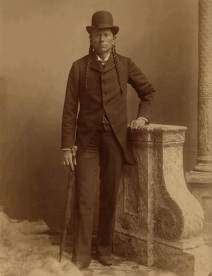
Quanah Parker stands as one of the larger Native Americans in Texas history. This photo puts a face to a reputation in Texas history textbooks. Texas teachers may want to be certain to get a copy of the photo. His life story includes so many episodes that seem to come out of a Native American version of Idylls of the King that a fiction writer could not include them all, were they not real.
Quanah’s mother was part of the famous Parker family that helped settle West Texas in the 1830s. Cynthia Ann Parker was captured in 1836 when Comanches attacked Fort Parker, near present-day Groesbeck, Texas, in Limestone County. (See Fort Parker State Park.) Given a new name, Nadua (found one), she assimilated completely with the Nocona band of Comanches, and eventually married the Comanche warrior Noconie (also known as Peta Nocona). Quanah was their first child, born in 1852.
Nadua was captured by a Texas party led by Lawrence Sullivan “Sul” Ross in 1860, in the Battle of Pease River. Noconie, Quanah, and most of the Nocona men were off hunting at the time, and the fact of Nadua’s capture was not realized for some time. Nadua asked to return to the Comanches and her husband, but she was not allowed to do so. When her youngest daughter, who had been captured with her, died of an infection, Nadua stopped eating, and died a few weeks later.
Sul Ross was a character in his own right. At the time he participated in the raid that recaptured Cynthia Parker, he was a student at Baylor University (“What do I do on summer breaks? I fight Indians.”) At the outbreak of the Civil War, Ross enlisted in the Confederate Army as a private. Over 135 battles and skirmishes he rose to the rank of Brigadier General, the ninth youngest in the Confederate Army. A successful rancher and businessman back in Texas after the war, he won election as governor in 1887, served two very successful terms (he resolved the Jaybird-Woodpecker War in Fort Bend County, and had to call a special session of the legislature to deal with a budget surplus), refused to run for a third term, and was named president of Texas Agricultural and Mechanical College (Texas A&M) within a few days of stepping down as governor. Ross’s leadership of the college is legendary — students put pennies near a statue of Ross in a traditional plea to pass final exams, among many other traditions. After his death, Texas created Sul Ross State University, in Alpine, Texas, in his honor.
Quanah Parker’s father, Noconie, died a short time after his mother’s capture. He left the Nocona band, joined the Destanyuka band under Chief Wild Horse, but eventually founded his own band with warriors from other groups, the Quahadi (“antelope eaters”) (also known as Kwahadi). The Quahadi band grew to be one of the largest and most notorious, always with Quanah leading them. The Quahadis refused to sign the 1867 Medicine Lodge Treaties, and so avoided immediate internment to a reservation. However, dwindling food supplies and increasing opposition forced Quanah to retire to a reservation in 1875, in what is now southwestern Oklahoma. This was the last Comanche band to come to the reservation.
Quanah was appointed Chief of all the Comanches.
Through investments, Quanah became rich — probably the richest Native American of his time.
Quanah hunted with President Theodore Roosevelt.
Quanah Parker in later life, as a successful businessman. Wikipedia image, public domain
Rejecting monogamy and Christianity, Quanah founded the Native American Church movement, which regards the use of peyote as a sacrament. Quanah had been given peyote by a Ute medicine man while recovering from wounds he’d suffered in battle with U.S. troops. Among his famous teachings: The White Man goes into his church and talks about Jesus. The Indian goes into his Tipi and talks with Jesus.
Bill Neeley wrote of Quanah Parker: “Not only did Quanah pass within the span of a single lifetime from a Stone Age warrior to a statesman in the age of the Industrial Revolution, but he never lost a battle to the white man and he also accepted the challenge and responsibility of leading the whole Comanche tribe on the difficult road toward their new existence.”
Quanah Parker died on February 23, 1911. He is buried at Fort Sill Cemetery, Oklahoma, next to his mother and sister.
Quanah Parker’s epitaph reads:
Resting Here Until Day Breaks
And Shadows Fall and Darkness Disappears is
Quanah Parker Last Chief of the Comanches
Born 1852
Died Feb. 23, 1911
You’ve got to love C-SPAN. Commercial television networks spend billions purchasing rights to be the sole broadcaster of sporting events, the Superbowl, the World Series, the NBA championships, the NCAA basketball championships, the Olympics.
What’s a money poor, creativity- and content-rich public affairs cable channel to do? Well, gee, there’s the bicentennial of Abraham Lincoln’s birth coming up in February 2009 . . .:
Note the site, set your video recorders (digital or not — just capture the stuff). C-SPAN plans monthly broadcasts on Lincoln and the times, plus special broadcasts on certain events — November 19, the 145th anniversary of the Gettysburg Address, for example.
Teachers, bookmark that site. Are you out for the summer? U.S. history teachers have a couple of months to mine those resources, watch the broadcasts, and watch and capture the archived videos, to prepare for bell-ringers, warm-ups, and lesson plans.
What will your classes do for the Lincoln Bicentennial? Will that collide with your plans for the Darwin bicentennial?
Spread the word; friends don't allow friends to repeat history.
This typewriter with a linotype keyboard arrangement was sold by the Empire Typefoundry, Buffalo. Very few of these machines were made and today their exact purpose is obscure. Possibly this kind of typewriter was intended for the small newspaper office where the editorial staff also operated the linotype.
(9.5 inches high)
The Linotype machine was the device that mechanically set the type to print the newspaper, generally a very large, noisy machine that mechanically assembled lead slugs of letters, and then cast a lead plate that could be used to print the page.
I wonder: Do you know of any linotype machines still in use?
Spread the word; friends don't allow friends to repeat history.
In New York this summer? You rather owe it to your grandchildren to go see the stadium, don’t you? Note this is the last year for Shea Stadium, too — better plan an extra day on that trip to the home office in Manhattan.
Confession: I’ve never been inside the stadium. Once, on a road trip to New York City, visiting a friend, Mark Wade, we parked in the shadow of the stadium. Oops — somebody didn’t lock one door. Two days in the City, parked in a tough neighborhood, with a door wide open, nothing happened to the car. There’s some magic in that ballpark.
I believe this is an excerpt from a NOVA tribute to Feynman, which has never been available commercially so far as I have found. Anybody know how to get a copy of the video?
Among other things, the piece included comments from some of Feynman’s closest friends, and it detailed their fascination with a tiny republic then inside of the Soviet Union, Tannu Tuva, which Feynman had determined to be the most obscure and difficult nation on Earth to travel to — and so, of course, he wanted to go. The place is known today as Tuva.
No denying the man his orange juice.
Spread the word; friends don't allow friends to repeat history.
Or, until that account is unsuspended by the forces supporting Donald Trump: Follow @FillmoreWhite, the account of the Millard Fillmore White House Library
We've been soaking in the Bathtub for several months, long enough that some of the links we've used have gone to the Great Internet in the Sky.
If you find a dead link, please leave a comment to that post, and tell us what link has expired.
Thanks!
Retired teacher of law, economics, history, AP government, psychology and science. Former speechwriter, press guy and legislative aide in U.S. Senate. Former Department of Education. Former airline real estate, telecom towers, Big 6 (that old!) consultant. Lab and field research in air pollution control.
My blog, Millard Fillmore's Bathtub, is a continuing experiment to test how to use blogs to improve and speed up learning processes for students, perhaps by making some of the courses actually interesting. It is a blog for teachers, to see if we can use blogs. It is for people interested in social studies and social studies education, to see if we can learn to get it right. It's a blog for science fans, to promote good science and good science policy. It's a blog for people interested in good government and how to achieve it.
BS in Mass Communication, University of Utah
Graduate study in Rhetoric and Speech Communication, University of Arizona
JD from the National Law Center, George Washington University


 Posted by Ed Darrell








 Millard Fillmore's Bathtub
