August 12, 2010
Earlier I found an idea I’ve not been able to incorporate into my classes, but which I still like: Take historic photos of your town, go to the same place today and see what it looks like.
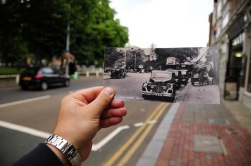
Students could do this: Comparing historic images with places today
A Russian photographer takes the exercise further, and creates sometimes-stunning art.
Sergey Larenkov has photos from Europe in World War II. He blends parts of those images with photos of the same places today, in cities across Europe. He has images from Berlin, Leningrad, and other cities (crawl over his LiveJournal site — there’s good stuff).

Sergey Larenkov, World War II historic photo overlay on modern shot - is this Leningrad? Whose soldiers, what year?

Sergey Larenkov work, the Siege of Leningrad, and Leningrad today (reverting to the name St. Petersburg)
Ghostly, no?
The photos show the destruction of war, and how far Europe has come since then. It’s an astounding view of history. If a picture is worth a thousand words, these photo mashups are worth ten thousand words or more.
Tip of the old scrub brush to Alices’ blog at My Modern Met.


Spread the word; friends don't allow friends to repeat history.
 6 Comments |
  Education, Famous Battles, History, History images, photography, War, World War II | Tagged: Education, Famous Battles, History, photography, Siege of Leningrad, Student projects, World War II |
  Permalink
 Posted by Ed Darrell
August 1, 2010

The world is still safe for fairness.

The world is still safe for fairness.
No resurrection of McCarthyism this year.
Tip of the old scrub brush to James. Photo of the grave of Sen. Joseph R. McCarthy, from Appleton, Wisconsin, copyright by James Darrell.
Spread the word; friends don't allow friends to repeat history.
5 Comments | History, History images, McCarthyism, Politics, U.S. Senate | Tagged: Cold War, History, History images, McCarthyism, Politics, Sen. Joe McCarthy, U.S. Senate | Permalink
Posted by Ed Darrell
July 25, 2010
Chamblee 54 carried this photo of President McKinley, the “last portrait” before his assassination the following day (there were other, later photos, but no later portraits). The picture was taken on the afternoon of September 5, 1901, in Buffalo, New York.
The photo comes from the American Memory Collection at the Library of Congress. It was taken by Francis Benjamin Johnston (1864-1952).
I am curious: Who are the other people in the photo, especially that tall guy?

Last portrait of President William McKinley
To the left of the photo, the fellow peeking out from between the dignified-looking woman and the guy with the really droopy, white walrus moustache, is the president of the Buffalo Exposition, John Milburn. Who is the woman? Who is the guy with the white moustache? Is there any chance the guy with the dark moustache to the right could be McKinley’s vice president, Theodore Roosevelt? (We should be able to figure out where Roosevelt was that day.) More likely, he’s George B. Cortelyou, later the first Secretary of Commerce and Labor.
People in the picture are: Left to right: Mrs. John Miller Horton, Chairwoman of the Entertainment Committee of the Woman’s Board of Managers; John G. Milburn; Senor Asperoz, the Mexican Ambassador; the President; George B. Courtelyou, the President’s secretary; Col. John H. Bingham of the Government Board.
More, including a larger version of the photo, below the fold.
Read the rest of this entry »
Spread the word; friends don't allow friends to repeat history.
11 Comments | Assassination, Gilded Age, History, History images, Presidents, Progressive Era | Tagged: Assassination, Buffalo, Gilded Age, historic photographs, History, Presidents, Progressive Era, William McKinley | Permalink
Posted by Ed Darrell
July 7, 2010

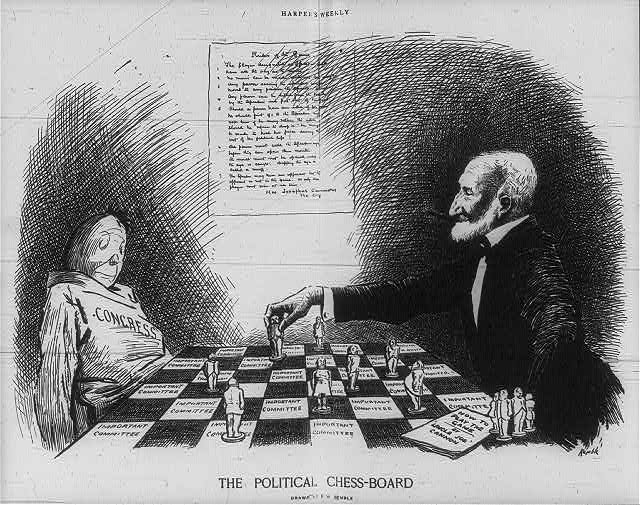
The Poltiical Chessboard, Harper's Magazine, February 5, 1910, by E. W. Kemble - Library of Congress image
Description from the Library of Congress:
Joseph Cannon playing chess with straw man labelled “Congress,” using toy men on chessboard with squares labelled “important committee” and “freak committee.”
Legendary House Speaker Joe Cannon — after whom the Cannon House Office Building is named — is remembered for the almost absolute power he held over the House of Representatives. Here’s the generic description at Wikipedia:

House Speaker Joseph G. Cannon - Wikimedia image, photo from October 1915
Cannon wielded the office of Speaker with unprecedented power. At the time of Cannon’s election the Speaker of the House concurrently held the chair of the Rules Committee, which determined under what rules and restrictions bills could be debated, amended, and voted on, and in some cases whether they would be allowed on the floor at all. As such, Cannon effectively controlled every aspect of the House’s agenda: Bills reached the floor of the house only if Cannon approved of it, and then in whatever form he determined—with he himself deciding whether and to what extent the measures could be debated and amended.
Cannon also reserved to himself the right to appoint not only the chairs of the various House committees, but also all of committees’ members, and (despite the seniority system that had begun to develop) used that power to appoint his allies and proteges to leadership positions while punishing those who opposed his legislation. Crucially, Cannon exercised these powers to maintain discipline within the ranks of his own party: the Republicans were divided into the conservative “Old Guard,” led by Cannon, and the progressives, led by President Theodore Roosevelt. His committee assignment privileges ensured that the party’s Progressive element was essentially powerless in the House, and his control over the legislative process obstructed progressive legislation.
Progressives wished to break Cannon’s ability to control so completely the flow of legislation. By early 1910, progressives in the Republican Party especially chafed under Cannon’s rule. Anxious for revolt, they struck on March 17, just a few weeks after this cartoon appeared.
On March 17, 1910, after two failed attempts to curb Cannon’s absolute power in the House, Nebraska Representative George Norris [of Nebraska] led a coalition of 42 progressive Republicans and the entire delegation of 149 Democrats in a revolt. With many of Cannon’s most powerful allies absent from the Chamber, but enough Members on hand for a quorum, Norris introduced a resolution that would remove the Speaker from the Rules Committee and strip him of his power to assign committees.
While his lieutenants and the House sergeant-at-arms left the chamber to collect absent members in attempt to rally enough votes for Cannon, the Speaker’s allies initiated a filibuster in the form of a point of order debate. When Cannon supporters proved difficult to find (many of the staunchest were Irish and spent the day at various St. Patrick’s Day celebrations), the filibuster continued for 26 hours, with Cannon’s present friends making repeated motions for recess and adjournment. When Cannon finally ruled the resolution out of order at noon on March 19, Norris appealed the resolution to the full House, which voted to overrule Cannon, and then to adopt the Norris resolution.
Cannon managed to save some face by promptly requesting a vote to remove him as Speaker, which he won handily since the Republican majority would not risk a Democratic speaker replacing him. However, his iron rule of the House was broken, and Cannon lost the Speakership when the Democrats won a majority later that same year.
Instead of the Speaker’s wishes, committee assignments and chairs were selected by a seniority system.
Cannon lost his seat representing Illinois in the progressive tide of 1912, but regained it in 1914, and served another four terms in the House, to 1922.
I have found no information on whether Cannon actually played chess.
Norris’s star was on the rise at the same time. Though he supported Theodore Roosevelt in the election of 1912, when Roosevelt bolted the Republican Party and ran as a Progressive or “Bullmoose Party” nominee for president, Norris stayed with the Republican Party and won election to the U.S. Senate in 1912.
Norris became an isolationist, and was one of six senators to vote against the declaration of war in 1917 that pushed the U.S. into World War I. Norris also opposed the Versailles Treaty, and played an important role in keeping the treaty from U.S. ratification. He supported Franklin Roosevelt’s New Deal Reforms a decade-and-a-half later, and one of the early dams of the Tennessee Valley Authority is named for him. Norris’s role in the New Deal, and in pushing progressive reforms well into the 20th century, is not fully appreciated, for example:
In 1932, along with Rep. Fiorello H. La Guardia, Norris secured passage of the Norris-La Guardia Act, which outlawed the practice of requiring prospective employees not to join a labor union as a condition of employment (the so-called yellow-dog contract) and greatly limited the use of court injunctions against strikes.
A staunch supporter of President Roosevelt’s New Deal programs, Norris sponsored the Tennessee Valley Authority Act of 1933. In appreciation, the TVA Norris Dam and a new planned city in Tennessee were named after him.[3][4] Norris was also the prime Senate mover behind the Rural Electrification Act that brought electrical service to under-served and unserved rural areas across the United States.
Switching to the Democratic Party in 1936 when the Republicans fell into the minority, Norris generally supported New Deal efforts but did not fear to oppose ideas he found unworthy, regardless their source or party connection. His opposition to President Franklin Roosevelt’s “court packing” plan helped smother the idea. Norris finally lost election in 1942. Norris is one of eight U.S. senators profiled in John F. Kennedy’s book, Profiles in Courage.
Spread the word; friends don't allow friends to repeat history.
2 Comments | Cartoons, Chess, History, History images, New Deal, Politics, Progressive Era, U.S. House of Representatives | Tagged: Cartoons, Chess, History, Politics, Progressive Era, Speaker Joseph Cannon, U.S. House of Representatives | Permalink
Posted by Ed Darrell
July 3, 2010

Bob Dylan at the chessboard, Woodstock, New York, 1964 – low resolution version of the original photo, copyright by Daniel Kramer – Barbara Archer Galleries
A good decade before I got to Woodstock.
Daniel Kramer began photographing Bob Dylan early in Dylan’s career, making many of the best shots available.
This 1964 photo of Dylan playing chess in Woodstock, New York, featured in an exhibition of Kramer’s photographs put on by Barbara Archer Galleries in 2005.
From the exhibit’s biography of Kramer:
Daniel Kramer is a New York-based photographer and film director who is long recognized for his portraits and picture stories in national and international magazines and books. Shortly after opening his first studio in New York City, Daniel Kramer saw Bob Dylan perform The Lonesome Death of Hattie Carroll on television in 1964. Even after the show ended, Kramer couldn’t shake the image of Dylan from his mind. “I was completely taken by what this man had done and how he had done it. His performance was perfect. With simple, basic tools – his voice, a guitar, and a harmonica, he drove his message deep into my mind. I was aware that I was seeing a very important talent.”
In August 1964, after months of phone calls and letters to Dylan’s manager, Albert Grossman, Kramer was given the opportunity to arrange a portrait sitting in Woodstock, New York with the twenty-three-year old performer who was by then in the process of becoming an international star. The two men quickly developed a warm and trusting professional relationship that allowed for many extraordinary photographic sessions. “Photography has brought me into contact with many notable people, including Presidents of the United States, and I have happily had the opportunity to meet and talk with prominent people in all walks of life,” comments Kramer. “Although many of these encounters were memorable, my association with Dylan has a special meaning.”
Many of these photographs were first published in Kramer’s 1967 book bob dylan, the first major work about the performer-songwriter (reprinted as Bob Dylan: A Portrait of the Artist’s Early Years, 2001). They were also used on the album covers for Highway 61 Revisited (1965), Biograph (1985) and Bringing It All Back Home (1965), which was nominated for a Grammy and selected by Rolling Stone as one of the “100 Greatest Album Covers of All Time.” A number of rare and previously unpublished pictures by Kramer also appear in the 52-page booklet and packaging that accompanies Bob Dylan’s two-CD set, Live 1964: Concert at Philharmonic Hall – The Bootleg Series, Volume 6 (2004) and on the cover of a three-CD boxed set BOB DYLAN the collection (2004).
Daniel Kramer’s photographs have also been exhibited or collected by such museums as the Whitney Museum of American Art, The International Center of Photography in New York, The Smithsonian’s National Portrait Gallery in Washington, D.C., The Experience Music Project in Seattle, The Rock and Roll Hall of Fame and Museum in Cleveland, and in numerous national and international galleries.
An interesting three-way marriage of the young Bob Dylan, a great photographer in Daniel Kramer, and one of the world’s oldest and most respected games of skill, chess. Go see all the photos.
More:
Spread the word; friends don't allow friends to repeat history.
6 Comments | Art, Chess, History, History images, Music, photography | Tagged: Art, Barbara Archer Galleries, Bob Dylan, Chess, Daniel Kramer, History, Music, photography | Permalink
Posted by Ed Darrell
June 20, 2010

Sarah Bernhardt, in fur, selling newspapers in Salt Lake City, March 28, 1913 - Utah Historical Society image
Just get the most famous actress in the world to hawk the newspaper on the street.
In this photo Sarah Bernhardt sells newspapers to a group of men in the street in Salt Lake City (probably State Street, but perhaps Main Street; I have not identified the building behind her in the photograph). The photograph is from the Shipler Company Collection at the Utah Historical Society.
In 1913, Bernhardt was in the early autumn of her career, with several movies but not many plays in front of her. She had lost a leg to gangrene from a badly-treated broken knee in 1905 (in Rio), but still acted in plays that she produced herself, and in movies.
The photo is dated 1913. Bernhardt conducted a tour of the U.S. in 1915. One may wonder if the date was misread from a handwritten note.
I wonder: Who are other people in the photo?
Spread the word; friends don't allow friends to repeat history.
1 Comment | History, History images, Newspapers, photography, Utah | Tagged: History, Newspapers, Photographs, Sarah Bernhardt, Utah, Utah Historical Society | Permalink
Posted by Ed Darrell
June 16, 2010

Troop 1, Brownsville, Texas, May 20, 1916 - photo by Robert Runyon (The Center for American History and General Libraries, University of Texas at Austin; via American Memory, Library of Congress)
On June 15, 1916, President Woodrow Wilson signed the law granting a national charter to the Boy Scouts of America, which had been incorporated six years earlier. The charter is now encoded at 36 USC 309.
The purposes of the corporation are to promote, through organization, and cooperation with other agencies, the ability of boys to do things for themselves and others, to train them in scoutcraft, and to teach them patriotism, courage, self-reliance, and kindred virtues, using the methods that were in common use by boy scouts on June 15, 1916.
Good goals then, good goals now — maybe more important now.
Have you volunteered to be a leader?
Resources (and councils where I’ve Scouted and volunteered):
- National Council, Boy Scouts of America (BSA)
- Circle 10 Council, BSA (Dallas area)
- Wisdom Trail District (part of Circle 10, for Southwest Dallas County)
- Utah National Parks Council, BSA (Utah, south of Salt Lake County) (where I did most of my Scouting)
- National Capital Area Council, BSA (Washington, D.C. area) (where I was a Cubmaster)
- Great Salt Lake Council, BSA
- Snake River Council, BSA (serving the Magic Valley of Idaho, including Burley)
- BeAScout.org (help in finding a unit to join — but with a few glitches right now!)
- Troop 355, Duncanville, Texas (First Christian Church, Disciples of Christ, of Duncanville)
Tip of the old scrub brush to the Bill of Rights Institute on Facebook.

Click here for a larger view of the Troop 1 of Brownsville, Texas, in 1916
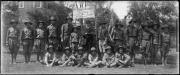
Click here for a larger view of a second photo of Troop 1 of Brownsville, Texas, in 1916
Spread the word; friends don't allow friends to repeat history.
1 Comment | Boy Scouts of America, History, History images, photography | Tagged: Boy Scouts of America, Circle 10 Council, History, History images, photography, Scouting's National Charter, Wisdom Trail District, Woodrow Wilson | Permalink
Posted by Ed Darrell
June 14, 2010
From the digital collections at the Library of Congress:

Boy Scout wreath, 1924 - Library of Congress Digital Collection, National Photo Company Collection (Call Number: LC-F8- 28581 (P&P))
Three Boy Scouts and a wreath with the BSA’s fleur de lis, in 1924. Who are the Scouts? What was the occasion? Questions we have in the centennial year of Boy Scouting.
This photo is in the middle of a collection of photos taken at the funeral of President Woodrow Wilson, which was on February 6, 1924. Was this the Boy Scouts’ tribute to Wilson? By the way, Wilson is the only president interred in the District of Columbia (Arlington National Cemetery is across the Potomac River, in Virginia). Wilson’s sarcophagus in in the main chapel of the National Cathedral.

Woodrow Wilson's tomb in the National Cathedral, Washington, D.C. - Wikimedia image
Spread the word; friends don't allow friends to repeat history.
Leave a Comment » | Boy Scouts of America, History, History images, Libraries, photography | Tagged: 1924, Boy Scouts, History, History images, Library of Congress, photography, Scouting Centennial | Permalink
Posted by Ed Darrell
June 14, 2010
June 14th marks the anniversary of the resolution passed by the Second Continental Congress in 1777, adopting the Stars and Stripes as the national flag.
Fly your flag today. This is one of the score of dates upon which Congress suggests we fly our flags.

Flag Day 1916, parade in Washington, D.C. - employees of National Geographic Society march - photo by Gilbert Grosvenor
The photo above drips with history. Here’s the description from the National Geographic Society site:
One hundred and fifty National Geographic Society employees march in the Preparedness Parade on Flag Day, June 14, in 1916. With WWI underway in Europe and increasing tensions along the Mexican border, President Woodrow Wilson marched alongside 60,000 participants in the parade, just one event of many around the country intended to rededicate the American people to the ideals of the nation.
Not only the anniversary of the day the flag was adopted by Congress, Flag Day is also the anniversary of President Dwight Eisenhower’s controversial addition of the words “under God” to the Pledge of Allegiance in 1954.
(Text adapted from “:Culture: Allegiance to the Pledge?” June 2006, National Geographic magazine)
The first presidential declaration of Flag Day was 1916, by President Woodrow Wilson. Wilson won re-election the following November with his pledge to keep America out of World War I, but by April of 1917 he would ask for a declaration of war after Germany resumed torpedoing of U.S. ships. The photo shows an America dedicated to peace but closer to war than anyone imagined. Because the suffragettes supported Wilson so strongly, he returned the favor, supporting an amendment to the Constitution to grant women a Constitutional right to vote. The amendment passed Congress with Wilson’s support and was ratified by the states.
The flags of 1916 should have carried 48 stars. New Mexico and Arizona were the 47th and 48th states, Arizona joining the union in 1913. No new states would be added until Alaska and Hawaii in 1959. That 46-year period marked the longest time the U.S. had gone without adding states, until today. No new states have been added since Hawaii, more than 49 years ago. (U.S. history students: Have ever heard of an essay, “Manifest destiny fulfilled?”)
150 employees of the National Geographic Society marched, and as the proud CEO of any organization, Society founder Gilbert H. Grosvenor wanted a photo of his organization’s contribution to the parade. Notice that Grosvenor himself is the photographer.
I wonder if Woodrow Wilson took any photos that day, and where they might be hidden.
History of Flag Day from a larger perspective, from the Library of Congress:
Since 1916, when President Woodrow Wilson issued a presidential proclamation establishing a national Flag Day on June 14, Americans have commemorated the adoption of the Stars and Stripes by celebrating June 14 as Flag Day. Prior to 1916, many localities and a few states had been celebrating the day for years. Congressional legislation designating that date as the national Flag Day was signed into law by President Harry Truman in 1949; the legislation also called upon the president to issue a flag day proclamation every year.
According to legend, in 1776, George Washington commissioned Philadelphia seamstress Betsy Ross to create a flag for the new nation. Scholars debate this legend, but agree that Mrs. Ross most likely knew Washington and sewed flags. To date, there have been twenty-seven official versions of the flag, but the arrangement of the stars varied according to the flag-makers’ preferences until 1912 when President Taft standardized the then-new flag’s forty-eight stars into six rows of eight. The forty-nine-star flag (1959-60), as well as the fifty-star flag, also have standardized star patterns. The current version of the flag dates to July 4, 1960, after Hawaii became the fiftieth state on August 21, 1959.
Fly your flag with pride today.

Elmhurst Flag Day 1939, DuPage County Centennial - Posters From the WPA
Elmhurst flag day, June 18, 1939, Du Page County centennial / Beauparlant.
Chicago, Ill.: WPA Federal Art Project, 1939.
By the People, For the People: Posters from the WPA, 1936-1943
This is an encore post, from June 14, 2009
Spread the word; friends don't allow friends to repeat history.
1 Comment | Flag etiquette, Fly your flag today, Historic documents, History, History images, Patriotism, Pledge to the flag, World War I | Tagged: Flag Day, Flag etiquette, Fly your flag today, Historic Images, History, June 14, Library of Congress, Patriotism, Posters, World War I | Permalink
Posted by Ed Darrell
June 6, 2010
Encore posts:

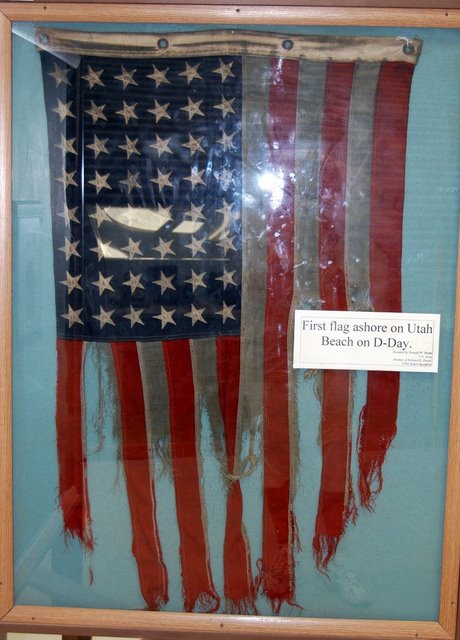
First U.S. flag on Utah Beach, Normandy, D-Day, June 6, 1944; Pima Air Museum, Tucson, Arizona
This mostly an encore post. A reader sent an e-mail with a question: Does U.S. law suggest the flying of the U.S. flag on the anniversary of D-Day?
Today is the 66th anniversary of the Invasion of Normandy in World War II, a date generally called D-Day. No, you don’t have to fly your flag. This is not one of the days designated by Congress for flag-flying.
But you may, and probably, you should fly your flag. If you have any D-Day veterans in your town, they will be grateful, as will their spouses, children, widows and survivors. A 22-year-old soldier on the beach in 1944 would be 87 today, if alive. These men and their memories of history fade increasingly fast. Put your flag up. You may be surprised at the reaction.
If you do run into a D-Day veteran, ask him about it. Keep a record of what he says.

"First Wave at Omaha: The Ordeal of the Blue and the Gray" by Ken Riley: Behind them was a great invasion armada and the powerful sinews of war. But in the first wave of assault troops of the 29th (Blue and Gray) Infantry Division, it was four rifle companies landing on a hostile shore at H-hour, D-Day -- 6:30 a.m., on June 6, 1944. The long-awaited liberation of France was underway. After long months in England, National Guardsmen from Virginia, Maryland and the District of Columbia found themselves in the vanguard of the Allied attack. In those early hours on the fire-swept beach the 116th Infantry Combat Team, the old Stonewall Brigade of Virginia, clawed its way through Les Moulins draw toward its objective, Vierville-sur-Mer. It was during the movement from Les Moulins that the battered but gallant 2d Battalion broke loose from the beach, clambered over the embankment, and a small party, led by the battalion commander, fought its way to a farmhouse which became its first Command post in France. The 116th suffered more than 800 casualties this day -- a day which will long be remembered as the beginning of the Allies' "Great Crusade" to rekindle the lamp of liberty and freedom on the continent of Europe. Image from National Guard Heritage series, from which the caption was borrowed.
 [Encore post from 2007.]
Soldiers, Sailors, and Airmen of the Allied Expeditionary Force: You are about to embark upon the Great Crusade, toward which we have striven these many months. The eyes of the world are upon you.
Order of the Day, 6 June, 1944 (some sources list this as issued 2 June)
mmm
Spread the word; friends don't allow friends to repeat history.
3 Comments | D-Day, Famous Battles, Famous quotes, Historic documents, History, History images, World War II | Tagged: D-Day, Dwight Eisenhower, Famous Battles, Famous quotes, History, History images, June 6 1944, World War II | Permalink
Posted by Ed Darrell
June 5, 2010
Minor mystery, but still, it nags.
Who is the woman in this photo? This is a chance to play history detective.

Utah Sen. Arthur V. Watkins, Sec. of Agriculture Ezra Taft Benson, and President Dwight D. Eisenhower, with unidentified woman, on September 9, 1958. Photo by Shipler Commercial Photography, scanned at Marriott Library from the collection of the Utah Historical Society (which holds the rights).
I stumbled across the photo at the on-line archives of the Utah Historical Society. At the time of this picture, Watkins was running for re-election in a race he would lose in November, in a three-way vote split, to Democrat Frank E. Moss. Watkins had run afoul of very conservative Utah politics when he chaired the Senate select committee that investigated Sen. Joseph McCarthy, and recommended censure of McCarthy.
Ezra Taft Benson served as Eisenhower’s Secretary of Agriculture for the full eight years of Eisenhower’s administration. Benson was an arch conservative, closely affiliated with the extreme right-leaning John Birch Society, which officially regarded Eisenhower as a bit of a traitor. Benson later served as President of the Church of Jesus Christ of Latter-day Saints (LDS, or Mormon).
Oddly, the picture doesn’t identify the woman. She’s in a wheel chair. The large stone columns suggest this is a government building, or monument. The microphone is set at the level of the woman, so obviously she was speaking at this event, whatever it was. In an election year, such a scene might be played out in the state of the election, Utah — but I suspect it was a Washington, D.C., venue (was Eisenhower in Utah in 1958?). Shipler Photography was a Utah company, though — what would they be doing in Washington?
Who is that woman? What was the event? Where was it?
_______________
Update: Best guess so far: Louise Lake, a polio victim from Salt Lake City, and “handicapped American of the year” for 1958. See comments.
Spread the word; friends don't allow friends to repeat history.
5 Comments | Author query, Dwight Eisenhower, History, History images, Politics, Presidents | Tagged: Historic Photos, History, History images, President Eisenhower, Sec. of Agriculture Ezra Taft Benson, Sen. Arthur V. Watkins | Permalink
Posted by Ed Darrell
June 2, 2010
English colonists, and then citizens of the new United States of America, regarded Native Americans as foreign groups, people of other lands. It’s part of a history of bad relations and bad faith between peoples on this continent that we gloss over with the good relations and good faith.
The whole story is important. It’s been told, and told well, at the Library of Congress:
On June 2, 1924, Congress enacted the Indian Citizenship Act, which granted citizenship to all Native Americans born in the U.S. The right to vote, however, was governed by state law; until 1957, some states barred Native Americans from voting. In a WPA interview from the 1930s, Henry Mitchell describes the attitude toward Native Americans in Maine, one of the last states to comply with the Indian Citizenship Act:
One of the Indians went over to Old Town once to see some official in the city hall about voting. I don’t know just what position that official had over there, but he said to the Indian, ‘We don’t want you people over here. You have your own elections over on the island, and if you want to vote, go over there.
‘”The Life of Henry Mitchell,”
Old Town, Maine,
Robert Grady, interviewer,
circa 1938-1939.
American Life Histories, 1936-1940

Native Americans During Mathematics Class at Indian School, Carlisle, Pennsylvania
Native Americans During Mathematics Class, (detail)
Indian School, Carlisle, Pennsylvania,
Frances Benjamin Johnston, photographer, 1903.
Prints and Photographs Division
Previously, the Dawes Severalty Act (1887) had shaped U.S. policy towards Native Americans. In accordance with its terms, and hoping to turn Indians into farmers, the federal government redistributed tribal lands to heads of families in 160-acre allotments. Unclaimed or “surplus” land was sold, and the proceeds used to establish Indian schools where Native-American children learned reading, writing, and the domestic and social systems of white America. By 1932, the sale of both unclaimed land and allotted acreage resulted in the loss of two-thirds of the 138 million acres that Native Americans had held prior to the Dawes Act.
In addition to the extension of voting rights to Native Americans, the Secretary of the Interior commission created the Meriam Commission to assess the impact of the Dawes Act. Completed in 1928, the Meriam Report described how government policy oppressed Native Americans and destroyed their culture and society.
The poverty and exploitation resulting from the paternalistic Dawes Act spurred passage of the 1934 Indian Reorganization Act. This legislation promoted Native-American autonomy by prohibiting allotment of tribal lands, returning some surplus land, and urging tribes to engage in active self-government. Rather than imposing the legislation on Native Americans, individual tribes were allowed to accept or reject the Indian Reorganization Act. From 1934 to 1953, the U.S. government invested in the development of infrastructure, health care, and education, and the quality of life on Indian lands improved. With the aid of federal courts and the government, over two million acres of land were returned to various tribes.
American Indians of the Pacific Northwest

Salish Man Named Paul Challae and Small Child,
Montana,
date unknown.

Salish Man and Woman Sitting on Rocks, Montana (?) (date unknown.)
Salish Man and Woman Sitting on Rocks,
Montana [?],
date unknown.

Salish Woman and Children
Salish Woman and Children,
St. Ignatius Mission, Montana.
1924.
American Indians of the Pacific Northwest integrates over 2,300 photographs and 7,700 pages of text relating to Native Americans of two cultural areas of the Pacific Northwest. Many aspects of life and work — including housing, clothing, crafts, transportation, education, and employment, are illustrated in this collection drawn from the extensive holdings of the University of Washington Libraries, the Cheney Cowles Museum/Eastern Washington State Historical Society, and the Museum of History and Industry in Seattle.
- Listen to Native American music. Omaha Indian Music features traditional Omaha music from the 1890s and 1980s. The multiformat ethnographic field collection contains 44 wax cylinder recordings collected by Francis La Flesche and Alice Cunningham Fletcher between 1895 and 1897, 323 songs and speeches from the 1983 Omaha harvest celebration pow-wow, and 25 songs and speeches from the 1985 Hethu’shka Society concert at the Library of Congress. Search by keyword or browse the list of recorded music.
- View photographs documenting Native American life in the 1930s and 1940s. Search the collection, America from the Great Depression to World War II: Photographs from the FSA and OWI, ca. 1935-1945 on reservation or Indian.
- George Washington Papers, 1741-1799 includes many references to Indian treaties and rights; to explore this aspect of Washington’s correspondence, search the collection on Indian rights and Indian treaties.
- Words and Deeds in American History contains three features highlighting aspects of Native American history in the Northern and Central U.S.
- Search the Today in History archive on Native American to read additional features including pages on Jim Thorpe, the Cherokee chief John Ross, the Paiute writer and translator Sarah Winnemucca, and the Wounded Knee Massacre.
- Photographs from the Chicago Daily News includes images of Native Americans.
- Edward S. Curtis’s The North American Indian: Photographic Images collection portrays the traditional customs and lifeways of eighty Indian tribes.
- The History of the American West, 1860-1920: Photographs from the Collection of the Denver Public Library includes images of Native Americans from more than forty tribes living west of the Mississippi River.
And doesn’t that just frost the tar out of the birthers? Herbert Hoover just five years later chose Charles Curtis to be his vice presidential candidate, and Curtis served for four years. Curtis, born in the Kansas Territory before it was a state, came from Native American ancestry.
Spread the word; friends don't allow friends to repeat history.
3 Comments | American Indians, Citizenship, Civil Rights, History, History images, Human Rights, Native Americans | Tagged: 1924, American Indians, Calvin Coolidge, Citizenship, Civil Rights, History, Human Rights, Library of Congress, Native Americans, U.S. history | Permalink
Posted by Ed Darrell
March 19, 2010
You’ve read the health care reform bill, and you didn’t find any creeping socialism in it, nor did you find any little Joe Stalins hiding in Section 34, nor anywhere else.
How could people make such bizarre, outlandish claims?
It’s historic, really.

Keep America Committee flyer, 1955 - courtesy of Alex Massie
That’s right! Good mental health is anathema to conservative Republicans!
Spread the word; friends don't allow friends to repeat history.
5 Comments | Health care, Historic documents, History images, McCarthyism, Political Smear, Politics, Red Scare, Socialism | Tagged: Health Care Reform, History, Keep America Committee, McCarthyism, Mental Health Care, Polio Vaccine, Political Smear, Red Scare, Water Fluoridation | Permalink
Posted by Ed Darrell
February 22, 2010

1865 – Lincoln’s funeral procession; Passing the (Cornelius) Roosevelt Mansion, sw corner 14th Street, Broadway, view looking North on Broadway – Flickr image from Stratis
See the house on the corner, at the left? Look at the second story, at the window on the side of the house facing the camera. Is that young Theodore Roosevelt watching Lincoln’s funeral procession?
Stratis, who posted this photo at Flickr, added the note at that window:
6 year old, Theodore Roosevelt watches Abraham Lincoln’s funeral procession from an upstairs window of his grandfather, Cornelius Roosevelt’s mansion on Union Square with his younger brother Elliott and a friend. Teddy lived at 28 East 20th Street.
Is that accurate? Is that his grandfather’s house? I assume that it is not 28 East 20th Street, which is where he was born and the house of his father.
A timeline of TR’s life said he watched the passing funeral entourage:
- 1865 – Watches Abraham Lincoln’s funeral procession from an upstairs window of his grandfather’s house on Union Square, New York City. With him are his younger brother Elliott and a friend named Edith Kermit Carow.
Interesting intersection of history. This would probably be the only meeting of Theodore Roosevelt and Abraham Lincoln, though Teddy almost certainly knew Lincoln’s sole surviving son, Robert, pretty well. Both were in Buffalo when William McKinley was assassinated; Robert Lincoln, having lived through his father’s assassination, and then been present at the assassinations of James Garfield and McKinley, declined an invitation to Roosevelt’s inauguration in 1905, not wishing to extend one of the oddest bad luck streaks ever imaginable.
Can you add details about the photo?
More:
- Lincoln Highway News said the photo is now held by the New York Historical Society; also, the house of Theodore Roosevelt’s grandfather is gone
- Harper’s Weekly of May 13, 1865, featured a lengthy story on the aftermath of the assassination, the new President Andrew Johnson, events at the end of the civil war and an engraving of the funeral procession in New York City; see and read it at Son of the South.
- A stereographic version of the photo above can be seen at About.com
- Mrs. Lincoln could not say “no” most requests made of her in the days and weeks after the assassination. Many American cities asked to hold services while the body of Lincoln was on its way from Washington, D.C., to Springfield, Illinois. Consequently, astoundingly, there were 13 funeral services held for the dead president, including Baltimore, Philadelphia, New York City, Albany and Buffalo, New York; Cleveland, Columbus, Indianapolis, Michigan City (Indiana) (unscheduled), and Chicago, before the final service and interment in Springfield.
- October 29, 2013: Yes, Reddit readers, it is almost certain that one of those two people in the window is the young Teddy Roosevelt. See Mr. Sloan’s comment below.
Spread the word; friends don't allow friends to repeat history.
11 Comments | 1861-1865, Abraham Lincoln, Assassination, Historic documents, History, History images, photography, Presidents, Theodore Roosevelt | Tagged: 1861-1865, Abraham Lincoln, Assassination, Civil War, historic photographs, History, Lincoln's Funeral Procession, New York City, Presidents, Theodore Roosevelt | Permalink
Posted by Ed Darrell
February 8, 2010
In honor of Scouting’s 100 years in the U.S., I call your attention to the stained glass window in Trinity Episcopal Church in Torrington, Connecticut, The Boy Scout Window:
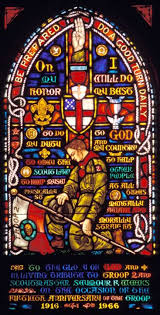
Described at the church’s website:
This is one of Trinity’s most well-known windows.
It was dedicated on Boy Scout Sunday, 13 February 1966, a service of Morning Prayer that began with the hymn “We Thank You, Lord of Heaven.” The window was given “to the Glory of God and in living tribute to Troop 2 and Seymour F. Weeks on the 50th anniversary of the Troop, 1916-1966.”
Mr. Weeks had been scoutmaster of Troop 2 since 1934 and would continue to lead the troop until his death in 1967.
Troop 2 produced Torrington’s first Eagle Scout, Paul Pfistner, whose family donated another window at Trinity Church.
Behind the kneeling scout with the flag is the seal of the Episcopal Church and above that a hand raised in the scout hand sign. Flanking the Episcopal seal are the emblems of the First Class Scout and the Eagle Scout badge. The words of the Boy Scout oath form the background. The border is composed of ropes showing some of the knots Scouts must learn. In between the ropes are two of the Scout’s mottoes: Do a Good Turn Daily, and Be Prepared.
Obviously, this window does not follow the architect’s pictorial plan for a window here showing the Holy Family with Jesus as a child.
Although several of Trinity’s windows were made by Len Howard of Kent, CT, one of Mr. Howard’s former associates is nearly positive this window was not made by Mr. Howard. However, a current parishioner’s great uncle, who was on the vestry in 1966, recalls that the church was dealing with an artist in Kent, CT, and there were no other stained glass artists in Kent except for Len Howard. Until further proof one way or another, this window will be attributed to Len Howard of Kent.
To the best of my searching, Troop 2 appears to have vanished from Torrington.
Spread the word; friends don't allow friends to repeat history.
8 Comments | Art, Boy Scouts of America, History, History images, Stained Glass | Tagged: Boy Scout Window, Boy Scouts of America, Stained Glass, Torrington Connecticut, Trinity Episcopal Church, Troop 2 | Permalink
Posted by Ed Darrell







 Millard Fillmore's Bathtub