No, not current senators — don’t get your ignoble hopes up.
With more than 40,000 photographs and other images, the Senate Historical Office has images of almost all people who have served as members of the U.S. Senate. 5o members are completely absent from the Senate collection, however.
Got any idea where to find images of these guys? This comes from the Senate Historical Office:
Senators Not Represented in Senate Historical Office Photo Collection
The Senate Historical Office maintains a collection of more than 40,000 still pictures, slides, and negatives. The collection includes photographs and illustrations of most former senators, but to date no photo or other illustration of about fifty members has been found. Below is a list (by state) of U.S. Senators for whom we have no image in our collection. If you have an image, or information that may lead us to an image, please contact the Senate’s photo historian.
You just know that somewhere out there, a local museum has a painting of one of these guys. Or, someone has a painting or drawing of an old-timey guy hanging over a fireplace, a family heirloom that features one of these guys. I mean, how could a guy like Outerbridge Horsey fail to inspire an artist somewhere?
High school sophomores in Texas study world history, and juniors study U.S. history. At 16 and 17 years old, they have difficulty figuring out the fuss over the Berlin Wall. It’s just pictures in their textbook.
The Wall was already three or four years gone when they were born. They don’t remember living with the Soviet Union at all — it’s been Russia to them for their entire lives.
I have some hopes that the celebrations set for this week will aid their understanding, on the 20th anniversary of the breaching and destruction of the wall.
Caption from CBC: "Dominoes are placed where the Berlin Wall once stood in front of the Brandenburg Gate in the German capital. (Herbert Knosowski/Associated Press)"
About 1,000 plastic foam dominoes will fall to the ground Monday along the route where the Berlin Wall once stood to mark the 20th anniversary of the crumbling of the Cold War barrier.
The 2.3-metre-high blocks, painted by schoolchildren, stretch for 1.5 kilometres in a path near the Brandenburg Gate and the German parliament.
Former Polish leader Lech Walesa, whose pro-democracy movement Solidarity played a key role in ending communism in Eastern Europe, will tip the first domino at 8 p.m. local time.
I made one visit to the wall, late on a night in 1988. American Airlines explored the possibility of taking over the service authorized from Munich to Berlin. Soviet and East German rules required passenger flights to stay at a very uncomfortable 10,000 feet. Pan Am had the route, but Pan Am was in trouble. We spent a day with Berlin airport authorities and real estate agents trying to figure out how to set up a reservations office and other ground facilities. European airports tended to force foreign carriers to share gate facilities, which was a problem, and we devoted a lot of time to gathering data for computer lines.
But then, after a smashing dinner of sausage and German-style potatoes in a great, small Berlin pub, we talked our taxi driver into giving us a tour of the wall. He drove a spot near the Brandenburg gate, and there on a chain link fence keeping westerners from the wall were eight fresh wreaths. Eight people had died trying to cross from East Berlin to West Berlin in the previous six months. One wreath for each death.
Just over a year later, the Berlin Wall itself would be gone.
West Berlin acted much like a normal, western European city. But the wall was there as a constant reminder of the oppression on the other side, a dull fog to constantly dim even the sunniest day.
Old posts on the Berlin Wall here at the bathtub are suddenly popular — usually they get a lot of hits after March when U.S. schools get to the post-World War II era, the Cold War and the Berlin airlift. I imagine the current popularity has something to do with the anniversary.
I hope somebody has some great video of the dominoes toppling.
Dominoes acerbicly note the irony: While the U.S. feared nations would fall under communism in a “domino effect,” especially in Southeast Asia (Indochina), communism broke up in a domino effect, as one communist-dominated country after another found freedom near the end of the Cold War. Why has no one done a serious essay on the domino effect of freedom?
From “Whose father was he?” a four-part essay on tracking down the story of three children whose photograph was discovered on the corpse of a Union soldier killed at the Battle of Gettysburg, in 1863:
Perhaps more than any other artifact, the photograph has engaged our thoughts about time and eternity. I say “perhaps,” because the history of photography spans less than 200 years. How many of us have been “immortalized” in a newspaper, a book or a painting vs. how many of us have appeared in a photograph [32]? The Mayas linked their culture to the movements of celestial objects. The ebb and flow of kingdoms and civilizations in the periodicities of the moon, the sun and the planets. In the glyphs that adorn their temples they recorded coronations, birth, deaths. Likewise, the photograph records part of our history. And expresses some of our ideas about time. The idea that we can make the past present.
The photograph of Amos Humiston’s three children — of Frank, Alice and Fred — allows us to imagine that we have grasped something both unique and universal. It suggests that the experience of this vast, unthinkable war can be reduced to the life and death of one man — by identifying Gettysburg’s “Unknown Soldier” we can reunite a family. That we can be saved from oblivion by an image that reaches and touches people, that communicates something undying and transcendent about each one of us.
And the footnote, number 32:
[32] I had an opportunity to visit the fossil collections at the Museum of the Rockies in Bozeman, Montana. It was part of a dinosaur fossil-hunting trip with Jack Horner, the premier hunter of T-Rex skeletons. Downstairs in the lab, there was a Triceratops skull sitting on a table. I picked it up and inserted my finger into the brain cavity. (I had read all these stories about how small the Triceratops brain had to have been and I wanted to see for myself.) I said to Jack Horner, “To think that someday somebody will do that with my skull.” And he said, “You should be so lucky. It’s only the privileged few of us who get to be fossils.”
See Errol Morris’s whole series, “Whose father was he?” at the New York Times blogs:
Yesterday, October 9, was the Feast Day of St. Denis.
Who? He’s the patron saint of Paris (and France, by some accounts), and possessed people. Take a look at this statue, from the “left door” of the Cathedral of Notre Dame in Paris (Cathédrale Notre-Dame de Paris: portail de gauche). He was martyred by beheading, in about 250 C.E.
St. Denis, patron saint of Paris and possessed people, greets visitors to the Notre Dame Cathedral. Wikimedia image, by Urban
According to the Golden Legend, after his head was chopped off, Denis picked it up and walked two miles, preaching a sermon the entire way.[6] The site where he stopped preaching and actually died was made into a small shrine that developed into the Saint Denis Basilica, which became the burial place for the kings of France. Another account has his corpse being thrown in the Seine, but recovered and buried later that night by his converts.[2]
Clearly, he is the guy to pray to about Michelle Bachmann, Rush Limbaugh, intelligent design, and the Texas State Board of Education, no? You catch my drift, you can use this factoid to some advantage, enlightenment, and perhaps humor.
As Rod Stewart sang, just “let your imagination run wild.” Maybe St. Denis is listening.
Spread the word; friends don't allow friends to repeat history.
Hidalgo himself was captured by the Spanish in 1811, and executed.
Statue of Father Hidalgo in Dolores, Mexico.
It’s a great story. It’s a good speech, what little we have of it (Hidalgo used no text, and we work from remembered versions).
Why isn’t there a good 10- to 15-minute video on the thing for classroom use? Get a good actor to do the speech, it could be a hit. Where is the video when we need it?
Update for 2008: Glimmerings of hope on the video front: Amateur videos on YouTube provide some of the sense of what goes on in modern celebrations.
The Grito de Dolores (“Cry of/from Dolores”) was the battle cry of the Mexican War of Independence, uttered on September 16, 1810, by Miguel Hidalgo y Costilla, a Roman Catholic priest from the small town of Dolores, near Guanajuato, Mexico.
“My Children, a new dispensation comes to us today…Will you free yourselves? Will you recover the lands stolen 300 years ago from your forefathers by the hated Spaniards? We must act at once.”
Although many mistakenly attribute the Cinco de Mayo holiday as the celebration of Mexican independence, Sept. 16 was the day the enthusiastic Indian and mestizo congregation of Hidalgo’s small Dolores parish church took up arms and began their fight for freedom against Spain.
Portals to the World contains selective links providing authoritative, in-depth information about the nations and other areas of the world. Resources on Mexico include information on the country’s history, religion, culture and society to name a few.
September is also a notable month for Hispanic culture with the celebration of Hispanic Heritage Month Sept 15 – Oct. 15. Sept. 15 is significant because it is the anniversary of independence for Latin American countries Costa Rica, El Salvador, Guatemala, Honduras and Nicaragua. In addition to Mexico’s independence day on Sept. 16, Chile recognizes its independence day Sept.18. Also, Columbus Day or Día de la Raza, which is Oct. 12, falls within this 30-day period.
The theme for the 2009 Hispanic Heritage Month is “Embracing the Fierce Urgency of Now!” To coincide with the celebration, the Library and several partners present a website honoring Hispanic culture and people.
Specifically on the Grito de Dolores, see the Library of Congress’s American Memory Project:
Cry of Dolores
My Children, a new dispensation comes to us today…Will you free yourselves? Will you recover the lands stolen three hundred years ago from your forefathers by the hated Spaniards? We must act at once.Cry of Dolores, attributed to Father Miguel Hidalgo y Costilla, September 16, 1810.
Early on the morning of September 16, 1810, Father Miguel Hidalgo y Costilla summoned the largely Indian and mestizo congregation of his small Dolores parish church and urged them to take up arms and fight for Mexico’s independence from Spain. His El Grito de Dolores, or Cry of Dolores, which was spoken—not written—is commemorated on September 16 as Mexican Independence Day.
Father Hidalgo was born into a moderately wealthy family in the city of Guanajuato, northwest of Mexico City, in 1753. He attended the Jesuit College of San Francisco Javier, received a bachelor’s degree from the University of Mexico in 1774, and was ordained into the priesthood in 1778. He soon earned the enmity of the authorities, however, by openly challenging both church doctrine and aspects of Spanish rule by developing Mexican agriculture and industry.
In 1803, Hidalgo accepted the curacy of the small parish of Dolores, not far from his native city of Guanajuato. Between 1803 and 1810, he directed most of his energy to improving the economic prospects of his parishioners. He also joined the Academia Literaria, a committee seeking Mexico’s independence from Spain.
In September 1810, Spanish authorities learned of the group’s plot to incite a rebellion. On September 13, they searched the home of Emeterio González in the city of Queretaro where they found a large supply of weapons and ammunition. Warned of his impending arrest, Hidalgo preempted authorities by issuing the ElGrito de Dolores on the morning of September 16. Attracting enthusiastic support from the Indian and mestizo population, he and his band of supporters moved toward the town of San Miguel.
The rebel army encountered its first serious resistance at Guanajuato. After a fierce battle that took the lives of more than 500 Spaniards and 2,200 Indians, the rebels won the city. By October, the rebel army, now 80,000 strong, was close to taking Mexico City. Hidalgo, fearful of unleashing the army on the capital city, hesitated, then retreated to the north. He was captured in Texas, then still a part of the Spanish empire, and executed by firing squad on July 31, 1811. After ten more years of fighting, a weakened and divided Mexico finally won independence from Spain with the signing of the Treaty of Córdoba on August 24, 1821.
Learn more about Mexico:
View the Huexotzinco Codex, one of the Top Treasures in the Library of Congress’ American Treasures online exhibition. The codex is an eight-sheet document on amatl,a pre-European paper made from tree bark in Mesoamerica. It is part of the testimony in a legal case against representatives of Spain’s colonial government in Mexico and dates to 1531, ten years after Mexico’s defeat.
Read the Today in History feature on the Mexican holiday Cinco de Mayo, which celebrates Mexico’s defeat of French troops at the town of Puebla in 1862. This event is also widely celebrated by Latinos in the U.S.
Hispanic Heritage Month.gov, from the Library of Congress, National Gallery of Art, National Endowment for the Humanities and several other federal agencies and institutions
To locate resources for the study of Mexico and its history, search the Handbook of Latin American Studies, an online bibliography of works selected and annotated by scholars of Latin American history and culture, or visit the Hispanic Reading Room, which also offers a portal for online information on Mexico.
Share this bit of history:
Spread the word; friends don't allow friends to repeat history.
"On the Threshold," illustration from Harper's Weekly, September 14, 1901
Teachers should be mining the “On This Day” feature at the New York Times, which usually features an historic cartoon or illustration from an antique Harper’s Weekly. It is a favorite feature, to me.
his post-dated cartoon was published as President William McKinley lay dying from an assassin’s bullet. He had been shot on September 6, 1901, by anarchist Leon Czolgosz (pronounced chol-gosh) at the Pan-American Exposition in Buffalo, New York. The president died on September 14. Here, McKinley is led to the Hall of Martyrs by grief-stricken personifications of the North and South. Between pillars topped by busts of the two previously slain presidents, Abraham Lincoln and James Garfield, the angel of death prepares to place a laurel wreath of honor upon McKinley’s head. (Images related to Garfield’s assassination also showed a reconciled North and South.)
There is much more at the Times site.
Robert Lincoln, the son of Abraham Lincoln, was present when McKinley was shot. Accounts I have read but not confirmed say that Robert Lincoln had been invited to attend Ford’s Theatre with his father and mother, the night his father was shot. As a member of President James Garfield’s cabinet, Robert Lincoln had been awaiting Garfield’s arrival at Union Station in Washington, D.C., when Garfield was shot.
And as a visitor in Buffalo, Robert Lincoln had as a matter of respect lined up to shake President William McKinley’s hand.
Astounding if true. Four U.S. presidents have been assassinated. Robert Lincoln was present for two of them, and close to the first assassination. Where can we confirm or deny that story?
McKinley’s death catapulted the do-gooder, Theodore Roosevelt, into the presidency, probably to the great chagrin of corrupt Republican politicians who had hoped that by getting him nominated to the vice presidency they could get him out of New York politics.
The rest is history.
Spread the word; friends don't allow friends to repeat history.
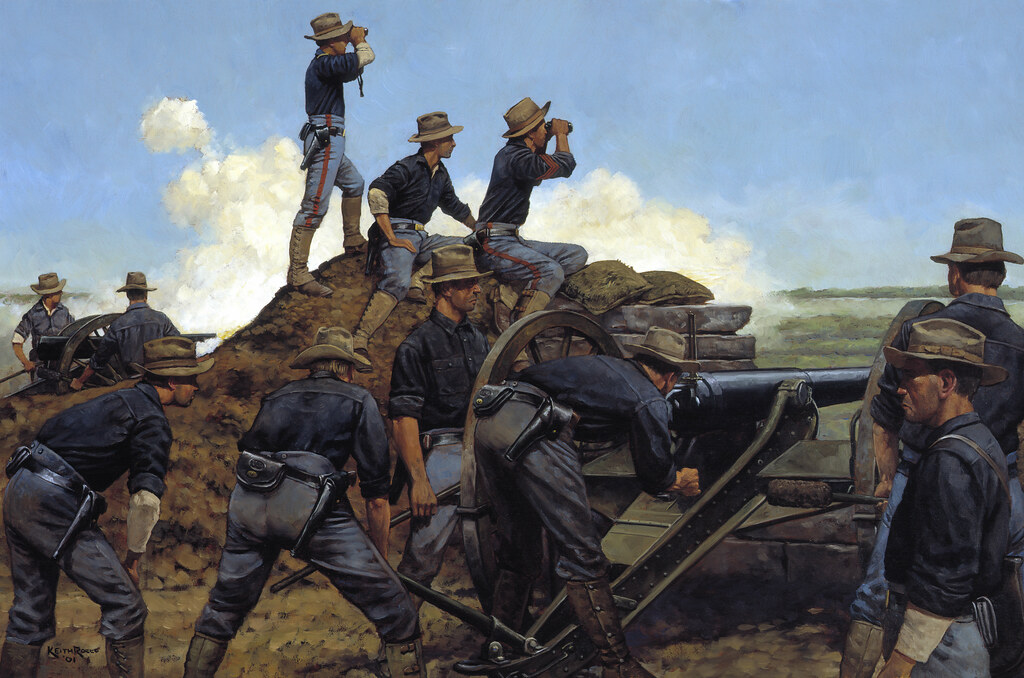
Utah Light Artillery in the Spanish-American War – National Guard Heritage Gallery
On April 6, 1898, Congress declared war on Spain and President William McKinley organized United States forces for the “Splendid Little War.” Of the tens of thousands of regular, volunteer and National Guard (Militia) troops who served, 343 Utah Guardsmen saw service in the Philippine Islands. On May 1st, after the Navy’s stunning victory at Manila Bay, McKinley authorized an invasion force to capture the Philippine archipelago from Spain. Organized into two batteries, the Utah “Light” Artillery mustered into federal service on May 9, 1898 at Fort Douglas, Utah. Shortly thereafter, at Camp Merritt near San Francisco, the Utah Artillery became part of Brig. Gen. Francis V. Greene’s brigade of the U.S. VIII Corps under the command of Maj. Gen. Wesley Merritt.
Leaving San Francisco, Greene’s brigade first raised the U.S. flag in Guam and then arrived on the island of Luzon on July 17, 1898. In the Philippines, 15,000 Americans not only faced 13,000 Spanish soldiers but a second army of some 12,000 Philippine rebels under Emilo Aguinaldo. The rebels had been fighting for national independence from Spain and hoping for American assistance. When Merritt ordered to keep the rebels out of the fight against Spain, the rebels became a second possible enemy.
On August 13th, the Utah Artillery supported Greene’s brigade as it attacked towards the “old” city of Manila. The battle was predetermined to be a “limited” one in order to preserve Spanish honor and minimize casualties. The rebels, however, made this impossible. As American forces moved quickly against the Spanish defenses, a race to the old city center developed between the Americans and Aguinaldo’s rebels. The Utah batteries fired and re-deployed several times providing close and accurate support for the infantry attacks.
The Utah Light Artillery continued in federal service for another year and fought in the Philippine Insurrection until returning to Utah in August 1899. Today’s 145th Field Artillery, Utah Army National Guard, carries on the history and traditions of the Utah Light Artillery.
Or, “How a little study of history can make your visit to a city so much more entertaining and fun.” At Clio Bluestocking Tales.
Why do visitors leave pennies at this gravesite? Read the story at Clio Bluestocking Tales
For five weeks, I walked around the streets of Baltimore, or at least the distance between a certain major university known for its doctors, the Inner Harbor, and Fells Point — especially Fells Point — with some diversions elsewhere. As I walked, I began to notice landmarks of some very bad guys who have graced the streets of this interesting city.
Fans of “The Wire” will especially want to read it. Did you catch the reason Clio is in Baltimore, for the full effect?
It’s not that history tells you how to live your life, or save it; it can make your life worth the living and saving.
Spread the word; friends don't allow friends to repeat history.
Homeland Defense in the 9th and 10th century European settlements in America - Aardvarchaeology
Re-enactors in Canada bring alive two periods of Swedish immigration to the Americas, the Viking experiments of the 9th and 10th centuries, and later, in the 19th century.
From Aard regular Christina Reid (she started commenting less than a week after the blog opened, bless her heart!), a few pictures from Mid-summer Eve at the Scandinavian Cultural Centre in Burnaby, British Columbia. Tina and her hubby are active in the Reik Félag reenactment group. And her brother is the singer of Viking/Tolkienian metallers Amon Amarth!
How do Canadian public school curricula treat these events? They are all but completely missing from the normal world history and U.S. history texts we use in Texas — of course, the U.S. history texts generally ignore the other two nations of North America in all contexts.
The town I mostly grew up in, Pleasant Grove, Utah, had been settled in large part by Scandanavians who had joined Mormonism and then migrated to Utah. Generally looked down upon by English descendants, they rebelled by voting our high school’s mascot as Vikings. The Christiansens, Fugals, Christesons, Larssons, Andersons, Andersens and others probably would have enjoyed the idea of a Viking re-enactment.
Those wily Canadians figure out so many ways to have fun and hide learning in the activity.
Young Viking couple in Canada, 9th or 10th century, or 21st century reenactors - image at Aardvarchaeology
Spread the word; friends don't allow friends to repeat history.
Magna charta cum statutis angliae, (Great Charter with English Statutes). Library of Congress
These links are to exhibits that are closed, but whose images are still maintained on line. The Library promises to update exhibits, and on line collections will grow, too.
There really is some remarkable stuff, most of it obscure enough to be really cool, still.
A 16th century miniature pictures Rustam, the hero of the Persian national epic, The Shah Namah, tossed into the sea by the demon Akwan. (Library of Congress, Near East Section).
Spread the word; friends don't allow friends to repeat history.
Millard Fillmore was elected vice president largely because he was on the ticket with the very popular Gen. Zachary Taylor, hero of the Mexican War.
About 15 months into his presidency, President Taylor took ill after presiding over July 4 festivities in blazing heat. He died on July 9, 1850; Vice President Millard Fillmore took the oath as president the next day, and served out the term.
Millard Fillmore in an 1850 lithograph by Francis D'Avignon after a photograph by Matthew Brady (unclear if this was before or after his ascending to the presidency) - Library of Congress image
Taylor had encouraged New Mexico and California to draw up state constitutions, which would have disallowed slavery in those states. To southern leaders who threatened secession, Taylor promised to personally lead the army that would hold the union together by force, and personally hang those who had proposed rebellion.
Fillmore had presided over the Senate during months of furious debate on issues that always seemed to come down to slavery. Because he didn’t hold to the views of the Whig Party which had elected the Taylor-Fillmore ticket, even more than Taylor had strayed, the cabinet resigned. Fillmore appointed Daniel Webster as Secretary of State, and proceeded to push for compromise on issues to avoid war. His machinations helped get California admitted as a free state, but left New Mexico as a territory. His support of the Fugitive Slave Act alienated even more Whigs, and by 1852 the Whigs refused to nominate Fillmore for a term of his own. He left office in 1853, succeded by Franklin Pierce.
Fillmore’s greatest accomplishment as president, perhaps, was his sending a fleet of ships to Japan to force that nation to open up to trade from the U.S. The political furor over the Fugitive Slave Act, the Missouri Compromise, and other issues around slavery, tend to eclipse the memory of the good that Fillmore did.
Nota bene: Controversy surrounded the death of Taylor. Because he had threatened southern secessionists and incurred anger from several other groups, from the time of his death there were rumors he had been poisoned with arsenic. Officially, the cause of death was gastroenteritis; popular accounts note that he had, in the heat of July, drunk milk and eaten cherries and cucumbers. Certainly strep, staph or other bacteria in the milk could have created a problem. In 1991 a team led by George Washington University Law Professor James Starrs exhumed Taylor’s body from his Louisville, Kentucky burial plot, and tested his remains for arsenic at the Oak Ridge National Laboratory. Analysis presented to the Kentucky medical examiner indicated aresenic levels way too low for a poisoning victim.
Spread the word; friends don't allow friends to repeat history.
A few weeks ago I finally got a copy of “Fog of War,” at Half-Price Books. I’ve watched it three times so far.
DVD box for Fog of War, Errol Morris's Academy Award-winning documentary
For a talking head documentary, it’s compelling, and interesting. It may be just that I lived through the time, and hearing former Defense Secretary Robert McNamara explain now what was going on at various points . . . “Fog of War” is like a director’s cut DVD of the Vietnam War with Coppola, Scorsese, Spielberg and Wilder all explaining every facet of what the director was doing.
Errol Morris’s interviews over the past few daysare good, too. Morris is the director of the movie. He reminds us that he was making the movie before, and then in the aftermath of the attacks on the World Trade Center. Wrong decisions about war were being repeated.
I was looking to find excerpts that might work in world history or U.S. history classes. I’m not sure there is one, now. It should be a powerful film for an AP U.S. history class, but probably assigned viewing rather than in-class.
For his part, Robert McNamara was never anything less than brilliant, even when wrong. We often forget that he rose to his role as Secretary of Defense because of his being right when others were so wrong — at Ford Motor, McNamara was the one who saw the Edsel as a dismal failure and the wrong path, years before the ultimate failure of the marque, the man who saved Lincoln, the man who pushed the small car revolution in the Ford Falcon, the man who pushed safety packages with seatbelts before they were popular, or required. Even at Defense he was more capable that his predecessors, more careful, and more often right. (Read that Miami Herald piece from Joseph Califano — it reveals the brilliance of Lyndon Johnson, too.)
McNamara’s descriptions of errors in the highest places are also brilliant in their insight.
With the possible exception of Eisenhower’s never-used apology and fault-accepting letter for the failure of D-Day, the Normandy invasion — never used because the invasion worked — have we seen a more forthright mea culpa and warning from any of our warriors about their own mistakes, and how to avoid them?
Is that why it seems like he, almost alone among the architects of that horrible conflict, confessed to error in Vietnam? He was a man who could do almost anything, had done much, but at the most important time could not do whatever it was that was required to achieve a just peace, nor even an end to war. We don’t know yet what the right thing to do might have been.
The exhibit left the George H. W. Bush Presidential Library in March 2007 — but the good folks who run the library left an on-line version. It’s a gallery of 100 photographic portraits of important Texans. Click on the photo, you get a short biography of each person.
Red Adair, pioneer in putting out oil field fires - Image from George H. W. Bush Presidential Library
Red Adair holds the first spot on the list, and ZZ Top occupies the last (the list is alphabetical). The list is eclectic, and useful. The list focuses on the 20th century, leaving out the usual Texas luminaries Austin, Houston and de Zavala, and that’s good. This is a great list for junior high Texas history students to use, for learning Texas history, or for selecting the “famous Texan” who will be the subject of their biography project.
A handful of these people are commonly reported on in classrooms. Most are not, however. You’ll learn more about Texas folklore and Texas’s Mexican heritage in music from these short biographies than you can learn in many Texas history courses. Adair to ZZ Top, including John Henry Faulk, John Nance Garner, Walter Cronkite, Bobby Layne, Janis Joplin, Scott Joplin, Michael DeBakey, George Foreman, Lydia Mendoza, Sam “Lightnin'” Hopkins, Hector Garcia, and Bessie Coleman, and 86 others. All the major Texas industries are represented, and all parts of Texas. If a student knew all of these people, the student would have a heck of a bunch of Texas knowledge.
Bessie Coleman, world's first licensed black pilot - image from the George H. W. Bush Presidential Library
Use this exhibit to broaden your knowledge of Texas history, or to invent new teaching points. A savvy teacher could use these to create 100 bell ringers, I suspect — and do a lot more.
It would be great if the library were to publish a poster featuring the 100 portraits. Anybody in College Station listening?
How do you use this exhibit in your classroom?
Spread the word; friends don't allow friends to repeat history.
Juneteenth, celebrated on June 19, is the name given to emancipation day by African-Americans in Texas. On that day in 1865 Union Major General Gordon Granger read General Order #3 to the people of Galveston. General Order #3 stated “The people of Texas are informed that, in accordance with a proclamation from the Executive of the United States, all slaves are free. This involves an absolute equality of personal rights and rights of property between former masters and slaves, and the connection heretofore existing between them becomes that between employer and hired labor. The freedmen are advised to remain quietly at their present homes and work for wages. They are informed that they will not be allowed to collect at military posts and that they will not be supported in idleness either there or elsewhere.”
Large celebrations on June 19 began in 1866 and continued regularly into the early 20th century. The African-Americans treated this day like the Fourth of July and the celebrations contained similar events. In the early days, the celebration included a prayer service, speakers with inspirational messages, reading of the emancipation proclamation, stories from former slaves, food, red soda water, games, rodeos and dances.
The celebration of June 19 as emancipation day spread from Texas to the neighboring states of Louisiana, Arkansas and Oklahoma. It has also appeared in Alabama, Florida, and California as African-American Texans migrated.
In many parts of Texas, ex-slaves purchased land, or “emancipation grounds,” for the Juneteenth gathering. Examples include: Emancipation Park in Houston, purchased in 1872; what is now Booker T. Washington Park in Mexia; and Emancipation park in East Austin.
Celebration of Juneteenth declined during World War II but revived in 1950 at the Texas State Fair Grounds in Dallas. Interest and participation fell away during the late 1950’s and 1960’s as attention focused on expansion of freedom for African-Americans. In the 1970’s Juneteenth revived in some communities. For example, in Austin the Juneteenth celebration returned in 1976 after a 25 year hiatus. House Bill no.1016 passed in the 66th legislature, regular session, declared June 19, “Emancipation Day in Texas,” a legal state holiday effective January 1, 1980. Since that time, the celebration of Juneteenth continues across the state of Texas with parades, picnics and dancing.
Texas State Library Reference Services 3/95
Celebrations across Texas started last Saturday, and will continue for another three or four days, I gather. Thought it’s an official State of Texas holiday, few people take it off. So celebrations are scheduled when they can be.
Or, until that account is unsuspended by the forces supporting Donald Trump: Follow @FillmoreWhite, the account of the Millard Fillmore White House Library
We've been soaking in the Bathtub for several months, long enough that some of the links we've used have gone to the Great Internet in the Sky.
If you find a dead link, please leave a comment to that post, and tell us what link has expired.
Thanks!
Retired teacher of law, economics, history, AP government, psychology and science. Former speechwriter, press guy and legislative aide in U.S. Senate. Former Department of Education. Former airline real estate, telecom towers, Big 6 (that old!) consultant. Lab and field research in air pollution control.
My blog, Millard Fillmore's Bathtub, is a continuing experiment to test how to use blogs to improve and speed up learning processes for students, perhaps by making some of the courses actually interesting. It is a blog for teachers, to see if we can use blogs. It is for people interested in social studies and social studies education, to see if we can learn to get it right. It's a blog for science fans, to promote good science and good science policy. It's a blog for people interested in good government and how to achieve it.
BS in Mass Communication, University of Utah
Graduate study in Rhetoric and Speech Communication, University of Arizona
JD from the National Law Center, George Washington University


 Posted by Ed Darrell


![Viva la república! Viva el Cura Hidalgo! Una página de Gloria, TITLE TRANSLATION: Long live the republic! Long live Father Hidalgo! A page of glory. Between 1890 and 1913. Prints and Photographs Division. Reproduction Information: Reproduction Nos.: LC-USZ62-98851 (b&w film copy neg.), LC-DIG-ppmsc-04595 (digital file from original, recto), LC-DIG-ppmsc-04596 (digital file from original, verso); Call No.: PGA - Vanegas, no. 123 (C size) [P&P] Catalog Record: http://hdl.loc.gov/loc.pnp/ppmsc.04595](http://www.loc.gov/wiseguide/sept09/images/Mexican_A.jpg)
![A street in Guanajuato, Mexico. Between 1880 and 1897. Prints and Photographs Division. Reproduction Information: Reproduction No.: LC-D418-8481 (b&w glass neg.); Call No.: LC-D418-8481 <P&P>[P&P] Catalog Record: http://hdl.loc.gov/loc.pnp/det.4a27131](http://www.loc.gov/wiseguide/sept09/images/Mexican_B.jpg)







 Millard Fillmore's Bathtub