Relic bomb crater found in Darwin, Australia

October 20, 2010

A bit of World War II history:  Darwin, Australia, took more bombs than Pearl Harbor, during World War II.

We learn this from the Australian Broadcasting Corp. story on the recent rediscovery of a large bomb crater there:

Map of Australia

Map of Australia, from Australia.com

Bomb crater found in Darwin CBD

It has been confirmed that a large hole uncovered by earthworks in Darwin’s CBD is a bomb crater probably created during the first Japanese raid on Darwin in 1942.

The crater was spotted by a passing motorist who reported it to the Department of Heritage.

Archaeologist Silvano Jung has now investigated the site and says it is almost certainly a bomb crater.

“Judging by the diameter of the crater, it was probably a 1,000 pound bomb, or a 500 kilo bomb, dropped by a medium bomber either from Java or Ambon [in Indonesia],” he said.

“Most likely on February 19 [1942] as well.”

Mr Jung says the bomb crater will become a special part of Darwin’s history.

“Often it’s the small things in history that are really important and given that this is the only one, it makes it unique. It’s a unique hole in Darwin,” he said.

Darwin was subjected to 63 bombing raids during the war, with more bombs dropped on the city than Pearl Harbour.

Now we study bomb craters in archaeology.

According to some reports, it is the sole surviving bomb crater from the war, in Darwin:

Northern Territory heritage Minister Karl Hampton said the exciting discovery on McMinn Street provided a clear link with the past.

“World War II is an important part of the Territory’s history and identity,” Mr Hampton said in a statement released on Wednesday.

“Territorians are proud of our unique history, and we now have another attraction no other capital city can match – an authentic World War II bomb crater.”


Annals of DDT: Interior Dept compliments Rachel Carson’s research in Silent Spring

October 17, 2010

One of the most frequent hoax charges against Rachel Carson claims that she didn’t base Silent Spring on research.  Greater hoaxers claim that there is little or no evidence of harm to birds from DDT.

Rachel Carson's book stirs controversy, newspaper headlines

Rachel Carson’s book stirred controversy, as shown in newspaper headlines

These critics forget history, or they try to cover it up so you won’t know any better.  Carson provided more than 50 pages of citations to peer-reviewed research and communications with leading scientists in ornithology and chemistry about DDT and the damage it does.

Carson’s deep research won acknowledgment from the U.S. Department of the Interior, in this 1962 speech before the Audubon Society meeting in Corpus Christi, Texas, by the Special Assistant Assistant Secretary for Fish and Wildlife Robert M. Paul.

Paul told the birders that Interior was proud of the fact that so much of the research in the book relied on Interior’s research, from the U.S. Fish and Wildlife Service:

In addition, we are proud that so much of ‘Silent Spring“ is based on Fish and Wildlife Service research. And, with no modesty at all, we like to point out that Miss Carson is nobly carrying on a tradition that employees of the Department of the Interior, beginning with Walt Whitman nearly a century ago, have written some of the Nation’s most important books.

That’s quite the compliment to Carson, being compared even distantly to Walt Whitman.  It’s also a helluva brag for USFWS.

It’s also a 30-second response to the false charge that Carson’s work was not research based, or that research did not show DDT damage to wildlife.

Paul spoke to the Audubon Society about work to set up and operate the Federal Pest Control Board.

A .pdf of the speech can be found at the website for Interior, in a compilation of information from Interior about DDT between 1945 and 1998.  Full text below the fold.

Read the rest of this entry »


October 14: Chuck Yeager/BOOM! Day

October 15, 2010

Rats. On October 14 I missed noting the anniversary of Chuck Yeager’s great feat, breaking the sound barrier in level flight.

BOOM! Day.

Greg Laden’s blog reminded me, “Happy Anniversary, the Breaking of the Barrier.” Below, what I wrote in 2007, mostly still accurate.

_____________

Panorama of the Mountains noted the 60th anniversary of the first known faster-than-sound flight by a human — October 14, 1947. Test pilot and all-around good guy Chuck Yeager did it.

Bell X-1, on display at National Air and Space Museum

Bell X-1 displayed at the National Air and Space Museum

This is a great post-World War II, Cold War story of technology that should pique interest in the time and the events for many students. For a 90 minute class, a solid lesson plan could be developed around the science and technology of the flight (yes, even in history — this is key stuff in the development of economics, too). The physics of sound, a brief history of flight and aircraft, the reasons for post-war development of such technologies, the political situation: There are a dozen hooks to get into the topic. Fair use would cover showing a clip from “The Right Stuff” about the flight, and there are some dramatic clips there. (The movie is 3 hours and 13 minutes; great stuff in a format too long for classroom use. Is there any possibility your kids would read the Tom Wolfe book?)

When will someone – the Air Force? NASA? an aircraft company? — put together a DVD with authorized film clips from the newsreels and the movie, and suggested warm ups and quiz questions?

Back in the bad old days one of my elementary school teachers did an entire morning on the speed of sound, aircraft engineering, and the history of faster-than-sound flight. I learned the accurate way to measure the distance to lightning by counting seconds to the thunder (it’s about a mile for every 5 seconds, not a mile for every second, as our school-yard lore had it).

Chuck Yeager at C. R. Smith Museum, 7-25-2010 - photo by Ed Darrell

Brig. Gen. Chuck Yeager at the C. R. Smith Museum at American Airlines HQ, July 25, 2010. Photo by Ed Darrell

This program, to fly at the speed of sound, at what is now Edwards Air Force Base changed the way science of flight is done in the U.S. Yeager led the group of Air Force pilots who proved that military pilots could do the testing of aircraft; the project proved the value of conducting research with experimental aircraft on military time. The methods developed for testing, evaluating, redesigning and retesting are still used today. The drive for safety for the pilots also grew out of these early efforts at supersonic flight.

Yeager’s flight came when technology was cool, not just for the virtual reality role playing games (RPGs), which were still decades in the future, but because it was new, interesting, and it opened a world of possibilities. We all wanted to fly airplanes, especially small, fast airplanes. A sonic boom over southern Idaho produced a couple dozen calls to the local police and fire departments (long before 911 emergency calling systems), and a couple of paragraphs in the local newspaper.Later, when we moved to Utah County at the foot of Mt. Timpanogos, we kids relished the flights of fighter jets at 6,000 or 7,000 feet above MSL on their way to or from Hill AFB in Ogden, only a thousand feet or so above our heads in those mountain valleys.

Whether authorized to fly them or not, the fighter jocks recruited us kids with their ground-hugging forays. And if one jet occasionally passed the speed of sound, the school bus-stop would buzz with it for a couple of days, as we tried to determine whether anybody ever really lost a window to such fun and excitement as a sonic boom. We could hardly wait to be the pilots of those airplanes, giving a start and a thrill to housewives across America who worried their replica Ming vases and picture windows would crash to smithereens.

Supersonic transport excited me then, and still does. As a lover of the environment, perhaps I should have stood firmly against supersonic flights of the British-French Concord over the U.S., but I hoped a compromise could be reached. New York to Los Angeles in two hours seemed like a good idea to me at the time, and it still does. The U.S. legislated ban on supersonic passenger flights probably doomed the idea of supersonic transport. Boeing dropped its plans to build a competitor to the Concord. The Concord itself never got the support it needed to continue production and refinement of the idea. By the time the Concord was retired in October 2004, it was 50-year-old technology.

I wondered at the time what would have happened had research on passenger supersonic flight continued. Shutting off technology is a strange thing. Steam engine technology was poised to make a great leap forward in the early 20th century, some argue. Diesel and gasoline engine sales blocked the leap, especially the creation of the Diesel-electric railroad locomotive engine.

But make no mistake about it: The Concord was fun. My friend Perry W. Buffington — as amiable and useful a traveling companion as is known in the modern world — found a fantastic fare for a Concord flight for us over the Christmas-New Year’s holidays, 1978 and 1979. We flew to London on a Delta L-1011 on Christmas night; we spent a week in London getting cheap tickets to great shows (the Royal Ballet’s Nutcracker, featuring a kid I knew from Spanish Fork, Utah; Pirates of Penzance at D’Oyly Carte; Evita in the first run, as I recall; a great revival of Oliver! Great stuff, cheap tickets). Then, to cap it off, the Concord from London to New York. Mach 2, on January 1.

It snowed record depths in all of southern England. On New Year’s Eve day, we skated the snow-packed streets to Harrod’s for last minute souvenir shopping, and bumped into Lauren Bacall. Then we sat in the bar of the hotel and watched the news reports of how the entire country was shut down by the snow, including the British Railroad. Our flight out seemed to be due a delay, at least. But we got a call from British Airways confirming the flight, later that night. So on January 1 we got a snowcat — not really, just a brave taxi — to the downtown check-in office of BA.

Then the show kicked in. The agent checking us in took our bags, reached into a drawer and pulled out a roll of pound notes. Without breaking his conversation with us, he beckoned over a woman who was helping passengers onto the shuttle bus to Heathrow, handed her the roll of bills and said simply, “Concord for these gentleman.” She sprinted to the curb outside and hailed a taxi. The agent had called the airport and informed us that while nothing else had flown, “The Concord will depart on schedule. Thank you for flying British Air — your taxi is waiting.” The woman at the curb held the door for us — no bus shuttle for Concord passengers!

The taxi rocketed to Heathrow. I don’t know how much BA paid, but the driver was extremely happy to move us at extreme speeds over slippery roads.

Concord waiting lounges provided the best amenities. Separated from even First Class lounges, the free champagne, and any other liquor, was served on the ground as well as in the air. For morning departures, a chef in the lounge created elaborate egg dishes to order, for breakfast.

Flying the Concord was always a celebrity experience. The festive feeling of our New Year’s Day flight zoomed considerably when Lauren Bacall breezed into the waiting room. (The only other time I got into a Concord lounge was at Dulles a few years later; Ray Charles checked in for the flight. He asked for a window seat.) We watched a television news report that all flights at Heathrow were delayed by the snow as we got the announcement the Concord was ready to board, on time. If our flight wasn’t the only flight leaving Heathrow that day, it was definitely the first. “Snow doesn’t bother the Concord,” one agent explained.

Supersonic flight passenger jets present special problems to air traffic control, especially with their speed. Plus, they fly better where the air is thinner. So instead of the normal 30,000 to 45,000 feet altitude of commercial airliners, Concords flew at about 70,000 feet. This becomes clear to a passenger on take off: Concords get off the ground, and then take a radically steeper climb that, from the inside, feels like going straight up. At cruising altitude, at about noon, a passenger looking out the window can look up to see the blue sky disappearing into darkness (a night flight with the Aurora Borealis must have been some great spectacle).

Concord’s cabin was not spacious. It held 100 passengers, a bit smaller than a modern 737. The food service was divine, with plenty of stewards on hand to attend to passengers. Among the best lamb chops I’ve ever had (and mind you, I come from sheep country). Complimentary champagne, wine, and cigars — “not Cuban, I’m sorry,” the steward explained. “U.S. rules.”

Sit back, sip the champagne, or puff a cigar and sip the port, and watch the Machmeter: “0.5 . . . 0.7 . . . 0.9 . . . 1.0 (Mach 1, the speed of sound).” The ride, smooth as it was, got a lot smoother. The entire aircraft was quieter. “1.3 . . . 1.7 . . . 2.0.” Twice the speed of sound is half as scary as Mach 1, once you’re already moving so fast.

Two hours from Heathrow to JFK. We flew faster than the time zones changed, landing a couple of hours earlier than our departure. Time travel!

(The week in London, airfare there, and the Concord back, was under $1,500 in 1978. Inflation affected the prices before the Concord retired.)

Two in my immediate family have flown faster than sound. My brother, Wes, flew F-4s. And champagne and steward service notwithstanding, he had the much better deal. He did it more often, and he had the stick.

Chuck Yeager did it first, in level flight (there is some conjecture that a British pilot had done it earlier, in a dive — but he didn’t recover from the dive).

How best to commemorate breaking the sound barrier? Do it again!

Photo of Astronauts Chuck Yeager and Dave Scott, with their co-pilots, prior to the 60th anniversary sound-barrier breaking flight, 2007 Edwards AFB

Astronauts Chuck Yeager and Dave Scott, with their co-pilots, prior to the 60th anniversary sound-barrier breaking flight, 2007 Edwards AFB

Edwards Air Force Base, September 21, 2007 – General Yeager flew a US Air Force F-16 to commemorate the 60th anniversary of Breaking the Sound Barrier (October 14, 2007), the 60th anniversary of the United States Air Force (September 18, 2007) and 65 years of General Yeager flying in military cockpits. Yeager was part of a flight of four planes; two F-16’s with Gen. Chuck Yeager and Maj. Gen. Joe Engle aboard, and two T-38’s carrying F-15 pilot Fitz Fulton, NASA Astronaut Col. Dave Scott, and Commander Curt Bedke. Yeager and Engle’s F-16’s broke the sound barrier high above the Base Operations Center – a double sonic boom, then the four planes executed a slow straight through pass, pitched out, landed, and taxied up to the hanger where the 2007 Air Force Ball was about to begin, attended by more than 1,000. Hundreds of ball guests, in gowns, tuxedoes, and dress blues, were assembled to greet the flyers, who snapped on black bowties and strolled into the ball wearing their flight suits. Gen. Yeager was honored at the dinner with a 60th Anniversary Sound Barrier Busting cake.

Additional resources:


How evolution makes bedbugs resistant to DDT

October 12, 2010

Our internet’s best expert in bedbugs, Bug Girl, recently featured another post relating how DDT drove evolution of bedbugs, so that bedbugs are no longer susceptible to DDT.  You should go read what Bug Girl said.

And you can view the video here, too; let’s spread the word, eh?

As Bug Girl describes it:

I discovered that bed bug evolution–specifically resistance to pesticides–was also the subject of the National Evolutionary Synthesis Center‘s podcast this month.  A FASCINATING interview with one of the grand old men of evolutionary genetics, James Crow.  He worked on DDT resistance back in the late 40s and 50s.

Watch, and increase your knowledge.


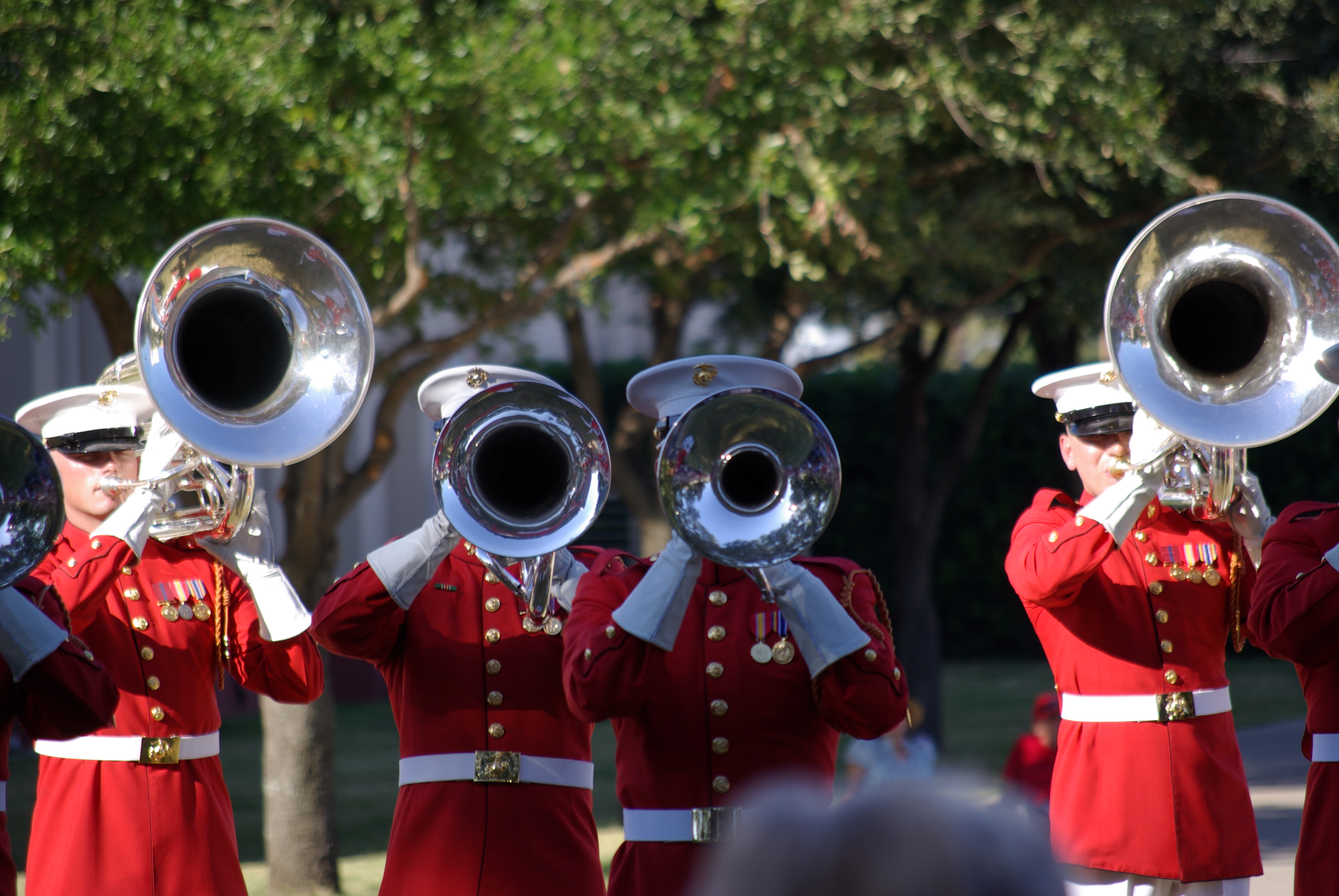
Texas State Fair: U.S. Marine Drum and Bugle Corps

October 11, 2010

Fan makes a video of the U.S. Marine Drum and Bugle Corps at Texas State Fair, 10-8-10 - photo by Ed Darrell

A fan makes a video of the U.S. Marine Drum and Bugle Corps at Texas State Fair, 10-8-10 - photo by Ed Darrell

Friday evenings at the Marine Barracks near the Navy Yard in Washington, D.C., the U.S. Marine Corps Drum and Bugle Corps performs publicly.  It’s a free concert.  It’s a delightful way to spend a spring or fall afternoon-into-evening.  An easy walk from our old apartment on East Capitol Street S.E., and now, offering a dozen venues for a good dinner on the return.

Except, September 24 through October 10 we had them here in Dallas, at the State Fair of Texas.

Statue at front of Texas Women's Museum looks over USMC Drum & Bugle Corps performance at Texas State Fair - photo by Ed Darrell, use permitted with attribution

Statue at front of Texas Women's Museum looks over USMC Drum & Bugle Corps performance at Texas State Fair - photo by Ed Darrell


Kathryn and I took advantage of Dallas ISD’s State Fair Day to carry out a dozen errands including blood chemistry checks and a run to Kenny’s school, the University of Texas at Dallas, to finish some paperwork for his visa in China.  We arrived at the State Fair in mid-afternoon, in time to catch the USMC Drum and Bugle Corps’ entire performance in a venue quite different from their usual spit-and-polish home.

Under the aegis of Big Tex, they performed on the parade ground off to the side of the Texas Women’s Museum.  The grandstands were larger than D.C.’s, but covering only three sides and leaving the backdrop open for tourists wandering by to spoil, or add interest to, the photos of other fair goers.

A woman pauses, a man strolls, becoming part of the changing backdrop of the stage for the USMC Drum and Bugle Corps at the Texas State Fair - photo by Ed Darrell

A woman pauses, a man strolls, becoming part of the changing backdrop of the stage for the USMC Drum and Bugle Corps at the Texas State Fair - photo by Ed Darrell


The group’s performance sparkled with brilliant performances in the drum and bugle corps style — we’ve been spoiled by the Duncanville High School Marching Band’s constant level of near-perfection, but were not disappointed in the crisp musicality delivered by the Marines.  These were performances to make other musicians smile and clap with joy at the sound, but delivered without a smile or hint of satisfaction in Marine unsmiling style.  Such incongruence.

Solos featured young Marines from Texas, no doubt including several who had marched in competition against Duncanville for their Texas high schools.  Performances included a Sousa march, and several new compositions from the director honoring, among others, the Navy Medical Corpsmen.  In a tribute to Texas, the group played Elmer Bernstein’s “Theme from the Sons of Katie Elder,” a John Wayne movie shot in Clearwater, Texas, more than a generation ago.  There were percussion numbers, a calypso, a cover of Gloria Estefan.

The set performance closed out with Lee Greenwood’s “I’m Proud to Be An American.”  This is one of my least favorite tunes to suffer through since most performances turn quickly to maudlin.  Not so here.  Confined to crisp drums and tight brass, the song avoided sappiness, even when the entire Corps put down their instruments for an a capella rendition of the vocal, sung quietly enough the crowd had to strain to be quiet to hear.  This lent a gravity to the lyric that is completely missing from a country band’s high-volume blast.

USMC Drum & Bugle Corps at Texas State Fair - Ed Darrell photo

In a drum and bugle corps, all the horns must function as bugles do -- valves are allowable, so trumpets appear in the group. But there are no slide trombones, no French horns. They are replaced instead by euphonium and mellophone. The groups use tubas with mouthpiece extensions to make them work like bugles, no Sousaphones. Note the tuba players hefting the horns on their shoulders. USMC Drum & Bugle Corps at Texas State Fair, October 8, 2010


In the midst of people who didn’t want to pay attention, watched over by the bare-breasted art-deco titaness guarding the Texas Women’s Museum, and in the heat of a Texas October, the USMC Drum and Bugle Corps played as tightly and honorably as they do at more sober and somber venues.  It was great.

I was surprised when the group marched off after an hour’s concert, to the “Marine Corps Hymn.”  They marched a half-mile to one of the fair’s midways, and performed another mini-concert.  Still no visible sweat in the heat.

USMC Drum and Bugle Corps drum major's baton rests while the Corps performs - photo by Ed Darrell

USMC Drum and Bugle Corps drum major's baton rests while the Corps performs - photo by Ed Darrell


Annals of DDT: Remembering Rachel Carson

October 8, 2010

From America.gov, the real story of Rachel Carson, in less than two minutes:

More:


TARP saved my nation, and all I got was this bitter, cold tea party

October 5, 2010

Remember TARP, the Toxic Asset Relief Program?

Oh, that’s right — we hate it.  Big hole in the federal budget and all.

Then you should be dancing that it died Sunday night, right?  Yeah, that’s right:  TARP expired.

But, maybe we should be lamenting its passage, and celebrating it.  It ended up costing us almost nothing but the problem of having Tea Party, ignorant ingrates involved in the campaign.  It might even have turned a profit.  In any case, it didn’t leave a big hole in the federal budget, and there is little doubt that it saved us from the Greater Depression.

See the story at NPR:

What do we do with the end of TARP?

And what do we do with the news that TARP will not have cost anything like the $700 billion we thought it would? What if it really cost $50 billion, or less?

What if, in the end, the Toxic Asset Relief Program so controversial at birth and vilified throughout its two years of life turns out to have turned a profit for the government and the taxpayer?

We — most of the news media this is — simply don’t know what to do with this news.

The suggestion that TARP did not blow a hole in the federal budget potentially blows a hole in some other presumptions as well. Economists will argue for years over the necessity of TARP, and the rest of us can argue over the bonuses investment bankers still got (and continue to get).But we won’t argue about whether the government could or should have done more to prevent the collapse of the credit markets and the mass failure of banks in 2008. Because the government did do TARP, and those other things did not happen. We did not go back to 1929 or worse. And, unlovely as it may be, TARP remains the closest thing we have to an explanation for that.

Still, the expiration of the program as Sunday turned to Monday passed largely unremarked. And insofar as the media have noticed the story of TARP’s apparently much-reduced cost, that tale has been anything but ballyhooed.

(For an exception, see the package offered Sunday evening by Guy Raz and the crew at Weekend All Things Considered.)

On the last business day before TARP expired, The New York Times and The Washington Post did report the much-reduced cost figures — mentioning the potential for the program to actually make money for taxpayers in the final accounting.  But the Times put the story in the Business Section, and the Post played it on the Federal Page.

What other “common sense” delusions will misdirect this year’s election vote?

What thanks do we get?  What thanks do we give?


Eleanor Roosevelt: Didn’t like the description, “No good in a bed”

October 3, 2010

Eleanor Roosevelt, image from MedScape; at Pearl Harbor, 1943

Eleanor Roosevelt at Pearl Harbor in 1943 - image from MedScape

Is this story true? I’ve not been able to verify the quote — it’s a great story, and better if true. From MedScape Today, “The Case of the Well-known Woman with Unexplained Anemia”:

Although reserved, Roosevelt had a quiet sense of humor. When commenting about how she felt about having a rose named after her, she remarked: “I was very flattered . . . but not pleased with the description in the catalogue: no good in a bed, but fine up against a wall.”

Can anyone tell us when and where she said that?  Gardeners, can you confirm?  Can anyone find a photo of the rose, “Eleanor Roosevelt?”  (It’s probably a yellow rose, but I haven’t found a description.)

Eleanor Roosevelt teacup, First Ladies Library

Eleanor Roosevelt teacup, First Ladies Library

More:


Music stopped the deadly sniper

October 2, 2010

Fascinating story well told by the man who lived it:  After D-Day, an Allied unit was pinned down by a sniper.  Unable to move, and on an inspired whim, one of the American soldiers, Jack Leroy Tueller,  took out his trumpet, and played “Lili Marlene.”

Jack Tuler holding his trumpet, at 90 (maniacworld)

Jack Tueller holding his trumpet, at 90 (image from maniacworld/ Wearethemusic.com)

In the morning he was introduced to a German soldier, a sniper who had surrendered, unable to keep fighting after some mysterious trumpeter played the song that made him think of his home, his mother, his girlfriend, and love.

Two minutes of amazing history, vividly told and played, suitable for classroom use.

Go view “Taming a Nazi sniper with a trumpet,” at ManiacWorld.


[Is this the lost video from above? I think so.]

Videos say that Jack Tueller is 90 years old.  I’m guessing the video is about a year old — does anyone know any more about Col. Jack Tuler, his story, or where he livesCould this be the late Jack Tuler of Chicago? Hey, anyone:  Where is Jack Tueller today?  Who has his life details?  (Tueller lives today in Bountiful, Utah, with his wife, Marjorie.  He still plays the trumpet.)

Tip of the old scrub brush to Kenny, in China, and to Common American Journal, who had a YouTube copy.  Special tip of the old scrub brush to J. A. Higginbotham, who tracked down the Deseret News stories.

(Our YouTube host misspelled the name of the song, I think.)

_____________

Update, October 3, 2010: Reader J. A. Higginbotham tracked down two stories in the Deseret News, in Salt Lake City, about Col. Tueller.  I’ve corrected the spellings above, and edited otherwise to point to the details.  A new post is probably warranted.  Go to the Deseret News site and read their fine work, especially the long story by Doug Robinson.

Update March 2019: Both video links above seem to have died; here’s a video from StudiesWeekly.com, put up on YouTube in 2015.

Sad to hear, Jack Tueller died in 2016, at age 95.


Constitution Monday

October 2, 2010

Here’s an idea your class could carry out in its own blog:  Alaskan Librarian covers part of the Constitution each monday — here’s the middle of coverage on the amendments.

There’s a bell ringer or 27 bell ringers in there somewhere.


Annals of Global Warming: Another broken campaign promise: 2010 hottest year on record

October 2, 2010

Last November and December, in their campaign to impugn science and promote air pollution, climate change “skeptics” said that global warming is done, and that we are in a new planetary cooling phase.

It’s one more broken campaign promise from the anticlimate science politicians, like Anthony Watts2010 on track to be the hottest year on record.

“The interesting thing about it is the temperature anomaly map for June shows it was pretty much warm everywhere over land except for a few places,” said David Easterling, of NOAA’s National Climatic Data Center in Asheville, N.C., which released the data. “That’s somewhat of an uncommon pattern to see almost all the land mass being that warm.”

Only the U.S. Pacific Northwest, northern Europe and southern China were cooler than average, according to NOAA.

As the Earth continues to heat up from rising levels of carbon dioxide in our atmosphere, the planet is likely to see more record-breaking years. “As we continue to get warmer, the odds of any given year breaking the record are pretty high,” Easterling said.

Indeed, four of the five warmest years on record have come in the last decade. The reigning warmest year on record is 2005, followed by 1998, 2003, 2006 and 2009, Easterling said.

We don’t even have to see their intimate e-mails to know they fibbed to us.  The thermometer on the patio has the news.

Last year, when the world’s leaders were preparing to meet in Copenhagen, harpies from the radical and crazy right insisted that global warming had ceased its advances, and the global cooling would be the norm for the near and midrange future.  They promised!*

Good heavens!  Do you think they were fibbing when they said the scientists were wrong, and mean?  Were they fibbing when they said CO2 is not a pollutant?

How many more broken promises?  (/sarcasm off)

Would Copenhagen’s result been different had this information been available a year earlier?

See also:

_____________

*  Note:  No, they didn’t promise, not really.  Critics of taking action for a better future never promise anything solid.  They only carp that whatever being done is wrong, unnecessary, and too expensive.  Plus, they complain that the food is horrible to the point of being inedible, and the portions are too small.


Columbus’s most prized possession

September 28, 2010

Columbus feared that King Ferdinand and Queen Isabella would not honor pledges they had made to him as recompense and honor for his great work of discovery on their behalf.  Before his final voyage, he assembled a legal document showing those promises made to him, and his work for Spain.

This illustrates, once again, the human dimension of the great drama of the age of exploration, of Columbus’s stumbling on to the America’s in his efforts to get to China.

The Library of Congress and the History Channel team up again to show off these grand snippets of history:

On January 5, 1502, prior to his fourth and final voyage to America, Columbus gathered several judges and notaries in his home in Seville. The purpose? To have them authorize copies of his archival collection of original documents through which Isabel and Fernando had granted titles, revenues, powers and privileges to Columbus and his descendants. These 36 documents are popularly called “Columbus’ Book of Privileges.” Four copies of his “Book” existed in 1502, three written on vellum and one on paper. The Library’s copy, one of the three on vellum, has a unique paper copy of the Papal Bull Dudum siquidem of September 26, 1493, which extended the Spanish claim for future explorations.

Borrowed with permission from Mr. Darrell’s Wayback Machine.


Debunking creationist claims of human and dinosaur footprints together . . .

September 26, 2010

. . . from 1983!

Steve Schafersman, now president of Texas Citizens for Science, played the yeoman then:

Description of the program:

Did humans coexist with dinosaurs? The tracks tell the tale. Dr. John R. Cole, Dr. Steven Schafersman, Dr. Laurie Godfrey, Dr. Ronnie Hastings, Lee Mansfield, and other scientists examine the claims and the evidence. Air date: 1983.

Tip of the old scrub brush to the National Center for Science Education.


H. W. Brands on the study of history, with technology

September 26, 2010

Spent half a day with H. W. Brands, professor of history at the University of Texas, and author of at least one of my favorite history books, The First American (and several others).

Brands banned the use of computers for notetaking in his classrooms this fall.  It’s not the notes he objects to, of course, but the students’ side-activities of checking e-mail, eBay, and ESPN, rather than paying attention to the lecture, and other activities in lieu of taking notes.

Nominally our discussion centered on the decade of 1890 to 1900, the Reckless Decade, as Brands’ book on the era titles it.   Brands took a larger, circular route to the topic, today.  These discussions come under the aegis of the Dallas Independent School District’s Teaching American History Grant, and the Gilder-Lehrman Institute chipped in today, too.  We are a polyglot group of teachers of American history, and a few other related social studies subjects, in Dallas high schools.

I asked about technology beyond lecture, or “direct instruction” as the curriculum and teacher berating  rubrics so dryly and inaccurately phrase it.   Brands focused on the effects of connected students in the lecture, a problem which we officially should not have in Dallas schools.  We discovered he’s using Blackboard (probably the electronic classroom standard for UT-Austin).  I’ve used Blackboard in college instruction, and a somewhat less luxurious version in high schools.  Blackboard works better than others I’ve tried.

Over several hours Brands said he teaches best when he performs well as a story teller — when the students put down their note-taking pencils and listen.  Two observations:  It helps to be a good story teller, and, second, that requires that one know a story to tell.

Our grant could give us better stories to tell.  Most educational enterprises produce great benefits as by-products of the original learning goal.  Our teacher studies of history are no different.


What does urban sprawl look like?

September 22, 2010

Teachers looking for a good way to portray urban sprawl, for geography and history classes, should take a look at this photo essay at the New York Times; unfortunately for teachers, Christoph Gielen’s stunning aerial landscapes cannot be copied for PowerPoint.

Gielen’s work is well known, and many of those same images can be found at other sites.  Images to illustrate “urbanization” and “urban sprawl” from internet sources generally carry a lot more punch than the stock photos delivered with textbooks.  Mind the copyrights.

Untitled X Nevada, urban sprawl in Nevada, copyright Christoph Gielen

(Caption from New York Times presentation): Untitled XI Nevada, 2010 This Vegas-area community was built by the same company that designed the circular communities on the outskirts of Phoenix in “Untitled X / XII / XI.” Credit: Christoph Gielen (Go see the presentation at the Times site to see the other photos)

More resources: