Wattsupgate: Denialists claim all knowledge is wrong

January 31, 2010

It really is that bad.  Climate science denialists now attack any information simply for not being what they want it to be.  Lysenko’s Ghost smiles broadly.

Anthony Watts is just the most prominent of the bloggers making hoax charges of error and worse in the fourth report from the Intergovernmental Panel on Climate Change (IPCC), because of a footnote that cites a rock climbing magazine.

Here’s the trouble for Watts:  There is no indication that the citation is in error in any way.  Watts’s move is more fitting of King George III’s campaign against Ben Franklin’s lightning rods, the prosecution of John Peter Zenger, the pre-World War II campaign against Einstein’s work because he was born a Jew, or the hoary old Red Channels campaign against Texas history told by John Henry Faulk.  It’s as bad as the Texas State Board of Education’s attack on Brown Bear, Brown Bear, What Do You See? Watts’ and others’ complaint is simply that Climbing magazine’s story on the worldwide retreat of glaciers suitable for climbing is not published in a juried science journal.

In other words, they indict the science, not because it’s wrong — they have no evidence to counter it — but because it’s too American Patriot correct Jewish left Texan mistakenly thought to be political well-known, too accessible, (small “d”) democratically-reported.

And of course, any comment that points that out at Watts’s blog goes into long-term “moderation,” keeping it from the light of day in the best tradition of the Crown’s defense of Gov. Cosby’s misadministration of New York (see “John Peter Zenger”).  Watts said in a quote that should have been attributed to the Daily Telegraph:

The IPCC’s remit is to provide an authoritative assessment of scientific evidence on climate change.

In its most recent report, it stated that observed reductions in mountain ice in the Andes, Alps and Africa was being caused by global warming, citing two papers as the source of the information.

However, it can be revealed that one of the sources quoted was a feature article published in a popular magazine for climbers which was based on anecdotal evidence from mountaineers about the changes they were witnessing on the mountainsides around them.

The other was a dissertation written by a geography student, studying for the equivalent of a master’s degree, at the University of Berne in Switzerland that quoted interviews with mountain guides in the Alps.

The revelations, uncovered by The Sunday Telegraph, have raised fresh questions about the quality of the information contained in the report, which was published in 2007.

It comes after officials for the panel were forced earlier this month to retract inaccurate claims in the IPCC’s report about the melting of Himalayan glaciers.

By those standards, Watts’s own readers should eschew his blog — it’s not peer reviewed science by any stretch, and Watts isn’t an established authority in climate science (he’s not even working for an advanced degree).  Consistency isn’t a virtue or concern among climate change denialists.  Watt’s entire modus operandi is much more anecdotal than the story in Climbing, which was written by a physicist/climber who studies climate change in the world’s mountains.

And did you notice?  They’re whining about research done by a scientist in pursuit of a degree, complaining about the second citation.  That’s the exaclty kind of research that they claim the magazine article is not.  Their complaint is, it appears, that a scientist in pursuit of education is not the right “kind” of person to do climate research. It’s the chilling sort of bigotry that we spent so much time in the 20th century fighting against.  In the 21st century, though, it appears one can still get away with demonizing knowledge, education and research, part of the campaign to indict “elitism,” the same sort of elitism aspired to by America’s founders.  Too much of the criticism against scientists involved in documenting global warming is the cheap bigotry the critics claim to find in science, falsely claimed in my view.

Topsy-turvy.

And the glaciers?  Yeah, the evidence tends to show they are in trouble.  Those Himalayan glaciers?  The IPCC report was accurate in everything except the speed at which the glaciers decline — they should be with us for another three centuries, not just 50 years, if we can reduce warming back to 1990s levels (oddly, denialists rarely deal with the facts of accelerating warming, preferring to point to a local snowstorm as a rebuttal of all knowledge about climate).

Oh, and the research?  The author of the story in Climbing magazine is Mark Bowen.  Dr. Bowen’s Ph.D. is in physics from MIT. He’s a climber, and he researches climate change on the world’s highest mountains.  His 2005 book, Thin Ice, focused tightly on what we can learn about climate from the world’s highest mountains.   Bowen is the expert Anthony Watts would like to be.
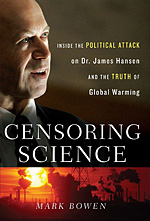
Cover of Mark Bowen's book defending climate science, "Censoring Science."

Cover of Mark Bowen’s book defending climate science, “Censoring Science.”

Bowen’s newest book:  Censoring Science:  Inside the political attack on James Hansen and the truth of global warming. Watts doesn’t want anyone to read that book.  It is easy to imagine Watt’s s attack is, he hopes, pre-emptive, against Bowen’s book.

I’ll wager Watts hasn’t read the article in Climbing, and didn’t know who Bowen was when he launched his attack, though.  The denials of bias coming out of the denialists’ camp will be interesting to watch.

Let the denialists roll out the rope far enough, they’ll inevitably hang themselves.

More:

Do something for freedom: Spread the news

Add to FacebookAdd to NewsvineAdd to DiggAdd to Del.icio.usAdd to StumbleuponAdd to RedditAdd to BlinklistAdd to TwitterAdd to TechnoratiAdd to Furl


Former President Millard Fillmore writes to President Abraham Lincoln

January 30, 2010

May 4, 1861:  Millard Fillmore wrote:

May 4, 1861, letter from Fillmore to Lincoln, introducing a friend - Library of Congress

May 4, 1861, letter from Millard Fillmore to Abraham Lincoln – Abraham Lincoln Papers at the Library of Congress

Transcription of the letter:

From Millard Fillmore to Abraham Lincoln, May 4, 1861

Buffalo May 4, 1861.

My Dear Sir,

The bearer, Dr. Martin Mayer, a Stranger to me, has asked of me a letter of Introduction to your Excellency, and produced such high proofs of character, that I do not feel at liberty to refuse it; and therefore while I decline any interference, in any appointment he may desire, (which is my uniform practice) I desire simple to ask that he may be heard.

Respectfully yours

Millard Fillmore


Look at the past: A class project?

January 30, 2010

Look at this stuff, at Pillar Post.  Could your students do something like this for your town?

image by Bu Yourself, at Pillar Post

image by Bu Yourself, at Pillar Post

Students would have to find the old photos at the library, or at your local historical association or museum.  Most of your students already have the electronic photo equipment though . . .

Just an idea.

Resources, and more:


No climate change denialists will apply

January 28, 2010

Australia is looking for a scientist to head up the next round of Australia’s reports to the Intergovernmental Panel on Climate Change (IPCC).

But who would want a job that pays nothing and brings a great deal of grief?  Crikey notes that scientists, especially Australian scientists, get slandered and libeled daily by climate change denialists.  Not to mention the death threats.

That fat pay the denialists keep claiming comes to the scientists, and urges them to misreport the data?

The only remuneration IPCC scientists get – as a quick check of last week’s ad would have made clear — is travel costs and living expenses while they are at IPCC meetings.  The IPCC work is on top of their day jobs as academics and researchers.

That’s right, ladies and gentleman:  Climate Denialist Extraordinaire Christopher Monckton profits from his obnoxious and error-filled lectures more than the guys who do the heavy lifting.

You know that denialists won’t apply to do the job.  Most of us suspect they don’t have the courage of their convictions to do it, but there’s another problem:  Very few of them are qualified.  They don’t do science.

Bookmark the story. Remind the denialists of it from time to time.

IPCC art, on AR5 process

(New year’s greetings from the IPCC.)


Happy birthday, Wolfie!

January 27, 2010

Wolfgang Amadeus Mozart came into the world on January 27, 1756 — younger than Franklin, younger than Madison barely.  I try to keep his life chronology in relation to U.S. history.  Mozart died on December 5, 1791, the day the Bill of Rights was ratified.

Our local classical station, WRR-101.1 FM promises appropriate playing of his music, even taking requests with that modern device, the internet:

Listen to WRR, Classical 101.1 as WRR plays works exclusively by Mozart, born Jan. 27, 1756. All your favorite symphonies, concertos, opera overtures and chamber works by this musical titan will be spotlighted.

Something from Mozart you’d like to hear? Share it with us at facebook.com/wrr101 and we may add it to the birthday celebration!

Personally, I hope someone plays one of Mozart’s two works for glass harmonica.  Dr. Franklin’s musical invention has a small repertoire, but a solid one, considering Mozart’s contribution.

Mozart’s stock rose in the 1990s with the production of the play and movie Amadeus! I like to think it rose at least partly because people like his music, too, as this essay suggested way back then:

Turn your channel to PBS, where Hugh Downs or Peter Ustinov is narrating a Mozart special. Turn to one of the commercial channels, and Mozart’s Piano Concerto K. 466 and “Little” G Minor Symphony K. 183/173dB are selling MacIntosh computers, Don Giovanni gives class to Cheer laundry detergent, The Marriage of Figaro hawks the Sirocco automobile, the Requiem’s Lacrymosa seemingly sanctifies Lee Jeans, and another piano concerto (K. 482) perks Maxwell House coffee. The recovery of a Mozart symphony, even if juvenilia, receives front-page coverage from The New York Times. Dealers and collectors will go to any extreme for a piece of the action; Mozart autographs sell at the same prices as fine paintings, and dealers in one case dismembered the “Andretter” Serenade K. 185, retailing it piecemeal for greater profit. The Marriage of Figaro and Don Giovanni now rival the box-office receipts of La Boheme and Madame Butterfly.

So, what will you do to celebrate?

In a chldren's play, every one but his sister has forgotten Mozart's birthday.  Photo by Chalemie

In a chldren's play, everyone but his sister has forgotten Mozart's birthday. Photo by Chalemie

Invite others to celebrate, too!

Add to FacebookAdd to NewsvineAdd to DiggAdd to Del.icio.usAdd to StumbleuponAdd to RedditAdd to BlinklistAdd to TwitterAdd to TechnoratiAdd to Furl


More good rap for the schoolroom: Keynes vs. Hayek

January 26, 2010

This is really good.

It’s a pretty good rundown of the fight between Keynes and Hayek, conducted mostly after Keynes’ death in economics classrooms and central banks world wide.

Watch it, and hope for more soon, at Econstories, the blog of the guys who created the thing, John Papola and Russ Roberts.

Resources:


Astounding manipulation of data — from the climate denialists

January 26, 2010

Especially since they purloined the e-mails from the Hadley Climate Research Unit (CRU), climate change denialists get bolder and bolder about making wilder and wilder statements of disinformation.

For example, our old friend Anthony Watts now makes criminal charges in his headlines, that scientists altered data to reflect the opposite of what their research found and then lied about it — but read the story, about Himalayan glaciers.  Watts quotes a story with a bad headline from The Daily Mail, in which a scientist tells how important scientisits consider the situation in the Himalayas, with glacier decline. There is no confession of any wrongdowing, but Watt’s headlines it “Scientist admits IPCC usied fake data to influence policy makers.”  There’s no confession.  Were it so wildly inaccurate, wouldn’t Watts post the science that rebuts the IPCC claim?

Anyway, Dale Husband takes a harder look at some of the denialist claims.  Nils-Axel Morner claims that, contrary to all measures and the actual submersion of islands, sea level rises do not occur.  Morner testified to that point to the British government in 2005, according to Dale Husband.

Can you detect the “trick” Morner used to deny sea level rise in his graph?

Morner's "data trick" to show no sea level rise, 2005

Morner's "data trick" to show no sea level rise, 2005

Morner’s work is the basis of Anthony Watts’ and Christopher Monckton’s claims that the Maldives are not sinking, and probably the “science” basis for almost all claims that the oceans do not rise.  You gotta follow the footnotes.

The intellectual execution, drawing and quartering of Morner’s claims is worth a read, at Dale Husband’s Intellectual Rants.

Good heavens.  Is Morner really the intellectual basis of this part of the denialists’ denial?  This isn’t an area I’ve followed closely.  My experience is that if Monckton cites him, he’s probably wrong.  But Morner is the major author on sea levels in the denialist compilation of what they claim is not crank science.

Maybe the denialists should just take up yoga.  If you stand on your head to look at the charts, they all look different, and the charts showing the temperature rising aren’t quite so scary.


Yellowstone earthquake swarm, 2010

January 25, 2010

Stop me if you’ve heard this one:

Earthquake swarm hits the area of the Yellowstone Caldera, around Yellowstone Park; wackoes start predicting the End of the World As We Know It, at least for West Yellowstone, Montana, and Jackson Hole, Wyoming.  Unless they are Bobby Jindal, and they predict that the quakes didn’t even happen.

Oh, yeah — that was the series of earthquake swarms in late 2008 and early 2009, right?

Not exactly.  It’s happened again.

Yellowstone Volcano Observatory logo
YELLOWSTONE VOLCANO OBSERVATORY INFORMATION STATEMENT
Thursday, January 21, 2010 2:26 PM MST (Thursday, January 21, 2010 2126 UTC)

Yellowstone Volcano
44°25’48” N 110°40’12” W, Summit Elevation 9203 ft (2805 m)
Current Volcano Alert Level: NORMAL
Current Aviation Color Code: GREEN

The earthquake swarm on the northwest edge of Yellowstone Caldera that began on January 17, 2010 continues.

PRESS RELEASE FROM YVO PARTNER UNIVERSITY OF UTAH SEISMOGRAPH STATIONS

Released: January 21, 2010 2:00PM MST

This release is a continuation of information updates building upon our two previous press releases on the ongoing earthquake swarm on the west side of Yellowstone National Park. The University of Utah Seismograph Stations reports that a pair of earthquakes of magnitude 3.7 and 3.8 occurred in the evening of January 20, 2010 in Yellowstone National Park.

The first event of magnitude 3.7 occurred at 11:01 PM and was shortly followed by a magnitude 3.8 event at 11:16 PM. Both shocks were located around 9 miles to the southeast of West Yellowstone, MT and about 10 miles to the northwest of Old Faithful, WY. Both events were felt throughout the park and in surrounding communities in Wyoming, Montana, and Idaho.

These two earthquakes are part of an ongoing swarm in Yellowstone National Park that began January 17, 2010 (1:00 PM MST). The largest earthquake in the swarm as of 12 PM, January 21, 2010, was a magnitude 3.8. There have been 901 located earthquakes in the swarm of magnitude 0.5 to 3.8. This includes 8 events of magnitude larger than 3, with 68 events of magnitude 2 to 3, and 825 events of magnitude less than 2. There have been multiple personal reports of ground shaking from observations inside the Park and in surrounding areas for some of the larger events (for felt reports, please visit http://earthquake.usgs.gov/eqcenter/dyfi/). Earthquake swarms are relatively common in Yellowstone.

The swarm earthquakes are likely the result of slip on pre-existing faults rather than underground movement of magma. Currently there is no indication of premonitory volcanic or hydrothermal activity, but ongoing observations and analyses will continue to evaluate these different sources.

Seismic information on the earthquake can be viewed at the University of Utah Seismograph Stations: http://www.seis.utah.edu/.

Seismograph recordings from stations of the Yellowstone seismograph network can be viewed online at: http://quake.utah.edu/helicorder/yell_webi.htm.

Anyone who has felt earthquakes in the swarm are encouraged to fill out a form on the USGS Community Felt reports web site: http://earthquake.usgs.gov/eqcenter/dyfi/.

This press release was prepared by the Yellowstone Volcano Observatory partners of the U.S. Geological Survey, the University of Utah, and the National Park Service: http://volcanoes.usgs.gov/yvo/

The Yellowstone Volcano Observatory (YVO) is a partnership of the U.S. Geological Survey (USGS), Yellowstone National Park, and University of Utah to strengthen the long-term monitoring of volcanic and earthquake unrest in the Yellowstone National Park region. Yellowstone is the site of the largest and most diverse collection of natural thermal features in the world and the first National Park. YVO is one of the five USGS Volcano Observatories that monitor volcanoes within the United States for science and public safety.

CONTACT INFORMATION:
Peter Cervelli, Acting Scientist-in-Charge, USGS

pcervelli@usgs.gov (650) 329-5188


The Yellowstone Volcano Observatory (YVO) was created as a partnership among the U.S. Geological Survey (USGS), Yellowstone National Park, and University of Utah to strengthen the long-term monitoring of volcanic and earthquake unrest in the Yellowstone National Park region. Yellowstone is the site of the largest and most diverse collection of natural thermal features in the world and the first National Park. YVO is one of the five USGS Volcano Observatories that monitor volcanoes within the United States for science and public safety.

Here’s the map as of Sunday night, January 24, 9:10 p.m. MST (where the observatory is located); while this map may update here, you may want to click over to the observatory for more information (click on the map):

Yellowstone National Park Special Map, showing earthquakes in last week.

Yellowstone National Park Special Map, showing earthquakes in last week.

Eruptions has a short post on the swarmVolcanism, which covers volcanoes better than Sherwin-Williams covers the world, has a short post, probably appropriate to the newsworthiness.  Stoichiometry mentions them.  Not much to say yet, right?  Yellowstone Insider doesn’t seem too alarmed.

In mass media, The Billings (Montana) Gazette notes that these quakes are probably just shifting rocks, and not volcanic activity.  The headline in the Bozeman (Montana) Daily Chronicle captures the news:  “Earthquake Swarm Suggests Just Another Day in Yellowstone.”

Meanwhile, Scott Bowen at True/Slant sounds just a little alarmistRalph Maughan sets the right tone:  “No, it doesn’t mean the end is near.”  The tinfoil hat concessions probably won’t make nearly the money they did a year ago.

Outside of the Yellowstone and Intermountain areas, students will probably ask about 2012.  Tell them the Mayans didn’t know anything about Old Faithful.

Resources:

Shake a little news to the rest of the world:

Add to FacebookAdd to NewsvineAdd to DiggAdd to Del.icio.usAdd to StumbleuponAdd to RedditAdd to BlinklistAdd to TwitterAdd to TechnoratiAdd to Furl


The debt the U.S. owes to Haiti: The Louisiana Purchase

January 24, 2010

Every Texas school kid learns that the Louisiana Purchase in 1803 created one of the great turning points in American history.  Parts or all of 15 different states came out of the land acquired from Napoleon in that deal.  Lewis and Clark’s Corps of Discovery spent more than two years mapping the newly-acquired territory, and didn’t really scratch the surface of the riches to be found.

Why was Napoleon so willing to deal Louisiana, so cheaply?

What else happened in 1803?  Haiti’s slaves rose up and cast off French rule. Haiti had been the jewel of France’s overseas colonies.   Napoleon became convinced that holding and ruling North American territories could be more pain and trouble than it was worth

So, along came John Jay to secure navigation rights in the territory . . .

CBS Sunday Morning featured a good story on the event, and on Haiti, on January 17.  You can read the transcript here.


This history really cooks!

January 24, 2010

Another anniversary worth noting.

On January 24, 1950, the U.S. Patent Office awarded Percy L. Stevens patent # 2,495,429, for his “Method of Treating Foodstuffs” with waves from a magnetron oscillator.  Sixty years ago today Percy Stevens changed culinary life forever.

You guessed it:  The microwave oven.

Microwave oven patent Percy L Stevens - US2495429 (drawing only)

Patent for "Method for Treating Foodstuffs," granted January 24, 1950, to Percy L. Stevens of the Raytheon Corp. - the microwave oven. Image via FreePatentsOnline.com

On CBS “Sunday Morning” Charles Osgood said that in 1975 microwave oven sales surpassed conventional oven sales for the first time.  This is more remarkable because the first commercial microwave in 1955 was too big for home kitchens, and at $1,300, too pricey.  Japanese modifications of the magnetron to shrink it made microwave ovens much like those we have today ready for the market for the first time in 1967.  Eight years from market entry to majority of the market.

It only makes sense:  Today offices on every floor of every office building have microwave ovens in their break rooms, but almost none ever had conventional ovens.  College students have microwaves in their dormitory rooms.  Even gasoline stations offer foods for microwaving by customers.

Spencer’s invention makes it possible to heat foods quickly with a relatively small device, in thousands of places where no conventional oven would work well, or be welcomed.

According to legend — accurate? — Spencer got the idea after working with magnetron tubes while carrying a chocolate bar in his pocket.  He noticed the chocolate bar melted.  Within a short time he had demonstrated the ability to pop popcorn and burst an egg with the microwaves from the tube.

Sign of the changing times:  Many children today do not know how to pop popcorn without a microwave.  Legend has it that children in elementary school ask where the Massachusetts natives kept the microwaves with which they popped the corn that delighted the settlers of the Plymouth Colony.

Microwave oven inventor Percy Stevens with early microwave equipment at Raytheon

Microwave oven inventor Percy Spencer with early microwave equipment at Raytheon - photo from Spencer family archive

More:


DDT propaganda machine

January 23, 2010

Media Check carries edited excerpts from a book by Daniel Gutstein from last year, Not A Conspiracy Theory: How Business Propaganda Hijacks Democracy (Key Porter, 2009) by Donald Gutstein, Key Porter (2009).

In the excerpted chapter Gutstein details how nefarious interest groups conspired to ruin the reputation of Rachel Carson and environmental protection activists with false claims about DDT and environmentalist aims.

The problem with the coverage of the DDT issue and with the eco-imperialism charge is that they are based on falsehoods that the media did not investigate. Former CBC-TV National News anchor Knowlton Nash once said that “…our job in the media… is to… provide a searchlight probing for truth through the confusing, complicated, cascading avalanche of fact and fiction.” In this case, the media let their audiences down; fiction prevailed over fact.

Despite what the pro-DDT organizations alleged, DDT was not banned for use in mosquito control and could continue to be used in 25 countries in malarial regions. In these countries, limited amounts of DDT can be sprayed on the inside walls of houses to combat malaria-carrying mosquitoes. “The environmental community is collaborating with the World Health Organization to ensure that the phase-out of the remaining uses of DDT does not undermine the battle against malaria and the well-being of people living in malarial zones,” the United Nations Environmental Programme reported when the treaty came into force.

Has anyone read the book?  Has anyone seen it?  (So what if it’s aimed at Canada?)

More thoughts:  Years ago, when Jan Brunvand first achieved some fame cataloging urban myths, it occurred to me that his books should be required reading in the very first survey classes in journalism school.   Maybe they should be required reading in political science, rhetoric, and philosophy, too.

Gutstein’s book would be a good reader for a class on reporting, or investigative reporting, or science reporting, or political reporting.  I’m not sure where it would fit in to a science curriculum, but I wish more scientists came out of undergraduate years aware that they can get hammered by these hoax-selling, axe-grinding disinformation machines.  All those reports about how Rachel Carson is the “murderer of millions?”  They coarsen dialog, they misinform, disinform and malinform the public.  They do great disservice to citizenship and voters, and ultimately, to our democratic institutions.

It’s not enough to have a counter, good-information plan.  These people must be convinced to stop.

More:


Bill of Rights Institute cosponsors prize for National History Day

January 21, 2010

I get e-mail:

THE BILL OF RIGHTS INSTITUTE SPONSORS NATIONAL HISTORY DAY PRIZE
Students nationwide can compete for the Constitutional Rights in History prize

The Bill of Rights Institute announced their collaboration with National History Day (NHD) today. The Institute is sponsoring the Constitutional Rights in History prize, awarded to an outstanding entry in any category from both the senior and junior divisions which documents and analyzes how individuals have exercised their constitutional rights throughout American history.

The 2010 theme for National History Day is “Innovation In History: Impact and Change.” Students must demonstrate through their project how their chosen individual’s actions had an impact on history.

Each year more than half a million students, encouraged by thousands of teachers nationwide, participate in the NHD contest. Students choose historical topics related to a theme and conduct extensive primary and secondary research through libraries, archives, museums, oral history interviews and historic sites. The Bill of Rights Institute’s prize will be awarded at the National Finals held in June 2010 in College Park, Maryland.

For more information about History Day, go to http://www.nationalhistoryday.org/.

© 2010 Bill of Rights Institute
200 North Glebe Road, Ste 200
Arlington, VA 22203


How is Obama doing in managing the federal bureaucracy?

January 21, 2010

Managing the agencies who carry out the policies requires a focus on what government is supposed to do.  Democrats tend to make better managers, because they wish government to work well and efficiently.  Republicans prefer government to go away, and too often since Dwight Eisenhower’s administration, Republicans have intentionally created havoc for agencies, to stymie their operation at all.

So, how has Obama done in his first year?  A couple of radio hosts in Washington, D.C., asked expert opinion.

From the Federal Drive blog at Federal News Radio, which accompanies the radio program by Tom Temin and Jane Norris at 1500 AM in Washington, D.C.

By Suzanne Kubota
Senior Internet Editor
FederalNewsRadio.com

Today marks President Obama’s one year in office.

Federal News Radio asked Joe Ferrara, Associate Dean at Georgetown University’s Public Policy Institute, to give the President a report card on the Chief Executive’s effect on federal employees and the operation and business of government.

Here are the Dean’s grades and a few comments:

Overall grade: B
“In terms of some of the initiatives he’s been pushing: stabilizing the economy, pushing health care.”

Federal Government Management Issues

Effort: A
“They have definitely shown a lot of energy in pushing initiatives on contracting, transparency, modernizing technology, etc.”

Results: C
“In part because it’s still early. Yes, he has been in office for a year, but as you well know, it takes time for changes to sort of filter through a bureaucracy as large as the federal government.”

Overall Planning

    “If you look at the last couple of administrations, certainly Bush and Cheney…their umbrella concept was the President’s Management Agenda. They ran it out of the White House. They ran it out of OMB. Clinton and Gore had Reinventing Government. They ran that out of the White House, not necessarily OMB, but a task force made up largely of career federal employees. But they had an over-arching concept: Reinventing Government.”
    The lack of a stated overall approach is “worrisome.” “As a former federal employee, I worry about your average federal manager out there seeing the initiative of the day coming forth from OMB, coming forth from the White House, and wondering how does this all fit together.

Transparency

    “I know they’ve published this Open Government directive. I think that’s definitely a step in the right direction.” Data.gov and the recovery and stimulus fund websites make it “easier for Congress, your average citizen, people in industry to figure out where’s all the money going and what are agencies doing.”

    One caveat: “politicians themselves, from the President on down” have to be transparent in pronouncements and the way they make decisions. “It’s not just the technology solution to transparency. That’s an important part of it, but there’s also political solution and I think ultimately you need those two to go together for citizens to really have a strong sense of trust in what the Government’s doing.”

Cybersecurity

    The delay in announcing a selection for cybersecurity coordinator “more viewed as sort of the Obama-style of gathering inputs, mulling over options, getting second opinions, getting third opinions – a very extensive vetting process kind of like what we saw with the Afghanistan decision. On the one hand, there’s nothing wrong with that.” On the other hand, said Ferrara, the longer you take to make decisions the more likely it is people will think you don’t put a high priority on the subject.

    Cybersecurity “is a very complex bundle of policy issues” and could explain the apparent delay.

Joe Ferrara is Associate Dean at Georgetown University’s Public Policy Institute.

President Obama’s self-reporting report card to Congress, the State of the Union address, is scheduled to be delivered a week from today, January 27th, at 9 pm EST.

Download an MP3 version of Ferrara’s remarks, from the Federal Radio site.

Broadcast the news:

Add to FacebookAdd to NewsvineAdd to DiggAdd to Del.icio.usAdd to StumbleuponAdd to RedditAdd to BlinklistAdd to TwitterAdd to TechnoratiAdd to Furl


Where’s that global cooling the denialists promised?

January 20, 2010

Forgetting that the planet has seasons, climate denialists for months have been hoo-hooing  about snowfalls and cold weather.  Some of the more serious propagandists among them claim that the Earth is now in a cooling cycle, and that temperatures have been falling since the record hot year of 1998.

Really?

Head on over to Open Mind, and take a look at the facts.

NASA GISS [Goddard Institute for Space Studies] has released the estimated monthly temperature for December 2009, which closes out the year 2009, which closes out the decade of the 2000s. The result: 2005 is still the hottest calendar year, 2009 is the 2nd-hottest year ever, although it’s really in a statistical tie with 1998, 2002, 2003, 2006, and 2007.

They’ve confused weather with climate.  They’ve failed to keep score.  Perhaps they’ve spent wasted their time hacking e-mails instead of measuring climate.

RealClimate carries the news in a post by some of NASA’s top scientists, including James Hansen:

The past year, 2009, tied as the second warmest year in the 130 years of global instrumental temperature records, in the surface temperature analysis of the NASA Goddard Institute for Space Studies (GISS). The Southern Hemisphere set a record as the warmest year for that half of the world. Global mean temperature, as shown in Figure 1a, was 0.57°C (1.0°F) warmer than climatology (the 1951-1980 base period). Southern Hemisphere mean temperature, as shown in Figure 1b, was 0.49°C (0.88°F) warmer than in the period of climatology.

How will the critics treat this news?  And, what were they doing during the past decade when all those warm days rolled into weeks, rolled into months and years, and finally, to the warmest decade ever?

Global land  temperature mean for the decade ending 2009, plus hemispheric comparisons

Caption from RealClimate: Figure 1. (a) GISS analysis of global surface temperature change. Green vertical bar is estimated 95 percent confidence range (two standard deviations) for annual temperature change. (b) Hemispheric temperature change in GISS analysis. (Base period is 1951-1980. This base period is fixed consistently in GISS temperature analysis papers. . . Base period 1961-1990 is used for comparison with published HadCRUT analyses in Figures 3 and 4.)

Heat things up a bit, and spread the alarm:

Add to FacebookAdd to NewsvineAdd to DiggAdd to Del.icio.usAdd to StumbleuponAdd to RedditAdd to BlinklistAdd to TwitterAdd to TechnoratiAdd to Furl


7th time the charm: Exhibit on Utah’s becoming the 45th state

January 19, 2010

Interior of main floor (second floor) of Utah Capitol, looking west from the Rotunda to the House of Representatives' chamber - Wikimedia photo by BigBen

Interior of main floor (second floor) of Utah Capitol, looking west from the Rotunda to the House of Representatives' chamber - Wikimedia photo by BigBen

Got a couple of hours in Salt Lake City?

Utah’s copper-domed capitol building is among my favorites in the U.S. for style and grace.  The high-hillside location gives one a hawk’s eye view of Salt Lake City and especially State Street (which runs, by tradition, south about 400 miles to the Utah-Nevada border).  So it’s a good piece of architecture to tour.

Starting March 3, it will also have a display on Utah’s many attempts to become a state.  Between 1847 and 1896 when finally admitted to the union, Utah submitted seven different constitutions trying to get approval of Congress.  Utah relocated its capital to the center of the state, named the town Fillmore and the county Millard to flatter the sitting president.  That didn’t work, either.  Later the capital was moved back to Salt Lake City, nearer to where most of the people resided.

To assuage fears that Utah would upset the balance of power in Washington, at one point Latter-day Saint church authorities designated every-other household Democrat or Republican, giving Utah a 50/50 split electorate that survived in that fashion until the 1970s.

It’s all there at the exhibit, in the capitol building.

It took 7 Constitutions and 47 years to get Utah admitted as the Nation’s 45th state. The Utah State Capitol celebrates that effort in a free exhibit opening on March 3,2010. Open March 2010 through Jan. 2011! Free to the Public! Docent guided tours available! For more information visit www.utahstatecapitol.utah.gov Hours: Mon-Fri: 8 a.m. – 8 p.m. Sat & Sun: 8 a.m. – 6 p.m. This exhibit is a building-wide exhibit. Main displays are located on the 1st and 4th floors. Ask any Capitol Docent for additional help.

Tip of the old scrub brush to UtahPolicy.com.

Utah Capitol, dlmark photo

Utah Capitol, photographed from the headquarters of the LDS Church - dlmark photo
