
Groucho Marx in a 1958 NBC publicity photograph. NBC Television-NBC Photo/Photographer: Elmer Holloway
30 years without Groucho is too much.
Groucho Marx in a 1958 NBC publicity photograph. NBC Television-NBC Photo/Photographer: Elmer Holloway
30 years without Groucho is too much.
 Leave a Comment » |
  Biography, History, Humor |
  Permalink
 Posted by Ed Darrell
American Presidents, which is a great blog for history and economics teachers and students anyway, hosts the Military History Carnival.
Got a lot of carnival catch up to do. This one should help you focus on polishing lesson plans and getting ideas for student projets.
◊ Tenth century soap opera? It’s a true story. Great background — is this the sort of story that might interest women more?
◊ Waterberg – the first genocide of the 20th century. “Trail of bones.” Largely forgotten — or unknown — history of war in Africa in 1904. I’ll wager you didn’t know about it. It’s not in your world history book.
◊ What do you know about African troops fighting in Europe in World War I? This post, “Forgotten soldiers of the Great War,” is guaranteed to make World War I more relevant to your African-related students.
◊ Are you really prepared to explain the significance of the Battle of Shiloh?
◊ The school’s network went down and took your PowerPoint presentation on the Spanish Armada. What to do? Here’s some help — the PowerPoint slides you’re missing, perhaps.
◊ History is Elementary is represented by a great post about camouflage in war, particularly World War I. This is a wonderful foundation for a lesson plan that deals with non-electronic technology — and as a sidelight, this is the sort of topic where the hunters among your students will be able to provide five or six examples of modern versions, with detailed explanations about the best places to use them. (You should read the post even if it’s out of your area; it’s a fascinating mashup of art, modern art, botany, zoology, psychology and war.)
There is a magnanimous link to the Bathtub’s post on panoramic photos of World War II sites.
And a lot more. Go see.
3 Comments | 1861-1865, 1914-1918, 1941-1945, Capturing history, Civil War, Famous Battles, Geography - Physical, Heroes, Historic documents, History, War, War of 1812, World War I, World War II | Permalink
Posted by Ed Darrell
Winston Churchill often gets credit, or blame, for “famous quotations” that he did not say.

Misattribution is a common problem in speeches, press releases, DeathbyPowerPoint, and in all other human interaction. I believe the third or fourth most powerful human instinct is to misattribute aphorisms to admired, famous people. So in business presentations across the world today, someone will quote Lincoln, Jefferson, Madison, Washington, Franklin, Einstein and Churchill, as saying things they never uttered.
Below the fold, from the Churchill Centre in London, here is a collection of famous things often attributed to Winston Churchill that he did not actually say: Read the rest of this entry »
2 Comments | Accuracy, Bad Quotes, Famous quotes, History, Winston Churchill | Permalink
Posted by Ed Darrell
The previous photo showed Faulkner himself using the machine.
It was a desktop machine. This color shot shows Faulkner’s portable typewriter, a different machine from the one in the publicity still from 1954.

Photographer Gary Bridgman provided a thorough history and explanation, at the Wikipedia Media site, which I quote completely and directly — bless him for the story:
The “Faulkner portable”: American novelist William Faulkner’s (1897-1962) Underwood Universal Portable typewriter, resting on a tiny desk his stepson helped him build. This space at Rowan Oak, the author’s home, was part of the back porch until Faulkner spent part of a Random House advance to enclose it in 1952, long after he had written his seminal Compson and Sartoris family novels. He insisted that this room not be called his “study.” According to biographer Joseph Blotner, “he did not study in it, so there was no sense in calling it that. It was the ‘office,’ the traditional name for the room in the plantation houses where the business was transacted.” As to the typewriter itself, Underwood introduced its Universal Portable in the mid-1930s among a full line of portables such as Champion, Noiseless Portable and Junior. Faulkner had a habit of buying used portables locally, wearing them out, then trading them in on more used portables. This Underwood was one of at least three typewriters in Faulkner’s possession at the time of his death (the University of Virginia has one, too). So, this is no more “the” typewriter any more than those square carpenter’s pencils next to it are “the” pencils. Had Faulkner lived a few more years, this machine would have met the same fate as the rest. Still, the room has a resonance. BOOK magazine was publishing an article of mine on “Yoknapatourism,” and thinking (mistakenly) that the editors hadn’t already selected a photographer, I returned to Oxford on a rainy October afternoon to make my own pictures for submission. The travel piece was eventually illustrated with sunny-day brochure shots, but I was happy to keep this one for myself. There was no direct lighting within the office, so I let the film take its time, soaking up faint incandescent glow from the library and main hallway, which neatly balanced the cloudy daylight. I used the camera’s timer so my hand wouldn’t jostle the tripod, and I even backed out of the room–in part to let the scarce light do its work and, I think, because I wanted Faulkner’s office truly vacant.
Trivia: the book next to the typewriter is the 1939 edition of Writer’s Market. Thanks to Bill Griffith, curator of Rowan Oak, for letting me past the Lucite wall and to Milly Moorhead West for lending me the tripod. – Gary Bridgman
Photo by Gary Bridgman, southsideartgallery.com.
Leave a Comment » | Books, Heroes, History, Technology, Travel, Typewriters | Permalink
Posted by Ed Darrell
Jefferson dollars will be unveiled today in a ceremony at the Jefferson Memorial in Washington, D.C. They officially go into circulation tomorrow, August 16, 2007.
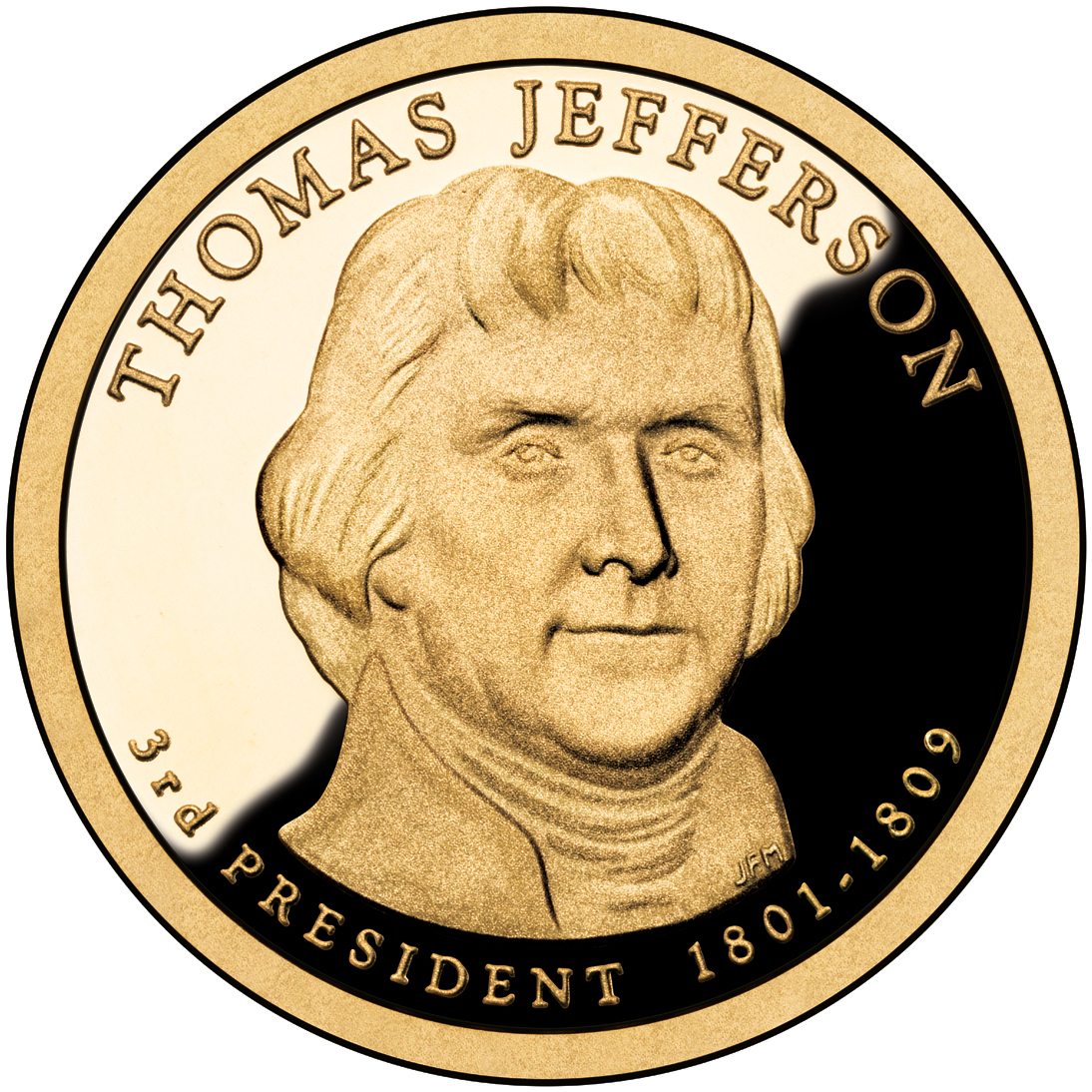
Jefferson dollars are the third in a series commemorating U.S. presidents. The series started with Washington and will proceed, three new coins a year, through all the presidents. (Quick: What’s the cheapest amount you can invest to get dollars representing all 43 administrations? Don’t forget Grover Cleveland’s anomaly . . .)
The Associated Press story notes three things of interest:
History: Fewer than a third of Americans know Jefferson was the third president. They did better with Washington as the first president. I had a few scary moments last year covering a Texas history course when kids kept answering either “George Washington” or “Abraham Lincoln” to the questions, “Who was the the Father of Texas?” (Stephen F. Austin) and “Who was the first president of the Republic of Texas?” (Sam Houston).
Economics: The vending machine industry loses about $1 billion each year when dollar bills jam in the machine’s vending mechanism. The U.S. Mint and vending machine operators hope the dollar coins catch on and help reduce those losses.
Dollar coins are unpopular: This is another in a series of efforts to “wean” people from paper dollars to coins — remember the Sacagawea dollar? The Eisenhower dollar? The Susan B. Anthony dollar? Just last week I got an Eisenhower dollar in change from our local Starbucks — they had mistakenly put it in the coin drawer for quarters. You can get dollar coins in change at the U.S. Post Office, but not at many other places. Our local post office occasionally sneaks a Euro into the dollar change mechanism. Bonus!
The Washington Post story carried more details of the poll, conducted by the Gallup organization for the U.S. Mint: Read the rest of this entry »
5 Comments | Economics, Financial literacy, Heroes, History, Lesson plans, TAKS, Thomas Jefferson | Tagged: coinage, Economics, Jefferson dollar, money, US Mint | Permalink
Posted by Ed Darrell
August 15, 1945, was VJ Day — the day that World War II ended in the Pacific Theatre. VJ is an acronym for Victory Japan. Victory in Europe, VE Day, was declared the previous April.
VJ Day is affiliated with a series of images that students of U.S. history should recognize; these images tell much of the story of the day and the events of the weeks leading up to it.
The most famous image is Alfred Eisenstadt’s photograph of an exuberant sailor kissing a swept-off-her-feet- for-the-moment nurse in Times Square, New York City. This is one of the most famous photographs from the most famous photographer from Life Magazine:
 Eisenstadt coolly titled his photo “VJ Day, Times Square.” It came to be known as The Smack Seen ‘Round the World. It was fitting that the photo would be taken by Eisenstadt, since his work came to be a symbol of Henry Luce’s Life Magazine in a pre-television era when photography magazines like Life and Look were key news organs for the nation.
In a fun and continuing mystery, several people have claimed to be the sailor, or the nurse, through the years.
Before the victory celebration, there had to be a victory. Japan asked for conditional surrender discussions, but the Allied forces insisted on unconditional surrender. Japanese military officials were rather certain that, if the Soviet Union entered the Pacific War, Allied victory would be assured. Japan hoped to either get a conditional surrender agreement, according to some sources, or inflict heavy losses on Allied forces to get better surrender conditions, but before Russia entered the war. Russia and Japan had long-standing grudges against one another dating from before their earlier war in the first decade of the 20th century.
12 Comments | 1941-1945, Atomic Bomb, Historic documents, History, History audio sources, Lesson plans, World War II | Permalink
Posted by Ed Darrell
August 15 is Leon Theremin’s birthday (b. 1896).
 Without Leon Theremin, musical scores to horror movies would be nearly impossible, at least for everyone except Henry Mancini and John Williams.
His life would make a great movie. He invented the Theremin in the midst of World War I in Russia; after the war he toured Europe, and then the U.S. He played Carnegie Hall, he collaborated with Albert Einstein, and he married a young African-American ballerina, Lavinia Williams. In 1938 he was kidnapped by the Soviet KGB and forced to return to Russia, in the Union of Soviet Socialist Republics (USSR).
Sent to a work camp, he worked alongside Andrei Tupelov and a host of other famous Soviet scientists. Theremin was “rehabilitated” in 1956. He returned to invention, and invented bugging devices, including the famous microphone that was placed in the Great Seal of the United States in the U.S. Embassy in Moscow. The bug had no moving or active parts, and no power supply, but could transmit when hit with a microwave transmission. The bug spied on U.S. diplomats from 1945 until its accidental discovery in 1952.
Later Theremin turned to inventions of devices to open doors, and to burglar alarms. He trained his niece, Lydia Kavina, on the Theremin — she is considered a virtuoso at the instrument today. In 1991 he returned to the U.S., reunited with some of the artists he’d worked with 50 years earlier for several concerts. He died in Russia in 1993, at the age of 97.
And if you’ve ever heard the Beach Boys’ recording of “Good Vibrations,” you know what a Theremin sounds like.
Leave a Comment » | Biography, Cold War, Communism, Creativity, History, Music, Technology | Permalink
Posted by Ed Darrell
Today is the 46th anniversary of the beginning of the Berlin Wall. The post I wrote last year on this topic continues to be popular, day in and day out, but especially when high school curricula get to the Cold War, the Berlin Airlift, the 1960s, and the collapse of the Soviet empire, best exemplified by the destruction of the Berlin Wall itself and the reunification of Germany.
The photograph I used to illustrate that post has become one of the more popular photos of the Berlin Wall on the internet. It is from a small, too-little used collection posted by Corey Hatch at the University of Utah.
Here is another photo from his collection. It comes without caption; from the barbed wire and the uniform and helmet, I would say This is cropped version of a photo of an East German soldier, Conrad Schumann , assigned to shoot people trying to breach the wall to escape to West Germany, who instead decided to leap to freedom himself, probably at Checkpoint Charlie, one of three gates between East and West Berlin. I regret I have no further credit information on the photo on August 15, 1961. The photo is by West German photographer Peter Leibing, then working for Contiepress, in Hamburg.
German authorities announced the Wall was open for travel between the two entities of divided Germany on November 9, 1989. Jubilant Germans on both sides of the wall tore down sections, poked holes in the concrete barriers, and generally vandalized the wall over the next few weeks. Negotiations then led the way for the Reunification of Germany on October 3, 1990.
23 Comments | Cold War, Communism, Democracy, Economics, Free market economics, Freedom - Economic, Freedom - Political, Geography - Political, History, History images | Tagged: Berlin Wall, Cold War, famous photographs | Permalink
Posted by Ed Darrell
Spectacular images of World War II historical sites are available at two websites every history or geography teacher should have bookmarked, and use frequently.
The first is D-Day spots, which features satellite photo/map hybrids, and dozens of Quicktime interactive panoramas of dozens of sites all along the beaches of Normandy.

The panoramic images are made up of digital photos, usually very high quality, which would be useful images even were they not part of the interactive, panoramic feature; see the image of the West Pointe du Hoc cliffs at right.
 Many beach shots are there, of course — the panoramic images also include a few other sites around the beaches, and some of those images are spectacular all on their own, such as the interior of a local church, Sainte Mére-Eglise.

The second site is Panoramas of World War II Landmarks 1945-2007.
These landmarks feature many battlefield sites, and they offer interactive, Quicktime panoramas of some sites that are not so well known as they ought to be, such as the graveyard at Al Alamein in Egypt (see photo below). To U.S. audiences, some of these sites may be relatively unknown — it’s a good excuse to explore the sites and get more familiar with the European view of World War II.

This site also features photos of the war in the Pacific, with a series of photos from Hiroshima (see below), Nagasaki and Tokyo, but also including Pearl Harbor and Okinawa.
Integrating these sites into directed teaching should be easy, if you have a computer and projector. At the D-Day site, many of the panoramas are downloadable. For the Landmarks site, an active internet connection may be required.

1 Comment | 1941-1945, D-Day, Famous Battles, Geography - Physical, History, History images, On-line education, On-line learning | Permalink
Posted by Ed Darrell
Our Italian physicist friend, Dorigo, at A Quantum Diaries Survivor reports that an Italian court ruled against a newspaper that started a campaign to deny the history of the Ardeatine Massacre.
Good news today. The supreme court of Cassazione in Italy has ruled that the press campaign labeling “terrorists” the GAP partisans who organized the bombing of Via Rasella in nazi-occupied Rome in 1944, launched by the national newspaper “Il Giornale”, was a striking example of manipulation of historic truth for political means. The newspaper is owned by Paolo Berlusconi (brother of Silvio, formerly premier of Italy in 1994 and 2001-2006), and was directed by Vittorio Feltri . . . a journalist who never hid his sympathy for the extreme right.
What was the Ardeatine Massacre?
The massacre of Fosse Ardeatine (Italian: Eccidio delle Fosse Ardeatine) took place in Rome, Italy during World War II. On 23 March 1944, 2 German soldiers, 31 Italian soldiers of Battaglione Bozen and a few Italian civilians passing along the road, were killed when members of the Italian Resistance set off a bomb close to a column of German soldiers who were marching on via Rasella[1]. This terrorist attack was led by the Gruppi di Azione Patriottica, of Rosario Bentivegna, Carla Capponi, Antonello Trombadori (Head of GAP in Roma) and the approval of Sandro Pertini (later President of Italian Republic), in order to provocate the reaction of SS troops.
Adolf Hitler is reported but never confirmed to have ordered that within 24 hours, one-hundred Italians were to be shot for each dead German. Commander Herbert Kappler in Rome concluded that ten Italians for each dead German would be sufficient and quickly compiled a list of 320 civilians who were to be killed. Kappler voluntarily added ten more names to the list when the 33rd German/Italian died after the Partisan attack. The total number of people murdered at the Fosse Ardeatine was 335, most Italians. The largest cohesive group among the murdered were the members of Bandiera Rossa, a Communist military Resistance group.
Why is there controversy 60 years later? Read the rest of this entry »
4 Comments | 1941-1945, Accuracy, Bogus history, History, History Revisionism, Hoaxes, Jurisprudence, Justice, Politics, TAKS, TEKS, Voodoo history, War, World War II | Tagged: Ardeatine Massacre, Holocaust, Human Rights, Rome, Travel, World War II | Permalink
Posted by Ed Darrell
Santayana’s ghost* e-mailed to call attention to this interview with Vice President Dick Cheney, in which he tells the errors of invading Iraq and deposing Saddam Hussein.
Unfortunately, the interview was with Dick Cheney in 1994, when he was ex-Secretary of Defense, hanging out with the American Enterprise Institute.
Talk about condemned to repeat the errors of history!
* In this case, in the guise of son, Kenny.
3 Comments | History, History video sources, Iraq, Presidents, Quotes, Santayana's ghost, War | Permalink
Posted by Ed Darrell
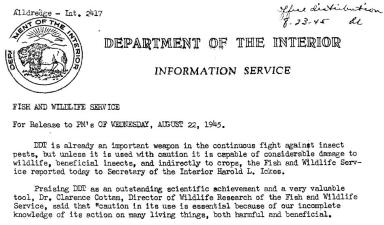
Archives of the U.S. Fish and Wildlife Service (FWS) reveal a long history of trouble with DDT, almost from the first uses of the chemical as an insecticide during World War II. You’ll find extensive links to historic press releases from FWS below the fold.
Critics of the various restrictions on DDT use often claim that DDT is a God-sent chemical that nearly eradicated malaria from the world (absolutely untrue) and which was banned only because of hysteria caused by Rachel Carson’s 1962 book, Silent Spring (untrue at both ends, hysteria and the power of Carson’s book). This is history revisionism at its worst, it is bogus history.
A careful study of the history of the use of DDT shows that scientists were concerned about its dangers from the first uses as a pesticide. The U.S. Fish and Wildlife Service reported dangers in a press release on August 22, 1945, just a week after the surrender of Japan ended World War II (VJ Day was August 15 in Tokyo, August 14 in Washington). In that release FWS noted the beneficial uses of DDT to fight insect and lice infestations that threatened troops and civilians with typhus and other diseases, but cautioned that such use should not become common, that more study was needed: Read the rest of this entry »
5 Comments | Bogus history, DBQ sources, DDT, Environmental protection, Historic documents, History, History Revisionism, Hoaxes, War on Science | Permalink
Posted by Ed Darrell
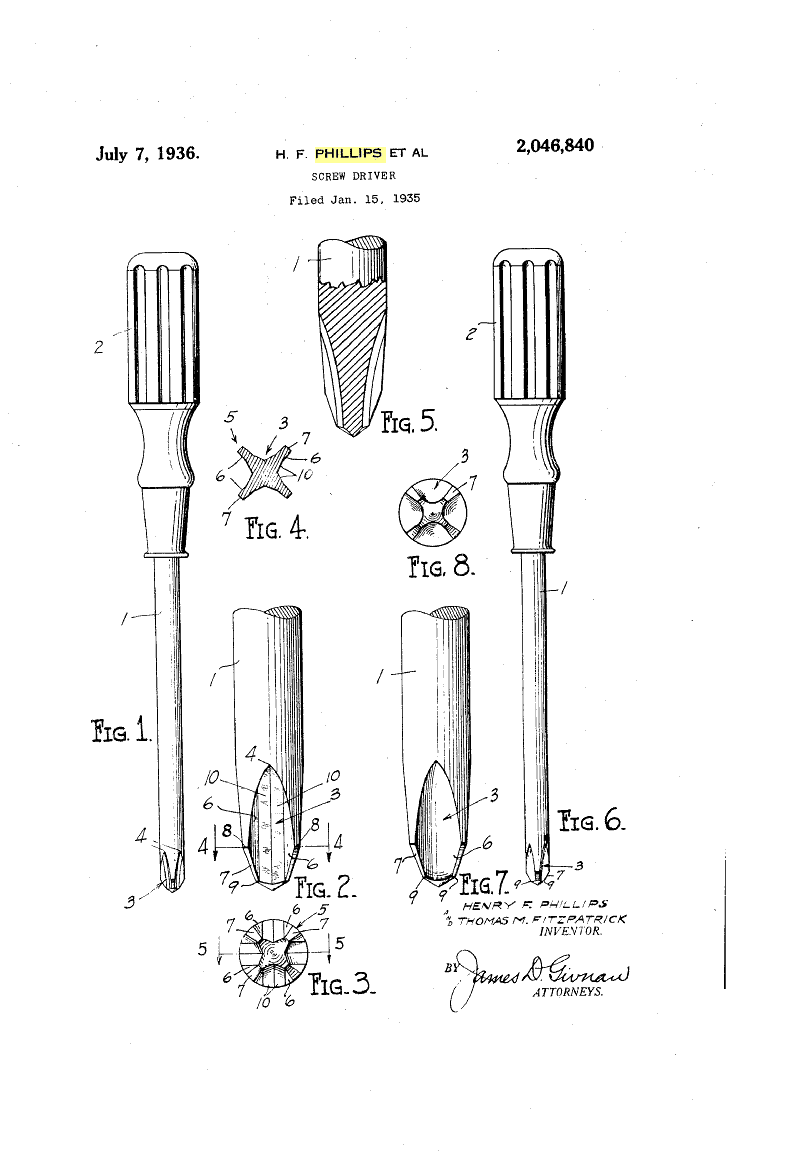
Patent drawings for the Phillips screw and screwdriver, 1936
Only Crook in Town was alerted to the work of Henry F. Phillips by an alert and helpful librarian (well — aren’t they all?). She worries –January 15 is Martin Luther King, Jr., Day, and July 7 is the middle of the summer — what day would be appropriate to celebrate the invention and patenting of the Phillips Screwdriver? (If image above does not display, click the thumbnail picture at the end of the post.)
Ah, history teachers, you noticed that the drawing comes from Google’s files of patent applications. And now you wonder: What other wonderful illustrations can we legally rip off to use in class? Wonderful question — what do you find?
The Phillips screwdriver came along in time for World War II and the mass assembly of aircraft, and aircraft instrument panels. The Phillips screw head helped aircraft assemblers keep from scratching the black metal of the rest of the panel while securing instruments into the forms.
12 Comments | Business, Business Ethics, Creativity, DBQ sources, Heroes, History, Invention, Law, Patents, Technology, World War II | Tagged: Business, Creativity, DBQ sources, Henry F. Phillips, Heroes, History, Inventions, Law, Phillips Screwdriver, Technology, World War II | Permalink
Posted by Ed Darrell
Continuing the week of contemplation of atomic bombs: Remember today is the anniversary of the destruction of Nagasaki, with a U.S. atomic bomb.

Japan surrendered unconditionally a short while later. See the earlier posts for more links.

Top photo: Nagasaki after the bomb. Bottom photo, Nagasaki National Peace Memorial Hall, photo by Toshio Kaneko, Architectural Record.
6 Comments | Atomic Bomb, History, War, World War II | Permalink
Posted by Ed Darrell
Here’s something students in economics courses should be discussing, from London’s Telegraph.com:
The Chinese government has begun a concerted campaign of economic threats against the United States, hinting that it may liquidate its vast holding of US treasuries if Washington imposes trade sanctions to force a yuan revaluation.
On so many levels, that discussion offers opportunities for students of economics to understand how markets, finance, and borrowing work. This news report alone could be the foundation for a couple of weeks of lesson plans on international finance, the Federal Reserve system, government spending, and general operation of markets.
Two officials at leading Communist Party bodies have given interviews in recent days warning – for the first time – that Beijing may use its $1.33 trillion (£658bn) of foreign reserves as a political weapon to counter pressure from the US Congress.
Shifts in Chinese policy are often announced through key think tanks and academies.
Described as China’s “nuclear option” in the state media, such action could trigger a dollar crash at a time when the US currency is already breaking down through historic support levels.
It would also cause a spike in US bond yields, hammering the US housing market and perhaps tipping the economy into recession. It is estimated that China holds over $900bn in a mix of US bonds.
Xia Bin, finance chief at the Development Research Centre (which has cabinet rank), kicked off what now appears to be government policy with a comment last week that Beijing’s foreign reserves should be used as a “bargaining chip” in talks with the US.
Could China afford to try such a move? Would it sink their economy, too? How could the U.S. try to mitigate such a move? Does this mean the U.S. needs to seriously control trade with China, or would that kind of interference in free markets do more damage by itself?
The Dow dropped 387 points in trading on the New York Stock Exchange today. News analysts ascribe it to concerns over sub-prime mortgage lender troubles, which caused a panic in French markets today. The credit-crunch “ripples around the world,” according to a PBS reporter.
One blogger at Telegraph.com says not to worry; Ambrose Evans-Pritchard says the dollar will not collapse:
Disregard all hysteria. The ailing Greenback will not collapse this year, not in ten years, not in twenty years, not in half a century. There is no credible currency against which it can collapse. (Unless you count gold). None of the world’s rival power blocs have the economic and demographic depth to challenge American dominance.
That view is shared by a lot of the more pragmatic and successful investment advisors.
What do your local newspapers say? How can you use this to weave together a coherent narrative for your economics curriculum, starting in a week or two?
Sources to beef up your classroom presentations:
1 Comment | Economics, Free market economics, Freedom - Economic, Freedom - Political, History, Personal finance | Permalink
Posted by Ed Darrell
You are currently browsing the archives for the History category.


Ed Darrell on Texas's Colorado River


Come on in, the water's fine. Come often: Cleanliness is next to godliness.


