George Washington: No military junta, no king; an example we can all follow

December 23, 2016

This is a mostly encore post, emphasizing George Washington’s astounding ability to draw from history just exactly the right lesson, and then set the example that makes history.

Washington, though having never attended college, was an inveterate reader, and a sharp student of history.  Early he read the story of the great Roman, Cincinnatus, who made the Roman Republic great with his refusal to lust for power.  Cincinnatus twice was named Dictator, and both times resigned the commission rather than personally profit as others did — after saving Rome both times, of course.

In his own life, Washington also twice cast off the mantle of top leader, once when he resigned his commission as Commander in Chief of the Continental Army when so many assumed he would just keep on, and add the title of “King of America;” and the second time when, as president, he stepped aside and retired, leaving the leadership of the nation up to the Constitutional processes that had never before been tried successfully in any nation.

Washington’s resignation from the army command came on December 23, 1783 — such an important anniversary usually gets lost in preparations for Christmas, so I’ll post it a bit early.  In your holiday toasts, lift a glass to George Washington, who gave us civilian rule, an end to monarchy, and an example of responsible leadership making way for peaceful succession.

In 2007, I wrote:

On December 23, 1783, Commander of the Continental Army, Gen. George Washington resigned his commission, to the Continental Congress sitting in Annapolis, Maryland. Washington modeled his actions on the life of Roman general and patriot Cincinnatus. (See especially this site, the Society of the Cincinnati)

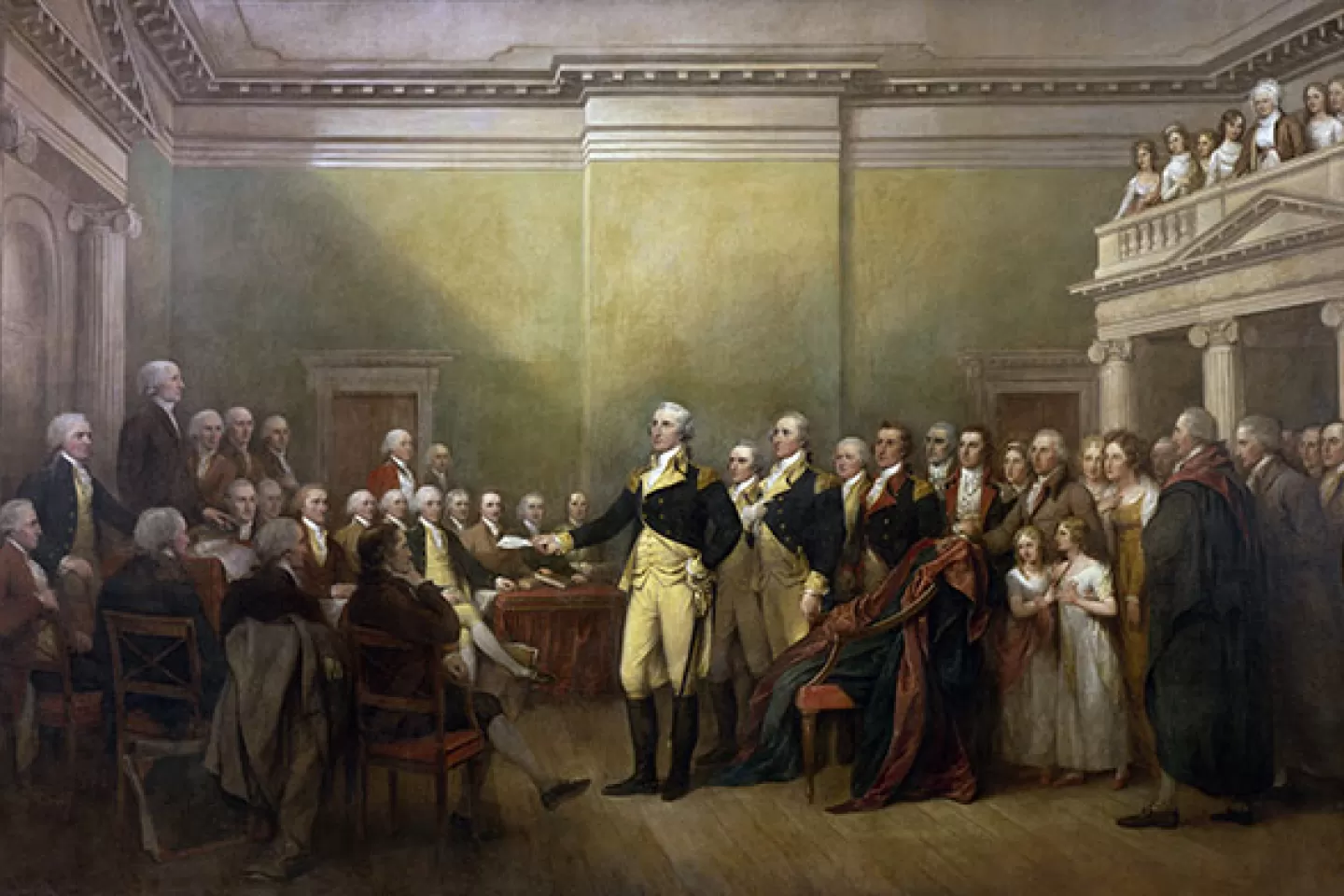
John Trumbull painting of Washington resigning his commission

John Trumbull’s painting of Washington resigning his commission; one of eight great paintings hanging in the Rotunda of the U.S. Capitol

Washington had been thought to be in a position to take over the government and declare himself king, if he chose. Instead, at some cost to himself he personally put down a rebellion of the officers of the army who proposed a coup d’etat against the Continental Congress, angered that they had not been paid. Washington quietly asked that the men act honorably and not sully the great victory they had won against Britain. Then Washington reviewed the army, wrapped up affairs, journeyed to Annapolis to resign, and returned to his farm and holdings at Mount Vernon, Virginia.

Because Washington could have turned into a tyrant, it is reported that King George III of England, upon hearing the news of Washington’s resignation, refused to believe it. If the report were true, George is reported to have said, Washington was the greatest man who ever lived.

Washington’s resignation set precedent: Civilian government controlled the military; Americans served, then went back to their private lives and private business; Americans would act nobly, sometimes when least expected.

From the Library of Congress American Memory site, “Today in History”:

George Washington resigned his commission as commander-in-chief of the Continental Army on December 23, 1783, in the senate chamber of the Maryland State House in Annapolis, where the Continental Congress was then meeting.

Although the British had recognized American independence with the signing of the Treaty of Paris on September 3, British troops did not evacuate New York until December 4. After the last British ships left the harbor, Washington bid an emotional farewell to his officers and set out for Annapolis. On the journey south he was met with throngs of well-wishers paying him tribute for his role in the nation’s military victory over Great Britain.

Washington left Annapolis at dawn on December 24 and set out for Mount Vernon, his plantation on the Potomac River in Virginia. He arrived home before nightfall on Christmas Eve, a private citizen for the first time in almost nine years.

The Maryland State Capitol in Annapolis.

The Maryland State Capitol in Annapolis.

Maryland State House, Annapolis, Maryland
William Henry Jackson, photographer, circa 1892.
Touring Turn-of-the-Century America, 1880-1920

When Washington visited The Maryland State House in 1783, the structure was incomplete and suffered from a leaking roof. By 1786, when representatives from Maryland and Virginia meeting at the State House rallied support for the movement to remedy defects in the Articles of Confederation, construction of a new dome had begun. Today, the building begun in 1772 is the oldest state house still in legislative use.

Located at the mouth of the Severn River on the Chesapeake Bay, Annapolis was settled in 1649 by Puritans who moved there from Virginia. The town was known in the seventeenth century as Town of Proctor’s, Town at the Severn, and Anne Arundel Town before it was named for Queen Anne in 1695. It is home to the U.S. Naval Academy and to St. John’s College, founded in 1696.

This is an encore post.

Yes, this is an encore post. Defeating ignorance takes patience and perseverance.

Save


Flags in New Jersey flying for statehood, December 18

December 18, 2016

New Jersey's Capitol in Trenton, by Vagabond Voyage. Many complain it's difficult to get a good, nice looking photo of this building due to development around it. This photo is alleged to be one of the better photos possible.
New Jersey’s Capitol in Trenton, by Vagabond Voyage. Many complain it’s difficult to get a good, nice looking photo of this building due to development around it. This photo is alleged to be one of the better photos possible.

December 18 is New Jersey Statehood Day.

U.S. Flag Code encourages residents of each state to fly the U.S. flag on their state’s anniversary of statehood. New Jersey won consideration as the Third State, on December 18, 1787, by being the third colony to ratify the U.S. Constitution. Technically the U.S. did not come into existence until six more states ratified, but among the first 13 states, statehood dates are calculated traditionally as the day the colony ratified.

Does anyone in New Jersey celebrate it?

New Jersey's state flag. Just try to find photos of the U.S. flag and New Jersey flag flying together.
New Jersey’s state flag. Just try to find photos of the U.S. flag and New Jersey flag flying together.
New Jersey's Capitol Building and surroundings in Trenton, from across the Delaware River. U.S. flag can be seen flying at the Capitol. Wikipedia image.
New Jersey’s Capitol Building and surroundings in Trenton, from across the Delaware River. U.S. flag can be seen flying at the Capitol. Wikipedia image.

More:

  • Next Fly Your Flag dates: December 28 in Iowa, for Iowa statehood; December 29 in Texas, for Texas statehood.

Save


Ashes to ashes, airplanes to spread them, Damon Runyon and silver bells; Wrights flew on December 17, on December 18 an airplane spread Damon Runyon’s ashes (not the same year)

December 18, 2016

Spent a day with my aging father-in-law last week. Conversation is difficult, but memories always flow. We watched the movie version of “Guys and Dolls,” with Sinatra and Brando, and Stubby Kaye’s get-up-and-sing version of “Sit Down! You’re Rockin’ the Boat.”

He was happy to see the thing again, though in the first few minutes he said he didn’t think he’d ever seen the film. My fondness for the piece, and for Damon Runyon’s stories, goes back (too many) decades to a production of the play by the Utah Valley Opera Society. They hired our high school drama director, David Larson, to direct. On a lark I auditioned, telling them I couldn’t really sing or dance, and ended up with a lot of lines in a couple of supporting roles, and singing and dancing both in the chorus.

When my father-in-law joined in the movie chorus of “Fugue for Tinhorns,” I knew we had a good couple of hours. We laughed, watched, reminisced, and sang along.

Damon Runyon could tell stories, true stories about real people. Sometimes the names were changed to protect the innocent, or the guilty; sometimes the real names were more entertaining than the fictional names Runyon invented.

Some time ago I stumbled across the story of Runyon’s son, Damon Runyon, Jr., using an early airplane to spread the playwright’s ashes. It’s a story Runyon would have appreciated. It’s appropriate for the day after the anniversary of the Wrights’ first flight; December 18 is the anniversary of the event.

On December 17, Orville and Wilbur Wright got their heavier-than-air flying contraption to actually fly with motor driving it along.

First flight of the Wright Flyer I, December 1...

First flight of the Wright Flyer I, December 17, 1903, Orville piloting, Wilbur running at wingtip. Photo from Wikipedia

On December 18, Damon Runyon, Jr., got Eddie Rickenbacker to fly over Broadway to scatter the ashes of his father, Damon Runyon.

First Lieutenant E. V. [Eddie] Rickenbacker, 9...

First Lieutenant E. V. [Eddie] Rickenbacker, 94th Aero Squadron, American ace, standing up in his Spad plane. Near Rembercourt, France. Photo from Wikipedia. This photo dates near World War I; Rickenbacker remained a hero for a couple of decades. In 1946, he flew a DC-3 over New York City, and illegally scattered the ashes of raconteur Damon Runyon over his beloved Broadwary.

Not exactly the next day. 43 years and one day apart.  The Wrights first flew in 1903; Runyon died in 1946.

Today in Literature, for December 18:

On this day in 1946 Damon Runyon’s ashes were scattered over Broadway by his son, in a plane flown by Eddie Rickenbacker. Runyon was born in Manhattan, Kansas; he arrived at the bigger apple at the age of thirty, to be a sportswriter and to try out at Mindy’s and the Stork Club and any betting window available his crap-shoot worldview: “All of life is six to five against.” Broadway became his special beat, and in story collections like Guys and Dolls he developed the colorful characters — Harry the Horse, the Lemon Drop Kid, Last Card Louie — and the gangster patois that would swept America throughout the thirties and forties.

A lot of history packed in there.  Runyon’s early reportorial career included a lot of that history — he wrote the lead story for United Press on the inauguration of Franklin Roosevelt, for one example.  Runyon found a uniquely American vein of literary ore on Broadway in New York City, and in the ne’er-do-wells, swells, tarts and reformers who flocked to the City that Never Sleeps to seek fame, or fortune, or swindle that fortune from someone else.

As a reporter and essayist, he smoked a lot.  Throat cancer robbed him, first of his voice, then his life at 56.

Runyon’s ashes were spread illegally over Broadway, from a DC-3 piloted by Rickenbacker. Runyon would have liked that.

You couldn’t make this stuff up.

Factoids of history:

  • Twenty movies got crafted from Runyon stories, including “The Lemon Drop Kid” — in two versions, 1934 and 1951. Appropriate to the Christmas season, the 1951 version introduced the song, “Silver Bells” composed by Jay Livingston and Ray Evans. (Great explanation of the movie, and song, here.)
  • Runyon got fame first as a sports writer.  He was inducted into the writer’s wing of the Baseball Hall of Fame in 1967.
  • According to Wikipedia, Jerry Lewis and others owe a great debt to Damon Runyon:  “The first ever telethon was hosted by Milton Berle in 1949 to raise funds for the Damon Runyon Cancer Research Foundation.”
  • One might salivate over the varied fare offered in the theaters of Broadway in 1946, Runyon’s final year, “Annie, Get Your Gun” through Shakespeare, and everything in between and on either side
  • Runyon and H. L. Mencken both covered the trial of Bruno Hauptmann, the accused (then convicted) kidnapper of Charles Lindbergh’s baby son
  • Yes, of course, “Guys and Dolls.” Frank Loesser created it, but not of whole cloth, but from the stories of Damon Runyon; it is a masterpiece, perhaps in several realms.  In homage to Runyon, Adam Gopnik wrote:

    Just as Chandler fans must be grateful for Bogart, Runyon fans have to be perpetually happy that the pure idea of Runyon, almost independent of his actual writings, produced the best of all New York musicals: Frank Loesser’s “Guys and Dolls,” which made its début in 1950 and is just now reopening on Broadway in a lavish and energetic new production. But then “Guys and Dolls” is so good that it can triumph over amateur players and high-school longueurs and could probably be a hit put on by a company of trained dolphins in checked suits with a chorus of girl penguins.

    Your author here, Dear Reader, was once one of those trained dolphins. It was magnificent.

“Silver Bells,” from “The Lemon Drop Kid,” with William Frawley, Virginia Maxwell and Bob Hope (1951 version):

More:

A view of New York City in 1946:

Thomas Hart Benton (1889–1975)

Thomas Hart Benton (1889–1975) “The Artist’s Show, Washington Square,” painted in 1946

Times Square, showing part of Broadway, in November 1946, from the magnificent archives of Life Magazine:

Brownout Time Square.November 1946.© Time Inc.Herbert Gehr - See more at: http://kcmeesha.com/2011/11/29/old-photos-times-square-through-the-years/#sthash.ru9W0F9h.dpuf

Brownout Time Square.November 1946.© Time Inc.Herbert Gehr – See more at: http://kcmeesha.com/2011/11/29/old-photos-times-square-through-the-years/#sthash.ru9W0F9h.dpuf

Yes, this is mostly an encore post. Fighting ignorance requires patience.

Yes, this is mostly an encore post. Fighting ignorance requires patience.

Save

Save


Beethoven’s birthday and baptism, and accident on the way to the concert hall

December 18, 2016

Beethoven takes an unplanned swim in his rush to the concert hall in Google's Doodle honoring the composer's 245th year. Image from Google, via Washington Post

Beethoven takes an unplanned swim in his rush to the concert hall in Google’s Doodle honoring the composer’s 245th year, 2015. Image from Google, via Washington Post.

Maybe we should say “happy baptism.” The infant Ludwig von Beethoven was baptized on December 17, 1770; he was born the previous day, perhaps (some historians disagree). In 2016, Beethoven is 246. No longer alive, of course.

But the point is, Google honored Beethoven with an interactive Google Doodle in 2015, one of the best they’ve ever done. The Doodle features the composer finishing scores and heading to the concert hall — with a series of mishaps along the way that scatter his musical scores and leaves them torn up, speared and generally out of order.

Then you, Dear Reader, get a chance to re-arrange the score in order. When you do that, it plays. Finally Beethoven gets to the concert hall.

It’s a great learning device, really. Can Google do this for history? Can we figure out a way to create these for use in our classrooms?

Here is the intro to the piece (I’m not skilled enough to embed the entire quiz). Click to Google for the entire piece, with the quizzes.

Now that you’ve finished the quizzes, relax for 42 minutes with Beethoven’s Symphony No. 6, The Pastorale, performed by the Bremen symphonie, directed by Paavo Jarvi.

Information:

Beethoven: Symphony No.6 in F, “Pastorale”, Op.68
Deutsche Kammerphilharmonie Bremen
Paavo Jarvi, dir.

Yes, this is mostly an encore post. Fighting ignorance requires patience.

Yes, this is mostly an encore post. Fighting ignorance requires patience. Just teaching history requires patience.

Save

Save


December 17, history written in the wind and engraved in stone

December 17, 2016

Ten feet in altitude, 120 feet traveled, 12 seconds long. That was the first flight in a heavier-than-air machine achieved by Orville and Wilbur Wright of Dayton, Ohio, at Kittyhawk, North Carolina, on December 17, 1903.

Few witnesses observed the flight.  Though the brothers Wright fully understood the potential of the machine they had created, even they waited before revealing to their supporters, and then the world, what they had accomplished.

Critics complain others achieved flight in a heavier-than-air machine before the Wrights. There are stories of flights in Texas, Connecticut, and France. If anyone achieved flight before the Wrights, the Wrights did a much better job of recording their achievement, and promoting it afterward. In the end, the Wrights left a legacy of flight research conducted in classic science, with careful records, a lot of experiments and observations, and publication of results.

We honor the Wrights.

From the Library of Congress:

On the morning of December 17, 1903, Wilbur and Orville Wright took turns piloting and monitoring their flying machine in Kill Devil Hills, North Carolina. Orville piloted the first flight that lasted just twelve seconds. On the fourth and final flight of the day, Wilbur traveled 852 feet, remaining airborne for 57 seconds. That morning the brothers became the first people to demonstrate sustained flight of a heavier-than-air machine under the complete control of the pilot.

No lost luggage, no coffee, no tea, no meal in a basket, either.  No ATC (Air Traffic Control) delays.  Neither brother endured a TSA screening.

Resources on the Wright Brothers’ first flight:

(I almost always forget the big dates until the end of the day.  This is mostly an encore post.)

Yes, this is mostly an encore post. Fighting ignorance requires patience.

Again, this is mostly an encore post. Fighting ignorance requires patience.

Save


Millard Fillmore’s letter to Abraham Lincoln, December 16, 1861: The Trent Affair

December 16, 2016

First page of Millard Fillmore's letter to Abraham Lincoln on the Trent Affair, sent December 16, 1861, 155 years ago today. Library of Congress image.

First page of Millard Fillmore’s letter to Abraham Lincoln on the Trent Affair, sent December 16, 1861, 155 years ago today. Library of Congress image.

Sometimes ex-presidents get the bug to offer advice to the person holding the office at the time.

Most of the time they let the urge pass.

But on December 16, 1861, former President Millard Fillmore shot off a letter to Abraham Lincoln, 7 months into the Civil War, warning Lincoln that a breach of relationships with Britain was to be avoided. Britain complained when U.S. warships stopped a British ship and arrested two Confederate diplomats.

It’s known as the Trent Affair, after the name of the British ship that was stopped.

It’s an example of a foreign nation interfering in domestic affairs of the U.S. Do we ever face such circumstances in the 21st century? Do we expect different results today?

Fillmore’s letter, in transcript:

Abraham Lincoln Papers at the Library of Congress. Transcribed and Annotated by the Lincoln Studies Center, Knox College. Galesburg, Illinois.

Millard Fillmore to Abraham Lincoln, Monday, December 16, 1861 (Trent Affair)

From Millard Fillmore to Abraham Lincoln, December 16, 1861

Buffalo, Dec. 16. 1861.

Sir,

I have never, under any circumstances, presumed to offer any advice, as to men or measures, to those who have succeeded me in the administration of the Government; and I beg of you to consider the few crude suggestions which I am now about to make, as mere hints from one who will feel no mortification, personally, if they should be wholly disregarded.

I can in some measure appreciate the difficulties with which the administration of the Government is now embarrassed by this unholy rebellion; for I heard the muttering thunder, and viewed the gathering storm at a distance in 1850; and while I approve most cordially of the firm stand which you have taken in support of the constitution, as it is, against insane abolitionism on one side and rebellious secessionism on the other, and hope and trust that you will remain firm; yet, it was not to speak of this that I took up my pen, but of a new danger which threatens more immediately our Northern frontier, but in its consequences, most fatally, the whole country. You of course must anticipate that I refer to a threatened rupture with England;1 for if we are so unfortunate as to be involved in a war with her at this time, the last hope of restoring the Union will vanish, and we shall be overwhelmed with the double calamities of civil and foreign war at the same time, which will utterly exhaust our resources, and may practically change the form of our government and compel us in the end to submit to a dishonorable peace.

I perceive that the telegram of this morning announces the fact from semi-official sources that, the law officers of Great Britain have given it as their opinion that the arrest of Messrs. Mason & Slidell and forcibly taking them from the Trent, a British merchant or transport vessel, was not justified by the law of nations; and that the British Cabinet were united in sending a despatch to Lord Lyon,2 protesting against the act, and demanding satisfaction by the restoration of the prisoners and a suitable apology for the insult to the British Flag. I still cherish the hope, however, that this statement may be greatly exagerated– But suppose it be true– What then? It may be said that one of two things must happen– Either, this Government must submit to the demand thus made upon it by Great Britain, or take the hazards of a war at a most inconvenient time to settle a point of international law by resort to arms. This alternative should be avoided it it can be with honor, and I venture to suggest that it may be, by urging in a firm but conciliatory argument in reply to the demand of Great Britain, our views of the Belligerent right to arrest these men, but conclude by saying that although we feel assured that we are right, yet if Great Britain after weighing our argument still adheres to the opinion that we are wrong, then as this is a purely legal question, where no insult was intended to the flag of Great Britain, nor any intention to invade her rights, and as the point in dispute is one of international law in which all maritime nations are interested, we propose to submit it to one of the crowned heads of Europe for arbitrament, agreeing to abide its award. It seems to me that Great Britain can not refuse so fair a proposition. But if she does, and insists on an unconditional compliance with her demand or war, all Christendom will then hold her responsible for the consequences.

I trust you will pardon these suggestions, which are made on the spur of the moment, without consultation with, or the knowledge of, any one; and may remain in confidence between us if you prefer that they should.

I am with sincere respect &

great haste, Truly yours

Millard Fillmore

[Note 1 On November 8, 1861 Captain Charles Wilkes of the U. S. S. San Jacinto intercepted the Trent, a British ship, and arrested James Mason and John Slidell who were on their way to Europe as representatives of the Confederacy. This violation of Britain’s neutrality nearly led to a war with the United States.]

[Note 2 Lord Lyons was the British minister to the United States.]

Could students today translate that letter, written in cursive? Maybe, for the sake of knowing history, we need to teach students how to read cursive, if not write it. Is it possible to teach reading without the writing?

Page 2, Millard Fillmore to Abraham Lincoln, on the Trent Affair. Library of Congress image.

Page 2, Millard Fillmore to Abraham Lincoln, on the Trent Affair. Library of Congress image.


Page 3 of Fillmore letter to Lincoln. Library of Congress image.

Page 3 of Fillmore letter to Lincoln. Library of Congress image.


Page 4 of Fillmore's letter to Lincoln. Library of Congress image.

Page 4 of Fillmore’s letter to Lincoln. Library of Congress image.


Page 6, the last page of Millard Fillmore's letter to Abraham Lincoln about the Trent Affair. Library of Congress image.

Page 5, the last page of Millard Fillmore’s letter to Abraham Lincoln about the Trent Affair. Page 6 shows only the author and topic.  Library of Congress image.

Save

Save


Fact sheet for World Malaria Report 2016

December 16, 2016

A woman shows the mosquito net that protects her and her family from malaria transmission, in India. India remains the world's top DDT user, but is switching to nets in an effort to bring malaria rates down and set up malaria eradication before the end of DDT in 2020. WHO image.

A woman shows the mosquito net that protects her and her family from malaria transmission, in India. India remains the world’s top DDT user, but is switching to nets in an effort to bring malaria rates down and set up malaria eradication before the end of DDT in 2020. WHO image.

World Health Organization publishes an annual World Malaria Report, with the year appended to the title. It summarizes the state of the fight against malaria worldwide, recording progress and setbacks.

In the tally of progress we get a clear indication of what is needed to continue or increase that progress, with the ultimate goal of controlling malaria to the point it poses no great economic risk, or health risk, to any nation, or better that human malaria is eradicated.

World Malaria Report 2016 is 184 pages, shorter than some previous reports but packed with figures and history, some of which requires greater background to understand completely.

For example, the 2016 publication notes that about 412,000 people died from malaria in 2016. This is a shocking figure. Most of the news coverage of the report mentions this death toll in the first paragraph.

It’s too many deaths. But it’s a more than 50% reduction in deaths from 1990s rates, and it’s a more than 90% reduction from the annual death tolls that shocked the world to concerted action after World War II. Most estimates are that about 5 million people a year died from malaria through the 1950s, and into the 1960s.

WHO concentrates on the malaria fight, and plays down the political aspects to encourage international cooperation to help fight the disease. But there are political statements made, if one has the background to understand them. There remains controversy over the use of DDT, with many people yelling far and wide that if ‘bans on DDT were removed’ then malaria would quickly become an eradicated disease. This position ignores the facts, that there were still 5 million people dying each year during peak DDT use; that death tolls plunged after the U.S. banned DDT use on crops; that the U.S. ban covered only crop use, and that DDT use against disease has never been banned anywhere in the world; and that DDT use continued long after the U.S. banned DDT, around the world. DDT use never stopped.

Taken together, we would understand that the 90% reduction in malaria deaths from peak DDT use years, was accomplished mostly without DDT, and that therefore DDT is not a panacea.

World Malaria Report 2016 also tallies the slow demise of DDT. Mosquito resistance to pesticides, especially DDT, is a major problem in the fight against the disease. But more DDT can’t fix that problem now that every mosquito on Earth carries alleles that make them resistant and wholly immune to the stuff. DDT will probably never be a panacea, even were its manufacture not scheduled to stop very soon.

History, and a complete assessment of the science and current conditions in the frontlines of the malaria fight, can help us put these things in perspective.

So far, only the Los Angeles Times in the U.S. provided any in-depth reporting on World Malaria Report 2016. We hope other media will take up the challenge to inform. They will find WHO’s Fact Sheet useful.

With that warning in mind, it’s good to look at the broad outlines of the report, which WHO has packaged into a fact sheet for our convenience.

Fact Sheet: World Malaria Report 2016

13 December 2016

The World Malaria Report, published annually by WHO, tracks progress and trends in malaria control and elimination across the globe. It is developed by WHO in collaboration with ministries of health and a broad range of partners. The 2016 report draws on data from 91 countries and areas with ongoing malaria transmission.

Global progress and disease burden (2010–2015)

According to the report, there were 212 million new cases of malaria worldwide in 2015 (range 148–304 million). The WHO African Region accounted for most global cases of malaria (90%), followed by the South-East Asia Region (7%) and the Eastern Mediterranean Region (2%).

In 2015, there were an estimated 429 000 malaria deaths (range 235 000–639 000) worldwide. Most of these deaths occurred in the African Region (92%), followed by the South-East Asia Region (6%) and the Eastern Mediterranean Region (2%).

Between 2010 and 2015, malaria incidence rates (new malaria cases) fell by 21% globally and in the African Region. During this same period, malaria mortality rates fell by an estimated 29% globally and by 31% in the African Region.

Between 2010 and 2015, malaria incidence rates (new malaria cases) fell by 21% globally and in the African Region. During this same period, malaria mortality rates fell by an estimated 29% globally and by 31% in the African Region.

Other regions have achieved impressive reductions in their malaria burden. Since 2010, the malaria mortality rate declined by 58% in the Western Pacific Region, by 46% in the South-East Asia Region, by 37% in the Region of the Americas and by 6% in the Eastern Mediterranean Region. In 2015, the European Region was malaria-free: all 53 countries in the region reported at least 1 year of zero locally-acquired cases of malaria.

Children under 5 are particularly susceptible to malaria illness, infection and death. In 2015, malaria killed an estimated 303 000 under-fives globally, including 292 000 in the African Region. Between 2010 and 2015, the malaria mortality rate among children under 5 fell by an estimated 35%. Nevertheless, malaria remains a major killer of under-fives, claiming the life of 1 child every 2 minutes.

Trends in the scale-up of malaria interventions

Vector control is the main way to prevent and reduce malaria transmission. Two forms of vector control are effective in a wide range of circumstances: insecticide-treated mosquito nets (ITNs) and indoor residual spraying (IRS).

ITNs are the cornerstone of malaria prevention efforts, particularly in sub-Saharan Africa. Over the last 5 years, the use of treated nets in the region has increased significantly: in 2015, an estimated 53% of the population at risk slept under a treated net compared to 30% in 2010.

Indoor residual spraying of insecticides (IRS) is used by national malaria programmes in targeted areas. In 2015, 106 million people globally were protected by IRS, including 49 million people in Africa. The proportion of the population at risk of malaria protected by IRS declined from a peak of 5.7% globally in 2010 to 3.1% in 2015.

Diagnostics

WHO recommends diagnostic testing for all people with suspected malaria before treatment is administered. Rapid diagnostic testing (RDTs), introduced widely over the past decade, has made it easier to swiftly distinguish between malarial and non-malarial fevers, enabling timely and appropriate treatment.

New data presented in the report show that, in 2015, approximately half (51%) of children with a fever who sought care at a public health facility in 22 African countries received a malaria diagnostic test compared to 29% in 2010. Sales of RDTs reported by manufacturers rose from 88 million globally in 2010 to 320 million in 2013, but fell to 270 million in 2015.

Treatment

Artemisinin-based combination therapies (ACTs) are highly effective against P. falciparum, the most prevalent and lethal malaria parasite affecting humans. Globally, the number of ACT treatment courses procured from manufacturers increased from 187 million in 2010 to a peak of 393 million in 2013, but subsequently fell to 311 million in 2015.

Prevention in pregnancy

Malaria infection in pregnancy carries substantial risks for the mother, her fetus and the newborn child. In Africa, the proportion of women who receive intermittent preventive treatment in pregnancy (IPTp) for malaria has been increasing over time, but coverage levels remain below national targets.

IPTp is given to pregnant women at scheduled antenatal care visits after the first trimester. It can prevent maternal death, anaemia and low birth weight, a major cause of infant mortality. Between 2010 and 2015, there was a five-fold increase in the delivery of 3 or more doses of IPTp in 20 of the 36 countries that have adopted WHO’s IPTp policy – from 6% coverage in 2010 to 31% coverage in 2015.

Insecticide and drug resistance

In many countries, progress in malaria control is threatened by the rapid development and spread of antimalarial drug resistance. To date, parasite resistance to artemisinin – the core compound of the best available antimalarial medicines – has been detected in 5 countries of the Greater Mekong subregion.

Mosquito resistance to insecticides is another growing concern. Since 2010, 60 of the 73 countries that monitor insecticide resistance have reported mosquito resistance to at least 1 insecticide class used in nets and indoor spraying; of these, 50 reported resistance to 2 or more insecticide classes.

Progress towards global targets

To address remaining challenges, WHO has developed the Global Technical Strategy for Malaria 2016-2030 (GTS). The Strategy was adopted by the World Health Assembly in May 2015. It provides a technical framework for all endemic countries as they work towards malaria control and elimination.

This Strategy sets ambitious but attainable goals for 2030, with milestones along the way to track progress. The milestones for 2020 include:

  • Reducing malaria case incidence by at least 40%;
  • Reducing malaria mortality rates by at least 40%;
  • Eliminating malaria in at least 10 countries;
  • Preventing a resurgence of malaria in all countries that are malaria-free.

Progress towards the GTS country elimination milestone is on track: In 2015, 10 countries and areas reported fewer than 150 locally-acquired cases of malaria. A further 9 countries reported between 150 and 1000 cases.

However, progress towards other GTS targets must be accelerated. Less than half (40) of the 91 malaria-endemic countries are on track to meet the GTS milestone of a 40% reduction in malaria case incidence by 2020. Progress has been particularly slow in countries with a high malaria burden.

Forty-nine countries are on track to achieve the milestone of a 40% reduction in malaria mortality; this figure includes 10 countries that reported zero malaria deaths in 2015.

Funding trends

In 2015, malaria funding totalled US$ 2.9 billion, representing only 45% of the GTS funding milestone for 2020. Governments of malaria-endemic countries provided 32% of total funding. The United States of America and the United Kingdom are the largest international funders of malaria control and elimination programmes, contributing 35% and 16% of total funding, respectively. If the 2020 targets of the GTS are to be achieved, total funding must increase substantially.

More:

Save

Save


December 14, Alabama flies the flag for statehood

December 14, 2016

U.S. and Alabama flags share a pole at the Alabama Capitol Building in Montgomery. USFlagStore.com image.

U.S. and Alabama flags share a pole at the Alabama Capitol Building in Montgomery. USFlagStore.com image.

Alabama joined the union on December 14, 1819, the 22nd state.

Under provisions of the U.S. Flag Code, residents of a state are encouraged to fly the U.S. flag on their respective statehood day.

Does Alabama commemorate its own statehood?

More: 


U.S. and Alabama flags flying together. Liberty Flagpoles image.

U.S. and Alabama flags flying together. Liberty Flagpoles image.

Save

Save


White House proclamation: Pearl Harbor Remembrance Day, 2016

December 7, 2016

President Barack Obama places a wreath at the USS Arizona Memorial, part of the World War II Valor in the Pacific National Monument, in Pearl Harbor, Hawaii, Dec. 29, 2011. (Official White House Photo by Pete Souza)

President Obama proclaimed Pearl Harbor Remembrance Day for 2016:

Presidential Proclamation

National Pearl Harbor Remembrance Day, 2016

NATIONAL PEARL HARBOR REMEMBRANCE DAY, 2016

– – – – – – –

BY THE PRESIDENT OF THE UNITED STATES OF AMERICA

A PROCLAMATION

Seventy-five years ago, Japanese fighter planes attacked the United States Naval Base at Pearl Harbor, destroying much of our Pacific Fleet and killing more than 2,400 Americans. The following day, President Franklin D. Roosevelt called on the Congress to declare war and “make it very certain that this form of treachery shall never again endanger us.” In that spirit, Americans came together to pay tribute to the victims, support the survivors, and shed the comforts of civilian life to serve in our military and fight for our Union. Each year on National Pearl Harbor Remembrance Day, we honor those whose lives were forever changed that December morning and resolve to uphold the legacy of all who stepped forward in our time of need.

From the docks of Pearl Harbor to the beaches of Normandy and far around the world, brave patriots served their country and defended the values that have sustained our Nation since its founding. They went to war for liberty and sacrificed more than most of us will ever know; they chased victory and defeated fascism, turning adversaries into allies and writing a new chapter in our history. Through their service and unparalleled devotion, they inspired a generation with their refusal to give in despite overwhelming odds. And as we reflect on the profound debt of gratitude we owe them for the freedoms we cherish, we are reminded of the everlasting responsibilities we have to one another and to our country.

In memory of all who lost their lives on December 7, 1941 — and those who responded by leaving their homes for the battlefields — we must ensure the sacrifices they made in the name of liberty and democracy were not made in vain. On this solemn anniversary, there can be no higher tribute to these American patriots than forging a united commitment to honor our troops and veterans, give them the support and care they deserve, and carry on their work of keeping our country strong and free.

The Congress, by Public Law 103-308, as amended, has designated December 7 of each year as “National Pearl Harbor Remembrance Day.”

NOW, THEREFORE, I, BARACK OBAMA, President of the United States of America, do hereby proclaim December 7, 2016, as National Pearl Harbor Remembrance Day. I encourage all Americans to observe this solemn day of remembrance and to honor our military, past and present, with appropriate ceremonies and activities. I urge all Federal agencies and interested organizations, groups, and individuals to fly the flag of the United States at half-staff this December 7 in honor of those American patriots who died as a result of their service at Pearl Harbor.

IN WITNESS WHEREOF, I have hereunto set my hand this sixth day of December, in the year of our Lord two thousand sixteen, and of the Independence of the United States of America the two hundred and forty-first.

BARACK OBAMA


December 7, 2016: Fly your flags for Pearl Harbor Remembrance, and for Delaware statehood — and at half staff

December 7, 2016

Flag flies at half-staff over the USS Utah, in Pearl Harbor (2004 photo – Pearl Harbor, Hawaii (May 31, 2004) – Sailors assigned to ships based at Pearl Harbor bring the flag to half-mast over the USS Utah Memorial on Ford Island in honor of Memorial Day May 31, 2004. U.S. Navy photo)

Flag flies at half-staff over the USS Utah, in Pearl Harbor (2004 photo – Pearl Harbor, Hawaii (May 31, 2004) – Sailors assigned to ships based at Pearl Harbor bring the flag to half-mast over the USS Utah Memorial on Ford Island in honor of Memorial Day May 31, 2004. U.S. Navy photo)

December 7 is a two-fer flag-flying day.

By public law, December 7 is Pearl Harbor Remembrance Day, and Americans fly the U.S. flag in memory of those who lost their lives at Pearl Harbor on December 7, 1941. U.S. flags should be flown at half-staff.

Under the U.S. Flag Code, residents of the relevant state should fly their U.S. flag on the date the state joined the union.

In 1787 Delaware quickly and promptly elected delegates to the former colony’s convention to ratify the Constitution proposed at the Philadelphia convention just over three months earlier. The ratification of the Constitution won opposition from strong factions in almost every state. Pols anticipated tough fights in New York, Virginia, and other states with large populations. They also expected other states would wait to see what the bigger states did.

Delaware didn’t wait.  On December 7 Delaware became the first of the former British colonies to ratify the Constitution. Perhaps by doing so, it guaranteed other states would act more favorably on ratification.

Because Delaware was first, it is traditionally granted first position in certain ceremonies, such as the parades honoring newly-inaugurated presidents. Delaware’s nickname is “The First State.”

In Delaware and the rest of the nation, fly your flags on December 7, 2016.

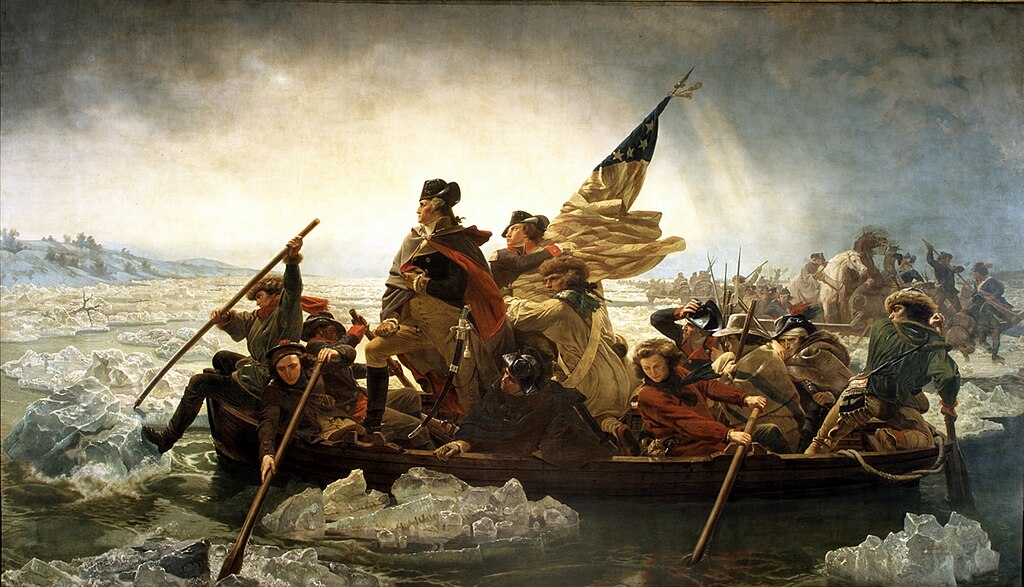
The most famous portrayal of a U.S. flag flying in Delaware is in the painting by Emanuel Leutze (American, 1816–1868).

The most famous portrayal of a U.S. flag flying in Delaware is in the painting by Emanuel Leutze (American, 1816–1868). “Washington Crossing the Delaware,” 1851. The Metropolitan Museum of Art, New York, Gift of John Stewart Kennedy, 1897 (97.34) Among other problems with this portrayal: The flag depicted had not been designated on the date of the crossing, Christmas 1776.

Yes, this is mostly an encore post. Fighting ignorance requires patience.

Yes, this is mostly an encore post. Fighting ignorance requires patience.

Save

Save


December 2016 flag-flying days

December 7, 2016

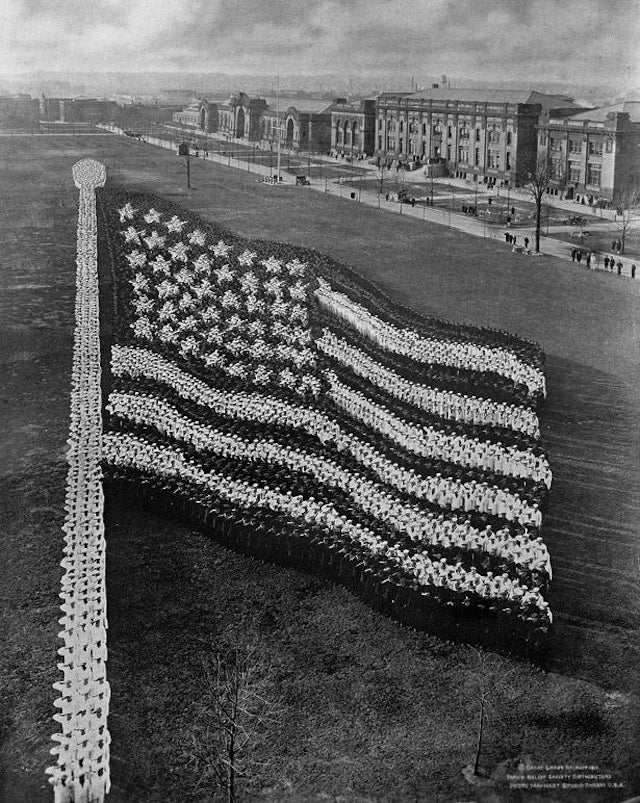
A

A “living flag” composed of 10,000 sailors, or “Blue Jackets at Salute,” by the Mayhart Studios, December 1917; image probably at the Great Lakes training facility of the Navy. Gawker media image

November offers several flag flying days, especially in years when there is an election.

But December may be the month with the most flag-flying dates, when we include statehood days.

December 7 is Pearl Harbor Remembrance Day.  It’s not in the Flag Code, but public law (P.L. 103-308) urges that the president should issue a proclamation asking Americans to fly flags.

December 25 is Christmas Day, a federal holiday, and one of the score of dates designated in the Flag Code. If you watch your neighborhood closely, you’ll note even some of the most ardent flag wavers miss posting the colors on this day, as they do on Thanksgiving and New Years.

Other dates?

Nine states attained statehood in December, so people in those states should fly their flags (and you may join them).  Included in this group is Delaware, traditionally the “First State,” as it was the first colony to ratify the U.S. Constitution:

  • Illinois, December 3 (1818, 21st state)
  • Delaware, December 7 (1787, 1st state)
  • Mississippi, December 10 (1817, 20th state)
  • Indiana, December 11 (1816, 19th state)
  • Pennsylvania, December 12 (1787, 2nd state)
  • Alabama, December 14 (1819, 22nd state)
  • New Jersey, December 18 (1787, 3rd state)
  • Iowa, December 28 (1846, 29th state)
  • Texas, December 29 (1845, 28th state)

December 15 is Bill of Rights Day, marking the day in 1791 when the Bill of Rights was declared ratified; but though this event generally gets a presidential proclamation, there is no law or executive action that requires flags to fly on that date, for that occasion.

Eleven flag-flying dates in December.  Does any other month have as many flag flying opportunities?

Have I missed any December flag-flying dates?  11 events on 10 days (Delaware’s statehood falls on the anniversary of the Pearl Harbor attack).

Here’s a list of the days to fly the flag, under national law, in chronological order:

  1. Illinois, December 3 (1818, 21st state)
  2. Pearl Harbor Remembrance Day, December 7
  3. Delaware, December 7 (1787, 1st state) (shared with Pearl Harbor Remembrance Day)
  4. Mississippi, December 10 (1817, 20th state)
  5. Indiana, December 11 (1816, 19th state)
  6. Pennsylvania, December 12 (1787, 2nd state)
  7. Alabama, December 14 (1819, 22nd state)
  8. New Jersey, December 18 (1787, 3rd state)
  9. Christmas Day, December 25
  10. Iowa, December 28 (1846, 29th state)
  11. Texas, December 29 (1845, 28th state)

Fly your flag with respect to the flag, for the republic it represents, and for all those who sacrificed that it may wave on your residence.

Appropriate to a snowy December.

Appropriate to a snowy December. “The Barn on Grayson-New Hope Road. This barn with its old truck and ever-present American flag, is often the subject of photographs and paintings by the locals.” Photo and copyright by Melinda Anderson

Yes, this is mostly an encore post. Fighting ignorance requires patience.

Yes, this is mostly an encore post. Fighting ignorance requires patience, and it’s taking much longer than I thought.

Encore

Save

Save


Georgia’s vote ratified the 13th Amendment, December 6, 1865

December 6, 2016

13th Amendment to the U.S. Constitution. National Archives image.

13th Amendment to the U.S. Constitution. National Archives image.

On December 6, 1865, Georgia’s legislature voted to ratify the 13th Amendment to the Constitution, pushing the total of states past the three-fourths margin required, 27 of 36 states. Secretary of State William Seward proclaimed the amendment ratified 12 days later, on December 18.

But we celebrate it in February.

February 1 is National Freedom Day in the U.S.

Text courtesy of the Legal Information Institute at Cornell University, 36 U.S. Code § 124 reads:

The President may issue each year a proclamation designating February 1 as National Freedom Day to commemorate the signing by Abraham Lincoln on February 1, 1865, of the joint resolution adopted by the Senate and the House of Representatives that proposed the 13th amendment to the Constitution.

(Pub. L. 105–225, Aug. 12, 1998, 112 Stat. 1259.)

The Library of Congress collects original documents teachers and students can use to study the 13th Amendment; here’s the full page, copied in case they change it:

Primary Documents in American History

13th Amendment to the U.S. Constitution

Thomas Nast's celebration of the emancipation of Southern slaves with the end of the Civil War.
Thomas Nast.
Emancipation.
Philadelphia: S. Bott, 1865.
Wood engraving.
Prints and Photographs Division.
Reproduction Number:
LC-USZ62-2573

The 13th Amendment to the Constitution declared that “Neither slavery nor involuntary servitude, except as a punishment for crime whereof the party shall have been duly convicted, shall exist within the United States, or any place subject to their jurisdiction.” Formally abolishing slavery in the United States, the 13th Amendment was passed by the Congress on January 31, 1865, and ratified by the states on December 6, 1865.

Library of Congress Web Site | External Web Sites | Selected Bibliography

Digital Collections

A Century of Lawmaking for a New Nation

This collection contains congressional publications from 1774 to 1875, including debates, bills, laws, and journals.

References to debate on the 13th Amendment (S.J. Res. 16) can be found in the Congressional Globe on the following dates:

  • March 31, 1864 – Debated in the Senate (S.J. Res. 16).
  • April 4, 1864 – Debated in the Senate.
  • April 5, 1864 – Debated in the Senate.
  • April 6, 1864 – Debated in the Senate.
  • April 7, 1864 – Debated in the Senate.
  • April 8, 1864 – The Senate passed the 13th Amendment (S.J. Res. 16) by a vote of 38 to 6.
  • June 14, 1864 – Debated in the House of Representatives.
  • June 15, 1864 – The House of Representatives initially defeated the 13th Amendment (S.J. Res. 16) by a vote of 93 in favor, 65 opposed, and 23 not voting, which is less than the two-thirds majority needed to pass a Constitutional Amendment.
  • December 6, 1864 – Abraham Lincoln’s Fourth Annual Message to Congress was printed in the Congressional Globe: “At the last session of Congress a proposed amendment of the Constitution, abolishing slavery throughout the United States, passed the Senate, but failed for lack of the requisite two-thirds vote in the House of Representatives. Although the present is the same Congress, and nearly the same members, and without questioning the wisdom or patriotism of those who stood in opposition, I venture to recommend the reconsideration and passage of the measure at the present session.
  • January 6, 1865 – Debated in the House of Representatives (S.J. Res. 16).
  • January 7, 1865 – Debated in the House of Representatives.
  • January 9, 1865 – Debated in the House of Representatives.
  • January 10, 1865 – Debated in the House of Representatives.
  • January 11, 1865 – Debated in the House of Representatives.
  • January 12, 1865 – Debated in the House of Representatives.
  • January 13, 1865 – Debated in the House of Representatives.
  • January 28, 1865 – Debated in the House of Representatives.
  • January 31, 1865 – The House of Representatives passed the 13th Amendment (S.J. Res. 16) by a vote of 119 to 56.
  • February 1, 1865 – President Abraham Lincoln signed a Joint Resolution submitting the proposed 13th Amendment to the states.
  • December 18, 1865 – Secretary of State William Seward issued a statement verifying the ratification of the 13th Amendment.

Abraham Lincoln Papers at the Library of Congress

The complete Abraham Lincoln Papers at the Library of Congress consists of approximately 20,000 documents. The collection is organized into three “General Correspondence” series which include incoming and outgoing correspondence and enclosures, drafts of speeches, and notes and printed material. Most of the 20,000 items are from the 1850s through Lincoln’s presidential years, 1860-65.

A selection of highlights from this collection includes:

Search the Abraham Lincoln Papers using the phrase “13th amendment” to locate additional documents on this topic.

The Alfred Whital Stern Collection of Lincolniana

This collection documents the life of Abraham Lincoln both through writings by and about Lincoln as well as a large body of publications concerning the issues of the times including slavery, the Civil War, Reconstruction, and related topics.

From Slavery to Freedom: The African-American Pamphlet Collection, 1822-1909

This collection presents 396 pamphlets from the Rare Book and Special Collections Division, published from 1822 through 1909, by African-American authors and others who wrote about slavery, African colonization, Emancipation, Reconstruction, and related topics.

Chronicling America: Historic American Newspapers

Chronicling America

This site allows you to search and view millions of historic American newspaper pages from 1836 to 1922. Search this collection to find newspaper articles about the 13th Amendment.

A selection of articles on the 13th Amendment includes:

Congress.gov

Constitution of the United States of America: Analysis and Interpretation

The Constitution of the United States of America: Analysis and Interpretation (popularly known as the Constitution Annotated) contains legal analysis and interpretation of the United States Constitution, based primarily on Supreme Court case law. This regularly updated resource is especially useful when researching the constitutional implications of a specific issue or topic. It includes a chapter on the 13th Amendment. (PDF, 201 KB)

Exhibitions

The African-American Mosaic

This exhibit marks the publication of The African-American Mosaic: A Library of Congress Resource Guide for the Study of Black History and Culture. This exhibit is a sampler of the kinds of materials and themes covered by this publication. Includes a section on the abolition movement and the end of slavery.

African American Odyssey: A Quest for Full Citizenship

This exhibition showcases the African American collections of the Library of Congress. Displays more than 240 items, including books, government documents, manuscripts, maps, musical scores, plays, films, and recordings. Includes a brochure from an exhibit at the Library of Congress to mark the 75th Anniversary of the 13th Amendment.

American Treasures of the Library of Congress: Abolition of Slavery

An online exhibit of the engrossed copy of the 13th Amendment as signed by Abraham Lincoln and members of Congress.

The Civil Rights Act of 1964: A Long Struggle for Freedom

This exhibition, which commemorates the fiftieth anniversary of the landmark Civil Rights Act of 1964, explores the events that shaped the civil rights movement, as well as the far-reaching impact the act had on a changing society.

The Teachers Page

American Memory Timeline: The Freedmen

The Emancipation Proclamation and Thirteenth Amendment freed all slaves in the United States. This page links to related primary source documents.

Link disclaimerExternal Web Sites

The Collected Works of Abraham Lincoln, Abraham Lincoln Association

Documents from Freedom: A Documentary History of Emancipation, 1861-1867, University of Maryland

End of Slavery: The Creation of the 13th Amendment, HarpWeek

“I Will Be Heard!” Abolitionism in America, Cornell University Library, Division of Rare and Manuscript Collections

Landmark Legislation: Thirteenth, Fourteenth, & Fifteenth Amendments, U.S. Senate

Mr. Lincoln and Freedom, The Lincoln Institute

Our Documents, 13th Amendment to the U.S. Constitution, National Archives and Records Administration

Proclamation of the Secretary of State Regarding the Ratification of the Thirteenth Amendment, National Archives and Records Administration

Proposed Thirteenth Amendment Regarding the Abolition of Slavery, National Archives and Records Administration

The Thirteenth Amendment, National Constitution Center

Selected Bibliography

Avins, Alfred, comp. The Reconstruction Amendments’ Debates: The Legislative History and Contemporary Debates in Congress on the 13th, 14th, and 15th Amendments. Richmond: Virginia Commission on Constitutional Government, 1967. [Catalog Record]

Hoemann, George H. What God Hath Wrought: The Embodiment of Freedom in the Thirteenth Amendment. New York: Garland Pub., 1987. [Catalog Record]

Holzer, Harold, and Sara Vaughn Gabbard, eds. Lincoln and Freedom: Slavery, Emancipation, and the Thirteenth Amendment. Carbondale: Southern Illinois University Press, 2007. [Catalog Record]

Maltz, Earl M. Civil Rights, the Constitution, and Congress, 1863-1869. Lawrence, Kan.: University Press of Kansas, 1990. [Catalog Record]

Richards, Leonard L. Who Freed the Slaves?: The Fight Over the Thirteenth Amendment. Chicago: The University of Chicago Press, 2015. [Catalog Record]

Tsesis, Alexander, ed. The Promises of Liberty: The History and Contemporary Relevance of the Thirteenth Amendment. New York: Columbia University Press, 2010. [Catalog Record]

—–. The Thirteenth Amendment and American Freedom: A Legal History. New York: New York University Press, 2004. [Catalog Record]

Vorenberg, Michael. Final Freedom: The Civil War, the Abolition of Slavery, and the Thirteenth Amendment. Cambridge; New York: Cambridge University Press, 2001. [Catalog Record]

Younger Readers

Biscontini, Tracey and Rebecca Sparling, eds. Amendment XIII: Abolishing Slavery. Detroit: Greenhaven Press, 2009. [Catalog Record]

Burgan, Michael. The Reconstruction Amendments. Minneapolis: Compass Point Books, 2006. [Catalog Record]

Schleichert, Elizabeth. The Thirteenth Amendment: Ending Slavery. Springfield, N.J.: Enslow Publishers, 1998. [Catalog Record]

Save

Yes, this is mostly an encore post. Fighting ignorance requires patience.

Yes, this is mostly an encore post. Fighting ignorance requires patience.


Quote of the moment, December 6, 1852: Millard Fillmore explains his legacy; history ignores it

December 6, 2016

For an accidental president, a man who no one expected to take the office; for a guy whose term was marked by his party’s rejection of his policies so much that they did not even entertain the idea he might be the nominee in the next election; for the last Whig president, an obvious dinosaur of a dying political view; for a guy so obscure that a hoax more than a half-century later remains his greatest acknowledged point of reference, Millard Fillmore left the U.S. in good shape.

Should that be his real legacy?

On the anniversary of his final State of the Union message, let us ponder what Millard Fillmore bragged about.

Millard Fillmore for President, campaign poster from 1856 (American Party)

Campaign poster for Millard Fillmore, running for president in 1856 on the American Party ticket. He carried Maryland, which is probably ironic, considering Maryland’s Catholic roots, and the American Party’s anti-Catholic views, views probably not entirely shared by Fillmore; the American Party is more often known as the “Know-Nothings.”  Image from the Library of Congress American Memory files.

These are the last two paragraphs of his final State of the Union message, delivered on paper on December 6, 1852 Perhaps establishing a tradition, he made the message a listing of current zeitgeist, starting out mourning the recent passing of Daniel Webster, and the abatement of epidemics of mosquito-borne plagues in several cities.  He recited activities of the government, including the abolishing of corporal punishment in the Navy and improvements in the Naval Academy; he mentioned U.S. exploration around the world, in the Pacific, in the Amazon River, in Africa, and especially his project to send a fleet to Japan to open trade there.  He noted great opportunities for trade, domestically across an expanded, Atlantic-to-Pacific United States, and in foreign markets reachable through both oceans.

The last two paragraphs would be considered greatly exaggerated had any president in the 20th century delivered them; but from Millard Fillmore, they were not.  He gave credit for these achievements to others, not himself.

In closing this my last annual communication, permit me, fellow-citizens, to congratulate you on the prosperous condition of our beloved country. Abroad its relations with all foreign powers are friendly, its rights are respected, and its high place in the family of nations cheerfully recognized. At home we enjoy an amount of happiness, public and private, which has probably never fallen to the lot of any other people. Besides affording to our own citizens a degree of prosperity of which on so large a scale I know of no other instance, our country is annually affording a refuge and a home to multitudes, altogether without example, from the Old World.

We owe these blessings, under Heaven, to the happy Constitution and Government which were bequeathed to us by our fathers, and which it is our sacred duty to transmit in all their integrity to our children. We must all consider it a great distinction and privilege to have been chosen by the people to bear a part in the administration of such a Government. Called by an unexpected dispensation to its highest trust at a season of embarrassment and alarm, I entered upon its arduous duties with extreme diffidence. I claim only to have discharged them to the best of an humble ability, with a single eye to the public good, and it is with devout gratitude in retiring from office that I leave the country in a state of peace and prosperity.

What president would not have been happy to have been able to claim as much?  Historians often offer back-handed criticism to Fillmore for the Compromise of 1850; in retrospect it did not prevent the Civil War.  In the circumstances of 1850, in the circumstances of Fillmore’s presidential career, should we expect more?  Compared to Buchanan’s presidency and the events accelerating toward war, did Fillmore do so badly?

Compare with modern analogs: Donald Trump appears to be working exactly contrary to those things Fillmore said were beneficial to the U.S., then: Friendly relations with foreign powers, the U.S. recognized as a refuge for persecuted people, and domestic prosperity. Any president since Franklin Roosevelt would have loved to have left such a legacy.

Have we underestimated Millard Fillmore?  Discuss.

More:

Yes, this is mostly an encore post. Fighting ignorance requires patience.

Yes, this is mostly an encore post. Fighting ignorance requires patience.

Save

Save


It’s Martin van Buren’s birthday, December 5

December 5, 2016

Former President Martin van Buren, circa 1855-1888. Matthew Brady photograph (Imperial print of Martin Van Buren. Salted paper print from glass negative. Provenance from W.H. Lowdermilk & Co., Rare Books, 1418 F Street, Washington, DC) Metropolitan Museum image, via Wikimedia

Former President Martin van Buren, circa 1855-1888. Matthew Brady photograph (Imperial print of Martin Van Buren. Salted paper print from glass negative. Provenance from W.H. Lowdermilk & Co., Rare Books, 1418 F Street, Washington, DC) Metropolitan Museum image, via Wikimedia

Martin van Buren was our nation’s 8th president, serving one term, 1837-1841.

This photo is roughly  15 years after van Buren left office, taken in the Washington, D.C., studio of Matthew Brady, whose photography gained fame from his work photographing battle sites during the American Civil War.

Martin van Buren was born December 5, 1872, in Kinderhook, New York. He is the only president to have the first name Martin.


December 2: Happy Guano Day! (Thank you, Millard Fillmore)

December 2, 2016

Why December 2?

(You couldn’t make this stuff up if you were Monty Python.)

English: Millard Fillmore White House portrait

Millard Fillmore’s White House portrait, via Wikipedia

President Millard Fillmore, in the State of the Union Address, December 2, 1850

Peruvian guano has become so desirable an article to the agricultural interest of the United States that it is the duty of the Government to employ all the means properly in its power for the purpose of causing that article to be imported into the country at a reasonable price. Nothing will be omitted on my part toward accomplishing this desirable end. I am persuaded that in removing any restraints on this traffic the Peruvian Government will promote its own best interests, while it will afford a proof of a friendly disposition toward this country, which will be duly appreciated.

Did any other U.S. President spend so much time thinking about guano?  Did any president ever mention it in a State of the Union Address?  The curious case of Millard Fillmore, Seer, just grows.

Guano, or bird poop (and its relative, bat poop), contains phosphorus, which is an essential element for life.  Consequently, it turns out to be a key ingredient in effective agricultural fertilizers.  In international competition for supremacy in farming and farm exports, guano became a key resource to fight over, in the 19th century.

It’s almost safe to say the fights were economic; but guano did play a key role in wars in South America (see Andrew Leonard’s article, noted below).

Fillmore figured out that the substance had great importance, coupled that with the rather esoteric knowledge that sea birds tended to deposit guano in great abundance on certain islands, often unoccupied, and ordered the U.S. Navy to claim islands found to contain guano deposits that were not claimed by other nations.

By the American Civil War, the importance of phosphorus to the production of gun powder became an issue for the armies of the North and South.  Millard Fillmore had set the stage for the North to win an important advantage in gun powder production, just one of many that led to the defeat of the South.

It’s one more thing we should thank Millard Fillmore for doing. Our study of history should inform us that it is, indeed, important for politicians to understand the importance of guano.

Fillmore knew his guano.

Take a moment on December 2 to toast Millard Fillmore’s prescience, on Guano Day!

More:  

Yes, this is mostly an encore post. Fighting ignorance requires patience.

Yes, this is mostly an encore post. Fighting ignorance requires patience.

Save

Save