Best editorial quote ever: “Yes, Virginia, there is a Santa Claus” It must be so, it was in the New York Sun

December 23, 2014

“Papa says, ‘If you see it in the Sun, it’s so.'”

Do we, you and I in 2014, stand as witnesses to the end of newspapers in America?  In recent months we’ve seen body blows to the New Orleans Times-Picayune, the San Diego Union, and The Cleveland Plain Dealer, and others.

It’s been a grand history. Newspapering gave us great leaders like Benjamin Franklin. Newspapering gave us wars, like the Spanish-American War. Newspapering gave us Charlie Brown, Ann Landers, the Yellow Kid, Jim Murray, Red Smith, Thomas Nast (and Santa Claus), the Federalist Papers, Watergate, Herblock, news of Vietnam and Pearl Harbor, Neil Armstrong on the Moon, the Pentagon Papers, and coupons to save money on laundry soap.

It’s been a curious history, too. An 1897 editorial vouching for Santa Claus rates as the most popular editorial of all time, according to the Newseum in Washington, D.C.  That’s 115 years ago, and that’s quite some staying power.

Francis Pharcellus Church, probably about 1860

The man who saved Christmas, at least for Virginia O’Hanlon, Francis Pharcellus Church, probably about 1860 – Wikipedia image

In autumn, 1897, 8-year-old Virginia O’Hanlon of 115 West 95th Street in New York, wrote to the New York Sun with this simple question:

“Please tell me the truth; is there a Santa Claus?”

In the age of Yellow Journalism, the fiercely competitive Sun‘s editors turned the letter to Francis Pharcellus. He responded to little Virginia on September 21, 1897:

Yes, Virginia, there is a Santa Claus.”

Church’s brother, William Conant Church, owned and published the newspaper. Both had followed their father into the news business. They co-founded The Army-Navy Journal in 1863, and went on to a series of journalistic collaborations. Francis was 58 years old when he answered Virginia’s letter. (He died at age 67, in 1906.)

The New York Sun held down the conservative corner in New York journalism at the time, versus the New York Times and the New York Herald-Tribune. But it also had an interesting history, to a blogger intrigued by hoaxes. In 1835 the paper published a series of six newspaper stories falsely attributed to Sir John Herschel, a well-known astronomer, claiming to describe a civilization on the Moon — the Great Moon Hoax. The discovery was credited to a new, very powerful telescope.

In 1844 the paper published a hoax written by Edgar Allen Poe, the Balloon Hoax. Under a pseudonym, Poe wrote that a gas balloon had crossed the Atlantic in three days.

The Sun also featured outstanding reporting. A 1947 and 1948 series about crime on the docks of New York City won a Pulitzer Prize for writer Malcolm Johnson. That series inspired Elia Kazan’s 1954 movie On the Waterfront starring Marlon Brando, Rod Steiger, Eva Marie Saint, Karl Malden and Lee J. Cobb.

The New York Sun ceased publication in 1950.

For all of its history, the Sun and the Churches are most remembered for that defense of belief in Santa Claus.

Virginia O'Hanlon, about the age of 8

Virginia O’Hanlon, about the age of 8, when she wrote to The New York Sun’s editors to inquire about the veracity of the Santa Claus story.

Virginia O’Hanlon grew up, graduated from Hunter College, got a masters at Columbia, and earned a Ph.D. from Fordham Univeresity. She taught in the New York City Public School system, from which she retired in 1959. She died in 1971.

Birth of tradition

Columbia University was Church’s alma mater, as well as O’Hanlon’s. Her letter and his response get a reading each year at the Yule Log Ceremony at Columbia College, along with the poem “A Visit from St. Nicholas.” Animated, live-acting, and other television productions have been mounted in 1974, 1991, and 2009.

Is there a Santa Claus? Did Church write a credible defense? The text of the letter and answer, below the fold.

More:  

Read the rest of this entry »


Quote of the moment, for politics at the end of 2014: Ebenezer Scrooge, “darkness is cheap”

December 23, 2014

Roberto Innocenti, Scrooge on a dark staircase

Ebenezer Scrooge, up a dark staircase; “Darkness was cheap, and Scrooge liked it.” Illustration by Roberto Innocenti, via Pinterest.

Quote of the moment (an encore post for the season, with a bit of context thrown in later):

Darkness is cheap, and Scrooge liked it.

– Charles Dickens, A Christmas Carol, Stave 1

I think of that line of Dickens’s often when  I read of the celebrations of calumny that pass as discourse in Republican politics these days. Although, with the 2008 renewing of Limbaugh’s contract, it may no longer be true that his particular brand of darkness is cheap.

Cheap or not, darkness remains dark.

John Leach, Scrooge meets Ignorance and Want

Scrooge meets Ignorance and Want, the products of his stinginess (drawing by John Leech, 1809-1870)


Drawing by John Leech (1809-1870), to illustrate Charles Dickens’ A Christmas Carol. Work in the public domain (available at WikiSource).

Here is the sentence Dickens put before the quote, to add a little context; Scrooge was climbing a very large, very dark staircase.

Half-a-dozen gas-lamps out of the street wouldn’t have lighted the entry too well, so you may suppose that it was pretty dark with Scrooge’s dip.

Up Scrooge went, not caring a button for that. Darkness is cheap, and Scrooge liked it.

Speaking of darkness, a longer excerpt from Dickens’s story:

‘Forgive me if I am not justified in what I ask,’ said Scrooge, looking intently at the Spirit’s robe, ‘but I see something strange, and not belonging to yourself, protruding from your skirts. Is it a foot or a claw?’

‘It might be a claw, for the flesh there is upon it,’ was the Spirit’s sorrowful reply. ‘Look here.’

From the foldings of its robe, it brought two children; wretched, abject, frightful, hideous, miserable. They knelt down at its feet, and clung upon the outside of its garment.

‘Oh, Man! look here. Look, look, down here!’ exclaimed the Ghost.

They were a boy and girl. Yellow, meagre, ragged, scowling, wolfish; but prostrate, too, in their humility. Where graceful youth should have filled their features out, and touched them with its freshest tints, a stale and shrivelled hand, like that of age, had pinched, and twisted them, and pulled them into shreds. Where angels might have sat enthroned, devils lurked, and glared out menacing. No change, no degradation, no perversion of humanity, in any grade, through all the mysteries of wonderful creation, has monsters half so horrible and dread.

Scrooge started back, appalled. Having them shown to him in this way, he tried to say they were fine children, but the words choked themselves, rather than be parties to a lie of such enormous magnitude.

‘Spirit! are they yours?’ Scrooge could say no more.

‘They are Man’s,’ said the Spirit, looking down upon them. ‘And they cling to me, appealing from their fathers. This boy is Ignorance. This girl is Want. Beware them both, and all of their degree, but most of all beware this boy, for on his brow I see that written which is Doom, unless the writing be erased. Deny it!’ cried the Spirit, stretching out its hand towards the city. ‘Slander those who tell it ye! Admit it for your factious purposes, and make it worse. And bide the end!’

‘Have they no refuge or resource?’ cried Scrooge.

‘Are there no prisons?’ said the Spirit, turning on him for the last time with his own words. ‘Are there no workhouses?’ The bell struck twelve.

Scrooge looked about him for the Ghost, and saw it not. As the last stroke ceased to vibrate, he remembered the prediction of old Jacob Marley, and lifting up his eyes, beheld a solemn Phantom, draped and hooded, coming, like a mist along the ground, towards him.

A Christmas Carol, Stave 3

Christmas is a festival to celebrate light, what many Christians call “the light of the world?” If so, let us work to stamp out the darkness which the unrepentant Scrooge so dearly loved.

Darkness may be cheap, but it is not good.  Light a candle, and run into the darkness, spreading light. We need more light.

More:


Christmas 2014: Do we know who invented Santa Claus? Who really wrote the “Night Before Christmas?”

December 23, 2014

An encore post and Millard Fillmore’s Bathtub tradition from 2007, with a few modifications.

“Today in History from the Associated Press notes, for December 23:

In 1823, the poem “Account of a Visit from St. Nicholas” was published anonymously in the Troy (N.Y.) Sentinel; the verse, more popularly known as “‘Twas the Night Before Christmas,” was later attributed to Clement C. Moore.

Regardless who wrote the poem first published 191 years ago today, how has it influenced America’s view of St. Nicholas, or Santa Claus?  And how much of the Santa Claus story really was invented in America?

Thomas Nast invented Santa Claus? Clement C. Moore didn’t write the famous poem that starts out, “‘Twas the night before Christmas, and all through the house . . . ?”

The murky waters of history from Millard Fillmore’s Bathtub soak even our most cherished ideas and traditions.

Isn’t that part of the fun of history?

Santa Claus delivers to Union soldiers, "Santa Claus in Camp" - Thomas Nast, Harper's Weekly, Jan 3, 1863

In Janaury 1863, Thomas Nast portraye Santa Claus delivered gifts to Union troops in Washington, D.C., wearing a blue, star-spangled coat, just a few days earlier.

Yes, Virginia (and California, too)! Thomas Nast created the image of Santa Claus most of us in the U.S. know today. Perhaps even more significant than his campaign against the graft of Boss Tweed, Nast’s popularization of a fat, jolly elf who delivers good things to people for Christmas makes one of the great stories in commercial illustration. Nast’s cartoons, mostly for the popular news publication Harper’s Weekly, created many of the conventions of modern political cartooning and modeled the way in which an illustrator could campaign for good, with his campaign against the graft of Tammany Hall and Tweed. But Nast’s popular vision of Santa Claus can be said to be the foundation for the modern mercantile flurry around Christmas.

Nast is probably ensconced in a cartoonists’ hall of fame. Perhaps he should be in a business or sales hall of fame, too.  [See also Bill Casselman’s page, “The Man Who Designed Santa Claus.]

Nast’s drawings probably drew some inspiration from the poem, “Account of a Visit from St. Nicholas,” traditionally attributed to Clement C. Moore, a New York City lawyer, published in 1822. The poem is among the earliest to describe the elf dressed in fur, and magically coming down a chimney to leave toys for children; the poem invented the reindeer-pulled sleigh.

Modern analysis suggests the poem was not the work of Moore, and many critics and historians now attribute it to Major Henry Livingston, Jr. (1748-1828) following sleuthing by Vassar College Prof. Don Foster in 2000. Fortunately for us, we do not need to be partisans in such a query to enjoy the poem (a complete copy of which is below the fold).

The Library of Congress still gives Moore the credit. When disputes arise over who wrote about the night before Christmas, is it any wonder more controversial topics produce bigger and louder disputes among historians?

Moore was not known for being a poet. The popular story is that he wrote it on the spur of the moment:

Moore is thought to have composed the tale, now popularly known as “The Night Before Christmas,” on December 24, 1822, while traveling home from Greenwich Village, where he had bought a turkey for his family’s Christmas dinner.

Inspired by the plump, bearded Dutchman who took him by sleigh on his errand through the snow-covered streets of New York City, Moore penned A Visit from St. Nicholas for the amusement of his six children, with whom he shared the poem that evening. His vision of St. Nicholas draws upon Dutch-American and Norwegian traditions of a magical, gift-giving figure who appears at Christmas time, as well as the German legend of a visitor who enters homes through chimneys.

Again from the Library of Congress, we get information that suggests that Moore was a minor celebrity from a well-known family with historical ties that would make a good “connections” exercise in a high school history class, perhaps (”the link from Aaron Burr’s treason to Santa Claus?”): (read more, below the fold)

Clement Moore was born in 1779 into a prominent New York family. His father, Benjamin Moore, president of Columbia University, in his role as Episcopal Bishop of New York participated in the inauguration of George Washington as the nation’s first president. The elder Moore also administered last rites to Alexander Hamilton after he was mortally wounded in a tragic duel with Aaron Burr.

A graduate of Columbia, Clement Moore was a scholar of Hebrew and a professor of Oriental and Greek literature at the General Theological Seminary in Manhattan. [See comment from Pam Bumsted below for more on Moore.] He is said to have been embarrassed by the light-hearted verse, which was made public without his knowledge in December 1823. Moore did not publish it under his name until 1844.

Tonight, American children will be tucked in under their blankets and quilts and read this beloved poem as a last “sugarplum” before slipping into dreamland. Before they drift off, treat them to a message from Santa, recorded by the Thomas Edison Company in 1922.

Santa Claus Hides in Your Phonograph
By Arthur A. Penn, Performed by Harry E. Humphrey.
Edison, 1922.
Coupling date: 6/20/1922. Cutout date: 10/31/1929.
Inventing Entertainment: The Motion Pictures and Sound Recordings of the Edison Companies

Listen to this recording (RealAudio Format)

Listen to this recording (wav Format, 8,471 Kb)

But Henry Livingston was no less noble or historic. He hailed from the Livingstons of the Hudson Valley (one of whose farms is now occupied by Camp Rising Sun of the Louis August Jonas Foundation, a place where I spent four amazing summers teaching swimming and lifesaving). Livingston’s biography at the University of Toronto site offers another path for a connections exercise (”What connects the Declaration of Independence, the American invasion of Canada, the famous poem about a visit from St. Nick, and George W. Bush?”):

Henry Livingston Jr. was born in Poughkeepsie, New York, on Oct. 13, 1748. The Livingston family was one of the important colonial and revolutionary families of New York. The Poughkeepsie branch, descended from Gilbert, the youngest son of Robert Livingston, 1st Lord of Livingston Manor, was not as well off as the more well-known branches, descended from sons Robert and Philip. Two other descendants of Gilbert Livingston, President George Walker Herbert Bush and his son, President-Elect George W. Bush, though, have done their share to bring attention to this line. Henry’s brother, Rev. John Henry Livingston, entered Yale at the age of 12, and was able to unite the Dutch and American branches of the Dutch Reformed Church. At the time of his death, Rev. Livingston was president of Rutgers University. Henry’s father and brother Gilbert were involved in New York politics, and Henry’s granduncle was New York’s first Lt. Governor. But the law was the natural home for many of Henry’s family. His brother-in-law, Judge Jonas Platt, was an unsuccessful candidate for governor, as was his daughter Elizabeth’s husband, U.S. Supreme Court Justice Smith Thompson. Henry’s grandson, Sidney Breese, was Chief Justice of the Illinois Supreme Court.

Known for his encyclopedic knowledge and his love of literature, Henry Livingston was a farmer, surveyor and Justice of the Peace, a judicial position dealing with financially limited criminal and civil cases. One of the first New Yorkers to enlist in the Revolutionary Army in 1775, Major Henry Livingston accompanied his cousin’s husband, General Montgomery, in his campaign up the Hudson River to invade Canada, leaving behind his new wife, Sarah Welles, and their week-old baby, on his Poughkeepsie property, Locust Grove. Baby Catherine was the subject of the first poem currently known by Major Livingston. Following this campaign, Livingston was involved in the War as a Commissioner of Sequestration, appropriating lands owned by British loyalists and selling them for the revolutionary cause. It was in the period following Sarah’s early death in 1783, that Major Livingston published most of his poems and prose, anonymously or under the pseudonym of R. Ten years after the death of Sarah, Henry married Jane Patterson, the daughter of a Dutchess County politician and sister of his next-door neighbor. Between both wives, Henry fathered twelve children. He published his good-natured, often occasional verse from 1787 in many journals, including Political Barometer, Poughkeepsie Journal, and New-York Magazine. His most famous poem, “Account of a Visit from St. Nicholas,” was until 2000 thought to have been the work of Clement Clarke Moore (1779-1863), who published it with his collected poems in 1844. Livingston died Feb. 29, 1828.

More on Henry Livingston and his authorship of the Christmas poem here.

Thomas Nast's full realization of Santa Claus, 1881.  Harper's Weekly, from the Ohio State University Billy Ireland Cartoon Collection.

Thomas Nast’s full realization of Santa Claus, “Merry Old Santa Claus,” January 1, 1881. Harper’s Weekly, from the Ohio State University Billy Ireland Cartoon Library and Museum.

Our views of Santa Claus owe a great deal also to the Coca-Cola advertising campaign. Coca-Cola first noted Santa’s use of the drink in a 1922 campaign to suggest Coke was a year-round drink (100 years after the publication of Livingston’s poem). The company’s on-line archives gives details:

In 1930, artist Fred Mizen painted a department store Santa in a crowd drinking a bottle of Coke. The ad featured the world’s largest soda fountain, which was located in the department store of Famous Barr Co. in St. Louis, Mo. Mizen’s painting was used in print ads that Christmas season, appearing in The Saturday Evening Post in December 1930.

1936 Coca-Cola Santa cardboard store display

  • 1936 Coca-Cola Santa cardboard store display

Archie Lee, the D’Arcy Advertising Agency executive working with The Coca-Cola Company, wanted the next campaign to show a wholesome Santa as both realistic and symbolic. In 1931, The Coca-Cola Company commissioned Michigan-born illustrator Haddon Sundblom to develop advertising images using Santa Claus — showing Santa himself, not a man dressed as Santa, as Mizen’s work had portrayed him.
1942 original oil painting - 'They Remembered Me'

  • 1942 original oil painting – ‘They Remembered Me’

For inspiration, Sundblom turned to Clement Clark Moore’s 1822 poem “A Visit From St. Nicholas” (commonly called “‘Twas the Night Before Christmas”). Moore’s description of St. Nick led to an image of Santa that was warm, friendly, pleasantly plump and human. For the next 33 years, Sundblom painted portraits of Santa that helped to create the modern image of Santa — an interpretation that today lives on in the minds of people of all ages, all over the world.

Santa Claus is a controversial figure. Debates still rage among parents about the wisdom of allowing the elf into the family’s home, and under what conditions. Theologians worry that the celebration of Christmas is diluted by the imagery. Other faiths worry that the secular, cultural impact of Santa Claus damages their own faiths (few other faiths have such a popular figure, and even atheists generally give gifts and participate in Christmas rituals such as putting up a decorated tree).

For over 100 years, Santa Claus has been a popular part of commercial, cultural and religious life in America. Has any other icon endured so long, or so well?

________________________
Below:
From the University of Toronto Library’s Representative Poetry Online

Major Henry Livingston, Jr. (1748-1828)

Account of a Visit from St. Nicholas

1 ‘Twas the night before Christmas, when all thro’ the house,

2 Not a creature was stirring, not even a mouse;

3 The stockings were hung by the chimney with care,

4 In hopes that St. Nicholas soon would be there;

5 The children were nestled all snug in their beds,

6 While visions of sugar plums danc’d in their heads,

7 And Mama in her ‘kerchief, and I in my cap,

8 Had just settled our brains for a long winter’s nap –

9 When out on the lawn there arose such a clatter,

10 I sprang from the bed to see what was the matter.

11 Away to the window I flew like a flash,

12 Tore open the shutters, and threw up the sash.

13 The moon on the breast of the new fallen snow,

14 Gave the lustre of mid-day to objects below;

15 When, what to my wondering eyes should appear,

16 But a miniature sleigh, and eight tiny rein-deer,

17 With a little old driver, so lively and quick,

18 I knew in a moment it must be St. Nick.

19 More rapid than eagles his coursers they came,

20 And he whistled, and shouted, and call’d them by name:

21 “Now! Dasher, now! Dancer, now! Prancer, and Vixen,

22 “On! Comet, on! Cupid, on! Dunder and Blixem;

23 “To the top of the porch! to the top of the wall!

24 “Now dash away! dash away! dash away all!”

25 As dry leaves before the wild hurricane fly,

26 When they meet with an obstacle, mount to the sky;

27 So up to the house-top the coursers they flew,

28 With the sleigh full of Toys — and St. Nicholas too:

29 And then in a twinkling, I heard on the roof

30 The prancing and pawing of each little hoof.

31 As I drew in my head, and was turning around,

32 Down the chimney St. Nicholas came with a bound:

33 He was dress’d all in fur, from his head to his foot,

34 And his clothes were all tarnish’d with ashes and soot;

35 A bundle of toys was flung on his back,

36 And he look’d like a peddler just opening his pack:

37 His eyes — how they twinkled! his dimples how merry,

38 His cheeks were like roses, his nose like a cherry;

39 His droll little mouth was drawn up like a bow.

40 And the beard of his chin was as white as the snow;

41 The stump of a pipe he held tight in his teeth,

42 And the smoke it encircled his head like a wreath.

43 He had a broad face, and a little round belly

44 That shook when he laugh’d, like a bowl full of jelly:

45 He was chubby and plump, a right jolly old elf,

46 And I laugh’d when I saw him in spite of myself;

47 A wink of his eye and a twist of his head

48 Soon gave me to know I had nothing to dread.

49 He spoke not a word, but went straight to his work,

50 And fill’d all the stockings; then turn’d with a jerk,

51 And laying his finger aside of his nose

52 And giving a nod, up the chimney he rose.

53 He sprung to his sleigh, to his team gave a whistle,

54 And away they all flew, like the down of a thistle:

55 But I heard him exclaim, ere he drove out of sight –

56 Happy Christmas to all, and to all a good night.

Online text copyright © 2005, Ian Lancashire for the Department of English, University of Toronto. Published by the Web Development Group, Information Technology Services, University of Toronto Libraries. Be sure to visit this site for more information on this poem, on Maj. Livingston, and on poetry in general.

More:


Post-election kissing and making up

December 21, 2014

Someone, now I forget who, sent me this little ditty in the wake of Barack Obama’s election victory in 2012.

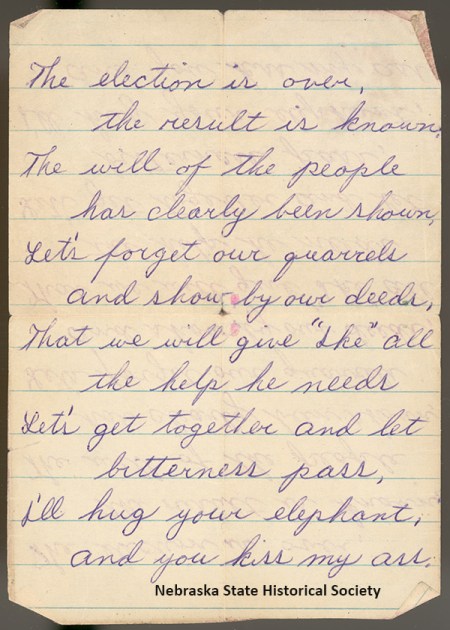
The election is over,
The talking is done.

From CarStickers.com

From CarStickers.com

Your party lost.
My party won.

So let us be friends,
Let arguments pass.
I’ll hug your elephant,
If you kiss my ass.

I wondered who wrote it.  My handwritten note says whoever sent it to me said they got it off the internet.

Who needs plagiarism with the WorldWide Web? The usual tendencies to attribute witty or snarky sayings to famous people, and to strip actual authorship, get huge boosts from the internet. Mark Twain said a good lie could get around the Earth seven times before truth gets its boots on — with the internet, the lies, falsehoods and lack-of-appropriate attribution pieces fly at the speed of electronic interchange, near the speed of light but for the copper in the wires.

Here, a couple of years later, it could come into use again. Have I learned any more about who wrote it? Not really.  I looked, and didn’t find an authoritative version with an author’s name attached, which looks to be final.

From Etsy and ThinkOutLoudApparel.

From Etsy and ThinkOutLoudApparel.

This version claims to come from 1972, and the re-election of Richard Nixon:

The election is over, the results are now known,
The will of the people has clearly been shown.

Let’s all get together and show by our deeds,
That we will give Dick all the help that he needs.

Let bygones by bygones and all bitterness pass,
I’ll hug your elephant if you kiss my ass.

Still no author; from 2004:

The election is over, the results are now known.
The will of the people has clearly been shown.
We should show by our thoughts and our words and our deeds
That unity is just what our country now needs.
Let’s all get together. Let bitterness pass.
I’ll hug your elephant.
You kiss my ass.

We might assume it’s been around at least since Nixon’s second election then. I’ll wager it goes back farther into the recesses of history.

But does anyone know for sure? It’s been around long enough to have made the leap to bumperstickers, and other political paraphernalia.

Help us out in comments, if you have information.
[Update December 2020]

Handwritten note suggesting the poem comes no later than 1956; sadly, note comes from the wallet of a murder victim. History Nebraska blog

Handwritten note suggesting the poem comes no later than 1956; sadly, note comes from the wallet of a murder victim. History Nebraska blog

From Kaboodle.com

From Kaboodle.com

[Editor’s note: What was the image from Kaboodle.com, that is now no longer available there? December 2020]


Holiday greetings from President Kennedy: Don’t worry about the Russians bombing the North Pole and Santa Claus

December 19, 2014

In 1961 a little girl named Michelle wrote to President John F. Kennedy, expressing her fears that in a nuclear exchange, the Russians might bomb the North Pole, and Santa Claus might be lost.

President Kennedy’s response was human, and fatherly.

We should work to spread that spirit this season, and all seasons.

Tip of the old scrub brush, with pine-scented bubbles for the season, to the John F. Kennedy Library.


Yeah, if you put it that way, Obama is a very successful president

December 18, 2014

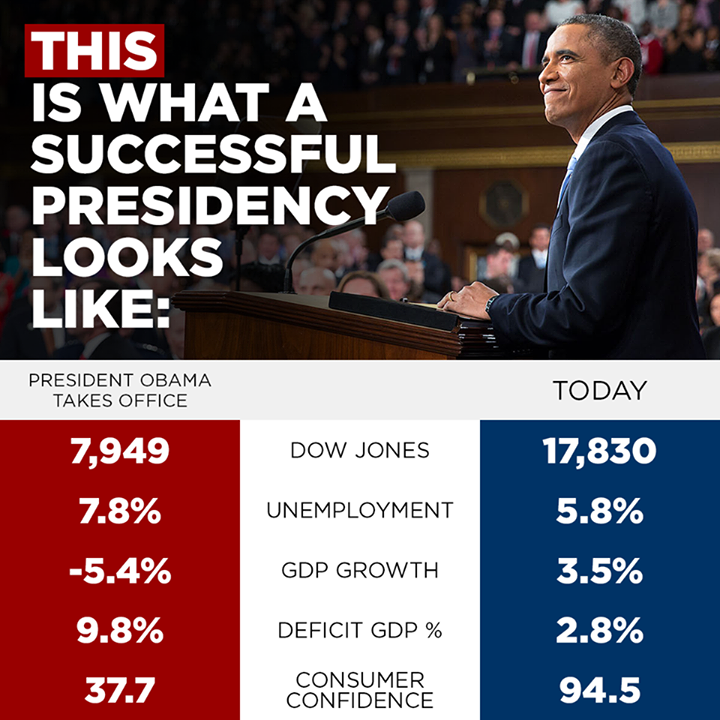
Got this chart from the national Democrats, The Democratic Congressional Campaign Committee (DCCC):

Obama is a very successful president.

Obama’s presidency is a success, by the GOP’s favorite numbers.

An old friend on Facebook told me he wants verification of the numbers, because he doesn’t feel it. Few of us below the very, very rich feel it — which is what Obama’s been saying, and what Sen. Bernie Sanders, Sen. Elizabeth Warren, Paul Krugman and Robert Reich have been saying in various ways daily.  That’s what the struggle on income inequality is all about.

But the numbers check out.  Go see for yourself (some of the sites I list below update monthly, or daily, so if you’re not looking at this in December 2014, they may vary; look for the link to historic numbers).

I wrote:

Numbers are dated in Consumer Confidence (but much higher than I thought! See below).

But the other numbers are well published.

Dow Jones Index plugged at least nightly on NBC, ABC, CBS and PBS — hourly at least on CNN and MSNBC (I don’t get the latter two).

http://stockcharts.com/freecharts/historical/djia1900.html

Unemployment is updated monthly by the Bureau of Labor Statistics — and again, plugged on national news when it happens.

http://www.bls.gov/bls/unemployment.htm

GDP growth:

http://data.worldbank.org/indicator/NY.GDP.MKTP.KD.ZG
and
http://www.bea.gov/newsreleases/glance.htm

US deficits as % of GDP:

Bloomberg press report:
http://www.bloomberg.com/…/u-s-deficit-decline-to-2-8…

St. Louis Branch, Federal Reserve:
http://research.stlouisfed.org/fred2/series/FYFSGDA188S

Consumer Confidence is tracked by the anti-Obama Conference Board:

http://www.conference-board.org/data/consumerdata.cfm

Reuters report on October Consumer Confidence report:

http://www.reuters.com/…/us-usa-economy-confidence…

As a socialist anti-free market guy, Obama is the worst in history.

Now will you listen to Obama when he tells you that we need to do something OTHER than what the GOP says, to make the growth something YOU feel? Please?

So tomorrow, and every day until January 21, 2017, when your very conservative and otherwise not stupid friends tell you we must “cut government” because “America can’t afford to be great any longer,” instead of flipping them the bird like you usually do, send them here to get the links to look at the numbers for themselves.

Don’t take my word for it, nor the DCCC’s word for it. Look for yourself, using the sites I’ve listed above.

Now ask: Why can’t Congress figure this out, and give Obama some support?


Is December the flag-flyingest month?

December 16, 2014

November offers several flag flying days, especially in years when there is an election.

But December may be the month with the most flag-flying dates, if we include statehood days.

December 7 is Pearl Harbor Remembrance Day.  It’s not in the Flag Code, but it is in a public law (P.L. 103-308) that the president should issue a proclamation asking Americans to fly flags.

December 25 is Christmas Day, a federal holiday, and one of the score of dates designated in the Flag Code.

Other dates?

Several states attained statehood in December, so people in those states should fly their flags (and you may join them):

  • Illinois, December 3 (1818, 21st state)
  • Delaware, December 7 (1787, 1st state)
  • Mississippi, December 10 (1817, 20th state)
  • Indiana, December 11 (1816, 19th state)
  • Pennsylvania, December 12 (1787, 2nd state)
  • Alabama, December 14 (1819, 22nd state)
  • New Jersey, December 18 (1787, 3rd state)
  • Iowa, December 28 (1846, 29th state)
  • Texas, December 29 (1845, 28th state)

December 15 is Bill of Rights Day, marking the day in 1791 when the Bill of Rights was declared ratified; but though this event generally gets a presidential proclamation, there is no law or executive action that requires flags to fly on that date, for that occasion.

Eleven flag-flying dates in December.  Does any other month have as many flag flying opportunities?

Have I missed any December flag-flying dates?

Flags at the Washington Monument, looking down the Capital Mall towards the U.S. Capitol.

Flags at the Washington Monument, looking down the Capital Mall towards the U.S. Capitol.


Pearl Harbor survivors dwindle, but still make the pilgrimage

December 7, 2014

Back in 2008, most of the formal reunions stopped. https://timpanogos.wordpress.com/2008/12/07/pearl-harbor-a-day-that-will-live-in-infamy/

We owe them, big time.

Wikipedia image. Pearl Harbor Survivors Assn breaks ground on USS Oklahoma Memorial, in 2006

Wikipedia caption:  Members of the Peral Harbor Survivors Association break ground on USS Oklahoma Memorial, in 2006


Fly your flag December 7, 2014, for National Pearl Harbor Remembrance Day

December 7, 2014

President Obama paid respects to those who died at Pearl Harbor on a visit in 2011; White House caption: President Barack Obama places a wreath at the USS Arizona Memorial, part of the World War II Valor in the Pacific National Monument, in Pearl Harbor, Hawaii, Dec. 29, 2011. (Official White House Photo by Pete Souza)

From the White House:

Presidential Proclamation — National Pearl Harbor Remembrance Day, 2014
NATIONAL PEARL HARBOR REMEMBRANCE DAY, 2014

– – – – – – –

BY THE PRESIDENT OF THE UNITED STATES OF AMERICA

A PROCLAMATION

On the morning of December 7, 1941, Japanese planes thundered over Hawaii, dropping bombs in an unprovoked act of war against the United States.The attack claimed the lives of more than 2,400 Americans.It nearly destroyed our Pacific Fleet, but it could not shake our resolve.While battleships smoldered in the harbor, patriots from across our country enlisted in our Armed Forces, volunteering to take up the fight for freedom and security for which their brothers and sisters made the ultimate sacrifice.On National Pearl Harbor Remembrance Day, we pay tribute to the souls lost 73 years ago, we salute those who responded with strength and courage in service of our Nation, and we renew our dedication to the ideals for which they so valiantly fought.

In the face of great tragedy at Pearl Harbor — our first battle of the Second World War — our Union rallied together, driven by the resilient and unyielding American spirit that defines us.The millions of Americans who signed up and shipped out inspired our Nation and put us on the path to victory in the fight against injustice and oppression around the globe.As they stormed the beaches of Normandy and planted our flag in the sands of Iwo Jima, our brave service members rolled back the tide of tyranny in Europe and throughout the Pacific theater.Because of their actions, nations that once knew only the blinders of fear saw the dawn of liberty.

The men and women of the Greatest Generation went to war and braved hardships to make the world safer, freer, and more just.As we reflect on the lives lost at Pearl Harbor, we remember why America gave so much for the survival of liberty in the war that followed that infamous day.Today, with solemn gratitude, we recall the sacrifice of all who served during World War II, especially those who gave their last full measure of devotion and the families they left behind.As proud heirs to the freedom and progress secured by those who came before us, we pledge to uphold their legacy and honor their memory.

The Congress, by Public Law 103-308, as amended, has designated December 7 of each year as “National Pearl Harbor Remembrance Day.”

NOW, THEREFORE, I, BARACK OBAMA, President of the United States of America, do hereby proclaim December 7, 2014, as National Pearl Harbor Remembrance Day. I encourage all Americans to observe this solemn day of remembrance and to honor our military, past and present, with appropriate ceremonies and activities.I urge all Federal agencies and interested organizations, groups, and individuals to fly the flag of the United States at half-staff this December 7 in honor of those American patriots who died as a result of their service at Pearl Harbor.

IN WITNESS WHEREOF, I have hereunto set my hand this fifth day of December, in the year of our Lord two thousand fourteen, and of the Independence of the United States of America the two hundred and thirty-ninth.

BARACK OBAMA

If your flag staff doesn’t have a half-staff ability, fly the flag anyway.

If you’re wondering: no, this flag-flying date has not been added to the Flag Code; but according to the law, it will recur every year.

More: 


Changing a nation’s flag? New Zealand might

December 4, 2014

A few of us, a vanishing few, remember when Canada changed its flag in 1965.

Canada's flag in 1965. Wikipedia image.

Canada’s flag in 1965, featuring the British Union Jack. This design dates from 1957, following several earlier, similar designs. Wikipedia image.

Change the flag?  What a concept!

We probably forget that the U.S. flag, while recognizable since 1789, changed quite a bit between then and now, mostly in stars, but also in stripes.

Here’s what Canada settled on in 1965, after a surprisingly bitter debate that ran for months in 1964:

Wikipedia:  The National Flag of Canada,[1] also known as the Maple Leaf and l'Unifolié (French for

Wikipedia: The National Flag of Canada,[1] also known as the Maple Leaf and l’Unifolié (French for “the one-leafed”), is a flag consisting of a red field with a white square at its centre, in the middle of which is featured a stylized, 11-pointed, red maple leaf. Adopted in 1965 to replace the Union Flag, it is the first ever specified by statute law for use as the country’s national flag. The Canadian Red Ensign had been unofficially used since the 1890s and was approved by a 1945 Order in Council for use “wherever place or occasion may make it desirable to fly a distinctive Canadian flag”

New Zealand contemplates changing her flag, with a referendum on the action pending, probably in 2016.  What are they in for?  Will the debate in New Zealand be so bitter as Canada’s was?

At the BBC site, a few more details:

New Zealand is to hold a binding referendum in 2016 on whether to change the national flag.

The announcement by Prime Minister John Key of the referendum came after his government last month won a third term in a general election.

A panel of “respected New Zealanders” will lead the public discussion on potential designs for a new flag.

Mr Key has previously said he would like to see a new flag featuring a silver fern, on a black background.

That would be similar to the banner already used by many New Zealand teams such as the All Blacks national rugby union team.

“I believe that this is the right time for New Zealanders to consider changing the [flag’s] design to one that better reflects our status as a modern, independent nation,” Mr Key said.

Photo illustrating the BBC story, showing the silver fern flag of the New Zealand All Blacks football club -- Getty Images

Photo illustrating the BBC story, showing the silver fern flag of the New Zealand All Blacks football club — Getty Images

A fern leaf.  Hey, that’s rather like Canada’s switch from the mostly-red flag with a Union Jack to a maple leaf.  Canada’s been happy with that flag for more than 50 years, now.  Right?

Wait. Canadian Prime Minister Harper wants to change the maple leaf now?

OTTAWA — Prime Minister Stephen Harper surprised media this morning by unveiling a “new-look” Canadian flag in red, white, and blue that “just by fluke” matches the colours of the Conservative Party’s logo.

“I was doodling with my magic markers a while back and it just came to me out of the blue. Our flag needs some blue!” said Harper sporting a lapel pin with his proposed new flag design.

“Frankly, the boring old flag doesn’t reflect my new Canada…we needed something with more energy, something gutsier to better reflect my world leadership role.”

Harper’s doodle, cleaned up a bit:

A new flag for Canada, with blue added in?  And what a lovely shade of blue it is . . . why does it make us suspicious?

A new flag for Canada, with blue added in? Stephen Harper’s proposed new flag. And what a lovely shade of blue it is . . . why does it make us suspicious?

When a CBC reporter pointed out that Harper’s new flag colours are identical to the Conservative Party logo the PM said he was surprised by the question and hadn’t really noticed the similarity.

“Wow…I guess if you squint at our new flag you could maybe see some loose, loose likeness to my party’s logo colours.  But my new design really captures the new Canada…bold and not to be messed with.”

ConservativePartyLogoSmaller

“Proud Canadians will rally behind this new flag as a patriotic symbol of what Canada has become.”

Liberal Party leader Justin Trudeau reacted immediately telling the Ottawa Citizen, “I, like most Canadians, must now question the very sanity of Mr. Harper.  Has he gone nuts?  That’s a real and pressing question.  Has Mr. Harper’s ego finally won the sweaty arm-wrestling match that goes on in his brain.”

“The NDP has been calling loudly for increased spending on mental health care and Mr. Harper just proved the need,” said opposition leader Tom Mulcair.

[Well, no, not really.  Notice that the source of the Canadian flag proposal is The Lapine, Canada’s most successful on-line satirical news site — the Onion of the Frozen North.  Yes, I got suckered in, until I read the entire article; if it makes you shake your head, be suspicious, even if it doesn’t trigger your Hemingway™ Shit Detector. New Zealand is serious, though.]

Flag wars ahead!  Social studies teachers, you should tee this up so your students can enjoy the popcorn.

Good thing the U.S. had Betsy Ross around to tell the rebels what the flag would be, eh?*

More, and resources:


60 years ago this month: Disneyland, a gleam in Walt’s eye

December 3, 2014

Let’s check the archives.

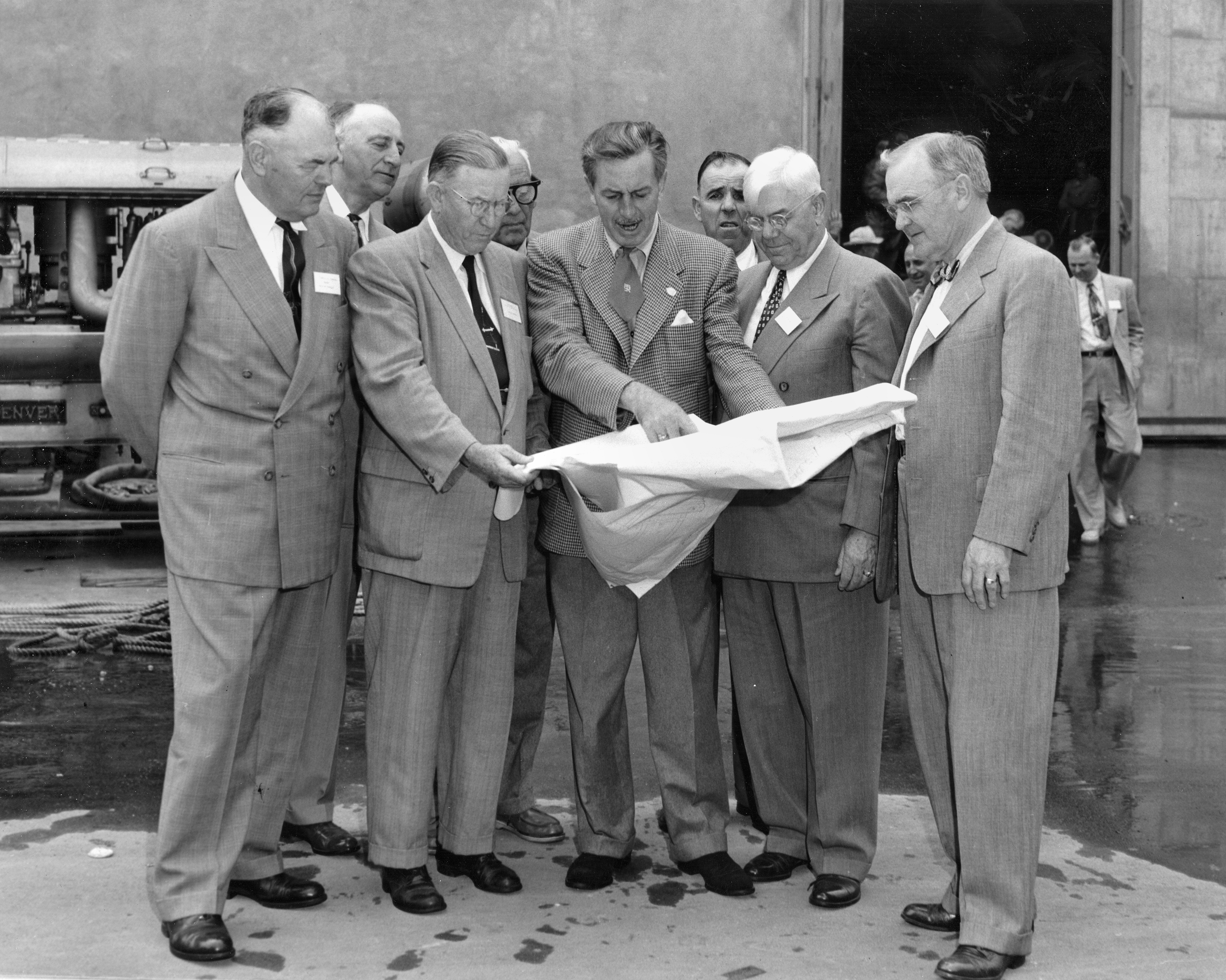
From the Orange County Archives: Walt Disney shows Disneyland plans to Orange County officials, Dec. 1954  The men in the front row (left to right) are Anaheim Mayor Charles Pearson, Orange County Supervisor Willis Warner, Walt Disney, Supervisor Willard Smith, and Orange County Planning Commission Chairman Dr. W. L. Bigham. The photo was taken at Disney Studios in Burbank. Photo from the Orange County Archives' Willard Smith Collection.

From the Orange County Archives: Walt Disney shows Disneyland plans to Orange County officials, December 1954.
The men in the front row (left to right) are Anaheim Mayor Charles Pearson, Orange County Supervisor Willis Warner, Walt Disney, Supervisor Willard Smith, and Orange County Planning Commission Chairman Dr. W. L. Bigham. The photo was taken at Disney Studios in Burbank. Photo courtesy the Orange County Archives’ Willard Smith Collection.

Newspaper and public relations photography relied heavily on posed images such as this one, through most of the 20th century.  Cameras often were bulky.  For a good image, film was slow, with a lot of light needed.  Public groups often were taken out of an office or auditorium and posed in the sun, as here, just to get enough light.

By the end of the 1950s, faster films and smaller cameras encouraged more spontaneous photos of events.  Especially after the Kennedy presidential campaign hired a photographer to take candid shots, which showed up everywhere, candid photos started to take over newspapers.

Posing these photographs was an art itself, an art mostly lost these days.

These posed photographs still beat most selfies.

More:

  • Early History of Disneyland in Pictures, slideshow at the Orange County Register; that site suggests an alternative caption for the photo above:
    July 21, 1954 – Race against time
    Walt Disney visited Anaheim often to oversee every detail of the construction. On July 21, 1954, the park held its official groundbreaking – starting a race against time to build Disneyland in one year. Shown here, Anaheim Mayor Charles Pearson, left, with O.C. Supervisor William Warner, Walt Disney, O.C. Supervisor Willard Smith and O.C. Planning Commission Chair W.L. Bigham look at plans for what would soon be called The Happiest Place on Earth.
    REGISTER ARCHIVE PHOTO, TEXT BY TOM BERG, THE ORANGE COUNTY REGISTER

December 2: Millard Fillmore’s Guano Day!

December 1, 2014

Why December 2?

(You couldn’t make this stuff up if you were Monty Python.)

English: Millard Fillmore White House portrait

Millard Fillmore’s White House portrait, via Wikipedia

President Millard Fillmore, in the State of the Union Address, December 2, 1850

Peruvian guano has become so desirable an article to the agricultural interest of the United States that it is the duty of the Government to employ all the means properly in its power for the purpose of causing that article to be imported into the country at a reasonable price. Nothing will be omitted on my part toward accomplishing this desirable end. I am persuaded that in removing any restraints on this traffic the Peruvian Government will promote its own best interests, while it will afford a proof of a friendly disposition toward this country, which will be duly appreciated.

Did any other U.S. President spend so much time thinking about guano?  Did any president ever mention it in a State of the Union Address?  The curious case of Millard Fillmore, Seer, just grows.

Guano, or bird poop (and its relative, bat poop), contains phosphorus, which is an essential element for life.  Consequently, it turns out to be a key ingredient in effective agricultural fertilizers.  In international competition for supremacy in farming and farm exports, guano became a key resource to fight over, in the 19th century.

It’s almost safe to say the fights were economic; but guano did play a key role in wars in South America (see Andrew Leonard’s article, noted below).

Fillmore figured out that the substance had great importance, coupled that with the rather esoteric knowledge that sea birds tended to deposit guano in great abundance on certain islands, often unoccupied, and ordered the U.S. Navy to claim islands found to contain guano deposits that were not claimed by other nations.

By the American Civil War, the importance of phosphorus to the production of gun powder became an issue for the armies of the North and South.  Millard Fillmore had set the stage for the North to win an important advantage in gun powder production, just one of many that led to the defeat of the South.

It’s one more thing we should thank Millard Fillmore for doing. Our study of history should inform us that it is, indeed, important for politicians to understand the importance of guano.

Fillmore knew his guano.

Take a moment on December 2 to toast Millard Fillmore’s prescience, on Guano Day!

More:  


Rosa Parks, Pete Seeger and friends at the Highlander School

December 1, 2014

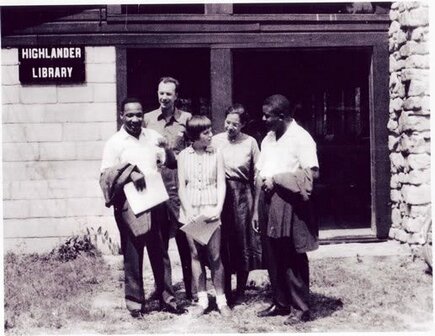
December 1, 1955, was not an accident of history.  Rosa Parks, often described as “a seamstress,” was college educated, trained as a teacher, and trained in civil rights actions at the Highlander School in New Market, Tennessee.

On this anniversary of Mrs. Parks’s Earth-moving action of civil disobedience, I think back to a photograph taken a couple of years later, at the Highlander School.

It’s a stunning photograph, not for its photographer’s skills, nor the artistic nature of the taking.  It’s a true snapshot.  Five people on a farm in Tennessee, in black and white.  Probably the photographer used a Kodak camera made just for snapshots.

Except, it was 1957.  The farm is the Highlander School.  The five people in the photo include folksinger Pete Seeger, and Rosa Parks, and the Rev. Dr. Martin Luther King, Jr.

Pete Seeger, MLK , and others at Highlander School, 1957

From left, Martin Luther King, Jr., Pete Seeger, Charis Horton, one of the founders of the Highlander School, Rosa Parks, and the Rev. Ralph Abernathy. At a workshop at the Highlander School in Tennessee, circa 1957.

12,346

Who was the photographer?  Perhaps Myles Horton, the director of the school (and Charis’s husband).

In a sort piece filmed at his home in Beacon, New York, for the Highlander’s 75th Anniversary in 2007, Pete described the time and the occasion.

Don’t  you love the cricket singing along with Pete?

More:

Yes, this is mostly an encore post.  Fighting ignorance requires patience.

Yes, this is mostly an encore post. Fighting ignorance requires patience.


December 1, 1955: “Why do you push us around?” Rosa Parks asked the cop. (Anyone know the answer?)

December 1, 2014

Mrs. Rosa Parks asked a question of the policeman who arrested her for refusing to move to the back of the bus. In 2014, it’s a chilling question, to which we have no good answer.

Rosa Parks being fingerprinted, Library of Congress

Mrs. Parks being fingerprinted in Montgomery, Alabama; photo from New York World-Telegram & Sun Collection, Library of Congress

Rosa Parks: “Why do you push us around?”

Officer: “I don’t know but the law is the law and you’re under arrest.”

From Rosa Parks with Gregory J. Reed, Quiet Strength
(Grand Rapids, MI: Zondervan Pub. House, 1994), page 23.

Photo: Mrs. Parks being fingerprinted in Montgomery, Alabama; photo from New York World-Telegram & Sun Collection, Library of Congress

Today in History at the Library of Congress provides the simple facts:

On the evening of December 1, 1955, Rosa Parks, an African American, was arrested for disobeying an Alabama law requiring black passengers to relinquish seats to white passengers when the bus was full. Blacks were also required to sit at the back of the bus. Her arrest sparked a 381-day boycott of the Montgomery bus system and led to a 1956 Supreme Court decision banning segregation on public transportation.

Rosa Parks made a nearly perfect subject for a protest on racism. College-educated, trained in peaceful protest at the famous Highlander Folk School, Parks was known as a peaceful and respected person. The sight of such a proper woman being arrested and jailed would provide a schocking image to most Americans. Americans jolted awake.

Often lost in the retelling of the story are the threads that tie together the events of the civil rights movement through the 1940s, 1950s and 1960s. As noted, Parks was a trained civil rights activist. Such training in peaceful and nonviolent protest provided a moral power to the movement probably unattainable any other way. Parks’ arrest was not planned, however. Parks wrote that as she sat on the bus, she was thinking of the tragedy of Emmet Till, the young African American man from Chicago, brutally murdered in Mississippi early in 1955. She was thinking that someone had to take a stand for civil rights, at about the time the bus driver told her to move to allow a white man to take her seat. To take a stand, she kept her seat.

African Americans in Montgomery organized a boycott of the Montgomery bus system. This was also not unique, but earlier bus boycotts are unremembered. A bus boycott in Baton Rouge, Louisiana, earlier in 1955 did not produce nearly the same results.

The boycott organizers needed a place to meet, a large hall. The biggest building in town with such a room was the Dexter Street Baptist Church. At the first meeting on December 5, it made sense to make the pastor of that church the focal point of the boycott organizing, and so the fresh, young pastor, Rev. Dr. Martin Luther King, Jr., was thrust into civil rights organizing as president, with Ralph Abernathy as program director. They called their group the Montgomery Improvement Association (MIA). When their organizing stretched beyond the city limits of Montgomery, the group became the Southern Christian Leadership Conference.

Litigation on the boycott went all the way to the Supreme Court (Browder v. Gale). The boycotters won. The 381-day boycott was ended on December 21, 1956, with the desegregation of the Montgomery bus system.

Sources for lesson plans and projects:

Yes, this is mostly an encore post.  Fighting ignorance requires patience.

Yes, this is mostly an encore post. Fighting ignorance requires patience.


Tip of the old scrub brush to Slacktivist, who gave this post a nice plug.


A toast on Whiskey and Cigar Day 2014: Excelsior! to Mark Twain’s and Winston Churchill’s births (November 30)

November 30, 2014

Mark Twain, afloat

Mark Twain aboard a ship, on his way to Hawaii. Young Samuel Clemens apprenticed to be a Mississippi river boat pilot, and held a fascination for water-going vessels his entire life. His pilot years are documented, and analyzed, in Life on the Mississippi.
This photo of Twain remains one of my favorites.

November 30 is the birthday of Mark Twain (1835), and Winston Churchill (1874).

This is the traditional Millard Fillmore’s Bathtub post to remind you. Both Twain and Churchill were lovers of good whiskey, and good cigars. Surely they would have toasted themselves with a drink and a smoke.

Even if we don’t, we can pretend we did.

In 2014, we have the benefit of having had a couple of years to digest Twain’s Autobiography, and a year to assess Volume II; and we have the benefit of new scholarship from a great book on Churchill, William Manchester’s and Paul Reid’s The Last Lion: Winston Spencer Churchill: Defender of the Realm, 1940-1965.

Twain had a comment on the Texas Education Agency and State Board of Education:

In the first place God made idiots. This was for practice. Then He made School Boards.

Following the Equator; Pudd’nhead Wilson‘s New Calendar

The Nobel literature committees were slow. Twain never got a Nobel in Literature; he died in 1910. Churchill did win a Nobel in Literature, in 1953.

Both men were aficionados of good whiskey and good cigars. Both men suffered from depression in old age.

Both men made a living writing, early in their careers as newspaper correspondents. One waged wars of a kind the other campaigned against. Both were sustained by their hope for the human race, against overwhelming evidence that such hope was sadly misplaced.

churchill-time-cover-man-of-the-year-1941.jpg

Winston S. Churchill, Time Magazine’s Man of the Year for 1941, copyright 1941 by Time Magazine. Churchill’s career was built much on his work as First Lord of the Admiralty, a position he took in 1911.  While he was the goat of the Battle of the Dardanelles (and had to resign as a result), his earlier work to switch Britain’s Navy to oil power from coal, and to use airplanes in combat, kept the British Navy as an important and modern military organization through World War II.

Both endured fantastic failures that would have killed other people, and both rebounded.

Each possessed a great facility with words, and wit, and frequently said or wrote things that people like to remember and repeat again.

Both of them rank near the top of the list of people to whom almost any quote will be attributed if the quote is witty and the speaker can’t remember, or doesn’t know, who actually said it.

Both men are worth study. And wouldn’t you really love to have had them over to dinner?

Twain, on prisons versus education:

Every time you stop a school, you will have to build a jail. What you gain at one end you lose at the other. It’s like feeding a dog on his own tail. It won’t fatten the dog.” – Speech, November 23, 1900

Churchill on the evil men and nations do:

“No One Would Do Such Things”

“So now the Admiralty wireless whispers through the ether to the tall masts of ships, and captains pace their decks absorbed in thought. It is nothing. It is less than nothing. It is too foolish, too fantastic to be thought of in the twentieth century. Or is it fire and murder leaping out of the darkness at our throats, torpedoes ripping the bellies of half-awakened ships, a sunrise on a vanished naval supremacy, and an island well-guarded hitherto, at last defenceless? No, it is nothing. No one would do such things. Civilization has climbed above such perils. The interdependence of nations in trade and traffic, the sense of public law, the Hague Convention, Liberal principles, the Labour Party, high finance, Christian charity, common sense have rendered such nightmares impossible. Are you quite sure? It would be a pity to be wrong. Such a mistake could only be made once—once for all.”

—1923, recalling the possibility of war between France and Germany after the Agadir Crisis of 1911, in The World Crisis,vol. 1, 1911-1914, pp. 48-49. (Obviously, and sadly, Churchill was wrong — twice wrong.)

Image of Twain aboard ship – origin unknown. Image of Winston S. Churchill, Time Magazine’s Man of the Year for 1941, copyright 1941 by Time Magazine.

More on Mark Twain

More on Winston Churchill

Orson Welles, with Dick Cavett, on Churchill, his wit, humor and grace (tip of the old scrub brush to the Churchill Centre):

Yeah, mostly this is an encore post from past years.

More, contemporary reports from 2012:

And in 2013:

2014:

Should you fly your flag today?  Congress doesn’t list this dual birthday as an event for flying the U.S. flag.  But you’re welcome to fly the flag any day.  Go ahead, if you want to.

If I get one, it will be the only cigar I’ve had this year. Or this decade.

But I will break out the Scotch.

At a very minimum, click on some of the links and read the works of these two great writers.  Anything else today would not be so profitable.