Fly your flag August 21, for Hawaii Statehood

August 21, 2013

A newsboy happily hawks the Honolulu Star-Bulletin with the headline showing the state had achieved statehood, August 21, 1959.  Star-Bulletin photo

13-year-old paperboy Chester Kahapea happily hawks a commemorative edition of the Honolulu Star-Bulletin with the headline showing the state had achieved statehood after the U.S. House of Representatives passed the law authorizing Hawaii as a state. Star-Bulletin photo by Murray Befeler.

Hawaii’s official statehood day is August 21, commemorating the day in 1959 when Hawaii was recognized as a member of the union of the United States of America.  Hawaiians should fly their flags to day in honor of the date (you may, too).

Hawaii formally celebrates the day on the third Friday in August — oops, last Friday, for 2013.  I hope you joined in the festivities (it’s a holiday in Hawaii) — but under the U.S. Flag Code, you may certainly fly your flags on August 21, regardless which day of the week that is.

Specimen copy of the ballot used by Hawaiians in a June 27, 1959, plebiscite to approve conditions of statehood.  Image from Hawaii Magazine, 2009

Specimen copy of the ballot used by Hawaiians in a June 27, 1959, plebiscite to approve conditions of statehood. Image from Hawaii Magazine, 2009

After the U.S. annexed Hawaii in 1898 (in action separate from the Spanish-American War) attempts at getting Hawaii admitted as a state got rolling.  After World War II, with the strategic importance of the islands firmly implanted in Americans’ minds, the project picked up some steam.  Still, it was 14 years after the end of the war that agreements were worked out between the people of Hawaii, the Hawaiian royal family, Congress and the executive branch.  The deal passed into law had to be ratified by a plebiscite among Hawaiian citizens.  The proposition won approval with 94% of votes in favor.

Some native Hawaiian opposition to statehood arose later, and deference to those complaints has muted statehood celebrations in the 21st century.

Other than the tiny handful of loudmouth birthers, most Americans today are happy to have Hawaii as a state, the fifth richest in the U.S. by personal income.  The nation has a lot of good and great beaches, but the idea of catching sun and surf in Hawaii on vacation might be considered an idealized part of the American dream.

Hawaiian and U.S. flags fly from the stern of a boat touring Hawaii. Are these flags displayed properly, under the U.S. flag code?

Hawaiian and U.S. flags fly from the stern of a boat touring Hawaii. Are these flags displayed properly, under the U.S. flag code?

More:

From Prologue, the blog of the National Archives: This petition, rolled onto a wooden spool, was signed by 116,000 supporters of Hawaii statehood and presented to the U.S. Senate on February 26, 1954. (RG 46, Records of the U.S. Senate)

From Prologue, the blog of the National Archives: This petition, rolled onto a wooden spool, was signed by 116,000 supporters of Hawaii statehood and presented to the U.S. Senate on February 26, 1954. (RG 46, Records of the U.S. Senate)

U.S. postage stamp issued in 2009 commemorating the 50th anniversary of Hawaii's admission to the union.

U.S. postage stamp issued in 2009 commemorating the 50th anniversary of Hawaii’s admission to the union.

English: August 21, 1959 7¢ Rose Hawaii Stateh...

Contrast the first class postage price above with the airmail postage price of this stamp issued in 1959 — August 21, 1959 7¢ Rose Hawaii Statehood C55 26432. Wikipedia image


Lost history: Groucho Marx died on August 19, 1977

August 19, 2013

1958 Publicity photo of Groucho Marx from the television program You Bet Your Life.  NBC Television-NBC Photo/Photographer:  Elmer Holloway

1958 Publicity photo of Groucho Marx from the television program You Bet Your Life. NBC Television-NBC Photo/Photographer: Elmer Holloway

36 years ago?  Grouch Marx died on August 19, 1977? 

cropped version of Image:Grouchoicon.jpg - &qu...

The man became an icon, though too few know the great history behind the icon. “Self-made caricature of Groucho Marx” Wikipedia image


That means that not only have your high school history students probably never seen much, or anything, of Groucho Marx and his comic genius; it means their parents don’t know him, either.

What a great tragedy.

Groucho Marx brought genius to American comedy films, to radio, and then to television.  His genius was of a sort that does not age, but remains fresh to audiences of today — get a group of teenagers to view Duck Soup or A Day at the Races and you’ll find them laughing heartily at even some of Marx’s more cerebral jokes.  It is symbolic that the films that brought writer Norman Cousins to laughter, and a lack of pain, were Marx Brothers movies (in the day when one had to rent a projector to show the film, long before VCR).  Cousins went on to a grand second career talking about hope in healing, starting with the book, Head First: The Biology of Hope and the Healing Power of the Human Spirit.  I recommend these films to anyone seriously injured or ill, or recovering.  We got VHS, and then DVD copies of several of the films when our kids were ill, with great effect.

Groucho Marx should be in the pantheon of great Americans, of the 20th century, if not all time, studied by children in high school, for history and for literature purposes.

Groucho’s been gone for 36 years, and we are much poorer for his passing.

More:

Groucho grills Ray Bradbury and a woman named Leticia on You Bet Your Life in a 1955 episode:

English: Groucho Marx & anonymous blogging

“I intend to live forever, or die trying.” ― Groucho Marx (Wikipedia image)


Forgotten Texas history: Bicentennial of the Battle of Medina, August 18, 1813

August 19, 2013

1813?

Back in 2006, reporter Art Chapman in the Fort Worth Star-Telegram makes a plea to remember the deadliest battle for Texas independence, fought years before the Texas Revolution.

In 2013 the Battle of Medina lies buried under seven more years of newspapers and historic events.  We need to fight to remember history.  This is another punch in that fight.

Billy Calzada photo, 2011 Reenactment of the Battle of Medina (in Texas)

Caption from Tropas de Ulramar: Re-enactors dressed as participants in the Battle of Medina fire a musket volley during a ceremony on Saturday, Aug. 20, 2011, commemorating the 198th anniversary of the Battle of Medina. The event was sponsored by the Texas Society – Sons of the American Revolution. The Battle of Medina was fought on Aug. 18, 1813, when a Spanish army, attempting to win Texas from the Republican Army of the North, which was supported by the United States and included veterans of the American Revolution, won a battle fought south of San Antonio near Espey. It is thought that about 800 Republicans died in the battle. [Other estimates put the death toll on the Texas side at 1,500]
Photo: BILLY CALZADA


The long drive for Texas independence from Mexico may be more clearly seen in the light of the continents-long struggles for independence that included not only the American Revolution, but also revolutions in the nations of Haiti, Mexico, Chiapas, and others across Central America and South America. The Battle of Medina was a part of that earlier history. Fought on August 18, 1813, it was more deadly than any other battle in the wars for Texas independence, it is linked to Mexico’s long history of struggle. It occurred in the same year that Haiti got independence, and in the middle of the War of 1812, which helps to obscure the history of the battle.

Chapman’s report said:

“Contrary to popular belief, the struggle for democracy in Texas did not begin with the Anglo-led revolution of 1835-36,” author and historian James Haley wrote in a recent Austin American-Statesman article. “In fact, the yearning for liberty had its own ongoing legacy in Latin America.

“As early as 1810, movements for independence began simultaneously in Venezuela and Argentina. It was also in 1810, on Sept. 16, that the Mexican priest Father Miguel Hidalgo y Costilla raised his famous grito, the cry for social justice that opened the Mexican campaign for independence, a date now celebrated as Diez y Seis.”

America was drawn into that campaign when it funded a small force under the control of Bernardo Gutierrez de Lara, one of Father Hidalgo’s emissaries. A former Army officer, Augustus Magee, went along with the expedition to offer military advice. The Gutierrez-Magee Expedition, also called the Green Flag Rebellion because of its banner, soon captured Nacogdoches. All went well for the expedition — too well — and Texas independence was quickly claimed. Spain took immediate measures to quell the insurrection.

It ended at the Battle of Medina, “the biggest, bloodiest battle ever fought on Texas soil,” a South Texas historian says.

Spanish forces slaughtered more than 1,000 of the rebels, perhaps as many as 1,500. The battle methods, and total extirpation of the losing forces, would recur in the Texas Revolution.

Fewer than 100 republic troops survived the battle, Thonhoff said. Those not killed in the battle were later chased down and executed. Retaliation went on for days. Royalist forces swept into San Antonio and took revenge on anyone they suspected of aiding the rebel forces. One of the royalist officers was a young Lt. Antonio Lopez de Santa Anna.

The bodies of soldiers killed in battle were left where they fell. It would be nine years before their bones were gathered and buried in a communal grave.

This story should translate well to the Texas-required 7th-grade history course. Here is a cause — the archaeological excavation and historical marking of the battlefield itself — which lends itself well to getting students to write letters to state legislators and state education authorities. Here is news of an archaeological site that could provide work for a generation of diggers, and experience for countless school kids taken on tour. And the story of the battle is one of those relatively unknown gems that excite students who realize, after they discover it, that they know something that most others do not know.

English: Medina Battle -State Marker- Near Lem...

Medina Battle -State of Texas historic marker Near Leming, Texas. Wikipedia image

As well, this should be supplement to world history courses, which in my experience too often overlook the independence wars and successes in Central and South America. The article mentions independence movements in Argentina and Venezuela. The United States fought Britain in the War of 1812, which was the western fallout of England’s simultaneous war with Napoleon (who was on the road to getting his comeuppance in Russia). Haiti’s drive for independence from France racked that Caribbean nation. A mapping exercise showing the various independence movements occurring between 1800 and 1826 provides links to parts of the narrative of American nations’ independence that often gets overlooked.

The battle also ties together several otherwise loose threads in the Texas history curriculum.

  • The Gutierrez-McGee Expedition falls into that time period and that type of movement to steal Texas known as the filibusters.
  • The treachery of the Green Flag Rebels in executing the Spanish officers in San Antonio after the Spanish had surrendered raises issues of ethics in battle that are rich for discussion.
  • Incompetence with which the Texian forces were led into the battle, missing completely the feint the Spanish troops made until they were already into a classic battle trap, is another place to emphasize the importance of having good leaders especially in rebellion (this will become clear to students, perhaps, when they study the events of 1775 and 1776 and Washington’s leadership, in the 8th grade curriculum in Texas).
  • Santa Anna’s presence as a young officer at the Battle of Medina suggests that he got the idea of “no quarter” early in his career; see how the tactic plays out 23 years later at the Battle of the Alamo, the Battle of Coleto, Goliad, and the Battle of San Jacinto, with an older Santa Anna in command.
  • In the context of Texas’ becoming a “majority-minority” state with a very large population with historical ties to Mexico, the Battle of Medina deserves greater consideration in Texas history curricula.

Partly due to the brutality of the Spanish victors to the survivors, wounded and dead, the battlefield itself was not cleaned up for years — bodies lay across a wide area.  Medina was a touchy point, a point of embarrassment perhaps to local Mexicans and Texians, a loyalty test for the Spanish rulers.  So the battle site was ignored and hushed up.  200 years later, we don’t know the exact site of the battle.  A lot of work remains to be done, exploration of archives in Spain, Mexico and Texas, exploration of map collections, archaeological and paleontological work on the suspected sites of the battle.  But every year this work remains undone, the story becomes that much more difficult to find.  It is unlikely we’ll ever know all that we probably should about the Battle of Medina.

Other sources you may find useful:


Encore quote for August 17: George Washington, “to bigotry, no sanction”

August 17, 2013

Maybe we should designate August 17 as “No Bigotry Day.”

August 17, 1790, found U.S. President George Washington traveling the country, in Newport, Rhode Island.

Washington met with “the Hebrew Congregation” (Jewish group), and congregation leader (Rabbi?) Moses Seixas presented Washington with an address extolling Washington’s virtues, and the virtues of the new nation. Seixas noted past persecutions of Jews, and signalled a hopeful note:

Deprived as we heretofore have been of the invaluable rights of free citizens, we now (with a deep sense of gratitude to the Almighty disposer of all events) behold a government erected by the Majesty of the People–a Government which to bigotry gives no sanction, to persecution no assistance, but generously affording to All liberty of conscience and immunities of Citizenship, deeming every one, of whatever Nation, tongue, or language, equal parts of the great governmental machine.

George Washingtons reply to the Newport, RI, Hebrew congregation, August 17, 1790 - Library of Congress image

George Washingtons reply to the Newport, RI, Hebrew congregation, August 17, 1790 – Library of Congress image,

President Washington responded with what may be regarded as his most powerful statement in support of religious freedom in the U.S. — and this was prior to the ratification of the First Amendment:

It is now no more that toleration is spoken of as if it was the indulgence of one class of people that another enjoyed the exercise of their inherent natural rights. For happily, the government of the United States, which gives to bigotry no sanction, to persecution no assistance, requires only that they who live under its protection should demean themselves as good citizens, in giving it on all occasions their effectual support.

Below the fold, more history of the events and religious freedom, from the Library of Congress.

Read the rest of this entry »


Old teacher returns to the classroom, April 1970

August 16, 2013

In 1970, Lyndon Johnson met with students (at the University of Texas)

In 1970, Lyndon Johnson met with students (at the University of Texas Southwest Texas State University, in San Marcos), in a science lecture hall. Did the TV class have to relocate?

Johnson’s first job out of college was teaching Hispanic students, an experience that brought him to see the wisdom of civil rights laws and great education.  Who was in TV 2301.01 — and did they realize they’d have met with a president if they’d stayed in their classroom?

The photo was taken on April 27, 1970.  It comes from the collection of the LBJ Presidential Library, in Austin, Texas, via Wikimedia.  The Lyndon Johnson School for Public Affairs was established in 1970, but this photo may have been too early in the year for a class there.

Anyone have more details?  (See update below.)

Update: This photo may have been taken at LBJ’s alma mater, now the Texas State University at San Marcos, judging by this other photo I found at Humanties Texas.

Lyndon Johnson in the classroom during an April 1970 visit to his alma mater. Photo courtesy Texas State University-San Marcos.

Caption from Humanities Texas: Lyndon Johnson in the classroom during an April 1970 visit to his alma mater. Photo courtesy Texas State University-San Marcos.


Update, September 10, 2014:  Thanks @c_banks.

B3725-18A
Date: 04/27/1970
Credit: LBJ Library photo by Frank Wolfe
Event: President Lyndon B. Johnson meets with college students
Description: President Lyndon B. Johnson addresses students
Location: South West Texas State University, San Marcos, Texas
Collection: LBJ Library
Rights: Public Domain: This image is in the public domain and may be used free of charge without permissions or fees.

Remember when business leaders supported civil rights?

August 16, 2013

Remember civil discussion?

June 4, 1963:  Business leaders listening to Vice President Lyndon B. Johnson, with President John F. Kennedy, in the White House.  Photo from the Kennedy Library, public domain

June 4, 1963: Business leaders listening to Vice President Lyndon B. Johnson, with President John F. Kennedy, in the White House. Photo from the Kennedy Library, public domain

Could one get such a meeting on an issue today?  Probably — and wouldn’t it be nice to see more of them?

President John F. Kennedy invited top business leaders of the nation to the White House on June 4, 1963, to talk about civil rights.  This photo captures the early moments of the late afternoon meeting in the East Room of the White House, with Vice President Lyndon Johnson addressing the group, and President Kennedy waiting to speak.

According to the Kennedy Library, these are people in in the photo:

Vice President Lyndon B. Johnson (at podium, with back to camera) speaks to a group of business executives with establishments in southern cities, at a civil rights meeting conducted by President John F. Kennedy (seated at far right), Vice President Johnson, and Attorney General Robert F. Kennedy (not pictured). Those pictured include: Milton L. Elsberg, President of Drug Fair Inc.; Carling L. Dinkler, Jr., President of Dinkler Hotel Corporation; Lucien E. Oliver, Vice President of Sears, Roebuck & Company; Louis C. Lustenberger, President of W. T. Grant Company; William B. Thalhimer, Jr., President of Thalhimer Brothers, Inc.; G. Stockton Strawbridge, President of Strawbridge & Clothier; Bruce A. Gimbel, President of Gimbel Brothers, Inc.; and E. D. Martin, President of Martin Theatres of Georgia, Inc. East Room, White House, Washington, D.C.

Few of those companies exist today; those that do are in much changed form.  Just fifty years ago.

The Kennedy Presidential Library in Massachusetts makes this photo available with hundreds of others at its on-line site.


Typewriter of the moment: Aaron Copland in California

August 15, 2013

Composer Aaron Copland at his typewriter in California; Aaron Copland Collection, Library of Congress, circa 1939 or 1940

Composer Aaron Copland at his typewriter in California; Aaron Copland Collection, Library of Congress, circa 1939 or 1940. The photos is placed as either San Diego or Palm Springs; I’m leaning towards Palm Springs with those mountains. Anyone know?

Oddly, the Library of Congress photo site is down for the weekend; here's an image that shows what the photo should look like.  Links should work again come Monday.

Oddly, the Library of Congress photo site is down for the weekend; here’s an image that shows what the photo should look like. Links should work again come Monday.

Details for scholars and history buffs:

ITEM TITLE

Aaron Copland at typewriter, Palm Springs or San Diego, 1939-1940.

SOURCE

Collection: Aaron Copland Collection; Music Division, Library of Congress
Box/Folder: 472/1
Original format: 1 print: b&w; 2.5 x 2.5 in.

DIGITAL ID

copland phot0077

I don’t think this photo is under any copyright, but the collection contains this general language:

Photographs – used by permission of The Aaron Copland Fund for Music, Inc., 254 West 31st Street, 15th floor, New York, NY 10001, phone 461-6956, fax (212) 810-4567. The Fund’s permission is limited to the right to reproduce the image of Aaron Copland. All rights to use individual photographs are controlled by the respective owners of the copyrights in those photographs. For those listed as unidentified, we invite users to contact us with any information they may have with regard to those items.

Is it odd to find a composer working at a typewriter, and not a piano?  Especially before 1990, music writers had much occasion to use the machines — for lyrics, for descriptions of their music and how the published version should look, and for correspondence — and, baby, do composers have correspondence!  The brand on this machine I have not been able to determine; it’s a portable, I imagine, looking at the case to Copland’s left — the typewriter case.

Was Copland a hunt-and-peck typer?  Looks like to me from this photo.

Did you notice the U.S. flag on the pole on the other side of the house?

I wonder what he was working on, in California, at that time.

More:

English: Aaron Copland

Aaron Copland at a machine where we’d expect to find him — years after the photo at the top. Wikipedia image


Favorite images for VJ Day, August 15

August 15, 2013

August 15, 1945, was VJ Day — the day that World War II ended in the Pacific Theatre. VJ is an acronym for Victory Japan. Victory in Europe, VE Day, was declared the previous April.

VJ Day is affiliated with a series of images that students of U.S. history should recognize; these images tell much of the story of the day and the events of the weeks leading up to it.

The most famous image is Alfred Eisenstadt’s photograph of an exuberant sailor kissing a swept-off-her-feet- for-the-moment nurse in Times Square, New York City. This is one of the most famous photographs from the most famous photographer from Life Magazine:

The Smack Seen 'Round the World, photo by Alfred Eisenstadt, Life Magazine, 8-15-1945

The Smack Seen ‘Round the World, photo by Alfred Eisenstadt, Life Magazine, August 15, 1945

Eisenstadt coolly titled his photo “VJ Day, Times Square.” It came to be known as The Smack Seen ‘Round the World. It was fitting that the photo would be taken by Eisenstadt, since his work came to be a symbol of Henry Luce’s Life Magazine in a pre-television era when photography magazines like Life and Look were key news organs for the nation.

In a fun and continuing mystery, several people have claimed to be the sailor, or the nurse, through the years.

Before the victory celebration, there had to be a victory. Japan asked for conditional surrender discussions, but the Allied forces insisted on unconditional surrender. Japanese military officials were rather certain that, if the Soviet Union entered the Pacific War, Allied victory would be assured. Japan hoped to either get a conditional surrender agreement, according to some sources, or inflict heavy losses on Allied forces to get better surrender conditions, but before Russia entered the war. Russia and Japan had long-standing grudges against one another dating from before their earlier war in the first decade of the 20th century.

Read the rest of this entry »


Remembering VJ Day, the end of World War II – August 15, 1945

August 15, 2013

August 15, the Ides of August, hosted several significant events through the years. In 1945, the Emperor of Japan put his voice on radio to announce Japan would unconditionally surrender to the Allies, ending World War II in the Pacific.  Here is an update of an earlier post I wrote on the day, with a few additions and updates.

August 15, 2013, is the 68th anniversary of “Victory Japan” Day, or VJ Day. On that day Japan announced it would surrender unconditionally.

President Harry Truman warned Japan to surrender, unconditionally, from the Potsdam Conference, in July. Truman warned that the U.S. had a new, horrible weapon. Japan did not accept the invitation to surrender. The announced surrender came nine days after the U.S. dropped an atomic bomb on Hiroshima, and six days after a second bomb was dropped on Nagasaki. The actual surrender occurred on September 2, 1945, aboard the battleship U.S.S. Missouri, anchored in Tokyo Harbor.

Celebrations broke out around the world, wherever U.S. military people were, and especially across the U.S., which had been hunkered down in fighting mode for the previous four years, since the attack on Pearl Harbor by the Japanese on December 7, 1941.

I posted some of the key images of the day, earlier (go see), and repost one of my favorites here.

An unnamed U.S. sailor boldly celebrates Japans surrender with an unnamed, passing nurse, in Times Square, New York, August 15, 1945 - Alfred Eisenstadt, Life Magazine

Alfred Eisenstaedt’s iconic photo of the Kiss in Times Square, V-J Day 1945.

More and Resources:


Outlaw flying in the American west

August 15, 2013

Old Jules tells a great story here about cranking up the old Cessna and climbing high enough to watch the vast powers of the U.S. military run training operations in the New Mexico Desert.

Pilots, bless ’em, tend toward the ornery end of the scale.  That’s what you want if something breaks on your airplane.  You want a guy at the stick who says, “Dagnab it, let’s see how to get out of this one safely.”  (Shades of Flight.  A great movie, really — did you see it?)

This is the place to insert the heroics of pilots in various times of stress, Wally Stewart and his crew bringing their B-24 bomber back over the Mediterrannean and dropping it perfectly on the runway, where it fell apart from the bullet holes [See KUED resources here].  That brave American Airlines crew in the DC-10 over Detroit, Flight 96, who lost hydraulic control when the rear cargo door blew out, and after a string of blue talking, brought the plane down safely (one flight attendant died in the explosion). Those United Airlines pilots who brought the DC-10 Flight 232 down in Sioux City, Iowa, after the rear engine flew apart and destroyed all control of the tail and rudder.  That brave U.S. Airways crew that executed a perfect landing in the Hudson River with Flight 1549.

I think if you talk with pilots much, you get the idea that they like things a little on the edge.  They don’t develop those cool, steely nerves that save lives by having nothing go wrong, ever, or by not pushing their aircraft where the wonks at the Federal Aviation Administration in Washington, D.C., say aircraft should not be pushed.  We hope they do all this pushing in flight simulators; but we also know better.

Cessnas, and just violating some of the rules, don’t deserve those accolades, really.  These stories tell how pilots might develop the skills the brave guys use later.  But they are stories, nevertheless, and they deserve to be told.  They may not save your life flying, but they’ll enrich your life, and help you get through the stuff here on the ground.

So go read Old Jules’s tale.

Then come back here; here are a couple of stories, true as I remember them (a couple of which really should be tracked down; the American west of the latter-half the of 20th century is full of these stories, and they need to be told).

I told Old Jules:

What’s outlaw in flying?

Two observations.

Years ago, while I was staffing the Senate, my brother, Jerry Jones, who spent a good deal of time in his last 20 years in Page, Arizona, called to ask me to check in on a Senate hearing on some FAA issue or other.  Turns out someone — National Park Service, perhaps? — was asking FAA to significantly tighten rules on flying around NPS stuff, including around Rainbow Bridge National Monument.  Apart from the usual issues of air traffic congestion and safety around conflicts between “fixed wing and rotary wing aircraft” (airplanes and helicopters) in and around the Grand Canyon, there were complaints about small plane pilots flying under Rainbow bridge.  The thing really is massive, and you could put the dome of the U.S. Capitol under it, so it’s about 500 feet high . . . what barnstorming pilot could resist?

A somewhat skeptical group of senators quizzed the FAA and Park Service guys on what the problem was, other than noise and hubbub to hikers (who had hiked a mile from the marina on Lake Powell).  About that time Sen. Barry Goldwater, R-Arizona, shuffled into the hearing.  Goldwater was very protective of grand things to see in Arizona, like Rainbow Bridge, and he was also a pilot.

Barry Goldwater, U.S. Senator (AZ-R)

Barry Goldwater, U.S. Senator, R-Arizona. Wikipedia image.

At some point, one of the officials making a case to yank licenses from pilots who pulled the illegal stunt made a comment that questioned the sanity of any pilot who would do such a thing.  Goldwater sat upright.  You mean any pilot who would do such a thing is crazy? Goldwater asked.  Well, yes — and we don’t want crazy people flying airplanes, the official said.  How about such crazy people representing the people of Arizona and passing judgment on your proposals? Goldwater asked.  Then he said he didn’t want an answer to that, that he had some grave reservations about the proposal, and he left the hearing.

I later caught a conversation with the senator in a hallway, in which someone asked him directly if he’d ever flown under Rainbow Bridge, and he said something like, not enough times that the FAA needs to worry about it.

Brother Jerry started a public service effort in his Page days, Page Attacks Trash, a project to clean up litter in and around Page, on the Navajo Reservation, and in the Lake Powell National Recreation Area (NRA) and Rainbow Bridge NM.  It was a great clean-up effort, got the support of the Salt River Project (who operate the Navajo Generating Station in Page); it was big time.  Iron Eyes Cody, who did the famous anti-littering ad featuring the tear in the eye of an American Indian, sometimes dropped in to help out.

Jerry arranged for some television Public Service Announcements (PSAs) filmed in and around Lake Powell, to fight littering.  One of the spots was shot at Rainbow Bridge.  Jerry’s health had been failing for years, but he’d get his cane and make the hike, just to watch the proceedings and keep it all going well.  They finished the spot, broke sticks (as they used to say in the filming biz), and were walking back to the boats at the marina, Jerry and his cane far in the rear.  Just before the film crew rounded the bend, they heard a small airplane buzzing around and the tell-tale cut of the engine, to lose altitude, before roaring the engine to pass under the stone formation.  One of the cameramen had some footage left, and had the presence of mind to turn on the camera and film the thing.

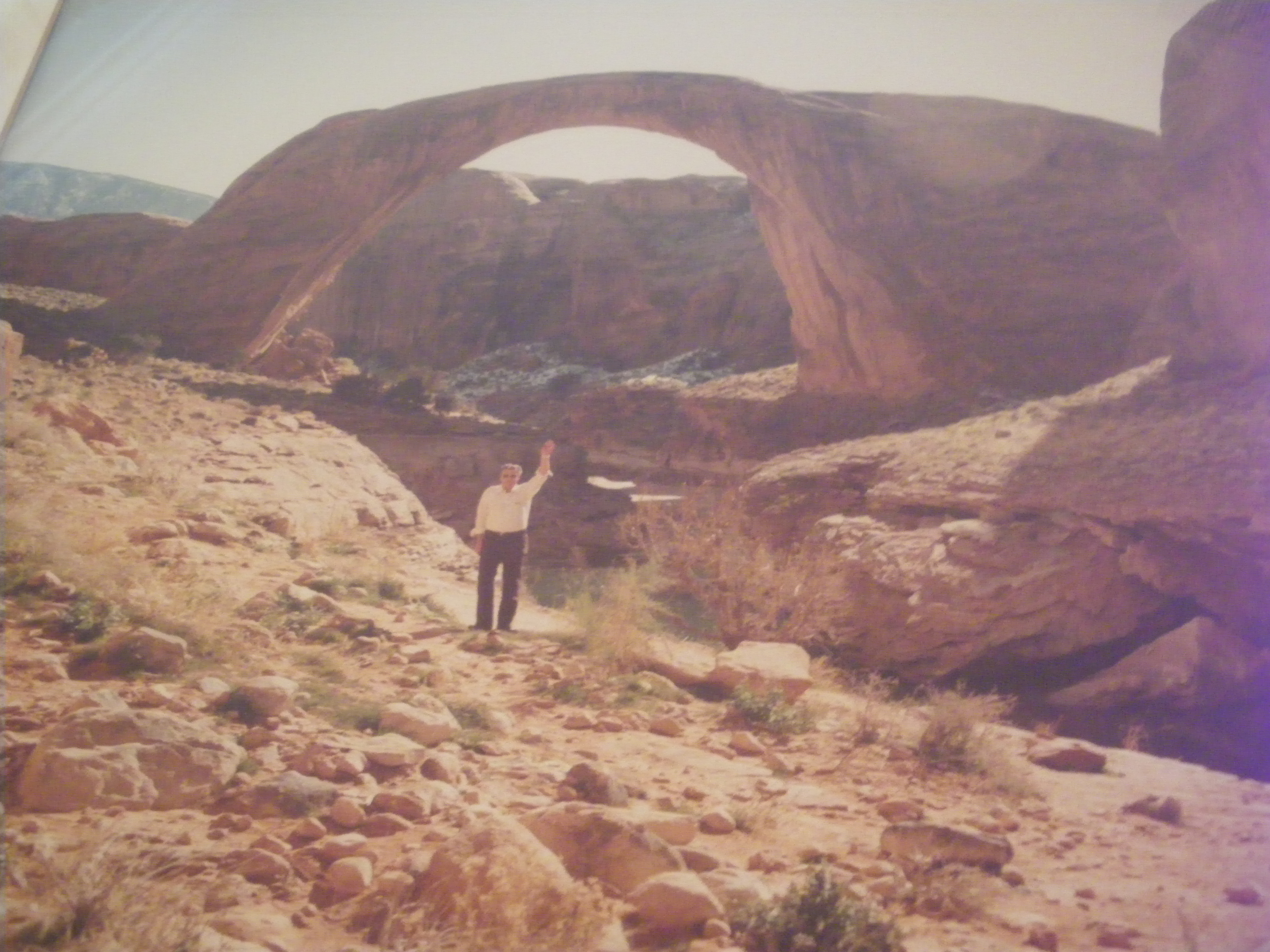
Well, the Park Service and FAA were outraged to hear of the event.  They subpoenaed the film footage, and blew up every frame to see if they could get the tail number on the airplane.  To be honest, I don’t know how that turned out.  I do know that on my wall I have a large photograph of my late brother, two by two-and-a-half feet, waving to the cameraman, with Rainbow Bridge in the background.  That frame didn’t have any useful information, and the law gave him the photo.

The Rainbow Brigde National Monument

Rainbow Bridge National Monument; no, I wouldn’t try to fly a plane under it, either. You could, if you had to, but the authorities would probably track you down like a woodpecker and yank your license. Wikipedia image

Two:

The West Utah Desert remains desolate. On the border between Nevada and Utah, there ain’t much of nothin’. A few roads connect a few ranches, but there’s a good reason U.S. 50 and 6 out there is known as “the loneliest highway in the world.” Bandits might be regarded as welcome company out there sometimes.

Anyway, it was expensive to run copper wires out there, say, 50 miles, to an isolated ranch house, or a lone gas station, or some other building said to be a business. So mostly, AT&T didn’t do it. People who lived and worked out there just had to get along without phone service. Enter a guy named Art Silver Brothers (I think; my memory fades, too), who figured out that radiophone service worked okay. Give people a radiophone — a device which existed then, but which required several pounds of gear and a lot of juice, relatively — and they could dial up the “local” grocery store to check to be sure the milk was good this week, before driving 50 miles to get some dairy whitener for the coffee.

A photo from Beehive Telephone in 2012, showing their service area.

A photo from Beehive Telephone in 2012, showing a part of their service area in Utah, or Nevada, or both. The company still exists!  On their website, they say:  “

Art strung wires where he could, using REA-installed power poles, or fence poles, or whatever he could, and thin, light copper wiring. His Beehive Phone Company was one of the last truly independent phone operations in the U.S., serving a grossly underserved area with patchy service. He didn’t get rich doing it.  He was the company’s only employee most of the time.

Stringing copper over 50 miles for one phone, a company can have difficulty maintaining such lines. Art had a pilot’s license, and he learned he could spot downed lines and other trouble from the air . . . and it was just one step to landing his small airplane on the local road, fixing the problem, and taking off again.

Well, that got the ire of the FAA. They said he shouldn’t do that. They argued that he was impeding traffic an imposing dangers. He said he was keeping lifelines open for people in far-flung places, and it was not a problem for traffic on roads where there might be two vehicles a week passing by. FAA paid for traffic studies on a bunch of those roads; and they enlisted the FCC to try to shut down Silver’s operations.

Remember, part of the system was wired, and part was radio. Turns out that in those pre-cellular days, the radio frequencies Silver used were in the “emergency” spectrum — radio frequencies used by cops and firefighters in places where cops and firefighters existed. FCC took to taping the “phone conversations” of Art’s customers, and in yet another hearing in the Senate, charged that Art was abusing emergency frequencies. The star audio was a tape recording of a woman ordering a significant amount of liquor from a liquor store that served probably six counties in eastern Nevada. FCC argued that obviously was not an emergency, and it amounted to an abuse of spectrum, and it was enough of an abuse to shut down the phone company.

Art finally got his chance to explain. Someone quizzed him about that liquor order, and whether that was appropriate use of emergency radio spectrum.

Well, Art started, the woman making the liquor order was the owning madam of [a] western Nevada brothel, set way in the hell in the middle of nowhere. “And I gotta tell you, if you run a whore house, and you run out of whiskey, that’s an emergency.”

Those were good days to attend hearings in Washington. The Tea Party has ruined all that.

That’s my story; the true facts are probably better.

More:

Jerry Jones and Rainbow Bridge

A bad snapshot of the picture on my wall, Jerry Jones waving from the path in Rainbow Bridge National Monument, moments after a small aircraft flew under the Bridge.


Will Rogers and Wiley Post crashed in Alaska, August 15, 1935

August 15, 2013

Will Rogers, images from Will Rogers Museums, Oklahoma

Will Rogers, images from Will Rogers Museums, Oklahoma

August 15, the Ides of August, hosted several significant events through the years.  In 1935, it was a tragic day in Alaska, as an airplane crash took lives of Will Rogers and Wiley Post.  To refresh your memory, an encore post, with a few edits and additions.

After Mark Twain died, America found another great humorist, raconteur, story-teller, who tickled the nation’s funny-bone and pricked the collective social conscience at the same time. Will Rogers is most famous today for his sentiment that he never met a man he didn’t like. In 1935, he was at the height of his popularity, still performing as a lariat-twirling, Vaudeville comedian who communed with presidents, and kept his common sense. He wrote a daily newspaper column that was carried in 500 newspapers across America.  Rogers was so popular that Texas and Oklahoma have dueled over who gets the bragging rights in claiming him as a native son.

Will Rogers ready to perform.  Photo taken prior to 1900 - Wikimedia

Will Rogers ready to perform. Photo taken prior to 1900 – Wikimedia

Wiley Post was known as one of the best pilots in America. He gained fame by being the first pilot to fly solo around the world. Post was famous for his work developing new ways to fly at high altitudes. Post was born in Texas and moved to Oklahoma. He lost an eye in an oil-field accident in 1924, then used the settlement money to buy his first airplane. He befriended Will Rogers when flying Rogers to an appearance at a Rodeo, and the two kept up their friendship literally to death.

Post asked Rogers to come along on a tour of the great unknown land of Alaska, where Post was trying to map routes for mail planes to Russia. Ever adventurous, Rogers agreed — he could file his newspaper columns from Alaska by radio and telephone. On August 15, 1935, their airplane crashed near Point Barrow, Alaska, killing them both.

Wiley Post, first to fly solo around the world, in an early pressure suit for high-altitude flying - Wikimedia photo

Wiley Post, first to fly solo around the world, in an early pressure suit for high-altitude flying – Wikimedia photo

On August 15, 2008, a ceremony in Claremore, Oklahoma, honored the two men on the 73rd anniversary of their deaths. About 50 pilots from Oklahoma, Missouri, Kansas and Arkansas will fly in to the Claremore Airport for the Will Rogers-Wiley Post Fly-In Weekend. Oklahoma Lt. Gov. Jari Askins will offer a tribute.

Rogers was 56, leaving behind his wife, Betty, and four children. Post, 36, left a widow.

Rogers’ life is really quite legendary. Historian Joseph H. Carter summed it up:

Will Rogers was first an Indian, a cowboy then a national figure. He now is a legend.

Born in 1879 on a large ranch in the Cherokee Nation near what later would become Oologah, Oklahoma, Will Rogers was taught by a freed slave how to use a lasso as a tool to work Texas Longhorn cattle on the family ranch.
As he grew older, Will Rogers’ roping skills developed so special that he was listed in the Guinness Book of Records for throwing three lassos at once: One rope caught the running horse’s neck, the other would hoop around the rider and the third swooped up under the horse to loop all four legs.

Will Rogers’ unsurpassed lariat feats were recorded in the classic movie, “The Ropin’ Fool.”

His hard-earned skills won him jobs trick roping in wild west shows and on the vaudeville stages where, soon, he started telling small jokes.

Quickly, his wise cracks and folksy observations became more prized by audiences than his expert roping. He became recognized as being a very informed and smart philosopher–telling the truth in very simple words so that everyone could understand.

After the 10th grade, Will Rogers dropped out of school to become a cowboy in a cattle drive. He always regretted that he didn’t finish school, but he made sure that he never stopped learning–reading, thinking and talking to smart people. His hard work paid off.

Will Rogers was the star of Broadway and 71 movies of the 1920s and 1930s; a popular broadcaster; besides writing more than 4,000 syndicated newspaper columns and befriending Presidents, Senators and Kings.

During his lifetime, he traveled around the globe three times– meeting people, covering wars, talking about peace and learning everything possible.

He wrote six books. In fact he published more than two million words. He was the first big time radio commentator, was a guest at the White House and his opinions were sought by the leaders of the world.

Inside himself, Will Rogers remained a simple Oklahoma cowboy. “I never met a man I didn’t like,” was his credo of genuine love and respect for humanity and all people everywhere. He gave his own money to disaster victims and raised thousands for the Red Cross and Salvation Army.

Post’s legacy is significant, too. His employer, Oklahoma oil man F. C. Hall, encouraged Post to push for aviation records using Hall’s Lockheed Vega, and Post was happy to comply. Before his history-making trip around the world, he had won races and navigation contests. NASA traces the development of the space-walking suits worn by astronauts to Post’s early attempts for flight records:

For Wiley Post to achieve the altitude records he sought, he needed protection. (Pressurized aircraft cabins had not yet been developed.) Post’s solution was a suit that could be pressurized by his airplane engine’s supercharger.

First attempts at building a pressure suit failed since the suit became rigid and immobile when pressurized. Post discovered he couldn’t move inside the inflated suit, much less work airplane controls. A later version succeeded with the suit constructed already in a sitting position. This allowed Post to place his hands on the airplane controls and his feet on the rudder bars. Moving his arms and legs was difficult, but not impossible. To provide visibility, a viewing port was part of the rigid helmet placed over Post’s head. The port was small, but a larger one was unnecessary because Post had only one good eye!

Last photo of Will Rogers (in the hat) and Wiley Post, in Alaska in 1935 (from Century of Flight)

Last photo of Will Rogers (in the hat) and Wiley Post, in Alaska in 1935 (from Century of Flight)

Tip of the old scrub brush to Alaska bush advocate Pamela Bumsted.

Resources:


Gun nuts offensive, even in the unconscious subtext

August 14, 2013

Found this on Facebook, a poster designed to be clever:

Facebook poster, from National Gunrights.org

Facebook poster, from National Gunrights.org, featuring guerrilla fighters from the Second Boer War

I like people who use history and historical photographs to inform modern issue debates well.  But I worry sometimes about the subtexts when people use these photos.

For example, who are these guys?  Were they Pinkerton Detectives hired to shoot iron workers at Andrew Carnegie‘s Homestead, Pennsylvania, steel works?  Hatfields, or McCoys?  The deputy sheriffs in Cheyenne, Wyoming, looking out for Butch Cassidy and the Hole in the Wall Gang?  Is it Butch and the gang?  Are these crazed killers, sporting men, officers of the law, or what?

One hopes it’s not a lynch mob from Kansas, or Georgia, or Texas . . .  When the photo’s subjects are unidentified, we might wonder what is the message intended by showing these people; use of the photo implies endorsement, especially absent any disclaimer.  Oh, yeah, it’s quite likely that the person who put the photo up was wholly ignorant of historical context.  But that’s another form of ignorance promotion.  Looking at the list of possibilities I came up with, you can see why I wouldn’t want to promulgate an image that offers endorsement of murderers, thugs, thieves or racists or any combination of that list.

TinEye.com turned up 49 uses across the internet (there may be more, just out of TinEye’s view). Using those links, I’ve learned that the photo is of some unnamed Boer guerrilla fighters in the Second Boer War, circa 1899.  Well, there is this wag claiming the photo may be of George Sydenham Clarke.  He’s in the minority.

Would you want these guys representing your political views?  Any of these guys among those who tried to kill Winston Churchill?  Do they want that in their legacy?

I’m pretty sure I don’t want Boer guerrilla fighters representing my views; they were racist (not that the British were any better), they were crude, and they often tended to let bullets speak for them when words would have worked and been much better for all concerned. 

One might wonder what message the group, NationalGunrights.org, intended.

In the screenplay for the great movie, “Butch Cassidy and the Sundance Kid,” the great William Goldman wrote Butch Cassidy wondering at the collection of hired assassins the railroads sent after him and his gang:  “Who are those guys,” Butch said, several times.

It’s an apt question here.  Who are those guys?  Why would anyone want them representing them?

(And, historically, I wonder whether anyone knows the names of any of these five men; I haven’t found any identification).

More:


Can’t make this stuff up: Utah internet sales magnate wants Constitutional Amendment for . . . religious freedom

August 13, 2013

You know what?  The Stupid doesn’t burn, after all — if it did, this guy would have self-immolated long ago.

Utah Policy Daily is an online-newsletter of public policy stuff in the Beehive State — a very good one.  It’s done by some top Utah political consultants from both parties, and former political writers, colleauges and friends from the University of Utah and the political and culture wars in the state.

Utah Policy Daily carried this story, this morning, which I present in full only because you wouldn’t believe it otherwise:

Constitutional Amendment Would Protect ‘Religious Liberty’

By Bryan Schott

Jonathan Johnson, Executive Vice-President of Overstock.com, is leaping into the political ring with a proposed constitutional amendment to protect religious liberty.

Jonathan Johnson of OverStock.com

Jonathan Johnson of OverStock.com

The Daily Caller reports Johnson wants his proposed amendment to exempt churches from being forced to perform same-sex marriages. Johnson says the amendment wouldn’t interfere with the Supreme Court rulings in favor of same-sex marriage, but it also protects groups opposed to the practice at the same time.

Johnson and some friends hatched an idea for states to pass a constitutional amendment saying: ”A religious organization, religious association, religious society or any person acting in a role connected with such organization, association or society and shall not be required to solemnize, officiate in, or recognize any particular marriage or religious rite of marriage in violation of its constitutional right of conscience or its free exercise of religion.”

(The wording is still being fleshed out, but that’s basically what it will say.)

In some ways, this shouldn’t be controversial. The proposed amendment “doesn’t get in the way of gay marriage,” Johnson notes — “but it [also] doesn’t have gay marriage encroach into areas of religious liberty.”

Read more: Utah Policy – Constitutional Amendment Would Protect Religious Liberty

As I understand it, this amendment would be aimed at preventing the government from ordering preachers to marry people they don’t want to marry.

Maybe Johnson is so much a Mormon (I do not know his faith) that he does not know that this “right” is protected by the First Amendment, and has been practiced by far too many Catholic priests, Baptists ministers, and even Mormon Bishops, over the past 225 years.  Preachers regularly refuse to allow their churches to be used by people for any fool reason whatever, and no preacher is forced to solemnize a marriage.  In short, his proposed amendment is wholly superfluous, already covered by the First Amendment.

Unless his real purpose is to create some new way of bashing homosexuals, as I suspect.  Bigot.

Here’s the scary part:  This guy has created a lobbying group to push for the amendment, and has already raised more than $100,000 to push it.  According to the RWNJournal Daily Caller:

As conservatives work to create a firewall on the issue of religious liberty, don’t be surprised if this effort catches on nationwide. Johnson already has a Utah PAC (First Freedom PAC) and a 501 (c)(4) that he says has “raised low six digits — and we’re not really trying yet,” he says.

How many stupid people, people wholly unaware of the First Amendment, are out there with the checkbooks open willing to be suckered by confidence schemes like this?  Enough to raise “low six digits.”

Hey:  For just $10,000, I’ll come to your home and explain why the First Amendment already gives us religious freedom, and tell you why it shouldn’t be mucked with.  I’ll bring PowerPoints and patriotic music, if you want, and give it all to you in less than an hour — or take a whole day if you want.  I won’t even charge expenses.

Then you can put your remaining money into a group that really works to defend the Constitution, or the First Amendment specifically — and I’ll tell you who they are.

Next thing you know, this guy will “come up” with an idea for an amendment to recognize Jesus.

History and policy ignoramii.  Santayana’s Ghost is grumbling and going back for another cup of coffee.  Has Chris Rodda heard about this yet?  Ed Brayton? (Oh, yeah, Ed’s on it already.  Good.)

One point of light:  My old colleague at the Daily Utah Chronicle, Bob Bernick, wrote a column detailing that Utah politicians generally are not so stupidly right-wing as many in the rest of the nation, “Utah, not as crazy as we could be.”  Maybe some of those not-stupid people will take Mr. Johnson aside and explain the Constitution to him.

Update:  Point of darkness:  Johnson has a law degree from BYU.  Seriously.  I thought U.S. Sen. Mike Lee was an aberration,

More:

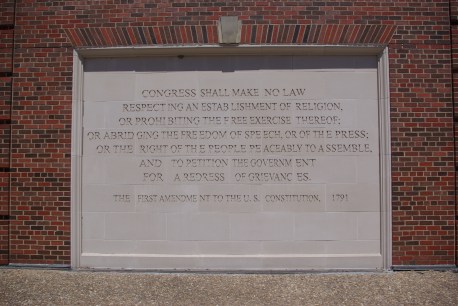
Here in Texas, we have the First Amendment engraved in stone, at Southern Methodist University.

Here in Texas, we have the First Amendment engraved in stone, at Southern Methodist University. Photo by Ed Darrell – use encouraged.
Text of the First Amendment: Amendment:
Congress shall make no law respecting an establishment of religion, or prohibiting the free exercise thereof; or abridging the freedom of speech, or of the press; or the right of the people peaceably to assemble, and to petition the Government for a redress of grievances.


90 years ago: Harding died in San Francisco; Coolidge rose to presidency

August 11, 2013

It’s another one of those mostly-unexplored crevices of history.  90 years ago this August, President Warren G. Harding died in a San Francisco hotel, while on a trip visiting western states.  Harding’s death promoted Calvin Coolidge to the presidency.  They were Republican presidents in one of the hottest stock market eras of all time, during the Roaring ’20s.  Their policies probably helped lead the nation to the financial ruin after the dramatic stock market crash of 1929.

Perhaps its no wonder people would like to forget that fascinating time — but shouldn’t we really give Harding and Coolidge some diligent study?  Consider: Harding and Coolidge would be the last ticket to defeat Franklin Delano Roosevelt for anything; FDR’s reputation rests on his rollback of Harding-Coolidge-Hoover policies.  But in 1920, FDR’s ticket ran on policies more similar to those policies than opposed to them.  Odd how history turns sometimes.

Warren Gamaliel Harding won the election to succeed Woodrow Wilson, some said simply because he looked like a president.  Harding was a little laid back for the times — considering McKinley was assassinated, his successor, the hyper-caffeinated Teddy Roosevelt would die young of a heart attack, obesity nearly took out Teddy’s successor, William H. Taft, and Wilson had suffered a stroke about half-way through his second term.  It was an era when high blood pressure had no particular treatment, and the Type A men who presided over the nation could suffer from all the syndromes high blood pressure can cause.  At the White House website [links added here]:

In 1921, President Warren Harding spoke into a recording apparatus to create a phonographic copy of one of his speeches.  Photo from the Miller Center, University of Virginia

In 1921, President Warren Harding spoke into a recording apparatus to create a phonographic copy of one of his speeches. Photo from the Miller Center, University of Virginia

Before his nomination, Warren G. Harding declared, “America’s present need is not heroics, but healing; not nostrums, but normalcy; not revolution, but restoration; not agitation, but adjustment; not surgery, but serenity; not the dramatic, but the dispassionate; not experiment, but equipoise; not submergence in internationality, but sustainment in triumphant nationality….”

A Democratic leader, William Gibbs McAdoo, called Harding’s speeches “an army of pompous phrases moving across the landscape in search of an idea.” Their very murkiness was effective, since Harding’s pronouncements remained unclear on the League of Nations, in contrast to the impassioned crusade of the Democratic candidates, Governor James M. Cox of Ohio and Franklin D. Roosevelt.

Thirty-one distinguished Republicans had signed a manifesto assuring voters that a vote for Harding was a vote for the League. But Harding interpreted his election as a mandate to stay out of the League of Nations.

Harding took office promising to be a business-friendly president, meaning he supported the big money guys.  Laying out a lesson of history that too many today never learned, Harding led Washington to cut taxes on the upper income levels and bigger businesses, and set up the Roaring ’20s economy that would lead to the financial collapse of the U.S. in 1929, plunging the nation into the Great Depression.  Off the job, he played poker at the White House with bootleg whiskey on the table.  No Treasury “revenuer” would bust the President and his high-rolling friends.

In 1923, Harding’s luck started to run out.  Stories of corruption in his administration began to circulate.  The Miller Center describes what led to his unexpected death:

Death of the President

Shaken by the talk of corruption among the friends he had appointed to office, Warren and Florence Harding began a tour on June 20, 1923 of the West and Alaska. He hoped to get out and meet people, to shake hands and explain his policies. Although suffering from high blood pressure and an enlarged heart, he seemed to enjoy himself—especially in Alaska. On his return journey, he became ill with what was then attributed to a touch of ptomaine (food) poisoning. The presidential train rushed to San Francisco, where his condition worsened. On August 2, he most likely suffered a heart attack in the evening, while his wife was reading to him. He died quietly and instantaneously.

Word quickly spread that Mrs. Harding, the last person to be with him that evening, had poisoned him to prevent him from being brought up on charges of corruption that soon engulfed his administration. A sensationalist book published in 1930 detailed the allegations against her. Her refusal to allow an autopsy of the President only fed the rumors. Harding left the bulk of his estate, valued at $850,000, to his wife.

It was August, after all.  Coolidge retreated from Washington to his home in Vermont.  The Miller Center’s account is a good one:

On August 2, 1923, John Coolidge woke his vacationing son and daughter-in-law at the family home in Plymouth Notch, Vermont, to tell them of President Harding’s death from a heart attack. Coolidge knelt, prayed, and went downstairs. Although the old house had no phone, it was soon abuzz with reporters. At 2:24 a.m., with the newspaper men settled and a copy of the Constitution retrieved, the elder Coolidge, a justice of the peace, administered the oath of office to his son by the light of a kerosene lamp. Soon after, Calvin Coolidge went back to bed as the 30th President of the United States.

Coolidge is the only president to have been sworn in by a close family member.  The “Constitution retrieved”  should be a point of study of presidential aides.  After the assassination of President John Kennedy in Dallas, federal Judge Sarah Hughes got a call to administer the oath of office to Lyndon Johnson before Johnson flew back to Washington.  Hughes said she’d do it, but she needed a copy of the oath.  Apparently not giving adequate thought, this spurred a furious search for a copy of the oath.  After too long, a lawyer in the U.S. attorney’s office recalled the oath is in the Constitution, and a copy in a law book was taken to where Johnson and the presidential entourage awaited aboard Air Force 1 at Love Field.

You never know when you’re going to need to remember history, and know where to retrieve some bit of law.

Coolidge used a calm hand at the tiller during his presidency, continuing what he and others thought to be wise policies to encourage the growth of business.  He’s always struck me as one of the better balanced men in the White House.  Coolidge brought Scouting into the mansion, for his two sons, John, and Calvin, Jr. — he was devoted to his family, and to outdoor recreation (though usually in a coat and tie — the fashion of the time).  John attended Amherst College during his father’s term.

He won his own term of office in 1924, but lost his younger son.  Calvin, Jr., played his brother in tennis, but developed a blister on his foot from the match.  The blister got infected, and the boy developed blood poisoning, which took his life on July 7, 1924.  Although Coolidge, Sr., won the election that fall, after his son’s death he appeared anxious to get out of the White House.  Using the “two-term” precedent as his excuse, and claiming the small part of Harding’s term as his first, Coolidge did not run for re-election in 1928.

Coolidge enjoyed wearing various hats, and did not blanch at posing in clothing created for him, which means we have a rich (though limited) catalog of photographs of Coolidge in strange attire.  Campaign staffs for presidential candidates since at least 1960 have made a study of this, working hard to avoid such photos, failing with some consequences.

President Calvin Coolidge and a 10-gallon hat.  Library of Congress image

President Calvin Coolidge and a 10-gallon hat. Library of Congress image

More:


Remembering Leonidas and the 300 Spartans: died August 11, 480 B.C.

August 11, 2013

300 popped up on some movie channel back in 2008 as I was preparing to teach world history again.  I did not major in history, and my high school history instruction featured no AP courses (Pleasant Grove High, in Utah, didn’t offer such things then; I assume they do now, but I don’t know).

What I knew about Sparta and the stand of the 300 at Thermopylae came from my reading encyclopedias as a child, and culture.  Never had an occasion to write a speech about the events, though had I known the history better, I might have found some opportunity.  Sen. Orrin Hatch would have loved a compare and contrast speech between the stand of the Spartans and his work against the labor law reform bill in 1977 and 1978; more likely, we could have used the simple historical facts that the stand of the 300 at the same place today would be impossible due to poor soil conservation practices of the local farmers, which has created a plain broad enough for a Persian Army to march through with impunity, never fearing drowning in the sea that no longer exists there.  Thermopylae is a grand historical metaphor for a good orator.  The simple facts of history are important, too — Churchill knew Herodotus’s stories well, and considered them when planning military actions in the area in two world wars.

The movie came up from students in the previous year; it offered, perhaps, a hook for an introduction to world history, explaining why we bother to study it at all.

I got a time delay recording to watch it, which I did, mostly.  Interesting stylization.  Cartoonish characterizations, which one should expect from a movie intended as homage to the graphic novel that directly spawned it, more than an instruction about history.  We might doubt that the Persians had trained and armored rhinoceroses in their armament.  Dialogue — well, this is Hollywood.  It would have been in some dialect of Greek, and no Hollywood scriptwriter would have been able to reproduce it.

What about the battle itself.  World history courses in U.S. high schools should pay attention to this battle, I think.

A monument to Leonidas I - Inscription, Molon Lave, which roughly translates to Come and get it!

A monument to Leonidas I – Inscription, “Molon Lave,” which roughly translates to “Come and get it!”

Several sources dated the climax of the battle as August 11, 480 B.C. — 2,493 years ago. (The battle is said to have occurred during the Olympics that year, too.)

World history classes dig through that period of history in the first semester.  Teachers, it’s time to think about how we’re going to facilitate this history this year.  As always, some bright student will wave a hand in the air and ask, “Mr. Darrell!  How do they know what happened if no one survived, and nobody had their Sony videocorder?”

At least one other student in the course of the day will be surprised to discover the movie wasn’t a filmed-on-the-spot documentary.  But apart from that, how do we know the events well enough to pin it down to one day?  And, since the Greeks surely didn’t use the Gregorian calendar, since it wasn’t invented until the 18th century — how do we know the date?

The short answer is “Herodotus.”  The longer answer may resonate better:  This is one dramatic battle in a year-long fight for the history of the world.  The Greeks were understandably and justifiably proud that they had turned back Xerxes’s armies and navy (The Battle of Salamis, a bit after Thermopylae).  So, these events were preserved in poetry, in the chronicles, in song, in sculpture, and in every other medium available to the Greeks.  Your AP English students will probably tell you the movie reminds them of The IliadThere’s an entré for discussion.

Turning points in history:  Had Xerxes succeeded in avenging his father’s, Darius’s, defeats, and subjugated the Greeks, history would be much different.  The culture the Romans built on, the trading patterns from east to west and around the Mediterranean, the technologies, the myths, and the stories of the battles, would be different. (Remember, one of Darius’s defeats was at the Battle of Marathon, from which we get the modern marathon racing event, the traditional close of the modern Olympics.)

How do we know?  How do we know?

How do you handle that question?  (Tell us in comments, please.)

I like this battle for the way it ties together many of the loose threads that vex high school sophomores.  Is history exciting?  It can be, as the Frank Miller graphic novel and and the Zack Snyder movie demonstrate.  How important is accuracy in making the story exciting?  (Do the rhinoceroses improve the story of the courage of the Spartans, or merely offer a good graphical metaphor for the overwhelming forces of the Persians?)  What happens when one nation invades another — who has the advantage?  Is knowledge of geography important — in battle, for example?  The philosopher Santayana notes that those who do not remember history are “condemned” to repeat it.  Xerxes tried to apply the lessons of the history of his father’s failed invasion; was he successful?  Remember this point:  Napoleon failed in his invasion of Russia in 1812; Adolf Hitler assigned his generals to study Napoleon’s failure, for Germany’s invasion of Russia in 1941; so convinced were the Germans that they knew the lessons, they invade Russia on the anniversary of Napoleon’s invasion.  Did it go any better?  George Washington consciously patterned his life on the great Roman warrior and leader, Cincinnatus — especially in turning over rule once the task was done, as Washington did twice.  What if Washington had, instead, patterned his life after Leonidas?  How might the American Revolution have turned out, and how might the United States have developed, had Washington sacrificed himself as Leonidas did?

The story of the Battle of Thermopylea, the bravery and cunning tactics of Leonidas and the 300, the wars between Persia and the Greek City States, form a good foundation for a study of history at any point after.  It is the stuff of great history, and the stuff of great rhetoric.  It could be the stuff of great AP essays and good writing exercises in general.   Damn the Common Core State Standards*, and damn the misguided Texas critics of CSCOPE, this is a topic I wish more world history teachers would spend some good, profitable time on

Resources and commentary on Thermopylae, Leonidas, and the 300:

More:

Livius.org map of the area where the Battle of Thermopylae was fought

Livius.org map of the area where the Battle of Thermopylae was fought. Note that, in purple, the map shows where a plain now exists, which was an ocean the Spartans could use to squeeze the Persian Army, about 25 centuries ago. What a difference 25 centuries can make.

_____________

*  Common Core State Standards in social studies actually would support what I’m asking here, if only they weren’t filtered through state school boards who do not value scholarship, but instead wish history to be a checklist of faux-patriotic bullet points to regurgitate.  Here in Texas, we are not affected by Common Core — but we are affected by meddling in history standards by people whose agenda does not include making history exciting and good.  Common Core standards — technically — do not mention Thermopylae.  However, this is the sort of material, including the original texts of Herodotus, whose study the Common Core standards encourage, especially for analysis of the sort I think Thermopylae invites.  Texas TEKS allow mention of the battle, though the Battle of Thermopylae has been purged from the actual standards; Texas lesson plans frequently suggest “watching a film on the Battle of Thermopylae,” and “Answer questions on the battle; trade and grade.”  Teachers infuse those dull words with life — we hope.  Teachers’ actual practice in the classroom is the saving grace for this important history, in Texas; Texas world history teachers face their own Xerxes.  The Texas Lege recently removed the requirement that students study world history, instead giving them a choice of either world history or world geography.  And so the dumbing down of history by (probably well-meaning, but not well-thinking) legislators continues.